Minimal Recursion Semantics as Dominance Constraints:
Translation, Evaluation, and Analysis
Ruth Fuchss,1Alexander Koller,1Joachim Niehren,2and Stefan Thater1 1Dept. of Computational Linguistics, Saarland University, Saarbrücken, Germany∗
2INRIA Futurs, Lille, France
{fuchss,koller,stth}@coli.uni-sb.de
Abstract
We show that a practical translation of MRS de-scriptions into normal dominance constraints is fea-sible. We start from a recent theoretical translation and verify its assumptions on the outputs of the En-glish Resource Grammar (ERG) on the Redwoods corpus. The main assumption of the translation— that all relevant underspecified descriptions are
nets—is validated for a large majority of cases; all
non-nets computed by the ERG seem to be system-atically incomplete.
1 Introduction
Underspecification is the standard approach to deal-ing with scope ambiguity (Alshawi and Crouch, 1992; Pinkal, 1996). The readings of underspecified expressions are represented by compact and concise descriptions, instead of being enumerated explic-itly. Underspecified descriptions are easier to de-rive in syntax-semantics interfaces (Egg et al., 2001; Copestake et al., 2001), useful in applications such as machine translation (Copestake et al., 1995), and can be resolved by need.
Two important underspecification formalisms in the recent literature are Minimal Recursion Seman-tics (MRS) (Copestake et al., 2004) and dominance constraints (Egg et al., 2001). MRS is the under-specification language which is used in large-scale HPSG grammars, such as the English Resource Grammar (ERG) (Copestake and Flickinger, 2000). The main advantage of dominance constraints is that they can be solved very efficiently (Althaus et al., 2003; Bodirsky et al., 2004).
Niehren and Thater (2003) defined, in a theo-retical paper, a translation from MRS into normal dominance constraints. This translation clarified the precise relationship between these two related for-malisms, and made the powerful meta-theory of dominance constraints accessible to MRS. Their goal was to also make the large grammars for MRS
∗ Supported by the CHORUS project of the SFB 378 of the
DFG.
and the efficient constraint solvers for dominance constraints available to the other formalism.
However, Niehren and Thater made three techni-cal assumptions:
1. that EP-conjunction can be resolved in a pre-processing step;
2. that the qeq relation in MRS is simply domi-nance;
3. and (most importantly) that all linguistically correct and relevant MRS expressions belong to a certain class of constraints called nets.
This means that it is not obvious whether their result can be immediately applied to the output of practical grammars like the ERG.
In this paper, we evaluate the truth of these as-sumptions on the MRS expressions which the ERG computes for the sentences in the Redwoods Tree-bank (Oepen et al., 2002). The main result of our evaluation is that 83% of the Redwoods sentences are indeed nets, and 17% aren’t. A closer analysis of the non-nets reveals that they seem to be sys-tematically incomplete, i. e. they predict more read-ings than the sentence actually has. This supports the claim that all linguistically correct MRS expres-sions are indeed nets. We also verify the other two assumptions, one empirically and one by proof.
Our results are practically relevant because dom-inance constraint solvers are much faster and have more predictable runtimes when solving nets than the LKB solver for MRS (Copestake, 2002), as we also show here. In addition, nets might be useful as a debugging tool to identify potentially problematic semantic outputs when designing a grammar.
2 Minimal Recursion Semantics
This section presents a definition of Minimal Re-cursion Semantics (MRS) (Copestake et al., 2004) including EP-conjunctions with a merging seman-tics. Full MRS with qeq-semantics, top handles, and event variables will be discussed in the last para-graph.
MRS Syntax. MRS constraints are conjunctive formulas over the following vocabulary:
1. An infinite set of variables ranged over by h. Variables are also called handles.
2. An infinite set of constants x,y,z denoting
in-divual variables of the object language. 3. A set of function symbols ranged over by P,
and a set of quantifier symbols ranged over by
Q. Pairs Qxare further function symbols.
4. The binary predicate symbol ‘=q’.
MRS constraints have three kinds of literals, two kinds of elementary predications (EPs) in the first two lines and handle constraints in the third line:
1. h : P(x1,...,xn,h1,...,hm), where n,m≥0
2. h : Qx(h1,h2)
3. h1=qh2
In EPs, label positions are on the left of ‘:’ and
argu-ment positions on the right. Let M be a set of literals.
The label setlab(M)contains all handles of M that occur in label but not in argument position, and the
argument handle setarg(M)contains all handles of
M that occur in argument but not in label position.
Definition 1 (MRS constraints). An MRS
con-straint (MRS for short) is a finite set M of
MRS-literals such that:
M1 every handle occurs at most once in argument position in M,
M2 handle constraints h=qh always relate argu-ment handles h to labels h, and
M3 for every constant (individual variable) x in ar-gument position in M there is a unique literal of the form h : Qx(h1,h2)in M.
We say that an MRS M is compact if every han-dle h in M is either a label or an argument hanhan-dle. Compactness simplifies the following proofs, but it is no serious restriction in practice.
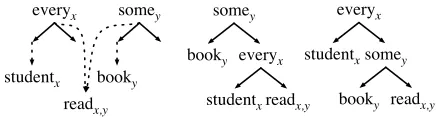
We usually represent MRSs as directed graphs: the nodes of the graph are the handles of the MRS, EPs are represented as solid lines, and handle con-straints are represented as dotted lines. For instance, the following MRS is represented by the graph on the left of Fig. 1.
{h5: somey(h6,h8),h7: book(y),h1: everyx(h2,h4),
h3: student(x),h9: read(x,y),h2=qh3,h6=qh7}
everyx somey
studentx booky readx,y
everyx somey
studentx booky
readx,y
everyx
somey studentx
[image:2.595.318.536.73.132.2]booky readx,y
Figure 1: An MRS and its two configurations.
Note that the relation between bound variables and their binders is made explicit by binding edges drawn as dotted lines (cf. C2 below); transitively re-dundand binding edges (e. g., from someyto booky)
however are omited.
MRS Semantics. Readings of underspecified rep-resentations correspond to configurations of MRS constraints. Intuitively, a configuration is an MRS where all handle constraints have been resolved by plugging the “tree fragments” into each other.
Let M be an MRS and h,hbe handles in M. We say that h immediately outscopes h in M if there
is an EP in M with label h and argument handle h, and we say that h outscopes hin M if the pair(h,h)
belongs to the reflexive transitive closure of the im-mediate outscope relation of M.
Definition 2 (MRS configurations). An MRS M is
a configuration if it satisfies conditions C1 and C2: C1 The graph of M is a tree of solid edges: (i) all
handles are labels i. e.,arg(M) =/0and M con-tains no handle constraints, (ii) handles don’t properly outscope themselve, and (iii) all han-dles are pairwise connected by EPs in M. C2 If h : Qx(h1,h2)and h: P(...,x,...)belong to
M, then h outscopes hin M i. e., binding edges in the graph of M are transitively redundant. We say that a configuration M is configuration of
an MRS M if there exists a partial substitutionσ:
lab(M)arg(M)that states how to identify labels with argument handles of Mso that:
C3 M={σ(E)|E is an EP in M}, and
C4 for all h=qhin M, h outscopesσ(h)in M. The value σ(E) is obtained by substituting all la-bels indom(σ)in E while leaving all other handels unchanged.
The MRS on the left of Fig. 1, for instance, has two configurations given to the right.
P1, P2
P3
{h1: P1(h2),h1: P2(h3),h4: P3
[image:3.595.130.236.152.198.2]h2=qh4,h3=qh4}
Figure 2: An unsolvable MRS with EP-conjunction
P1
P3 P2
P1
P2, P3 configures
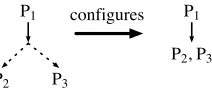
Figure 3: A solvable MRS without merging-free configaration
Fig. 2 shows an MRS with an EP-conjunction and its graph. The function symbols of both EPs are con-joined and their arguments are merged into a set. The MRS does not have configurations since the ar-gument handles of the merged EPs cannot jointly outscope the node P4.
We call a configuration merging if it contains EP-conjunctions, and merging-free otherwise. Merging configurations are needed to solve EP-conjuctions such as{h : P1,h : P2}. Unfortunately, they can also
solve MRSs without EP-conjunctions, such as the MRS in Fig. 3. The unique configuration of this MRS is a merging configuration: the labels of P1
and P2must be identified with the only available
ar-gument handle. The admission of merging configu-rations may thus have important consequences for the solution space of arbitrary MRSs.
Standard MRS. Standard MRS requires three further extensions: (i) qeq-semantics, (ii) top-handles, and (iii) event variables. These extensions are less relevant for our comparision.
The qeq-semantics restricts the interpretation of handle constraints beyond dominance. Let M be an MRS with handles h,h. We say that h is qeq hin M
if either h=h, or there is an EP h : Qx(h0,h1)in M
and h1is qeq h in M. Every qeq-configuration is a
configuration as defined above, but not necessarily
vice versa. The qeq-restriction is relevant in theory
but will turn out unproblematic in practice (see §6). Standard MRS requires the existence of top handles in all MRS constraints. This condition doesn’t matter for MRSs with connected graphs (see (Bodirsky et al., 2004) for the proof idea). MRSs with unconnected graphs clearly do not play any role in practical underspecified semantics.
Finally, MRSs permit events variables e,e as a second form of constants. They are treated equally to individual variables except that they cannot be bound by quantifiers.
3 Dominance Constraints
Dominance constraints are a general framework for describing trees. For scope underspecification, they are used to describe the syntax trees of object lan-guage formulas. Dominance constraints are the core language underlying CLLS (Egg et al., 2001) which adds parallelism and binding constraints.
Syntax and semantics. We assume a possibly in-finite signatureΣ={f,g,...}of function symbols with fixed arities (writtenar(f)) and an infinite set of variables ranged over by X,Y,Z.
A dominance constraint ϕ is a conjunction of
dominance, inequality, and labeling literals of the following form, wherear(f) =n:
ϕ::=X∗Y |X=Y |X : f(X1,...,Xn)|ϕ∧ϕ
Dominance constraints are interpreted over fi-nite constructor trees i. e., ground terms constructed from the function symbols inΣ. We identify ground terms with trees that are rooted, ranked, edge-ordered and labeled. A solution for a dominance constraint ϕ consists of a tree τ and an assign-mentα that maps the variables in ϕ to nodes of τ
such that all constraints are satisfied: labeling lit-erals X : f(X1,...,Xn) are satisfied iff α(X) is
la-beled with f and its daughters areα(X1),...,α(Xn)
in this order; dominance literals X∗Y are satisfied
iffα(X)dominatesα(Y)inτ; and inequality literals
X =Y are satisfied iff α(X) and α(Y) are distinct nodes.
Solved forms. Satisfiable dominance constraints have infinitely many solutions. Constraint solvers for dominance constraints therefore do not enumer-ate solutions but solved forms i. e., “tree shaped” constraints. To this end, we consider (weakly)
nor-mal dominance constraints (Bodirsky et al., 2004).
We call a variable a hole ofϕif it occurs in argu-ment position inϕand a root ofϕotherwise.
Definition 3. A dominance constraint ϕ is normal if it satisfies the following conditions.
N1 (a) each variable ofϕoccurs at most once in the labeling literals ofϕ.
(b) each variable ofϕoccurs at least once in the labeling literals ofϕ.
N2 for distinct roots X and Y ofϕ, X=Y is inϕ. N3 (a) if X∗Y occurs inϕ, Y is a root inϕ.
(b) if X∗Y occurs inϕ, X is a hole inϕ. We call ϕ weakly normal if it satisfies the above
properties except for N1 (b) and N3 (b).
everyx somey
studentx booky
readx,y
everyx
somey
studentx
booky readx,y
everyx somey
studentx
booky
[image:4.595.356.500.73.131.2]readx,y
Figure 4: A normal dominance constraint (left) and its two solved forms (right).
a serious restriction, as weakly normal dominance constraints can be compactified, provided that dom-inance links relate either roots or holes with roots.
Weakly normal dominance constraints ϕcan be
represented by dominance graphs. The dominance graph ofϕis a directed graph G= (V,ETED)
de-fined as follows. The nodes of G are the variables of
ϕ. Labeling literals X : f(X1,...,Xk)are represented
by tree edges(X,Xi)∈ET, for 1≤i≤k, and
domi-nance literals X∗Xare represented by dominance
edges(X,X)∈ED. Inequality literals are not
repre-sented in the graph. In pictures, labeling literals are drawn with solid lines and dominance edges with dotted lines.
We say that a constraint ϕis in solved form if its graph is in solved form. A graph G is in solved form iff it is a forest. The solved forms of G are solved forms G which are more specific than G i. e., they differ only in their dominance edges and the reacha-bility relation of G extends the reachareacha-bility of G. A
minimal solved form is a solved form which is
min-imal with respect to specificity. Simple solved forms are solved forms where every hole has exactly one outgoing dominance edge. Fig. 4 shows as a con-crete example the translation of the MRS descrip-tion in Fig. 1 together with its two minimal solved forms. Both solved forms are simple.
4 Translating Merging-Free MRS-Nets
This section defines MRS-nets without
EP-conjunctions, and sketches their translation to normal dominance constraints. We define nets equally for MRSs and dominance constraints. The key semantic property of nets is that different notions of solutions coincide. In this section, we show that merging-free configurations coincides to minimal solved forms. §5 generalizes the trans-lation by adding EP-conjunctions and permitting merging semantics.
Pre-translation. An MRS constraint M can be represented as a corresponding dominance con-straint ϕM as follows: The variables of ϕM are the
handles of M, and the literals of ϕM correspond
... ... ...
... ...
[image:4.595.78.292.75.146.2](a) strong (b) weak (c) island
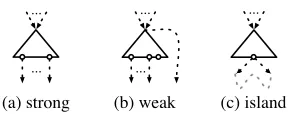
Figure 5: Fragment Schemata of Nets
those of M in the following sence:
h : P(x1,...,xn,h1,...,hk) →h : Px1,...,xn(h1,...,hk)
h : Qx(h1,h2) →h : Qx(h1,h2)
h=qh →h∗h
Additionally, dominance literals h∗hare added to
ϕMfor all h,hs. t. h : Qx(h1,h2)and h: P(...,x,...)
belong to M (cf. C2), and literals h=h are added toϕMfor all h,hin distinct label position in M.
Lemma 1. If a compact MRS M does not contain
EP-conjunctions thenϕMis weakly normal, and the
graph of M is the transitive reduction of the graph ofϕM.
Nets. A hypernormal path (Althaus et al., 2003) in a constraint graph is a path in the undirected graph that contains for every leaf X at most one in-cident dominance edge.
Letϕbe a weakly normal dominance constraint and let G be the constraint graph of ϕ. We say that
ϕ is a dominance net if the transitive reduction G of G is a net. G is a net if every tree fragment F of Gsatisfies one of the following three conditions, illustrated in Fig. 5:
Strong. Every hole of F has exactly one outgoing
dominance edge, and there is no weak root-to-root dominance edge.
Weak. Every hole except for the last one has
ex-actly one outgoing dominance edge; the last hole has no outgoing dominance edge, and there is ex-actly one weak root-to-root dominance edge.
Island. The fragment has one hole X , and all
vari-ables which are connected to X by dominance edges are connected by a hypernormal path in the graph where F has been removed.
We say that an MRS M is an MRS-net if the pre-translation of its literals results in a dominance net
ϕM. We say that an MRS-net M is connected ifϕM
is connected;ϕM is connected if the graph ofϕMis
connected.
can be resolved i. e., MRSs with EP-conjunctions can be mapped to corresponding MRSs without EP-conjunctions.
If M is an MRS-net (without EP-conjunctions), then M can be translated into a corresponding dom-inance constraint ϕ by first pre-translating M into a ϕM and then normalizing ϕM by replacing weak
root-to-root dominance edges in weak fragments by dominance edges which start from the open last hole.
Theorem 1 (Niehren and Thater, 2003). Let M be
an MRS andϕM be the translation of M. If M is a
connected MRS-net, then the merging-free configu-rations of M bijectively correspond to the minimal solved forms of theϕM.
The following section generalizes this result to MRS-nets with a merging semantics.
5 Merging and EP-Conjunctions
We now show that if an MRS is a net, then all its configurations are merging-free, which in particular means that the translation can be applied to the more general version of MRS with a merging semantics.
Lemma 2 (Niehren and Thater, 2003). All
mini-mal solved forms of a connected dominance net are simple.
Lemma 3. If all solved forms of a normal
domi-nance constraint are simple, then all of its solved forms are minimal.
Theorem 2. The configurations of an MRS-net M
are merging-free.
Proof. Let Mbe a configuration of M and letσbe the underlying substitution. We construct a solved formϕM as follows: the labeling literals ofϕM are
the pre-translations of the EPs in M, andϕM has a
dominance literal h∗h iff(h,h)∈σ, and inequal-ity literals X=Y for all distinct roots inϕM.
By condition C1 in Def. 2, the graph of M is a tree, hence the graph ofϕM must also be a tree i. e.,
ϕM is a solved form. ϕM must also be more
spe-cific than the graph ofϕM because the graph of M
satisfies all dominance requirements of the handle constraints in M, henceϕM is a solved form ofϕM.
M clearly solved ϕM. By Lemmata 2 and 3,ϕM
must be simple and minimal because ϕM is a net.
But then Mcannot contain EP-conjunctions i. e., M is merging-free.
The merging semantics of MRS is needed to solve EP-conjunctions. As we have seen, the merg-ing semantics is not relevant for MRS constraints
which are nets. This also verifies Niehren and Thater’s (2003) assumption that EP-conjunctions are “syntactic sugar” which can be resolved in a pre-processing step: EP-conjunctions can be resolved by exhaustively applying the following rule which adds new literals to make the implicit conjunction explicit:
h : E1(h1,...,hn),h : E2(h1,...,hm)⇒
h : ‘E1&E2’(h1,...,hn,h1,...,hm),
where E(h1,...,hn)stands for an EP with argument
handles h1,...,hn, and where ‘E1&E2’ is a complex
function symbol. If this rule is applied exhaustively
to an MRS M, we obtain an MRS M without
EP-conjunctions. It should be intuitively clear that the configurations of M and M correspond; Therefore, the configurations of M also correspond to the min-imal solved forms of the translation of M.
6 Evaluation
The two remaining assumptions underlying the translation are the “net-hypothesis” that all lin-guistically relevant MRS expressions are nets, and the “qeq-hypothesis” that handle constraints can be given a dominance semantics practice. In this sec-tion, we empirically show that both assumptions are met in practice.
As an interesting side effect, we also compare the run-times of the constraint-solvers we used, and we find that the dominance constraint solver typically outperforms the MRS solver, often by significant margins.
Grammar and Resources. We use the English Resource Grammar (ERG), a large-scale HPSG grammar, in connection with the LKB system, a grammar development environment for typed fea-ture grammars (Copestake and Flickinger, 2000). We use the system to parse sentences and output MRS constraints which we then translate into domi-nance constraints. As a test corpus, we use the Red-woods Treebank (Oepen et al., 2002) which con-tains 6612 sentences. We exclude the sentences that cannot be parsed due to memory capacities or words and grammatical structures that are not included in the ERG, or which produce ill-formed MRS expres-sions (typically violating M1) and thus base our evaluation on a corpus containing 6242 sentences. In case of syntactic ambiguity, we only use the first reading output by the LKB system.
...
[image:6.595.119.253.69.126.2](a) open hole (b) ill-formed island
Figure 6: Two classes of non-nets
which is implemented in C++ and uses LEDA, a
class library for efficient data types and algorithms (Mehlhorn and Näher, 1999).
6.1 Relevant Constraints are Nets
We check for 6242 constraints whether they consti-tute nets. It turns out that 5200 (83.31%) consticonsti-tute nets while 1042 (16.69%) violate one or more net-conditions.
Non-nets. The evaluation shows that the hypoth-esis that all relevant constraints are nets seems to be falsified: there are constraints that are not nets. However, a closer analysis suggests that these con-straints are incomplete and predict more readings than the sentence actually has. This can also be il-lustrated with the average number of solutions: For the Redwoods corpus in combination with the ERG, nets have 1836 solutions on average, while non-nets have 14039 solutions, which is a factor of 7.7. The large number of solutions for non-nets is due to the “structural weakness” of non-nets; often, non-nets have only merging configurations.
Non-nets can be classified into two categories (see Fig. 6): The first class are violated “strong” fragments which have holes without outgoing dom-inance edge and without a corresponding root-to-root dominance edge. The second class are violated “island” fragments where several outgoing domi-nance edges from one hole lead to nodes which are not hypernormally connected. There are two more possibilities for violated “weak” fragments— having more than one weak dominance edge or hav-ing a weak dominance edge without empty hole—, but they occur infrequently (4.4%). If those weak fragments were normalized, they would constitute violated island fragments, so we count them as such. 124 (11.9%) of the non-nets contain empty holes, 762 (73.13%) contain violated island fragments, and 156 (14.97%) contain both. Those constraints that contain only empty holes and no violated is-land fragments cannot be configured, as in configu-rations, all holes must be filled.
Fragments with open holes occur frequently, but not in all contexts, for constraints representing for example time specifications (e. g., “from nine to
twelve” or “a three o’clock flight”) or intensional
expressions (e. g., “Is it?” or “I suppose”).
Ill-availablee, ax
ay cafeteriax
saunayande,x,y prop
ax
ay cafeteriax
saunay, ande,x,y
availablee prop
ax ay
cafeteriax saunay ande,x,y
availablee prop
ϕ1 ϕ2
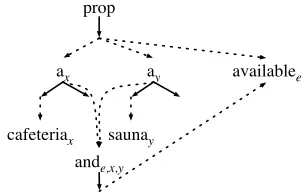
Figure 7: An MRS for “A sauna and a cafeteria are available” (top) and two of sixteen merging config-urations (below).
ax ay
cafeteriax saunay ande,x,y
[image:6.595.349.507.75.257.2]availablee prop
Figure 8: The “repaired” MRS from Fig. 7
formed island fragments are often triggered by some kind of coordination, like “a restaurant and/or a
sauna” or “a hundred and thirty Marks”, also
im-plicit ones like “one hour thirty minutes” or “one
thirty”. Constraints with both kinds of violated
frag-ments emerge when there is some input that yields an open hole and another part of the input yields a violated island fragment (for example in construc-tions like “from nine to eleven thirty” or “the ten
o’clock flight Friday or Thursday”, but not
neces-sarily as obviously as in those examples).
The constraint on the left in Fig. 7 gives a con-crete example for violated island fragments. The topmost fragment has outgoing dominance edges to otherwise unconnected subconstraintsϕ1andϕ2.
[image:6.595.351.503.324.421.2]everywhere, only restricted by the “qeq-semantics” which forbids for instance “available” to be merged with “sauna.” In fact, the MRS constraint solver de-rives sixteen configurations for the constraint, two of which are given in Fig. 7, although the sentence has only two scope readings.
We conjecture that non-nets are semantically “in-complete” in the sense that certain constraints are missing. For instance, an alternative analysis for the above constraint is given in Fig. 8. The constraint adds an additional argument handle to “and” and places a dominance edge from this handle to “avail-able.” In fact, the constraint is a net; it has exactly two readings.
6.2 Qeq is dominance
For all nets, the dominance constraint solver cal-culates the same number of solutions as the MRS solver does, with 3 exceptions that hint at problems in the syntax-semantics interface. As every config-uration that satisfies proper qeq-constraints is also a configuration if handle constraints are interpreted under the weaker notion of dominance, the solutions computed by the dominance constraint solver and the MRS solver must be identical for every con-straint. This means that the additional expressivity of proper qeq-constraints is not used in practice, which in turn means that in practice, the translation is sound and correct even for the standard MRS no-tion of soluno-tion, given the constraint is a net.
6.3 Comparison of Runtimes
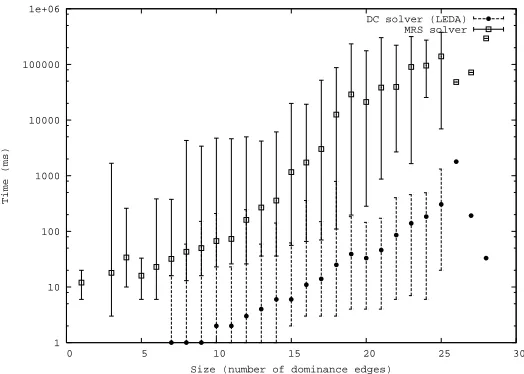
The availability of a large body of underspecified descriptions both in MRS and in dominance con-straint format makes it possible to compare the solvers for the two underspecification formalisms. We measured the runtimes on all nets using a Pen-tium III CPU at 1.3 GHz. The tests were run in a multi-user environment, but as the MRS and domi-nance measurements were conducted pairwise, con-ditions were equal for every MRS constraint and corresponding dominance constraint.
The measurements for all MRS-nets with less than thirty dominance edges are plotted in Fig. 9. Inputs are grouped according to the constraint size. The filled circles indicate average runtimes within each size group for enumerating all solutions us-ing the dominance solver, and the empty circles in-dicate the same for the LKB solver. The brackets around each point indicate maximum and minimum runtimes in that group. Note that the vertical axis is logarithmic.
We excluded cases in which one or both of the solvers did not return any results: There were 173 sentences (3.33% of all nets) on which the LKB
solver ran out of memory, and 1 sentence (0.02%) that took the dominance solver more than two min-utes to solve.
The graph shows that the dominance constraint solver is generally much faster than the LKB solver: The average runtime is less by a factor of 50 for constraints of size 10, and this grows to a factor of 500 for constraints of size 25. Our experiments show that the dominance solver outperforms the LKB solver on 98% the cases. In addition, its run-times are much more predictable, as the brackets in the graph are also shorter by two or three orders of magnitude, and the standard deviation is much smaller (not shown).
7 Conclusion
We developed Niehren and Thater’s (2003) theoret-ical translation into a practtheoret-ical system for translat-ing MRS into dominance constraints, applied it sys-tematically to MRSs produced by English Resource Grammar for the Redwoods treebank, and evaluated the results. We showed that:
1. most “real life” MRS expressions are MRS-nets, which means that the translation is correct in these cases;
2. for nets, merging is not necessary (or even pos-sible);
3. the practical translation works perfectly for all MRS-nets from the corpus; in particular, the
=q relation can be taken as synonymous with
dominance in practice.
Because the translation works so well in practice, we were able to compare the runtimes of MRS and dominance constraint solvers on the same inputs. This evaluation shows that the dominance constraint solver outperforms the MRS solver and displays more predictable runtimes. A researcher working with MRS can now solve MRS nets using the ef-ficient dominance constraint solvers.
A small but significant number of the MRS con-straints derived by the ERG are not nets. We have argued that these constraints seem to be systemati-cally incomplete, and their correct completions are indeed nets. A more detailed evaluation is an impor-tant task for future research, but if our “net hypoth-esis” is true, a system that tests whether all outputs of a grammar are nets (or a formal “safety criterion” that would prove this theoretically) could be a use-ful tool for developing and debugging grammars.
1 10 100 1000 10000 100000 1e+06
0 5 10 15 20 25 30
Time (ms)
Size (number of dominance edges)
[image:8.595.174.436.74.261.2]DC solver (LEDA) MRS solver
Figure 9: Comparison of runtimes for the MRS and dominance constraint solvers.
and dominance hardly plays a role in practice. If the net hypothesis is true, it also follows that merging is not necessary because EP-conjunctions can be con-verted into ordinary conjunctions. More research along these lines could help unify different under-specification formalisms and the resources that are available for them.
Acknowledgments We are grateful to Ann Copestake for many fruitful discussions, and to our reviewers for helpful comments.
References
H. Alshawi and R. Crouch. 1992. Monotonic se-mantic interpretation. In Proc. 30th ACL, pages 32–39.
Ernst Althaus, Denys Duchier, Alexander Koller, Kurt Mehlhorn, Joachim Niehren, and Sven Thiel. 2003. An efficient graph algorithm for dominance constraints. Journal of Algorithms, 48:194–219.
Manuel Bodirsky, Denys Duchier, Joachim Niehren, and Sebastian Miele. 2004. An efficient algo-rithm for weakly normal dominance constraints. In ACM-SIAM Symposium on Discrete
Algo-rithms. The ACM Press.
Ann Copestake and Dan Flickinger. 2000. An open-source grammar development environment and broad-coverage english grammar using HPSG. In Conference on Language Resources
and Evaluation.
Ann Copestake, Dan Flickinger, Rob Malouf, Su-sanne Riehemann, and Ivan Sag. 1995. Transla-tion using Minimal Recursion Semantics. Leu-ven.
Ann Copestake, Alex Lascarides, and Dan
Flickinger. 2001. An algebra for semantic
construction in constraint-based grammars. In
Proceedings of the 39th Annual Meeting of the Association for Computational Linguistics, pages
132–139, Toulouse, France.
Ann Copestake, Dan Flickinger, Carl Pollard, and Ivan Sag. 2004. Minimal recursion semantics: An introduction. Journal of Language and
Com-putation. To appear.
Ann Copestake. 2002. Implementing Typed Feature
Structure Grammars. CSLI Publications,
Stan-ford, CA.
Markus Egg, Alexander Koller, and Joachim Niehren. 2001. The Constraint Language for Lambda Structures. Logic, Language, and
Infor-mation, 10:457–485.
K. Mehlhorn and S. Näher. 1999. The LEDA
Plat-form of Combinatorial and Geometric Comput-ing. Cambridge University Press, Cambridge.
See alsohttp://www.mpi-sb.mpg.de/LEDA/.
Joachim Niehren and Stefan Thater. 2003. Bridg-ing the gap between underspecification for-malisms: Minimal recursion semantics as dom-inance constraints. In Proceedings of the 41st
Annual Meeting of the Association for Computa-tional Linguistics.
Stephan Oepen, Kristina Toutanova, Stuart Shieber,
Christopher Manning, Dan Flickinger, and
Thorsten Brants. 2002. The LinGO Redwoods treebank: Motivation and preliminary applica-tions. In Proceedings of the 19th International
Conference on Computational Linguistics (COLING’02), pages 1253–1257.