Graph Transformations in Data-Driven Dependency Parsing
Jens Nilsson
V¨axj¨o University
Joakim Nivre
V¨axj¨o University and Uppsala University
Johan Hall
V¨axj¨o University
Abstract
Transforming syntactic representations in order to improve parsing accuracy has been exploited successfully in statistical parsing systems using constituency-based representations. In this paper, we show that similar transformations can give sub-stantial improvements also in data-driven dependency parsing. Experiments on the Prague Dependency Treebank show that systematic transformations of coordinate structures and verb groups result in a 10% error reduction for a deterministic data-driven dependency parser. Combin-ing these transformations with previously proposed techniques for recovering non-projective dependencies leads to state-of-the-art accuracy for the given data set.
1 Introduction
It has become increasingly clear that the choice of suitable internal representations can be a very important factor in data-driven approaches to syn-tactic parsing, and that accuracy can often be im-proved by internal transformations of a given kind of representation. This is well illustrated by the Collins parser (Collins, 1997; Collins, 1999), scru-tinized by Bikel (2004), where several transforma-tions are applied in order to improve the analy-sis of noun phrases, coordination and punctuation. Other examples can be found in the work of John-son (1998) and Klein and Manning (2003), which show that well-chosen transformations of syntac-tic representations can greatly improve the parsing accuracy obtained with probabilistic context-free grammars.
In this paper, we apply essentially the same techniques to data-driven dependency parsing,
specifically targeting the analysis of coordination and verb groups, two very common constructions that pose special problems for dependency-based approaches. The basic idea is that we can facili-tate learning by transforming the training data for the parser and that we can subsequently recover the original representations by applying an inverse transformation to the parser’s output.
The data used in the experiments come from the Prague Dependency Treebank (PDT) (Hajiˇc, 1998; Hajiˇc et al., 2001), the largest avail-able dependency treebank, annotated according to the theory of Functional Generative Description (FGD) (Sgall et al., 1986). The parser used is MaltParser (Nivre and Hall, 2005; Nivre et al., 2006), a freely available system that combines a deterministic parsing strategy with discriminative classifiers for predicting the next parser action.
The paper is structured as follows. Section 2 provides the necessary background, including a definition of dependency graphs, a discussion of different approaches to the analysis of coordina-tion and verb groups in dependency grammar, as well as brief descriptions of PDT, MaltParser and some related work. Section 3 introduces a set of dependency graph transformations, specifically defined to deal with the dependency annotation found in PDT, which are experimentally evaluated in section 4. While the experiments reported in section 4.1 deal with pure treebank transforma-tions, in order to establish an upper bound on what can be achieved in parsing, the experiments pre-sented in section 4.2 examine the effects of differ-ent transformations on parsing accuracy. Finally, in section 4.3, we combine these transformations with previously proposed techniques in order to optimize overall parsing accuracy. We conclude in section 5.
2 Background
2.1 Dependency Graphs
The basic idea in dependency parsing is that the syntactic analysis consists in establishing typed, binary relations, called dependencies, between the words of a sentence. This kind of analysis can be represented by a labeled directed graph, defined as follows:
• LetR={r1, . . . , rm}be a set of dependency types (arc labels).
• A dependency graph for a string of words
W = w1. . . wn is a labeled directed graph G= (W, A), where:
– W is the set of nodes, i.e. word tokens in the input string, ordered by a linear precedence relation<.
– Ais a set of labeled arcs(wi, r, wj),wi, wj ∈W,r∈R.
• A dependency graph G = (W, A) is well-formed iff it is acyclic and no node has an in-degree greater than 1.
We will use the notationwi →r wj to symbolize
that (wi, r, wj) ∈ A, where wi is referred to as
the head and wj as the dependent. We say that
an arc is projective iff, for every wordwj
occur-ring between wi and wk (i.e., wi < wj < wk
or wi > wj > wk), there is a path from wi to wj. A graph is projective iff all its arcs are
pro-jective. Figure 1 shows a well-formed (projective) dependency graph for a sentence from the Prague Dependency Treebank.
2.2 Coordination and Verb Groups
Dependency grammar assumes that syntactic structure consists of lexical nodes linked by binary dependencies. Dependency theories are thus best suited for binary syntactic constructions, where one element can clearly be distinguished as the syntactic head. The analysis of coordination is problematic in this respect, since it normally in-volves at least one conjunction and two conjuncts. The verb group, potentially consisting of a whole chain of verb forms, is another type of construc-tion where the syntactic relaconstruc-tion between elements is not clear-cut in dependency terms.
Several solutions have been proposed to the problem of coordination. One alternative is to avoid creating dependency relations between
the conjuncts, and instead let the conjuncts have a direct dependency relation to the same head (Tesni`ere, 1959; Hudson, 1990). Another approach is to make the conjunction the head and let the conjuncts depend on the conjunction. This analysis, which appears well motivated on seman-tic grounds, is adopted in the FGD framework and will therefore be called Prague style (PS). It is exemplified in figure 1, where the conjunction a (and) is the head of the conjuncts bojovnost´ı and
tvrdost´ı. A different solution is to adopt a more
hierarchical analysis, where the conjunction de-pends on the first conjunct, while the second con-junct depends on the concon-junction. In cases of multiple coordination, this can be generalized to a chain, where each element except the first depends on the preceding one. This more syntactically oriented approach has been advocated notably by Mel’ˇcuk (1988) and will be called Mel’ˇcuk style (MS). It is illustrated in figure 2, which shows a transformed version of the dependency graph in figure 1, where the elements of the coordination form a chain with the first conjunct (bojovnost´ı) as the topmost head. Lombardo and Lesmo (1998) conjecture that MS is more suitable than PS for incremental dependency parsing.
The difference between the more semantically oriented PS and the more syntactically oriented MS is seen also in the analysis of verb groups, where the former treats the main verb as the head, since it is the bearer of valency, while the latter treats the auxiliary verb as the head, since it is the finite element of the clause. Without questioning the theoretical validity of either approach, we can again ask which analysis is best suited to achieve high accuracy in parsing.
2.3 PDT
PDT (Hajiˇc, 1998; Hajiˇc et al., 2001) consists of 1.5M words of newspaper text, annotated in three layers: morphological, analytical and tectogram-matical. In this paper, we are only concerned with the analytical layer, which contains a surface-syntactic dependency analysis, involving a set of 28 dependency types, and not restricted to projec-tive dependency graphs.1 The annotation follows FGD, which means that it involves a PS analysis of both coordination and verb groups. Whether better parsing accuracy can be obtained by transforming
(“The final of the tournament was distinguished by great fighting spirit and unexpected hardness”) A7
Velkou
great
?
Atr
N7 bojovnost´ı
fighting-spirit
?
Obj Co
Jˆ a
and
?
Coord
A7 neˇcekanou
unexpected
?
Atr
N7 tvrdost´ı
hardness
?
Obj Co
P4 se
itself
?
AuxT
Vp
vyznaˇcovalo
distinguished
N2 fin´ale
final
?
Sb
N2 turnaje
of-the-tournament
?
[image:3.595.73.516.74.161.2]Atr
Figure 1: Dependency graph for a Czech sentence from the Prague Dependency Treebank
(“The final of the tournament was distinguished by great fighting spirit and unexpected hardness”) A7
Velkou
great
?
Atr
N7 bojovnost´ı
fighting-spirit
?
Obj
Jˆ a
and
?
Coord
A7 neˇcekanou
unexpected
?
Atr
N7 tvrdost´ı
hardness
?
Obj
P4 se
itself
?
AuxT
Vp
vyznaˇcovalo
distinguished
N2 fin´ale
final
?
Sb
N2 turnaje
of-the-tournament
?
Atr
Figure 2: Transformed dependency graph for a Czech sentence from the Prague Dependency Treebank
this to MS is one of the hypotheses explored in the experimental study below.
2.4 MaltParser
MaltParser (Nivre and Hall, 2005; Nivre et al., 2006) is a data-driven parser-generator, which can induce a dependency parser from a treebank, and which supports several parsing algorithms and learning algorithms. In the experiments below we use the algorithm of Nivre (2003), which con-structs a labeled dependency graph in one left-to-right pass over the input. Classifiers that pre-dict the next parser action are constructed through memory-based learning (MBL), using the TIMBL software package (Daelemans and Van den Bosch, 2005), and support vector machines (SVM), using LIBSVM (Chang and Lin, 2005).
2.5 Related Work
Other ways of improving parsing accuracy with respect to coordination include learning patterns of morphological and semantical information for the conjuncts (Park and Cho, 2000). More specifi-cally for PDT, Collins et al. (1999) relabel coordi-nated phrases after converting dependency struc-tures to phrase strucstruc-tures, and Zeman (2004) uses a kind of pattern matching, based on frequencies of the parts-of-speech of conjuncts and conjunc-tions. Zeman also mentions experiments to
trans-form the dependency structure for coordination but does not present any results.
Graph transformations in dependency parsing have also been used in order to recover non-projective dependencies together with parsers that are restricted to projective dependency graphs. Thus, Nivre and Nilsson (2005) improve parsing accuracy for MaltParser by projectivizing training data and applying an inverse transformation to the output of the parser, while Hall and Nov´ak (2005) apply post-processing to the output of Charniak’s parser (Charniak, 2000). In the final experi-ments below, we combine these techniques with the transformations investigated in this paper.
3 Dependency Graph Transformations
In this section, we describe algorithms for trans-forming dependency graphs in PDT from PS to MS and back, starting with coordination and con-tinuing with verb groups.
3.1 Coordination
The PS-to-MS transformation for coordination will be designated τc(∆), where ∆is a data set.
[image:3.595.70.519.222.308.2]Before the actual transformation, the base con-junction and all its dependents need to be classi-fied into three different categories. First, the base conjunction is categorized as a separator (S). If the coordination consists of more than two con-juncts, it normally has one or more commas sep-arating conjuncts, in addition to the base conjunc-tion. These are identified by looking at their de-pendency type (mostly AuxX) and are also catego-rized asS. The coordination in figure 1 contains no commas, so only the word a will belong toS.
The remaining dependents of the base conjunc-tion need to be divided into conjuncts (C) and other dependents (D). To make this distinction, the algorithm again looks at the dependency type. In principle, the dependency type of a conjunct has the suffix Co, although special care has to be taken for coordinated prepositional cases and em-bedded clauses (B¨ohmov´a et al., 2003). The words
bojovnost´ı and tvrdost´ı in figure 1, both having the
dependency type Obj Co, belong to the category
C. Since there are no other dependents of a, the coordination contains no instances of the category
D.
Given this classification of the words involved in a coordination, the transformation τc(∆) is
straightforward and basically connects all the arcs in a chain. LetC1, . . . , Cnbe the elements ofC,
ordered by linear precedence, and letS1i, . . . , Smi be the separators occurring betweenCiandCi+1.
Then everyCibecomes the head ofS1i, . . . , Smi,
Smi becomes the head of Ci+1, andC1 becomes the only dependent of the original head of the base conjunction. The dependency types of the con-juncts are truncated by removing the suffix Co.2 Also, each word inwd∈Dbecomes a dependent
of the conjunct closest to its left, and if such a word does not exist,wdwill depend on the leftmost
con-junct. After the transformationτc(∆), every
coor-dination forms a left-headed chain, as illustrated in figure 2.
This new representation creates a problem, however. It is no longer possible to distinguish the dependents inDfrom other dependents of the con-juncts. For example, the word Velkou in figure 2 is not distinguishable from a possible dependent inD, which is an obvious drawback when trans-forming back to PS. One way of distinguishingD
elements is to extend the set of dependency types.
2Preliminary results indicated that this increases parsing accuracy.
The dependency typerof eachwd∈Dcan be
re-placed by a completely new dependency typer+
(e.g., Atr+), theoretically increasing the number of dependency types to2· |R|.
The inverse transformation, τ−1
c (∆), again
starts by identifying base conjunctions, using the same conditions as before. For each identified base conjunction, it calls a procedure that per-forms the inverse transformation by traversing the chain of conjuncts and separators “upwards” (right-to-left), collecting conjuncts (C), separators (S) and potential conjunction dependents (Dpot).
When this is done, the former head of the left-most conjunct (C1) becomes the head of the right-most (base) conjunction (Smn−1). In figure 2, the leftmost conjunct is bojovnost´ı, with the head
vyznaˇcovalo, and the rightmost (and only)
con-junction is a, which will then have vyznaˇcovalo as its new head. All conjuncts in the chain become dependents of the rightmost conjunction, which means that the structure is converted back to the one depicted in figure 1.
As mentioned above, the original structure in figure 1 did not have any coordination dependents, but Velkou ∈ Dpot. The last step of the inverse
transformation is therefore to sort out conjunction dependents from conjunct dependents, where the former will attach to the base conjunction. Four versions have been implemented, two of which take into account the fact that the dependency types AuxG, AuxX, AuxY, and Pred are the only dependency types that are more frequent as con-junction dependents (D) than as conjunct depen-dents in the training data set:
• τc: Do not extend arc labels inτc. Leave all
words inDpotin place inτc−1.
• τc∗: Do not extend arc labels inτc. Attach all
words with label AuxG, AuxX, AuxY or Pred to the base conjunction inτ−1
c .
• τc+: Extend arc labels from r to r+for D
elements inτc. Attach all words with label r+to the base conjunction (and change the label tor) inτ−1
c .
• τc+∗: Extend arc labels fromr tor+forD
elements in τc, except for the labels AuxG, AuxX, AuxY and Pred. Attach all words with
labelr+, AuxG, AuxX, AuxY, or Pred to the base conjunction (and change the label torif necessary) inτ−1
3.2 Verb Groups
To transform verb groups from PS to MS, the transformation algorithm,τv(∆), starts by
identi-fying all auxiliary verbs in a sentence. These will belong to the setAand are processed from left to right. A word waux ∈ A iff wmain AuxV−→ waux,
wherewmainis the main verb. The transformation
into MS reverses the relation between the verbs, i.e., waux AuxV−→ wmain, and the former head of wmainbecomes the new head ofwaux. The main
verb can be located on either side of the auxiliary verb and can have other dependents (whereas aux-iliary verbs never have dependents), which means that dependency relations to other dependents of
wmain may become non-projective through the
transformation. To avoid this, all dependents to the left of the rightmost verb will depend on the leftmost verb, whereas the others will depend on the rightmost verb.
Performing the inverse transformation for verb groups, τ−1
v (∆), is quite simple and essentially
the same procedure inverted. Each sentence is tra-versed from right to left looking for arcs of the type waux AuxV−→ wmain. For every such arc, the
head ofwauxwill be the new head ofwmain, and wmainthe new head ofwaux. Furthermore, since waux does not have dependents in PS, all
depen-dents of waux in MS will become dependents of wmainin PS.
4 Experiments
All experiments are based on PDT 1.0, which is divided into three data sets, a training set (∆t), a
development test set (∆d), and an evaluation test
set (∆e). Table 1 shows the size of each data set, as
well as the relative frequency of the specific con-structions that are in focus here. Only 1.3% of all words in the training data are identified as auxil-iary verbs (A), whereas coordination (S and C) is more common in PDT. This implies that coor-dination transformations are more likely to have a greater impact on overall accuracy compared to the verb group transformations.
In the parsing experiments reported in sections 4.1–4.2, we use∆tfor training,∆dfor tuning, and
∆e for the final evaluation. The part-of-speech
tagging used (both in training and testing) is the HMM tagging distributed with the treebank, with a tagging accuracy of 94.1%, and with the tagset compressed to 61 tags as in Collins et al. (1999).
Data #S #W %S %C %A
∆t 73088 1256k 3.9 7.7 1.3
∆d 7319 126k 4.0 7.8 1.4
[image:5.595.315.518.63.117.2]∆e 7507 126k 3.8 7.3 1.4
Table 1: PDT data sets; S = sentence, W = word; S = separator, C = conjunct, A = auxiliary verb
T AS
τc 97.8 τc∗ 98.6
τc+ 99.6 τc+∗ 99.4
τv 100.0
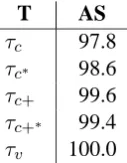
Table 2: Transformations; T = transformation; AS = attachment score (unlabeled) ofτ−1(τ(∆
t))
compared to∆t
MaltParser is used with the parsing algorithm of Nivre (2003) together with the feature model used for parsing Czech by Nivre and Nilsson (2005). In section 4.2 we use MBL, again with the same settings as Nivre and Nilsson (2005),3and in sec-tion 4.2 we use SVM with a polynomial kernel of degree 2.4 The metrics for evaluation are the at-tachment score (AS) (labeled and unlabeled), i.e., the proportion of words that are assigned the cor-rect head, and the exact match (EM) score (labeled and unlabeled), i.e., the proportion of sentences that are assigned a completely correct analysis. All tokens, including punctuation, are included in the evaluation scores. Statistical significance is as-sessed using McNemar’s test.
4.1 Experiment 1: Transformations
The algorithms are fairly simple. In addition, there will always be a small proportion of syntactic con-structions that do not follow the expected pattern. Hence, the transformation and inverse transforma-tion will inevitably result in some distortransforma-tion. In order to estimate the expected reduction in pars-ing accuracy due to this distortion, we first con-sider a pure treebank transformation experiment, where we compareτ−1(τ(∆
t))to∆t, for all the
different transformationsτ defined in the previous section. The results are shown in table 2.
We see that, even though coordination is more frequent, verb groups are easier to handle.5 The
3
TIMBL parameters: -k5 -mM -L3 -w0 -dID. 4
[image:5.595.386.450.167.249.2]tree-coordination version with the least loss of infor-mation (τc+) fails to recover the correct head for
0.4% of all words in∆t.
The difference betweenτc+andτc is expected.
However, in the next section this will be contrasted with the increased burden on the parser for τc+,
since it is also responsible for selecting the correct dependency type for each arc among as many as
2· |R|types instead of|R|.
4.2 Experiment 2: Parsing
Parsing experiments are carried out in four steps (for a given transformationτ):
1. Transform the training data set intoτ(∆t).
2. Train a parserponτ(∆t).
3. Parse a test set∆usingpwith outputp(∆). 4. Transform the parser output intoτ−1(p(∆)).
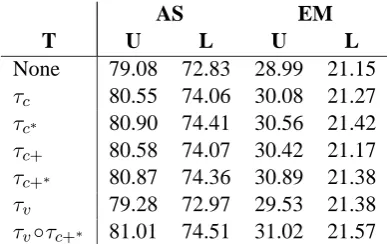
Table 3 presents the results for a selection of trans-formations using MaltParser with MBL, tested on the evaluation test set∆ewith the untransformed
data as baseline. Rows 2–5 show that transform-ing coordinate structures to MS improves parstransform-ing accuracy compared to the baseline, regardless of which transformation and inverse transformation are used. Moreover, the parser benefits from the verb group transformation, as seen in row 6.
The final row shows the best combination of a coordination transformation with the verb group transformation, which amounts to an improvement of roughly two percentage points, or a ten percent overall error reduction, for unlabeled accuracy.
All improvements over the baseline are statis-tically significant (McNemar’s test) with respect to attachment score (labeled and unlabeled) and unlabeled exact match, withp < 0.01 except for the unlabeled exact match score of the verb group transformation, where0.01 < p < 0.05. For the labeled exact match, no differences are significant. The experimental results indicate that MS is more suitable than PS as the target representation for deterministic data-driven dependency parsing. A relevant question is of course why this is the case. A partial explanation may be found in the “short-dependency preference” exhibited by most parsers (Eisner and Smith, 2005), with MaltParser being no exception. The first row of table 4 shows the accuracy of the parser for different arc lengths under the baseline condition (i.e., with no trans-formations). We see that it performs very well on
bank contains 19 erroneous heads.
AS EM
T U L U L
None 79.08 72.83 28.99 21.15
τc 80.55 74.06 30.08 21.27
τc∗ 80.90 74.41 30.56 21.42
τc+ 80.58 74.07 30.42 21.17 τc+∗ 80.87 74.36 30.89 21.38
τv 79.28 72.97 29.53 21.38
[image:6.595.319.513.62.184.2]τv◦τc+∗ 81.01 74.51 31.02 21.57
Table 3: Parsing accuracy (MBL,∆e); T =
trans-formation; AS = attachment score, EM = exact match; U = unlabeled, L = labeled
AS∆e 90.1 83.6 70.5 59.5 45.9 Length: 1 2-3 4-6 7-10
[image:6.595.316.520.244.312.2]11-∆t 51.9 29.4 11.2 4.4 3.0 τc(∆t) 54.1 29.1 10.7 3.8 2.4 τv(∆t) 52.9 29.2 10.7 4.2 2.9
Table 4: Baseline labeled AS per arc length on∆e
(row 1); proportion of arcs per arc length in ∆t
(rows 3–5)
short arcs, but that accuracy drops quite rapidly as the arcs get longer. This can be related to the mean arc length in ∆t, which is 2.59 in the
un-transformed version, 2.40 in τc(∆t) and 2.54 in τv(∆t). Rows 3-5 in table 4 show the distribution
of arcs for different arc lengths in different ver-sions of the data set. Both τc andτv make arcs
shorter on average, which may facilitate the task for the parser.
Another possible explanation is that learning is facilitated if similar constructions are represented similarly. For instance, it is probable that learning is made more difficult when a unit has different heads depending on whether it is part of a coordi-nation or not.
4.3 Experiment 3: Optimization
In this section we combine the best results from the previous section with the graph transforma-tions proposed by Nivre and Nilsson (2005) to re-cover non-projective dependencies. We write τp
for the projectivization of training data andτ−1
p for
the inverse transformation applied to the parser’s output.6 In addition, we replace MBL with SVM, a learning algorithm that tends to give higher accu-racy in classifier-based parsing although it is more
6More precisely, we use the variant called P
AS EM
T LA U L U L
None MBL 79.08 72.83 28.99 21.15
τp MBL 80.79 74.39 31.54 22.53
τp◦τv◦τc+∗ MBL 82.93 76.31 34.17 23.01
None SVM 81.09 75.68 32.24 25.02
τp SVM 82.93 77.28 35.99 27.05
[image:7.595.180.421.60.172.2]τp◦τv◦τc+∗ SVM 84.55 78.82 37.63 27.69
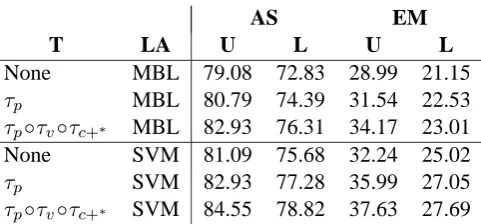
Table 5: Optimized parsing results (SVM, ∆e); T = transformation; LA = learning algorithm; AS =
attachment score, EM = exact match; U = unlabeled, L = labeled
T P:S R:S P:C R:C P:A R:A P:M R:M
None 52.63 72.35 55.15 67.03 82.17 82.21 69.95 69.07
τp◦τv◦τc+∗ 63.73 82.10 63.20 75.14 90.89 92.79 80.02 81.40
Table 6: Detailed results for SVM; T = transformation; P = unlabeled precision, R = unlabeled recall
costly to train (Sagae and Lavie, 2005).
Table 5 shows the results, for both MBL and SVM, of the baseline, the pure pseudo-projective parsing, and the combination of pseudo-projective parsing with PS-to-MS transformations. We see that pseudo-projective parsing brings a very con-sistent increase in accuracy of at least 1.5 percent-age points, which is more than that reported by Nivre and Nilsson (2005), and that the addition of the PS-to-MS transformations increases accu-racy with about the same margin. We also see that SVM outperforms MBL by about two percentage points across the board, and that the positive effect of the graph transformations is most pronounced for the unlabeled exact match score, where the improvement is more than five percentage points overall for both MBL and SVM.
Table 6 gives a more detailed analysis of the parsing results for SVM, comparing the optimal parser to the baseline, and considering specifically the (unlabeled) precision and recall of the cate-gories involved in coordination (separatorsS and conjunctsC) and verb groups (auxiliary verbsA
and main verbs M). All figures indicate, with-out exception, that the transformations result in higher precision and recall for all directly involved words. (All differences are significant beyond the 0.01 level.) It is worth noting that the error reduc-tion is actually higher forAandMthan forSand
C, although the former are less frequent.
With respect to unlabeled attachment score, the results of the optimized parser are slightly below the best published results for a single parser. Hall and Nov´ak (2005) report a score of 85.1%,
apply-ing a corrective model to the output of Charniak’s parser; McDonald and Pereira (2006) achieve a score of 85.2% using a second-order spanning tree algorithm. Using ensemble methods and a pool of different parsers, Zeman and ˇZabokrtsk´y (2005) attain a top score of 87.0%. For unlabeled exact match, our results are better than any previously reported results, including those of McDonald and Pereira (2006). (For the labeled scores, we are not aware of any comparable results in the literature.)
5 Conclusion
The results presented in this paper confirm that choosing the right representation is important in parsing. By systematically transforming the representation of coordinate structures and verb groups in PDT, we achieve a 10% error reduc-tion for a data-driven dependency parser. Adding graph transformations for non-projective depen-dency parsing gives a total error reduction of about 20% (even more for unlabeled exact match). In this way, we achieve state-of-the-art accuracy with a deterministic, classifier-based dependency parser.
Acknowledgements
References
Daniel M. Bikel. 2004. Intricacies of Collins’ parsing model. Computational Linguistics, 30:479–511.
Alena B¨ohmov´a, Jan Hajiˇc, Eva Hajiˇcov´a, and Barbora Hladk´a. 2003. The Prague Dependency Treebank: A three-level annotation scenario. In Anne Abeill´e, editor, Treebanks: Building and Using Syntactically
Annotated Corpora. Kluwer Academic Publishers.
Chih-Chung Chang and Chih-Jen Lin. 2005. LIB-SVM: A library for support vector machines.
Eugene Charniak. 2000. A
maximum-entropy-inspired parser. In Proceedings of the First
Meet-ing of the North American Chapter of the Associa-tion for ComputaAssocia-tional Linguistics (NAACL), pages
132–139.
Michael Collins, Jan Hajiˇc, Eric Brill, Lance Ramshaw, and Christoph Tillmann. 1999. A statistical parser for Czech. In Proceedings of the 37th Annual
Meet-ing of the Association for Computational LMeet-inguistics (ACL), pages 505–512.
Michael Collins. 1997. Three generative, lexicalised models for statistical parsing. In Proceedings of the
35th Annatual Meeting of the Association for Com-putational Linguistics (ACL), pages 16–23.
Michael Collins. 1999. Head-Driven Statistical
Mod-els for Natural Language Parsing. Ph.D. thesis, University of Pennsylvania.
Walter Daelemans and Antal Van den Bosch. 2005.
Memory-Based Language Processing. Cambridge
University Press.
Jason Eisner and Noah A. Smith. 2005. Parsing with soft and hard constraints on dependency length. In
Proceedings of the 9th International Workshop on Parsing Technologies (IWPT).
Jan Hajiˇc, Barbora Vidova Hladka, Jarmila Panevov´a, Eva Hajiˇcov´a, Petr Sgall, and Petr Pajas. 2001. Prague Dependency Treebank 1.0. LDC, 2001T10.
Jan Hajiˇc. 1998. Building a Syntactically Annotated Corpus: The Prague Dependency Treebank. In
Is-sues of Valency and Meaning, pages 12–19. Prague
Karolinum, Charles University Press.
Keith Hall and Vaclav Nov´ak. 2005. Corrective mod-eling for non-projective dependency parsing. In
Proceedings of the 9th International Workshop on Parsing Technologies (IWPT).
Richard Hudson. 1990. English Word Grammar. Basil Blackwell.
Mark Johnson. 1998. Pcfg models of linguistic tree representations. Computational Linguistics,
24:613–632.
Dan Klein and Christopher Manning. 2003. Accu-rate unlexicalized parsing. In Proceedings of the
41st Annual Meeting of the Association for Compu-tational Linguistics (ACL), pages 423–430.
Vincenzo Lombardo and Leonardo Lesmo. 1998. Unit coordination and gapping in dependency the-ory. In Proceedings of the Workshop on Processing
of Dependency-Based Grammars, pages 11–20.
Ryan McDonald and Fernando Pereira. 2006. Online learning of approximate dependency parsing algo-rithms. In Proceedings of the 11th Conference of
the European Chapter of the Association for Com-putational Linguistics (EACL).
Igor Mel’cuk. 1988. Dependency Syntax: Theory and
Practice. State University of New York Press.
Joakim Nivre and Johan Hall. 2005. MaltParser: A language-independent system for data-driven depen-dency parsing. In Proceedings of the Fourth
Work-shop on Treebanks and Linguistic Theories (TLT),
pages 137–148.
Joakim Nivre and Jens Nilsson. 2005. Pseudo-projective dependency parsing. In Proceedings of
the 43rd Annual Meeting of the Association for Computational Linguistics (ACL), pages 99–106.
Joakim Nivre, Johan Hall, and Jens Nilsson. 2006. MaltParser: A data-driven parser-generator for de-pendency parsing. In Proceedings of the 5th
In-ternational Conference on Language Resources and Evaluation.
Joakim Nivre. 2003. An efficient algorithm for pro-jective dependency parsing. In Proceedings of the
8th International Workshop on Parsing Technologies (IWPT), pages 149–160.
Jong C. Park and Hyung Joon Cho. 2000. Informed parsing for coordination with combinatory catego-rial grammar. In Proceedings of the 18th
Inter-national Conference on Computational Linguistics (COLING), pages 593–599.
Kenji Sagae and Alon Lavie. 2005. A classifier-based parser with linear run-time complexity. In
Proceed-ings of the 9th International Workshop on Parsing Technologies (IWPT), pages 125–132.
Petr Sgall, Eva Hajiˇcov´a, and Jarmila Panevov´a. 1986.
The Meaning of the Sentence in Its Pragmatic As-pects. Reidel.
Lucien Tesni`ere. 1959. El´ements de syntaxe struc-´ turale. Editions Klincksieck.
Daniel Zeman and Zdenˇek ˇZabokrtsk´y. 2005. Improv-ing parsImprov-ing accuracy by combinImprov-ing diverse depen-dency parsers. In Proceedings of the 9th
Interna-tional Workshop on Parsing Technologies (IWPT).
Daniel Zeman. 2004. Parsing with a Statistical