1. Introduction
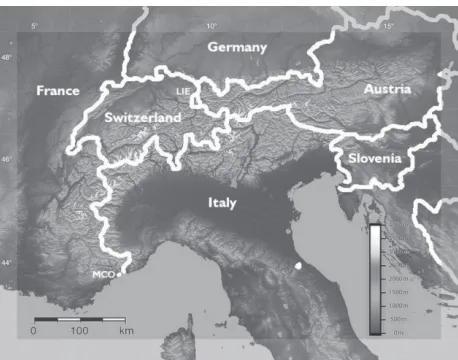
The Alps are one of the great mountain range sys -tems of Europe, stretching 1200 km across 8 different countries, namely: Austria, France, Germany, Italy, Liechtenstein, Monaco, Slovenia and Switzerland (Fig. 1). Despite national borders, the region is united by common ecological and cultural characteristics, which set it apart from the rest of Europe (Onida 2009). For this reason, trans-boundary regionalism has become a dom -inant trend in the economical and political integration of the alpine space. The process of regionalization offers new opportunities to innovation and sustainable devel -opment. This is best expressed by the Alpine Conven -tion, signed in 1991 between the European Union and the eight states with territory in the Alps (Balsiger 2008).
Forest cover represents 40 % of the Alpine land -scape. Forests have always played an important role
Cable Logging Contract Rates in the Alps:
the Effect of Regional Variability
and Technical Constraints
Raffaele Spinelli, Rien Visser, Oliver Thees, Udo Hans Sauter, Nike Krajnc, Catherine
Riond, Natascia Magagnotti
Abstract
A survey of cable logging contracts was conducted in 5 of the 8 Alpine countries, namely: France, Germany, Italy, Slovenia and Switzerland. The goals of the survey were to set a
gen-eral reference for cable logging rates, to identify eventual differences between countries and to determine the effect of technical work parameters (i.e. piece size, removal per hectare, line
length) on actual contract rates. With a total sample size of 566 units, the mean removal and rate were 165 m3 ha-1 and 42.9 € m-3, respectively. Both removal per hectare and contract
log-ging rates varied considerably and the study found significant differences between countries. Switzerland stood out from the group with the highest removal (345 m3 ha-1), but also the
highest contract rate (79.5 € m-3). Removal per hectare was lowest in Italy with just 58.3 m3
ha-1, and logging rate lowest in Slovenia at 29.3 € m-3. Logging rates were highly correlated
with the average labour rate of each country. Technical factors such as tree size, line length and tract size explained about 40 % of the variability in logging rates. Therefore, 60 % of the variability is explained by other technical factors not included in our data and by
non-techni-cal factors, such as lonon-techni-cal market dynamics.
[image:1.567.297.526.518.698.2]Keywords: harvesting, mountain, wood, forestry, yarder
in supporting the alpine economy, and that is still true today with the boom of engineered wood products and energy biomass (Onida 2009). Alpine forests also have a protective function, as they prevent soil erosion and shield settlements from avalanches and rock fall (Dorren et al. 2004).
The need to balance cost effective wood production with careful protection makes alpine forestry particu -larly complex. Continuous cover forestry is popular, as it offers a good compromise between these two vital functions. However, continuous cover forestry reduc -es harv-est removal and it may constrain operation profitability (Mason et al. 1999). Low removals and the typical access constraints of the Alpine territory hinder the introduction of modern mechanisation, which is the only solution to cost containment in the face of increasing fuel and labour cost (Spinelli and Magag -notti 2011). As a consequence, silviculture is often de -layed and results in a skewed age distribution (Binder et al. 2004). That contributes to the high vulnerability of Alpine forests to the effects of climate change (Seidl et al. 2011). Therefore, it is crucial to optimize forest operations in order to guarantee timely regeneration and maximize resiliency.
A first step towards optimization is cost control (Mathews 1942). To this end, it is necessary to know accurately the current harvesting contract rates, as well as their sensitivity to market factors (e.g. compe -tition, labour cost, cost of living, etc.) and technical factors (e. g. line length, tree size, removal, etc.).
Time and motion studies are often used to develop an understanding of how individual elements in a log -ging system respond to stand and terrain parameters (Visser and Stampfer 2003). These studies can be com -bined to provide system cost figures. Otherwise, com -plex system models can be developed, using advanced simulation software. Such models are capable of com -bining stand, terrain and system information in order to produce reliable cost figures (McDonagh et al. 2004). However, all these tools provide information about the technical cost of harvesting, not the actual logging rate reported on the harvesting contract (Stuart and Grace 2011). The latter is influenced by many non-technical factors, related to market structure and contractor in -teraction (Visser 2009). For this reason, predictions based exclusively on technical factors may not reflect actual rates, weakening the ability to predict and man -age logging costs.
In trans-boundary regions, further differences in logging rates can be expected to derive from the spe -cific economic conditions encountered in the different states that share the common regional space. While the landscape and culture are indeed common, local dif
-ferences are encountered in market competition, la -bour cost, fuel cost, access to credit, government sub -sidies and fiscal pressure, among others. Knowledge of these differences is especially important when plan -ning for trans-border activities. For example, when concentrating a large international task force to face a sudden local crisis, such as catastrophic forest damage (CTBA 2004). Potential interface problems should be explored and solved well in advance, because the fre -quency and severity of catastrophic forest damage has been predicted to increase in the future, due to the unfavourable combination of climate change and past silvilcultural choices (Schelhaas et al. 2010, Klaus et al. 2011). This will also affect lumber prices (Koch et al. 2013).
Therefore, the goals of this study were to:
Þ quantify the contract cable logging rates cur
-rently applied across the Alpine space,
Þ determine the extent and the significance of pos -sible national differences,
Þ gauge the amount of variability introduced by non-technical local market factors (e.g. labour cost, cost of living, competition, etc.) in order to assess the potential error of relying only on tech -nical factors.
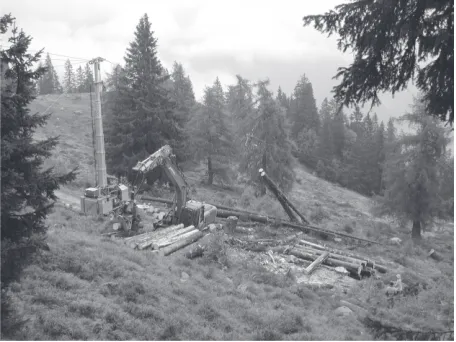
This study focuses on cable logging (Fig. 2), which is the backbone of steep slope harvesting world-wide (Bont and Heinimann 2012). In 2012, there were over 350 cable logging contractors in alpine Italy alone (Spinelli et al. 2013). On steep terrain, cable logging is the cost effective alternative to building an extensive network of skidding trails and results in a much low -er site impact compared to ground based logging (Spinelli et al. 2010). On the other hand, cable logging is inherently expensive because it is normally de
[image:2.567.298.526.542.713.2]ployed on difficult sites. For this reason, cable logging offers lower profit margins compared to ground based logging. This justifies a stronger optimization effort, supported by a deeper knowledge of technical cost and market rates.
2. Material and methods
Actual contract data were obtained from forest owners in 5 of the 8 Alpine countries, namely: France, Germany, Italy, Slovenia and Switzerland. Owners were asked to provide information about the actual contract rate in € per m3, as indicated in each indi
-vidual contract. They were also asked to provide the following technical information relative to each con -tract: contract number; place name; forest compart -ment; total harvest volume; harvest area; number of harvested trees; line length; occurrence and inclusion of two staging in the contract rate. This information allowed calculating average tree size, tract size and removal per hectare, which are among the most im -portant parameters affecting technical cost (Hasel 1946), together with line length.
A total of 566 data entries were collected: 64 from northern Italy (Friuli Venezia Giulia and Trentino), 96 from Switzerland, 42 from south-eastern France (Alpes du Nord), 227 from Slovenia and 127 from southern Germany. Contracts included all main work steps re -quired for turning standing trees into merchandised logs, stacked at the landing (Spinelli and Magagnotti 2011). In particular, all contracts covered felling, pro -cessing and extraction to a landing. Since yarder land -ings are often small and remote, contracts may also include a further work step, namely: moving the logs from the yarder landing to a larger log yard that is accessible to on-road transportation, an operation that is commonly known as two staging (Spinelli et al. 2014). French, Italian and Swiss contracts did indicate two staging, and the Italian contracts also reported the actual two staging distance. However, German and Slovenian contracts provided no indication about the possible occurrence of two staging. The largest major -ity of the French, Italian and Slovenian contracts con -cerned public forests.
All contracts were based on regeneration cuts of mature stands, which were conducted according to different techniques, and especially selection cut and patch cut. The study included no clear cuts, which are generally banned in all the countries spanned by our survey in order to contain hydro geological risk. The type of cut applied in each contract was inferred from the removal per hectare. All stands were pure soft -wood or soft-wood-dominated mixed forests. Norway
spruce (Picea abies Karst.) was the most common spe -cies, followed by larch (Larix Europea L.), silver fir ( Ab-ies alba L.), beech (Fagus sylvatica L.) and pines (Pinus sylvestris L. and Pinus cembra L.).
Most contracts were dated between 2010 and 2013. A few were older, and the oldest ones had been issued in 2002. For this reason, all rates were annualized to 2013 figures using the consumer price indices found in the respective national statistics. Figures of average hourly labour costs for each country were obtained from the Eurostat database (Eurostat 2013). Swiss rates were expressed in Swiss francs and they were con -verted into Euros using the official exchange rate of December 2013, equal to 0.81 Euro per 1 Swiss franc. Volume figures were generally provided under bark: the over bark figures were converted into their under bark equivalents using appropriate coefficients.
The German data set contained no information about tree size and line length, and therefore it was impossible to calculate the effect of these factors on the German contract rates.
Data were analyzed statistically using SPSS. As a first step, descriptive statistics were determined for each country. Then, the significance of these differ -ences was tested through the analysis of variance, after checking that the data pool met all statistical assump -tions. Regression analysis of the data allowed testing the relationship between contract rate and the main technical parameters listed above, and namely: re -moval, tree size, tract size, line length and the even -tual inclusion of two staging in the contract. The re -gression coefficient R2 was taken as an indicator of
how strong the effect of the main technical parameters was on contract rate. Conversely, unexplained vari -ability was considered to derive at least in part from non-technical parameters, such as: local competition, negotiation and general market dynamics.
3. Results and discussion
Mean contract rate was 42.9 € m-3, while mean tree
size was 1.3 m3 (Table 1). The mean tract contained 500
trees, or 670 m3. Line length ranged between 100 and
450 m (interquartile range). Variations in removals were even higher, ranging between 30 and 400 m3 ha-1 (interquartile range).
Two staging was noted in Italy (81 % of cases) and Switzerland (100 % of cases), but not in France, Ger -many and Slovenia. Only Italy recorded the actual two staging distance, and the average was 3.7 km.
France and Germany, compared to the rest. Removal per hectare was over three times larger in Switzerland (345 m3 ha-1) than in all the other countries. Italy showed the lowest removal (58.3 m3 ha-1), half the value as the combined average. In contrast, tree size was relatively even, with the French mean slightly higher than the means of all other countries. Mean line length was 591 m in France, significantly higher than the 353 m in Switzerland, which in turn was signifi -cantly higher than Italy and Slovenia (360 m and 220 m, respectively). Mean contract rate varied from 29 to 79 € m-3, and it was significantly different between
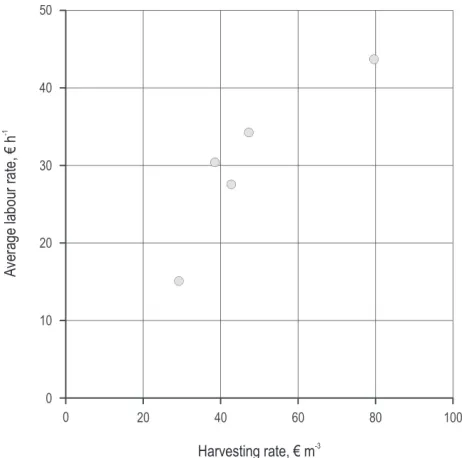
countries. It was lowest in Slovenia and highest in Switzerland. The mean contract rate recorded for Swit -zerland was twice as high as in all other countries com -bined. Contract rates showed a strong relationship with national labour cost data (Fig. 3).
Regression analysis showed a good relationship between contract rate and such technical work condi -tions as harvest area, piece size and line length (Eq. 1). Removal per hectare also had a significant effect, but this variable was excluded from the regression equa -tion because of its strong collinearity with the country
variable. Removal was much higher for Switzerland, which also had the highest contract rates. As a conse -quence, inclusion of removal in the regression would return a positive parameter, with contract rate increas -ing as a function of removal. Therefore, inclusion of this variable was contrary to sound statistical practice and it returned illogical results.
CR = 25.92 + 0.037 L – 0.253 A – 2.91 TS
Sig.= 0.005; R2 = 0.41
Where:
CR Contract Rate, € m-3;
L Line length, m;
A Harvest Area, ha;
[image:4.567.296.527.87.316.2]TS Tree Size, m3.
Table 1 Summary of data submitted for all countries
n Average Percentile5th Percentile95th
Number of trees, n 428 509 76 1499
Harvest area, ha 453 5.24 0.79 17.10
Total volume, m3 553 671 107 1790
Piece size, m3 415 1.33 0.37 2.47
Stand density, m3/ha 440 165 33 405
Average extraction
distance, m 426 285 86 500
[image:4.567.41.273.103.267.2]Harvesting rate, €/m3 566 42.9 17.6 86.5
Table 2 Breakdown by country showing average values and standard deviation
Country
Harvest area, ha Harvest,m3 Removal,m3/ha Piece size,m3/tree Line length, m Harvesting rate 2013 €/m3
Mean Standard deviation Mean Mean Standard deviation Mean Standard deviation Mean Standard deviation Mean Standard deviation
France 9.6a 6.1 997a 103a 60.3 1.7a 0.75 591a 302 47.2a 6.5
Germany 12.0b 6.9 1173b 97.6a 35.4 no data no data no data no data 38.5b 7.7
Italy 9.9a 7.2 578c 58.3b 45.2 1.3b 0.88 246c 98 42.6c 7.5
Slovenia 4.0c 3.5 386d 97.5a 87.2 1.2b 0.63 209d 87 29.3d 10.3
Switzerland 1.6d 0.8 538c 345c 81.4 1.4b 0.59 353b 83 79.5e 27.2
[image:4.567.40.528.605.720.2]Equation 1 shows that the contract rate increases with line length and decreases with tract (harvest area) and tree size. This relationship is logical, because in -creasing line lengths tend to decrease productivity and increase cost, whereas increasing tract and tree size tend to increase productivity and decrease cost.
A careful literature search found no other surveys of Alpine or European logging contract rates, which highlights the value of our study and denies the pos -sibility of any direct comparison with similar studies. Similar studies are available for the USA (Baker et al. 2013) and New Zealand (Visser 2012), but harvesting technology and work conditions are so different from the Alpine ones that it is virtually impossible to draw any meaningful comparisons (Smidt et al. 2009).
Cable logging is more complex and expensive than ground based logging, which places Alpine forestry at a general disadvantage in terms of pure harvesting cost. Even the lowest logging rates recorded in this study are much higher than the harvesting costs re -ported for the boreal forests of northern Europe (11 € m-3, Gerasimov et al. 2013), the eucalypt plantations of
western Europe (<20 € m-3, Magagnotti et al. 2011) and
South America (8 US$ t-1 or 6.5 € t-1, Oliveira and Seix -as 2012) or the pine plantations of the Southe-astern USA (9–10 US$ m-3 or ca. 7 € m-3, Conrad et al. 2013).
The main problem is steep terrain, which prevents us -ing cost effective ground-based logg-ing. On Alpine highland plateaus, it is possible to resort to mecha -nised cut-to-length harvesting by deploying the classic harvester-forwarder chain (Zambelli et al. 2012), and in that case harvesting cost is not much higher than reported for northern Europe (ca. 12 € m-3, Spinelli and
Magagnotti 2013). Fortunately, the high cost of steep terrain logging is largely offset by the high value of slow growth alpine timber. In northern Italy, the cur -rent price of saw logs is higher than 75 € m-3 at the
landing (IRE 2013). In Austria, saw log price often ex -ceeds 90 € m-3, for product delivered to the sawmill
(Federal Ministry of Agriculture 2012). In Slovenia the average saw log prices vary between 70 € m-3 and 76 €
m-3, at landing (SI-Stat 2013).
Published data are available for the calculated tech -nical cost of cable harvesting in a number of different Alpine countries. Stampfer et al. (2010) reported a cost of 32 € m-3 for a typical cable logging operation in Aus
-tria. Spinelli et al. (2008) reported figures between 28 and 40 € m-3 for northern Italy, based on two case stud
-ies. Pischedda et al. (2001) presented four case studies in the French and Italian Alps, with harvesting costs varying from 29 to 64 € m-3. Chagnon and Pischedda
(2005) indicated costs between 42 and 58 € m-3, spe
-cifically for the French Alps. Finally, Thees et al. (2011) reported costs between 45 and 65 € m-3 for the Swiss
Alps. Of course, these figures should first be annual -ized to 2013 values before making any comparisons. However, the bracket is so wide that these data could not offer much more than a general confirmation. In particular, it is not reasonable to use these data for gauging the difference between technical cost and market rate. In principle, such an attempt could be made by introducing the technical information con -tained in the contracts in one of the many cost calcula -tors developed for Alpine cable harvesting operations, such as the Swiss Hepromo (Frutig et al. 2009), the French Newfor (Magaud 2013) or the Italian HEKK (Stauder 2013). These software programs return a tech -nical harvesting cost based on user entered input data. However, all such programs can calculate a proper harvesting cost only if they receive accurate informa -tion about machine service life and annual use, which could not possibly be inferred from the content of the individual contracts. Such information is crucial to a reliable cost calculation, and it cannot be approximat -ed without much prejudice for the accuracy of the eventual cost estimate (Spinelli et al. 2011).
strong relationship between Contract Rate (€ m-3) and volume per metre of cable corridor. Unfortunately, for both of these measures collinearity prevented using removal as a meaningful independent variable.
However, the regression included both tree size and line length, which have long been recognized as the most important variables when predicting yarder productivity (LeDoux 1985). Tract size is also an im -portant predictor of harvesting cost (Greene et al. 1997, Moldenhauer and Bolding 2009, Visser 2012) and it was included as an independent variable in our regres -sion equation. For this reason, it is unlikely that the technical factors excluded from our equation may ac -count for 60 % of the variability in the data pool: a substantial part of that variability may be explained by non-technical factors, and especially local market dynamics and national economics.
National differences certainly play an important role, especially for Switzerland. The Swiss contract rates are significantly higher, which is in part ex -plained by the much higher labour cost, and a low productivity caused by several circumstances (e.g. dif -ficult terrain/working conditions). In fact, higher wag -es cause many foreign nationals to look for employ -ment in Switzerland from the neighbouring countries and justify a sustained cross border commuting pat -tern (Banfi et al. 2005).
The French contract rates are the second highest, and that could be explained by the longer mean line length. Harvesting cost generally increases with line length, and such increase can become quite steep if the distance exceeds the capacity of modern tower yard -ers, as it often occurs in France. In that case, it is neces -sary to resort to traditional long distance cable sys -tems, which incur much higher set up and dismantle costs compared with modern tower yarders (Stampfer et al. 2006). The high French rates may also be caused by the unbalance between the demand for yarding services and the actual availability. Grulois (2007) re -ports about the decline of cable yarding in France, which occurred over the past decades, when skidders became the exclusive choice of loggers in the French Alps. Efforts are being made to re-introduce cable yarding in southern France, but it will take several years before a large enough yarder fleet will be avail -able in the area. In the meantime there are very few yarder operators in the French Alps, although the de -mand for cable yarding services is increasing. The lon -ger line length and the lar-ger tree size found in France may also depend on the preference for skidder opera -tions in the past decades. French yarding operators are likely targeting those forests that are far from the road and have turned over-mature due to delayed regen -eration harvests.
The study also highlights some important differ -ences in the silvicultural practice applied in different countries. In particular, removals are much higher in Switzerland than in any other country included in this study. However, no contracts in our survey concerned clear cuts, and the very intense Swiss cuts were still selection cuts, applied to heavily overstocked stands. Of course, this is only the case of those owners who joined the study: we did not conduct comprehensive national surveys, and therefore our results cannot lead to any conclusions about the prevalent silvicultural practice in any of the participating countries. How -ever, our results may be indicative of trends, and they point to a very low removal in Italy and at a rather large one in Switzerland. It is certainly worth noticing that the Swiss contract rates are very high. This may further support the hypothesis of a large influence on non-technical market factors on establishing local ca -ble logging rates.
4. Conclusion
Contract rates differ significantly between coun -tries, and are proportional to local labour cost. Differ -ences are related to different work conditions, and especially removal per hectare, line length, tract size and tree size. However, technical factors explain only part of the difference in local contract rates, and non-technical market factors also seem to have a strong effect. In turn, that may make cross border activity a good business for those loggers based where labour cost is lowest. Contract rate differences must be con -sidered especially in the event of assembling a large international task force to face a sudden local crisis, such as catastrophic forest damage. Loggers cannot be drawn to countries with lower contract rates, unless rates are adjusted. While showing that actual contract rates are only partly related to technical factors, this study also highlights the lack of other similar studies, which contrasts with the large number of studies about technical cost. Future research should pay more attention to actual contract rates and expand this sur -vey to cover a larger number of countries: this type of information is especially relevant to sound forest man -agement, because actual contract rates may limit silvi -cultural choice.
Acknowledgements
5. References
Baker, S., Greene, D., Harris, T., Mei, R., 2013: Regional Cost Analysis and Indices for Conventional Timber Harvesting Operations. Wood Supply Research Institute, University of Georgia, Athens, Georgia (USA), 49 p.
Balsiger, J., 2008: Regional Sustainable Development in the
European Alps. European University Institute Working Pa
-per MWP 2008/23. European University, San Domenico di Fiesole, Firenze (Italy). ISSN: 1830–7728, 35 p.
Banfi, S., Filippini, M., Hunt, L., 2005: Fuel tourism in border regions: the case of Switzerland. Energy Economics 27(5): 689–707.
Binder, C., Hofer, C., Wiek, A., Scholz, R., 2004: Transition
towards improved regional wood flows by integrating mate
-rial flux analysis and agent analysis: the case of Appenzell Ausserrhoden, Switzerland. Ecological Economics 49(1): 1–17.
Bont, L., Heinimann, H., 2012: Optimum geometric layout of a single cable road. European Journal of Forest Research 131(5): 1439–1448.
Chagnon, J., Pischedda, D., 2005: La forêt cable (Cable-based forestry). Dossier spécial sur le débardage par câble. Le Bois International. Givors (France), 24 p.
Conrad, J., Bolding, C., Aust, M., Smith, R., Horcher, A., 2013:
Harvesting productivity and costs when utilizing energy
-wood from pine plantations of the southern Coastal Plain USA. Biomass and Bioenergy 52: 85–95.
CTBA, 2004: Technical guide on harvesting and conservation of storm damaged timber. CTBA, Paris (France). Available on line at: www.stodafor.org, 105 p.
Dorren, L., Berger, F., Imeson, A., Maier, B., Rey, F., 2004: Integrity, stability and management of protection forests in the European Alps. Forest Ecology and Management 195(1): 165–176.
Eurostat, 2013: Labour cost in the EU 27. Eurostat News Re
-lease 54. Downloaded from http://epp.eurostat.ec.europa.eu, 4 p.
Federal Ministry of Agriculture, 2012: Austrian market re
-port. Vienna (Austria), 16 p.
Frutig, F., Thees, O., Lemm, R., Kostadinov, F., 2009: Holz
-ernteproduktivitätsmodelle HeProMo - Konzeption, Real
-isierung, Nutzung und Weiterentwicklung. In: Thees O., Lemm R. (Ed.) Management zukunftsfähige Waldnutzung. Grundlagen, Methoden und Instrumente. Birmensdorf, Eidg. Forschungsanstalt für Wald, Schnee und Landschaft WSL; Zürich, VDF.: 441–466.
Gerasimov, Y., Sokolov, A., Syunev, V., 2013: Development
trends and future prospects of cut-to-length machinery. Ad
-vanced Materials Research 705: 468–473.
Greene, D., Harris, T., DeForest, C., Wang, J., 1997: Harvest
-ing cost implications of changes in the size of timber sales in
Georgia. Southern Journal of Applied Forestry 21(4): 193– 198.
Grulois, S., 2007: Cable yarding in France: past, present and perspectives. In: Sessions J., Havill Y. Proceedings of the In
-ternational Mountain Logging and 13th Pacific Northwest
Skyline Symposium. Corvallis, OR (USA), 299 p.
Hartley, D., Han, H.S., 2007: Effects of Alternative Silvicul
-tural Treatments on Cable Harvesting Productivity and Cost
in Western Washington. Western Journal of Applied For
-estry 22(3): 204–212.
Hasel, A., 1946: Logging cost as related to tree size and in
-tensity of cutting in Ponderosa pine. Journal of Forestry 44(8): 552–560.
Klaus, M., Holsten, A., Hostert, P., Kropp, J., 2011: Integrated methodology to assess windthrow impacts on forest stands under climate change. Forest Ecology and Management 261(11): 1799–1810.
Koch, S., Schwarzbauer, P., Stern, T., 2013: Monthly wood
supply behavior of associated forest owners in Austria–In
-sights from the analysis of a micro-econometric panel. Jour
-nal of Forest Economics 19(3): 331–346.
IRE, 2013: Listino dei prezzi all’ingrosso (Price list of bulk commodities). Chamber of Commerce, Industry, Crafts and Agriculture of Bolzano. Bullettin 12. Bolzano (Italy), 33 p. Le Doux, C., 1985: Stump-to-mill timber production cost
equations for cable logging eastern hardwoods. USDA For
-est Service, Northeast For-est Experiment Station Res. Pap. NE 566. Bromall, PA (USA). p. 6.
Magagnotti, N., Nati, C., Pari, L., Spinelli, R., Visser, R., 2011:
Assessing the cost of stump-site debarking in eucalypt plan
-tations. Biosystems Engineering 110(4): 443–449.
Magaud, P., 2013: A methodological approach towards spe
-cific cost and productivity models for cable yarding in the French Alps. In: Talbot B. (Ed.) Proceedins of the IUFRO Conference: Forest operations in mountainous conditions. June 2–5, Ås (Norway), 17 p.
Mason, B., Kerr, G., Simpson, J., 1999: What is continuous cover forestry? Forestry Commission Information Note 29. Forestry Commission, Edinburgh (UK).
Mathews, D.M., 1942: Cost Control in the Logging Industry. McGraw-Hill Book Company. New York (USA), 374 p.
McDonagh, K., Meller R., Visser, R., McDonald, T., 2004: Im
-proving harvesting system efficiency through system and machine simulation. Southern Journal of Applied Forestry 28(2): 91–99.
Moldenhauer, M., Bolding, C., 2009: Parcelization of South Carolina’s private forestland: loggers’ reactions to a growing threat. Forest Products Journal 59(6): 37–43.
Oliveira, E., Seixas, F., 2012: Energy analysis of two eucalyp
-tus harvesting systems in Brazil. Proceedings of the 35th
Council of Forest Engineers Annual Meeting. Sept. 9–12. New Bern, North Carolina (USA), 7 p.
Pischedda, D., Chagnon, J.L., Leclerc, D., Millot, M., Mermin,
E., Chauvin, C., 2001: Techniques for the sustainable, multi
-functional management of mountain forests: the case of the French and Italian Alps. In: Arzberger U., Grimoldi M. (Ed.) Proceedings of the FAO/ECE/ILO Workshop: New trends in wood harvesting with cable systems for sustainable forest
management in the mountains. June 18–24, Ossiach (Aus
-tria).
Schelhaas, M., Hengeveld, G., Moriondo, M., Reinds, G., Kundzewicz, Z., Maat, H., Bindi, M., 2010: Assessing risk and adaptation options to fires and windstorms in European forestry. Mitigation and Adaption Strategies for Global Change 15(7): 681–701.
Seidl, R., Rammer, W., Lexer, M., 2011: Climate change vul
-nerability of sustainable forest management in the Eastern Alps. Climatic Change 106(2): 225–254.
SI-Stat, 2013: Statistical data portal from Statistical office of the Republic of Slovenia, http://pxweb.stat.si/pxweb/dialog/ statfile1.asp. Accessed on August 8th, 2014.
Smidt, M., Tufts, R., Gallagher, T., 2009: Logging efficiency and cost. Alabama Cooperative Extension System Report ANR-1347. Auburn, Alabama (USA). Available on line at: www.aces.edu, 7 p.
Spinelli, R., Magagnotti, N., 2011: The effects of introducing
modern technology on the financial, labour and energy per
-formance of forest operations in the Italian Alps. Forest Policy and Economics 13(7): 520–524.
Spinelli, R., Magagnotti, N., 2013: The effect of harvest tree distribution on harvesting productivity in selection cuts. Scandinavian Journal of Forest Research 28(7): 701–709.
Spinelli, R., Magagnotti, N., Della Giacoma, F., 2008: Mec
-canizzazione nelle fustaie alpine: due diversi sistemi di
lavoro (mechanization in Alpine forests: two different har
-vesting systems). Sherwood 147: 45–49.
Spinelli, R., Magagnotti, N., Picchi, G., 2011: Annual use, economic life and residual value of cut-to-length harvesting machines. Journal of Forest Economics 17(4): 378–387. Spinelli, R., Magagnotti, N., Nati, C., 2010: Benchmarking the impact of traditional small-scale logging systems used
in Mediterranean forestry. Forest Ecology and Management 260(11): 1997–2001.
Spinelli, R., Magagnotti, N., Facchinetti, D., 2013: A survey of logging enterprises in the Italian Alps: firm size and type,
annual production, total workforce and machine fleet. Inter
-national Journal of Forest Engineering 24: 109–120.
Spinelli, R., Di Gironimo, G., Esposito, G., Magagnotti, N., 2014: Alternative supply chains for logging residues under access constraints. Scandinavian Journal of Forest Research 29(3): 266–274.
Stampfer, K., Visser, R., Kanzian, C., 2006: Cable corridor
installation times for European yarders. International Jour
-nal of Forest Engineering 17(2): 71–77.
Stampfer, K., Leitner, T., Visser, R., 2010: Efficiency and er
-gonomic benefits of using radio-controlled chokers in cable yarding. Croatian Journal of Forest Engineering 31(1): 1–9. Stauder, M., 2013: Personal communication. TIS Innovation Park, Bolzano (Italy).
Stuart, W., Grace, L., 2011: The logging cost index. Forest
Operations Review 5: Available on line at: www.forestop
-erationsreview.org/departments/features/item/79-the-log
-ging-cost-index, 4 p.
Thees, O., Frutig, F., Fenner, P., 2011: Colheita de madeira em terrenos acidentados – recentes desenvolvimentos técnicos e seu uso na Suíça. In Malinovski J. R. et al. (Ed.) Anais XVI
Seminário de atualizacão em sistemas de colheita de ma
-deira e transporte florestal. 11 e 12 de Abril de 2011. Campi
-nas, São Paulo, Brasil, 125–146 p.
Visser, R., Stampfer, K., 2003: Tree-length system evaluation of second thinning in loblolly pine plantations. Southern Journal of Applied Forestry 27(2): 77–82.
Visser, R., 2010: Methodologies for Setting timber Harvesting (Logging) Rates. New Zealand Journal of Forestry 55(3): 10–11.
Visser, R. 2012: Benchmarking to Improve Harvesting Cost and Productivity: 2011 Update. Future Forests Research Ltd, Rotorua, New Zealand. Harvesting Technical Note HTN04-08, 2012: 7 p.
Zambelli, P., Lora, C., Spinelli, R., Tattoni, C., Vitti, A., Za
Received: March 25, 2015 Accepted: August 6, 2015 Original scientific paper
Authors’ address: Raffaele Spinelli, PhD.* e-mail: [email protected] Natascia Magagnotti, PhD. e-mail: [email protected] CNR IVALSA
Via Madonna del Piano 10 50019 Sesto Fiorentino (FI) ITALY
Assoc. Prof. Rien Visser, PhD. e-mail: [email protected] University of Canterbury
College of Engineering Private Bag 480 Christchurch NEW ZEALAND Oliver Thees, PhD.
e-mail: [email protected]
Swiss Federal Research Institute WSL Zürcherstrasse 111
8903 Birmensdorf SWITZERLAND Udo Hans Sauter, PhD.
e-mail: [email protected]
Forest Research Institute Baden-Württemberg (FVA) Wonnhaldestraße 4
79100 Freiburg GERMANY Nike Krajnc, PhD.
e-mail: [email protected] Slovenian Forestry Institute
Department of Forest Techniques and Economy Večna pot 2
1000 Ljubljana SLOVENIA
Catherine Riond, PhD. e-mail: [email protected] ONF Pôle R&D Montagne Quai Charles Roissard 42 73026 Chambery CEDEX FRANCE