Opinion Recommendation Using A Neural Model
∗Zhongqing Wang†,‡andYue Zhang‡ †Soochow University, Suzhou, China
‡Singapore University of Technology and Design, Singapore
[email protected], yue [email protected],
Abstract
We present opinion recommendation, a novel task of jointly generating a review with a rating score that a certain user would give to a certain product which is unreviewed by the user, given existing re-views to the product by other users, and the reviews that the user has given to oth-er products. A charactoth-eristic of opinion recommendation is the reliance of multi-ple data sources for multi-task joint learn-ing. We use a single neural network to model users and products, generating cus-tomised product representations using a deep memory network, from which cus-tomised ratings and reviews are construct-ed jointly. Results show that our opinion recommendation system gives ratings that are closer to real user ratings on Yelp.com data compared with Yelp’s own ratings. our methods give better results compared to several pipelines baselines.
1 Introduction
Offering a channel for customers to share opin-ions and give scores to products and services, re-view websites have become a highly influential in-formation source that customers refer to for mak-ing purchase decisions. Popular examples include IMDB.com on the movie domain, Epinions.com on the product domain, and Yelp.com on the ser-vice domain. Figure 1 shows a screenshot of a restaurant review page on Yelp.com, which offers two main types of information. First, an overal-l rating score is given under the restaurant name; second, detailed user reviews are listed below the rating.
∗This work has been done when the first author worked
at SUTD.
Figure 1: A restaurant review on Yelp.com.
Though offering useful overview and details about a product or service, such information has several limitations for a user who hasnotused the product or service. First, the overall rating is gen-eral and not necessarily agreeable to the taste of an individual customer. Being a simple reflection of all customer scores, it serves an average cus-tomer well, but can be rather inaccurate for indi-viduals. For example, the authors themselves of-ten find highly rated movies being tedious. Sec-ond, there can be hundreds of reviews for a prod-uct or service, which makes it infeasible for ex-haustive reading. It would be useful to have a brief summary of all reviews, which ideally should be customized to the reader.
To address the limitations above, we propose a new task calledopinion recommendation, which is to generate a customized review score of the product that the user is likely to give, as well as a
customized reviewthat the user would have written for the target product, if the user had reviewed the product. The proposed opinion recommendation task is closely related to several existing lines of work in NLP. The first issentiment analysis (Hu
and Liu,2004;Pang and Lee, 2008) and opinion
summarization(Nishikawa et al.,2010;Wang and Ling,2016), which is to give a rating score or sum-mary based on existing customer reviews. Our
task is different in that we aim to generate user rat-ing scores and review of a product unreviewed by the user. The second isrecommendation (Su and
Khoshgoftaar,2009;Yang et al.,2014), which is to
give a ranking score to a certain product or service based on the purchase history of the user and other customers who have purchased the target product. Our task is different in the source of input, which istextualcustomer reviews and ratings rather than
numericalpurchase history.
There are two types of inputs for our task, namely existing reviews of the target product, and the reviews of the user on other products, and t-wo types of outputs, namely a customized rating score and a customized review. The ideal solu-tion should consider the interacsolu-tion between all given types of information, jointly predicting the two types of outputs. This poses significant chal-lenges to statistical models, which require man-ually defined features to capture relevant pattern-s from training data. Deep learning ipattern-s a relative-ly more feasible choice, offering viabilities of in-formation fusion by fully connected hidden
layer-s (Collobert et al., 2011;Henderson et al., 2013;
Zhang and Weiss, 2016;Chen et al.,2016a). We
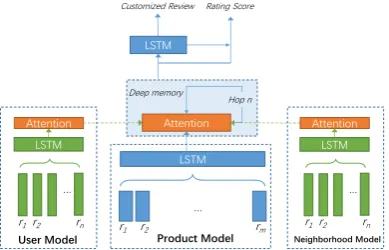
leverage this advantage in building our model. In particular, we use a sub RNN to model the semantic content of each review. A sub product model is used to consolidate existing reviews for the target product, and a user model is built by consolidating the reviews of the given user into a single vector form. To address potential sparsi-ty of a user’s history reviews, neighbor users are identified by collaborative filtering (Ding et al.,
2006), and a vector representation is learned by using a neural neighborhood model. Finally, a deep memory network is utilized to find the asso-ciation between the user and target product, joint-ly yielding the rating score and customised re-view. Experiments on a Yelp dataset show that the model outperforms several pipelined base-lines. We make our source code publicly avail-able under GPL at https://github.com/
wangzq870305/opinion_recommend.
2 Related Work
Sentiment Analysis. Our task is related to document-level sentiment classification (Pang and Lee, 2008) for various neural network model-s have been umodel-sed, including convolutional neu-ral networks (Kim, 2014), recursive neural
net-work (Socher et al., 2013) and recurrent neural network (Teng et al., 2016;Tai et al., 2015), Re-view rating prediction aims to predict the numer-ic rating of a given review. Pang and Lee(2005) pioneered this task by regarding it as a classifica-tion/regression problem. Most subsequent work focuses on designing effective textural features of reviews (Qu et al., 2010; Li et al., 2011; Wan,
2013).
User information has been widely investigated in sentiment analysis.Gao et al.(2013) developed user-specific features to capture user leniency, and
Li et al.(2014) incorporated textual topic and
user-word factors through topic modeling. For integrat-ing user information into neural network models,
Tang et al. (2015) predicted the rating score
giv-en a review by using both lexical semantic infor-mation and a user embedding model. Chen et al.
(2016b) proposed a neural network to incorporate
global user and product information for sentiment classification via an attention mechanism.
Different from the above research, which focus-es on predicting the opinion on existing reviews, our task is to recommend the score that a user would give to a new productwithoutknowing his review text. The difference originates from the ob-jective. Previous research aims to predict opinions on reviewed products, while our task is to recom-mend opinion on new products, which the user has not reviewed.
Opinion Summarization. Our work also over-laps with to the area of opinion summarization, which constructs natural language summaries for multiple product reviews (Hu and Liu, 2004). Most previous work extracts opinion words and aspect terms. Typical approaches include asso-ciation mining of frequent candidate aspects (Hu
and Liu,2004;Qiu et al., 2011), sequence
label-ing based methods (Jakob and Gurevych, 2010;
Yang and Cardie, 2013), as well as topic
mod-eling techniques (Lin and He, 2009). Recently, word embeddings and recurrent neural network-s are alnetwork-so unetwork-sed to extract anetwork-spect termnetwork-s (Irsoy and
Cardie,2014;Liu et al.,2015). While all the
perform abstractive summarization. However, dif-ferent from the above research, which summarize existing reviews, we generatecustomizedreviews for a unreviewed product.
Recommendation. has been solved on mainly purchase history. There are two main approach-es, which are content-based and collaborative-filtering (CF) based (Adomavicius and Tuzhilin,
2005;Yang et al.,2014), respectively. Most
exist-ing social recommendation systems are CF-based, and can be further grouped into model-based CF and neighborhood-based CF (Kantor et al.,2011;
Su and Khoshgoftaar, 2009). Matrix
Factoriza-tion (MF) is one of the most popular models for CF. In recent MF-based social recommendation works, user-user social trust information is inte-grated with user-item feedback history (e.g., rat-ings, clicks, purchases) to improve the accuracy of traditional recommendation systems, which on-ly factorize user-item feedback data (Ding et al.,
2006;Koren,2008;He et al.,2016).
There has been work integrating sentiment anal-ysis and recommendation systems, which use rec-ommendation strategies such as matrix factoriza-tion to improve the performance of sentiment anal-ysis (Leung et al.,2006;Singh et al.,2011). These methods typically use ensemble learning (Singh
et al., 2011) or probabilistic graph models (Wu
and Ester, 2015). For example, Zhang et al.
(2014) proposed a factor graph model to recom-mend opinion rating scores by using explicit prod-uct features as hidden variables. Different from the above research, we recommend user opinions. Neural Network Models. Multi-task learn-ing has been recognised as a strength of neu-ral network models for natuneu-ral language process-ing (Collobert et al.,2011;Henderson et al.,2013;
Zhang and Weiss,2016;Chen et al.,2016a), where
hidden feature layers are shared between different tasks that have common basis. Our work can be regarded as an instance of such multi-tasks learn-ing via shared parameters, which has been widely used in the research community recently.
Dynamic memory network models have been applied for NLP tasks such as question answer-ing (Sukhbaatar et al.,2015;Kumar et al.,2016), language modeling (Tran et al., 2016) and ma-chine translation (Wang et al., 2016). There are typically used to find abstract semantic represen-tations of texts towards certain tasks, which are consistent with our main need, namely
abstract-LSTM LSTM
LSTM
Attention
Customized Review
Attention
Hop n Deep memory
…
User Model
LSTM Attention
…
Neighborhood Model
Rating Score
Product Model
… r1 r2 rm
[image:3.595.322.517.63.188.2]r1r2 rn r1r2 rn
Figure 2: Overview of proposed model.
ing the representation of a product that is biased towards the taste of a certain user. We use a vari-ation of the memory network model for obtaining user-specific review representation.
3 Model
Formally, the input to our model is a tuple
hRT, RU, RNi, where RT = {rT1, rT2, ..., rTnt}
is the set of existing reviews of a target product, RU ={rU1, rU2, ..., rUnu}is the set of user’s
his-tory reviews, and RN = {rN1, rN2, ..., rNnn} is
the set of the user’s neighborhood reviews. All the reviews are sorted with temporal order. The output is a pairhYS, YRi, whereYS is a real number be-tween 0 and 5 representing the customized rating score of the target product, andYRis a customised review. A characteristic of our model is that YS and YR are generated on a product that the user has not reviewed.
For capturing both general and personalized in-formation, we first build aproduct model, auser model, and a neighborhood model, respectively, and using a memory network model to integrate these three types of information, constructing a
customized product model. Finally, we predict a customized rating score and a review collectively using neural stacking framework. The overall ar-chitecture of the model is shown in Figure2. 3.1 Review Model
the review, each wordxk is represented with aK -dimensional embeddingew
k (Mikolov et al.,2013). We use the Pk(ew
k)/m for the representation of the reviewed(r).
3.2 User Model
A standard LSTM (Hochreiter and Schmidhu-ber, 1997) is used to learn the hidden states of an user’s reviews to build the user mod-el. Denoting the recurrent function at step t as
LSTM(xt, ht−1), we obtain a sequence of
hid-den state vectors{hU1, hU2, ..., hUnu}recurrently
by feeding{ed(r
U1), ed(rU2), ..., ed(rUnu)}as
in-puts, wherehUi = LSTM(ed(rUi), hUi−1). The
initial state and all standard LSTM parameters are randomly initialized and tuned during training.
Not all reviews contribute equally to the repre-sentation of a user. We use the attention mech-anism (Bahdanau et al., 2014;Yang et al.,2016) to extract the reviews that are relatively more important, aggregating the representation of re-views to form a vector. Taking the hidden s-tate{hU1, ...hU2, ..., hUnu}of user model as input,
the attention model outputs, a continuous vector vU ∈Rd×1, which is computed as a weighted sum of each hidden statehUi, namely
vU = nu
X
i
αihUi (1)
wherenuis the hidden variable size,αi ∈[0,1]is the weight ofhUi, and
P
iαi = 1.
For each piece of hidden statehUi, the scoring
function is calculated by
ui= tanh(WUhUi+bU) (2)
αi= Pexp(ui)
jexp(uj) (3) whereWU andbU are model parameters. The at-tention vectorvU is used to represent the user for theUser Model.
3.3 Neighborhood Model
We use neighborhood reviews to improve the us-er model, since a usus-er may not have sufficient re-views to construct a reliable model. Here a neigh-bor refers to a user that has similar tastes to the target user (Koren,2008;Desrosiers and Karypis,
2011). The same as the user model, we construct
the neighborhood model vN using the neighbor-hood reviewsRN ={rN1, rN2, ..., rNnn}with an
attention recurrent network.
A key issue in building the neighborhood model is how to find neighbors of a certain user. In this study, we use matrix factorization (Koren, 2008) to detect neighbors, which is a standard approach for recommendation (Ding et al., 2006;Li et al.,
2009;He et al., 2016). In particular, users’
rat-ing scores of products are used to build a product-users matrixM ∈ Rnt×nu with nt products and
nu users. We approximate it using three factors, specifying soft membership of products and user-s (Ding et al.,2006) by finding:
min
F,S,T||M−F ST T||
s.t.S≥0, F ≥0, T ≥0 (4)
whereF ∈ Rnt×K represents the posterior
prob-ability ofK topic clusters for each product; S ∈
RK×K encodes the distribution of each topic k; andT ∈RK×nu indicates the posterior
probabili-ty ofK topic clusters for each user.
As a result of matrix factorization, we directly obtain the probability of each user on each topic from the person-topic matrix T. To infer T, the optimization problem in Eq.4can be solved using the following updating rule:
Tjk ←Tjk (M
TF S)jk
(T TTMTF S)jk (5)
With the user-topic matrixT, we measure the im-plicit connection between two users using:
sim(i, j) =Xk
k=1
TikTjk (6)
where sim(i, j) measure the implicit connection degree between usersiandj. Ifsim(i, j)is high-er than a threshold η, we consider user j as the neighbor of useri.
3.4 Product Model
Given the representations of existing reviews
{ed(r
T1), ed(rT2), ..., ed(rTnt)} of the
produc-t, we use LSTM to model their temporal or-ders, obtaining a sequence of hidden vectors hT = {hT1, hT2, ..., hTnt} by recurrently feeding
{ed(rT
1), ed(rT2), ..., ed(rTnt}as inputs. The
Customized Product Model. The produc-t model represenproduc-ts salienproduc-t informaproduc-tion of exisproduc-ting reviews in their temporal order, yet do not reflect the taste of a particular user. We build the cus-tomised product model to integrate user informa-tion and product informainforma-tion (as reflected by the product model), resulting in a single vector that represents a customised product. From this vector we are able to synthesis both a customised review and a customised rating score. In particular, we use the user representationvU and the neighbour representationvN to transform the target produc-t represenproduc-taproduc-tionhT = {hT1, hT2, ..., hTnt}into a
customised product representation vC, which is tailored to the taste of the user.
A naive model of yielding vC could utilise the attention mechanism over ht, deriving a weight-ed sum according to user information. On the other hand, dynamic memory networks have been shown highly useful for deriving abstract semantic information compared with simple attention, and hence we followSukhbaatar et al.(2015) and
X-iong et al. (2016), building a variation of DMN
to iteratively find increasingly abstract representa-tions ofht, by injectingvU andvN information.
The memory model consists of multiple dynam-ic computational layers (hops), each of whdynam-ich con-tains an attention layer and a linear layer. In the first computational layer (hop 1), we take the hid-den variableshTi (0 ≤i ≤ nt) of product model
as input, adaptively selecting important evidences through one attention layer usingvU andvN. The output of the attention layer gives a linear inter-polation ofhT, and the result is considered as in-put to the next layer (hop 2). In the same way, we stack multiple hops and run the steps multiple times, so that more abstract representations of the target product can be derived.
The attention model outputs a continuous vector vC ∈Rd×1, which is computed as a weighted sum ofhTi(0≤i≤nt), namely
vC = nt
X
i
βihTi (7)
wherentis the hidden variable size,βi ∈[0,1]is the weight ofhTi, and
P
iβi = 1. For each piece of hidden statehTi, we use a feed forward neural
network to compute its semantic relatedness with the abstract representationvC. The scoring
func-tion is calculated as follows at hopt:
uti = tanh(WThTi+WCvCt−1
+WUvU+WNvN +b) (8)
βit= Pexp(uti)
jexp(utj) (9) The vectorvC is used to represent the customized product model. At the first hop, we defineV0
C = P
ihTi/nt.
The product model hTi (0 ≤ i ≤ nt)
rep-resents salient information of existing reviews in their temporal order, they do not reflect the taste of a particular user. We use the customised uct model to integrate user information and prod-uct information (as reflected by the prodprod-uct mod-el), resulting in a single vector that represents a customised product. From this vector we are able to synthesis both a customised review and a cus-tomised rating score.
3.5 Customized Review Generation
The goal of customized review generation is to generate a reviewYR from the customized prod-uct representationvC, composed by a sequence of wordsyR1, ..., yRnr. We use a standard LSTM
de-coder (Rush et al.,2015) to decompose the predic-tion ofYR into a sequence of word-level predic-tions:
logP(YR|vC) = X
j
P(yRj|yR1, ..., yRj−1, vC) (10)
where each word yRj is predicted conditional on
the previously generated yR1, ..., yRj−1 and the
customized product vectorvC. The probability is estimated by using standard word softmax:
P(yRj|yR1, ..., yRj−1, vC) =
softmax(hRj)
(11)
where hRj is the hidden state variable at
times-tampj, which is modeled asLST M(uj−1, hRj). Here a LSTM is used to generate a new statehRj
from the representation of the previous statehRj−1
anduj−1. uj−1is the concatenation of previously
generated wordyRj−1and the input representation
3.6 Customized Rating Prediction
A straightforward approach to predicting the rat-ing score of a product is to take the average of ex-isting review scores. However, the drawback is that it cannot reflect the the variance in user tastes. In order to integrate user preferences into the rat-ing, we instead take a user-based weighted aver-age of existing rating scores, so that the scores of reviews that are closer to the user preference are given higher weights. However, existing ratings can be all different from a users personal rating, if the existing reviews do not come from the user’s neighbours. We thus use the customized product vectorvcas a bias of the weighted average of ex-isting rating scores.
Formally, given the rating scores s1, s2, ..., sn of existing reviews, and the the customized prod-uct representationvC, we calculate:
YS = n X
i
βi·si+µtanh(WSvC +bS) (12)
In the left termPni βi·si, we use attention weights βiin Eq.9to measure the important of each rating scoresi. The right term tanh(WSvC +bS) is a review-based shift, weighted byµ.
Since the result of customized review genera-tion can be helpful for rating score predicgenera-tion, we use neural stacking additionally feeding the last hidden state hRn of review generation model as
input forYS prediction, resulting in
YS = n X
i
αi·si+
+µtanh(WS(vC⊕hRn) +bS)
(13)
where⊕denotes vector concatenation. 3.7 Training
For our task, there are two joint training objec-tives, for review scoring and review summarisa-tion, respectively. For review scoring, the loss function is defined as:
L(Θ) =XN
i=1
(YS∗i −YSi)2+
λ
2||Θ||2 (14)
whereY∗
Si is the predicted rating score,YSi is the
rating score in the training data, Θ is the set of model parameters andλis a parameter for L2 reg-ularization.
[image:6.595.367.465.62.121.2]Amount Business 15,584 Review 334,997 User 303,032 Table 1: Statistics of the dataset.
For customized review generation, loss is de-fined by maximizing the log probability of
E-q.10 (Sutskever et al., 2014; Rush et al., 2015).
The two loss functions for score and review pre-diction share the representation vectors undervC, hence forming multi-task learning.
Standard back propagation is performed to op-timize parameters, where gradients also propagate from the scoring objective to the review genera-tion objective due to neural stacking (Eq.13). We apply online training, where model parameters are optimized by using AdaGrad (Duchi et al.,2011). Word embeddings are trained using theSkip-gram
algorithm (Mikolov et al.,2013)1.
4 Experiments
4.1 Experimental Settings
Our data are collected from the yelp academic dataset2, provided by Yelp.com, a popular
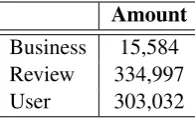
restau-rant review website. The data set contains three types of objects:business,user, andreview, where business objects contain basic information about local businesses (i.e. restaurants), review objects contain review texts and star rating, and user ob-jects contain aggregate information about a single user across all of Yelp. Table1illustrates the gen-eral statistics of the dataset.
For evaluating our model, we choose 4,755 product pairs from the dataset. The user-product pairs are extracted by following criterions: for each selected user-product pair, the user should have written 10 reviews at least, and the product should contain 100 reviews at least. In addition, the gold-standard review that the user write for the corresponding product should contain 10 helpful hits at least. We did not try alternative data selec-tion rules. We will give the detail in our draft.
For each pair, the existing reviews of the target service (restaurant) are used for the product mod-el. The rating score given by each user to the target service is considered as the gold customized rating score, and the review of the target service given by
each user is used as the gold-standard customized review for the user. The remaining reviews of each user are used for training the user model. We use 3,000 user-product pairs to train the model, 1,000 pairs as testing data, and remaining data for devel-opment.
We use the ROUGE-1.5.5 (Lin, 2004) toolk-it for evaluating the performance of customized review generation, and report unigram overlap (ROUGE-1) as a means of assessing informative-ness. Mean Square Error (MSE) (Wan,2013;Tang
et al., 2015) is used as the evaluation metric for
measuring the performance of customized rating score prediction. MSE penalizes more severe er-rors more heavily.
4.2 Hyper-parameters
There are several important hyper-parameters in our models, and we tune their values using the development dataset. We set the regularization weightλ = 10−8 and the initial learning rate to 0.01. We set the size of word vectors to 128, the size of hidden vectors in LSTM to 128. In order to avoid over-fitting, dropout (Hinton et al.,2012) is used for word embedding with a ratio of 0.2. The neighbor similarity thresholdηis set to 0.25.
4.3 Development Experiments 4.3.1 Ablation Test
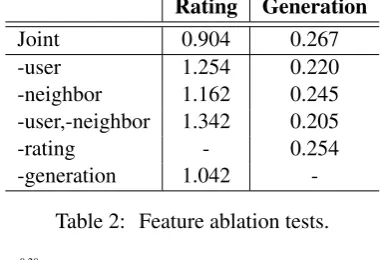
Effects of various configurations of our model, are shown on Table2, whereJointis the full model of this paper,-userablates the user model,-neighbor
ablates the neighbor model,-ratingis a single-task model that generates a review without the rating score, and-generationyields only the rating.
By comparing “Joint” and “-user,-neighbor”, we can find that customized information have sig-nificant influence on both the rating and review generation results (p −value < 0.01 using t -test). In addition, comparison between “-Joint” and “user”, and between “user” and “user, -neighbor” shows that both the user information and the neighbour user information of the user are effective for improving the results. A users neigh-bours can indeed alleviate scarcity of user reviews. Finally, comparison between “Joint” and “-generation”, and between “Joint” and “-rating” shows that multi-task learning by parameter shar-ing is highly useful.
Rating Generation
Joint 0.904 0.267
-user 1.254 0.220
-neighbor 1.162 0.245 -user,-neighbor 1.342 0.205
-rating - 0.254
-generation 1.042 -Table 2: Feature ablation tests.
0.20 0.21 0.22 0.23 0.24 0.25 0.26 0.27 0.28
0 1 2 3 4 5 6 7 8 9 10
RO
UG
E
-1
[image:7.595.320.511.66.196.2]Hop
Figure 3: Influence of hops.
4.3.2 Influence of Hops
We show the influence of hops of memory net-work for customized review generation on Fig-ure3. When hop = 0, the model considers only the general product reviews (−user,−neighbor). Whenhop ≥ 1, customized product information is leveraged. From the figure we can find that, when hop = 3, the performance is the best. It indicates that multiple hops can capture more ab-stract evidences from external memory to improve the performance. However, too many hops leads to over-fitting, thereby harms the performance. As a result, we choose 3 as the number of hops in our final test.
4.3.3 Influence ofµ
We show the influence of the bias weight parame-terµfor rating prediction in Figure4. Withµ be-ing 0, the model uses the weighted sum of existbe-ing reviews to score the product. Whenµis very large, the system tends to use only the customized prod-uct representation vc to score the product, hence ignoring existing review scores, which are a use-ful source of information. Our results show that whenµis 1, the performance is optimal, thus indi-cating both existing review scores and review con-tents are equally useful.
4.4 Final Results
[image:7.595.324.515.194.297.2]HOP Bais
0 1.342 0 1.102
1 1.102 1 0.904
2 1.046 2 1.067
3 0.904 3 1.136
4 0.987 4 1.206
5 1.102 5 1.227
6 1.045
7 1.126
8 1.172
9 1.152
10 1.167
0.90 0.95 1.00 1.05 1.10 1.15 1.20 1.25
0 1 2 3 4 5
M
SE
μ
0.90 0.95 1.00 1.05 1.10 1.15 1.20 1.25 1.30 1.35 1.40
0 1 2 3 4 5 6 7 8 9 10
M
SE
[image:8.595.317.517.62.193.2]hop
Figure 4: Influence of bias score.
following state-of-the-art baseline systems:
• RS-Average-Yelpis the widely-adopted base-line (e.g., by Yelp.com), using the averaged review scores as the final score.
• RS-Linear estimates the rating score that a user would give bysui=sall+su+si(
Ric-ci et al.,2011), wheresu andsi are the the
training deviations of rating score of the user uand the producti, respectively.
• RS-Item applies kNN to estimate the rating score (Sarwar et al., 2001). We choose the cosine similarity between vc to measure the distance between product.
• RS-MF is a state-of-the-art recommendation model, which uses matrix factorisation to predict rating score (Ding et al., 2006; Li et al.,2009;He et al.,2016).
• Sum-Opinosisuses a graph-based framework to generate abstractive summarisation given redundant opinions (Ganesan et al.,2010).
• Sum-LSTM-Attis a state-of-the-art neural ab-stractive summariser, which uses an atten-tional neural model to consolidate informa-tion from multiple text sources, generat-ing summaries usgenerat-ing LSTM decodgenerat-ing (Rush
et al.,2015;Wang and Ling,2016).
Being non-opinion recommendation methods, all the baselines are single-task models, with-out considering rating and summarisation predic-tion jointly. The results are shown in Table 3. Our model (“ Joint”) significantly outperforms both “RS-Average-Yelp” and “RS-Linear” (p −
value < 0.01 using t-test). Note that, our pro-posed rating recommendation for the user are sig-nificantly closer individual real user rating com-pared with Yelp’s rating.
Rating Generation RS-Average-Yelp 1.280
-RS-Linear 1.234
-RS-Item 1.364
-RS-MF 1.143
-Sum-Opinosis - 0.183 Sum-LSTM-Att - 0.196
Joint 1.023 0.250
Table 3: Final results.
Our proposed model also significantly outper-forms state-of-the-art recommendation systems (RS-Item and RS-MF) (p−value <0.01usingt -test), indicating that textual information are a use-ful addition to the rating scores themselves for rec-ommending a product.
Finally, comparison between our proposed model and state-of-the-art summarisation tech-niques (Sum-Opinosis and Sum-LSTM-Att) shows the advantage of leveraging user informa-tion to enhance customised review generainforma-tion, and also the strength of joint learning.
4.5 Example Output
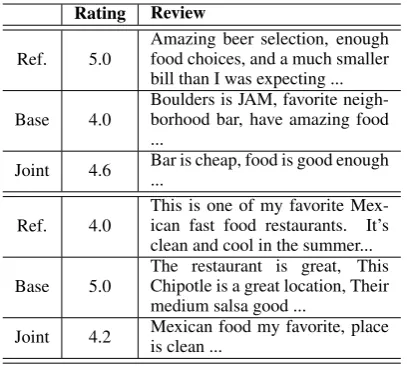
Table 4 shows example outputs of rating scores and reviews. Ref. is the rating score and re-view written by user her/himself, andBaseis the baseline model, that generates the rating score by RS-MF, and review by Sum-LSTM-Att. From these examples, we can find that, both rating s-core and review which generated by the proposed Joint model is closer to the real user. In particular, in the first example, the baseline system correctly identifies the main both price and quality informa-tion, which the target user wrote in the review, yet the baseline model did not yield comments about the price based on reviews of other users. Associ-ating reviews and rAssoci-atings closely, the joint model gives a rating score that is much closer to the re-al user score compared to the score given by the recommendation model MF. In addition, we can also find some habits of certain users from their customized reviews, for example, Mexican food, cheap and clean restaurant.
5 Conclusion
[image:8.595.82.281.64.170.2]Rating Review
Ref. 5.0 Amazing beer selection, enoughfood choices, and a much smaller bill than I was expecting ...
Base 4.0 Boulders is JAM, favorite neigh-borhood bar, have amazing food ...
Joint 4.6 Bar is cheap, food is good enough...
Ref. 4.0 This is one of my favorite Mex-ican fast food restaurants. It’s clean and cool in the summer...
Base 5.0 The restaurant is great, ThisChipotle is a great location, Their medium salsa good ...
[image:9.595.80.284.61.244.2]Joint 4.2 Mexican food my favorite, placeis clean ...
Table 4: Example outputs.
deep memory network was utilized to find the as-sociation between the user and the product, jointly yielding the rating score and customised review. Results show that our methods are better result-s compared to result-several pipelineresult-s baresult-selineresult-s uresult-sing state-of-the-art sentiment rating and summarisa-tion systems. Review scores given by the opinion recordation system are closer to real user review scores compared to the review scores which Yelp assigns to target products.
Acknowledgments
The corresponding author is Yue Zhang. We are grateful for the help of Xuanyi Li for his initial exploration. We thank our anonymous reviewers for their constructive comments, which helped to improve the paper. This work is supported by the Temasek Lab grant IGDST1403012 at Singapore University of Technology and Design, and sup-ported by the National Natural Science Founda-tion of China (No.61402314).
References
Gediminas Adomavicius and Alexander Tuzhilin. 2005. Toward the next generation of recommender systems: A survey of the state-of-the-art and pos-sible extensions. IEEE transactions on knowledge and data engineering, 17(6):734–749.
Dzmitry Bahdanau, Kyunghyun Cho, and Yoshua Ben-gio. 2014. Neural machine translation by joint-ly learning to align and translate. CoRR, ab-s/1409.0473.
Hongshen Chen, Yue Zhang, and Qun Liu. 2016a.
Neural network for heterogeneous annotations. In Proceedings of the 2016 Conference on Empirical
Methods in Natural Language Processing, EMNLP 2016, Austin, Texas, USA, November 1-4, 2016, pages 731–741.
Huimin Chen, Maosong Sun, Cunchao Tu, Yankai Lin, and Zhiyuan Liu. 2016b. Neural sentiment classifi-cation with user and product attention. In Proceed-ings of the 2016 Conference on Empirical Method-s in Natural Language ProceMethod-sMethod-sing, EMNLP 2016, Austin, Texas, USA, November 1-4, 2016, pages 1650–1659.
Ronan Collobert, Jason Weston, L´eon Bottou, Michael Karlen, Koray Kavukcuoglu, and Pavel P. Kuksa. 2011. Natural language processing (almost) from scratch. Journal of Machine Learning Research, 12:2493–2537.
Christian Desrosiers and George Karypis. 2011. A comprehensive survey of neighborhood-based rec-ommendation methods. In Recommender Systems Handbook, pages 107–144.
Chris Ding, Tao Li, Wei Peng, and Haesun Park. 2006. Orthogonal nonnegative matrix t-factorizations for clustering. InProceedings of the 12th ACM SIGKD-D international conference on Knowledge discovery and data mining, pages 126–135. ACM.
John C. Duchi, Elad Hazan, and Yoram Singer. 2011.
Adaptive subgradient methods for online learning and stochastic optimization. Journal of Machine Learning Research, 12:2121–2159.
Kavita Ganesan, ChengXiang Zhai, and Jiawei Han. 2010. Opinosis: a graph-based approach to abstrac-tive summarization of highly redundant opinions. In Proceedings of the 23rd international conference on computational linguistics, pages 340–348. Associa-tion for ComputaAssocia-tional Linguistics.
Wenliang Gao, Naoki Yoshinaga, Nobuhiro Kaji, and Masaru Kitsuregawa. 2013. Modeling user leniency and product popularity for sentiment classification. InIJCNLP, pages 1107–1111.
Xiangnan He, Hanwang Zhang, Min-Yen Kan, and Tat-Seng Chua. 2016. Fast matrix factorization for online recommendation with implicit feedback. In Proceedings of the 39th International ACM SIGIR conference on Research and Development in Infor-mation Retrieval, SIGIR 2016, Pisa, Italy, July 17-21, 2016, pages 549–558.
James Henderson, Paola Merlo, Ivan Titov, and Gabriele Musillo. 2013. Multilingual joint pars-ing of syntactic and semantic dependencies with a latent variable model. Computational Linguistics, 39(4):949–998.
Sepp Hochreiter and J¨urgen Schmidhuber. 1997.
Long short-term memory. Neural Computation, 9(8):1735–1780.
Minqing Hu and Bing Liu. 2004. Mining and summa-rizing customer reviews. InProceedings of the Tenth ACM SIGKDD International Conference on Knowl-edge Discovery and Data Mining, Seattle, Washing-ton, USA, August 22-25, 2004, pages 168–177. Ozan Irsoy and Claire Cardie. 2014. Opinion mining
with deep recurrent neural networks. In EMNLP, pages 720–728.
Niklas Jakob and Iryna Gurevych. 2010. Extracting opinion targets in a single and cross-domain setting with conditional random fields. InProceedings of the 2010 Conference on Empirical Methods in Nat-ural Language Processing, EMNLP 2010, 9-11 Oc-tober 2010, MIT Stata Center, Massachusetts, USA, A meeting of SIGDAT, a Special Interest Group of the ACL, pages 1035–1045.
Paul B Kantor, Lior Rokach, Francesco Ricci, and Bracha Shapira. 2011. Recommender systems hand-book.
Yoon Kim. 2014. Convolutional neural networks for sentence classification. InProceedings of the 2014 Conference on Empirical Methods in Natural Lan-guage Processing, EMNLP 2014, October 25-29, 2014, Doha, Qatar, A meeting of SIGDAT, a Special Interest Group of the ACL, pages 1746–1751. Yehuda Koren. 2008. Factorization meets the
neigh-borhood: a multifaceted collaborative filtering mod-el. In Proceedings of the 14th ACM SIGKDD in-ternational conference on Knowledge discovery and data mining, pages 426–434. ACM.
Ankit Kumar, Ozan Irsoy, Peter Ondruska, Mohit Iyy-er, James Bradbury, Ishaan Gulrajani, Victor Zhong, Romain Paulus, and Richard Socher. 2016. Ask me anything: Dynamic memory networks for natural language processing. InProceedings of the 33nd In-ternational Conference on Machine Learning, ICM-L 2016, New York City, NY, USA, June 19-24, 2016, pages 1378–1387.
Cane WK Leung, Stephen CF Chan, and Fu-lai Chung. 2006. Integrating collaborative filtering and sen-timent analysis: A rating inference approach. In Proceedings of the ECAI 2006 workshop on recom-mender systems, pages 62–66.
Fangtao Li, Nathan Nan Liu, Hongwei Jin, Kai Zhao, Qiang Yang, and Xiaoyan Zhu. 2011. Incorpoing reviewer and product information for review rat-ing prediction. In IJCAI 2011, Proceedings of the 22nd International Joint Conference on Artificial In-telligence, Barcelona, Catalonia, Spain, July 16-22, 2011, pages 1820–1825.
Fangtao Li, Sheng Wang, Shenghua Liu, and Ming Zhang. 2014. Suit: A supervised user-item based topic model for sentiment analysis. InAAAI, pages 1636–1642.
Tao Li, Yi Zhang, and Vikas Sindhwani. 2009. A non-negative matrix tri-factorization approach to senti-ment classification with lexical prior knowledge. In Proceedings of the Joint Conference of the 47th An-nual Meeting of the ACL and the 4th International Joint Conference on Natural Language Processing of the AFNLP: Volume 1-Volume 1, pages 244–252. Association for Computational Linguistics.
Chenghua Lin and Yulan He. 2009. Joint sentimen-t/topic model for sentiment analysis. InProceedings of the 18th ACM Conference on Information and Knowledge Management, CIKM 2009, Hong Kong, China, November 2-6, 2009, pages 375–384. Chin-Yew Lin. 2004. Rouge: A package for
automat-ic evaluation of summaries. InText summarization branches out: Proceedings of the ACL-04 workshop, volume 8. Barcelona, Spain.
Pengfei Liu, Shafiq R. Joty, and Helen M. Meng. 2015.
Fine-grained opinion mining with recurrent neural networks and word embeddings. InProceedings of the 2015 Conference on Empirical Methods in Nat-ural Language Processing, EMNLP 2015, Lisbon, Portugal, September 17-21, 2015, pages 1433–1443. Tomas Mikolov, Ilya Sutskever, Kai Chen, Gregory S. Corrado, and Jeffrey Dean. 2013. Distributed rep-resentations of words and phrases and their com-positionality. In Advances in Neural Information Processing Systems 26: 27th Annual Conference on Neural Information Processing Systems 2013. Pro-ceedings of a meeting held December 5-8, 2013, Lake Tahoe, Nevada, United States., pages 3111– 3119.
Hitoshi Nishikawa, Takaaki Hasegawa, Yoshihiro Mat-suo, and Gen-ichiro Kikui. 2010. Optimizing in-formativeness and readability for sentiment summa-rization. InACL 2010, Proceedings of the 48th An-nual Meeting of the Association for Computation-al Linguistics, July 11-16, 2010, UppsComputation-ala, Sweden, Short Papers, pages 325–330.
Bo Pang and Lillian Lee. 2005. Seeing stars: Exploit-ing class relationships for sentiment categorization with respect to rating scales. InACL 2005, 43rd An-nual Meeting of the Association for Computation-al Linguistics, Proceedings of the Conference, 25-30 June 2005, University of Michigan, USA, pages 115–124.
Bo Pang and Lillian Lee. 2008. Opinion mining and sentiment analysis. Foundations and trends in infor-mation retrieval, 2(1-2):1–135.
Guang Qiu, Bing Liu, Jiajun Bu, and Chun Chen. 2011. Opinion word expansion and target extraction through double propagation. Computational Lin-guistics, 37(1):9–27.
2010, 23rd International Conference on Computa-tional Linguistics, Proceedings of the Conference, 23-27 August 2010, Beijing, China, pages 913–921. Francesco Ricci, Lior Rokach, Bracha Shapira, and Paul B. Kantor, editors. 2011. Recommender Sys-tems Handbook. Springer.
Alexander M. Rush, Sumit Chopra, and Jason Weston. 2015. A neural attention model for abstractive sen-tence summarization. In Proceedings of the 2015 Conference on Empirical Methods in Natural Lan-guage Processing, EMNLP 2015, Lisbon, Portugal, September 17-21, 2015, pages 379–389.
Badrul M. Sarwar, George Karypis, Joseph A. Konstan, and John Riedl. 2001. Item-based collaborative fil-tering recommendation algorithms. InProceedings of the Tenth International World Wide Web Confer-ence, WWW 10, Hong Kong, China, May 1-5, 2001, pages 285–295.
Vivek Kumar Singh, Mousumi Mukherjee, and Ghan-shyam Kumar Mehta. 2011. Combining collab-orative filtering and sentiment classification for improved movie recommendations. In Multi-disciplinary Trends in Artificial Intelligence - 5th ternational Workshop, MIWAI 2011, Hyderabad, In-dia, December 7-9, 2011. Proceedings, pages 38– 50.
Richard Socher, Alex Perelygin, Jean Y Wu, Jason Chuang, Christopher D Manning, Andrew Y Ng, and Christopher Potts. 2013. Recursive deep mod-els for semantic compositionality over a sentiment treebank. InProceedings of the 2013 Conference on Empirical Methods in Natural Language Process-ing, EMNLP 2013, 18-21 October 2013, Grand Hy-att SeHy-attle, SeHy-attle, Washington, USA, A meeting of SIGDAT, a Special Interest Group of the ACL. Xiaoyuan Su and Taghi M Khoshgoftaar. 2009. A
sur-vey of collaborative filtering techniques. Advances in artificial intelligence, 2009:4.
Sainbayar Sukhbaatar, Arthur Szlam, Jason Weston, and Rob Fergus. 2015. End-to-end memory net-works. InAdvances in Neural Information Process-ing Systems 28: Annual Conference on Neural In-formation Processing Systems 2015, December 7-12, 2015, Montreal, Quebec, Canada, pages 2440– 2448.
Ilya Sutskever, Oriol Vinyals, and Quoc V. Le. 2014.
Sequence to sequence learning with neural network-s. In Advances in Neural Information Processing Systems 27: Annual Conference on Neural Informa-tion Processing Systems 2014, December 8-13 2014, Montreal, Quebec, Canada, pages 3104–3112. Kai Sheng Tai, Richard Socher, and Christopher D.
Manning. 2015. Improved semantic representation-s from tree-representation-structured long representation-short-term memory net-works. In Proceedings of the 53rd Annual Meet-ing of the Association for Computational LMeet-inguistics
and the 7th International Joint Conference on Natu-ral Language Processing of the Asian Federation of Natural Language Processing, ACL 2015, July 26-31, 2015, Beijing, China, Volume 1: Long Papers, pages 1556–1566.
Duyu Tang, Bing Qin, Ting Liu, and Yuekui Yang. 2015.User modeling with neural network for review rating prediction. In Proceedings of the Twenty-Fourth International Joint Conference on Artificial Intelligence, IJCAI 2015, Buenos Aires, Argentina, July 25-31, 2015, pages 1340–1346.
Zhiyang Teng, Duy-Tin Vo, and Yue Zhang. 2016.
Context-sensitive lexicon features for neural senti-ment analysis. In Proceedings of the 2016 Con-ference on Empirical Methods in Natural Language Processing, EMNLP 2016, Austin, Texas, USA, November 1-4, 2016, pages 1629–1638.
Ke M. Tran, Arianna Bisazza, and Christof Monz. 2016. Recurrent memory networks for language modeling. InNAACL HLT 2016, The 2016 Confer-ence of the North American Chapter of the Associ-ation for ComputAssoci-ational Linguistics: Human Lan-guage Technologies, San Diego California, USA, June 12-17, 2016, pages 321–331.
Xiaojun Wan. 2013. Co-regression for cross-language review rating prediction. InProceedings of the 51st Annual Meeting of the Association for Computation-al Linguistics, ACL 2013, 4-9 August 2013, Sofia, Bulgaria, Volume 2: Short Papers, pages 526–531. Lu Wang and Wang Ling. 2016. Neural
network-based abstract generation for opinions and argu-ments. InNAACL HLT 2016, The 2016 Conference of the North American Chapter of the Association for Computational Linguistics: Human Language Technologies, San Diego California, USA, June 12-17, 2016, pages 47–57.
Mingxuan Wang, Zhengdong Lu, Hang Li, and Qun Liu. 2016. Memory-enhanced decoder for neural machine translation. In Proceedings of the 2016 Conference on Empirical Methods in Natural Lan-guage Processing, EMNLP 2016, Austin, Texas, US-A, November 1-4, 2016, pages 278–286.
Yao Wu and Martin Ester. 2015. FLAME: A proba-bilistic model combining aspect based opinion min-ing and collaborative filtermin-ing. In Proceedings of the Eighth ACM International Conference on Web Search and Data Mining, WSDM 2015, Shanghai, China, February 2-6, 2015, pages 199–208. Caiming Xiong, Stephen Merity, and Richard Socher.
2016. Dynamic memory networks for visual and textual question answering. InProceedings of the 33nd International Conference on Machine Learn-ing, ICML 2016, New York City, NY, USA, June 19-24, 2016, pages 2397–2406.
for Computational Linguistics, ACL 2013, 4-9 Au-gust 2013, Sofia, Bulgaria, Volume 1: Long Papers, pages 1640–1649.
Xiwang Yang, Yang Guo, Yong Liu, and Harald Steck. 2014. A survey of collaborative filtering based so-cial recommender systems. Computer Communica-tions, 41:1–10.
Zichao Yang, Diyi Yang, Chris Dyer, Xiaodong He, Alex Smola, and Eduard Hovy. 2016. Hierarchical attention networks for document classification. In NAACL 2016, 15th Annual Conference of the North American Chapter of the Association for Computa-tional Linguistics: Human Language Technologies, San Diego, US.
Yongfeng Zhang, Guokun Lai, Min Zhang, Yi Zhang, Yiqun Liu, and Shaoping Ma. 2014. Explicit factor models for explainable recommendation based on phrase-level sentiment analysis. InThe 37th Inter-national ACM SIGIR Conference on Research and Development in Information Retrieval, SIGIR ’14, Gold Coast , QLD, Australia - July 06 - 11, 2014, pages 83–92.