Proceedings of the 2011 Conference on Empirical Methods in Natural Language Processing, pages 1489–1499,
Training dependency parsers by jointly optimizing multiple objectives
Keith Hall Ryan McDonald Jason Katz-Brown Michael Ringgaard
Google Research
{kbhall|ryanmcd|jasonkb|ringgaard}@google.com
Abstract
We present an online learning algorithm for training parsers which allows for the inclusion of multiple objective functions. The primary example is the extension of a standard su-pervised parsing objective function with addi-tional loss-functions, either based on intrinsic parsing quality or task-specific extrinsic mea-sures of quality. Our empirical results show how this approach performs for two depen-dency parsing algorithms (graph-based and transition-based parsing) and how it achieves increased performance on multiple target tasks including reordering for machine translation and parser adaptation.
1 Introduction
The accuracy and speed of state-of-the-art depen-dency parsers has motivated a resumed interest in utilizing the output of parsing as an input to many downstream natural language processing tasks. This includes work on question answering (Wang et al., 2007), sentiment analysis (Nakagawa et al., 2010), MT reordering (Xu et al., 2009), and many other tasks. In most cases, the accuracy of parsers de-grades when run on out-of-domain data (Gildea, 2001; McClosky et al., 2006; Blitzer et al., 2006; Petrov et al., 2010). But these accuracies are mea-sured with respect to gold-standard out-of-domain parse trees. There are few tasks that actually depend on the complete parse tree. Furthermore, when eval-uated on a downstream task, often the optimal parse output has a model score lower than the best parse as predicted by the parsing model. While this means
that we are not properly modeling the downstream task in the parsers, it also means that there is some information from small task or domain-specific data sets which could help direct our search for optimal parameters during parser training. The goal being not necessarily to obtain better parse performance, but to exploit the structure induced from human la-beled treebank data while targeting specific extrinsic metrics of quality, which can include task specific metrics or external weak constraints on the parse structure.
One obvious approach to this problem is to em-ploy parser reranking (Collins, 2000). In such a setting, an auxiliary reranker is added in a pipeline following the parser. The standard setting involves training the base parser and applying it to a devel-opment set (this is often done in a cross-validated jack-knife training framework). The reranker can then be trained to optimize for the downstream or extrinsic objective. While this will bias the reranker towards the target task, it is limited by the oracle performance of the original base parser.
eters are optimized based on the objective function associated with the instance (either intrinsic or ex-trinsic), thus jointly optimizing multiple objectives. An update schedule trades-off the relative impor-tance of each objective function. We call our algo-rithm augmented-loss trainingas it optimizes mul-tiple losses to augment the traditional supervised parser loss.
There have been a number of efforts to exploit weak or external signals of quality to train better pre-diction models. This includes work on generalized expectation (Mann and McCallum, 2010), posterior regularization (Ganchev et al., 2010) and constraint driven learning (Chang et al., 2007; Chang et al., 2010). The work of Chang et al. (2007) on constraint driven learning is perhaps the closest to our frame-work and we draw connections to it in Section 5. In these studies the typical goal is to use the weak signal to improve the structured prediction models on the intrinsic evaluation metrics. For our setting this would mean using weak application specific sig-nals to improve dependency parsing. Though we explore such ideas in our experiments, in particular for semi-supervised domain adaptation, we are pri-marily interested in the case where the weak signal is precisely what we wish to optimize, but also de-sire the benefit from using both data with annotated parse structures and data specific to the task at hand to guide parser training.
In Section 2 we outline the augmented-loss algo-rithm and provide a convergence analysis. In Sec-tion 3 and 4 we present a set of experiments defin-ing diffent augmented losses coverdefin-ing a task-specific extrinsic loss (MT reordering), a domain adapta-tion loss, and an alternate intrinsic parser loss. In all cases we show the augmented-loss framework can lead to significant gains in performance. In Section 5 we tie our augmented-loss algorithm to other frameworks for encoding auxiliary informa-tion and/or joint objective optimizainforma-tion.
2 Methodology
We present the augmented-loss algorithm in the con-text of the structured perceptron. The structured perceptron (Algorithm 1) is an on-line learning al-gorithm which takes as input: 1) a set of training examplesdi = (xi, yi) consisting of an input
sen-Algorithm 1Structured Perceptron
{Input data sets:D={d1= (x1, y1). . . dN= (xN, yN)}}
{Input 0/1 loss:L(Fθ(x), y) = [Fθ(x)6=y? 1 : 0]}
{Let:Fθ(x) = arg maxy∈Yθ·Φ(y)}
{Initialize model parameters:θ=~0}
repeat
fori= 1. . . N do
{Compute structured loss} ˆ
yi=Fθ(xi) ifL(ˆyi, yi)>0then
{Update model Parameters} θ=θ+ Φ(yi)−Φ(ˆyi) end if
end for untilconverged {Return modelθ}
tence xi and an output yi; and 2) a loss-function, L(ˆy, y), that measures the cost of predicting
out-put yˆ relative to the gold standard y and is
usu-ally the 0/1 loss (Collins, 2002). For dependency parser training, this set-up consists of input sen-tences x and the corresponding gold dependency
tree y ∈ Yx, where Yx is the space of possible
parse trees for sentencex. In the perceptron setting, Fθ(x) = arg maxy∈Yxθ·Φ(y)whereΦis mapping
from a parse treey for sentencexto a high dimen-sional feature space. Learning proceeds by predict-ing a structured output given the current model, and if that structure is incorrect, updating the model: re-warding features that fire in the gold-standardΦ(yi),
and discounting features that fire in the predicted output,Φ(ˆyi).
The structured perceptron, as given in Algo-rithm 1, only updates when there is a positive loss, meaning that there was a prediction mistake. For the moment we will abstract away from details such as the precise definition of F(x) and Φ(y). We
will show in the next section that our augmented-loss method is general and can be applied to any de-pendency parsing framework that can be trained by the perceptron algorithm, such as transition-based parsers (Nivre, 2008; Zhang and Clark, 2008) and graph-based parsers (McDonald et al., 2005).
2.1 Augmented-Loss Training
mechanism to incorporate multiple loss functions in online learner training. Algorithm 2 is the pseudo-code for the augmented-loss structured perceptron algorithm. The algorithm is an extension to Algo-rithm 1 where there are 1) multiple loss functions being evaluated L1, . . . , LM; 2) there are multiple
datasets associated with each of these loss functions
D1, . . . ,DM; and 3) there is a schedule for
pro-cessing examples from each of these datasets, where Sched(j, i)is true if thejthloss function should be
updated on the ith iteration of training. Note that
for data pointdji = (x, y), which is theithtraining
instance of thejth data set, that y does not
neces-sarily have to be a dependency tree. It can either be a task-specific output of interest, a partial tree, or even null, in the case where learning will be guided strictly by the lossLj. The training algorithm is
ef-fectively the same as the perceptron, the primary dif-ference is that ifLj is an extrinsic loss, we cannot
compute the standard updates since we do not nec-essarily know the correct parse (the line indicated by
†). Section 2.2 shows one method for updating the
parser parameters for extrinsic losses.
In the experiments in this paper, we only consider the case where there are two loss functions: a super-vised dependency parsing labeled-attachment loss; and an additional loss, examples of which are pre-sented in Section 3.
2.2 Inline Ranker Training
In order to make Algorithm 2 more concrete, we need a way of defining the loss and resulting pa-rameter updates for the case whenLj is not a
stan-dard supervised parsing loss († from Algorithm 2).
Assume that we have a cost function C(xi,y, yˆ i)
which, given a training example(xi, yi)will give a
score for a parse yˆ ∈ Yxi relative to some output yi. While we can compute the score for any parse,
we are unable to determine the features associated with the optimal parse, as yi need not be a parse
tree. For example, consider a machine translation re-ordering system which uses the parseyˆto reorder the
words ofxi, the optimal reordering beingyi. Then C(xi,y, yˆ i)is a reordering cost which is large if the
predicted parse induces a poor reordering ofxi.
We propose a general purpose loss function which is based on parserk-best lists. The inline reranker uses the currently trained parser model θ to parse
Algorithm 2Augmented-Loss Perceptron {Input data sets}:
D1=
{d1
1 = (x11, y11). . . d1N1 = (x1N1, y1N1)},
. . . DM =
{dM
1 = (xM1 , y1M). . . dMNM = (xMNM, yMNM)}
{Input loss functions:L1. . . LM
} {Initialize indexes:c1. . . cM =~0}
{Initialize model parameters:θ=~0} i= 0
repeat
forj= 1. . . Mdo
{Check whether to updateLjon iterationi
}
ifSched(j, i)then
{Compute index of instance – reset ifcj≡Nj}
cj= [(cj≡Nj) ? 0 : cj+ 1]
{Compute structured loss for instance}
ifLjis intrinsic lossthen
ˆ
y=Fθ(xjcj)
ifLj(ˆy, yj
cj)>0then
θ=θ+ Φ(yj
cj)−Φ(ˆy) {y
j
cj is a tree}
end if
else ifLjis an extrinsic lossthen
{See Section 2.2}†
end if end if end for i=i+ 1
untilconverged {Return modelθ}
the external input, producing ak-best set of parses: Fθk-best(xi) = {yˆ1, . . . ,yˆk}. We can compute the
cost functionC(xi,y, yiˆ )for allyˆ∈Fθk-best(xi). If
the1-best parse,yˆ1, has the lowest cost, then there is
no lower cost parse in thisk-best list. Otherwise, the lowest-cost parse in Fθk-best(xi) is taken to be the correct output structure yi, and the 1-best parse is
taken to be an incorrect prediction. We can achieve this by substituting the following into Algorithm 2 at line†.
Algorithm 3Reranker Loss {y1, . . . ,ˆ yˆk}=Fθk-best(xi)
τ= minτC(xjcj,yˆτ, y
j
cj) {τis min const index}
Lj(ˆy1, yj
cj) =C(x
j cj,y1, yˆ
j
cj)−C(x
j cj,yˆτ, y
j cj) ifLj(ˆy1, yj
cj)>0then
θ=θ+ Φ(ˆyτ)−Φ(ˆy1)
end if
in positiveLj. The intuition behind this method is
that in the presence of only a cost function and a
k-best list, the parameters will be updated towards
the parse structure that has the lowest cost, which over time will move the parameters of the model to a place with low extrinsic loss.
We exploit this formulation of the general-purpose augmented-loss function as it allows one to include any extrinsic cost function which is depen-dent of parses. The scoring function used does not need to be factored, requiring no internal knowledge of the function itself. Furthermore, we can apply this to any parsing algorithm which can generatek-best
lists. For each parse, we must retain the features associated with the parse (e.g., for transition-based parsing, the features associated with the transition sequence resulting in the parse).
There are two significant differences from the in-line reranker loss function and standard reranker training. First, we are performing this decision per example as each data item is processed (this is done in the inner loop of the Algorithm 2). Second, the feedback function for selecting a parse is based on an external objective function. The second point is actually true for many minimum-error-rate training scenarios, but in those settings the model is updated as a post-processing stage (after the base-model is trained).
2.3 Convergence of Inline Ranker Training
A training setDis loss-separable with marginγ >0
if there exists a vector u with kuk = 1 such that
for all y0, y00 ∈ Yx and (x, y) ∈ D, if L(y0, y) < L(y00, y), thenu·Φ(y0)−u·Φ(y00)≥γ. Furthermore,
letR ≥ ||Φ(y)−Φ(y0)||, for ally, y0.
Assumption 1. Assume training set D is loss-separable with marginγ.
Theorem 1. Given Assumption 1. Letmbe the num-ber of mistakes made when training the perceptron (Algorithm 2) with inline ranker loss (Algorithm 3) on D, where a mistake occurs for(x, y) ∈ D with
parameter vectorθ when∃yˆj ∈ Fθk-best(x) where
ˆ
yj 6= ˆy1 andL(ˆyj, y) < L(ˆy1, y). If training is run
indefinitely, thenm≤ R2
γ2.
Proof. Identical to the standard perceptron proof, e.g., Collins (2002), by inserting in loss-separability for normal separability.
Like the original perceptron theorem, this implies that the algorithm will converge. However, unlike the original theorem, it does not imply that it will converge to a parameter vector θ such that for all
(x, y)∈ D, ifyˆ= arg maxyˆθ·Φ(ˆy)thenL(ˆy, y) = 0. Even if we assume for everyxthere exists an
out-put with zero loss, Theorem 1 still makes no guar-antees. Consider a training set with one instance
(x, y). Now, setk= 2for thek-best output list and
let yˆ1, yˆ2, andyˆ3 be the top-3 scoring outputs and
let L(ˆy1, y) = 1,L(ˆy2, y) = 2 andL(ˆy3, y) = 0.
In this case, no updates will ever be made and yˆ1
will remain unchanged even though it doesn’t have minimal loss. Consider the following assumption:
Assumption 2. For any parameter vectorθthat ex-ists during training, either 1) for all (x, y) ∈ D, L(ˆy1, y) = 0 (or some optimal minimum loss),
or 2) there exists at least one (x, y) ∈ D where ∃yˆj ∈Fθk-best(x)such thatL(ˆyj, y)< L(ˆy1, y).
Assumption 2 states that for any θ that exists during training, but before convergence, there is at least one example in the training data where k is
large enough to include one output with a lower loss whenyˆ1 does not have the optimal minimal loss. If k = ∞, then this is the standard perceptron as it
guarantees the optimal loss output to be in thek-best list. But we are assuming something much weaker here, i.e., not that thek-best list will include the
min-imal loss output, only a single output with a lower loss than the current best guess. However, it is strong enough to show the following:
Theorem 2. Given Assumption 1 and Assumption 2. Training the perceptron (Algorithm 2) with inline ranker loss (Algorithm 3) on D 1) converges in fi-nite time, and 2) produces parameters θ such that for all(x, y) ∈ D, if yˆ = arg maxyˆθ·Φ(ˆy) then
L(ˆy, y) = 0(or equivalent minimal loss).
Proof. It must be the case for all (x, y) ∈ D that
L(ˆy1, y) = 0 (and yˆ1 is the argmax) after a finite
amount of time. Otherwise, by Assumption 2, there exists somex, such that when it is next processed,
Thus, the perceptron algorithm will converge to optimal minimal loss under the assumption that k
is large enough so that the model can keep improv-ing. Note that this does not mean kmust be large
enough to include a zero or minimum loss output, just large enough to include a better output than the current best hypothesis. Theorem 2, when cou-pled with Theorem 1, implies that augmented-loss learning will make at mostR2/γ2mistakes at
train-ing, but does not guarantee the rate at which these mistakes will be made, only that convergence is fi-nite, providing that the scheduling time (defined by Sched()) between seeing the same instance is always
finite, which is always true in our experiments. This analysis does not assume anything about the lossL. Every instance(x, y)can use a different loss.
It is only required that the loss for a specific input-output pair is fixed throughout training. Thus, the above analysis covers the case where some training instances use an extrinsic loss and others an intrin-sic parsing loss. This also suggests more efficient training methods when extracting the k-best list is
prohibitive. One can parse withk = 2,4,8,16, . . .
until ankis reached that includes a lower loss parse.
It may be the case that for most instances a small
kis required, but the algorithm is doing more work
unnecessarily ifkis large. 3 Experimental Set-up 3.1 Dependency Parsers
The augmented-loss framework we present is gen-eral in the sense that it can be combined with any loss function and any parser, provided the parser can be parameterized as a linear classifier, trained with the perceptron and is capable of producing ak-best list of trees. For our experiments we focus on two dependency parsers.
• Transition-based: An implementation of the transition-based dependency parsing frame-work (Nivre, 2008) using an arc-eager transi-tion strategy and are trained using the percep-tron algorithm as in Zhang and Clark (2008) with a beam size of 8. Beams with varying sizes can be used to producek-best lists. The
features used by all models are: the part-of-speech tags of the first four words on the buffer and of the top two words on the stack; the word
identities of the first two words on the buffer and of the top word on the stack; the word iden-tity of the syntactic head of the top word on the stack (if available); dependency arc label iden-tities for the top word on the stack, the left and rightmost modifier of the top word on the stack, and the left most modifier of the first word in the buffer (if available). All feature conjunc-tions are included.
• Graph-based: An implementation of
graph-based parsing algorithms with an arc-factored parameterization (McDonald et al., 2005). We use the non-projectivek-best MST algorithm to
generatek-best lists (Hall, 2007), wherek= 8
for the experiments in this paper. The graph-based parser features used in the experiments in this paper are defined over a word,wiat
po-sitioni; the head of this wordwρ(i)whereρ(i)
provides the index of the head word; and part-of-speech tags of these wordsti. We use the
following set of features similar to McDonald et al. (2005):
isolated features: wi, ti, wρ(i), tρ(i) word-tag pairs: (wi, ti); (wρ(i), tρ(i)) word-head pairs: (wi, wρ(i)),(ti, tρ(i)) word-head-tag triples:(tρ(i), wi, ti)
(wρ(i), wi, ti) (wρ(i), tρ(i), ti) (wρ(i), tρ(i), wi)
tag-neighbourhood: (tρ(i), tρ(i)+1, ti−1, ti) (tρ(i), tρ(i)+1, ti+1, ti) (tρ(i), tρ(i)−1, ti−1, ti) (tρ(i), tρ(i)−1, ti+1, ti)
between features: ∀ji < j < ρ(i)||ρ(i)< j < i (tρ(i), tj, ti)
arc-direction/length : (i−ρ(i)>0,|i−ρ(i)|)
3.2 Data and Tasks
measure the standard intrinsic parser metrics unla-beled attachment score (UAS) and launla-beled attach-ment score (LAS) (Buchholz and Marsi, 2006).
In terms of treebank data, the primary training corpus is the Penn Wall Street Journal Treebank (PTB) (Marcus et al., 1993). We also make use of the Brown corpus, and the Question Treebank (QTB) (Judge et al., 2006). For PTB and Brown we use standard training/development/testing splits of the data. For the QTB we split the data into three sections: 2000 training, 1000 development, and 1000 test. All treebanks are converted to de-pendency format using the Stanford converter v1.6 (de Marneffe et al., 2006).
4 Experiments
4.1 Machine Translation Reordering Score
As alluded to in Section 2.2, we use a reordering-based loss function to improve word order in a ma-chine translation system. In particular, we use a sys-tem of source-side reordering rules which, given a parse of the source sentence, will reorder the sen-tence into a target-side order (Collins et al., 2005). In our experiments we work with a set of English-Japanese reordering rules1 and gold reorderings based on human generated correct reordering of an aligned target sentences. We use a reordering score based on the reordering penalty from the METEOR scoring metric. Though we could have used a fur-ther downstream measure like BLEU, METEOR has also been shown to directly correlate with translation quality (Banerjee and Lavie, 2005) and is simpler to measure.
reorder-score= 1−# unigrams matched# chunks−1 −1
reorder-cost= 1−reorder-score
All reordering augmented-loss experiments are run with the same treebank data as the baseline (the training portions of PTB, Brown, and QTB). The extrinsic reordering training data consists of 10930 examples of English sentences and their cor-rect Japanese word-order. We evaluate our results on an evaluation set of 6338 examples of similarly cre-ated reordering data. The reordering cost, evaluation
1Our rules are similar to those from Xu et al. (2009).
Exact Reorder
trans–PTB + Brown + QTB 35.29 76.49
trans–0.5×aug.-loss 38.71 78.19
trans–1.0×aug.-loss 39.02 78.39
trans–2.0×aug.-loss 39.58 78.67
graph–PTB + Brown + QTB 25.71 69.84
graph–0.5×aug.-loss 28.99 72.23
graph–1.0×aug.-loss 29.99 72.88
[image:6.612.318.537.72.194.2]graph–2.0×aug.-loss 30.03 73.15
Table 1: Reordering scores for parser-based reordering (English-to-Japanese). Exact is the number of correctly reordered sentences. All models use the same treebank-data (PTB, QTB, and the Brown corpus). Results for three augmented-loss schedules are shown:0.5where for every two treebank updates we make one augmented-loss update,1is a 1-to-1 mix, and2is where we make twice as many augmented-loss updates as treebank updates.
criteria and data used in our experiments are based on the work of Talbot et al. (2011).
Table 1 shows the results of using the reordering cost as an augmented-loss to the standard treebank objective function. Results are presented as mea-sured by the reordering score as well as a coarse exact-match score (the number of sentences which would have correct word-order given the parse and the fixed reordering rules). We see continued im-provements as we adjust the schedule to process the extrinsic loss more frequently, the best result being when we make two augmented-loss updates for ev-ery one treebank-based loss update.
4.2 Semi-supervised domain adaptation
LAS UAS Root-F1
trans–PTB 67.97 73.52 47.60
trans–QTB 84.59 89.59 91.06
trans–aug.-loss 76.27 86.42 83.41
graph–PTB 65.27 72.72 43.10
graph–QTB 82.73 87.44 91.58
[image:7.612.83.288.73.167.2]graph–aug.-loss 72.82 80.68 86.26
Table 2: Domain adaptation results. Table shows (for both transition and graph-based parsers) the labeled ac-curacy score (LAS), unlabeled acac-curacy score (UAS) and Root-F1 for parsers trained on the PTB and QTB and tested on the QTB. The augmented-loss parsers are trained on the PTB but with a partial tree loss on QTB that considers only root dependencies.
transition-based parsers and graph-based parsers are given. Clearly there is significant drop in accu-racy for a parser trained on the PTB. For example, the transition-based PTB parser achieves a LAS of 67.97% relative to 84.59% for the parser trained on the QTB.
We consider the situation where it is possible to ask annotators a single question about the target do-main that is relatively easy to answer. The question should be posed so that the resulting answer pro-duces a partially labeled dependency tree. Root-F1 scores from Table 2 suggest that one simple ques-tion is “what is the main verb of this sentence?” for sentences that are questions. In most cases this task is straight-forward and will result in a single depen-dency, that from the root to the main verb of the sen-tence. We feel this is a realistic partial labeled train-ing setttrain-ing where it would be possible to quickly col-lect a significant amount of data.
To test whether such weak information can signif-icantly improve the parsing of questions, we trained an augmented-loss parser using the training set of the QTB stripped of all dependencies except the de-pendency from the root to the main verb of the sen-tence. In other words, for each sentence, the parser may only observe a single dependency at training from the QTB – the dependency to the main verb. Our augmented-loss function in this case is a simple binary function: 0 if a parse has the correct root de-pendency and 1 if it does not. Thus, the algorithm will select the first parse in thek-best list that has the
correct root as the proxy to a gold standard parse.2 The last row in each section of Table 2 shows the results for this augmented-loss system when weight-ing both losses equally durweight-ing trainweight-ing. By simply having the main verb annotated in each sentence – the sentences from the training portion of the QTB – the parser can eliminate half of the errors of the original parser. This is reflected by both the Root-F1 as well as LAS/UAS. It is important to point out that these improvements are not limited to simply better root predictions. Due to the fact that parsing algorithms make many parsing decisions jointly at test time, all such decisions influence each other and improvements are seen across the board. For exam-ple, the transition-based PTB parser has an F1 score of 41.22% for verb subjects (nsubj), whereas the augmented-loss parser has an F1 of 73.52%. Clearly improving just a single (and simple to annotate) de-pendency leads to general parser improvements.
4.3 Average Arc Length Score
The augmented-loss framework can be used to in-corporate multiple treebank-based loss functions as well. Labeled attachment score is used as our base model loss function. In this set of experiments we consider adding an additional loss function which weights the lengths of correct and incorrect arcs, the average (labeled) arc-length score:
ALS= P
iδP(ˆρi, ρi)(i−ρi)
i(i−ρi)
For each word of the sentence we compute the dis-tance between the word’s position i and the
posi-tion of the words headρi. The arc-length score is
the summed length of all those with correct head as-signments (δ(ˆρi, ρi) is 1 if the predicted head and
the correct head match, 0 otherwise). The score is normalized by the summed arc lengths for the sen-tence. The labeled version of this score requires that the labels of the arc are also correct. Optimizing for dependency arc length is particularly important as parsers tend to do worse on longer dependencies (McDonald and Nivre, 2007) and these dependen-cies are typically the most meaningful for down-stream tasks, e.g., main verb dependencies for tasks
2For the graph-based parser one can also find the higest
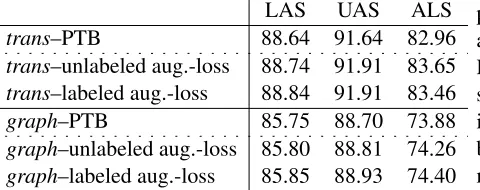
LAS UAS ALS
trans–PTB 88.64 91.64 82.96
trans–unlabeled aug.-loss 88.74 91.91 83.65
trans–labeled aug.-loss 88.84 91.91 83.46
graph–PTB 85.75 88.70 73.88
graph–unlabeled aug.-loss 85.80 88.81 74.26
[image:8.612.75.315.73.168.2]graph–labeled aug.-loss 85.85 88.93 74.40
Table 3: Results for both parsers on the development set of the PTB. When training with ALS (labeled and unla-beled), we see an improvement in UAS, LAS, and ALS. Furthermore, if we use a labeled-ALS as the metric for augmented-loss training, we also see a considerable in-crease in LAS.
like information extraction (Yates and Etzioni, 2009) and textual entailment (Berant et al., 2010).
In Table 3 we show results for parsing with the ALS augmented-loss objective. For each parser, we consider two different ALS objective functions; one based on unALS and the other on labeled-ALS. The arc-length score penalizes incorrect long-distance dependencies more than local dependen-cies; long-distance dependencies are often more de-structive in preserving sentence meaning and can be more difficult to predict correctly due to the larger context on which they depend. Combining this with the standard attachment scores biases training to fo-cus on the difficult head dependencies.
For both experiments we see that by adding the ALS augmented-loss we achieve an improvement in LAS and UAS in addition to ALS. The augmented-loss not only helps us improve on the longer depen-dencies (as reflected in the increased ALS), but also in the main parser objective function of LAS and UAS. Using the labeled loss function provides better reinforcement as can be seen in the improvements over the unlabeled loss-function. As with all experi-ments in this paper, the graph-based parser baselines are much lower than the transition-based parser due to the use of arc-factored features. In these experi-ments we used an inline-ranker loss with 8 parses. We experimented with larger sizes (16 and 64) and found very similar improvements: for example, the transition parser’s LAS for the labeled loss is 88.68 and 88.84, respectively).
We note that ALS can be decomposed locally and could be used as the primary objective function for
parsing. A parse with perfect scores under ALS and LAS will match the gold-standard training tree. However, if we were to order incorrect parses of a sentence, ALS and LAS will suggest different order-ings. Our results show that by optimizing for losses based on a combination of these metrics we train a more robust parsing model.
5 Related Work
A recent study by Katz-Brown et al. (2011) also in-vestigates the task of training parsers to improve MT reordering. In that work, a parser is used to first parse a set of manually reordered sentences to pro-ducek-best lists. The parse with the best reordering score is then fixed and added back to the training set and a new parser is trained on resulting data. The method is calledtargeted self-trainingas it is simi-lar in vein to self-training (McClosky et al., 2006), with the exception that the new parse data is targeted to produce accurate word reorderings. Our method differs as it does not statically fix a new parse, but dynamically updates the parameters and parse selec-tion by incorporating the addiselec-tional loss in the inner loop of online learning. This allows us to give guar-antees of convergence. Furthermore, we also evalu-ate the method on alternevalu-ate extrinsic loss functions.
Liang et al. (2006) presented a perceptron-based algorithm for learning the phrase-translation param-eters in a statistical machine translation system. Similar to the inline-ranker loss function presented here, they use ak-best lists of hypotheses in order to
identify parameters which can improve a global ob-jective function: BLEU score. In their work, they are interested in learning a parameterization over translation phrases (including the underlying word-alignment) which optimizes the BLEU score. Their goal is considerably different; they want to incor-porate additional features into their model and de-fine an objective function which allows them to do so; whereas, we are interested in allowing for mul-tiple objective functions in order to adapt the parser model parameters to downstream tasks or alternative intrinsic (parsing) objectives.
the addition of constraints based on unlabeled data (what we call extrinsic datasets). For each unla-beled example, they use the current model along with their set of constraints to select a set of k
au-tomatically labeled examples which best meet the constraints. These induced examples are then added to their training set and, after processing each unla-beled dataset, they perform full model optimization with the concatenation of training data and newly generated training items. The augmented-loss al-gorithm can be viewed as an online version of this algorithm which performs model updates based on the augmented-loss functions directly (rather than adding a set of examples to the training set). Un-like the CODL approach, we do not perform com-plete optimization on each iteration over the unla-beled dataset; rather, we incorporate the updates in our online learning algorithm. As mentioned earlier, CODL is one example of learning algorithms that use weak supervision, others include Mann and Mc-Callum (2010) and Ganchev et al. (2010). Again, these works are typically interested in using the ex-trinsic metric – or, in general, exex-trinsic information – to optimize the intrinsic metric in the absence of any labeled intrinsic data. Our goal is to optimize both simultaneously.
The idea of jointly training parsers to optimize multiple objectives is related to joint learning and in-ference for tasks like information extraction (Finkel and Manning, 2009) and machine translation (Bur-kett et al., 2010). In such works, a large search space that covers both the space of parse structures and the space of task-specific structures is defined and parameterized so that standard learning and infer-ence algorithms can be applied. What sets our work apart is that there is still just a single parameter set that is being optimized – the parser parameters. Our method only uses feedback from task specific objec-tives in order to update the parser parameters, guid-ing it towards better downstream performance. This is advantageous for two reasons. First, it decouples the tasks, making inference and learning more effi-cient. Second, it does not force arbitrary paraemter factorizations in order to define a joint search space that can be searched efficiently.
Finally, augmented-loss training can be viewed as multi-task learning (Caruana, 1997) as the model optimizes multiple objectives over multiple data sets
with a shared underlying parameter space.
6 Discussion
The empirical results show that incorporating an augmented-loss using the inline-ranker loss frame-work achieves better performance under metrics as-sociated with the external loss function. For the in-trinsic loss, we see that the augmented-loss frame-work can also result in an improvement in parsing performance; however, in the case of ALS, this is due to the fact that the loss function is very closely related to the standard evaluation metrics of UAS and LAS.
Although our analysis suggests that this algorithm is guaranteed to converge only for the separable case, it makes a further assumption that if there is a better parse under the augmented-loss, then there must be a lower cost parse in thek-best list. The
em-pirical evaluation presented here is based on a very conservative approximation by choosing lists with at most 8 parses. However, in our experiments, we found that increasing the size of the lists did not sig-nificantly increase our accuracy under the external metrics. If we do have at least one improvement in ourk-best lists, the analysis suggests that this is
enough to move in the correct direction for updating the model. The assumption that there will always be an improvement in thek-best list if there is some
better parse breaks down as training continues. We suspect that an increasing k, as suggested in
Sec-tion 2.3, will allow for continued improvements. Dependency parsing, as presented in this pa-per, is performed over (k-best) part-of-speech tags and is therefore dependent on the quality of the tagger. The experiments presented in this paper made use of a tagger trained on the source treebank data which severely limits the variation in parses. The augmented-loss perceptron algorithm presented here can be applied to any online learning prob-lem, including part-of-speech tagger training. To build a dependency parser which is better adapted to a downstream task, one would want to perform augmented-loss training on the tagger as well.
7 Conclusion
additional loss functions to adapt the model towards extrinsic evaluation metrics. Analytical results are presented that show that the algorithm can opti-mize multiple objective functions simultaneously. We present an empirical analysis for training depen-dency parsers for multiple parsing algorithms and multiple loss functions.
The augmented-loss framework supports both in-trinsic and exin-trinsic losses, allowing for both com-binations of objectives as well as multiple sources of data for which the results of a parser can be eval-uated. This flexibility makes it possible to tune a model for a downstream task. The only requirement is a metric which can be defined over parses of the downstream data. Our dependency parsing results show that we are not limited to increasing parser performance via more data or external domain adap-tation techniques, but that we can incorporate the downstream task into parser training.
Acknowledgements: We would like to thank Kuz-man Ganchev for feedback on an earlier draft of this paper as well as Slav Petrov for frequent discussions on this topic.
References
S. Banerjee and A. Lavie. 2005. METEOR: An auto-matic metric for MT evaluation with improved corre-lation with human judgments. InProceedings of the ACL Workshop on Intrinsic and Extrinsic Evaluation Measures for Machine Translation and/or Summariza-tion.
J. Berant, I. Dagan, and J. Goldberger. 2010. Global learning of focused entailment graphs. In Proc. of ACL.
J. Blitzer, R. McDonald, and F. Pereira. 2006. Domain adaptation with structural correspondence learning. In
Proc. of EMNLP.
S. Buchholz and E. Marsi. 2006. CoNLL-X shared task on multilingual dependency parsing. InProc. of CoNLL.
D. Burkett, J. Blitzer, and D. Klein. 2010. Joint parsing and alignment with weakly synchronized grammars. InProc. of NAACL.
R. Caruana. 1997. Multitask learning. Machine Learn-ing, 28(1):41–75.
M.W. Chang, L. Ratinov, and D. Roth. 2007. Guiding semi-supervision with constraint-driven learning. In
Proc. of ACL.
M. Chang, D. Goldwasser, D. Roth, and V. Srikumar. 2010. Structured output learning with indirect super-vision. InProc. of ICML.
M. Collins, P. Koehn, and I. Kuˇcerov´a. 2005. Clause re-structuring for statistical machine translation. InProc. of ACL.
Michael Collins. 2000. Discriminative reranking for nat-ural language parsing. InProc. of ICML.
M. Collins. 2002. Discriminative training methods for hidden markov models: Theory and experiments with perceptron algorithms. InProc. of ACL.
M.C. de Marneffe, B. MacCartney, and C. Manning. 2006. Generating typed dependency parses from phrase structure parses. In Proc. of LREC, Genoa, Italy.
J.R. Finkel and C.D. Manning. 2009. Joint parsing and named entity recognition. InProc. of NAACL. K. Ganchev, J. Grac¸a, J. Gillenwater, and B. Taskar.
2010. Posterior regularization for structured latent variable models. Journal of Machine Learning Re-search.
D. Gildea. 2001. Corpus variation and parser perfor-mance. InProc. of EMNLP.
K. Hall. 2007. k-best spanning tree parsing. InProc. of ACL, June.
J. Judge, A. Cahill, and J. Van Genabith. 2006. Question-bank: Creating a corpus of parse-annotated questions. InProc. of ACL, pages 497–504.
J. Katz-Brown, S. Petrov, R. McDonald, D. Talbot, F. Och, H. Ichikawa, M. Seno, and H. Kazawa. 2011. Training a parser for machine translation reordering. InProc. of EMNLP.
S. K¨ubler, R. McDonald, and J. Nivre. 2009. Depen-dency parsing. Synthesis Lectures on Human Lan-guage Technologies. Morgan & Claypool Publishers. P. Liang, A. Bouchard-Ct, D. Klein, and B. Taskar. 2006.
An end-to-end discriminative approach to machine translation. InProc. of COLING/ACL.
G.S. Mann and A. McCallum. 2010. Generalized Ex-pectation Criteria for Semi-Supervised Learning with Weakly Labeled Data. The Journal of Machine Learn-ing Research, 11:955–984.
M. Marcus, B. Santorini, and M.A. Marcinkiewicz. 1993. Building a large annotated corpus of en-glish: The penn treebank. Computational Linguistics, 19:313–330.
D. McClosky, E. Charniak, and M. Johnson. 2006. Reranking and self-training for parser adaptation. In
Proc. of ACL.
R. McDonald and J. Nivre. 2007. Characterizing the errors of data-driven dependency parsing models. In
R. McDonald, K. Crammer, and F. Pereira. 2005. Online large-margin training of dependency parsers. InProc. of ACL.
T. Nakagawa, K. Inui, and S. Kurohashi. 2010. De-pendency tree-based sentiment classification using crfs with hidden variables. InProc. of NAACL.
J. Nivre. 2008. Algorithms for deterministic incremen-tal dependency parsing. Computational Linguistics, 34(4):513–553.
S. Petrov, P.C. Chang, M. Ringgaard, and H. Alshawi. 2010. Uptraining for accurate deterministic question parsing. InProc. of EMNLP, pages 705–713.
D. Talbot, H. Kazawa, H. Ichikawa, J. Katz-Brown, M. Seno, and F. Och. 2011. A lightweight evalu-ation framework for machine translevalu-ation reordering. InProc. of the Sixth Workshop on Statistical Machine Translation.
M. Wang, N.A. Smith, and T. Mitamura. 2007. What is the Jeopardy model? A quasi-synchronous grammar for QA. InProc. of EMNLP-CoNLL.
P. Xu, J. Kang, M. Ringgaard, and F. Och. 2009. Us-ing a dependency parser to improve SMT for Subject-Object-Verb languages. InProc. of NAACL.
A. Yates and O. Etzioni. 2009. Unsupervised meth-ods for determining object and relation synonyms on the web. Journal of Artificial Intelligence Research, 34(1):255–296.
Y. Zhang and S. Clark. 2008. A Tale of Two