Joint Inference for Knowledge Base Population
Liwei Chen1, Yansong Feng1∗, Jinghui Mo1, Songfang Huang2, and Dongyan Zhao1 1ICST, Peking University, Beijing, China
2IBM China Research Lab, Beijing, China
{chenliwei,fengyansong,mojinghui,zhaodongyan}@pku.edu.cn
Abstract
Populating Knowledge Base (KB) with new knowledge facts from reliable text re-sources usually consists of linking name mentions to KB entities and identifying relationship between entity pairs. How-ever, the task often suffers from errors propagating from upstream entity linkers to downstream relation extractors. In this paper, we propose a novel joint infer-ence framework to allow interactions be-tween the two subtasks and find an opti-mal assignment by addressing the coher-ence among preliminary local predictions: whether the types of entities meet the ex-pectations of relations explicitly or implic-itly, and whether the local predictions are globally compatible. We further measure the confidence of the extracted triples by looking at the details of the complete ex-traction process. Experiments show that the proposed framework can significantly reduce the error propagations thus obtain more reliable facts, and outperforms com-petitive baselines with state-of-the-art re-lation extraction models.
1 Introduction
Recent advances in natural language processing have made it possible to construct structured KBs from online encyclopedia resources, at an un-precedented scale and much more efficiently than traditional manual edit. However, in those KBs, entities which are popular to the community usu-ally contain more knowledge facts, e.g., the bas-ketball player LeBron James, the actor Nicholas Cage, etc., while most other entities often have fewer facts. On the other hand, knowledge facts should be updated as the development of entities, such as changes in the cabinet, a marriage event, or an acquisition between two companies, etc.
In order to address the above issues, we could consult populating existing KBs from reliable text resources, e.g., newswire, which usually involves enriching KBs with new entities and populating KBs with new knowledge facts, in the form of <Entity, Relation, Entity>triple. In this paper, we will focus on the latter, identifying relationship be-tween two existing KB entities. This task can be intuitively considered in a pipeline paradigm, that is, name mentions in the texts are first linked to entities in the KB (entity linking, EL), and then the relationship between them are identified (re-lation extraction, RE). It is worth mentioning that the first task EL is different from the task of named entity recognition (NER) in traditional informa-tion extracinforma-tion (IE) tasks, where NER recognizes and classifies the entity mentions (to several pre-defined types) in the texts, but EL focuses on link-ing the mentions to their correspondlink-ing entities in the KB. Such pipeline systems often suffer from errors propagating from upstream to downstream, since only the local best results are selected to the next step. One idea to solve the problem is to allow interactions among the local predictions of both subtasks and jointly select an optimal assignment to eliminate possible errors in the pipeline.
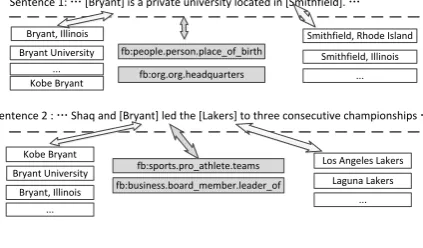
Let us first look at an example. Suppose we are extracting knowledge facts from two sentences in Figure 1: in sentence [1], if we are more confi-dent to extract the relation fb:org.headquarters1,
we will be then prompted to selectBryant Univer-sity, which indeed favors the RE prediction that requires an organization to be its subject. On the other side, if we are sure to link to Kobe Bryant in sentence [2], we will probably select fb:pro athlete.teams, whose subject position ex-pects an athlete, e.g., an NBA player. It is not dif-ficult to see that the argument type expectations of relations can encourage the two subtasks interact with each other and select coherent predictions for
1The prefixfbmeans the relations are defined in Freebase.
Sentence 1: … [Bryant] is a private university located in [Smithfield]. …
Sentence 2 : … Shaq and [Bryant] led the [Lakers] to three consecutive championships … Bryant, Illinois
fb:people.person.place_of_birth
fb:sports.pro_athlete.teams fb:org.org.headquarters
fb:business.board_member.leader_of Bryant University
... Kobe Bryant
Kobe Bryant Bryant University
Bryant, Illinois ...
Smithfield, Rhode Island Smithfield, Illinois
...
Los Angeles Lakers Laguna Lakers
[image:2.595.80.292.68.192.2]...
Figure 1: Two example sentences from which we can harvest knowledge facts.
both of them. In KBs with well-defined schemas, such as Freebase, type requirements can be col-lected and utilized explicitly (Yao et al., 2010). However, in other KBs with less reliable or even no schemas, it is more appropriate to implicitly capture the type expectations for a given relation (Riedel et al., 2013).
Furthermore, previous RE approaches usually process each triple individually, which ignores whether those local predictions are compatible with each other. For example, suppose the local predictions of the two sentences above are<Kobe Bryant, fb:org.headquarters, Smithfield, Rhode Is-land> and <Kobe Bryant, fb:pro athlete.teams, Los Angeles Lakers>, respectively, which, in fact, disagree with each other with respect to the KB, since, in most cases, these two relations cannot share subjects. Now we can see that either the re-lation predictions or the EL results for “Bryant” are incorrect. Those disagreements provide us an effective way to remove the possible incorrect pre-dictions that cause the incompatibilities.
On the other hand, the automatically extracted knowledge facts inevitably contain errors, espe-cially for those triples collected from open do-main. Extractions with confidence scores will be more than useful for users to make proper deci-sions according to their requirements, such as trad-ing recall for precision, or supporttrad-ing approximate queries.
In this paper, we propose a joint framework to populate an existing KB with new knowledge facts extracted from reliable text resources. The joint framework is designed to address the error propa-gation issue in a pipeline system, where subtasks are optimized in isolation and locally. We find an optimal configuration from top k results of both subtasks, which maximizes the scores of each step,
fulfills the argument type expectations of relations, which can be captured explicitly or implicitly, in the KB, and avoids globally incoherent predic-tions. We formulate this optimization problem in an Integer Linear Program (ILP) framework, and further adopt a logistic regression model to mea-sure the reliability of the whole process, and assign confidences to all extracted triples to facilitate fur-ther applications. The experiments on a real-world case study show that our framework can elimi-nate error propagations in the pipeline systems by taking relations’ argument type expectations and global compatibilities into account, thus outper-forms the pipeline approaches based on state-of-the-art relation extractors by a large margin. Fur-thermore, we investigate both explicit and implicit type clues for relations, and provide suggestions about which to choose according to the character-istics of existing KBs. Additionally, our proposed confidence estimations can help to achieve a pre-cision of over 85% for a considerable amount of high quality extractions.
In the rest of the paper, we first review related work and then define the knowledge base popula-tion task that we will address in this paper. Next we detail the proposed framework and present our experiments and results. Finally, we conclude this paper with future directions.
2 Related Work
Knowledge base population (KBP), the task of ex-tending existing KBs with entities and relations, has been studied in the TAC-KBP evaluations (Ji et al., 2011), containing three tasks. The entity link-ing task links entity mentions to existlink-ing KB nodes and creates new nodes for the entities absent in the current KBs, which can be considered as a kind of entity population (Dredze et al., 2010; Tamang et al., 2012; Cassidy et al., 2011). The slot-filling task populates new relations to the KB (Tamang et al., 2012; Roth et al., 2012; Liu and Zhao, 2012), but the relations are limited to a predefined sets of attributes according to the types of enti-ties. In contrast, our RE models only require min-imal supervision and do not need well-annotated training data. Our framework is therefore easy to adapt to new scenarios and suits real-world appli-cations. The cold-start task aims at constructing a KB from scratch in a slot-filling style (Sun et al., 2012; Monahan and Carpenter, 2012).
re-lated tasks. Many EL models explore local con-texts of entity mentions to measure the similarity between mentions and candidate entities (Han et al., 2011; Han and Sun, 2011; Ratinov et al., 2011; Cheng and Roth, 2013). Some methods further ex-ploit global coherence among candidate entities in the same document by assuming that these enti-ties should be closely related (Han et al., 2011; Ratinov et al., 2011; Sen, 2012; Cheng and Roth, 2013). There are also some approaches regarding entity linking as a ranking task (Zhou et al., 2010; Chen and Ji, 2011). Lin et al. (2012) propose an approach to detect and type entities that are cur-rently not in the KB.
Note that the EL task in KBP is different from the name entity mention extraction task, mainly in the ACE task style, which mainly identifies the boundaries and types of entity mentions and does not explicitly link entity mentions into a KB (ACE, 2004; Florian et al., 2006; Florian et al., 2010; Li and Ji, 2014), thus are different from our work.
Meanwhile, relation extraction has also been studied extensively in recent years, ranging from supervised learning methods (ACE, 2004; Zhao and Grishman, 2005; Li and Ji, 2014) to unsuper-vised open extractions (Fader et al., 2011; Carl-son et al., 2010). There are also models, with dis-tant supervision (DS), utilizing reliable texts re-sources and existing KBs to predict relations for a large amount of texts (Mintz et al., 2009; Riedel et al., 2010; Hoffmann et al., 2011; Surdeanu et al., 2012). These distantly supervised models can ex-tract relations from texts in open domain, and do not need much human involvement. Hence, DS is more suitable for our task compared to other tradi-tional RE approaches.
Joint inference over multiple local models has been applied to many NLP tasks. Our task is dif-ferent from the traditional joint IE works based in the ACE framework (Singh et al., 2013; Li and Ji, 2014; Kate and Mooney, 2010), which jointly extract and/or classify named entity mentions to several predefined types in a sentence and iden-tify in a sentence level which relation this specific sentence describes (between a pair of entity men-tions in this sentence). Li and Ji (2014) follow the ACE task definitions and present a neat incre-mental joint framework to simultaneously extract entity mentions and relations by structure percep-tron. In contrast, we link entity mentions from a text corpus to their corresponding entities in an
ex-isting KB and identify the relations between pairs of entities based on that text corpus. Choi et al. (2006) jointly extracts the expressions and sources of opinion as well as the linking relations (i.e., a source entity expresses an opinion expression) be-tween them, while we focus on jointly modeling EL and RE in open domain, which is a different and challenging task.
Since the automatically extracted knowledge facts inevitably contain errors, many approaches manage to assign confidences for those extracted facts (Fader et al., 2011; Wick et al., 2013). Wick et al. (2013) also point out that confidence estima-tion should be a crucial part in the automated KB constructions and will play a key role for the wide applications of automatically built KBs. We thus propose to model the reliability of the complete extraction process and take the argument type ex-pectations of the relation, coherence with other predictions and the triples in the existing KB into account for each populated triple.
3 Task definition
We formalize our task as follows. Given a set of entities sampled from an existing KB, E = {e1, e2, ..., e|E|}, a set of canonicalized relations
from the same KB, R = {r1, r2, ..., r|R|}, a set
of sentences extracted from news corpus, SN = {sn1, sn2, ..., sn|SN|}, each contains two
men-tionsm1 andm2 whose candidate entities belong
toE, a set of text fragmentsT ={t1, t2, ..., t|T |},
whereticontains its corresponding target sentence
sniand acts as its context. Our task is to link those
mentions to entities in the given KB, identify the relationship between entity pairs and populate new knowledge facts into the KB.
4 The Framework
cor-Sentence 1: … [Bryant] is a private university located in [Smithfield]. …
Sentence 2: … Shaq and [Bryant] led the [Lakers] to three consecutive championships from 2000 to 2002. …
Bryant, Illinois
fb:people.place_of_birth
fb:pro_athlete.teams fb:org.headquarters
fb:business.leader_of
Bryant University
...
Kobe Bryant
Kobe Bryant
Bryant University
Bryant, Illinois
...
Smithfield, Rhode Island
Smithfield, Illinois
...
Los Angeles Lakers
Laguna Lakers
...
[image:4.595.147.454.77.273.2]Disagreement!
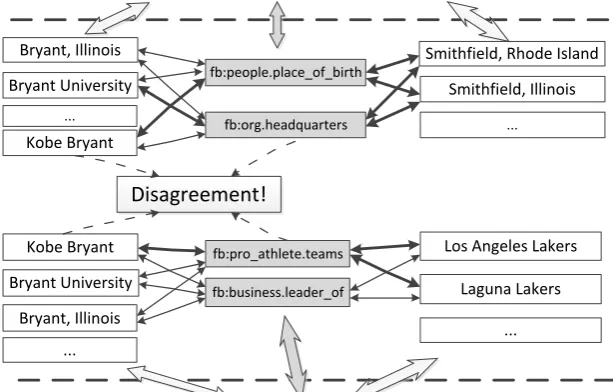
Figure 2: An example of our joint inference framework. The top and bottom are two example sentences with entity mentions in the square brackets, candidate entities in the white boxes, candidate relations in the grey boxes, and the solid lines with arrows between relations and entities represent their preference scores, with thickness indicating the preferences’ value.
rect relations for an entity pair. Thus, after finding an optimal sentence-level assignment, we aggre-gate those local predictions by ORing them into the entity pair level. Finally, we employ a regres-sion model to capture the reliability of the com-plete extraction process.
4.1 Preliminary Models
Entity Linking The preliminary EL model can be any approach which outputs a score for each entity candidate. Note that a recall-oriented model will be more than welcome, since we expect to in-troduce more potentially correct local predictions into the inference step. In this paper, we adopt an unsupervised approach in (Han et al., 2011) to avoid preparing training data. Note the chal-lenging NIL problem, i.e., identifying which en-tity mentions do not have corresponding entities in the KB (labeled as NIL) and clustering those mentions, will be our future work. For each men-tion we retain the entities with toppscores for the succeeding inference step.
Relation Extraction The choice of RE model is also broad. Any sentence level extractor whose results are easy to be aggregated to entity pair level can be utilized here (again, a recall-oriented version will be welcome), such as Mintz++
men-tioned in (Surdeanu et al., 2012), which we adapt into a Maximum Entropy version. We also include a special label, NA, to represent the case where there is no predefined relationship between an en-tity pair. For each sentence, we retain the relations with top q scores for the inference step, and we also call that this sentence supportsthose candi-date relations. As for the features of RE models, we use the same features (lexical features and syn-tactic features) with the previous works (Chen et al., 2014; Mintz et al., 2009; Riedel et al., 2010; Hoffmann et al., 2011).
4.2 Relations’ Expectations for Argument Types
In most KBs’ schemas, canonicalized relations are designed to expect specific types of entities to be their arguments. For example, in Figure 2, it is more likely that an entityKobe Bryant takes the subject position of a relationfb:pro athlete.teams, but it is unlikely for this entity to take the subject position of a relationfb:org.headquarters. Making use of these type requirements can encourage the framework to select relation and entity candidates which are coherent with each other, and discard incoherent choices.
the entities inE and the relations inR, we gener-ate two matrices with |E|rows and|R|columns, whose elementsspijindicates the preference score
of entityiand relationj. The matrixSsubj is for
relations and their subjects, and the matrixSobjis
for relations and their objects. We initialize the two matrices using the KB as follows: for entityi and relationj, if relationjtakes entityias its sub-ject/object in the KB, the element at the position
(i, j) of the corresponding matrix will be 1, oth-erwise it will be 0. Note that in our experiments, we do not count the triples that are evaluated in the testing data, to build the matrices. Now the prob-lem is how we can obtain the unknown eprob-lements in the matrices.
Explicit Type Information Intuitively, we should examine whether the explicit types of the entities fulfill the expectations of relations in the KB. For each unknown element Ssubj(i, j), we
first obtain the type of entityi, which is collected from the lowest level of the KB’s type hierarchy, and examine whether there is another entity with the same type taking the subject position of relation j in the initial matrix. If such an entity exists, Ssubj(i, j) = 1, otherwise 0. For
example, for the subjectJay Fletcher Vincent and the relation fb:pro athlete.teams, we first obtain the subject’s typebasketball player, and then we go through the initial matrix and find another entity Kobe Bryant with the same type taking the subject position of fb:pro athlete.teams, indicating thatJay Fletcher Vincent may take the relation fb:pro athlete.teams. The matrix Sobj is
processed in the same way.
Implicit Type Expectations In practice, few KBs have well-defined schemas. In order to make our framework more flexible, we need to come up with an approach to implicitly capture the rela-tions’ type expectations, which will also be rep-resented as preference scores.
Inspired by Riedel et al. (2013) who use a ma-trix factorization approach to capture the associa-tion between textual patterns, relaassocia-tions and entities based on large text corpora, we adopt a collabora-tive filtering (CF) method to compute the prefer-ence scores between entities and relations based on the statistics obtained from an existing KB.
In CF, the preferences between customers and items are calculated via matrix factorization over the initial customer-item matrix. In our
frame-work, we compute the preference scores between entities and relations via the same approach over the two initialized matrices Ssubj and Sobj,
re-sulting in two entity-relation matrices with esti-mated preference values. We use ALS-WR (Zhou et al., 2008) to process the matrices and compute the preference of a relation taking an entity as its subject and object, respectively. We normalize the preference scores of each entity using their means µand standard deviationsσ.
4.3 Compatibilities among Predicted Triples The second aspect we investigate is whether the extracted triples are compatible with respect to all other knowledge facts. For example, according to the KB, the two relationsfb:org.headquartersand fb:pro athlete.teamsin Figure 2 cannot share the same entity as their subjects. So if such sharing happens, that will indicate either the predictions of the relations or the entities are incorrect. The clues can be roughly grouped into three categories, namely whether two relations can share the same subjects, whether two relations can share the same objects, and whether one relation’s subject can be the other relation’s object.
Global compatibilities among local predictions have been investigated by several joint models (Li et al., 2011; Li and Ji, 2014; Chen et al., 2014) to eliminate the errors propagating in a pipeline sys-tem. Specifically, Chen et al. (2014) utilized the clues with respect to the compatibilities of rela-tions in the task of relation extraction. Following (Li et al., 2011; Chen et al., 2014), we extend the idea of global compatibilities to the entity and re-lation predictions during knowledge base popula-tion. We examine the pointwise mutual informa-tion (PMI) between the argument sets of two re-lations to collect such clues. For example, if we want to learn whether two relations can share the same subject, we first collect the subject sets of both relations from the KB, and then compute the PMI value between them. If the value is lower than a certain threshold (set to -3 in this paper), the clue thatthe two relations cannot share the same subject is added. These clues can be easily inte-grated into an optimization framework in the form of constraints.
candi-date entityeof mentionmin text fragmentt, we define a boolean decision variabledm,et , which de-notes whether this entity is selected into the final configuration or not. Similarly, for each candidate relationr of fragment t, we define a boolean de-cision variabledr
t. In order to introduce the
pref-erence scores into the model, we also need a deci-sion variable dr,m,et , which denotes whether both relationrand candidate entityeof mentionmare selected int.
We usest,m,eel to represent the score of mention mintdisambiguated to entitye, which is output by the EL model,st,r
re representing the score of
re-lation r assigned tot, which is output by the RE model, sr,e
p the explicit/implicit preference score
between relationrand entitye.
Our goal is to find the best assignment to the variablesdr
t anddm,et , such that it maximizes the
overall scores of the two subtasks and the co-herence among the preliminary predictions, while satisfying the constraints between the predicted triples as well. Our objective function can be writ-ten as:
maxel×confent+re×confrel+sp×cohe−r (1) whereel, reandspare three weighting parameters tuned on development set. confent is the overall
score of entity linking:
confent =X t
X
m∈M(t)
X
e∈Ce(m)
st,m,eel dm,et (2)
whereM(t)is the set of mentions int,Ce(m)is
the candidate entity set of the mentionm.confrel
represents the overall score of relation extraction:
confrel=X t
X
r∈Cr(t)
st,rredrt (3)
whereCr(t)is the set of candidate relations int.
cohe−ris the coherence between the candidate
re-lations and entities in the framework:
cohe−r =X t
X
r∈Cr(t)
X
m∈M(t)
X
e∈Ce(m)
sr,ep dr,m,et (4)
Now we describe the constraints used in our ILP problem. The first kind of constraints is intro-duced to ensure that each mention should be dis-ambiguated to only one entity:
∀t,∀m∈M(t), X
e∈Ce(m)
dm,et ≤1 (5)
The second type of constraints ensure that each en-tity mention pair in one sentence can only take one relation label:
∀t, X
r∈Cr(t)
dtr ≤1 (6)
The third is introduced to ensure the decision vari-abledr,m,et equals 1 if and only if both the corre-sponding variablesdr
t anddm,et equal 1.
∀t,∀r∈Cr(t),∀m∈M(t),∀e∈Ce(m)
dr,m,et ≤drt (7) dr,m,et ≤dm,et (8) dr
t +dm,et ≤dr,m,et + 1 (9)
As for the compatibility constraints, we need to introduce another type of boolean decision vari-ables. If a mentionm1int1 and another mention
m2int2share an entity candidatee, we add a
vari-ableyfor this mention pair, which equals 1 if and only if bothdm1,e
t1 andd
m2,e
t2 equal 1. So we add the following constraints for each mention pairm1
andm2satisfies the previous condition:
y≤dm1,e
t1 (10) y≤dm2,e
t2 (11) dm1,e
t1 +dmt22,e ≤y+ 1 (12)
Then we further add the following constraints for each mention pair to avoid incompatible predic-tions:
∀r1 ∈Cr(t1), r2 ∈Cr(t2)
If(r1, r2)∈ Csr, p(m1) =subj, p(m2) =subj
dr1
t1 +drt22 +y≤2(13) If(r1, r2)∈ Cro, p(m1) =obj, p(m2) =obj
dr1
t1 +drt22 +y≤2(14) If(r1, r2)∈ Csro, p(m1) =obj, p(m2) =subj
dr1
t1 +drt22 +y≤2(15)
wherep(m)returns the position of mentionm, ei-thersubj(subject) orobj(object).Csris the pairs
of relations which cannot share the same subject,
Crois the pairs of relations which cannot share the
same object,Csrois the pairs of relations in which
one relation’s subject cannot be the other one’s ob-ject.
We use IBM ILOG Cplex2 to solve the above
ILP problem.
Table 1: The features used to calculate the confi-dence scores.
Type Feature
Real The RE score of the relation. Real The EL score of the subject. Real The EL score of the object.
Real The preference score between the relationand the subject. Real The preference score between the relationand the object. Real The ratio of the highest and the second highestrelation score in this entity pair. Real The ratio of the current relation score and themaximum relation score in this entity pair.
Real The ratio of the number of sentences supportingthe current relation and the total number of sentences in this entity pair.
Real Whether the extracted triple is coherent with the KBaccording to the constraints in Section 4.3.
4.5 Confidence Estimation for Extracted Triples
The automatically extracted triples inevitably con-tain errors and are often considered as with high recall but low precision. Since our aim is to pop-ulate the extracted triples into an existing KB, which requires highly reliable knowledge facts, we need a measure of confidence for those ex-tracted triples, so that others can properly utilize them.
Here, we use a logistic regression model to mea-sure the reliability of the process, how the entities are disambiguated, how the relationships are iden-tified, and whether those predictions are compat-ible. The features we used are listed in Table 1, which are all efficiently computable and indepen-dent from specific relations or entities. We manu-ally annotate 1000 triples as correct or incorrect to prepare the training data.
5 Experiments
We evaluate the proposed framework in a real-world scenario: given a set of news texts with en-tity mentions and a KB, a model should find more and accurate new knowledge facts between pairs of those entities.
5.1 Dataset
We use New York Times dataset from 2005 to 2007 as the text corpus, and Freebase as the KB. We divide the corpus into two equal parts, one for creating training data for the RE models using the distant supervision strategy (we do not need train-ing data for EL), and the other as the testtrain-ing data.
For the convenience of experimentation, we ran-domly sample a subset of entities for testing. We first collect all sentences containing two mentions which may refer to the sampled entities, and prune them according to: (1)there should be no more than 10 words between the two mentions; (2)the prior probability of the mention referring to the target entity is higher than a threshold (set to 0.1 in this paper), which is set to filter the impossi-ble mappings; (3)the mention pairs should not be-long to different clauses. The resulting test set is split into 10 parts and a development set, each with 3500 entity pairs roughly, which leads to averagely 200,000 variables and 900,000 constraints per split and may take 1 hour for Cplex to solve. Note that we do not count the triples that will be evaluated in the testing data when we learn the preferences and the clues from the KB.
5.2 Experimental Setup
We compare our framework with three baselines. The first one,ME-pl, is the pipeline system con-structed by the entity linker in (Han et al., 2011) and the MaxEnt version of Mintz++ extractor mentioned in (Surdeanu et al., 2012). The sec-ond and third baselines are the pipeline systems constructed by the same linker and two state-of-the-art DS approaches, MultiR (Hoffmann et al., 2011) and MIML-RE (Surdeanu et al., 2012), re-spectively. They are referred to asMultiR-pland MIML-plin the rest of this paper.
We also implement several variants of our framework to investigate the following two com-ponents in our framework: whether to use ex-plicit (E) or imex-plicit (I) argument type expecta-tions, whether to take global (G) compatibilities into account, resulting in four variants: ME-JE, ME-JI,ME-JEG,ME-JIG.
Table 2: The results of our joint frameworks and the three baselines.
Approach Precision NoC Top 50 Top 100
ME-pl 28.7±0.8 725±12 38±2 75±4 MultiR-pl 31.0±0.8 647±15 39±2 71±3 MIML-pl 33.2±0.6 608±16 40±3 74±5 ME-JE 32.8±0.7 768±10 46±2 90±3 ME-JEG 34.2±0.5 757±8 46±2 90±3 ME-JI 34.5±1.0 784±9 43±3 88±3 ME-JIG 35.7±1.0 772±8 43±3 88±4
Freebase to compute the precision, which may un-derestimate the performance since Freebase is in-complete. Since we do not have exact annotations for the EL, it is difficult to calculate the exact re-call. We therefore use NoC instead. We evalu-ate our framework on the 10 subsets of the testing dataset and compute their means and standard de-viations.
5.3 Overall Performance
We are interested to find out: (a)whether the task benefits from the joint inference i.e., can we col-lect more and correct facts? Or with a higher pre-cision? (b) whether the argument type expecta-tions (explicit and implicit) and global compati-bility do their jobs as we expected? And, how do we choose from these components ? (c)whether the framework can work with other RE models? (d)whether we can find a suitable approach to measure the confidence or uncertainty during the extraction so that users or other applications can better utilize the extracted KB facts?
Let us first look at the performance of the baselines and our framework in Table 2 for an overview. Comparing the three pipeline sys-tems, we can discover that using the same en-tity linker,MIML-plperforms the best in precision with slightly fewer correct triples, while ME-pl performs the worst. It is not surprising,ME-pl, as a strong and high-recall baseline, outputs the most correct triples. As for the results with high confi-dences, MultiR-ploutputs more correct triples in the top 50 results thanME-pl, and MIML-pl per-forms better or comparable than ME-pl in top n results.
After performing the joint inference, ME-JE improves ME-pl with 4.1% in precision and 43 more correct triples averagely, and results in bet-ter performance in topnresults. By taking global compatibilities into consideration, ME-JEG fur-ther improve the precision to 34.2% in average with slightly fewer correct triples, indicating that
0 100 200 300 400 500
0.4 0.5 0.6 0.7 0.8 0.9 1
Number of Correct Triples
Precision
ME−pl MultiR−pl MIML−pl ME−JEG ME−JIG
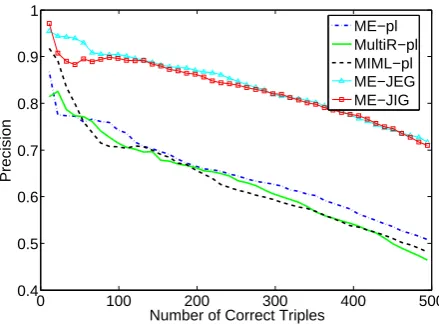
Figure 3: The numbers of correct triples v.s. the precisions for different approaches.
both argument type expectations and global com-patibilities are useful in improving the perfor-mance: argument type information can help to select the correct and coherent predictions from the candidates EL and RE outputs, while global compatibilities can further prune incorrect triples that cause disagreements, although a few correct ones may be incorrectly eliminated. We can also observe that ME-JIG performs even higher than ME-JEG in overall precision, but ME-JEG col-lects more correct triples thanME-JIGin the top n predictions, showing that explicit type expec-tations with more accurate type information may perform better in high confidence results.
Furthermore, even though MultiR-pl and MIML-pl are based on state-of-the-art RE ap-proaches, our model (for example, ME-JIG) can still outperform them in terms of all metrics, with 4.7% higher in precision than MultiR-pl, 2.5% higher thanMIML-pl. Our model can extract 125 more correct triples than MultiR-pl, 164 more thanMIML-pl, and perform better in topnresults as well.
In previous RE tasks, Precision-Recall curves are mostly used to evaluate the systems’ perfor-mances. In our task, since it is difficult to calculate the recall exactly, we use the number of correct triples instead, and plot curves of Precision-NoC to show the performance of the competitors and our approaches in more detail. For each value of NoC, the precision is the average of the ten splits of the testing dataset.
Table 3: The results of our joint frameworks with MultiR sentence extractor.
Approach Precision NoC Top 50 Top 100
MultiR-pl 31.0±0.8 647±15 39±2 71±3 MultiR-JEG 36.9±0.8 687±15 46±2 88±3 MultiR-JIG 38.5±0.9 700±15 45±2 88±3
the pipeline systems, indicating that our frame-work is more suitable for harvesting high quality knowledge facts. Comparing the two kinds of type clues, we can see that explicit ones perform better when the confidence control is high and the num-ber of correct triples is small, and then the two are comparable. Since the precision of the triples with high confidences is crucial for the task of KBP, we still suggest choosing the explicit ones when there is a well-defined schema available in the KB, although implicit type expectations can result in higher overall precision.
5.4 Adapting MultiR Sentence Extractor into the Framework
The preliminary relation extractor of our frame-work is not limited to the MaxEnt3 extractor. It
can be any sentence level recall-oriented relation extractors. To further investigate the generaliza-tion of our joint inference framework, we also try to fit other sentence level relation extractors into the framework. Considering that MIML-RE does not output sentence-level results, we only adapt MultiR, with both global compatibilities and explicit/implicit type expectations, named as MultiR-JEG andMultiR-JIG, respectively. Since the scores output by the original MultiR are un-normalized, which are difficult to directly apply to our framework, we normalize their scores and re-tune the framework’s parameters accordingly. The parameters are set tore= 1,el= 32,sp= 16.
As seen in Table 3, MultiR-JEG helps MultiR obtain about 40 more correct triples in average, and achieves 5.9% higher in precision, as well as significant improvements in topncorrect pre-dictions. As for MultiR-JIG, the improvements are 7.5% in precision and 53 in number of cor-rect triples. In terms of topnresults, the explicit and implicit type expectations perform compara-ble. We also observe that our framework improves MultiR as much as it does to MaxEnt, indicating our joint framework can generalize well in differ-ent RE models.
3http://homepages.inf.ed.ac.uk/
lzhang10/maxent_toolkit.html
0 100 200 300 400 500
0.4 0.6 0.8 1
Number of Correct Triples
Precision
[image:9.595.309.528.260.416.2]MultiR−pl MultiR−JEG MultiR−JIG
Figure 4: The numbers of correct triples v.s. the precisions for approaches with MultiR extractor.
0.5 0.6 0.7 0.8 0.9 1
0.3 0.4 0.5 0.6 0.7 0.8 0.9 1
Confidence Threshold
Precision
ME−pl MultiR−pl ME−JIG MultiR−JIG MIML−pl ME−JEG MultiR−JEG
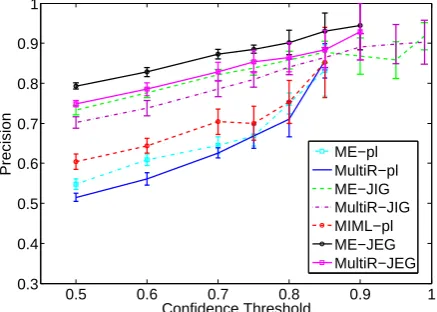
Figure 5: The precisions of different models un-der different confidence thresholds. The error bars represents the standard deviations of the results.
We further plot Precision-NoC curves for MultiR-JEG and MultiR-JIG in Figure 4, show-ing that our framework can result in better perfor-mance and smoother curves with MultiR extractor. It is interesting to see that with MultiR extractor, the two kinds of expectations perform comparably.
5.5 Results with Confidence Estimations Now, we will investigate the results from another perspective with the help of confidence estima-tions. We calculate the precisions of the competi-tors and our approaches on different confidence thresholds from 0.5 to 1. The results are summa-rized in Figure 5. Note that the results across dif-ferent approaches are not directly comparable, we put them in the same figure only to save space.
lower thresholds tend to result in estimations with smaller standard derivations due to those preci-sions are estimated over much more triples than those with higher thresholds, which means the ran-domness will be smaller.
On the other hand, our joint frameworks pro-vide more epro-vidences that can be used to well cap-ture the reliability of an extraction. For example, the precisions ofMultir-JIGandME-JIGboth stay around 85% when the confidence is higher than 0.85, with about 120 correct triples, indicating that by setting a proper threshold, we can obtain con-siderable amount of high quality knowledge facts at an acceptable precision, which is crucial for KBP. However, we cannot harvest such amount of high quality knowledge facts from the other three pipeline systems.
6 Conclusions
In this paper, we propose a joint framework for the task of populating KBs with new knowledge facts, which performs joint inference on two subtasks, maximizes their preliminary scores, fulfills the type expectations of relations and avoids global incompatibilities with respect to all local predic-tions to find an optimal assignment. Experimen-tal results show that our framework can signifi-cantly eliminate the error propagations in pipeline systems and outperforms competitive pipeline sys-tems with state-of-the-art RE models. Regard-ing the explicit argument type expectations and the implicit ones, the latter can result in a higher overall precision, while the former performs bet-ter in acquiring high quality knowledge facts with higher confidence control, indicating that if the KB has a well-defined schema we can use explicit type requirements for the KBP task, and if not, our model can still perform well by mining the implicit ones. Our framework can also generalize well with other preliminary RE models. Further-more, we assign extraction confidences to all ex-tracted facts to facilitate further applications. By setting a suitable threshold, our framework can populate high quality reliable knowledge facts to existing KBs.
For future work, we will address the NIL is-sue of EL where we currently assume all entities should be linked to a KB. It would be also inter-esting to jointly model the two subtasks through structured learning, instead of joint inference only. Currently we only use the coherence of extracted
triples and the KB to estimate confidences, which would be nice to directly model the issue in a joint model.
Acknowledgments
We would like to thank Heng Ji, Kun Xu, Dong Wang and Junyang Rao for their helpful discus-sions and the anonymous reviewers for their in-sightful comments that improved the work consid-erably. This work was supported by the National High Technology R&D Program of China (Grant No. 2012AA011101, 2014AA015102), National Natural Science Foundation of China (Grant No. 61272344, 61202233, 61370055) and the joint project with IBM Research. Any correspondence please refer to Yansong Feng.
References
ACE. 2004. The automatic content extraction projects. http://projects.ldc.upenn.edu/ace.
Andrew Carlson, Justin Betteridge, Byran Kisiel, Burr Settles, Estevam Hruschka Jr., and Tom Mitchell. 2010. Toward an architecture for never-ending lan-guage learning. In Proceedings of the Conference
on Artificial Intelligence (AAAI), pages 1306–1313.
AAAI Press.
Taylor Cassidy, Zheng Chen, Javier Artiles, Heng Ji, Hongbo Deng, Lev-Arie Ratinov, Jing Zheng, Jiawei Han, and Dan Roth. 2011. Entity linking system description. InTAC2011.
Zheng Chen and Heng Ji. 2011. Collaborative rank-ing: A case study on entity linking. InProceedings of the Conference on Empirical Methods in
Natu-ral Language Processing, EMNLP ’11, pages 771–
781, Stroudsburg, PA, USA. Association for Com-putational Linguistics.
Liwei Chen, Yansong Feng, Songfang Huang, Yong Qin, and Dongyan Zhao. 2014. Encoding relation requirements for relation extraction via joint infer-ence. InProceedings of the 52nd Annual Meeting
on Association for Computational Linguistics, ACL
2014, pages 818–827, Stroudsburg, PA, USA. Asso-ciation for Computational Linguistics.
Xiao Cheng and Dan Roth. 2013. Relational inference for wikification. InEMNLP.
Mark Dredze, Paul McNamee, Delip Rao, Adam Ger-ber, and Tim Finin. 2010. Entity disambiguation for knowledge base population. InColing2010. Anthony Fader, Stephen Soderland, and Oren Etzioni.
2011. Identifying relations for open information ex-traction. In Proceedings of the Conference on
Em-pirical Methods in Natural Language Processing,
EMNLP ’11, pages 1535–1545, Stroudsburg, PA, USA. Association for Computational Linguistics. Radu Florian, Hongyan Jing, Nanda Kambhatla, and
Imed Zitouni. 2006. Factorizing complex mod-els: A case study in mention detection. In Proceed-ings of the 21st International Conference on Com-putational Linguistics and the 44th annual meeting
of the Association for Computational Linguistics,
pages 473–480. Association for Computational Lin-guistics.
Radu Florian, John F Pitrelli, Salim Roukos, and Imed Zitouni. 2010. Improving mention detection robust-ness to noisy input. InProceedings of the 2010 Con-ference on Empirical Methods in Natural Language
Processing, pages 335–345. Association for
Com-putational Linguistics.
Xianpei Han and Le Sun. 2011. A generative entity-mention model for linking entities with knowledge base. InProceedings of ACL, HLT ’11, pages 945– 954, Stroudsburg, PA, USA. Association for Com-putational Linguistics.
Xianpei Han, Le Sun, and Jun Zhao. 2011. Collective entity linking in web text: a graph-based method. In
SIGIR, SIGIR ’11, pages 765–774, New York, NY,
USA. ACM.
Raphael Hoffmann, Congle Zhang, Xiao Ling, Luke Zettlemoyer, and Daniel S. Weld. 2011. Knowledge-based weak supervision for information extraction of overlapping relations. InProceedings
of the 49th ACL-HLT - Volume 1, HLT ’11, pages
541–550, Stroudsburg, PA, USA. ACL.
Heng Ji, Ralph Grishman, and Hoa Dang. 2011. Overview of the tac2011 knowledge base population track. InProceedings of TAC.
Rohit J. Kate and Raymond J. Mooney. 2010. Joint entity and relation extraction using card-pyramid parsing. In Proceedings of the Fourteenth
Confer-ence on Computational Natural Language Learning,
CoNLL ’10, pages 203–212, Stroudsburg, PA, USA. Association for Computational Linguistics.
Qi Li and Heng Ji. 2014. Incremental joint extrac-tion of entity menextrac-tions and relaextrac-tions. In Proceed-ings of the 52nd Annual Meeting on Association for
Computational Linguistics, ACL 2014, pages 402–
412, Stroudsburg, PA, USA. Association for Com-putational Linguistics.
Qi Li, Sam Anzaroot, Wen-Pin Lin, Xiang Li, and Heng Ji. 2011. Joint inference for cross-document information extraction. InProceedings of the 20th
ACM International Conference on Information and
Knowledge Management, CIKM ’11, pages 2225–
2228, New York, NY, USA. ACM.
Thomas Lin, Mausam, and Oren Etzioni. 2012. No noun phrase left behind: Detecting and typ-ing unlinkable entities. InProceedings of the 2012
EMNLP-CoNLL, EMNLP-CoNLL ’12, pages 893–
903, Stroudsburg, PA, USA. Association for Com-putational Linguistics.
Fang Liu and Jun Zhao. 2012. Sweat2012: Pattern based english slot filling system for knowledge base population at tac 2012. InTAC2012.
Mike Mintz, Steven Bills, Rion Snow, and Dan Ju-rafsky. 2009. Distant supervision for relation ex-traction without labeled data. InProceedings of the Joint Conference of the 47th Annual Meeting of the ACL and the 4th IJCNLP of the AFNLP: Volume 2
-Volume 2, ACL ’09, pages 1003–1011.
Sean Monahan and Dean Carpenter. 2012. Lorify: A knowledge base from scratch. InTAC2012.
Lev Ratinov, Dan Roth, Doug Downey, and Mike An-derson. 2011. Local and global algorithms for dis-ambiguation to wikipedia. InACL.
Sebastian Riedel, Limin Yao, and Andrew McCallum. 2010. Modeling relations and their mentions with-out labeled text. InMachine Learning and
Knowl-edge Discovery in Databases, volume 6323 of
Lec-ture Notes in Computer Science, pages 148–163.
Springer Berlin / Heidelberg.
Sebastian Riedel, Limin Yao, Benjamin M. Marlin, and Andrew McCallum. 2013. Relation extraction with matrix factorization and universal schemas. InJoint Human Language Technology Conference/Annual Meeting of the North American Chapter of the Asso-ciation for Computational Linguistics (HLT-NAACL ’13), June.
Benjamin Roth, Grzegorz Chrupala, Michael Wiegand, Mittul Singh, and Dietrich Klakow. 2012. General-izing from freebase and patterns using cluster-based distant supervision for tac kbp slotfilling 2012. In
TAC2012.
Prithviraj Sen. 2012. Collective context-aware topic models for entity disambiguation. In Proceedings of the 21st International Conference on World Wide Web, WWW ’12, pages 729–738, New York, NY, USA. ACM.
Sameer Singh, Sebastian Riedel, Brian Martin, Jiap-ing Zheng, and Andrew McCallum. 2013. Joint inference of entities, relations, and coreference. In
Proceedings of the 2013 Workshop on Automated
Knowledge Base Construction, AKBC ’13, pages 1–
6, New York, NY, USA. ACM.
Mihai Surdeanu, Julie Tibshirani, Ramesh Nallap-ati, and Christopher D. Manning. 2012. Multi-instance multi-label learning for relation extraction.
InEMNLP-CoNLL, pages 455–465. ACL.
Suzanne Tamang, Zheng Chen, and Heng Ji. 2012. En-tity linking system and slot filling validation system.
InTAC2012.
Michael Wick, Sameer Singh, Ari Kobren, and Andrew McCallum. 2013. Assessing confidence of knowl-edge base content with an experimental study in en-tity resolution. InAKBC2013.
Limin Yao, Sebastian Riedel, and Andrew McCallum. 2010. Collective cross-document relation extraction without labelled data. In Proceedings of EMNLP, EMNLP ’10, pages 1013–1023, Stroudsburg, PA, USA. ACL.
Shubin Zhao and Ralph Grishman. 2005. Extracting relations with integrated information using kernel methods. InProceedings of the 43rd Annual
Meet-ing on Association for Computational LMeet-inguistics,
ACL ’05, pages 419–426, Stroudsburg, PA, USA. Association for Computational Linguistics.
Yunhong Zhou, Dennis Wilkinson, Robert Schreiber, and Rong Pan. 2008. Large-scale parallel collabo-rative filtering for the netflix prize. InProceedings of the 4th International Conference on Algorithmic
Aspects in Information and Management, AAIM
’08, pages 337–348, Berlin, Heidelberg. Springer-Verlag.
Yiping Zhou, Lan Nie, Omid Rouhani-Kalleh, Fla-vian Vasile, and Scott Gaffney. 2010. Resolving surface forms to wikipedia topics. InProceedings of the 23rd International Conference on
Computa-tional Linguistics, COLING ’10, pages 1335–1343,