Discriminative Methods for Transliteration
Dmitry Zelenko
SRA International
4300 Fair Lakes Ct.
Fairfax VA 22033
[email protected]
Chinatsu Aone
SRA International
4300 Fair Lakes Ct.
Fairfax VA 22033
[email protected]
Abstract
We present two discriminative methods for name transliteration. The methods correspond to local and global modeling approaches in modeling structured output spaces. Both methods do not require alignment of names in different lan-guages – their features are computed di-rectly from the names themselves. We perform an experimental evaluation of the methods for name transliteration from three languages (Arabic, Korean, and Russian) into English, and compare the methods experimentally to a state-of-the-art joint probabilistic modeling approach. We find that the discriminative methods outperform probabilistic modeling, with the global discriminative modeling ap-proach achieving the best performance in all languages.
1 Introduction
Name transliteration is an important task of tran-scribing a name from alphabet to another. For example, an Arabic “مﺎﻴﻟو”, Korean “윌리엄”, and Russian “Вильям” all correspond to English “William”. We address the problem of translit-eration in the general setting: it involves trying to recover original English names from their tran-scription in a foreign language, as well as finding an acceptable spelling of a foreign name in Eng-lish.
We apply name transliteration in the context of cross-lingual information extraction. Name extractors are currently available in multiple lan-guages. Our goal is to make the extracted names understandable to monolingual English speakers by transliterating the names into English.
The extraction context of the transliteration application imposes additional complexity con-straints on the task. In particular, we aim for the transliteration speed to be comparable to that of extraction speed. Since most current extraction systems are fairly fast (>1 Gb of text per hour), the complexity requirement reduces the range of techniques applicable to the transliteration. More precisely, we cannot use WWW and the web count information to hone in on the right translit-eration candidate. Instead, all relevant translitera-tion informatranslitera-tion has to be represented within a compact and self-contained transliteration model.
We present two methods for creating and ap-plying transliteration models. In contrast to most previous transliteration approaches, our models are discriminative. Using an existing translitera-tion dictranslitera-tionary D (a set of name pairs {(f,e)}), we learn a function that directly maps a name f from one language into a name e in another language. We do not estimate either direct conditional p(e|f) or reverse conditional p(f|e) or joint p(e,f) probability models. Furthermore, we do away with the notion of alignment: our transliteration model does not require and is not defined of in terms of aligned e and f. Instead, all features used by the model are computed directly from the names f and e without any need for their alignment.
The two discriminative methods that we pre-sent correspond to local and global modeling paradigms for solving complex learning prob-lems with structured output spaces. In the local setting, we learn linear classifiers that predict a letter ei from the previously predicted letters
e1…ei-1 and the original name f. In the global
set-ting, we learn a function W mapping a pair (f,e) into a score W(f,e)∈ R. The function Wis linear in features computed from the pair (f,e). We de-scribe the pertinent feature spaces as well as
sent both training and decoding algorithms for the local and global settings.
We perform an experimental evaluation for three language pairs (transliteration from Arabic, Korean, and Russian into English) comparing our methods to a joint probabilistic modeling approach to transliteration, which was shown to deliver superior performance. We show experi-mentally that both discriminative methods out-perform the probabilistic approach, with global discriminative modeling achieving the best per-formance in all languages.
2 Preliminaries
Let E and F be two finite alphabets. We will use lowercase latin letters e, f to denote letters e∈E, f∈F, and we use bold letters e∈E*, f∈F* to
de-note strings in the corresponding alphabets. The subscripted ei, fj denote ith and jth symbols of the
strings e and f, respectively. We use e[i,j]to rep-resent a substring ei…ej of e. If j<i, then e[i,j] is
an empty string Λ.
A transliteration model is a function mapping a string f to a string e. We seek to learn a translit-eration model from a translittranslit-eration dictionary D={(f,e)}. We apply the model in conjunction with a decoding algorithm that produces a string e from a string f.
3 Local Transliteration Modeling
In local transliteration modeling, we represent a transliteration model as a sequence of local pre-diction problems. For each local prepre-diction, we use the history h representing the context of mak-ing a smak-ingle transliteration prediction. That is, we predict each letter ei based on the pair h=(e
[1,i-1], f) ∈ H.
Formally, we map H×E into a d-dimensional feature space ϕ: H×E → Rd, where each
ϕk(h,e)(k∈{1,..,d}) corresponds to a condition
defined in terms of the history h and the cur-rently predicted letter e.
In order to model string termination, we aug-ment E with a sentinel symbol $, and we append $ to each efrom D.
Given a transliteration dictionary D, we trans-form the dictionary in a set of |E| binary learning problems. Each learning problem Le corresponds
to predicting a letter e∈E. More precisely, for a pair (f[1,m],e[1,n]) ∈ D and i ∈ {1,…,n}, we generate a positive example ϕ((e[1,i-1], f),ei) for
the learning problem Le, where e=ei, and a
nega-tive example ϕ((e[1,i-1], f),e) for each Le, where
e≠ei.
Each of the learning problems is a binary clas-sification problem and we can use our favorite binary classifier learning algorithm to induce a collection of binary classifiers {ce : e∈E}. From
most classifiers we can also obtain an estimate of conditional probability p(e|h) of a letter e given a history h.
For decoding, in our experiments we use the beam search to find the sequence of letters (ap-proximately) maximizing p(e|h).
3.1 Local Features
The features used in local transliteration model-ing correspond to pairs of substrmodel-ings of e and f. We limit the length of substrings as well as their relative location with respect to each other.
• For ϕ((e[1,i-1], f),e), generate a feature for every pair of substrings (e[i-w,i-1],f [j-v,j]), where 1≤w<W(E) and 0≤v<W(F) and |i-j| ≤ d(E,F). Here, W(·) is the upper bound on the length of strings in the corre-sponding alphabet, and d(E,F) is the upper bound on the relative distance between substrings.
• For ϕ((e[1,i-1], f[1,m]),e), generate the length difference feature ϕlen=i-m. In
ex-periments, we discretize ϕlen to obtain 9
binary features: ϕlen=l (l∈[-3,3]), ϕlen ≤ -4,
4 ≤ϕlen.
• For ϕ((e[1,i-1], f[1,m]),e), generate a language modeling feature p(e| e[1,i-1]).
• For ϕ((e[1,i-1], f),e) and i=1, generate “start” features: (^f1,^e), (^f1f2,^e).
• For ϕ((e[1,i-1], f),e) and i=2, generate “start” features: (^f1,^e1e2), (^f1f2,^e1e2).
• For ϕ((e[1,i-1], f),e) and e=$, generate “end” features: (fm$,e$), (fm-1fm$,e$).
The parameters W(E), W(F), and d(E,F) are, in general, language-specific, and we will show, in the experiments, that different values of the pa-rameters are appropriate for different languages.
4 Global Transliteration Modeling
Each global feature corresponds to a condition on the pair of strings. The value of a feature is the number of times the condition holds true for a given pair of strings. In particular, for every local feature ϕk((e[1,i-1], f),ei) we can define the
corresponding global feature:
Φ
(
,
)
=
∑
((
[
1
,
−
1
],
),
)
i
i k
k
f
e
ϕ
e
i
f
e
(1)We seek a transliteration model that is linear in the global features. Such a transliteration model is represented by d-dimensional weight vector W∈ Rd. Given a string f, model
applica-tion corresponds to finding a string e such that
∑
Φ
=
k k k
W
(
,
)
max
arg
e'e'
f
e
(2)As with the case of local modeling, due to computational constraints, we use beam search for decoding in global transliteration modeling.
(Collins 2002) showed how to use the Voted Perceptron algorithm for learning W, and we use it for learning the global transliteration model. We use beam search for decoding within the Voted Perceptron training as well.
4.1 Global Features
The global features used in local transliteration modeling directly correspond to local features described in Section 3.1.
• For e[1,n] and f[1,m], generate a feature for every pair of substrings (e[i-w,i],f [j-v,j]), where 1≤w<W(E) and 0≤v<W(F) and |i-j| ≤ d(E,F).
• For e[1,n] and f[1,m], generate the length difference feature Φlen=n-m. In
ex-periments, we discretize Φlen to obtain 9
binary features: Φlen=l (l∈[-3,3]), ϕlen ≤ -4,
4 ≤ϕlen.
• For e[1,n], generate a language model-ing feature (p(e))1/n.
• For e[1,n] and f[1,m],, generate “start” features: (^f1,^e1), (^f1f2,^e1), (^f1,^e1e2),
(^f1f2,^e1e2).
• For e[1,n] and f[1,m], generate “end” features: (fm$,en$), (fm-1fm$,en).
5 Joint Probabilistic Modeling
We compare the discriminative approaches to a joint probabilistic approach to transliteration in-troduced in recent years.
In the joint probabilistic modeling approach, we estimate a probability distribution p(e,f). We
also postulate hidden random variables a repre-senting the alignment of e and f. An alignment a of e and f is a sequence a1,a2,…aL, where al =
(e[il-wl,il],f[jl-vl,jl]), il-1+1=il-wl, and jl-1+1=jl-vl.
Note that we allow for at most one member of a pair al to be an empty string.
Given an alignment a, we define the joint probability p(e,f|a):
]) , [ ], , [ ( )
| ,
( l
l
l l l l
l w i j v j i
p
p e f a =
∏
e − f −We learn the probabilities p(e[il-wl,il],f[jl-vl,jl])
using a version of EM algorithm. In our experi-ments, we use the Viterbi version of the EM al-gorithm: starting from random alignments of all string pairs in D, we use maximum likelihood estimates of the above probabilities, which are then employed to induce the most probable alignments in terms of the probability estimates. The process is repeated until the probability es-timates converge.
During the decoding process, given a string f, we seek both a string e and an alignment a such that p(e,f|a) is maximized. In our experiments, we used beam search for decoding.
Note that with joint probabilistic modeling use of a language model p(e) is not strictly neces-sary. Yet we found out experimentally that an adaptive combination of the language model with the joint probabilistic model improves the trans-literation performance. We thus combine the joint log-likelihood log(p(e,f|a)) with log(p(e)):
score(e|f) = log(p(e,f|a))+ αlog(p(e)) (3) We estimate the parameter α on a held-out set by generating, for each f, the set of top K=10 candidates with respect to log(p(e,f|a)), then us-ing (3) for re-rankus-ing the candidates, and pickus-ing α to minimize the number of transliteration er-rors among re-ranked candidates.
6 Experiments
We present transliteration experiments for three language pairs. We consider transliteration from Arabic, Korean, and Russian into English. For all language pairs, we apply the same training and decoding algorithms.
6.1 Data
names transliterated into Korean. All datasets were randomly split into training and (blind) test-ing parts.
Training Testing
[image:4.595.307.523.108.267.2]Arabic 935 233 Korean 11973 1363 Russian 545 121
Table 1. Transliteration Data.
Prior to transliteration, the Korean words of the Korean transliteration data were converted from their Hangul (syllabic) representation to Jamo (letter-based) representation to effectively reduce the alphabet size for Korean. The conver-sion process is completely automatic (see Uni-code Standard 3.0 for details).
6.2 Algorithm Details
For language modeling, we used the list of 100,000 most frequent names downloaded from the US Census website. Our language model is a 5-gram model with interpolated Good-Turing smoothing (Gale and Sampson 1995).
We used the learning-to-classify version of Voted Perceptron for training local models (Freund and Schapire 1999). We used Platt’s method for converting scores produced by learned linear classifiers into probabilities (Platt 1999). We ran both local and global Voted Per-ceptrons for 10 iterations during training.
6.3 Transliteration Results
Our discriminative transliteration models have a number of parameters reflecting the length of strings chosen in either language as well as the relative distance between strings. While we found that choice of W(E)=W(F) = 2 always produces the best results for all of our languages, the distance d(E,F) may have differ-ent optimal values for differdiffer-ent languages.
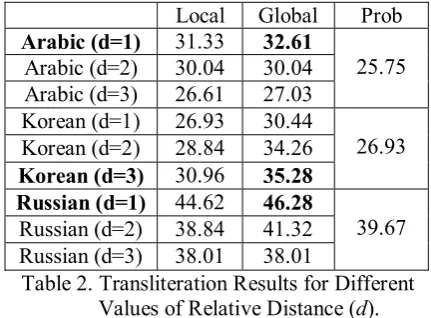
Table 2 presents the transliteration results for all languages for different values of d. Note that the joint probabilistic model does not depend on d. The results reflect the accuracy of translitera-tion, that is, the proportion of times when the top English candidate produced by a transliteration model agreed with the correct English translitera-tion. We note that such an exact comparison may be too inflexible, for many foreign names may have more than one legitimate English spelling. In future experiments, we plan to relax the re-quirement and consider alternative variants of
transliteration scoring (e.g., edit distance, top-N candidate scoring).
Local Global Prob
Arabic (d=1) 31.33 32.61
Arabic (d=2) 30.04 30.04 Arabic (d=3) 26.61 27.03
25.75
Korean (d=1) 26.93 30.44 Korean (d=2) 28.84 34.26
Korean (d=3) 30.96 35.28
26.93
Russian (d=1) 44.62 46.28
Russian (d=2) 38.84 41.32 Russian (d=3) 38.01 38.01
39.67
Table 2. Transliteration Results for Different Values of Relative Distance (d).
Table 2 shows that, for all three languages, the discriminative methods convincingly outperform the joint probabilistic approach. The global dis-criminative approach achieves the best perform-ance in all languages. It is interesting that differ-ent values of relative distance are optimal for different languages. For example, in Korean, the Hangul-Jamo decomposition leads to fairly re-dundant strings of Korean characters thereby making transliterated characters to be relatively far from each other. Therefore, Korean requires a larger relative distance bound. In Arabic and Russian, on the other hand, transliterated charac-ters are relatively close to each other, so the dis-tance d of 1 suffices. While for Russian such a small distance is to be expected, we are surprised by such a small relative distance for Arabic. Our intuition was that omitting short vowels in spell-ing names in Arabic will increase d.
We have the following explanation of the low value of d for Arabic from the machine learning perspective: incrementing d implies adding a lot of extraneous features to examples, that is, in-creasing attribute noise. Increased attribute noise requires a corresponding increase in the number of training examples to achieve adequate per-formance. While for Korean the number of train-ing examples is sufficient to cope with the attrib-ute noise, the relatively small Arabic training sample is not. We hypothesize that with increas-ing the number of trainincreas-ing examples for Arabic, the optimal value of d will also increase.
7 Related
Work
[image:4.595.78.282.120.188.2]incorporat-ing phonetics as an intermediate representation. (Al-Onaizan and Knight 2002) showed that use of outside linguistic resources such as WWW counts of transliteration candidates can greatly boost transliteration accuracy. (Li et al. 2004) introduced the joint transliteration model whose variant augmented with adaptive re-ranking we used in our experiments.
Among direct (non-source-channel) models, we note the work of (Gao et al. 2004) on apply-ing Maximum Entropy to English-Chinese trans-literation, and the English-Korean transliteration model of (Kang and Choi 2000) based on deci-sion trees.
All of the above models require alignment be-tween names. We follow the recent work of (Klementiev and Roth 2006) who addressed the problem of discovery of transliterated named entities from comparable corpora and suggested that alignment may not be necessary for translit-eration.
Finally, our modeling approaches follow the recent work on both local classifier-based mod-eling of complex learning problems (McCallum et al. 2000; Punyakanok and Roth 2001), as well as global discriminative approaches based on CRFs (Lafferty et al. 2001), SVM (Taskar et al. 2005), and the Perceptron algorithm (Collins 2002) that we used in our experiments.
8 Conclusions
We presented two novel discriminative ap-proaches to name transliteration that do not em-ploy the notion of alignment. We showed ex-perimentally that the approaches lead to superior experimental results in all languages, with the global discriminative modeling approach achiev-ing the best performance.
The results are somewhat surprising, for the notion of alignment seems very intuitive and use-ful for transliteration. We will investigate whether similar alignment-free methodology can be extended to full-text translation. It will also be interesting to study the relationship between our discriminative alignment-free methods and re-cently proposed discriminative alignment-based methods for transliteration and translation (Taskar et al. 2005a; Moore 2005).
We also showed that for name transliteration, global discriminative modeling is superior to local classifier-based discriminative modeling. This may have resulted from poor calibration of scores and probabilities produced by individual
classifiers. We plan to further investigate the re-lationship between the local and global ap-proaches to complex learning problems in natural language.
References
Y. Al-Onaizan and K. Knight. 2002. Translating Named Entities Using Monolingual and Bilingual Resources. Proceedings of ACL.
Y. Al-Onaizan and K. Knight. 2002a. Machine Trans-literation of Names in Arabic Text. Proceedings of ACL Workshop on Computational Approaches to Semitic Languages.
M. Collins. 2002. Discriminative Training for Hidden Markov Models: Theory and Experiments with Perceptron Algorithms. In Proceedings of EMNLP. Y. Freund and R. Shapire. 1999. Large margin clas-sification using the perceptron algorithm. Machine Learning, 37, 277–296.
W. Gale and G. Sampson. 1995. Good-Turing fre-quency estimation without tears. Journal of Quan-titative Linguistics 2:217-235.
Gao Wei, Kam-Fai Wong, and Wai Lam. 2004. Pho-neme-based transliteration of foreign names for OOV problem. Proceedings of the First Interna-tional Joint Conference on Natural Language Processing.
B.J. Kang and Key-Sun Choi, 2000. Automatic Trans-literation and Back-transTrans-literation by Decision Tree Learning, Proceedings of the 2nd International
Conference on Language Resources and Evalua-tion.
A. Klementiev and D. Roth. 2006. Named Entity Transliteration and Discovery from Multilingual Comparable Corpora. Proceedings of ACL.
K. Knight and J. Graehl. 1998. Machine Translitera-tion, Computational Linguistics, 24(4).
J. Lafferty, A. McCallum, and F. Pereira. 2001. Con-ditional Random Fields: Probabilistic Models for Segmenting and Labeling Sequence Data. Proceed-ings of the Eighteenth International Conference on Machine Learning.
Li Haizhou, Zhang Min, and Su Jian. 2004. A Joint Source-channel Model for Machine Transliteration.
Proceedings ofACL 2004.
A. McCallum, D. Freitag, and F. Pereira. 2000. Maxi-mum entropy Markov models for information ex-traction and segmentation. Proceedings of ICML.
Jong-Hoon Oh and Key-Sun Choi. 2000. An English-Korean Transliteration Model Using Pronunciation and Contextual Rules. Proceedings of COLING. J. Platt. 1999. Probabilistic outputs for support vector
machines and comparison to regularized likelihood methods. In Advances in Large Margin Classi£ers.
V. Punyakanok and D. Roth. 2001. The Use of Classi-fiers in Sequential Inference. Proceedings of the Conference on Advances in Neural Information Processing Systems.
B. Taskar, V. Chatalbashev, D. Koller and C. Gues-trin. 2005. Learning Structured Prediction Models: A Large Margin Approach. Proceedings of Twenty Second International Conference on Machine Learning.
B. Taskar, S. Lacoste-Julien, and D. Klein. 2005a. A Discriminative Matching Approach to Word Align-ment. Proceedings of the Conference on Empirical Methods in Natural Language Processing.