Composing Simple Image Descriptions using Web-scale N-grams
Siming Li, Girish Kulkarni, Tamara L Berg, Alexander C Berg, and Yejin Choi Department of Computer Science
Stony Brook University NY 11794, USA
{silli, gkulkarni, tlberg, aberg, ychoi}@cs.stonybrook.edu
Abstract
Studying natural language, and especially how people describe the world around them can help us better understand the visual world. In turn, it can also help us in the quest to generate natural language that describes this world in a human manner. We present a simple yet effec-tive approach to automatically compose im-age descriptions given computer vision based inputs and using web-scale n-grams. Unlike most previous work that summarizes or re-trieves pre-existing text relevant to an image, our methodcomposessentences entirely from scratch. Experimental results indicate that it is viable to generate simple textual descriptions that are pertinent to the specific content of an image, while permitting creativity in the de-scription – making for more human-like anno-tations than previous approaches.
1 Introduction
Gaining a better understanding of natural language, and especially natural language associated with im-ages helps drive research in both computer vision and natural language processing (e.g., Barnard et al. (2003), Pastra et al. (2003), Feng and Lapata (2010b)). In this paper, we look at how to exploit the enormous amount of textual data electronically available today, web-scale n-gram data in particular, in a simple yet highly effective approach to com-pose image descriptions in natural language. Auto-matic generation of image descriptions differs from automatic image tagging (e.g., Leong et al. (2010)) in that we aim to generate complex phrases or sen-tences describing images rather than predicting
in-dividual words. These natural language descriptions can be useful for a variety of applications, includ-ing image retrieval, automatic video surveillance, and providing image interpretations for visually im-paired people.
Our work contrasts to most previous approaches in four key aspects: first, we compose fresh sen-tences from scratch, instead of retrieving (Farhadi et al. (2010)), or summarizing existing text fragments associated with an image (e.g., Aker and Gaizauskas (2010), Feng and Lapata (2010a)). Second, we aim to generate textual descriptions that are truthful to the specific content of the image, whereas related (but subtly different) work in automatic caption gen-eration creates news-worthy text (Feng and Lapata (2010a)) or encyclopedic text (Aker and Gaizauskas (2010)) that is contextually relevant to the image, but not closely pertinent to the specific content of the image. Third, we aim to build a general image de-scription method as compared to work that requires domain specific hand-written grammar rules (Yao et al. (2010)). Last, we allow for some creativity in the generation process which produces more human-like descriptions than a closely related, very recent approach that drives annotation more directly from computer vision inputs (Kulkarni et al., 2011).
In this work, we propose a novel surface realiza-tion technique based on web-scale n-gram data. Our approach consists of two steps: (n-gram) phrase se-lection and (n-gram) phrase fusion. The first step
–phrase selection– collects candidate phrases that
may be potentially useful for generating the descrip-tion of a given image. This step naturally accom-modates uncertainty in image recognition inputs as
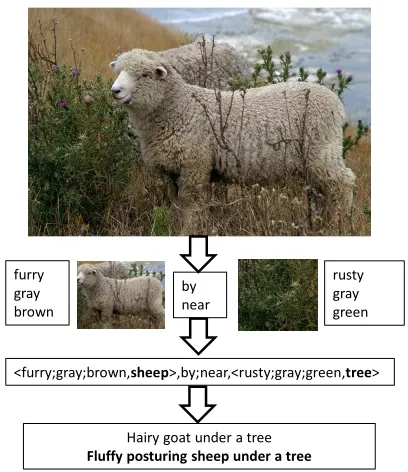
Hairy goat under a tree
Fluffy posturing sheep under a tree
<furry;gray;brown,sheep>,by;near,<rusty;gray;green,tree> furry
gray brown
rusty gray green by
[image:2.612.82.286.55.291.2]near
Figure 1: The big picture of our task to automatically generate image description.
well as synonymous words and word re-ordering to improve fluency. The second step – phrase fusion
– finds the optimal compatible set of phrases us-ing dynamic programmus-ing to compose a new (and more complex) phrase that describes the image. We compare the performance of our proposed approach to three baselines based on conventional techniques: language models, parsers, and templates.
Despite its simplicity, our approach is highly ef-fective for composing image descriptions: it gen-erates mostly appealing and presentable language, while permitting creative writing at times (see Fig-ure 5 for example results). We conclude from our exploration that (1) it is viable to generate simple textual descriptions that are germane to the specific image content, and that (2) world knowledge implic-itly encoded in natural language (e.g., web-scale n-gram data) can help enhance image content recogni-tion.
2 Image Recognition
Figure 1 depicts our system flow: a) an image is in-put into our system, b) image recognition techniques are used to extract visual content information, c) vi-sual content is encoded as a set of triples, d) natural
language descriptions are generated.
In this section, we briefly describe the image recognition system that extracts visual information and encodes it as a set of triples. For a given image, the image recognizer extractsobjects,attributesand
spatial relationshipsamong objects as follows:
1. Objects: includingthings(e.g., bird, bus, car)
andstuff (e.g., grass, water, sky, road) are
de-tected.
2. Visual attributes (e.g., feathered, black) are pre-dicted for each object.
3. Spatial relationships (e.g., on, near, under) be-tween objects are estimated.
In particular, object detectors are trained using state of the art mixtures of multi-scale deformable parts models (Felzenszwalb et al., 2010). Our set of objects encompasses the 20 PASCAL 2010 object challenge1 categories as well as 4 additional cate-gories forflower, laptop, tiger, andwindow trained on images with associated bounding boxes from Imagenet (Deng et al., 2009). Stuff detectors are trained to detect regions corresponding to non-part based object categories (sky, road, building, tree, water, and grass) using linear SVMs trained on the low level region features of (Farhadi et al., 2009). These are also trained on images with la-beled bounding boxes from ImageNet and evaluated at test time on a coarsely sampled grid of overlap-ping square regions over whole images. Pixels in any region with a classification probability above a fixed threshold are treated as detections.
We select visual attribute characteristics that are relevant to our object and stuff categories. Our at-tribute terms include 21 visual modifiers – adjec-tives – related to color (e.g. blue, gray), texture (e.g. striped, furry), material (e.g. wooden, feath-ered), general appearance (e.g. rusty, dirty, shiny), and shape (e.g. rectangular) characteristics. The at-tribute classifiers are trained on the low level fea-tures of (Farhadi et al., 2009) using RBF kernel SVMs. Preposition functions encoding spatial rela-tionships between objects are hand designed to eval-uate the spatial relationships between pairs of re-gions in an image and provide a score for 16 prepo-sitions (e.g., above, under, against, in etc).
From these three types of visual output, we con-struct a meaning representation of an image as a set of triples (one triple for every pair of detected objects). Each triple encodes a spatial relation be-tween two objects in the following format:<<adj1, obj1>, prep,<adj2, obj2>>. The generation pro-cedure is elaborated in the following two sections.
3 Baseline Approaches to Surface
Realization
This section explores three baseline surface realiza-tion approaches: language models (§3.1), random-ized local search (§3.2), and template-based (§3.3). Our best approach,phrase fusion using web-scale
n-gramsfollows in§4.
3.1 Language Model Based Approach
For each triple, as described in §2, we construct a sentence. For instance, given the triple <<white, cloud>, in, <blue, sky>>, we might generate
“There is a white cloud in the blue sky”.
We begin with a simple decoding scheme based on language models. Let t be a triple, and let Vt
be the set of words in t. We perform surface real-ization by adding function words in-between words inVt. As a concrete example, suppose we want to determine whether to insert a function word x be-tween a pair of wordsα ∈ Vt andβ ∈ Vt. Then, we need to compare the length-normalized probabil-itypˆ(αxβ)withpˆ(αβ), wherepˆtakes then’th root of the probabilityp for n-word sequences. We in-sert the new function word x if pˆ(αxβ) ≥ pˆ(αβ)
using the n-gram models, where the probability of any given sequencew1, ..., wmis approximated by
p(w1, ..., wm) =
m Y
i=1
p(wi|wi−(n−1), ..., wi−1)
Note that if we wish to reorder words inVtbased on
n-gram based language models, then the decoding problem becomes an instance of asymmetric trav-eler’s salesman problem (NP-hard). For brevity, we retain the original order of words in the given triple. We later lift this restriction using the web-scale n-gram based phrase fusion method introduced in§4.
3.2 Randomized Local Search Approach A much needed extension to the language model based surface realization is incorporating parsers to
Begin Loop (untilT iterations or convergence) Choose a positionito revise at random Choose an edit operation at random
If the edit yields a better score by LM and PCFG Commit the edit
End Loop
Table 1: Pseudo code for a randomized local search ap-proach. A possible edit operation includes insertion, deletion, andreplacement. The score of the current sen-tence is determined by the multiplication LM-based prob-ability and PCFG-based probprob-ability.
enforce long distance regularities for more gram-matically correct generation. However, optimiz-ing both language-model-based probabilities and parser-based probabilities is intractable. Therefore, we explore a randomized local search approach that makes greedy revisions using both language models and parsers. Randomized local search has been suc-cessfully applied to intractable optimization prob-lems in AI (e.g., Chisholm and Tadepalli (2002)) and NLP (e.g., White and Cardie (2002)).
Table 1 shows the skeleton of the algorithm in our study. Iterating through a loop, it chooses an edit location and an edit operation (insert, delete, or re-place) at random. If the edit yields a better score, then we commit the edit, otherwise we jump to the next iteration of the loop. We define the score as
score(X) = ˆpLM(X)ˆpP CF G(X)
where X is a given sentence (image description),
ˆ
pLM(X) is the length normalized probability ofX
based on the language model, andpˆP CF G(X)is the length normalized probability of X based on the probabilistic context free grammar (PCFG) model. The loop is repeated until convergence or a fixed number of iterations is reached. Note that this ap-proach can be extended to simulated annealing to al-low temporary downward steps to escape from local maxima. We use the PCFG implementation of Klein and Manning (2003).
3.3 Template Based Approach
dia-blue, bike [2669]
blue, bicycle [1365]
bike, blue [1184] blue, cycle [324] cycle, of, the, blue [172] cycle, blue [158] bicycle, blue [154] bike, in, blue [98] cycle, of, blue [64] bike, with, blue [43]
< < blue , bicycle >, near, < shiny , person > >
bright, boy [8092] bright, child [7840] bright, girl [6191] bright, kid [5873]
bright, person [5461]
bright, man [4936] bright, woman [2726] bright, women [1684] lady, bright [1360] bright, men [1050]
person, operating, a, bicycle [3409]
man, on, a, bicycle [2842] cycle, of, child [2507] bike, for, men [2485] person, riding, a, bicycle [2118] cycle, in, women [1853] bike, for, women [1442] boy, on, a, bicycle [1378] cycle, of, women [1288] man, on, a, bike [1283]
bright person operating a blue bicycle [25411589385]
[image:4.612.74.298.54.232.2]bright man on a blue bicycle [19148372880] bright man on a blue bike [16902478072] bright person riding a blue bicycle [15788133270] bright boy on a blue bicycle [15220809240] blue bike for bright men [6964088250] blue bike for bright women [6481207432] blue cycle of bright child [6368181120] blue cycle in bright women [1011026448]
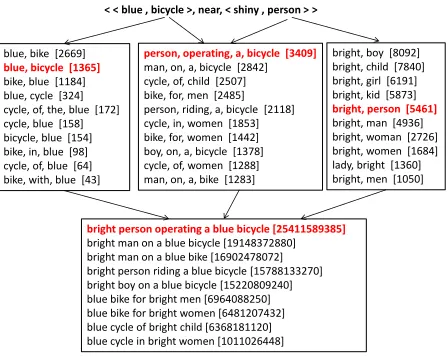
Figure 2: Illustration of phrase fusion composition al-gorithm using web-scale n-grams. Numbers in square brackets are n-gram frequencies.
logue systems (Channarukul et al., 2003). Because the meaning representation produced by the image recognition system has a fixed pattern of <<adj1, obj1>, prep,<adj2, obj2>>, it can be templated as
“There is a [adj1] [obj1] [prep] the [adj2] [obj2].”
We also include templates that encode basic dis-course constraints. For instance, the template that generated the first sentences in Figure 3 and 4 is: [PREFIX] [#(x1)] [x1], [#(x2)] [x2], ... and [#(xk)]
[xk], wherexiis the name of an object (e.g. “cow”),
#(xi) is the number of instances ofxi (e.g. “one”),
and PREFIX∈ {”This picture shows”, ”This is a pic-ture of”, etc}.
Although this approach can produce good looking sentences in a limited domain, there are many limita-tions. First, a template-based approach does not al-low creative writing and produces somewhat stilted prose. In particular, it cannot add interesting new words, or replace existing content words with better ones. In addition, such an approach does not allow any reordering of words which might be necessary to create a fluent sentence. Finally, hand-written rules are domain-specific, and do not generalize well to new domains.
4 Surface Realization by Phrase Fusion
using Web-scale N-gram
We now introduce an entirely different approach that addresses the limitations of the conventional
ap-proaches discussed in §3. This approach is based on web-scale n-gram, also known as Google Web 1T data, which provides the frequency count of each possible n-gram sequence for1≤n≤5.
4.1 [Step I] – Candidate Phrase Selection We first define three different sets of phrases for each given triple<<adj1, obj1>, prep,<adj2, obj2>>:
• O1 = {(x, f)|xis an n-gram phrase
describ-ing the first object using the words adj1 and
obj1, andf is the frequency ofx}
• O2 = {(x, f)|xis an n-gram phrase describ-ing thesecondobject using the wordsadj2and
obj2, andf is the frequency ofx}
• R={(x, f)|xis an n-gram describing the re-lationbetween the two objects using the words
obj1andobj2, andf is the frequency ofx}
We find n-gram phrases forO1,O2, andRfrom the
Google Web 1T data. The search patterns forO1is:
• [adj1] [♣]n−2 [obj1]
• [obj1] [♣]n−2 [adj1]
where [♣] is a wildcard word, and [♣]n−2 denotes a sequence ofn-2 number of wildcard words in an -gram sequence. For wildcards, we only allow a lim-ited set of function words, and verbs in the gerund form2 for reasons that will become clearer in the next step – phrase fusion in§4.2.
Note that it is the second pattern that allows interesting re-ordering of words in the final sen-tence generation. For instance, supposeadj1=green,
obj1=person. Then it is more natural to generate a phrase using the reverse pattern such as, “person
in green”or “person wearing green” than simply
concatenatingadj1andobj1to generate“green per-son”. Similarly, givenobj1=bicycle andobj2=man, generating a phrase using the reverse pattern, e.g.,
“man with a bicycle” would be more natural than
“bicycle with a man”. Our hypothesis is that such
ordering preference is implicitly encoded in the web-scale n-grams via frequencies.
It is worthwhile to note that our pattern matching is case sensitive, and we only allow patterns that are
Phrase Fusion
Black bull eating fluffy grass Bright apartment in the blue sky
Shaggy grass looking at the blue sky
Local Search
the black cow or even by the furry grass. the shiny building up by the same blue sky. the furry grass be
below over one blue sky.
Template This picture shows one cow, one building, one grass and
one sky. The black cow is by the shiny building, and by the furry grass, and by the blue sky. The shiny building is by the furry grass,
and by the blue sky. The furry grass is below the blue sky.
Simple decoding
the black cow or by the furry grass. the shiny building up by the blue sky. the
furry grass be below one blue sky.
Image Recognition Output as Tripes:
[image:5.612.77.297.58.240.2]<black;yellow;rusty,cow>,by;near;by,<furry;green;brown,grass> <shiny;colorful;yellow,building>,by;near;by,<blue;clear;colorful,sky> <furry;green;brown,grass>,below;beneath;by,<blue;clear;colorful,sky>
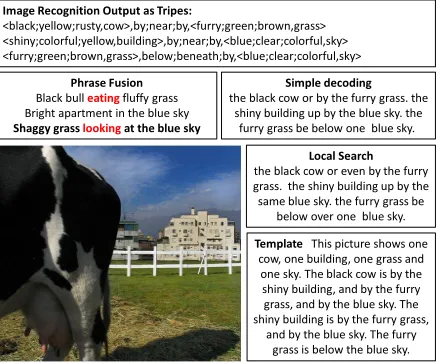
Figure 3: Comparison of image descriptions
all lower-case. From our pilot study, we found that n-grams with upper case characters are likely from named entities, which distort the n-gram frequency distribution that we rely on during the phrase fusion phase. To further reduce noise, we also discard any n-gram that contains a character that is not an alpha-bet.
Accommodating Uncertainty We extend candi-date phrase selection in order to cope with uncer-tainty from the image recognition. In particular, for each object detectionobji, we include its top 3
predicted modifiers adji1, adji2, adji3 determined
by the attribute classifiers (see §2) to expand the set O1 and O2 accordingly. For instance, given
adji =(shiny or white) andobji = sheep, we can consider both <shiny,sheep> and <white,sheep>
pairs to predict more compatible pairs of words.
Accommodating Synonyms Additionally, we augment each modifier adji and each object name obji with synonyms to further expand our sets O1, O2, and R. These expanded sets of phrases
enable resulting generations that are more fluent and creative.
4.2 [Step II] – Phrase Fusion
Given the expanded sets of phrasesO1,O2, andR described above, we perform phrase fusion to gen-erate simple image description. In this step, we find the best combination of three phrases, ( ˆx1,fˆ1) ∈
O1,( ˆx2,fˆ2)∈ O2, and( ˆxR,fRˆ)∈ Ras follows:
( ˆx1,xˆ2,xˆR) =argmaxx1,x2,xRscore(x1, x2, xR) (1) score(x1, x2, xR) =φ(x1)×φ(x2)×φ(xR) (2)
s.t.xˆ1andxRˆ are compatible
& xˆ2andxˆRare compatible
Two phrasesxˆiandxˆRare compatible if they share
the same object nounobji. We define the phrase-level score function φ(·) as φ(xi) = fi using the
Google n-gram frequencies. The equation (2) can be maximized using dynamic programming, by align-ing the decision sequence asxˆ1−xˆR−xˆ2.
Once the best combination – ( ˆx1,xˆ2,xˆR) is
de-termined, we fuse the phrases by replacing the word
obj1in the phrasexˆRwith the corresponding phrase
ˆ
x1. Similarly, we replace the wordobj2in the phrase
ˆ
xRwith the other corresponding phrasexˆ2. Because
the wildcard words – [♣] in§4.1 allow only a lim-ited set of function words and gerund, the resulting phrase is highly likely to be grammatically correct.
Computational Efficiency One advantage of our phrase fusion method is its efficiency. If we were to attempt to re-order words with language mod-els in a naive way, we would need to consider all possible permutations of words – an NP-hard prob-lem (§3.1). However, our phrase fusion method is clever in that it probes reordering only on selected pairs of words, where reordering is likely to be use-ful. In other words, our approach naturally ignores most word pairs that do not require reordering and has a time complexity of onlyO(K2n), whereKis the maximum number of candidate phrases of any phrase type, andnis the number of phrase types in each sentence.Kcan be kept as a small constant by selecting K-best candidate phrases of each phrase type. We setK = 10in this paper.
5 Experimental Results
To construct the training corpus for language mod-els, we crawled Wikipedia pages that describe our object set. For evaluation, we use the UIUC PAS-CAL sentence dataset3 which contains upto five human-generated sentences that describing 1000 im-ages. Note that all of the approaches presented in
Phrase fusion
shiny motorcycle nearby shiny motorcycle. black women operating a shiny motorcycle.
bright boy on a shiny motorcycle. girl showing pink on a shiny motorcycle.
Local search
the shiny motorbike or against the shiny motorbike. the shiny motorbike or by the black person. the shiny motorbike
or by the shiny person. the shiny motorbike or by the
pink person.
Simple Decoding
the shiny motorbike or against the shiny motorbike. the shiny motorbike or by the black
person. the shinny motorbike or by the shiny boy. the shiny motorbike or
by the pink person.
Template This is a picture of two motorbikes, three persons, one building and one tree. The first shiny motorbike is against the second shiny motorbike, and by the first black person. The second shiny motorbike is by the first black person, and by
the second shiny person, and by the third pink person. Image Recognition Output as Triples:
< < shiny; black; rusty , motorbike >, against; by; in , < shiny; black; rusty , motorbike > > < < shiny; black; rusty , motorbike >, by; near; by , < black; shiny; rusty , person > > < < shiny; black; rusty , motorbike >, by; near; by , < pink; rusty; striped , person > >
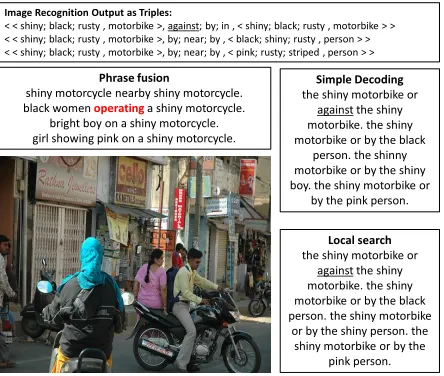
Figure 4: Comparison of image descriptions
Section 3 and 4 attempt to insert function words for surface realization. In this work, we limit the choice of function words to only those words that are likely to be necessary in the final output.4For instance, we disallow function words such as “who” or “or”.
Before presenting evaluation results, we present some samples of image descriptions generated by 4 different approaches in Figure 3 and 4. Notice that only the PHRASE FUSION approach is able to in-clude interesting and adequate verbs, such as
“eat-ing”or“looking” in Figure 3, and“operating”in
Figure 4. Note that the choice of these action verbs is based only on the co-occurrence statistics encoded in n-grams, without relying on the vision compo-nent that specializes in action recognition. These ex-amples therefore demonstrate that world knowledge implicitly encoded in natural language can help en-hance image content recognition.
Automatic Evaluation: BLEU (Papineni et al., 2002) is a widely used metric for automatic eval-uation of machine translation that measures the n -gram precision of machine generated sentences with respect to human generated sentences. Because our task can be viewed as machine translation from im-ages to text, BLEU (Papineni et al., 2002) may seem
4This limitation does not apply to T
EMPLATE.
w/o w/ syn
LANGUAGEMODEL 0.094 0.106
TEMPLATE 0.087 0.096
LOCALSEARCH 0.100 0.111
PHRASEFUSION(any best) 0.149 0.153
PHRASEFUSION(best w/ gerund) 0.146 0.149
[image:6.612.312.542.55.159.2]Human 0.500 0.510
Table 2: Automatic Evaluation: BLEU measured at 1
Creativ. Fluency Relevan.
LANGUAGEMODEL 2.12 1.96 2.09
TEMPLATE 2.04 1.7 1.96
LOCALSEARCH 2.21 1.96 2.04
[image:6.612.76.298.56.244.2]PHRASEFUSION 1.86 1.97 2.11
Table 3: Human Evaluation: the scores range over 1 to 3, where 1 is very good, 2 is ok, 3 is bad.
like a reasonable choice. However, there is larger inherent variability in generating sentences from im-ages than translating a sentence from one language to another. In fact two people viewing the same pic-ture may produce quite different descriptions. This means BLEU could penalize many correctly gener-ated sentences, and be poorly correlgener-ated with human judgment of quality. Nevertheless we report BLEU scores in absence of any other automatic evaluation method that serves our needs perfectly.
The results are shown in Table 2 – first column shows BLEU score considering exact matches, sec-ond column shows BLEU with full credit for syn-onyms. To give a sense of upper bound and to see some limitations of the BLEU score, we also com-pute the BLEU score between human-generated sen-tences by computing the BLEU score of the first hu-man sentence with respect to the others.
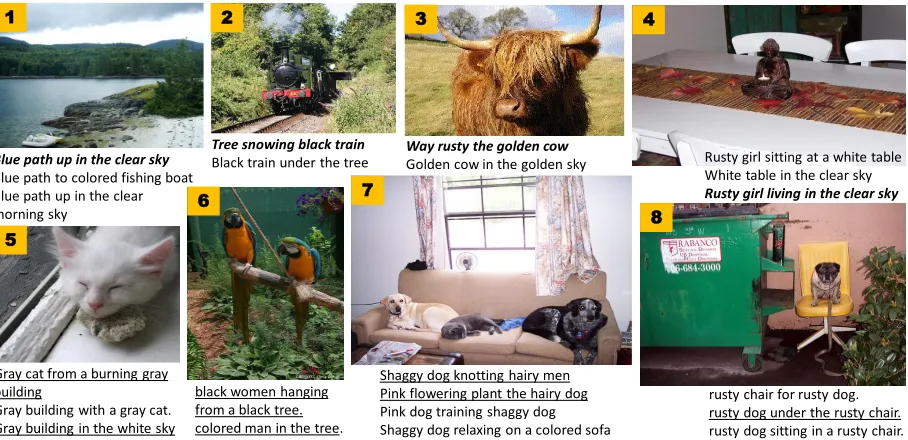
Way rusty the golden cow Golden cow in the golden sky Tree snowing black train
Black train under the tree Rusty girl sitting at a white table
White table in the clear sky Rusty girl living in the clear sky Blue path up in the clear sky
Blue path to colored fishing boat Blue path up in the clear morning sky
rusty chair for rusty dog. rusty dog under the rusty chair. rusty dog sitting in a rusty chair. Gray cat from a burning gray
building
Gray building with a gray cat. Gray building in the white sky
Shaggy dog knotting hairy men Pink flowering plant the hairy dog Pink dog training shaggy dog Shaggy dog relaxing on a colored sofa black women hanging
from a black tree. colored man in the tree.
1 2 3 4
5
6 7
[image:7.612.81.535.57.277.2]8
Figure 5: Sample image descriptions using PHRASE FUSION: some of the unexpected or poetic descriptions are highlighted inboldface, and some of the interesting incorrect descriptions are underlined.
more sentences in our output is overall lower BLEU scores, because BLEU precision penalizes spurious repetitions of the same word, which necessarily oc-curs when generating more sentences. This is not an issue for comparing different approaches however, as we generate the same number of sentences for each method.
From Table 2, we find that our final approach — PHRASE FUSION based on web-scale n-grams per-forms the best. Notice that there are two different evaluations for PHRASE FUSION: the first one is evaluated for the best combination of phrases (Equa-tion (1)), while the second one is evaluated for the best combination of phrases that contained at least one gerund.
Human Evaluation: As mentioned earlier, BLEU score has some drawbacks including obliviousness to correctness of grammar and inability to evaluate the creativity of a composition. To directly quantify these aspects that could not be addressed by BLEU, we perform human judgments on 120 instances for the four proposed methods. Evaluators do not have any computer vision or natural language generation background.
We consider the following three aspects to eval-uate the our image descriptions: creativity,fluency,
andrelevance. For simplicity, human evaluators
as-sign one set of scores for each aspect per image. The scores range from 1 to 3, where 1 is very good, 2 is ok, and 3 is bad.5 The definition and guideline for each aspect is:
[Creativity] How creative is the generated sen-tence?
1 There is creativity either based on unexpected words (in particular, verbs), or describing things in a poetic way.
2 There is minor creativity based on re-ordering words that appeared in the triple
3 None. Looks like a robot talking.
[Fluency] How grammatically correct is the gener-ated sentence?
1 Mostly perfect English phrase or sentence. 2 There are some errors, but mostly
comprehen-sible.
3 Terrible.
[Relevance] How relevant is the generated descrip-tion to the given image?
1 Very relevant.
2 Reasonably relevant. 3 Totally off.
5In our pilot study, human annotations on 160 instances
Table 3 shows the human evaluation results. In terms of creativity, PHRASE FUSION achieves the best score as expected. In terms of fluency and
relevance however, TEMPLATE achieves the best
scores, while PHRASEFUSIONperforms the second best. Remember that TEMPLATEis based on hand-engineered rules with discourse constraints, which seems to appeal to evaluators more. It would be straightforward to combine PHRASE FUSION with TEMPLATE to improve the output of PHRASE FU-SION with hand-engineered rules. However, our goal in this paper is to investigate statistically moti-vated approaches for generating image descriptions that can address inherent limitations of hand-written rules discussed in§3.3.
Notice that the relevance score of TEMPLATEis better than that of LANGUAGEMODEL, even though both approaches generate descriptions that consist of an almost identical set of words. This is presum-ably because the output from LANGUAGE MODEL contains grammatically incorrect sentences that are not comprehendable enough to the evaluators. The relevance score of PHRASE FUSIONis also slightly worse than that of TEMPLATE, presumably because PHRASE FUSION often generates poetic or creative expressions, as shown in Figure 5, which can be con-sidered a deviation from the image content.
Error Analysis There are different sources of er-rors. Some errors are due to mistakes in the origi-nal visual recognition input. For example, in the 3rd image in Figure 5, the color of sky is predicted to be “golden”. In the 4th image, the wall behind the table is recognized as “sky”, and in the 6th image, the parrots are recognized as “person”.
Other errors are from surface realization. For in-stance, in the 8th image, PHRASE FUSION selects the preposition “under”, presumably because dogs are typically under the chair rather than on the chair according to Google n-gram statistics. In the 5th image, an unexpected word “burning” is selected to make the resulting output idiosyncratic. Word sense disambiguation sometimes causes a problem in sur-face realization as well. In the 3rd image, the word “way” is chosen to represent “path” or “street” by the image recognizer. However, a different sense of way – “very” – is being used in the final output.
6 Related Work
There has been relatively limited work on automat-ically generating natural language image descrip-tions. Most work related to our study is discussed in§1, hence we highlight only those that are clos-est to our work here. Yao et al. (2010) present a comprehensive system that generates image descrip-tions using Head-driven phrase structure (HPSG) grammar, which requires carefully written domain-specific lexicalized grammar rules, and also de-mands a very specific and complex meaning rep-resentation scheme from the image processing. In contrast, our approach handles images in the open-domain more naturally using much simpler tech-niques.
We use similar vision based inputs – object detec-tors, modifier classifiers, and prepositional functions – to some very recent work on generating simple de-scriptions for images (Kulkarni et al., 2011), but fo-cus on improving the sentence generation method-ology and produce descriptions that are more true to human generated descriptions. Note that the BLEU scores reported in their work of Kulkarni et al. (2011) are not directly comparable to ours, as the scale of the scores differs depending on the number of sentences generated per image.
7 Conclusion
In this paper, we presented a novel surface realiza-tion technique based on web-scale n-gram data to automatically generate image description. Despite its simplicity, our method is highly effective in gen-erating mostly appealing and presentable language, while permitting creative writing at times. We con-clude from our study that it is viable to generate simple textual descriptions that are germane to the specific image content while also sometimes pro-ducing almost poetic natural language. Furthermore, we demonstrate that world knowledge implicitly en-coded in natural language can help enhance image content recognition.
Acknowledgments
References
A. Aker and R. Gaizauskas. 2010. Generating image descriptions using dependency relational patterns. In ACL.
K. Barnard, P. Duygulu, N. de Freitas, D. Forsyth, D. Blei, and M. Jordan. 2003. Matching words and pictures. JMLR, 3:1107–1135.
Songsak Channarukul, Susan W. McRoy, and Syed S. Ali. 2003. Doghed: a template-based generator for multimodal dialog systems targeting heterogeneous devices. InNAACL.
Michael Chisholm and Prasad Tadepalli. 2002. Learning decision rules by randomized iterative local search. In ICML, pages 75–82.
J. Deng, W. Dong, R. Socher, L.-J. Li, K. Li, and L. Fei-Fei. 2009. ImageNet: A Large-Scale Hierarchical Im-age Database. InCVPR.
A. Farhadi, I. Endres, D. Hoiem, and D. A. Forsyth. 2009. Describing objects by their attributes. InCVPR. A. Farhadi, M Hejrati, A. Sadeghi, P. Young, C. Rashtchian, J. Hockenmaier, and D. A. Forsyth. 2010. Every picture tells a story: generating sentences for images. InECCV.
P. Felzenszwalb, R. Girshick, D. McAllester, and D. Ra-manan. 2010. Object detection with discriminatively trained part based models. tPAMI, Sept.
Y. Feng and M. Lapata. 2010a. How many words is a picture worth? automatic caption generation for news images. InACL.
Yansong Feng and Mirella Lapata. 2010b. Topic models for image annotation and text illustration. InHLT. Dan Klein and Christopher D. Manning. 2003. Accurate
unlexicalized parsing. InProceedings of the 41st An-nual Meeting on Association for Computational Lin-guistics, pages 423–430. Association for Computa-tional Linguistics.
Girish Kulkarni, Visruth Premraj, Sagnik Dhar, Siming Li, Yejin Choi, Alexander C Berg, and Tamara L Berg. 2011. Babytalk: Understanding and generating simple image descriptions. InCVPR.
Chee Wee Leong, Rada Mihalcea, and Samer Hassan. 2010. Text mining for automatic image tagging. In COLING.
Kishore Papineni, Salim Roukos, Todd Ward, and Wei jing Zhu. 2002. Bleu: a method for automatic evalua-tion of machine translaevalua-tion.
Katerina Pastra, Horacio Saggion, and Yorick Wilks. 2003. Nlp for indexing and retrieval of captioned pho-tographs. InEACL.
Michael White and Claire Cardie. 2002. Selecting sen-tences for multidocument summaries using random-ized local search. In ACL Workshop on Automatic Summarization.
B.Z. Yao, Xiong Yang, Liang Lin, Mun Wai Lee, and Song-Chun Zhu. 2010. I2t: Image parsing to text de-scription. Proc. IEEE, 98(8).