Error-Driven Analysis of Challenges in Coreference Resolution
Jonathan K. Kummerfeld and Dan Klein
Computer Science Division University of California, Berkeley
Berkeley, CA 94720, USA
{jkk,klein}@cs.berkeley.edu
Abstract
Coreference resolution metrics quantify errors but do not analyze them. Here, we consider an automated method of categorizing errors in the output of a coreference system into intu-itive underlying error types. Using this tool, we first compare the error distributions across a large set of systems, then analyze common errors across the top ten systems, empirically characterizing the major unsolved challenges of the coreference resolution task.
1 Introduction
Metrics produce measurements that concisely sum-marize performance on the full range of error types, and for coreference resolution there has been ex-tensive work on developing effective metrics (Luo, 2005; Recasens and Hovy, 2011). However, it is also valuable to tease apart the errors to understand their relative importance.
Previous investigations of coreference errors have focused on quantifying the importance of subtasks such as named entity recognition and anaphoricity detection, typically by measuring accuracy improve-ments when partial gold annotations are provided (Stoyanov et al., 2009; Pradhan et al., 2011; Prad-han et al., 2012). For coreference resolution the drawback of this approach is that decisions are often interdependent, and so even partial gold information is extremely informative. Also, previous work only considered errors by counting links, which does not capture certain errors in a natural way, e.g. when a system incorrectly divides a large entity into two parts, each with multiple mentions. Recent work has considered some of these issues, but only with small scale manual analysis (Holen, 2013).
We present a new tool that automatically classifies errors in the standard output of any coreference res-olution system. Our approach is to identify changes that convert the system output into the gold annota-tions, and map the steps in the conversion onto lin-guistically intuitive error types. Since our tool uses only system output, we are able to classify errors made by systems of any architecture, including both systems that use link-based inference and systems that use global inference methods.
Using our tool we perform two studies to un-derstand similarities and differences between sys-tems. First, we compare the error distributions on coreference resolution of all of the systems from the CoNLL 2011 shared task plus several publicly avail-able systems. This comparison adds to the analy-sis from the shared task by illustrating the substan-tial variation in the types of errors different systems make. Second, we investigate the aggregate behav-ior of ten state-of-the-art systems, providing a de-tailed characterization of each error type. This in-vestigation identifies key outstanding challenges and presents the impact that solving each of them would have in terms of changes in the standard coreference resolution metrics.
We find that the best systems are not best across all error types, that a large proportion of span errors are due to superficial parse differences, and that the biggest performance loss is on missed entities that contain a small number of mentions.
This work presents a comprehensive investiga-tion of common errors in coreference resoluinvestiga-tion, identifying particular issues worth focusing on in future research. Our analysis tool is available at code.google.com/p/berkeley-coreference-analyser/.
2 Background
Most coreference work focuses on accuracy im-provements, as measured by metrics such as MUC (Vilain et al., 1995), B3(Bagga and Baldwin, 1998), CEAF (Luo, 2005), and BLANC (Recasens and Hovy, 2011). The only common forms of further analysis are results for anaphoricity detection and scores for each mention type (nominal, pronoun, proper). Two exceptions are: the detailed analysis of the Reconcile system by Stoyanov et al. (2009), and the multi-system comparisons in the CoNLL shared task reports (Pradhan et al., 2011, 2012).
A common approach to performance analysis is to calculate scores for nominals, pronouns and proper names separately, but this is a very coarse division (Ng and Cardie, 2002; Haghighi and Klein, 2009). More fine consideration of some subtasks does oc-cur, for example, anaphoricity detection, which has been recognized as a key challenge in coreference resolution for decades and regularly has separate re-sults reported (Paice and Husk, 1987; Sobha et al., 2011; Yuan et al., 2012; Bj¨orkelund and Farkas, 2012; Zhekova et al., 2012). Some work has also included anecdotal discussion of specific error types or manual classification of a small set of errors, but these approaches do not effectively quantify the rel-ative impact of different errors (Chen and Ng, 2012; Martschat et al., 2012; Haghighi and Klein, 2009). In a recent paper, Holen (2013) presented a detailed manual analysis that considered a more comprehen-sive set of error types, but their focus was on explor-ing the shortcomexplor-ings of current metrics, rather than understanding the behavior of current systems.
The detailed investigation presented by Stoyanov et al. (2009) is the closest to the work we present here. First, they measured accuracy improvements when their system was given gold annotations for three subtasks of coreference resolution: mention detection, named entity recognition, and anaphoric-ity detection. To isolate other types of errors they de-fined resolution classes, based on both the type of a mention, and properties of possible antecedents (for example, nominals that have a possible antecedent that is an exact string match). For each resolution class they measured performance while giving the system gold annotations for all other classes. While this approach is effective at characterizing variations
President Clinton1 is questioning the legitimacy of George W. Bush’s election victory. Speaking last night to Democratic supporters in Chicago, hesaid Bush won the election only because Re-publicans stopped the vote-counting in Florida, and Mr. Clinton1 praised Al Gore’s campaign manager, Bill Daley, for the way he handled the election. “I2want to thank Bill Daley for his ex-emplary service as Secretary of Commerce. He was brilliant. I2 think he did a brilliant job in leading Vice President Gore to victorymyself2.”
Figure 1: Two coreference errors. Mentions are under-lined and subscripts indicate entities. One error is a men-tion missing from the system output,he. The other is the division of references to Bill Clinton into two entities.
between the nine classes they defined, it misses the cascade effect of errors that only occur when all mentions are being resolved at once.
The only multi-system comparisons are the CoNLL task reports (Pradhan et al., 2011, 2012), which explored the impact of mention detection and anaphoricity detection through subtasks with differ-ent types of gold annotation. With a large set of sys-tems, and well controlled experimental conditions, the tasks provided a great snapshot of progress in the field, which we aim to supplement by characterizing the major outstanding sources of error.
This work adds to previous investigations by pro-viding a comprehensive and detailed analysis of er-rors. Our tool can automatically analyze any sys-tem’s output, giving a reliable estimate of the rela-tive importance of different error types.
3 Error Classification
When inspecting the output of coreference resolu-tion systems, several types of errors become imme-diately apparent: entities that have been divided into pieces, spurious entities, non-referential pronouns that have been assigned antecedents, and so on. Our goal in this work is to automatically assign intuitive labels like these to errors in system output.
A simple approach, refining results by measur-ing the accuracy of subsets of the mentions, can be misleading. For example, in Figure 1, we can in-tuitively see two pronoun related mistakes: a miss-ing mention (he), and a divided entity where the two pieces are the blue pronouns (I2,I2,myself2) and the
Simply counting the number of incorrect pronoun links would miss the distinction between the two types of mistakes present.
One question in designing an error analysis tool like ours is whether to operate on just system output, or to also consider intermediate system decisions. We focused on using system output because other methods cannot uniformly apply to the full range of coreference resolution decoding methods, from link based methods to global inference methods.
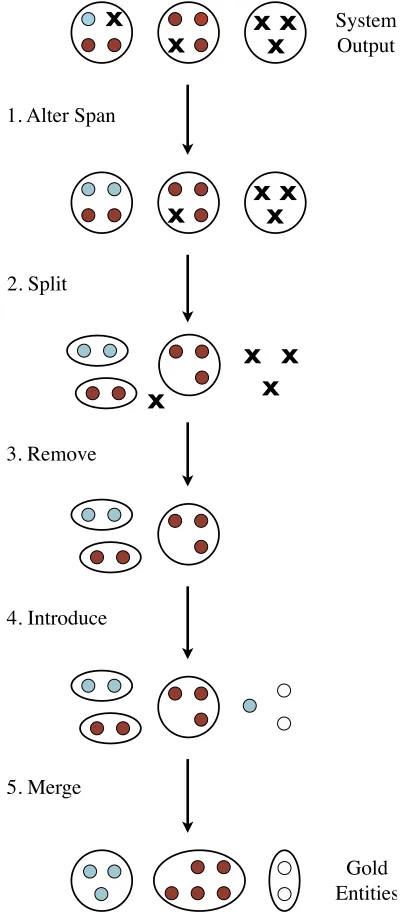
Our overall approach is to transform the sys-tem output into the gold annotations, then map the changes made in the conversion process to er-rors. The transformation process is presented in Sec-tion 3.1 and Figure 2, and the mapping process is described in Section 3.2 and Figure 3.
3.1 Transformations
The first part of our error classification process de-termines the changes needed to transform the system output into the gold annotations. This five stage pro-cess is described below, and an abstract example is presented in Figure 2.
1. Alter Span transforms an incorrect system mention into a gold mention that has the same head token. In Figure 2 this stage is demon-strated by a mention in the leftmost entity, which has its span altered, indicated by the change from an X to a light blue circle.
2. Split breaks the system entities into pieces, each containing mentions from a single gold entity. In Figure 2 there are three changes in this stage: the leftmost entity is split into a red piece and a light blue piece, the middle entity is split into a dark red piece and an X, and the rightmost entity is split into singletons.
3. Remove deletes every mention that is not present in the gold annotations. In Figure 2 this means the four singleton X’s are removed.
4. Introduce creates a singleton entity for each mention that is missing from the system output. In Figure 2 this stage involves the introduction of a light blue mention and two white mentions.
5. Merge combines entities to form the final, completely correct, set of entities. In Figure 2 the two red entities are merged, the singleton
Mentions
Spurious mention
Entity
1. Alter Span
2. Split
3. Remove
4. Introduce
5. Merge
X
X XXX
X X X X
X X X X
Gold entities indicated using common shading
X
Key
System Output
[image:3.612.328.534.158.615.2]Gold Entities
Figure 2: Abstract example of the transformation process that converts system output (at the top) to gold annota-tions (at the bottom).
Operation(s) Error System Gold
i) Alter Span Span error Gorbachev Soviet leader Gorbachev
ii) Multiple Introduces Missing Entity - the pills
and Merges - the tranquilizing pills
iii) Multiple Splits Extra Entity human rights
-and Removes Human Rights
-Introduce and Merge
the Arab region the Arab region
iv) Missing Mention the region the region
- it
Split and Remove
her story her story
v) Extra Mention this this
it
-vi) Merge Divided Entity
Iraq1 Iraq1
this nation2 this nation1
the nation2 the nation1
its1 its1
vii) Split Conflated Entities
Mohammed Rashid1 Mohammed Rashid1
the Rashid case1 the Rashid case2
Rashid1 Rashid1
[image:4.612.98.509.50.299.2]the case1 the case2
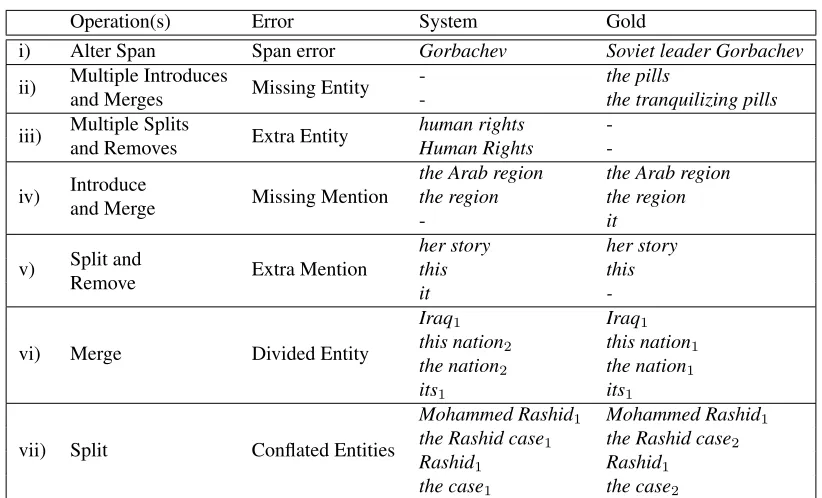
Figure 3: Examples of the error types. In examples (i) - (iv) and (vi) the system output contains a single entity. When multiple entities are involved, they are marked with subscripts. Mentions are in the order in which they appear in the text. All examples are from system output on the dev set of the CoNLL task.
One subtle point in the split stage is how to record an entity being split into several pieces. This could either be a single operation, one entity being split intoN pieces, orN−1operations, each involving a single piece being split off from the rest of the entity. We use the second approach, as it fits more naturally with the error mapping we describe in the follow-ing section. Similarly, for the merge operation, we recordN entities being merged asN−1operations.
3.2 Mapping
The operations in Section 3.1 are mapped onto seven error types. In some cases, a single change maps onto a single error, while in others a single error rep-resents several closely related operations from adja-cent stages in the error correction process. The map-ping is described below and in Figure 3.
1. Span Error. Each Alter Span operation is mapped to a Span Error, e.g. in Figure 3(i), the system mentionGorbachev is replaced by the annotated mentionSoviet leader Gorbachev.
2. Missing Entity. A set of Introduce and Merge operations that forms an entirely new entity, e.g. the white entity in Figure 2, andthe pills in Figure 3(ii). This error is still assigned if
the new entity includes pronouns that were al-ready present in the system output. The rea-soning for this is that most pronouns in the cor-pus are coreferent, so including just the pro-nouns from an entity is not meaningfully dif-ferent from missing the entity entirely.
3. Extra Entity. A set of Split and Remove oper-ations that completely remove an entity, e.g. the rightmost entity in Figure 2, and Figure 3(iii). As for the Missing Entity error type, this error is still assigned if the original entity contained pronouns that were valid.
4. Missing Mention. An Introduce and a Merge that apply to the same mention, e.g.it in Fig-ure 3(iv), and the blue mention in FigFig-ure 2.
5. Extra Mention. A Split and a Remove that ap-ply to the same mention, e.g.itin Figure 3(v), and the X in the red entity in Figure 2.
6. Divided Entity. Each remaining Merge oper-ation is mapped to a Divided Entity error, e.g. Figure 3(vi), and the red entity in Figure 2.
4 Methodology
Our tool processes the CoNLL task output, with no other information required. During development, and when choosing examples for this paper, we used the development set of the CoNLL shared task (Hovy et al., 2006; Pradhan et al., 2007; Pradhan et al., 2011). The results we present in the rest of the paper are all for the test set. Using the development set would have been misleading, as the entrants in the shared task used it to tune their systems.
4.1 Systems
We analyzed all of the 2011 CoNLL task systems, as well as several publicly available systems. For the shared task systems we used the output data from the task itself, provided by the organizers. For the publicly available systems we used the default con-figurations. Finally, we included another run of the Stanford system, with their OntoNotes-tuned param-eters (STANFORD-T).
The publicly available systems we used are: BERKELEY (Durrett and Klein, 2013), IMS (Bj¨orkelund and Farkas, 2012), STANFORD (Lee et al., 2013), RECONCILE (Stoyanov et al., 2010), BART (Versley et al., 2008), UIUC (Bengtson and Roth, 2008), and CHERRYPICKER (Rahman and Ng, 2009). The systems from the shared task are listed in Table 1 and in the references.
5 Broad System Comparison
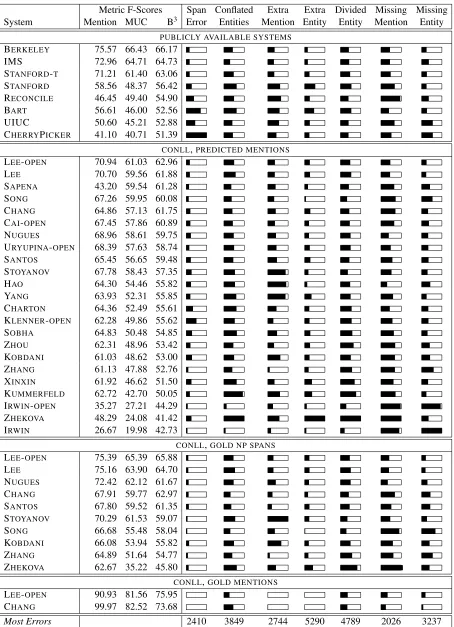
Table 1 presents the frequency of errors for each sys-tem and F-Scores for standard metrics1 on the test set of the 2011 CoNLL shared task. Each bar is filled in proportion to the number of errors the sys-tem made, with a full bar corresponding to the num-ber of errors listed in the bottom row.
The metrics provide an effective overall rank-ing, as the systems with high scores generally make fewer errors. However, the metrics do not convey the significant variation in the types of errors sys-tems make. For example, YANGandCHARTONare assigned almost the same scores, but YANG makes more than twice as many Extra Mention errors.
1CEAF and BLANC are not included as the most recent
ver-sion of the CoNLL scorer (v5) is incorrect, and there are no standard implementations available.
The most frequent error across all systems is Di-vided Entity. Unlike parsing errors (Kummerfeld et al., 2012), improvements are not monotonic, with better systems often making more errors of one type when decreasing the frequency of another type.
One outlier is the Irwin et al. (2011) system, which makes very few mistakes in five categories, but many in the last two. This reflects a high pre-cision, low recall approach, where clusters are only formed when there is high confidence.
The third section of Table 1 shows results for sys-tems that were run with gold noun phrase span in-formation. This reduces all errors slightly, though most noticeably Extra Mention, Missing Mention, and Span Error. On inspection of the remaining Span Errors we found that many are due to incon-sistencies regarding the inclusion of the possessive.
The final section of the table shows results for sys-tems that were provided with the set of mentions that are coreferent. In this setting, three of the error types are not present, but there are still Missing Mentions and Missing Entities because systems do not always choose an antecedent, leaving a mention as a single-ton, which is then ignored.
While this broad comparison gives a complete view of the range of errors present, it is still a coarse representation. In the next section, we characterize the common errors on a finer level by breaking down each error type by a range of properties.
6 Common Errors
To investigate the aggregate state of the art, in this section we consider results averaged over the top ten systems: CAI, CHANG, IMS, NUGUES, SAN -TOS, SAPENA, SONG, STANFORD-T, STOYANOV, URYUPINA-OPEN.2 These systems represent a broad range of approaches, all of which are effective.
In each section below, we focus on one or two error types, characterizing the mistakes by a range of properties. We then consider a few questions that apply across multiple error types.
6.1 Span Errors
To characterize the Span Errors, we considered the text that is in the gold mention, but not the system
2For systems that occur multiple times in Table 1, we only
Metric F-Scores Span Conflated Extra Extra Divided Missing Missing System Mention MUC B3 Error Entities Mention Entity Entity Mention Entity
PUBLICLY AVAILABLE SYSTEMS
BERKELEY 75.57 66.43 66.17
IMS 72.96 64.71 64.73
STANFORD-T 71.21 61.40 63.06
STANFORD 58.56 48.37 56.42
RECONCILE 46.45 49.40 54.90
BART 56.61 46.00 52.56
UIUC 50.60 45.21 52.88
CHERRYPICKER 41.10 40.71 51.39
CONLL,PREDICTED MENTIONS
LEE-OPEN 70.94 61.03 62.96
LEE 70.70 59.56 61.88
SAPENA 43.20 59.54 61.28
SONG 67.26 59.95 60.08
CHANG 64.86 57.13 61.75
CAI-OPEN 67.45 57.86 60.89
NUGUES 68.96 58.61 59.75
URYUPINA-OPEN 68.39 57.63 58.74
SANTOS 65.45 56.65 59.48
STOYANOV 67.78 58.43 57.35
HAO 64.30 54.46 55.82
YANG 63.93 52.31 55.85
CHARTON 64.36 52.49 55.61
KLENNER-OPEN 62.28 49.86 55.62
SOBHA 64.83 50.48 54.85
ZHOU 62.31 48.96 53.42
KOBDANI 61.03 48.62 53.00
ZHANG 61.13 47.88 52.76
XINXIN 61.92 46.62 51.50
KUMMERFELD 62.72 42.70 50.05 IRWIN-OPEN 35.27 27.21 44.29
ZHEKOVA 48.29 24.08 41.42
IRWIN 26.67 19.98 42.73
CONLL,GOLD NP SPANS
LEE-OPEN 75.39 65.39 65.88
LEE 75.16 63.90 64.70
NUGUES 72.42 62.12 61.67
CHANG 67.91 59.77 62.97
SANTOS 67.80 59.52 61.35
STOYANOV 70.29 61.53 59.07
SONG 66.68 55.48 58.04
KOBDANI 66.08 53.94 55.82
ZHANG 64.89 51.64 54.77
ZHEKOVA 62.67 35.22 45.80
CONLL,GOLD MENTIONS
LEE-OPEN 90.93 81.56 75.95
CHANG 99.97 82.52 73.68
[image:6.612.79.533.51.678.2]Most Errors 2410 3849 2744 5290 4789 2026 3237
Type Missing Extra
NP 65.8 45.0
POS 12.4 96.9
, 71.2 22.4
SBAR 55.9 1.9
PP 46.2 10.3
DT 17.0 35.9
[image:7.612.126.247.51.157.2]Total 271.1 224.6
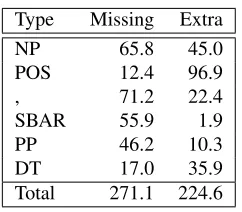
Table 2: Counts of Span Errors grouped by the label over the extra/missing part of the mention.
mention (missing text), and vice versa (extra text). We then found nodes in the gold parse that cov-ered just this extra/missing text, e.g. in Figure 3(i) we would consider the node overSoviet leader. In Table 2 we show the most frequent parse nodes.
Some of these differences are superficial, such as the possessive and the punctuation. Others, such as the missing PP and SBAR cases, may be due to parse errors. Of the system mentions involved in span er-rors,27.0%do not correspond to a node in the gold parse. The frequency of punctuation errors could also be parse related, because punctuation is not con-sidered in the standard parser evaluation.
Overall it seems that span errors can best be dealt with by improving parsing, though it is not possi-ble to completely eliminate these errors because of inconsistent annotations.
6.2 Extra Mention and Missing Mention
We consider Extra and Missing Mentions together as they mirror each other, forming a precision-recall tradeoff, where a high precision system will have fewer Extra Mentions and more Missing Mentions, and a high recall system will have the opposite.
Table 3 divides these errors by the type of men-tion involved and presents some of the most fre-quent Extra Mentions and Missing Mentions. For the corpus statistics we count as mentions all NP spans in the gold parse plus any word tagged with PRP, WP, WDT, or WRB (following the definition of gold mention boundaries for the CoNLL tasks).
The mentions it and you are the most common errors, matching observations from several of the papers cited in Section 2. However, there is a sur-prising imbalance between Extra and Missing cases, e.g. it accounts for a third of the extra errors, but only12%of the Missing errors. This imbalance may
Av. Errors Corpus Stats Mention Extra Missing Count % Coref.
Proper Name 281.6 297.7 6915 59.0 Nominal 484.2 516.5 33328 15.9
Pronoun 390.7 323.3 9926 69.7
it 130.4 38.9 1211 57.1
you 85.2 55.9 1028 44.9
we 39.6 19.6 691 64.7
us 23.2 3.2 242 23.6
that 13.8 13.4 2010 11.5
they 9.6 39.5 738 94.3
their 8.6 21.5 410 95.1
[image:7.612.321.533.53.215.2]Total 1156.5 1137.5 50169 32.5
Table 3: Counts of Missing and Extra Mention errors by mention type, and the most common mentions.
Proper Name Nominal Extra Missing Extra Missing
Text match 145.2 163.6 171.2 96.1 Head match 56.8 70.7 149.6 166.0
Other 79.6 63.4 163.4 254.4
NER Matches 143.4 174.4 23.0 32.0
NER Differs 6.6 6.1 2.4 0.0
NER Unknown 131.6 117.2 458.8 484.5 Total 281.6 297.7 484.2 516.5
Table 4: Counts of Extra and Missing Mentions, grouped by properties of the mention and the entity it is in.
be the result of systems being tuned to the metrics, which seem to penalize Missing Mentions more than Extra Mentions (shown in Section 6.7).
In Table 4 we consider the Extra Mention er-rors and Missing Mention erer-rors involving proper names and nominals. The top section counts errors in which the mention involved in the error has an exact string match with a mention in the cluster, or whether it has just a head match. The second sec-tion of the table considers the named entity anno-tations in OntoNotes, counting how often the men-tion’s type matches the type of the cluster.
In all cases shown in the table it appears that sys-tems are striking a balance between these two types of errors. One exception may be the use of exact string matching for nominals, which seems to be bi-ased towards Extra Mentions.
Composition Av. Errors Name Nom Pro Extra Missing
0 1 1 70.7 271.6
1 0 1 13.2 28.1
1 1 0 26.6 86.2
2 0 0 61.3 89.3
0 2 0 512.0 347.9
0 0 2 110.9 13.6
3+ 0 0 14.7 14.4
0 3+ 0 154.8 65.9
0 0 3+ 91.0 18.1
Other 51.8 216.4
[image:8.612.354.500.51.157.2]Total 1107.0 1151.5
Table 5: Counts of Extra and Missing Entity errors, grouped by the composition of the entity (Names, Nomi-nals, Pronouns).
Match Type Extra Missing
Proper Name 51.4 42.2
Exact Nominal 338.3 49.5
Pronoun 141.9 10.3
Head Proper Name 14.4 27.3 Nominal 234.7 129.0 Proper Name 10.2 34.2
None Nominal 92.8 235.3
Pronoun 60.0 21.4
Table 6: Counts of Extra and Missing Entity errors grouped by properties of the mentions in the entity.
6.3 Extra Entities and Missing Entities
In this section, we consider the errors that involve an entire entity that was either missing from the system output or does not exist in the annotations.
Table 5 counts these errors based on the compo-sition of the entity. There are several noticeable dif-ferences between the two error types, e.g. for entities containing one nominal and one pronoun (row 0 1 1) there are far more Missing errors than Extra errors, while entities containing two pronouns (row 0 0 2) have the opposite trend.
It is clear that entities consisting of a single type of mention are the primary source of these errors, accounting for 85.3% of the Extra Entity errors, and47.7%of Missing Entity errors. Table 6 shows counts for these cases divided into three groups: when all mentions are identical, when all mentions have the same head, and the rest.
Nominals are the most frequent type in Table 6, and have the greatest variation across the three
sec-Mention Extra Missing
that 6.9 99.7
it 47.7 47.8
this 0.9 36.2
they 3.8 29.1
their 2.1 23.5
them 0.9 13.8
[image:8.612.97.278.52.215.2]Any pronoun 83.9 299.7
Table 7: Counts of common Missing and Extra Entity errors where the entity has just two mentions: a pronoun and either a nominal or a proper name.
tions of the table. For the Extra column, Exact match cases are a major challenge, accounting for over half of the nominal errors. These errors include cases like the example below, where two mentions are not considered coreferent because they are generic:
everybody tends to mistake the part forthe whole. Here, mistaking the part forthe wholeis ...
For missing entities we see the opposite trend, with Exact match cases accounting for less than12%
of nominal errors. Instead, cases with no match are the greatest challenge, such as this example, which requires semantic knowledge to correctly resolve:
The charges related to her sale ofImClone stock. She soldthe sharea day before ...
The other common case in Table 5 is an entity containing a pronoun and a nominal. In Table 7 we present the most frequent pronouns for this case and the similar case involving a pronoun and a name.
One way of interpreting these errors is from the perspective of the pronoun, which is either incorrectly coreferent (Extra), or incorrectly non-coreferent (Missing). From this perspective, these errors are similar in nature to those described by Ta-ble 3. However, the distribution of errors is quite dif-ferent, withitbeing balanced here where previously it skewed heavily towards extra mentions, whilethat was balanced in Table 3 but is skewed towards being part of Missing Entities here.
[image:8.612.93.280.267.381.2]Incorrect Part Rest of Entity Av. Errors Na No Pr Na No Pr Conflated Divided
- - 1+ - - 1+ 312.7 69.9
- - 1+ - 1+ 1+ 238.5 179.8
- - 1+ - 1+ - 189.6 549.3
- 1+ - - 1+ - 181.5 156.5
- - 1+ 1+ 1+ 1+ 143.6 181.5
- - 1+ 1+ - 1+ 109.7 150.5
- - 1+ 1+ - - 60.0 136.5
Other 454.8 657.7
Total 1690.4 2081.7
Table 8: Counts of Conflated and Divided entities errors grouped by the Name / Nominal / Pronoun composition of the parts involved.
[image:9.612.328.524.53.143.2]6.4 Conflated Entities and Divided Entities
Table 8 breaks down the Conflated Entities errors and Divided Entity errors by the composition of the part being split/merged and the rest of the entity in-volved. Each 1+ indicates that at least one mention of that type is present (Name / Nominal / Pronoun).
Clearly pronouns being placed incorrectly is the biggest issue here, with almost all of the common errors involving a part with just pronouns. It is also clear that not having proper names in the rest of the entity presents a challenge. One particularly no-ticeable issue involves entities composed entirely of pronouns, which are often created by systems con-flating the pronouns of two entities together.
Table 8 aggregates errors by the presence of dif-ferent types of mentions. Aggregating instead by the exact composition of the incorrect part being con-flated or divided we found that instances with a part containing a single pronoun account for 38.9% of conflated cases and35.8%of divided cases.
Finally, it is worth noting that in many cases a part is both conflated with the wrong entity, and divided from its true entity. Only12.6%of Conflated Entity errors led to a complete gold entity with no other er-rors, and only21.3%of Divided Entity errors came from parts that were not involved in another error.
Conflated Entities and Divided Entities are domi-nated by pronoun link errors: cases where a pronoun was placed in the wrong entity. Finding finer charac-terizations of these errors is difficult, as almost any division produces sparse counts, reflecting the long tail of mistakes that make up these two error types.
Gold System Decision Count
Cataphoric
[image:9.612.77.298.53.192.2]Same referent 10.6 Different referent 13.4 Not cataphoric 208.2 Not present 42.8 Not cataphoric Cataphoric 46.2 Not present Cataphoric 186.8
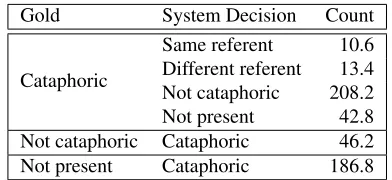
Table 9: Occurrence of mistakes involving cataphora.
6.5 Cataphora
Cataphora (when an anaphor precedes its an-tecedent) is a pronoun-specific problem that does not fit easily in the common left-to-right coreference resolution approach. In the CoNLL test set,2.8%of the pronouns are cataphoric. In Table 9 we show how well systems handle this challenge by counting mentions based on whether they are cataphoric in the annotations, are cataphoric in the system output, and whether the antecedents match.
Systems handle cataphora poorly, missing almost all of the true instances, and introducing a large number of extra cases. However, this issue is a fairly small part of the task, with limited metric impact.
6.6 Entity Properties
Gender, number, person, and named entity type are properties commonly used in coreference resolution systems. In some cases, two mentions with differ-ent properties are placed in the same differ-entity. Some of these cases are correct, such as variation in per-son between mentions inside and outside of quotes. However, many of these cases are errors. In Table 11 we present the percentage of entities that contain mentions with properties of more than one type. For named entity types we considered the annotations in OntoNotes; for the other properties we derive them from the pronouns in each cluster.
For all of the properties, there are many entities that we could not assign a value to, either because no named entity information was available, or be-cause no pronouns with an unambiguous value for the property were present. For named entity infor-mation, OntoNotes only has annotations for 68% of gold entities, suggesting that named entity taggers are of limited usefulness, matching observations on the MUC and ACE corpora (Stoyanov et al., 2009).
in-Mentions MUC B3
Error type P R F P R F P R F
Span Error 2.8 2.8 2.7 2.8 2.8 2.8 1.0 2.0 1.6
[image:10.612.139.479.53.165.2]Conflated Entities 1.7 0.0 0.8 9.9 0.0 4.5 15.9 0.0 6.2 Extra Mention 5.5 0.0 2.6 6.4 0.0 3.0 5.3 0.0 2.2 Extra Entity 15.3 0.0 7.0 11.4 0.0 5.2 6.1 0.0 2.4 Divided Entity 1.8 6.8 4.3 5.7 16.8 10.9 -10.0 21.6 4.5 Missing Mention 1.8 7.0 4.4 3.2 9.2 6.1 -1.3 7.3 3.4 Missing Entity 3.8 16.2 9.8 5.3 13.7 9.3 1.7 11.4 7.0
Table 10: Average accuracy improvement if all errors of a particular type are corrected. Each row in the lower section is calculated independently, relative to the change after the span errors have been corrected. Some values are negative because the merge operations involved in fixing the errors are applying to clusters that contain mentions from more than one gold entity.
Property System Gold
Named Entity 1.7% 0.7%
Gender 0.8% 0.1%
Number 2.1% 0.8%
[image:10.612.115.258.235.300.2]Person 6.4% 5.1%
Table 11: Percentage of entities that contain mentions with properties that disagree.
dicate possible errors in the annotations, e.g. in the 0.7% of entities with a mixture of named entity types there may be mistakes in the coreference annota-tions, or mistakes in the named entity annotations.3 However, even after taking into consideration cases where the mixture is valid and cases of annotation errors, current systems are placing mentions with different properties in the same clusters.
6.7 Impact of Errors on Metric Scores
Table 10 shows the performance impact of correct-ing errors of each type. The Span Error row gives improvements over the original scores, while all other rows are relative to the scores after Span Er-rors are corrected.4 By fixing each of the other error types in isolation, we can get a sense of the gain if just that error type is addressed. However, it also means some mentions are incorrectly placed in the same cluster, causing some negative scores.
Interaction between the error types and the way the metrics are defined means that the deltas do not
3
This kind of cross-annotation analysis may be a useful way of detecting annotation errors.
4
This difference was necessary as the later errors make changes relative to the state of the entities after the Span Errors are corrected, e.g. in Figure 2 a blue and red entity is split that previously contained an X instead of one of the blue mentions.
add up to the overall average gap in performance, but it is still clear that every error type has a noticeable impact. Missing Entity errors have the most sub-stantial impact, which reflects the precision oriented nature of many coreference resolution systems.
7 Conclusion
While the improvement of metrics and the organiza-tion of shared tasks have been crucial for progress in coreference resolution, there is much insight to be gained by performing a close analysis of errors.
We have presented a new means of automatically classifying coreference errors that provides an ex-haustive view of error types. Using our tool we have analyzed the output of a large set of coreference res-olution systems and investigated the common chal-lenges across state-of-the-art systems.
We find that there is considerable variability in the distribution of errors, and the best systems are not best across all error types. No single source of errors stands out as the most substantial chal-lenge today. However, it is worth noting that while confidence measures can be used to reduce precision-related errors, no system has been able to effectively address the recall-related errors, such as Missed Entities. Our analysis tool is available at code.google.com/p/berkeley-coreference-analyser/.
Acknowledgments
References
Amit Bagga and Breck Baldwin. 1998. Algorithms for scoring coreference chains. In Proceedings of The First International Conference on Language Resources and Evaluation Workshop on Linguistics Coreference, pages 563–566.
Eric Bengtson and Dan Roth. 2008. Understanding the value of features for coreference resolution. In Pro-ceedings of the Conference on Empirical Methods in Natural Language Processing, pages 294–303. Anders Bj¨orkelund and Rich´ard Farkas. 2012.
Data-driven multilingual coreference resolution using re-solver stacking. InJoint Conference on EMNLP and CoNLL - Shared Task, pages 49–55.
Anders Bj¨orkelund and Pierre Nugues. 2011. Explor-ing lexicalized features for coreference resolution. In Proceedings of the Fifteenth Conference on Compu-tational Natural Language Learning: Shared Task, pages 45–50.
Jie Cai, Eva Mujdricza-Maydt, and Michael Strube. 2011. Unrestricted coreference resolution via global hypergraph partitioning. In Proceedings of the Fif-teenth Conference on Computational Natural Lan-guage Learning: Shared Task, pages 56–60.
Kai-Wei Chang, Rajhans Samdani, Alla Rozovskaya, Nick Rizzolo, Mark Sammons, and Dan Roth. 2011. Inference protocols for coreference resolution. In Proceedings of the Fifteenth Conference on Compu-tational Natural Language Learning: Shared Task, pages 40–44.
Eric Charton and Michel Gagnon. 2011. Poly-co: a mul-tilayer perceptron approach for coreference detection. In Proceedings of the Fifteenth Conference on Com-putational Natural Language Learning: Shared Task, pages 97–101.
Chen Chen and Vincent Ng. 2012. Combining the best of two worlds: A hybrid approach to multilingual coref-erence resolution. InJoint Conference on EMNLP and CoNLL - Shared Task, pages 56–63.
Weipeng Chen, Muyu Zhang, and Bing Qin. 2011. Coreference resolution system using maximum en-tropy classifier. InProceedings of the Fifteenth Con-ference on Computational Natural Language Learn-ing: Shared Task, pages 127–130.
Greg Durrett and Dan Klein. 2013. Easy victories and uphill battles in coreference resolution. In Proceed-ings of the 2013 Conference on Empirical Methods in Natural Language Processing.
Aria Haghighi and Dan Klein. 2009. Simple coreference resolution with rich syntactic and semantic features. In Proceedings of the 2009 Conference on Empiri-cal Methods in Natural Language Processing, pages 1152–1161.
Gordana Ilic Holen. 2013. Critical reflections on evalu-ation practices in coreference resolution. In Proceed-ings of the 2013 NAACL HLT Student Research Work-shop, pages 1–7.
Eduard Hovy, Mitchell Marcus, Martha Palmer, Lance Ramshaw, and Ralph Weischedel. 2006. Ontonotes: the 90% solution. InProceedings of the Human Lan-guage Technology Conference of the NAACL, Com-panion Volume: Short Papers, pages 57–60.
Joseph Irwin, Mamoru Komachi, and Yuji Matsumoto. 2011. Narrative schema as world knowledge for coreference resolution. In Proceedings of the Fif-teenth Conference on Computational Natural Lan-guage Learning: Shared Task, pages 86–92.
Manfred Klenner and Don Tuggener. 2011. An incre-mental model for coreference resolution with restric-tive antecedent accessibility. In Proceedings of the Fifteenth Conference on Computational Natural Lan-guage Learning: Shared Task, pages 81–85.
Hamidreza Kobdani and Hinrich Schuetze. 2011. Super-vised coreference resolution with sucre. In Proceed-ings of the Fifteenth Conference on Computational Natural Language Learning: Shared Task, pages 71– 75.
Jonathan K. Kummerfeld, Mohit Bansal, David Burkett, and Dan Klein. 2011. Mention detection: Heuristics for the ontonotes annotations. In Proceedings of the Fifteenth Conference on Computational Natural Lan-guage Learning: Shared Task, pages 102–106. Jonathan K. Kummerfeld, David Hall, James R.
Cur-ran, and Dan Klein. 2012. Parser showdown at the wall street corral: An empirical investigation of er-ror types in parser output. In Proceedings of the 2012 Joint Conference on Empirical Methods in Natu-ral Language Processing and Computational NatuNatu-ral Language Learning, pages 1048–1059.
Sobha Lalitha Devi, Pattabhi Rao, Vijay Sundar Ram R, M. C S, and A. A. 2011. Hybrid approach for corefer-ence resolution. InProceedings of the Fifteenth Con-ference on Computational Natural Language Learn-ing: Shared Task, pages 93–96.
Heeyoung Lee, Yves Peirsman, Angel Chang, Nathanael Chambers, Mihai Surdeanu, and Dan Jurafsky. 2011. Stanfords multi-pass sieve coreference resolution sys-tem at the conll-2011 shared task. InProceedings of the Fifteenth Conference on Computational Natural Language Learning: Shared Task, pages 28–34. Heeyoung Lee, Angel Chang, Yves Peirsman, Nathanael
Chambers, Mihai Surdeanu, and Dan Jurafsky. 2013. Deterministic coreference resolution based on entity-centric, precision-ranked rules. Computational Lin-guistics, 39(4).
In Proceedings of the Fifteenth Conference on Com-putational Natural Language Learning: Shared Task, pages 107–111.
Xiaoqiang Luo. 2005. On coreference resolution perfor-mance metrics. In Proceedings of Human Language Technology Conference and Conference on Empirical Methods in Natural Language Processing, pages 25– 32.
Sebastian Martschat, Jie Cai, Samuel Broscheit, ´Eva M´ujdricza-Maydt, and Michael Strube. 2012. A multigraph model for coreference resolution. InJoint Conference on EMNLP and CoNLL - Shared Task, pages 100–106.
Vincent Ng and Claire Cardie. 2002. Improving machine learning approaches to coreference resolution. In Pro-ceedings of the 40th Annual Meeting on Association for Computational Linguistics, pages 104–111. Cicero Nogueira dos Santos and Davi Lopes Carvalho.
2011. Rule and tree ensembles for unrestricted coreference resolution. In Proceedings of the Fif-teenth Conference on Computational Natural Lan-guage Learning: Shared Task, pages 51–55.
C. D. Paice and G. D. Husk. 1987. Towards the auto-matic recognition of anaphoric features in english text: the impersonal pronoun ‘it’.Computer Speech & Lan-guage, 2(2):109–132.
Sameer Pradhan, Lance Ramshaw, Ralph Weischedel, Jessica MacBride, and Linnea Micciulla. 2007. Un-restricted coreference: Identifying entities and events in ontonotes. InProceedings of the International Con-ference on Semantic Computing, pages 446–453. Sameer Pradhan, Lance Ramshaw, Mitchell Marcus,
Martha Palmer, Ralph Weischedel, and Nianwen Xue. 2011. Conll-2011 shared task: Modeling unrestricted coreference in ontonotes. In Proceedings of the 15th Conference on Computational Natural Language Learning (CoNLL 2011), pages 1–27.
Sameer Pradhan, Alessandro Moschitti, Nianwen Xue, Olga Uryupina, and Yuchen Zhang. 2012. Conll-2012 shared task: Modeling multilingual unrestricted coref-erence in ontonotes. InJoint Conference on EMNLP and CoNLL - Shared Task, pages 1–40.
Altaf Rahman and Vincent Ng. 2009. Supervised mod-els for coreference resolution. InProceedings of the 2009 Conference on Empirical Methods in Natural Language Processing, pages 968–977.
M. Recasens and E. Hovy. 2011. BLANC: Implement-ing the rand index for coreference evaluation. Natural Language Engineering, 17:485–510, 9.
Emili Sapena, Llu´ıs Padr´o, and Jordi Turmo. 2011. Re-laxcor participation in conll shared task on coreference resolution. In Proceedings of the Fifteenth Confer-ence on Computational Natural Language Learning: Shared Task, pages 35–39.
Lalitha Devi. Sobha, RK. Rao. Pattabhi, R. Vijay Sundar Ram, CS. Malarkodi, and A. Akilandeswari. 2011. Hybrid approach for coreference resolution. In Pro-ceedings of the Fifteenth Conference on Computa-tional Natural Language Learning: Shared Task, pages 93–96.
Yang Song, Houfeng Wang, and Jing Jiang. 2011. Link type based pre-cluster pair model for coreference reso-lution. InProceedings of the Fifteenth Conference on Computational Natural Language Learning: Shared Task, pages 131–135.
Veselin Stoyanov, Nathan Gilbert, Claire Cardie, and Ellen Riloff. 2009. Conundrums in noun phrase coref-erence resolution: making sense of the state-of-the-art. InProceedings of the Joint Conference of the 47th Annual Meeting of the ACL and the 4th International Joint Conference on Natural Language Processing of the AFNLP, pages 656–664.
Veselin Stoyanov, Claire Cardie, Nathan Gilbert, Ellen Riloff, David Buttler, and David Hysom. 2010. Coref-erence resolution with reconcile. InProceedings of the ACL 2010 Conference Short Papers, pages 156–161. Veselin Stoyanov, Uday Babbar, Pracheer Gupta, and
Claire Cardie. 2011. Reconciling ontonotes: Unre-stricted coreference resolution in ontonotes with rec-oncile. InProceedings of the Fifteenth Conference on Computational Natural Language Learning: Shared Task, pages 122–126.
Olga Uryupina, Sriparna Saha, Asif Ekbal, and Massimo Poesio. 2011. Multi-metric optimization for coref-erence: The unitn / iitp / essex submission to the 2011 conll shared task. InProceedings of the Fifteenth Con-ference on Computational Natural Language Learn-ing: Shared Task, pages 61–65.
Yannick Versley, Simone Paolo Ponzetto, Massimo Poe-sio, Vladimir Eidelman, Alan Jern, Jason Smith, Xi-aofeng Yang, and Alessandro Moschitti. 2008. Bart: a modular toolkit for coreference resolution. In Pro-ceedings of the 46th Annual Meeting of the Associ-ation for ComputAssoci-ational Linguistics on Human Lan-guage Technologies: Demo Session, pages 9–12. Marc Vilain, John Burger, John Aberdeen, Dennis
Con-nolly, and Lynette Hirschman. 1995. A model-theoretic coreference scoring scheme. In Proceed-ings of the Sixth Message Uunderstanding Conference, pages 45–52.
Hao Xiong, Linfeng Song, Fandong Meng, Yang Liu, Qun Liu, and Yajuan Lv. 2011. Ets: An error tolera-ble system for coreference resolution. InProceedings of the Fifteenth Conference on Computational Natural Language Learning: Shared Task, pages 76–80. Yaqin Yang, Nianwen Xue, and Peter Anick. 2011. A
for ontonotes. InProceedings of the Fifteenth Confer-ence on Computational Natural Language Learning: Shared Task, pages 117–121.
Bo Yuan, Qingcai Chen, Yang Xiang, Xiaolong Wang, Liping Ge, Zengjian Liu, Meng Liao, and Xianbo Si. 2012. A mixed deterministic model for corefer-ence resolution. InJoint Conference on EMNLP and CoNLL - Shared Task, pages 76–82.
Desislava Zhekova and Sandra K¨ubler. 2011. Ubiu: A robust system for resolving unrestricted coreference. In Proceedings of the Fifteenth Conference on Com-putational Natural Language Learning: Shared Task, pages 112–116.
Desislava Zhekova, Sandra K¨ubler, Joshua Bonner, Marwa Ragheb, and Yu-Yin Hsu. 2012. Ubiu for mul-tilingual coreference resolution in ontonotes. InJoint Conference on EMNLP and CoNLL - Shared Task, pages 88–94.