Projection-based Coreference Resolution Using Deep Syntax
Michal Nov´ak and Anna Nedoluzhko and Zdenˇek ˇZabokrtsk´y
Charles University, Faculty of Mathematics and Physics Institute of Formal and Applied Linguistics Malostransk´e n´amˇest´ı 25, CZ-11800 Prague 1
{mnovak,nedoluzko,zabokrtsky}@ufal.mff.cuni.cz
Abstract
The paper describes the system for coref-erence resolution in German and Russian, trained exclusively on coreference rela-tions projected through a parallel corpus from English. The resolver operates on the level of deep syntax and makes use of mul-tiple specialized models. It achieves 32 and 22 points in terms of CoNLL score for Russian and German, respectively. Analy-sis of the evaluation results show that the resolver for Russian is able to preserve 66% of the English resolver’s quality in terms of CoNLL score. The system was submitted to the Closed track of the COR-BON 2017 Shared task.
1 Introduction
Projection techniques in parallel corpora are a popular choice to obtain annotation of various lin-guistic phenomena in a resource-poor language. No tools or gold manual labels are required for this language. Instead, far more easily available parallel corpora are used as a means to transfer the labels to this language from a language, for which such a tool or manual annotation exists.
This paper presents a system submitted to the closed track of the shared task collocated with the Workshop on Coreference Resolution Beyond
OntoNotes (CORBON 2017).1 The task was to
build coreference resolution systems for German and Russian without coreference-annotated train-ing data in these languages. The only allowed coreference-annotated training data was the En-glish part of the OntoNotes corpus (Pradhan et al., 2013). Alternatively, any publicly available
res-1Details on the shared task are available in its overview paper (Grishina, 2017) and athttp://corbon.nlp.ipipan. waw.pl/index.php/shared-task/
olution tool trained on this corpora could be em-ployed.
We adopted and slightly modified an approach previously used by de Souza and Or˘asan (2011) and Martins (2015). Parallel English-German and English-Russian corpora are used to project coref-erence links that had been automatically resolved on the English side of the corpora. The projected links then serve as input data for training a re-solver. Unlike the previous works, our coreference resolution system operates on a level of deep syn-tax. The original surface representation of coref-erence thus must be transferred to this level. Like-wise, coreference relations found by our system must be in the end transformed back to the sur-face representation, so that they can be evaluated in accordance with the task’s requirements. Our resolver also takes advantage of multiple models, each of them targeting a specific mention type.
According to the official results, we were the only participating team. Our system achieved 29.40 points and 30.94 points of CoNLL score for German and Russian portion of the official evalu-ation dataset, respectively.
The paper is structured as follows. After intro-ducing related works in Section 2, the paper con-tinues with description of the system and its three main stages (Section 3). Section 4 lists the train-ing and testtrain-ing data to enable evaluation of the proposed system in Section 5. In Section 6, the resolver is analyzed using two different methods. Finally, we conclude in Section 7.
2 Related Work
Approaches of cross-lingual projection have re-ceived attention with the advent of parallel cor-pora. They are usually aimed to bridge the gap of missing resources in the target language. So far, they have been quite successfully applied to
part-of-speech tagging (T¨ackstr¨om et al., 2013), syntactic parsing (Hwa et al., 2005), semantic role labeling (Pad´o and Lapata, 2009), opinion mining (Almeida et al., 2015), etc. Coreference resolution is no exception in this respect.
Coreference projection is generally approached in two ways. They differ in how they obtain the translation to the language for which a corefer-ence resolver exits. The first approach applies a machine-translation service to create synthetic data in this language. This usually happens at test times on previously unseen texts. Such approach was used by Rahman and Ng (2012) on Spanish and Italian, and by Ogrodniczuk (2013) on Polish. The other approach, which we employ in this work, takes advantage of the human-translated parallel corpus of the two languages. Unlike the first approach, the translation must be provided al-ready in train time. Postolache et al. (2006) fol-lowed this approach using an English-Romanian corpus. They projected manually annotated coref-erence, which was then postprocessed by linguists to acquire high quality annotation in Romanian. de Souza and Or˘asan (2011) applied projection in a parallel English-Portuguese corpus to build a resolver for Portuguese. Our work practically follows this schema, differing in some design de-tails (e.g., using specialized models, resolution on a level of deep syntax). Martins (2015) extended this approach by learning coreference with a spe-cific type of regularization at the end. Their gains over the standard projection come from ability of their method to recover links missing due to pro-jection over inaccurate alignment.
3 System description
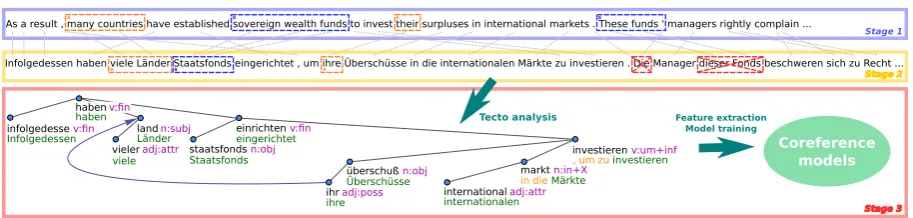
Our system for coreference resolution is an ex-ample of the projection in parallel corpus. It re-quires a corpus of parallel sentences in a source (English) and a target language (German and Rus-sian). The procedure consists of three stages il-lustrated in Figure 1. First, coreference links on the source-language side of the corpus are auto-matically resolved (see Section 3.1). The acquired links are then projected to the target-language side (Section 3.2). Finally, the target-language side en-riched with the projected links is used as a training data to build a coreference resolver (Section 3.3).
3.1 Coreference relations in English
The source-language side of the parallel corpus must get labeled with coreference. In our case, the English side of the parallel corpus already con-tained annotation of coreference provided by the shared task’s organizers. The annotation is ob-tained by Berkeley Entity Resolution system (Dur-rett and Klein, 2014), trained on the English sec-tion of OntoNotes 5.0 (Pradhan et al., 2013).
Although Berkeley system is a state-of-the-art performing coreference resolver, we found that it rarely addresses relative and demonstrative pro-nouns. To label coreference for relative pronouns, we introduced a module from the Treex frame-work2 that employs a simple heuristics based on
syntactic trees. Coreference of demonstratives has not been further resolved.
3.2 Cross-lingual projection of coreference The second stage the proposed schema is to project coreference relations from the source-language to the target-source-language side of the parallel corpus.
Specifically, we make use of word-level align-ment, which allows for potentially more accurate projection. As the parallel data provided for the task are aligned only on the sentence level, word alignment must be acquired on our own. For this purpose, we used GIZA++ (Och and Ney, 2000) a tool particularly popular in the community of sta-tistical machine translation. Even though GIZA++ implements a fully unsupervised approach, which allows for easy extension of the training data with raw parallel texts, it did not prove to be useful for us. We thus obtained word alignment for both the language pairs by running the tool solely on the parallel corpora coming from the organizers.3
Since both German and Russian are morpho-logically rich languages, we expected word align-ment to work better on lemmatized texts. We applied TreeTagger (Schmid, 1995), and MATE tools (Bj¨orkelund et al., 2010) for lemmatization in Russian and German, respectively. For robust-ness, also English texts were preprocessed with a similar procedure, namely a rule-based
lemmati-2Treex (Popel and ˇZabokrtsk´y, 2010) is a modular NLP framework, primarily designed for machine translation over deep syntax layer. It contains numerous modules for analysis in multiple languages.
Figure 1: Architecture of the system that consists of three stages: coreference resolution in English (Stage 1), cross-lingual projection of coreference (Stage 2) and resolution in the target language (Stage 3). In the projection stage, the mentionThese funds’is not projected because it is aligned to a discontinuous German span.
zation available as a module in the Treex frame-work.
Based on the word alignment, the projection it-self works as shown in Figure 1. We project men-tion spans along with its entity identifiers, which are shared among the cluster of coreferential men-tions. Only such a mention is projected, whose counterpart forms a consecutive sequence of to-kens in the target-language text. In practice, this approach succeeds in projecting around 90% of mentions.4
3.3 Coreference resolution in German and Russian
At this point, projected links are ready to serve as training data for a coreference resolver. We make use of an updated version of the already exist-ing resolver implemented within the Treex frame-work, which operates on a level of deep syntax. All the texts must thus be analyzed and the pro-jected mentions must be transferred up to this level before being used for training.
Analysis up to the tectogrammatical layer. Treex coreference resolver operates on a level of deep syntax, in Prague theory (Sgall et al., 1986) called tectogrammatical layer. On this layer, a sen-tence is represented as a dependency tree. Com-pared to a standard surface dependency tree, the tectogrammatical one is more compact as it con-sists only of content words (see Figure 1). In addi-tion, several types of ellipsis can be reconstructed in the tree, e.g. pro-drops.
To transform a text in a target language from a surface form to a tectogrammatical representation, we processed it with the following pipelines:
4However, they do not need to be necessarily correct, as the alignment may contain errors.
German texts are processed with the MATE tools pipeline (Bj¨orkelund et al., 2010) that in-cludes lemmatization, part-of-speech tagging, and transition-based dependency parsing (Bohnet and Nivre, 2012; Seeker and Kuhn, 2012). The surface dependency tree is then converted to the Prague style of annotation using a converter from the HamleDT project (Zeman et al., 2014). Trans-formation to tectogrammatics is then performed by a general Treex pipeline, with some language-dependent adjustments.
Russian texts are being parsed directly to the Prague style of surface dependency tree. We trained a UDPipe tool (Straka et al., 2016) on data from SynTagRus corpus (Boguslavsky et al., 2000) converted to the Prague style within the HamleDT project.5 Although UDPipe trained on
this data is able to lemmatize, we used lemmas produced by TreeTagger instead, as they seemed to be of better quality. In the same fashion as for German, tectogrammatical tree is built from the surface dependency tree using the Treex pipeline adjusted to Russian.
We also included named entity recognition, namely NameTag tool (Strakov´a et al., 2014), to the pipeline. We had trained it on an extended ver-sion of the Persons-1000 collection (Mozharova and Loukachevitch, 2016) and named entity an-notation of the NoSta-D corpus (Benikova et al., 2014) for Russian and German, respectively. Transfer of mentions from the surface and back. On the tectogrammatical layer, a
ence link always connects two nodes that repre-sent heads of the mentions. Tectogrammatics does not specify a span of the mention, though. The mention usually spans over the whole subtree, ex-cept for some notable cases. For instance, an an-tecedent of a relative pronoun does not include the relative clause itself in its span, even though the clause belongs to a subtree of the antecedent.
The transfer from the surface to the tectogram-matics is easy – a head of the mention must be found. We use the dependency structure of a tec-togrammatical tree for this and out of all nodes representing nouns or pronouns contained in the mention we pick the one that is closest to the root of the tree.
In the opposite direction, we consider the whole tectogrammatical subtree of a coreferential node. As mentions observed in the datasets rarely in-clude a dependent clause, we rather exin-clude all such clauses. We skip possible trailing punctua-tion and finally, we mark the first and the last to-ken of such selection as boundaries of the men-tion. Due to strict rules to find a mention span and possibly scrambled syntactic parses, this transfer is prone to errors (see Section 6).
Specialized models and features. Treex re-solver implements a mention-ranking approach (Denis and Baldridge, 2007). In other words, ev-ery candidate mention forms an instance, aggre-gating all antecedent candidates from a predefined window of a surrounding context. The antecedent candidates are ranked and the one with the high-est score is marked as the antecedent. Moreover, a dummy antecedent candidate is added. Highest score for the dummy antecedent implies that the candidate mention is not anaphoric, in fact.
In detail, the resolver consists of multiple mod-els, each of them focused on a specific mention type, e.g., relative pronouns, demonstrative pro-nouns, or noun phrases. It makes possible to use different windows and different features for each of the types. Personal and possessive pronouns are addressed jointly by two models: a model for per-sonal and possessive pronouns in third person and a model for these pronouns in other persons (in the following denoted asPP3 andPPo pronouns, re-spectively). Model configurations shared for both languages are listed in Table 1.
Features exploit information collected during the analysis to the tectogrammatical layer. As seen in the table, our models are trained using two kinds
Mention type DE RU Window Featset
NP X X curr sent, preceding5 prev sents NP PP3 X X 1 prev sent
curr sent, preceding general
PPo X X
demonstrative X X
reflexive X X curr sent, all
reflexive possessive × X
[image:4.595.310.525.63.156.2]relative X X curr sent, preceding
Table 1: Configuration of the coreference model for each mention type.
of a feature set:
• General: gender and number agreement,
other morphological features, distance fea-tures, named entity types, syntactic patterns in tectogrammatical trees (to address e.g., rel-ative and reflexive pronouns), dependency re-lations;
• NP: General + head lemma match, head
lemma Levehnstein distance, full match; for German: + a similarity score based on word2vec (Mikolov et al., 2013) embed-dings6of the mention heads.
The models were trained with logistic regres-sion optimized by stochastic gradient descent. We varied different values of hyperparameters (e.g., number of passes over data, L1/L2 regularization) and picked the setting best performing on the De-vAuto set (see Section 4). The learning method is implemented in the Vowpal Wabbit toolkit.7
4 Datasets
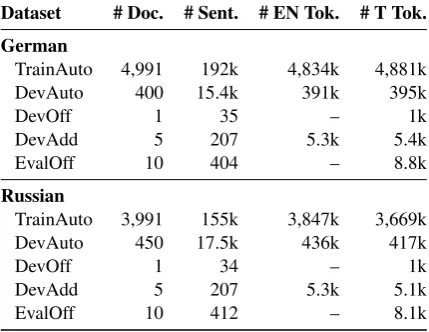
Raw datasets without manual annotation of coref-erence are used to train the pipeline described in Section 3. In contrast, manually annotated datasets are reserved exclusively for evaluation purposes. Table 2 shows some basic statistics of the datasets. We refer to each dataset by its label, which consists of two parts. The first part denotes the main purpose of the dataset: Trainis used for training,Devfor development testing, andEvalfor blind evaluation testing. The second part indicates the origin of the coreference annotation contained in the dataset: Auto denotes the projected auto-matic annotation,Off is the official manual anno-tation provided by the task’s organizers, andAdd
6http://devmount.github.io/GermanWordEmbeddings/ 7https://github.com/JohnLangford/vowpal_wabbit/
Dataset # Doc. # Sent. # EN Tok. # T Tok. German
TrainAuto 4,991 192k 4,834k 4,881k
DevAuto 400 15.4k 391k 395k
DevOff 1 35 – 1k
DevAdd 5 207 5.3k 5.4k
EvalOff 10 404 – 8.8k
Russian
TrainAuto 3,991 155k 3,847k 3,669k
DevAuto 450 17.5k 436k 417k
DevOff 1 34 – 1k
DevAdd 5 207 5.3k 5.1k
[image:5.595.309.525.64.173.2]EvalOff 10 412 – 8.1k
Table 2: Statistics of the datasets used throughout this work. The last two columns show the number of tokens in English and in the target language.
denotes the additional dataset annotated by the au-thors of this paper.
Raw data. We employed the parallel corpora provided by the task’s organizers for building
the resolver. Both the English-German and
English-Russian corpora come from the
News-Commentary11 collection (Tiedemann, 2012).
The datasets were provided in a tokenized sentence-aligned format. We split both corpora into two parts: TrainAuto and DevAuto. While the former is used for training the models, the lat-ter serves to pick the best values of the learning method’s hyperparameters (see Section 3.3). Coreference-annotated data. For evaluation purposes, we used two datasets manually anno-tated with coreference: DevOff andDevAdd. Ex-cept for these datasets, a dataset for the final eval-uation (EvalOff) of the shared task was provided by the organizer. However, the coreference anno-tation of this dataset has not been published.
Similarly to the raw data, DevOff has been pro-vided by the task’s organizers. In fact, both in German and Russian it is represented by a single monolingual document, presumably coming from the News-Commentary11 collection.
DevAdd dataset consists of the same five doc-uments randomly selected from both the English-German and English-Russian parallel corpora so that none of these are included in TrainAuto. Coreference relations were annotated on all the three language sides. The Russian and English sides were labelled by one of this paper’s co-authors, who speaks native Russian and fluent
Mention type German Russian
DevOff DevAdd DevOff DevAdd
[image:5.595.74.289.65.231.2]all 42 / 370 343 /2003 54 / 497 312 /2348 NP 27 / 312 181 /1568 40 / 475 157 /2129 PP3 10 / 16 76 / 142 10 / 10 68 / 70 PPo 0 / 4 33 / 53 1 / 2 29 / 49 demonstrative 1 / 19 9 / 107 0 / 4 0 / 27 reflexive 0 / 7 3 / 48 0 / 1 6 / 9 reflexive possessive – – 3 / 5 27 / 29 relative 4 / 12 41 / 85 0 / 0 25 / 35
Table 3: Distribution of mention types in German and Russian coreference-annotated datasets. De-nominators show the number of all mention candi-dates while numerators only of the anaphoric ones.
English, and has long experience of annotating anaphoric relations. The German side was split among three annotators and their outputs were re-vised by the annotator of the Russian and English part to reach higher consistency. They all followed the annotation guideline published by the orga-nizers.8 The reason for creating additional
anno-tated data is that the DevOff set consists only of a thousand words per language, which we found insufficient to reliably assess quality of designed systems. The English side was labelled to allow for assessing the quality of the projection pipeline over its stages (see Section 6).
Let us show some notable properties of the Ger-man and Russian evaluation data. Table 2 high-lights that the DevAdd sets expectedly contain five times more words than their DevOff counterparts. However, the number of sentences is six times big-ger. This may affect a proportion of individual mention types.
Table 3 gives a detailed picture of candidate and anaphoric mentions’ counts. Whereas Rus-sian anaphoric NPs account for 75% of all the anaphoric mentions in DevOff, it is only 50% in DevAdd. The disproportion appears also between the German datasets.
Finally, some of the mention types appear rarely in the DevOff sets. It especially holds for the Rus-sian DevOff containing a lack of reflexive, relative and PPo pronouns. Conversely, some of the even well-populated types are rarely or never anaphoric (e.g., German demonstrative, reflexive and PPo pronouns).
8https://github.com/yuliagrishina/
5 Evaluation
For both German and Russian, we submitted a sin-gle system to the shared task. Both the systems fulfill the requirements set on the closed track of the task. To build them we exploited the paral-lel English-German and English-Russian corpora selected from the News-Commentary11 collection by the task’s organizers.
Metrics. We present the results in terms of four standard coreference measures: MUC (Vilain et al., 1995), B3(Bagga and Baldwin, 1998),
CEAF-e (Luo, 2005) and thCEAF-e CoNLL scorCEAF-e (Pradhan CEAF-et al., 2014). The CoNLL score is an average of F-scores of the previous three measures. It was the main score of some previous coreference-related shared tasks, e.g., CoNLL 2012 (Pradhan et al., 2012), and it remains so for the CORBON 2017 Shared task.
Results. In Table 4, we report the results of eval-uating the submitted systems. Comparison across languages shows very similar performance on the DevOff set. However, evaluation on the larger De-vAdd set suggests the Russian resolver performs better. Scores on the EvalOff dataset confirms higher quality of the Russian resolver, however, the gap is not so big. As the latter dataset is the largest, these results can be considered the most reliable.
6 Discussion
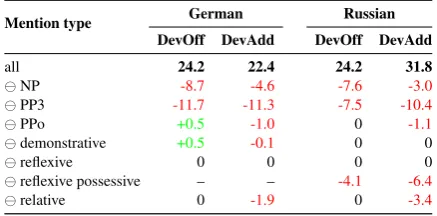
We conducted two additional experiments to learn more about the properties of the projection sys-tem. The first experiment investigates the impact of models for individual mention types. The sec-ond experiment, in contrast, should tell us more about the quality of the system over its stages. Model ablations. We conducted a model abla-tion experiment to shed more light on the model quality and difference between the two evaluation datasets. We repeated the same evaluation, how-ever, each time with a model for a specified men-tion type left out.
Results in Table 5 show that models for PP3 pronouns and NPs are the most valuable. Better performance of the Russian resolver on DevAdd seems to partly result from a decent model for re-flexive possessives, which do not exist in German. Other observations accord with what we high-lighted above after inspecting datasets’ statistics
Mention type German Russian
DevOff DevAdd DevOff DevAdd
all 24.2 22.4 24.2 31.8
NP -8.7 -4.6 -7.6 -3.0
PP3 -11.7 -11.3 -7.5 -10.4
PPo +0.5 -1.0 0 -1.1
demonstrative +0.5 -0.1 0 0
reflexive 0 0 0 0
reflexive possessive – – -4.1 -6.4
[image:6.595.307.526.63.171.2]relative 0 -1.9 0 -3.4
Table 5: Results of model ablation. The all line describes the complete resolver. Every following line represent an ablated resolver with a model for a given mention type left out. Differences in scores are listed in such line.
in Table 3. There is a big disproportion in score between the two datasets after the model for NPs is removed. This may be a consequence of dif-ferent ratios of anaphoric NPs to all the anaphoric mentions. Multiple models seem to have marginal, zero, or even negative impact on the final perfor-mance. The reasons are threefold:
• low frequency of the mention type in DevOff (e.g., Russian relative and PPo pronouns); • low frequency of its anaphoric occurrences in
the dataset (e.g., all demonstrative pronouns, German reflexive and PPo pronouns)
• the model learned to label most candidates as non-anaphoric (e.g. German demonstrative and reflexive pronouns)
Performance over projection stages. The final performance about 20-30 points seems to be much worse than the CoNLL scores over 60 points ob-served at the CoNLL 2012 shared task for English. Is coreference resolution in German and Russian so difficult or the projection system deteriorates as it proceeds over its stages?
Score DevOff GermanDevAdd EvalOff DevOff RussianDevAdd EvalOff
R P F R P F F R P F R P F F
MUC 19.0 50.0 27.6 15.7 59.6 24.9 – 16.7 64.3 26.5 23.8 57.5 33.7 –
B3 13.1 56.1 21.2 11.1 57.6 18.6 – 11.2 71.3 19.3 18.2 56.6 27.5 –
CEAF-e 21.2 27.2 23.8 16.2 44.3 23.7 – 22.1 34.1 26.8 26.9 46.8 34.2 –
[image:7.595.79.522.65.180.2]CoNLL 24.2 22.4 29.4 24.2 31.8 30.9
Table 4: Evaluation of the resolvers expressed in terms of Precision, Recall and F-score of some popular coreference measures.
back to the surface. This should find the price we pay for conducting coreference resolution at the tectogrammatical layer. Finally, we compare these figures with the final scores presented in Section 5 to see a penalty for modeling coreference.
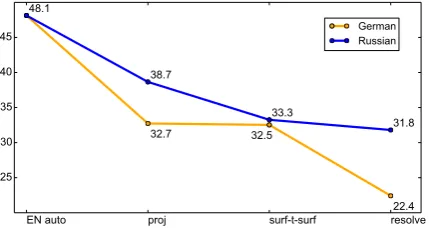
The experiment was undergone on the DevAdd dataset (see Section 5), annotated with coreference in German, Russian and English. The English part was used to evaluate after the first stage whereas the German and Russian parts for the rest. Perfor-mance was measured by CoNLL score.
Figure 2 illustrates how the score declines as the system proceeds over its stages (from left to right). The system for English evaluated after the first stage falls behind the state-of-the-art CR systems by more than 10 points. This can be attributed to a 33-times smaller test set as well as to gentle dif-ferences in annotation guidelines. Cross-lingual projection seems to be the bottleneck of the pro-posed approach. The performance drops by almost 10 points in Russian, even more in German. This could be partially rectified by using better align-ment techniques. The loss incurred by operating at the tectogrammatical layer is larger for Russian. It can be attributed to the parsing issues observed on Russian (see Section 3.3). On the other hand, modeling projected coreference by machine learn-ing harms a lot more for German. The models are fit using almost the same feature sets for both languages. Therefore, if the drop is not a conse-quence of the only difference in features, i.e. word embeddings for German set, it probably results from a different extent of expressive power of the feature set for the two languages. However, this must be taken with a grain of salt as we inferred it without searching for any empirical evidence.
Overall, while our projection-based resolver for Russian is able to preserve 66% of the quality achieved by the English resolver, it is only 46%
EN auto proj surf-t-surf resolve 25
30 35 40 45
48.1
38.7
33.3
31.8 32.7 32.5
22.4
German Russian
Figure 2: Performance decrease over the projec-tion stages. Measured by CoNLL score.
for German.
7 Conclusion
We introduced a system for coreference resolution via projection for German and Russian. The sys-tem does not exploit any manually annotated data in these languages. Instead, it projects the auto-matic annotation of coreference from English to these languages through a parallel corpus. The res-olution system operates on the level of deep syntax and takes advantage of specialized models for in-dividual mention types. It seems to be more suit-able for Russian as it is suit-able to achieve 66% of the English resolver’s quality, while it is less than 50% in German, both measured by CoNLL score. We submitted the system to the closed track of the CORBON 2017 Shared task.
Acknowledgments
[image:7.595.310.525.234.352.2]Ministry of Education, Youth and Sports of the Czech Republic.
We also gratefully thank to Katja Lapshinova-Koltunski from Saarland University, who helped us with annotation of German texts.
References
Mariana S. C. Almeida, Cl´audia Pinto, Helena Figueira, Pedro Mendes, and Andr´e F. T. Martins. 2015. Aligning Opinions: Cross-Lingual Opinion Mining with Dependencies. In Proceedings of the 53rd Annual Meeting of the Association for Compu-tational Linguistics and the 7th International Joint Conference on Natural Language Processing of the Asian Federation of Natural Language Processing, ACL 2015, Volume 1: Long Papers, pages 408–418, Stroudsburg, PA, USA. The Association for Com-puter Linguistics.
Amit Bagga and Breck Baldwin. 1998. Algorithms for Scoring Coreference Chains. InIn The First In-ternational Conference on Language Resources and Evaluation Workshop on Linguistics Coreference, pages 563–566.
Darina Benikova, Chris Biemann, and Marc Reznicek. 2014. NoSta-D Named Entity Annotation for Ger-man: Guidelines and Dataset. In Proceedings of the Ninth International Conference on Language Resources and Evaluation (LREC’14), Reykjavik, Iceland. European Language Resources Association (ELRA).
Anders Bj¨orkelund, Bernd Bohnet, Love Hafdell, and Pierre Nugues. 2010. A High-performance Syntac-tic and SemanSyntac-tic Dependency Parser. In Proceed-ings of the 23rd International Conference on Com-putational Linguistics: Demonstrations, pages 33– 36, Stroudsburg, PA, USA. Association for Compu-tational Linguistics.
Igor Boguslavsky, Svetlana Grigorieva, Nikolai Grig-oriev, Leonid Kreidlin, and Nadezhda Frid. 2000. Dependency Treebank for Russian: Concept, Tools, Types of Information. In Proceedings of the 18th Conference on Computational Linguistics-Volume 2, pages 987–991, Morristown, NJ, USA. Association for Computational Linguistics.
Bernd Bohnet and Joakim Nivre. 2012. A Transition-based System for Joint Part-of-speech Tagging and Labeled Non-projective Dependency Parsing. In
Proceedings of the 2012 Joint Conference on Empir-ical Methods in Natural Language Processing and Computational Natural Language Learning, pages 1455–1465, Stroudsburg, PA, USA. Association for Computational Linguistics.
Jos´e G. C. de Souza and Constantin Or˘asan. 2011. Can Projected Chains in Parallel Corpora Help
Coref-erence Resolution? In Proceedings of the 8th
International Conference on Anaphora Processing
and Applications, pages 59–69, Berlin, Heidelberg. Springer-Verlag.
Pascal Denis and Jason Baldridge. 2007. A Ranking Approach to Pronoun Resolution. InProceedings of the 20th International Joint Conference on Artifical Intelligence, pages 1588–1593, San Francisco, CA, USA. Morgan Kaufmann Publishers Inc.
Greg Durrett and Dan Klein. 2014. A Joint Model for Entity Analysis: Coreference, Typing, and Linking.
TACL, 2:477–490.
Yulia Grishina. 2017. CORBON 2017 Shared
Task: Projection-Based Coreference Resolution. In
The 15th Conference of the European Chapter of the Association for Computational Linguistics, Pro-ceedings of the Conference, Vol. 1 (Long Papers), Stroudsburg, PA, USA. Association for Computa-tional Linguistics.
Rebecca Hwa, Philip Resnik, Amy Weinberg, Clara
Cabezas, and Okan Kolak. 2005.
Bootstrap-ping Parsers via Syntactic Projection Across Parallel Texts. Natural Language Engineering, 11(3):311– 325.
Xiaoqiang Luo. 2005. On Coreference Resolution Performance Metrics. In Proceedings of the Con-ference on Human Language Technology and Em-pirical Methods in Natural Language Processing, pages 25–32, Stroudsburg, PA, USA. Association for Computational Linguistics.
Andr´e F. T. Martins. 2015. Transferring Coreference Resolvers with Posterior Regularization. In Pro-ceedings of the 53rd Annual Meeting of the Associ-ation for ComputAssoci-ational Linguistics and the 7th In-ternational Joint Conference on Natural Language Processing of the Asian Federation of Natural Lan-guage Processing, ACL 2015, Volume 1: Long Pa-pers, pages 1427–1437, Stroudsburg, PA, USA. As-sociation for Computational Linguistics.
Tomas Mikolov, Kai Chen, Greg Corrado, and Jeffrey Dean. 2013. Efficient Estimation of Word Repre-sentations in Vector Space. InProceedings of Work-shop at ICLR.
Valerie Mozharova and Natalia Loukachevitch. 2016. Two-stage Approach in Russian Named Entity Recognition. In Proceedings of the International FRUCT Conference on Intelligence, Social Media and Web (ISMW FRUCT 2016), pages 43–48, Saint Petersburg.
Franz J. Och and Hermann Ney. 2000. Improved Sta-tistical Alignment Models. In Proceedings of the 38th Annual Meeting on Association for Computa-tional Linguistics, pages 440–447, Stroudsburg, PA, USA. Association for Computational Linguistics.
Maciej Ogrodniczuk. 2013. Translation- and
Sebastian Pad´o and Mirella Lapata. 2009. Cross-lingual Annotation Projection of Semantic Roles.
Journal of Artificial Intelligence Research, 36(1):307–340.
Martin Popel and Zdenˇek ˇZabokrtsk´y. 2010.
Tec-toMT: Modular NLP Framework. In Proceedings
of the 7th International Conference on Advances in Natural Language Processing, pages 293–304, Berlin, Heidelberg. Springer-Verlag.
Oana Postolache, Dan Cristea, and Constantin Or˘asan. 2006. Transferring Coreference Chains through Word Alignment. In Proceedings of the Fifth In-ternational Conference on Language Resources and Evaluation, pages 889–892, Genoa, Italy. European Language Resources Association.
Sameer Pradhan, Alessandro Moschitti, Nianwen Xue, Olga Uryupina, and Yuchen Zhang. 2012. CoNLL-2012 Shared Task: Modeling Multilingual Unre-stricted Coreference in OntoNotes. In Joint Con-ference on Empirical Methods in Natural guage Processing and Computational Natural Lan-guage Learning - Proceedings of the Shared Task: Modeling Multilingual Unrestricted Coreference in OntoNotes, EMNLP-CoNLL 2012, pages 1–40, Jeju, Korea. Association for Computational Linguistics. Sameer Pradhan, Alessandro Moschitti, Nianwen Xue,
Hwee Tou Ng, Anders Bjrkelund, Olga Uryupina, Yuchen Zhang, and Zhi Zhong. 2013. Towards Ro-bust Linguistic Analysis using OntoNotes. In Pro-ceedings of the Seventeenth Conference on Com-putational Natural Language Learning, pages 143– 152, Sofia, Bulgaria. Association for Computational Linguistics.
Sameer Pradhan, Xiaoqiang Luo, Marta Recasens, Ed-uard Hovy, Vincent Ng, and Michael Strube. 2014. Scoring Coreference Partitions of Predicted Men-tions: A Reference Implementation. In Proceed-ings of the 52nd Annual Meeting of the Association for Computational Linguistics (Volume 2: Short Pa-pers), pages 30–35, Baltimore, Maryland. Associa-tion for ComputaAssocia-tional Linguistics.
Altaf Rahman and Vincent Ng. 2012. Translation-based Projection for Multilingual Coreference Res-olution. InProceedings of the 2012 Conference of the North American Chapter of the Association for Computational Linguistics: Human Language Tech-nologies, pages 968–977, Stroudsburg, PA, USA. Association for Computational Linguistics.
Helmut Schmid. 1995. Improvements In Part-of-Speech Tagging With an Application To German. In In Proceedings of the ACL SIGDAT-Workshop, pages 47–50, Stroudsburg, PA, USA. Association for Computational Linguistics.
Wolfgang Seeker and Jonas Kuhn. 2012. Making El-lipses Explicit in Dependency Conversion for a Ger-man Treebank. InProceedings of the Eight Interna-tional Conference on Language Resources and
Eval-uation, pages 3132–3139, Istanbul, Turkey. Euro-pean Language Resources Association (ELRA). Petr Sgall, Eva Hajiˇcov´a, Jarmila Panevov´a, and Jacob
Mey. 1986. The meaning of the sentence in its se-mantic and pragmatic aspects. Springer.
Milan Straka, Jan Hajiˇc, and Jana Strakov´a. 2016. UDPipe: Trainable Pipeline for Processing CoNLL-U Files Performing Tokenization, Morphological Analysis, POS Tagging and Parsing. InProceedings of the Tenth International Conference on Language Resources and Evaluation (LREC’16), pages 4290– 4297, Paris, France. European Language Resources Association (ELRA).
Jana Strakov´a, Milan Straka, and Jan Hajiˇc. 2014. Open-Source Tools for Morphology, Lemmatiza-tion, POS Tagging and Named Entity Recognition. In Proceedings of 52nd Annual Meeting of the As-sociation for Computational Linguistics: System Demonstrations, pages 13–18, Baltimore, Mary-land. Association for Computational Linguistics. Oscar T¨ackstr¨om, Dipanjan Das, Slav Petrov, Ryan T.
McDonald, and Joakim Nivre. 2013. Token and Type Constraints for Cross-Lingual Part-of-Speech Tagging. TACL, 1:1–12.
J¨org Tiedemann. 2012. Parallel Data, Tools and Inter-faces in OPUS. InProceedings of the Eight Interna-tional Conference on Language Resources and Eval-uation (LREC’12), pages 2214–2218, Paris, France. European Language Resources Association. Marc Vilain, John Burger, John Aberdeen, Dennis
Con-nolly, and Lynette Hirschman. 1995. A Model-theoretic Coreference Scoring Scheme. In Proceed-ings of the 6th Conference on Message Understand-ing, pages 45–52, Stroudsburg, PA, USA. Associa-tion for ComputaAssocia-tional Linguistics.