dynamic interceptive actions
STONE, Joseph A. <http://orcid.org/0000-0002-9861-4443>, MAYNARD, I.W. <http://orcid.org/0000-0003-2010-5072>, NORTH, J. S., PANCHUK, D. and DAVIDS, K. <http://orcid.org/0000-0003-1398-6123>
Available from Sheffield Hallam University Research Archive (SHURA) at: http://shura.shu.ac.uk/8561/
This document is the author deposited version. You are advised to consult the publisher's version if you wish to cite from it.
Published version
STONE, Joseph A., MAYNARD, I.W., NORTH, J. S., PANCHUK, D. and DAVIDS, K. (2015). Emergent perception–action couplings regulate postural adjustments during performance of externally-timed dynamic interceptive actions. Psychological
Research, 79 (5), 829-843.
Copyright and re-use policy
Emergent Perception-Action Couplings Regulate Postural Adjustments during Performance
of Externally-Timed Dynamic Interceptive Actions
J.A. Stone and I.W. Maynard
Sheffield Hallam University
J.S. North
St. Marys University, Twickenham
D. Panchuk
Victoria University, Victoria, Australia
K. Davids
Sheffield Hallam University
University of Jyväskylä
Authors Note
J.A. Stone and I.W. Maynard, Centre for Sport and Exercise Science, Sheffield
Hallam University; J.S. North, School of Sport, Health and Applied Science, St. Marys
University, Twickenham; D. Panchuk, Institute of Sport, Exercise, and Active Living,
Victoria University, Victoria, Australia; K. Davids, Centre for Sports Engineering Research,
Sheffield Hallam University and FiDiPro Programme, University of Jyväskylä.
Correspondence concerning this article should be addressed to Joseph Stone, Centre
for Sport and Exercise Science, Sheffield Hallam University, Collegiate Hall, Collegiate
Abstract
Studies of postural coordination during performance of externally-timed interceptive actions,
such as catching a ball, have been infrequent, with advanced visual information from a
thrower’s actions towards a catcher, typically excluded in experimental task constraints. Yet
evidence suggests that manipulating participant access to such information alters their hand
movements and gaze behaviours when catching. In this study, we manipulated participant
access to advanced information of a thrower’s actions and from ball flight while recording
whole body kinematic and kinetic data to investigate effects on postural control during
performance of interceptive actions. Twelve participants attempted to make or simulate
performance of one-handed catches in three experimental conditions: when facing integrated
videos of advanced visual information and ball flight only, videos of a thrower’s actions only,
and of ball flight only. Findings revealed when integrating advanced visual information and
ball flight, and when participants were provided with ball flight information only, lower limb
adjustments were primarily used to regulate posture. However, movement was initiated
earlier when advanced visual information was available prior to ball flight, resulting in more
controlled action and superior catching performance in the integrated condition. When
advanced visual information was presented without ball flight, smaller displacements were
observed in lower limb joint angles, resulting in upward projection of the centre of mass,
compared to a downward trajectory in the integrated video and ball flight, and ball-flight only
conditions. Results revealed how postural coordination behaviors are dependent on specific
informational constraints designed into experiments, implying that integration of task
Introduction
Externally-timed interceptive actions, such as catching a ball with one hand, require
precise spatiotemporal coordination between the catching arm and an approaching object in
order to bring the intercepting limb to the right place at the right time (Savelsbergh, Whiting,
Pijpers, & Van Santvoord, 1993). Previous studies of coordination of multi-articular actions
have revealed that movements like interceptions with the arm are 'nested' on to the
sub-system for regulation of upright posture (Riccio & Stoffregen, 1988; Savelsbergh, Bennett,
Angelakopoulos, & Davids, 2005). The equilibrium of vertical posture is achieved when the
center of mass (COM) of the body is positioned over the base of support and is aligned with
the center of pressure (COP). External perturbation can shift the projection of the COM
closer to the borders of the base of support and the alignment between the COM and COP is
disrupted, which may result in the loss of body equilibrium (Santos et al., 2010). Postural
regulation is required when catching a passing ball, both to counter effects of raising an arm
upwards and towards the object in space, but also to adjust against potential disequilibrium
caused by the mechanical impulse of an approaching projectile acting on the hand (Tijtgat et
al., 2013; Williams & McCririe, 1988). Indeed, previous research has shown that poor
catchers were able to achieve the performance level of good catchers when additional support
for postural control was provided to reduce the number of motor system degrees of freedom
that need to be coordinated in a synergy (see Angelakopoulos, Davids, Bennett,
Tsorbatzoudis, & Grouios, 2005; Davids, Bennett, Kingsbury, Jolley, & Brain, 2000;
Savelsbergh, et al., 2005).
Theoretical frameworks dedicated to explaining how the multitude of motor system
degrees of freedom can be regulated effectively and efficiently, such as ecological dynamics
(Warren, 2006; Kelso, 1995), propose that synergies are formed between system components
movement patterns have been defined as soft-assembled, compensatory, low-dimensional
relations between motor system components that emerge during performance of dynamic
activities, constrained by information sources available in performance environments (Kelso,
1995, Kelso, Buchanan, DeGuzman, & Ding, 1993; Riley, Shockley & Van Orden, 2012).
Accordingly, in this study, we aimed to examine how the nature of postural coordination is
affected by both perceptual task constraints and specificity of a required behavioural
response. We achieved this aim by manipulating participants’ access to advanced visual
information (defined as information available from a thrower’s movement patterns prior to
ball flight), as well as the required action response (interceptive action vs. simulated
micro-movement) undertaken during performance.
Ecological dynamics provides a conceptual framework for considering human beings
as complex adaptive systems composed of many interacting components or degrees of
freedom (such as muscles, joints, limb segments) (Araújo, Davids, & Hristovski, 2006;
Davids, Hristovski, Araújo, Balague-Serre, Button, & Passos,2014; Warren, 2006). In this
theoretical rationale for understanding human behavior, how individuals coordinate actions
with respect to objects, events and other people, during goal-directed behaviors, has been a
longstanding topic of investigation (see Kelso, et al. 1993). The coordination of actions with
a performance environment is predicated on the emergence of stable, adaptive behaviors
when motor system degrees of freedom become temporarily organized into ordered
movement patterns (Bernstein, 1967; Kelso, 1995; Kelso et al., 1993). Perception of
information about the world and the body constrains the emergence of these adaptive,
functional coordination patterns in human movement systems during goal-directed activity
(Warren, 2006; Davids, Araújo, Vilar, Renshaw & Pinder, 2013). Skilled movement
performance emerges through the enhanced coupling of perception and action sub-systems
Kirshner, 2001; Chow, Davids, Hristovski, Araújo, & Passos, 2011; Davids, Button, &
Bennett, 2008). Previous research has highlighted the importance of advanced information as
a critical constraint on the emergence and regulation of postural control during human
movement (Riccio & Stoffregen, 1988; Riccio & Stoffregen, 1991; Stoffregen et al., 1999).
Both implicit knowledge learned from trial repetition with similar motion characteristics, or
explicit prior warning in task constraints (e.g., perceived velocity of an approaching ball), can
influence postural control mechanisms during catching (Tijtgat, Bennett, Savelsbergh, De
Clercq, & Lenoir 2010, 2011) and upright standing (Aimola, Santello, La Grua, & Casabona,
2011; de Lima, de Azevedo Neto, & Teixeira 2010). Tijtgat et al. (2012) showed that, during
a catching task, provision of explicit advanced knowledge of ball velocity enabled a more
functional scaling of arm movement during the transport phase, with the initial motor
response adapting to the expected ball speed. These adaptions were absent when no advanced
information was available and the initial response was similar regardless of ball speed. With
the provision of advanced information, a smaller forward momentum of the rest of the body
was produced, indicating a less pronounced postural response, which enabled the motor
system to maintain balance during the sensitive grasping phase.
The importance of visual information for regulating postural behaviors was also
highlighted by Santos, Kanekar, and Aurin (2010a, 2010b). During a predictable perturbation
(with eyes open) individuals produced anticipatory postural adjustments, whereas in an
unpredictable condition (with eyes shut) significantly smaller anticipatory postural
adjustments emerged, being replaced by compensatory postural adjustments after the
perturbation. Furthermore, centre of pressure and centre of mass changes were much greater
in the unpredictable condition, demonstrating how anticipatory postural adjustments allow
individuals to maintain postural stability from a perturbation. These data suggest that, with
postural adjustments) might enable a reduction in compensatory postural adjustments. During
catching performance, the availability of visual information is important since it provides
greater system stability, which is functional for successfully catching a ball.
Surprisingly, despite these findings, there has been limited research on anticipatory
postural adjustments during performance of externally-timed interceptive actions. Existing
research has often excluded advanced perceptual information in experiments (e.g. Eckerle,
Berg, & Ward 2012; Kazennikov & Lipshits, 2010; Tijtgat et al., 2010, 2012, 2013) and
typically, studies of catching behaviors have been designed so that participants are
constrained to catch balls launched from a projection machine, to facilitate experimental
control of flight trajectory. However, projection machines do not provide access to advanced
visual information from a thrower’s actions. For example, Tijtgat et al. (2013) covered their
machine with black plastic to ensure participants could not anticipate ball delivery. The
removal of such informational constraints, although providing some experimental control,
significantly alters the affordances (invitations for action; Gibson, 1979) available to a
participant to regulate their actions. Skilled performers regulate interceptive actions by
coupling them to different sources of information that become partially available at different
times in dynamic performance contexts (van der Kamp, Rivas, Doorn, & Savelsbergh, 2008).
For example, information prior to ball flight has been revealed as important for successful
performance of interceptive actions(e.g., Panchuk, Davids, Sakadjian, MacMahon &
Partington, 2013; Stone, Panchuk, Davids, North, & Maynard, 2014). This control strategy of
adapting actions to emergent task constraints allows skilled performers to harness the
information richness of the performance environment and supports successful behavior.
The removal of key advanced information sources significantly alters the task
constraints for the performer, which in turn alters the emergent movement organisation (for a
Brunswik’s (1956) theory of representative design in experiments, Pinder et al. (2011)
highlighted two critical features within representative design: functionality of the
informational constraints in an experiment and action fidelity. Functionality enables
performers to regulate action with information that is representative of a performance
environment and action fidelity allows performers to organise actions that would be required
in a specific performance environment. Clearly, if the aim of empirical work is to investigate
the role of initial movements and postural control during catching, then the information
typically available when performing this task needs to be presented to participants (especially
the movement kinematics of a ball thrower’s actions).
Only recently have technological developments enabled perception (functionality)
and action (fidelity) to be fully integrated, while retaining experimental control of key
informational constraints, such as ball flight trajectory (for more detail see methods section
and Stone et al., 2013). Stone et al. (2014), using technology that integrated visual
information of images of an individual throwing a ball, synchronised with controlled ball
projection from a machine (Panchuk et al., 2013; Stone et al., 2013), reported more
successful catching behaviors in skilled catchers with the integrated technology, compared to
using a ball projection machine only. In addition, analysis of their gaze behaviors revealed
that more fixations were made, tracking of the ball occurred earlier, and for a longer period of
time, when advanced visual information was available for the catchers. Analysis of kinematic
measures of hand movements revealed a smaller maximum velocity and quicker time to reach
maximum grip aperture, allowing for a more controlled action of the hand, when advanced
visual information was combined with ball flight-only, compared to when a ball was
projected without advanced visual information available. Findings suggested that perception
and action need to be carefully coupled during studies of externally timed interceptive
interceptive actions, participants are frequently required to make reductionist, simplified
micro-movement responses to simulate actions (e.g., McRobert, Williams, Ward & Eccles,
2009; Vignais et al., 2009). To highlight this issue, Stone et al. (2014) also examined the
emergence of simulated catching actions in a condition with visual presentation of a
thrower’s actions only (without ensuing ball flight-only). When simulating catches,
participants did not organise the same arm/hand movements observed when they performed
catching actions. Arm and hand movements were initiated much later and at a higher
velocity, with grip aperture values being greater when simulating catching actions. Clearly,
micro-movements do not successfully simulate dynamics interceptive actions like
one-handed catching.
Taken together, these findings demonstrate how both vision of a thrower’s actions and
ball flight can act as critical informational constraints on successful performance of
interceptive actions. The data suggest the need to maintain functional couplings between
perception and action, which help to regulate postural control during performance of
externally-timed interceptive actions. To address this issue, we investigated how visual
information from an image of a ball thrower and during ball flight, along with the specific
actions produced, affected postural control and coordination of attempted interceptions in
participants during a one-handed catching task. To achieve our empirical aims, participants
completed a one-handed catching task in three conditions: (i) integrated video-ball flight,
when advanced visual information from a ball thrower (i.e. video) and ball flight were
combined, (ii) ball flight-only, when only ball flight information was available, and (iii)
video-only, when participants were only presented with advanced visual information from
videos of a thrower’s movement kinematics and were required to simulate a catching action.
These three conditions allowed i) a representative design with advanced visual information
(action fidelity). Condition ii) removed functionality (no advanced information) but
maintained fidelity (actual catch) and condition iii) maintained functionality (advanced
perceptual information) but removed action fidelity by making participants simulate the
action.
Based on Brunswik’s (1956) theory of representative design, and previous findings
reported by Stone et al. (2014), we developed two main hypotheses. First, we expected that
coordination of postural control and interceptive movements would be initiated earlier when
advanced visual information and ball flight were combined (integrated video-ball flight),
compared to a ball flight-only condition, due to advanced visual information providing more
specifying affordances, resulting in a better-timed and more controlled movement in skilled
catchers. We also predicted that during a simulated action (video-only), whole body
movements would occur later and a smaller advanced postural adjustment would be produced
compared to when a ball is projected. The removal of information from ball trajectory was
also expected to affect perception-action coupling, with limited postural adjustments being
required due to the removal of ball impact and the need to actually intercept an object.
Method
Participants
Twelve (10 Male, 2 Female; mean age 24.3 ± 4) skilled right-handed catchers
volunteered for the study. Participants were classified as skilled catchers since they had at
least 5 years’ experience in competitive sports that involved catching projectiles such as
cricket, Australian Rules Football and handball (obtained by a sport participation
questionnaire). During a pre-test they were also required to successfully catch at least 16 out
of 20 (M = 18.1 ± 1) balls at 50 km/h from the ball flight-only machine. Skill level was also
Institutional ethics approval was granted by a Research Ethics Committee and all participants
provided informed consent.
Apparatus
A custom-built apparatus (see Stone et al., 2013, for a detailed description) integrated
a ball projection machine (Spinefire Pro 2, Spinfiresport, Tennis Warehouse, Victoria,
Australia) with a PC (Windows XP, Microsoft, USA), video projector (BenqMP776s, Benq,
Australia) and a freestanding projection screen (Grandview, Grandview Crystal Screen,
Canada) with a 15 cm whole cut into the screen. This enabled a video to be projected onto the
screen and synchronised with ball projection. Videos of an actor throwing a ball were
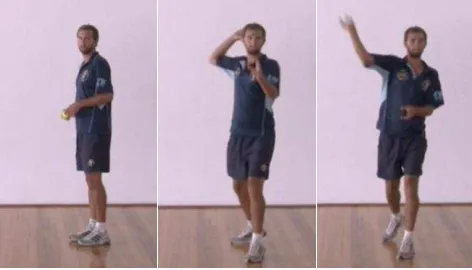
captured from the participant’s viewing perspective (see Figure 1). The criteria for a video to
be selected for presentation were: in a filmed throw, the ball had to hit a target area of 1 m x
1 m at a speed of 50 ± 2 km/h measured using a radar gun. Five videos were selected to
ensure the actor’s throw remained consistent across all trials. Three conditions, each with 30
trials, were created; A video-only condition where a video of a ball being thrown was shown
with no ball being projected; A ball flight-only condition, where balls were projected from a
machine without an accompanying video of a throw; finally, an integrated video-ball flight
condition which synchronised videos of a throwing action with ball flight-only from a
machine. Final Cut Pro software (Apple, California, USA) was used to edit footage so that
the spatial location of ball release occurred at the same position in each trial. Time to ball
release was recorded and aligned within the software to ensure accurate synchronisation of
the image of the thrower’s release of the ball and its projection from the machine.
Kinematic data from participants were collected using a VICON MX System
consisting of 10 MX-T-40S cameras recording data at 500 Hz. Markers were placed using a
cervical vertebrae, 10th thoracic vertebrae, clavicle, sternum, right back, left and right
shoulder (Acromio-clavicular joint), left and right upper arm, left and right elbow (lateral
epicondyle), left and right forearm, left and right wrist a and b, left and right finger (dorsum
of the hand just below the head of the second metacarpal), left and right anterior superior iliac
spine, sacral, left and right lateral epicondyle of knee, left and right thigh, left and right ankle
(lateral malleolus along), left and right tibia, left and right toe (second metatarsal head), and
left and right heel (calcaneous at the same height above the plantar surface of the foot as the
toe marker). Two additional markers were placed on the end of the right distal phalanges of
the index finger and thumb. A 14-segment model consisting of feet, shanks, thighs, pelvis,
thorax/abdomen, upper arms, lower arms and hands was created using VICON Nexus
Plug-in-Gait. Kinetic data were collected using a force plate (AMTI OR6) at 1000Hz, which was
synchronised with VICON Nexus.
Procedure
First, an overview of the apparatus was provided and sport participation
questionnaires completed by participants. Without synchronised videos, three practice trials
at a ball velocity of 50 km/h were performed, followed by a 20-trial pre-test of participant
catching skill. Using the Plug-in-Gait guidelines, reflective markers were attached using
double-sided tape. Five further trials were performed with videos of a thrower’s actions
available to enable participant familiarisation with equipment.Thirty trials in each of three
blocked conditions were undertaken in a counterbalanced design: ball flight-only, integrated
video-ball flight, and video-only. Participants were asked to catch the balls during ball
flight-only and the integrated video-ball flight conditions. They were asked to simulate a catch
during video-only trials by timing and placing their hand at the location where they expected
with their dominant (right) hand while standing 7 m away from the screen, starting in a
relaxed position with their hand by their side and feet shoulder width apart. The ball
(mid-pressed tennis balls, 66mm diameter) was placed into the projection machine and the
apparatus was activated after a random interval between 0-3 seconds; depending on the
experimental condition, the video and/or ball were projected. The only instructions given to
participants were to attempt to catch the ball or simulate a catching action, which enabled
analysis of emergent behaviors. Two researchers independently recorded the outcomes of
catching performance for each trialto ensure reliability. In order to prevent fatigue,
participants were given a 2-5 minute break between blocks. No discomfort or impediment
was reported when catching the ball using the equipment. Acoustic information from the
apparatus was removed by having participants wear earplugs.
Data Processing and Analysis
During integrated video-ball flight and ball flight-only conditions, each performance
outcome was recorded as a catch or drop, with success rate expressed as a percentage of trials
(after Stone et al., in press). Kinematic and kinetic data of participant catching
actions/simulations were recorded and analysed off-line using VICON Nexus software and
MS Excel. Kinematic and kinetic data were smoothed using a Butterworth filter (set to 8Hz
and 20Hz respectively). Of 1,080 trials recorded across all participants, 56 trials (5.1%) were
removed from analysis due to technical faults. The onset of movement was calculated by
calculating the forward acceleration of the right hand marker with a velocity threshold change
of 5m/s or greater, with all trials realigned to this point (Ton) (after Stone et al., in press).
Each trial was analysed from 300 ms before to 800 ms after Ton (based on Tijtgat et al.,
2013). All joint angles, centre of pressure (COP) and centre of mass (COM) are expressed
Joint angle data were produced using the Plug-in-Gait (PIG) model. The model
consisted of fourteen body segments, pelvis, femur (2), tibia (2), feet (2), humerus (2), radius
(2) hands (2) and thorax. Angular displacement (°) of flexion/extension was calculated on the
right side for ankle, knee, hip, shoulder, elbow, wrist and the spine and thorax. In the sagittal
plane, the positive sign corresponds to flexion and the negative to extension.
Displacement of COP in the anterior-posterior direction was calculated using the
approximation method (Winter et al., 1996).
COP = My + Fx * d/Fz
My = moment in sagittal plane. Fz and Fx are the vertical and anterior components of
ground reaction force (GRF) and d is the distance from the origin of the force platform to the
surface.Body mass and height with seven anthropometrical measures, leg length, knee,
ankle, elbow and wrist width and shoulder offset and hand thickness for each participant were
entered into the PIG model. These measures with kinematic data were used to calculate the
body’s COM position. COM in the sagittal (COMx), front (COMy) and transverse (COMz)
planes were analysed. Timing of displacement onset in COP (COP-Onset), COMx
(COMx-Onset), COMy (COMy-Onset) and COMz (COMz-Onset) was initially determined by a
trained researcher and confirmed by an acceleration rise of the signal of 0.5 m/s2 (Santos et
al., 2010b; Tijtgat et al., 2013). Peak displacements in COP (Peak-COP) and each plane of
COM, (Peak-COMx, Peak-COMy and Peak-COMz) and respective times were calculated
(Time-to-peak-COP, Time-to-peak-COMx, Time-to-peak-COMy and Time-to-peak COMz)
and used as an indication of postural control (Santos et al., 2010b). Time from COP Onset to
Peak-COP was calculated by subtracting Time-to-peak COP from COP-Onset and temporal
changes in displacement of COP are presented as an average over 50 ms intervals (see Figure
2). Descriptive statistics for the performance outcomes of successful catches and dropped
COM variables are also presented (Table 1). With three participants successfully catching all
the balls during the integrated video-ball flight condition, mean values for nine participants
were used to calculated the values for dropped catches in these conditions. Each of these
measures provided insights into participants’ regulation of posture during performance of the
catching action.
Mean displacement values of each angle were calculated for 4 epochs to examine
segmental control (using criteria of Santos et al., 2010b). Epochs 1 and 2 were based on
methods from previous studies of anticipatory postural adjustments (Shiratori & Latash,
2001; Santos et al., 2010b). Epochs 3 and Epochs 4 were selected on the corrective postural
control adjustments observed in the trunk and leg muscles during catching (Tijtgat et al.,
2013).
The epochs used were aligned to Ton with epoch 1 (Ep1) -200 ms to -50 ms, epoch 2
(Ep2) -50 ms to +100 ms, epoch 3 (Ep3) +100 ms to 250 ms and epoch 4 (Ep4) +250 ms to
400 ms. Epochs 1 and 2 are considered to reveal advanced postural adjustments, with 3 and 4
showing compensatory postural adjustments. These epochs were used for statistical analysis
and a temporal evaluation is also presented for each angle averaged over 50 ms intervals.
Statistical Analyses
A dependent measures t-test was performed on catching performance outcome data
observed in integrated video-ball flight and ball-flight only conditions. Multiple repeated
measures ANOVAs (Condition (3) x Variable) were used to analyse COP-onset,
COMx-onset, COMy-COMx-onset, COMz-COMx-onset, Peak-COP, Peak-COMx, Peak-COMy, Peak-COMz, Time
Multiple two-way repeated measures ANOVAs were used (Condition (3) and epochs
(4)) to analyse joint angles (Ankle, Knee, Hip, Spine, Thorax, Shoulder, Elbow, Wrist). A
Greenhouse-Geisser correction was applied to any violations of sphericity with the repeated
measures variables. Post-hoc testing was used to further analyse any main effect differences
using a Bonferroni correction. If an interaction was present, simple effects analysis, with a
Bonferroni correction was applied. Mean and standard error data are presented with all times
displayed in ms. Partial eta squared (ηp2) is used for effect size estimations of ANOVA main
effects with Cohen’s d presented, when appropriate, for post-hoc analyses.
Results
Catching Performance Outcomes
Performance condition affected catching performance outcomes t(1, 11) = 2.285, p
< .05, d = .79 with catching success being greater in the integrated video-ball flight condition
(94.7% ± 4.8 % of balls caught) than in the ball flight-only condition (88% ± 11.1%).
COP and COM
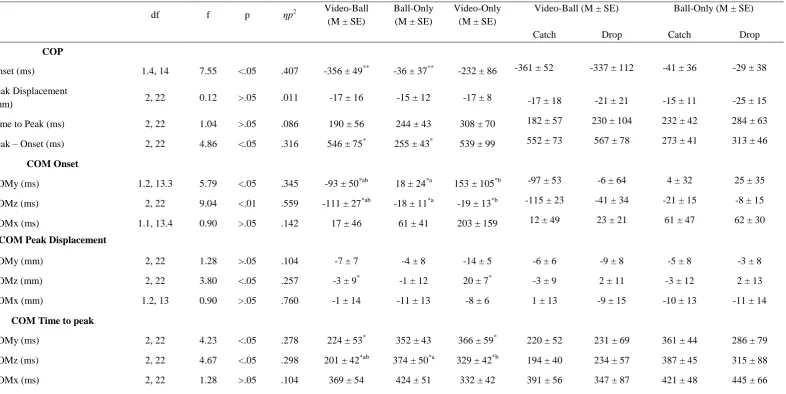
Statistical outcomes for analysis of both COP and COM measures are summarised in
Table 1. Two significant effects of conditions on COP were revealed. First, performance
condition had a main effect on COP-Onset (p < .05, ηp2= .40), withpost-hoc tests showing that in the ball flight-only condition, COP-Onset emerged significantly later than in the
integrated video-ball flight condition (p < .001, d = 2.1). Second, performance condition
affected the time difference between COP-Onset to Time-of-Peak-COP (p < .05, ηp2= .31) with post-hoc tests showing a smaller time difference in the ball flight-only condition
Changes in COMz and COMy were observed between conditions, with COMz-Onset
being affected by performance condition (p < .001, ηp2= .56). All COMz-Onset values emerged before Ton, with post-hoc tests revealing that this effect emerged earlier in the
integrated ball flight condition than in the ball flight-only (p < .05, d = 1.3) and
video-only conditions (p < .05, d = 1.24). There was also a main effect of performance condition on
Peak-COMz (p < .05, ηp
2
= .26) with post-hoc tests showing a smaller peak displacement for
Peak-COMz emerging in the integrated video-ball flight condition compared to the video-
only condition (p < .05, d = .80). Performance condition also affected Time-to-peak-COMz
(p > .05, ηp2= .30) with post-hoc tests showing that the Time-to-peak-COMz emerging in the ball flight-only and video-only conditions occurred later than in the integrated video-ball
flight condition (p = .046, d = 1.1, p < .05, d = .88 respectively).
There was also a main effect of performance condition on COMy-Onset (p < .05, ηp2 = .35). Post-hoc tests showed that in the integrated video-ball flight condition, COMy-Onset
emerged before Ton and differed in value in the ball flight-only (p < .05, d = .82) and video-
only (p < .05 d = .86) conditions, with their onsets emerging after Ton. Performance condition
had a main effect on Time-to-peak-COMy (p < .05, ηp2 = .28). Post-hoc tests showed that Time-to-peak-COMy emerged earlier during the integrated video-ball flight condition than in
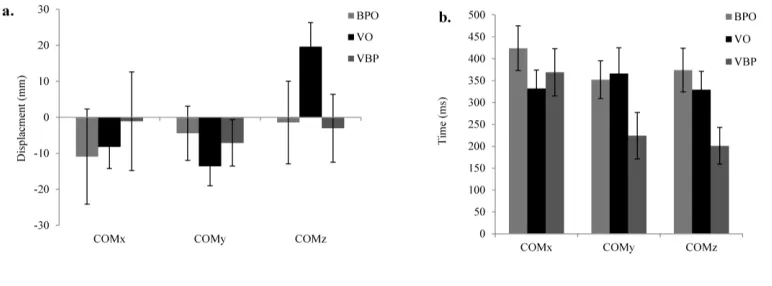
both the ball flight-only (p = .071, d = .76) and video-only (p = .052, d = .72) conditions (see
Figure 3).
Angles
Postural Control - Hip, Knee, Ankle, Spine and Thorax
Performance condition had a main effect on ankle displacement values, F(2, 22) =
than in the video-only (0.1° ± 0.1°) condition (p < .000, d = 2.10 and p < .05, d = 1.90
respectively)(see figure 4). Epochs had a main effect on ankle displacement values F(1.08,
11.79) 19.89, p < .001 ηp2= .64. Post-hoc tests showed differences between ankle
displacement values at all epochs, with greater ankle displacement values observed as time
increased; Ep1 (1.0° ± 0.2°) displayed smaller displacement values than Ep2 (1.9° ± 0.4°),
Ep3 (3.8° ± 0.7°) and Ep4 (5.8° ± 1.1°) (all p’s < .05, d = .84, d = 1.50, d = 1.70
respectively). Ankle displacement values in Ep2 were smaller than in Ep3 (p < .05, d = .89)
and Ep4 (p < .05, d = 1.34). Ep3 also revealed smaller ankle displacement values than Ep4 (p
< .05, d = .63). There was also a significant performance condition x epoch interaction,
F(1.30, 14.29) = 23.15, p < .000, ηp2 = .68.
Performance condition had a main effect on knee displacement values F(2, 22) =
7.93, p < .05, ηp2 = .42. Post-hoc tests showed that the ball flight-only (5.8° ± 1.6°) and integrated video-ball flight (6.0° ± 1.7°) conditions revealed greater knee displacement values
than the video-only condition (-0.1° ± .1°, both p’s < .05, d = 1.30, d = 1.31 respectively).
Epochs also affected knee displacement values F(1.07, 11.78) = 16.53, p < .001, ηp2= .60. Post-hoc tests showed that, as time increased, magnitude of knee displacement values
increased, (Ep1 1.0° ± 0.4°; Ep2 2.0° ± 0.6°; Ep3 4.9° ± 1.2°; Ep4 7.9° ± 1.8°; with knee
displacement values in each epoch significantly different from each other, p’s < .05). There
was also a condition x epoch interaction F(1.41, 15.51) = 8.32, p = < .05, ηp2 = .43.
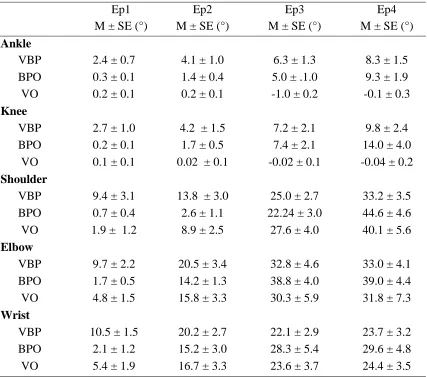
A summary of descriptive statistics for significant interactions of joint angle x epoch
is presented in Table 2. Analysis showed that during the video-only condition, both ankle and
knee displacement values did not change across epochs (both p > .05). In contrast, in the ball
flight-only condition, ankle and knee displacement values increased as time progressed (both
p < .05). Similarly, during the integrated video-ball flight condition, ankle displacement
from Ep1 and Ep2 (p > .05) and Ep3 and Ep4 (p > .05). During Ep1 and Ep2 (anticipatory
epochs) greater increases in ankle displacement values were seen in integrated video-ball
flight condition than ball flight-only condition (Ep1 p < .05, d = 1.30, Ep2 p < .05, d =
1.01 ). Greater knee displacement values were observed at Ep1 in the integrated video-ball
flight condition than in the ball flight-only condition (p < .05, d = 1.02). During the final
three epochs, ankle displacement values in the video-only condition were consistently smaller
than in the ball flight-only condition (Ep2, p < .05, d = 1.37; Ep3, p < .001 d = 2.05; Ep4, p
< .001, d = 2.02) and in the integrated video-ball flight condition (Ep2, p < .05, d = 1.5; Ep3,
p < .001, d = 1.95; Ep4, p < .000, d = 2.25). Similar observations were noted for knee
displacement values which were smaller in the video-only condition than the ball flight-only
condition (Ep2 p < .05, d = 1.38; Ep3, p < .05, d = 1.44; Ep4, p < .05, d = 1.43) and the
integrated video-ball flight condition (Ep2, p = .056, d = 1.12; Ep3, p < .05, d = 1.41; Ep4,
p < .05, d = 1.65).
Performance condition had no main effect on hip displacement values F(1.13, 12.42)
= 1.90, p > .05, or epochs F(1.02, 11.23) = 2.05, p > .05. There was also no displacement x
epoch interaction F(1.21, 13.32) = 2.79, p > .05.
Performance condition and epochs had no main effect on thorax displacement values
F(2, 22) = 1.74, p > .05, ηp2= .14 and F(1.14, 12.51) = 3.24, p > .05 respectively. There was also no performance condition x epochs interaction F(1.79, 19.72) = 1.11, p > .05, ηp2= .09.
Performance condition did not have a main effect on spine displacement values F(2,
22) = 1.76, p > .05, ηp2= .14, and nor did Epochs F(1.06, 11.65) = .53, p > .05. There was also no performance condition x epochs interaction, F(2.02, 22.25) = .81, p > .05.
Performance condition had no effect on shoulder displacement values F(1.23, 13.58)
= .39, p > .05, and nor did Epochs F(1.41, 15.55) = 100.73, p < .000, ηp2 = .90. Shoulder displacement values differed from one another at all epochs (p < .001), with shoulder
displacement values increasing as time progressed (Ep1 4.0 ± 1.2°; Ep2 8.5 ± 1.5°; Ep3 25.0
± 2.1°; Ep4 39.3 ± 2.1°). A significant performance condition x epochs interaction was
observed, F(1.62, 17.80) = 4.69, p < .05, ηp2 = .30 (see figure 4).
Performance condition had no main effect on elbow displacement values F(2, 22)
= .46, p > .05, ηp2= .04. There was a main effect of Epochs on elbow displacement values F(5.41, 13.28) = 46.92, p < .000, ηp2 = .81. Post-hoc tests showed elbow displacement values at Ep1 (5.4 ± 1.0°) were smaller than in Ep2 (16.8 ± 2.1°, p < .000, d = 2.01), Ep3
(34.0 ± 3.8°, p < .000 d = 2.94) and Ep4 (34.6 ± 4.4°, p < .000 d = 2.65). At Ep2 elbow
displacement values were smaller than in Ep3 (p < .000 d = 1.60) and Ep4 (p < .001 d =
1.49). There was also a performance condition x epochs interaction F (2.05, 22.50) = 3.56, p
< .05, ηp2 = .25.
Performance condition did not have a main effect on wrist displacement values F(2,
22) = .18, p > .05, ηp2 = .02. Epochs revealed a main effect on wrist displacement values F(1.22, 2.06) = 54.49, p < .000, ηp2 = .83. Ep1 (6.0 ± 1.2°) revealed smaller wrist
displacement values than Ep2 (17.4 ± 2.5°, p < .000, d = 1.69), Ep3 (24.7 ± 3.4° p < .000, d =
2.15) and Ep4 (25.9 ± 3.1°, p < .000, d = 2.4). Values of wrist displacement at Ep2 were
smaller than Ep3 (p < .001, d = .70) and Ep4 (p < .000, d = .86). A condition x epochs
interaction was present F(2.06, 22.63) = 6.31, p < .05, ηp2 = .36 (see Figure 5).
Simple effects analysis revealed limb displacement changes in all three conditions
(see Table 2 for descriptive statistics). Shoulder displacement values increased in each epoch
as time progressed (p <.05), apart from in the ball flight-only condition at Ep1 and Ep2
flight and ball flight-only conditions, in all epochs (p < .000, p < .05 respectively) apart from
Ep3 and Ep4 (p > .05). Elbow displacement values in the video only condition differed across
epochs (p < .05), other than in comparisons between Ep2 and Ep4 (p > .05) and Ep3 and Ep4
(p > .05). At the wrist, changes were observed in the ball flight-only condition in all epochs
(p < .001), apart from in comparisons between Ep3 and Ep4 (p >.05). In the video only
condition the wrist displacement values epochs were again different across all epochs (p
<.05) apart from in comparisons between Ep3 and Ep4 (p >.05) and during integrated
video-ball flight condition the wrist displacement values were all different, increasing as time
progressed (p < .05), apart from Ep2 and Ep4, Ep3 and Ep4 (p <.05).
At Ep1 increased displacement values were observed in the integrated video-ball
flight condition, compared to ball flight-only condition, at the shoulder (p < .05, d = 1.14),
elbow (p < .05 d =1.43) and wrist (p < .01, d = 1.82). The integrated video-ball flight
condition also revealed greater wrist displacement values at Ep1 than in the video-only
condition (p < .05, d = .88). At Ep2 shoulder displacement values were greater in the
integrated video-ball flight condition compared to the ball flight-only condition (p < .05, d =
1.45). No differences in shoulder displacement values were observed during Ep3 (p > .05).
However, at Ep4, the integrated video-ball flight condition revealed smaller shoulder
displacement values than in the ball flight-only condition (p < .05, d= .81).
Discussion
In this experiment we examined how manipulating access to advanced visual
information from the image of a thrower’s actions, and to vision of ball flight, constrained the
organisation of interceptive actions and postural control during performance in a one-handed
catching task. Results showed these manipulations produced significant changes in
participants observed under the three different conditions. These findings demonstrated that
postural control and interceptive actions are sensitive to the specific perceptual informational
constraints present during performance. Our data confirmed that, not only are interceptive
actions directly linked to such perceptual information sources, but so too are the anticipatory
postural adjustments that precede these movements.
Although similar movement patterns were observed in the two conditions when a ball
was physically intercepted by participants (integrated video-ball flight and ball flight-only),
changes in COM and COP behaviors, as well as lower limb joint angles, emerged later when
advanced visual information sources were removed. This finding supports our first
hypothesis that postural regulation behaviors would emerge earlier in the integrated
video-ball flight condition, compared to when only video-ball flight was available. When video and video-ball
flight information were combined, advanced postural adjustments emerged prior to onset of
the catching arm, suggesting that participants adapted earlier to the specific postural control
requirements of the catching task. The importance of earlier movement initiation during
interceptive actions was highlighted when the data were split into catches and drops. It
appears that during the integrated video-ball flight conditions earlier movements for COP,
COMx, COMy and COMz onsets and time to peak resulted in successful catches. In the ball
flight-only condition there was also earlier COP, COMy and COMz onsets during successful
catches compared to dropped catches. Yet as the second hypothesis proposed, during a
simulated action (video-only condition), limited postural control movements from the lower
limbs emerged. Indeed, directional changes emerged upwards in COMz, when catching
actions were simulated, compared to a downwards direction in conditions when catches were
coordinated.This observation provides support for an ecological dynamics perspective
proposing that humans, considered as complex adaptive systems, are capable of functionally
displayed an emergent tendency to harness processes of perception and action in adapting
their movement patterns with respect to available information in a performance environment
(Warren, 2006; Davids et al., 2014).
When performing, or simulating, a one-handed catching action, participants showed
the same sequence of postural adjustment initiation in each condition with COP-Onset
emerging first followed by changes in COMz, COMy and COMx. Yet the timing of these
sequences, in relation to the initiation of movement of the catching arm (Ton), differed across
conditions. During the integrated video-ball flight condition, COP-Onset, COMz-Onset and
COMy-Onset emerged before the initiation of movement of the catching arm. This
observation suggests that, with access to advanced visual information, anticipatory postural
adjustments can emerge prior to the coordination of an interceptive movement with the
catching arm. Yet when this visual information source was removed (in the ball flight-only
condition), despite COMz-Onset emerging prior to initiation of movement of the catching
arm, a much shorter time frame was seen (-18 ms). Consequently, COMy-Onset emerged
after initiation of movement of the catching arm. This observation suggests that anticipatory
postural adjustments, emerging when only ball flight information is available, differed to
when advanced visual information and ball trajectory information were combined. These data
support those reported by Tijtgat et al. (2013), who showed no clear evidence of advanced
postural adjustments during catching when advanced visual information was not available to
a catcher. With added affordances that the videos provide, participants were exposed to richer
informational constraints that allowed them to more accurately anticipate ball release and
organise advanced postural control adjustments accordingly, which ultimately resulted in
improved catching performance.
This proposal is further supported by differences observed in the timing between
representative perceptual and action constraints were combined, in contrast to conditions
when the images of a thrower’s action or ball flight information were removed, suggesting a
more controlled change in COP under the former task constraints. Santos et al. (2010b)
proposed that the CNS might not only control the magnitude of COP-peak displacement but
also the timing of this peak to maintain functional balance. The findings of our study showed
that, in the integrated video-ball flight condition, COP-Onset emerged earlier than when
advanced perceptual information was removed (ball-flight only). However, both peaks
occurred at similar time points. This observation suggests that under more predictable
performance conditions, when advanced visual information enables a more accurate
anticipation of ball flight-only, then more time is available for COP to reach its peak, which
allows a smoother and more controlled action to emerge. Without the affordances picked up
from the advanced visual informational constraints, participants were required to rely on ball
flight information only to constrain their actions, resulting in a more reactive response and
may account for the decreased catching performance. It could be argued that these behaviors
have limited functionality in typical performance environments, which are enriched with
informational constraints. After all, as Whiting (1991) argued long ago: action is not the same
as reaction.
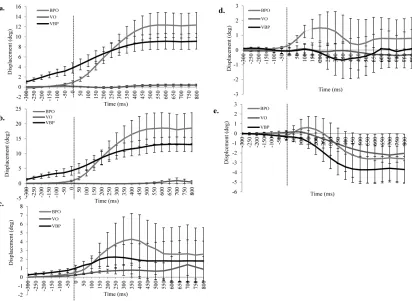
Lower limb joint flexion-extension patterns seemed primarily responsible for COM and
COP displacement during the two conditions in which participants were required to
physically catch the ball (ball flight-only, and integrated video-ball flight conditions). In
these conditions, participants used a combination of movements in the ankle, knee and hip
joints. The findings suggest the lower limb joints (in integrated video-ball flight and ball
flight-only conditions) played a key role in minimising upper body displacement, enabling
the upper body to stay vertical in orientation to help ensure the head and eyes remained
in lower limb displacement values, and their magnitudes in the integrated video-ball
flight-only and the ball flight-flight-only conditions, provide further evidence of the importance of
advanced visual information in postural control and performance accuracy. During integrated
video-ball flight, flexion of the ankle and knee began before the initiation of movement of the
catching arm (Ton). In contrast, when access to these visual information sources was not
available (i.e., when only ball flight information was presented), lower limb displacement
emerged at an equivalent time to arm movement (see Figure 5). This is an important
observation, since in line with previous research (Santos et al. 2010b), it seems that
perception of sources of advanced visual information is one of the main behavioral strategies
used to regulate postural control. In addition, the earlier movements observed when advanced
visual and ball flight information sources were combined may allow the body and head/eyes
to be prepared and stabilised in a functional position when the ball is released. This
behavioral strategy may enable earlier tracking of the ball and a smoother and more
controlled movement of the catching arm, both of which are associated with more accurate
catching performance (Panchuk et al., 2013; Stone et al., 2014). This proposal is supported by
kinematic data from the catching arm which revealed that displacements of the shoulder,
elbow and wrist emerged earlier during the integrated video-ball flight condition compared to
when ball flight information only was available.
The simulated catching action, when only advanced visual information was presented
(video-only), produced considerably different movement patterns in relation to the two
conditions that required actual interception of the ball. Participants showed minimal changes
in the lower limbs with an upward Peak-COMz. Without the need to control for the impact of
the ball, participants allow COMz to rise with the movement of the arm. Knowledge that
interception of an object is not required significantly affects postural control as well as arm
et al., in press). This is an important finding if researchers are attempting to use simulated
actions to test the role of anticipation in human behavior. The findings show that movement
patterns will be adapted, depending on the specificity of the task constraints presented to
participants. Action fidelity is a particularly important methodological issue, given the
growing use of virtual environments within research and training contexts (e.g. Fink, Foo, &
Warren, 2009; Chan, Leung, Tang, & Komura, 2011; Vignais et al., 2009). These virtual
environments allow varying levels of immersion by the participant and simulated actions are
commonly used. The data presented here suggests researchers and practitioners need to
ensure representative designs which allow the greatest level of immersion possible so that
adequate feedback is available to elicit the same postural responses as required in the
performance environments that are simulated
The findings observed in all three conditions added support for van der Kamp et al.’s
(2008) proposal that both advanced information prior to ball release and ball trajectory
information are essential for successful catching performance. Here we have demonstrated
that these information sources are also important for anticipatory postural regulation to
support the performance of interceptive actions during upright stance. The findings have
theoretical implications by highlighting the precise coupling between perception and action to
regulate behaviors of different movement sub-systems.
Data on adaptations to postural regulation behaviors and the kinematics of the
catching arm in the three conditions suggested that the catching action was 'nested' on the
task of postural regulation (see Riccio & Stoffregen, 1988). This coordination strategy
reduced the number of system degrees of freedom that the CNS needed to regulate in an
“umbrella” control strategy, with posture being dependent on the task being performed. For
example, when participants attempted to mediate the potentially destabilizing effects of ball
to when the same participants performed the simulated catching action. This observation
suggests that postural control and the nested catching action were integrated and organised
together, forming a new synergy from the re-organised motor system degrees of freedom.
These results support the proposal that the two sub-systems of postural control and
interception should not be considered as functioning independently, requiring two separate
control mechanisms. Rather posture is regulated continuously in order to facilitate the
performance of other nested actions, such as reaching into space to catch a passing ball (often
referred to as supra-postural goals, see Riccio & Stoffregen, 1988; Riccio & Stoffregen,
1991; Stoffregen et al., 1999).
In addition the findings pose significant challenges for research that neglects the
careful consideration of an action component (by using micro-movements) (e.g. Aglioti,
Cesari, Romani & Urgesi, 2008; Abreu et al., 2012; Tomeo, Cesari, Aglioti & Urgesi, 2012)
or which excludes availability of advanced perceptual information sources for participants.
Removal of either component, which is common in research, will alter the informational
constraints and fail to capture the dynamic, emergent nature of interceptive actions. Finally,
practitioners that rely on ball flight-only machines to train performers may wish to reconsider
the design of their practice environments considering the findings presented here.
In conclusion, we observed emergent perception-action couplings in three conditions with
varying informational constraints during performance of a one-handed catching task. The
data support the tenets of ecological dynamics, the theoretical rationale used to frame our
investigation of coordination. The findings however could also be interpreted through
alternative theoretical explanations such as the theory of event coding (TEC) (Hommel,
Müsseler, Aschersleben & Prinza, 2001). For example, the evidence of advanced postural
adjustments supports TEC’s proposal that human action is anticipatory in nature and
considering the intentions and goal-directed actions of participants, a key component of TEC
over previous cognitive based theories of human perception and action which have seen
actions as merely by products of perception (Hommel, 2009). Our findings showed that
simulated actions resulted in considerably emergence of distinct movement patterns under
different informational constraints, such as when ball flight information was available and
actual interception of an object was required. Further, when visual information of a thrower’s
action was not available to participants, despite a similar movement strategy and postural
control mechanism, the timing of such activation was delayed and prevented effective use of
anticipatory postural adjustments, decreasing system stability and resulting in impaired
catching performance. Further work should be undertaken to compare kinematic and kinetic
patterns emerging in trials resulting in successful and dropped catches which could provide
further insight into functional coordination strategies needed for performance of this kind of
interceptive action. Additionally, it would be important to examine how changes in ball
velocity, participant stance and other manipulations to informational constraints affect
References
Abreu, A. M., Macaluso, E., Azevedo, R. T., Cesari, P., Urgesi, C., & Aglioti, S. M. (2012).
Action anticipation beyond the action observation network: a functional magnetic
resonance imaging study in expert basketball players, European Journal of
Neuroscience, 35, 1646-1654.
Aglioti, S. M., Cesari, P., Romani, M., & Urgesi, C. (2008). Action anticipation and motor
responses in elite basketball players. Nature neuroscience, 11. doi:10.1038/nn.2182
Aimola, F., Santello, M., La Grua, G., & Casabona, A. (2011). Anticipatory postural
adjustments in reach-to-grasp: Effect of object mass predictability. Neuroscience Letters,
502, 84-88. doi:10.1016/j.neulet.2011.07.027
Angelakopoulos, G. T., Davids, K., Bennett, S. J., Tsorbatzoudis, H., & Grouios, G. (2005).
Postural stability and hand preference as constraints on one-handed catching performance
in children. Journal of Motor Behavior, 37, 377-385. doi:10.3200/JMBR.37.5.377-385
Araújo, D., Davids, K., & Hristovski, R. (2006). The ecological dynamics of decision making
in sport. Psychology of Sport and Exercise, 7, 653–676.
doi:10.1016/j.psychsport.2006.07.002
Barab, S. A., & Kirshner, D. (2001). Guest editors' introduction: Rethinking methodology in
the learning sciences. The Journal of the Learning Sciences, 10, 5–15.
Bernstein, N. A. (1967). The control and regulation of movements. London: Pergamon Press.
Brunswik, E. (1956). Perception and the representative design of psychological experiments
(2nd ed.). Berkeley: University of California Press
Chan, J., Leung, H., Tang, J., & Komura, T. (2011). A virtual reality dance training system
using motion capture technology. IEEE transactions on learning technologies, 4,
Chow, J. Y., Davids, K., Hristovski, R., Araújo, D., & Passos, P. (2011). Nonlinear
pedagogy: Learning design for self-organizing neurobiological systems. New Ideas in
Psychology, 29, 189–200. doi:10.1016/j.newideapsych.2010.10.001
Davids, K., Bennett, S. J., Kingsbury, D., Jolley, L., & Brain, T. (2000). Effects of postural
constraints of children’s catching behavior. Research Quarterly for Exercise and Sport,
71, 69-73. Doi:10.1080/02701367.2000.10608882
Davids, K., Araújo, D., Vilar, L., Renshaw, I., & Pinder, R. A. (2013). An ecological
dynamics approach to skill acquisition: Implications for development of talent in sport.
Talent Development & Excellence, 1–14.
Davids, K., Button, C., & Bennett, S. J. (2008). Dynamics of Skill Acquisition. Human
Kinetics Publishers, 1-251.
Davids, K., Hristovski, R., Araújo, D., Balague-Serre, N., Button, C. & Passos, P.
(2014) . Complex Systems in Sport. London: Routledge.
de Lima, A. C., de Azevedo Neto, R. M., & Teixeira, L. A. (2010). On the functional
integration between postural and supra-postural tasks on the basis of contextual cues and
task constraint. Gait & Posture, 32, 615-618. doi:10.1016/j.gaitpost.2010.09.003
Eckerle, J. J., Berg, W. P., & Ward, R. M. (2012). The effect of load uncertainty on
anticipatory muscle activity in catching. Experimental Brain Research, 220, 311-318.
doi:10.1007/s00221-012-3139-z
Fink, P. W., Foo, P. S., & Warren, W. H. (2009). Catching flying balls in virtual reality: A
Hommel, B., Müsseler, J., Aschersleben, G., & Prinza, W (2001). The theory of Event
Coding (TEC): A framework for perception and action planning. Behavioral and
Brain Sciences, 24, 849-937.
Hommel, B. (2009). Action control accoridng to TEC (theory of event coding). Psycholoigcal
Research, 73, 512-526. doi: 10.1007/s00426-009-0234-2
Kazennikov, O. V., & Lipshits, M. I. (2010). Dependence of the anticipatory change in the
grip force in the catching task on the result of the preceding trial. Human Physiology, 36,
370-381. doi:10.1134/SO362119710030205
Kelso, J. S. (1995). Dynamic patterns: The self-organization of brain and behaviour.
Cambridge: MIT.
Kelso, J. A. S., Buchanan, J. J., DeGuzman, G.C. & Ding, M. (1993). Spontaneous
recruitment and annihilation of degrees of freedom in biological coordination. Physics
Letters, 179, 364-371.
Gibson, J, J. (1979). The ecological approach to visual perception. Boston:
Houghton-Mifflin.
McRobert, A. P., Williams, A. M., Ward, P., & Eccles, D. W. (2009). Tracing the process of
expertise in a simulated anticipation task. Ergonomics, 52, 474-483.
doi:10.1080/00140130802707824
Panchuk, D., Davids, K., Sakadjian, A., MacMahon, C., & Parington, L. (2013). Did you see
that? Dissociating advanced visual information and ball flight constraints perception and
action processes during one-handed catching. Acta Psychologica, 142, 394-401.
Pinder, R. A., Davids, K., Renshaw, I., and Araújo, D. (2011) Representative learning design
and functionality of research and practice in sport. Journal of Sport and Exercise
Psychology, 33, 146-155.
Riccio, G. E., & Stoffregen, T. A. (1988). Affordances as constraints on the control of stance.
Human Movement Science, 7, 265-300.
Riccio, G. E., & Stoffregen, T. A. (1991). An ecological theory of motion sickness and
postural instability. Ecological Psychology, 3, 195–240.
Riley, M.A., Shockley, K., & Van Orden, G. (2012). Learning from the body about the mind.
Topics in Cognitive Science, 4, 21-34.
Santos, M. J., Kanekar, N., & Aruin, A. S. (2010a). The role of anticipatory postural
adjustments in compensatory control of posture: 1, Electromyographic analysis. Journal
of Electromyography and Kinesiology, 20, 388-397. doi:10.1016/j.jelekin.2010.01.002
Santos, M. J., Kanekar, N., & Aruin, A. S. (2010b). The role of anticipatory postural
adjustments in compensatory control of posture: 2. Biomechanical analysis. Journal of
Electromyography and Kinesiology, 20, 398-406. doi:10.1016/j.jelekin.2010.01.003
Savelsbergh, G.J.P., Bennett, S.J., Angelakopoulos G. T., & Davids, K. (2005).
Perceptual-motor organization of children’s catching behaviour under different postural constraints.
Neuroscience Letters, 373, 153-158. doi: 10.1016/j.neulet.2004.10.011
Savelsbergh, G. J. P., Whiting, H.T.A., Pijpers, J.R. & Van Santvoord, A.M.M. (1993). The
visual guidance of catching. Experimental Brain Research, 93, 146-156.
Shiratori, T., & Latash, M. L. (2001). Anticipatory postural adjustments during load catching
Stoffregen, T. A., Smart, L. J., Bardy, B. G., & Pagulayan, R. J. (1999). Postural stabilization
of looking. Journal of Experimental Psychology: Human Perception and
Performance, 25, 1641-1658.
Stone, J, A., Panchuk, D., Davids, K., North, J.S., & Maynard. I. W. (2014). Integrating
advanced visual information with ball flight-only technology constrains dynamic
interceptive actions. Procedia Engineering, 72, 156-161. doi:
10.1016/j.proeng.2014.06.027
Stone, J, A., Panchuk, D., Davids, K., North, J.S., Fairweather, I., & Maynard. I. W. (2013).
An integrated ball flight-only technology for the study of dynamic interceptive actions.
Behavior Research Methods. doi:10.3758/s13428-013-0429-8
Tijtgat, P., Bennett, S. J., Savelsbergh, G. J. P., De Clercq, D., & Lenoir, M. (2010). Advance
knowledge effects on kinematics of one-handed catching. Experimental Brain Research,
201, 875-884. doi:10.1007/s00221-009-2102-0
Tijtgat, P., Bennett, S. J., Savelsbergh, G. J. P., De Clercq, D., & Lenoir, M. (2011). To know
or not to know: influence of explicit advance knowledge of occlusion on interceptive
actions. Experimental Brain Research, 214, 483-490. doi:10.1007/s00221-011-2846-1
Tijtgat, P., Vanrenterghem, J., Bennett, S. J., De Clercq, D., Savelsbergh, G. J. P., & Lenoir,
M. (2012). Implicit advance knowledge effects on the interplay between arm movements
and postural adjustments in catching. Neuroscience Letters, 518, 117-121.
doi:10.1016/j.neulet.2012.04.066
Tijtgat, P., Vanrenterghem, J., Bennett, S. J., De Clercq, D., Savelsbergh, G. J. P., & Lenoir,
M. (2013). Postural adjustments in catching: on the interplay between segment
Tomeo, E., Cesari, P., Aglioti, S., Urgesi, C. (2012). Fooling the Kickers but not the
Goalkeepers: Behavioral and Neurophysiological Correlates of Fake Action Detection
in Soccer. Cerebral Cortex, doi: 10.1093/cercor/bhs279
van der Kamp, J., Rivas, F., Doorn, H. V., & Savelsbergh, G. J. P. (2008). Ventral and dorsal
system contributions to visual anticipation in fast ball sports. International Journal of
Sport Psychology, 39, 100-130.
Vignais, N., Bideau, B., Craig, C., Brault, S., Multon, F. & Kulpa, R. (2009). Virtual
environments for sport analysis: Perception-action coupling in handball goalkeeping. The
International Journal of Virtual Reality, 8, 43-48.
Warren, W. H. (2006). The dynamics of perception and action. Psychological Review, 113,
358-389.
Williams, J. G., & McCririe, N. (1988). Control of arms and fingers during ball catching.
Journal of Human Movement Studies, 14, 241-247.
Whiting, H. T. A. (1991). Action is not reaction! A reply to Mcleod and Jenkins.
Table 1. COP and the three directions of COM ANOVA and post-hoc outputs for Onset, peak and time to peak between each of the three performance conditions (Video-Ball- integrated video-ball flight; Ball-Only- ball flight-only).
df f p ηp2 Video-Ball (M ± SE)
Ball-Only (M ± SE)
Video-Only (M ± SE)
Video-Ball (M ± SE) Ball-Only (M ± SE)
Catch Drop Catch Drop
COP
Onset (ms) 1.4, 14 7.55 <.05 .407 -356 ± 49** -36 ± 37** -232 ± 86 -361 ± 52 -337 ± 112 -41 ± 36 -29 ± 38 Peak Displacement
(mm) 2, 22 0.12 >.05 .011 -17 ± 16 -15 ± 12 -17 ± 8 -17 ± 18 -21 ± 21 -15 ± 11 -25 ± 15
Time to Peak (ms) 2, 22 1.04 >.05 .086 190 ± 56 244 ± 43 308 ± 70 182 ± 57 230 ± 104 232 ± 42 284 ± 63
Peak – Onset (ms) 2, 22 4.86 <.05 .316 546 ± 75* 255 ± 43* 539 ± 99 552 ± 73 567 ± 78 273 ± 41 313 ± 46
COM Onset
COMy (ms) 1.2, 13.3 5.79 <.05 .345 -93 ± 50*ab 18 ± 24*a 153 ± 105*b -97 ± 53 -6 ± 64 4 ± 32 25 ± 35
COMz (ms) 2, 22 9.04 <.01 .559 -111 ± 27*ab -18 ± 11*a -19 ± 13*b -115 ± 23 -41 ± 34 -21 ± 15 -8 ± 15
COMx (ms) 1.1, 13.4 0.90 >.05 .142 17 ± 46 61 ± 41 203 ± 159 12 ± 49 23 ± 21 61 ± 47 62 ± 30
COM Peak Displacement
COMy (mm) 2, 22 1.28 >.05 .104 -7 ± 7 -4 ± 8 -14 ± 5 -6 ± 6 -9 ± 8 -5 ± 8 -3 ± 8 COMz (mm) 2, 22 3.80 <.05 .257 -3 ± 9* -1 ± 12 20 ± 7* -3 ± 9 2 ± 11 -3 ± 12 2 ± 13
COMx (mm) 1.2, 13 0.90 >.05 .760 -1 ± 14 -11 ± 13 -8 ± 6 1 ± 13 -9 ± 15 -10 ± 13 -11 ± 14
COM Time to peak
COMy (ms) 2, 22 4.23 <.05 .278 224 ± 53* 352 ± 43 366 ± 59* 220 ± 52 231 ± 69 361 ± 44 286 ± 79 COMz (ms) 2, 22 4.67 <.05 .298 201 ± 42*ab 374 ± 50*a 329 ± 42*b 194 ± 40 234 ± 57 387 ± 45 315 ± 88
COMx (ms) 2, 22 1.28 >.05 .104 369 ± 54 424 ± 51 332 ± 42 391 ± 56 347 ± 87 421 ± 48 445 ± 66
Table 2. Summary of descriptive statistic for ankle, knee, shoulder, elbow and wrist at each
epoch (VBP- integrated video-ball flight-only; BPO- ball flight-only only; VO- video
only).
Ep1 Ep2 Ep3 Ep4
M ± SE (°) M ± SE (°) M ± SE (°) M ± SE (°) Ankle
VBP 2.4 ± 0.7 4.1 ± 1.0 6.3 ± 1.3 8.3 ± 1.5 BPO 0.3 ± 0.1 1.4 ± 0.4 5.0 ± .1.0 9.3 ± 1.9 VO 0.2 ± 0.1 0.2 ± 0.1 -1.0 ± 0.2 -0.1 ± 0.3 Knee
VBP 2.7 ± 1.0 4.2 ± 1.5 7.2 ± 2.1 9.8 ± 2.4 BPO 0.2 ± 0.1 1.7 ± 0.5 7.4 ± 2.1 14.0 ± 4.0
VO 0.1 ± 0.1 0.02 ± 0.1 -0.02 ± 0.1 -0.04 ± 0.2 Shoulder
VBP 9.4 ± 3.1 13.8 ± 3.0 25.0 ± 2.7 33.2 ± 3.5 BPO 0.7 ± 0.4 2.6 ± 1.1 22.24 ± 3.0 44.6 ± 4.6 VO 1.9 ± 1.2 8.9 ± 2.5 27.6 ± 4.0 40.1 ± 5.6 Elbow
VBP 9.7 ± 2.2 20.5 ± 3.4 32.8 ± 4.6 33.0 ± 4.1 BPO 1.7 ± 0.5 14.2 ± 1.3 38.8 ± 4.0 39.0 ± 4.4 VO 4.8 ± 1.5 15.8 ± 3.3 30.3 ± 5.9 31.8 ± 7.3 Wrist
Figure 1. An example of three screen shots of the advanced visual information projected onto
Figure 2. Temporal evaluation of COP from -300ms to +800ms for the three performance
conditions. Each point represents COP displacement in the sagittal plane with backward (+)
and forward (). Each time point is averaged over 50ms intervals (e.g. 200 ms is 201 to
Figure 3. a). Peak displacement and b). Time to peak displacement in COMx, COMy and
COMz during the three performance conditions (M ± SE). (VBP- integrated video-ball
Figure 4. Temporal evaluation (from -300ms to + 800ms in relation to Ton) of the a)ankle, b)
knee, c) hip, d) spine and e) thorax during the three performance conditions. Each point
represents angular displacement in the sagittal plane with flexion (+) and extension (-). Each
time point is averaged over 50 ms intervals (e.g. -200 ms is -201 to -150 and so on) with
standard errors presented. The dotted vertical line showed Ton. VBP- integrated video-ball
Figure 5. Temporal evaluation (from -300ms to + 800ms in relation to Ton) of the a)
shoulder b) elbow and c) wrist during the three performance conditions. Each point
represents angular displacement in the sagittal plane with flexion (+) and extension (-). Each
time point is averaged over 50 ms intervals (e.g. -200 ms is -201 to -150 and so on) with