Statistical Recognition Method of Binary BCH Code
Jiafeng Wang, Yang Yue, Jun Yao
Institute of Electronic Engineering in China Academy of Engineering Physics, Mianyang, China
E-mail: [email protected]
Received October 30, 2010; revised January 5, 2010; accepted January 6, 2011
Abstract
In this paper, a statistical recognition method of the binary BCH code is proposed. The method is applied to both primitive and non-primitive binary BCH code. The block length is first recognized based on the cyclic feature under the condition of the frame length known. And then candidate polynomials are achieved which meet the restrictions. Among the candidate polynomials, the most optimal polynomial is selected based on the minimum rule of the weights sum of the syndromes. Finally, the best polynomial was factorized to get the generator polynomial recognized. Simulation results show that the method has strong capability of anti-random bit error. Besides, the algorithm proposed is very simple, so it is very practical for hardware im-plementation.
Keywords: Binary BCH Code, Blind Recognition, Code Length, Generator Polynomial
1. Introduction
With the development of the Communication Counter-measures, the methods of the communication counter-measures have transferred from the signal level to the information level. The blind recognition of channel cod-ing is the foundation of gettcod-ing the message, therefore has become the key technology in the area of the Com-munication Countermeasures and gets more and more attention. Besides, the blind recognition of channel cod-ing also has important applications in cooperative areas such as the intelligent communication.
The linear channel coding has two categories: block code and convolutional code. We can see that most re-searches focus on the blind recognition of convolutional code [1-2], while literature about the blind recognition of block code is rare. Literature [3] gives a blind recogni-tion method of the block code with low encoding rate, its essential principle is to resolve equations to recognize the syndrome matrix, and then get the generator matrix. Literature [4] discusses a method of blind recognition of primitive RS code, its essential principle is using reduced row echelon form of the matrix (RREF), fault-tolerant matrix decomposing (FTMD) and Galois field Fourier transform (GFFT) to recognize encoding parameters and syndrome matrixes. Both methods need matrix computa-tions on the finite field, when code length is long, the EMS memory needed will be very large, so it is not
ap-plicable to hardware implementation. At the same time, the error code capability is not ideal too.
In this paper we study the binary BCH code which is an important subclass of cyclic codes. According to the circular feature, we proposed a simple statistical recogni-tion method under the condirecogni-tion that the frame length is known. The method has strong anti-error capability. Be-sides, there is no need for matrix computation; therefore it is suitable for hardware implementation.
The reset of this paper is organized as follows: Section 1 introduces the basic feature of binary BCH code; Sec-tion 2 discusses the recogniSec-tion method of the block length; Section 3 discusses the method of recognition of the generator polynomial; Section 4 observes the recog-nition performance of this algorithm through simulation; finally, the paper is briefly summarized.
2. Binary BCH Code
Here we simply introduce the features of binary BCH code. The definition of binary BCH code and the details of encoding and decoding are discussed in literature [5]. Consider (n,k) BCH code defined on GF(2), n is the block length and k is the message length. Let
0, 1, , k 1
m m m m be the message word before
1 k 1 n 1 1
2 and code word each has a corresponding message poly-nomial and code polypoly-nomial defined on GF(2), as fol-lows
1 20 1 2
k k
k
m x m x m x m xm (1)
1 20 1 2
n k
k
c x c x c x c xc (2)
From literature [5], we know that the (n,k) binary BCH code has following features,
1) Block length n equals or is a factor of , where . If n equals , then it is primitive binary BCH code; otherwise, it is non- primi-tive one.
2m
2m1 3
m 2m
2) The code word c satisfies the circular feature, that is, after circular shifting the code word c for j times, get the code word
j1, , ,j k 1, , ,0 j 3, jc c c c c c c
and c also belongs to (n, k) binary BCH code set. 3) m x
and c x
satisfy following relationship,
c x m x g x (3)
where g x
is the generator polynomial defined on GF (2),
11 1
n k n k
n k 1
g x x g x g x (4) 4) There exists syndrome polynomial defined
on GF(2),
h x
11 1
k k
k
h x x h x h1x
(5)
which satisfies following relationships,
0 mod
n 1h x c x x (6)
n 1h x g x x (7)
5) g x
is irreducible.3. Recognition of Block Length
The recognition of the binary (n, k) BCH code is to rec-ognize three parameters: the block length n, the syn-drome word length k, and the generator polynomial
g x
. But we can see from formula (4) that the order ofg x is n-k, then as long as the block length n and the generator polynomial g x
are recognized, the valueof k can be ascertained. Then only the block length n and the generator polynomial g x
need to be recognized.In this section we introduce the recognition of block length n, and in next section we introduce the recognition of generator polynomialg x
.The recognition is based on the assumption that frame length fl is known. This assumption is rational,
be-cause usually in practice, frame head is not encoded, so it is easy to get.
Because fl is known, and there exists at least two
code words in one frame, so we could get following con-clusions:
1) 3,
2
l
f n
, where means floor function. 2) fl is divisible by n, that is, n is a factor of fl.
The factor numbers of fl in the rang 3,
2 l f
may
not be only one, assume is a factor of i fl and then
there are two situations, 1) in
Under this situation, if we take i as the block length, we could get Ni code words. Assume cp
x is the code polynomial of the th code word, then through left circular shifting for j times we get j code polynomi-alsp
1 pc x , cp2
x , , cpj
x , where 1 j i1.Because the binary BCH code satisfy the circular fea-ture, if there is no error code in cp, then the code words
corresponding to cp1
x , cp2
x
, , cpj
x and the code word corresponding to p belong to the same (n, k) binary BCH set, so their generator polynomi-als are the same. According to formula (3) which is the relationship between the code polynomial and the gen-erator polynomial, we know there is a common factor for
x c
pc x , cp1
x , cp2
x , , cpj
x . Let
cp
x 0p
c x , then the following relationship exists,
0 1
gcdcp x c, p x , , cpj x 1 1 j i 1 (8)
We call the code word that satisfies fomula (8) as a valid code word. Assume there are ic valid code
words among the i code words. Obviously, when
there is no error code, ic i, that is, the percentage
of the valid code words of all the code words N N
N N
ic
f is,
1 ic ic i N f N
(9)
2) in
Under this situation, if we take i as the block length, the blocking is wrong. Assume we get i code words,
there exist code words that do not satisfy formula (8) inevitably, so
N
ic i
N N , that is
1 ic ic i N f N
(10)
Above all, under the condition that no error code ex-ists, if take formula (8) as the rule to judge if the code word is valid or not, then for all the possible block lengths, when in, the percentage of valid code words is fic1; when in, the percentage of valid code
exist, even if in, fic could be less than 1. But we
can predict that fic should get the maximum when
. in
In addition, according to feature (1), n is odd , so we could get the recognition formula of the block length n,
3, ,2 arg m l l i f rem i rem f i
n
2 1 , 0 ax ic i f (11)
where max
means the maximum operation; rem f i
l,means the remainder of fl divided by i. The rule to
judge the validity of the code word is formula (8). Then we can get the recognition process of binary BCH code block length n:
1) Let i3 and initialize the value of j; 2) If can not divide i fl, then turn to (6);
3) Let i be the block length and get code
words; i
N
4) According to formula (8), calculate the number of valid code words Nic;
5) Compute ic i
N N
ic
f and save;
6) i i 2;
7) If i fl 2, turn to (2);
8) Compare all the saved fic, the estimation of n is
that made
i
ic
f has maximum value;
9) The recognition process is over.
We can see from step (11) and step (8), the recognition capability of block length n is relevant to i and ,
the more the value of i and , the better the
recogni-tion capability at the first glance; but large values mean that the length of the received code stream series is also large, and the computation complexity will increase, so we must consider this tradeoff according to the practical situations.
N j N
j
4. Recognition of Generator Polynomial
In this section, we discuss how to recognize the genera-tor polynomial g x
p
under the condition of the block length n is rightly recognized.
Assume we receive N code words, is the code polynomial for the th code word, and assume that there is no error code. According to section II, left circular shift to get n−1 code polynomials
pc x
pc x cp1
x ,2
p , , pn1 , and the generator polynomials of these n−1 code polynomials and are the same. In other words, the generator polynomial
c x
c
x
p c x
g x
x is acommon factor of , , , ,
. Also let
x
p
c
cp1
x cp2
x1 pn
c cp0 x cp
xp p
, and
gcd 0
, p1
, , pj
f x c x c x c
Then fp
x is the multiple of g x
.From the received N code words, we can get M (1M N) different polynomials according to formula
(12), consider there are error codes, these M polynomials belong to one of the four situations below:
1) Equal 1;
2) Not equals 1, but not equals g x
, also not themultiple formula of g x
;3) Equal g x
;4) Equal the multiple formula of g x
.Situations (1) and (2) illustrate there are error codes exist. Situations (3) and (4) illustrate there are no error codes exist in code words, or the error codes constitute another code words in the same sub code set. We can get the generator polynomial from the M candidate polyno-mials following three steps below.
Step 1. According to the constraint conditions of
g x satisfied, remove the polynomials that do not
sat-isfy the conditions
According to the feature of the binary circular code,
g x needs to satisfy the following restrictions [5],
1) g x
12)
qg x x 1
1 q n
, where is the positive integer and
q
3) g x
can divide xn1According to these three restrictions to remove the polynomials under situations (1) and (2).
Step 2. According to the minimum rule of the weights sum of the syndromes choose the most optimal polyno-mial
Assume after the step 1 there are L candidate polyno-mials remain, and g xi
( ) is the ith poly-nomial, and its corresponding syndrome polynomial is,1, 2, ,
i L
n 1
i
h x x g xi (13)
The jth syndrome of the code word is,
mod
n 1ij i j
r h x c x x
(14)The code weight is,
ij ij
w weight r (15)
For all the received N code word compute the syn-drome code weight,
1
1, 2, ,
N
i ij
j
w w i
L (16)The candidate polynomial made minimum is the most optimal polynomial, denotes as i
w
b
g x ,
( ), 1,2, ,
arg min i
b
g x i L i
g x
w (17)
x (12)
When the reorganization is correct, the most optimal polynomial gb
x is not necessarily equals g x
, but it is definitely the multiple of g x
, so further steps areneeded using gb
x
to estimate the generator polyno-mial.Firstly according to the rules in [6], judge whether
b
g x is reducible or not; if it is irreducible, then
0 b
g x g x (18)
If it is reducible, get all the irreducible factor of vgb
x that satisfy step 1, then follow step 2 to get themost optimal polynomial as the estimated generator polynomial g0
x . The method of factorization canindirectly get from the rules in [6], we do not comment on this because the limitation of space.
From the above recognition process, theoretically, as long as there is a code word without error code, it is of very high possibility to correctly recognize the generator polynomial, then this recognition method has strong anti-error capability.
5. Simulation
The simulation has three steps: first, we simulate for the recognition capability of the block length; second, we simulate for the recognition capability of the generator polynomial; third, according to the first two steps we get the total recognition capability.
In the simulation of the recognition capability, we run the simulation 1000 times for (15,11) primitive binary BCH code and (21,12) non-primitive binary BCH code respectively to get the statistical correct recognition rate. The generator polynomial of (15,11) primitive binary BCH code is
41 1
g x x x
9 x31
; the generator polyno-mial of (21,12) non-primitive binary BCH code is
1 ;assume that there are five code
words in one frame, and we choose the circular shifting time as 1 for recognizing the block length.
g x x
5.1. Simulation Results
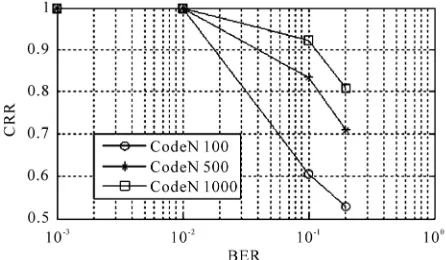
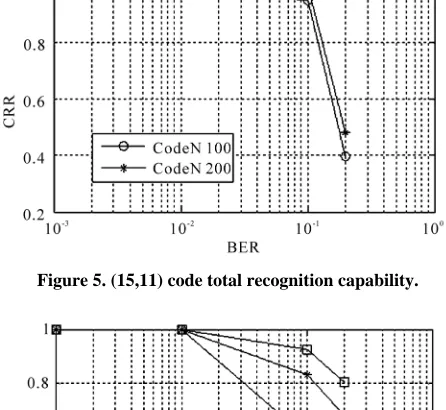
The recognition simulations are done according to the method described in Sections 2 and 3. The results are shown in Figures 1-6. The total recognition capability is computed according to the block length recognition ca-pability and generator length recognition caca-pability, the computation formula is as follows,
1 2
p p p (19)
where is the total correct recognition rate, 1 is the
correct recognition rate of block length, 2 is the
cor-rect recognition rate of generator polynomial.
p p
p
Figure 1. (15,11) code block length recognition capability.
Figure 2. (15,11) code generator polynominal recognition capability.
Figure 3. (21,12) code block length recognition capability.
[image:4.595.310.533.80.207.2] [image:4.595.310.532.236.368.2] [image:4.595.309.532.409.539.2] [image:4.595.311.533.568.694.2]Figure 5. (15,11) code total recognition capability.
Figure 6. (21,12) code total recognition capability.
Note: In pictures, BER represents “Bit Error Rate”, CRR represents “Correct Recognition Rate”, and CodeN repesents “Code-words Number”.
5.2. Analysis of Simulation Results
From the results of the simulation, we know that no mat-ter the recognition capability of the block length, the recognition capability of the generator polynomial, or the total recognition capability, will increase with the num-ber of code words that are used for the recognition proc-ess. The recognition capability will also increase with the circular shifting time. Because of the limitation of space, the simulation results are not given here.
Otherwise, we can see that under the condition of the number of code words is the same, the difference be-tween the recognition capability of these two kinds of code words is relatively large. For (15,11) code, when the error code rate is 10%, 100 code words are used , its total recognition capability could reach above 90%. While for (21,12) code, when the error code rate is the same, to reach the same recognition capability, we need 1000 code words. The reason for this difference is vari-ous,
1) The code length of (21,12) code is longer than
(15,11) code, then when the code words is the same, through a circular shift, the percentage of satisfying cir-cular feature would be higher than (15,11) code, even if not right blocking.
2) The frame length of (21,12) code is 105, it has 6 odd factor: 3, 5, 7, 15, 1, 35; while the frame length of (15,11) code is 75, it has 4 odd factor: 3, 5, 15, 25. Ob-viously, when the code word number is the same, the more the factor, the worse the recognition capability.
Of course, the recognition capability is also relevant to the structure of the code, (15,11) code is primitive binary BCH code and (21,12) code is non-primitive binary BCH code. But we can see from the simulation result, although when the number of code words is the same, the recogni-tion capability of (21,12) code is worse than (15,11) code, but we can increase code words to reach the same recog-nition capability .
6. Conclusions
The blind recognition method of the binary BCH code proposed in this paper is a statistical recognition method. So the recognition capability is directly related to statis-tical bit number, the more the statisstatis-tical bits, the better the recognition capability and the bigger the computation complexity, especially under the condition of long code, which is a drawback of the algorithm proposed in this paper. But when compared to its recognition capability, the big computation complexity is acceptable. Besides, the algorithms in this paper do not involve complicated computations, and it could be readily applied to the hardware processor because of its binary characteristics. So the hardware implementation is easy and the compu-tation can be accelerated.
7. Acknowledgment
The work in this paper is supported by the Fund of Sci-ence and Technology Development of CAEP. The num-ber is 2009B0403043.
8. References
[1] F. H. Wang, Z. T. Huang and Y. Y. Zhou, “A Method for Blind Recognition of Convolution Code Based on Euclidean Algorithm,” IEEE International Conference on Wireless Communication Networking and Mobile Com-puting, Shanghai, 2007, pp. 1414-1417. doi:10.1109/ WICOM.2007.358
[image:5.595.58.281.94.299.2][3] J. J. Zan and Y. B. Li, “Blind Recognition of Low Code-Rate Binary Linear Block Code,” Radio Engineer-ing of China, Vol. 39, No. 1, 2009, pp. 19-24.
[4] J. Liu, N. Xie and X. Y. Zhou, “Blind Recognition Method of RS Coding,” Journal of Electronic Science and Technology, Vol. 38, No. 3, March 2009, pp. 363- 367.
[5] S. Lin and D. J. Costello, “Error Control Coding,” 2nd
Edition, Pearson Prentice Hall, Upper Saddle River, 2004, pp. 136-146.