doi:10.4236/wsn.2010.212108 Published Online December 2010 (http://www.scirp.org/journal/wsn)
Lifetime Optimization via Network Sectoring in
Cooperative Wireless Sensor Networks
Hadi Jamali Rad1, Bahman Abolhassani1, Mohammad Abdizadeh2
1School of Electrical Engineering, Iran University of Science and Technology, Tehran, Iran 2School of Electrical Engineering, Sharif University of Technology, Tehran, Iran
E-mail: [email protected], [email protected], [email protected] Received October 3, 2010; revised October 12, 2010; accepted October 14, 2010
Abstract
Employing cooperative communication in multihop wireless sensor networks provides the network with sig-nificant energy efficiency. However, the lifetime of such a network is directly dependant upon the lifetime of each of its individual sections (or clusters). Ignoring the fact that those sections close to sink have to forward more data (their own data plus the data received from the previous sections) and hence die sooner with con-sidering equal section sizes, leads to a sub-optimal lifetime. In this paper, we optimize the section sizes of a multihop cooperative WSN so that it maximizes the network lifetime. Simulation results demonstrate a sig-nificant lifetime enhancement for the proposed optimal sectoring.
Keywords: Wireless Sensor Network (WSN), Cooperative Communications,
Virtual Multi-Input-Multi-Output (V-MIMO), Energy Efficiency
1. Introduction
Wireless sensor networks (WSNs) consist of a large num-ber of tiny sensor nodes deployed over a large area. Such wireless nodes typically operate with small batteries for which replacement, when possible is very difficult and expensive. Thus, in many practical scenarios, the wireless nodes should operate for many years without any battery replacement or recharge. Hence, minimizing the power consumption in different functional layers of wireless nodes is a very challenging design consideration. Fur-thermore, affected by channel impairments, energy con-straints of the sensor nodes are the main limiting factors of the system performance of WSNs and therefore power efficiency is of special importance in such networks.
Diversity techniques have been proposed to provide a wireless network with reliable and power efficient communications [1,2]. However, tiny sensor nodes cannot accommodate multiple antennas and hence the implementation of MIMO-based communications in a wireless sensor network (WSN) requires cooperation among sensor nodes [3,4]. These sensor nodes can be considered as a virtual MIMO (V-MIMO) unit.
Moreover, in large WSNs, multihop communications are used instead of long-haul transmission to reduce high energy consumption due to exponentially increase in path-loss with the distance between source and sink of information. In multihop networks, there are several
sections (also can be called clusters) between the source and the sink nodes. Thus, the multihop sections closer to the sink should not only transmit their own information but also relay the information of other sections. So, the closer the section to the sink is, the higher energy it con-sumes and hence the sooner it dies [5]. Therefore, mini-mizing the total energy consumption of these multihop networks results in dying of closer sections to the sink, which itself reduces the lifetime of the network. This motivated us to mathematically derive the optimum sec-toring (section sizes) of a multihop cooperative WSN to maximize its lifetime.
2. Network Model
In a typical multihop cooperative WSN, the network will be triggered by an event whose information should be collected by a local V-MIMO unit and then be transmit-ted by that unit to a sink. If the sink is far from the event, the information should be forwarded to the sink by a multihop-based routing manner [3].
To facilitate the analysis, we consider a linear network topology for such cooperative WSNs. The network with
a node density β (nodes/m) can be divided into m
sec-tions (the same clusters for a general configuration) each with one information collecting/forwarding V-MIMO
unit containing NT sensor nodes. The network length is
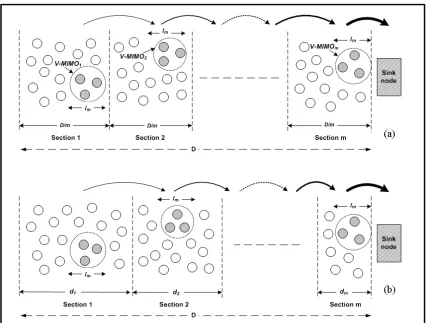
Figure 1. Network sectoring. (a) uniform sectoring; (b) optimal sectoring.
boundaries) is considered for each section (as depicted in Figure 1(a)).
Total energy consumption for transmitting L bits in a
MIMO system over a Rayleigh fading channel can be expressed as [3]
0
= 1+ b k ct cr b
E L E G d L P P R (1) where α is a parameter describing the efficiency of radio frequency power amplifier. Eb is the average energy per bit at the receiver for a given bit error rate requirement. G0
is the power attenuation factor at unit distance (d = 1 m) and k is the path-loss exponent. Pct and Pcr are the
circui-try power consumption at the transmitter and receiver sides, respectively. Rb is the bit rate [3-5]. Simply, if the
sensor nodes are uniformly distributed in the network, the average number of bits generated in each section will be equal L1 = L2= Lm= L. The scenario for
informa-tion transmission to the sink in this network can be ex-plained in the following three phases.
Phase 1: In each section, the local information is
col-lected by a V-MIMO unit (a group of NT nodes).
Con-sider that generalization for multiple V-MIMO units in each section is straight forward.
Phase 2 (non-cooperative communication): In each
section, the NT nodes broadcast their information to all
the other V-MIMO nodes using different time slots with
uncoded M-QAM [3]. Meanwhile, these NT nodes are
placed beside each other with a maximum separation of
lm = NT meters. For these transmissions, we consider
a Rayleigh fading channel with square-law path-loss plus additive white Gaussian noise (AWGN). Energy
con-sumption of the i-th section for the non-cooperative
phase can be expressed as [5]
2
2 0 2
= 1+
i
intra b m ct cr
E L E G l L P P b BW (2)
where b2 represents the modulation constellation size,
2 b
E denotes Eb for constellation size b2 and BW is the
transmission bandwidth of each sensor node.
Phase 3 (cooperative communication): When the to-tal information is collected by a V-MIMO unit, it will be encoded and transmitted using practical orthogonal STBC code design explained in [6] to the V-MIMO unit of the next section. This code design allows us to obtain the energy consumption with best accuracy. It is notable that each of these V-MIMO units should relay the infor-mation of previous units as well. For these transmissions,
path-loss plus AWGN.
In order to take the effect of training overheads for channel estimation into account, suppose that the
infor-mation block size of the STBC code is equal to F
sym-bols and in each block we include N training symbols.
Hence, if R is the transmission rate [4,5], the effective bit rate of the MIMO transmission is given by
1
effF N
R R b BW
F
(3)
where b1 represents the modulation constellation size for
the cooperative communications. Hence, by considering (1) and (3), energy consumption of each section for mul-tihop transmissions (cooperative communications) can be given by
1
1 0
1
= 1+ k T ct T ct
i
inter b i
eff eff eff
iL N P i L N P
b BW
E iL α E G d
R R R
(4) where Eb1 denotes Eb for constellation size b1. In the
above equation, the first term denotes the energy con-sumption for transmitting iL bits (L bits collected by the
i-th V-MIMO plus (i – 1)L bits received from (i – 1) pre-vious sections), the second and the third terms denote the
circuitry energy consumption for transmitting iL and
receiving (i – 1)L bits. Therefore, the total energy con-sumption of each section by considering both cooperative and non-cooperative communications can be expressed as
Ei = Eintrai Einteri .
3. Optimal Network Sectoring
As mentioned earlier, maximizing the lifetime of the network is our main goal. In the explained cooperative network model, the lifetime of the network is directly dependent upon the existence of each section. It means that if one section dies because of its high workload, the network connectivity will be broken and the network will become useless. Hence, the effective lifetime of the net-work is inversely proportional to the maximum energy consumption (workload) among the network sections as
1
, 1, , .
max( i)
Lifetime i m
E
(5)
Consider Figure 1(a) where the network has a
uni-form sectoring. In this case, the energy consumption for the non-cooperative communication (as in (2)) is ap-proximately equal for all sections. Therefore, knowing the fact that each section should not only transmit its own information but also forward the information of previous sections, the workload of the sections closer to the sink is much higher. Thus, with equal-size sections, the network lifetime is limited to the lifetime of the m-th section (the last section), whose lifetime is much shorter
than other sections. Obviously, this is not the optimal performance for this network.
In order to maximize the network lifetime, we propose to modify the section sizes as illustrated in Figure 1(b). To find the optimal network sectoring, the following optimization problem should be solved for the linear network under consideration
1
min max( ),
. . i m i i E
s t
d D (6)Lemma: Instead of solving the above optimization problem, we solve the following equivalent optimization problem problem
22
1 1
1
1 1
min ( ) ,
. .
m m
i i i i i
m i i
Var E m E m E
s t d D
(7)For the simplicity, by considering (2) and (4), we re-write Ei asEi iAdikiBC, where
1 1 0 1 , , . b effT ct T cr T cr
eff eff eff
b BW
A L E G
R
L N P L N P L N P
B C
R R R
(8)
Hence, we will have
2
21 1
1
1 1
min ,
. .
m k m k
i i
i i
m i i
iAd iB C iAd iB C
m m
s t d D
(9)To solve the above problem, we define the Lagrangian
(J) [7] associated with the problem (9) as
1
( i) im i .
J Var E D
d (10)By setting the first derivative of J with respect to each of its variables equal to zero, we have
1 2
2 2
0, 1, , ,
m
j j i i j
j j j
E E E E
J j m
d m d m d
(11) 1 1 2 2 2 . mj i i j
j
E E E
m m d
(12)To extract Ej, we take a summation over j from both
sides of (12), which results in
1
1 1 1
2 2
,
m m m j
j i
j i j
j E
E E
m m d
(13)1
1
0 mj j .
j E d
From (2) and (4), (Ej is strictly ascending function of dj) and hence λ = 0. By substituting λ= 0 into (12), we
have
1
1 2 .
m i i m
E
E E E E
m
(15)As is expected, Equation (15) means that to maximize the lifetime of the network, all of the sections should have equal workload and therefore all die together. From summation of (2) and (4) and considering (15), the op-timal section size can be expressed as
1, , .
k i
E C iB
d i m
iA
(16)
As is clear form (16), the optimal network sectoring
problem has a waterfilling form solution (di) with
para-meter E given by (15), which is determined by network
length constraint D.
Proof of the Lemma: We prove that (6) and (7) have the same solutions. Assume that these problems have different solutions
d Ei6, i6
and
7 7
,
i i
d E for i respectively.
Note that E7i values are equal i as discussed in (15).
Since the network length constraint should hold for both solutions, we cannot say di6 di7i. So, there should
be an i so that di6 di7 (unless
6 7
i i
d d ) and Ei6 Ei7.
This means that
d Ei7, i7
is a better solution forprob-lem (6); in other words,
d Ei6, i6
is not the optimalsolution for (6). Hence, our initial assumption was wrong and therefore (6) and (7) have the same solution.
4. Performance Evaluation
We consider the explained network model in Section 2 and evaluate the effect of the proposed network sectoring
for a linear m-section WSN using computer simulations.
We consider the case where m = 8, NT = 4, b1 = 2 and b2
= 8. The path-loss exponent is considered to be k = 2 for
non-cooperative transmissions and k = 3 for cooperative
transmissions. As described earlier, the lifetime of the network is inversely proportional to maximum energy consumption of individual sections as in (5). Thus, to represent the results, we define 1/max(Ei), i = 1, 2,, m
[image:4.595.319.530.82.227.2] [image:4.595.320.528.563.704.2]as lifetime coefficient.
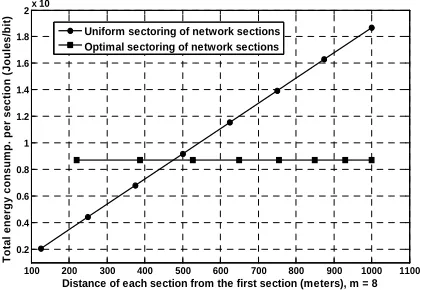
Figure 2 compares the total energy consumption of different sections of the multihop network for the case of uniform and the proposed optimal sectoring for D = 1000 m.
The x-axis represents the boundaries of different sec-
tions from the first section that is located at x = 0. From the figure, the proposed optimal sectoring (section sizes) results in equal total energy consumption for different sections of the network, which in turn leads to maximiz-ing of the total network lifetime. Meanwhile, in the uni-form sectoring the closest section to the sink consumes
100 200 300 400 500 600 700 800 900 1000 1100
0.2 0.4 0.6 0.8 1 1.2 1.4 1.6 1.8
2x 10
-3
Distance of each section from the first section (meters), m = 8
T
o
ta
l en
er
gy
co
nsu
m
p
. pe
r se
ct
io
n (
J
oul
e
s/
bi
t)
Uniform sectoring of network sections Optimal sectoring of network sections
Figure 2. Total energy consumption of different sections.
much more energy compared to that of the optimal sec-toring, and hence the uniformly sectored network will die sooner. As is expected from our previous analysis, to achieve even energy distribution in the explained net-work, the sections which are closer to the sink have smaller sizes.
Figure 3 illustrates the lifetime coefficient of uniform and the proposed optimal sectoring. As well, relative
lifetime (R = Lifetime coeff. of optimal/Lifetime coeff.
of uniform) for both schemes is depicted for different
network sizes (D). From the figure, the proposed optimal
sectoring enhances the lifetime of the network by about
130% (2.3 times) for large network sizes (D) compared
to that of the uniform sectoring.
5. Conclusions
In this paper, we investigated the effect of section (clus- ter) size on the total power consumption of multihop cooperative WSNs. We proposed an optimal network sectoring for linear multihop networks so that it mini-mizes the total power consumption of the network by evenly distributing the power in such a network. The simulation results illustrate that the proposed optimal
800 1000 1200 1400 1600 1800 2000 2200 2400 2600
0 0.5 1 1.5 2 2.5
Network length, D (meters)
Lifeime coefficient of uniform sectoring Lifeime coefficient of optimal sectoring Relative lifetime improvement (R)
sectoring scheme leads toequal power consumption in all
the sections and increases the lifetime of the network up to 2.3 times compared to the equal sectoring.
6. Acknowledgements
The authors would like to acknowledge Mr. Mehran Mashreghi for his insightful comments and helpful dis-cussions.
7. References
[1] S. Alamouti, “A Simple Transmit Diversity Technique for Wireless Communications,” IEEE Journal on Selected
Areas in Communications, Vol. 16, No. 8, October 1998,
pp. 1451-1458.
[2] J. N. Laneman, D. N. C. Tse and G. W. Wornell, “Co- operative Diversity in Wireless Networks: Effcient Pro- tocols and Outage Behaviour,” IEEE Transactions on
Informormation Theory, Vol. 50, No. 12, December 2004,
pp. 3062-3080.
[3] S. Cui, A. J. Goldsmith and A. Bahai, “Energy-Efficiency of MIMO and Cooperative MIMO Techniques in Sensor Networks,” IEEE Journal on Selected Areas in Commu-
nications, Vol. 22, No. 6, August 2004, pp. 1089-1098.
[4] S. K. Jayaweera, “Virtual MIMO-Based Cooperative Com- munication for Energy-Constrained Wireless Sensor Net- works,” IEEE Transactions on Wireless Communications, Vol. 5, No. 5, May 2006, pp. 984-989.
[5] M. Mashreghi and B. Abolhassani, “Prolongation of Life- time for Wireless Sensor Networks,” Proceedings of Inter-
national Conference on Intelligent Sensors, Sensor Networks
and Information Processing, Melbourne, 3-6 December
2007, pp. 73-78.
[6] K. Lu, S. Fu and X.-G. Xia, “Closed Form Designs of Complex Orthogonal Space-Time Block Codes of Rates (k+1)/(2k) for 2k1 or 2k Transmit Antennas,” Proceedings
of IEEE International Symposium on Information Theory,
Chicago, 27 June-2 July 2004, p. 307.