ISSN Online: 2165-3925 ISSN Print: 2165-3917
DOI: 10.4236/ojapps.2019.95028 May 15, 2019 342 Open Journal of Applied Sciences
Microstructure and Strength of Diffusion
Bonded 2014 AA Alloys Using Copper
Interlayer
Abass Ali Saleh
Department of Materials Engineering, College of Engineering, Mustansiriyah University, Baghdad, Iraq
Abstract
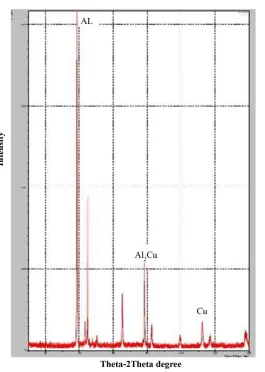
The major awkwardness when joining AA2014 lies in the presence of creation of oxide films and brittle intermetallic in the bond region. However, diffusion bonding can be used to join these alloys without much difficulty. This paper reveals the characterization of diffusion connection of aluminum alloy AA 2014 with and without applying copper powder. Joining was achieved in va-cuum up to (1 × 10⁻⁵ mbar) by means of vacuum system. Aluminum alloy AA2014 samples were done as cylinder form and interlayer thickness was equal 100 µm, under joining conditions of (325˚C - 475˚C) and 4 MPa and period of (1 hour). The ultimate strength was found equal to 188.36 MPa. Bonding joint was examined using light microscope, (SEM) with (EDS) for determining microstructure and depth of diffusion and microhardness was also used at connection zone. XRD outcomes display that the main interme-tallic compound phase formula was Al2C. The maximum depth of diffusion obtained was 19.1 µm.
Keywords
2014 AA Alloys, Diffusion Bonding, Microstructure
1. Introduction
In numerous engineering scopes, Al and its alloys are widely employed as suita-ble materials for constructions wanted to be lightened. AA2014 alloy is vital for army vehicle and aerospace requests [1]. Aluminum and alloy’s welding by con-ventional procedures give rise to various flaws, for instance deformation, air holes, and cracks, so there was a specific welding method essential to prevent or reduce these flaws. Product necessities in the aerospace, aircraft, electronics, How to cite this paper: Saleh, A.A. (2019)
Microstructure and Strength of Diffusion Bonded 2014 AA Alloys Using Copper In-terlayer. Open Journal of Applied Sciences, 9, 342-353.
https://doi.org/10.4236/ojapps.2019.95028
Received: April 3, 2019 Accepted: May 12, 2019 Published: May 15, 2019
Copyright © 2019 by author(s) and Scientific Research Publishing Inc. This work is licensed under the Creative Commons Attribution International License (CC BY 4.0).
http://creativecommons.org/licenses/by/4.0/
DOI: 10.4236/ojapps.2019.95028 343 Open Journal of Applied Sciences coating procedures. There is several usefulness of utilizing appropriate interlayer such rising the strength of the joining joint, reducing the development of weak intermetallic at joining region [4]. The goodness of a joint is based on its strength. To fetch the maximum strength, it is significant to control the relevant process parameters (temperature, pressure and interlayer) entirely. Consequent-ly, it is very significant to control and choose the welding process parameters [5]. All previous studies were restrictive to the evaluation of the diffusion parameters influence and microstructure at the interface of the diffusion bond. But, limited researches have considered the effect the interlayers function on the diffusion bonding joint and the influence of interlayer on the same materials. In the present study, the effect of bonding variables: temperature pressure and pure copper powder interlayer on the joint strength was investigated, also evaluating the intermetallic compound that may be formed during bonding.
2. Experimental Procedure
2.1. Materials
In this investigation, the base metals used was AA2014. Pure copper powder with particle size of 14 - 25 µm was utilized as interlayer. The chemical composi-tion and physical properties of base metals and interlayer are tabulated in Table 1, Table 2 respectively.
2.2. Test Materials and Specimen Preparation
[image:2.595.208.541.590.644.2]The aluminum alloy AA2014 was received as rods with 15 mm diameter. Then,
Table 1. The weight percentage of the chemical compositions.
Alloy Si Fe Cu Mn Mg Cr Zn Ti Pb In Al
2014 0.81 0.7 4.4 0.8 0.5 0.1 0.25 0.15 - - Bal.
Cupowder - - 99.80 - - - 0.125 0.075 -
Table 2. Some physical properties base metals and copper interlayer.
Alloy Purity % Liner Thermal expansion (μm/˚C) Density g/cm3
AA2014 23 2.8
[image:2.595.211.540.675.726.2]DOI: 10.4236/ojapps.2019.95028 344 Open Journal of Applied Sciences cut into 35 mm length of cylinder portions via wire cutting device. The surface of samples has been produced by polishing and grinding processes to get appro-priate flat surface for joining. The joining surface of the AA2014 samples has been grinded by employing diverse sets of (SiC) paper thereafter polished by means of diamond paste 0.3 µm grain size. Surface roughness portable device has been used to measure the roughness of surface after grinding and polishing. The amount of the surface roughness of the wholly samples is (0.5 μm). Cleaning the specimens with acetone was done by using ultrasonic bath device for 15 min to remove any contaminations adhering on it. The copper powders interlayer with 0.158 g weights, according to the mass equation of 100 µm thicknesses and density of powder, was place on surface of sample and sprinkled by alcohol to hold the powder.
2.3. Diffusion Ponding Process
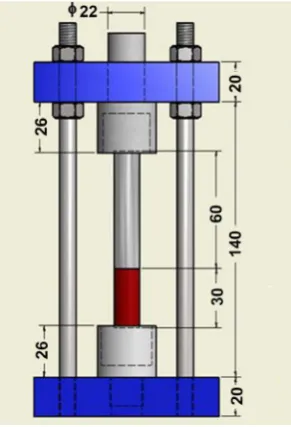
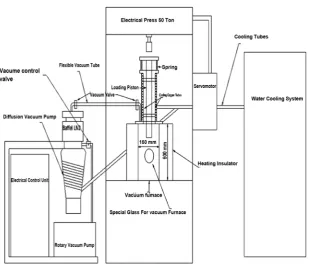
[image:3.595.316.432.359.464.2]The polished and chemically prepared specimens of a similar AA2014 aluminum alloys were stacked in a holder and fixture shown in Figure 1, and the complete diffusion joining die setup, shown in Figure 2, and its inserted into a vacuum chamber. The whole diffusion bonding system is shown in Figure 3. It involves
Figure 1. Holder and fixture.
[image:3.595.300.446.495.709.2]DOI: 10.4236/ojapps.2019.95028 345 Open Journal of Applied Sciences
Figure 3. The representation drawing of the diffusion bonding system.
of diffusion vacuum pump, vacuum tube furnace, rotary vacuum pump, cooling and heating system, control and loading unit. The practical load used for joining the samples by means of hydraulic kind (mega-Spanish) of size 50 ton that has servo motor, it should be noted that (each 1 ton is equivalent to 56 MPa accord-ing to cross section area of 176.6 mm2 of sample in this work).
The bonding process was conducted at 325,375,425,475˚C under a vacuum of 1 × 10⁵ m bar and holding pressure of 4 MPa for constant period (one hour). Tensile strength test has been carried out for the bonded specimens.
2.4. Tests
DOI: 10.4236/ojapps.2019.95028 346 Open Journal of Applied Sciences been carried out by using Energy Dispersive Spectroscopy type oxford at the bonding joint. The test has been performed for element analysis by line and point EDS to show element diffusion and depth of diffusion. The XRD examina-tion of specimen has been performed by means of XRD device kind (Shimad-zu-6000XRD) XRD outcomes are equated with standard chart.
3. Results and Discussion
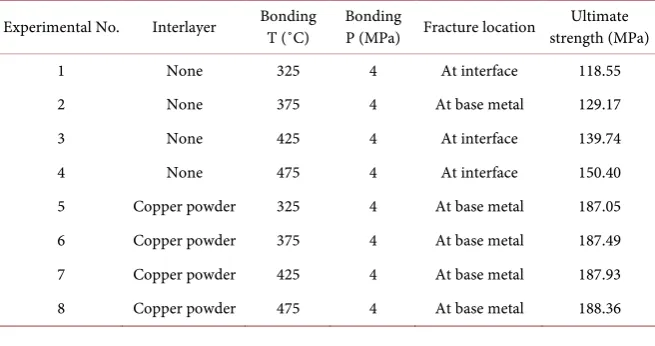
To examine the mechanical properties of the bonded specimens, uniaxial tension checks were achieved. Table 3 displays the results of tensile properties of the bonded specimens with Cu interlayers and without interlayer.
From Table 3, wholly tensile test samples for Cu interlayer, fracture happened at base metal. This denotes that strength at bonding area is greater bonded zone due to high vacuum atmosphere and good surface roughness of samples with decent conditions which drove to diffusion of Cu powder in the direction of base metal. The superior outcomes have been got when utilizing Cu powder as inter-layer with (187.05 - 188.36) MPa tensile strength. The maximum ultimate tensile strength is 188.36 MPa at 475˚C. The strength for joint bonded in the absence of interlayer grants good outcomes and the extent of tensile strength was (118.55 - 150.4) MPa.
3.1. Effect of Temperature on Joining Strength
The influence of temperature on joining strength with and without using inter-layer is clarified in Figure 4. The maximum bonding strength with and without interlayer is 188.39 MPa and 150.4 MPa respectively at 475˚C and pressure of 4 MPa. The plot shows the best bonding condition was obtained to be with inter-layer.
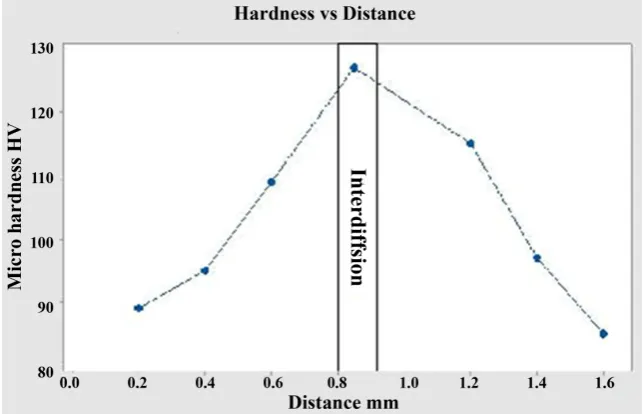
[image:5.595.210.538.559.732.2]Microhardness examination has been achieved for the testing sample diffusion bonding joint. The microhardness was computed at base metal and bonding area. The examination starts from the left side to the right side of the base metal passing through the interlayer with 0.2 mm spaced points. Figure 5 represents
Table 3. Results of tensile strength of diffusion bonding specimens.
Experimental No. Interlayer Bonding T (˚C) Bonding P (MPa) Fracture location strength (MPa) Ultimate
1 None 325 4 At interface 118.55
2 None 375 4 At base metal 129.17
3 None 425 4 At interface 139.74
4 None 475 4 At interface 150.40
5 Copper powder 325 4 At base metal 187.05
6 Copper powder 375 4 At base metal 187.49
7 Copper powder 425 4 At base metal 187.93
DOI: 10.4236/ojapps.2019.95028 347 Open Journal of Applied Sciences
Figure 4. Effect of temperature on joining strength.
Figure 5. Hardness of the optimum bonding condition.
the microhardness at the best conditions; the microhardness measured recorded (89 Hv) at base metal and enlarged progressively up to (109 Hv) nearby the in-terlayer. The microhardness measurement is (127 Hv) at interlayer which is su-perior than of base metal inasmuch as the interlayer is pure powder of copper and has higher hardness than the base metal. Thereafter, the microhardness thru the interlayer in the direction of the base metal on the right of bonding region commenced to reduce. The measurements were (97 Hv) and reduce to (85 Hv) at base metal. The cause for this difference was owing to the high hardness of the Cu powder that was greater than other areas.
3.2. Microstructure Test of Diffusion Bonding Joint
[image:6.595.212.534.259.466.2]DOI: 10.4236/ojapps.2019.95028 348 Open Journal of Applied Sciences
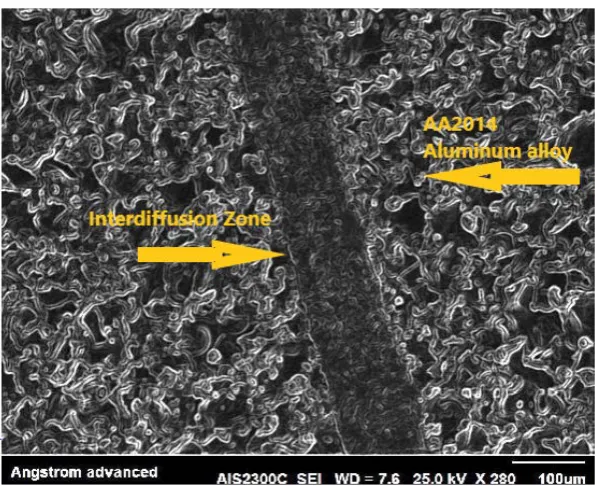
Figure 6. Optical microscope of bonded joints.
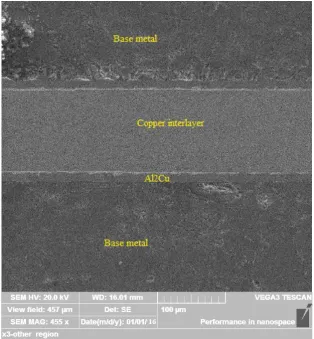
Figure 7. Scanning electron microscope of bonded joints.
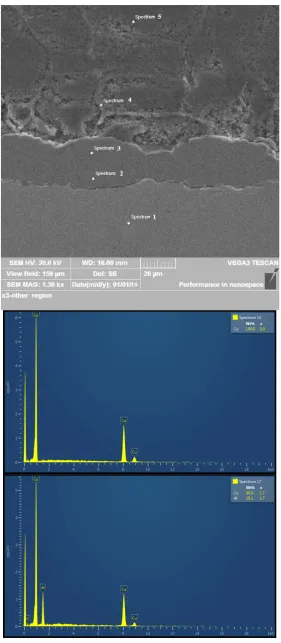
The significant factors for diffusion atoms in the diffusion bonding proce-dures were diffusion coefficient, sufficient time, pressure and temperature ap-plied. The diffusion process needs appropriate time to happen and when the atoms are large further time is required to get a homogenous structure [7]. SEM examination strong minded the structure, phase distribution and diffusion depth. Figure 8 displays the microstructure of best bonding joint regions with powder Cu interlayer. The maximum bonding strength was 188.36 MPa noted at maximum temperature. The combinations effect of temperature and pressure appeared at maximum temperature of 475◦C due to comprehensive coalescence
among two coupling surfaces associated with high diffusion rate.
[image:7.595.225.523.270.513.2]DOI: 10.4236/ojapps.2019.95028 349 Open Journal of Applied Sciences
Figure 8. SEM of joint bonded at 475˚C and 4 MPa.
creating of Al2Cu phase which grants the improvement of mechanical properties
[8]. Rising temperature extent bellow the temperature of annealing will improve the mechanical properties especially tensile strength of the welded joint to be superior than the analogous joint welding. Raising the temperature directly above 475˚C gave rise to fast grain growth which drove to a reduction in joining strength. Pressure is not extremely effective likened with other factors, the rise in pressure some more than increase temperature leads to plastic deformation and is not to get intact joint [9].
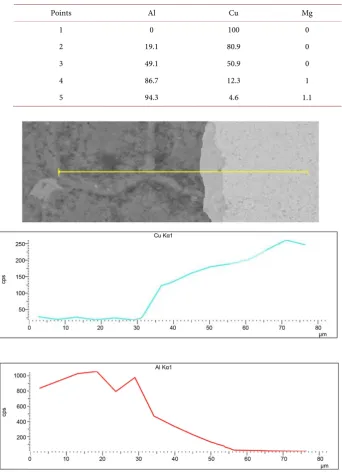
The bonded joint was tested using EDS at diverse points is exposed in Figure 9, which displayed the chemical composition of elements at the specific points. Point 1 represented the composition of the Cu powder and other points (2, 3, 4 and 5) indicated to diffusion of Cu into AA2014 Al alloy. Table 4 represents the chemical composition of elements at separately point.
The EDS line for best conditions joint regions has been inspected as shown in
DOI: 10.4236/ojapps.2019.95028 350 Open Journal of Applied Sciences
DOI: 10.4236/ojapps.2019.95028 351 Open Journal of Applied Sciences
Figure 10. EDS line on left side interdiffusion.
to in perfect bonding. The extreme deepness of diffusion of Cu atoms in the di-rection of base metal on both sides of diffusion region is nearly 19.1 µm. The diffusion deepness is elevated because the high free energy of the powder body, unstable and accompanying with existence of actual large internal interface [10].
[image:10.595.196.539.85.558.2]DOI: 10.4236/ojapps.2019.95028 352 Open Journal of Applied Sciences
Figure 11. XRD examination of optimum bonding joint.
particles of copper diffused into Al alloy caused an upsurge in mechanical prop-erties and intimate contact among the same alloy this was as a consequence of the increased creation of phases percentage of Al2Cu [11].
4. Conclusions
1) Bonding joint of aluminum alloy AA2014 with powder interlayer of Cu powder is better than without ones.
2) The best bonding conditions of diffusion bonding process are as pressure of 4 MPa, temperature of 475˚C and bonding duration one hour. This condition resulted in tensile strength of 188.36 MPa.
3) The microhardness of the diffusion zone is more than of base metal since the hardness of copper is higher than of aluminum alloy AA2014.
4) Maximum deepness of diffusion of copper powder into aluminum alloy AA2014 was about 19.1 µm.
Acknowledgements
En-DOI: 10.4236/ojapps.2019.95028 353 Open Journal of Applied Sciences
https://doi.org/10.12988/ces.2018.87345
[2] Mahendiran, G., Balasubramanian, V. and Sethilvelan, T. (2011) Mechanical and Metallurgical Properties of Diffusion Bonded AA2024 Aluminum Alloy and Com-mercial Grade Copper. Mechanical Engineering, 38, 4283-4289.
[3] ASM International (1993) Metals Handbook: Welding Brazing and Soldering. Vol. 6, American Society for Metals, Metals Park.
[4] Akac, E. and Gursel, A. (2015) The Importance of Interlayer in Diffusion Weld-ing—A Review. Periodicals of Engineering and Natural Science, 3, 12-16.
[5] Mahendiran, G., Balasubramanian, V. and Sethilvelan, T. (2010) Influences of Dif-fusion Bonding Process Parameters on Bond Characteristics of Mg-Cu Dissimilar Joints. Transactions of Nonferrous Metals Society of China, 20, 997-1005.
https://doi.org/10.1016/S1003-6326(09)60248-X
[6] ASTM International, B209M-14, Standard Specification for Aluminum and Alumi-num-Alloy Sheet and Plate (Metric).
[7] Balasubramanian, M. (2015) Application of Box-Behbken Design for Fabrication of Titanium Alloy and 304 Stainless Steel Joints with Silver Interlayer by Diffusion Bonding. Materials and Design, 77, 161-169.
https://doi.org/10.1016/j.matdes.2015.04.003
[8] Gao, Y., Mo, Q., Luo, Z., Zhand, L. and Huang, C. (2006) Atomic Bonding and Prop-erties of Al-Cu Alloy with θ(Al2Cu). Journal of Electronic Materials, 35, 1801-1805. https://doi.org/10.1007/s11664-006-0160-7
[9] Pilling, J. and Ridley, N. (1987) Solid State Bonding of Superplastic AA 7475. Mate-rials Science and Technology, 3, 353-359.
https://doi.org/10.1179/026708387790122666
[10] Lyushinskii, A.V. (2009) Criteria for Selecting Interlayers in Diffusion Bonding Dis-similar Metals. Welding International, 15, 830-832.
[11] Dolgopolov, N.A., Rodin, A.O., Simanov, A.V. and Gontar, I.G. (2009) Diffusion of Copper along Grain Boundaries in Aluminum. Non-Ferrous Metals, 50, 133-137.