REVIEW
The pervasive role of social learning in primate lifetime development
Andrew Whiten1 &Erica van de Waal2
Received: 11 December 2017 / Revised: 22 March 2018 / Accepted: 29 March 2018
#The Author(s) 2018
Abstract
In recent decades, an accelerating research effort has exploited a substantial diversity of methodologies to garner mounting evidence for social learning and culture in many species of primate. As in humans, the evidence suggests that the juvenile phases of non-human primates’lives represent a period of particular intensity in adaptive learning from others, yet the relevant research remains scattered in the literature. Accordingly, we here offer what we believe to be the first substantial collation and review of this body of work and its implications for the lifetime behavioral ecology of primates. We divide our analysis into three main phases: a first phase of learning focused on primary attachment figures, typically the mother; a second phase of selective learning from a widening array of group members, including some with expertise that the primary figures may lack; and a third phase following later dispersal, when a migrant individual encounters new ecological and social circumstances about which the existing residents possess expertise that can be learned from. Collating a diversity of discoveries about this lifetime process leads us to conclude that social learning pervades primate ontogenetic development, importantly shaping locally adaptive knowledge and skills that span multiple aspects of the behavioral repertoire.
Keywords Social learning . Traditions . Culture . Ontogeny . Development . Juvenile primates
Introduction
Social learning and culture (Table1) have been studied in non-human primates since the middle of the last century. A substan-tial scientific literature delineating these phenomena has since accumulated, spanning a diversity of vertebrate species includ-ing mammals, birds, and fish (Hoppitt and Laland2013; Whitehead and Rendell2015; Whiten2017a) as well as insects and other invertebrates (Grüter and Leadbeater 2015). Primatology has often led the way in these advances, and in the present century has delivered a new range and depth of
understanding in this field, supported by a diversity of innova-tive methodologies (discussed further below). These have often delivered satisfyingly convergent conclusions (Whiten2012; Watson et al.2018, for reviews), although there is also ample debate about the exact nature and distribution of the varied forms of social learning across different animal species (Tennie et al.2009; Whiten et al.2009; van Leeuwen and Haun2014; Galef and Whiten2017; Henrich and Tennie2017). In the case of cetaceans, Whitehead and Rendell’s (2015, p. 7) comprehensive review concluded thatBCulture…is a ma-jor part of what the whales are.^ In other words, culture is inferred to pervade the lives of the whales that these authors study, shaping so much of their behavioral repertoires that their lives would be drastically different if social learning did not play such an influential role in shaping adaptive be-haviors. Whiten (2017b) made a similar case for the cultural lives of the great apes. In the present article, we review the evidence bearing on more specific hypotheses: that social learning progressively pervades the infant and juvenile phases of primates’lives; and that it recurs to play an important role in later life events too, notably when individuals mature and disperse to new groups.
Our use of the termBpervades^includes a suite of hypoth-esized effects: (i) that much of the behavioral repertoire is adaptively shaped by learning from others; (ii) that this spans Communicated by F. Amici
This article is a contribution to the Topical Collection An evolutionary perspective on the development of primate sociality—Guest Editors: Federica Amici and Anja Widdig
* Andrew Whiten aw2@st–andrews.ac.uk
1
Centre for Social Learning and Cognitive Evolution, and Scottish Primate Research Group, School of Psychology and Neuroscience, University of St Andrews, St Andrews KY16 9JP, UK
multiple behavioral domains, from foraging to social behav-ior; and (iii) that effects may span multiple consecutive gen-erations of traditions acquired by juveniles. The main body of this review addresses these issues below. In the remainder of this introductory section, we indicate the principal outlines of what has been learned about primate social learning and cul-ture more generally, within which the particular dimension of ontogenetic development is to be situated.
Our understanding of this field has been enriched and strengthened by the application of a growing variety of meth-odological approaches to a widening database of primate spe-cies. One importantBbroad-brush^starting point has been to compare geographically separated communities of the same species, identifying behavioral differences that through exclu-sion of any apparent genetic or immediate environmental ex-planations are ascribed to cultural transmission. This approach has now identified multiple putative traditions in all the great ape genera (Whiten et al.1999; van Schaik et al.2003; Robbins et al.2016) and in several genera of monkeys (Panger et al. 2002; Leca et al.2007; Santorelli et al.2011). More recently, this approach has focused more minutely on differences be-tween neighboring communities of the same species both in enclosures in sanctuaries (van Leeuwen et al.2012,2014) and in the wild (Luncz and Boesch2014), thereby further minimiz-ing the possibility that the behavioral differences identified are caused by genetic or ecological variation.
Such conclusions have been re-inforced byBdiffusion experiments^ in which alternative techniques to deal with the same foraging task have been seeded in individuals acting
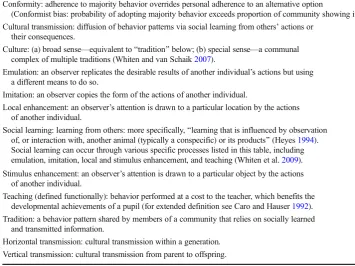
[image:2.595.176.532.65.331.2]as potential models in each of two or more groups, and the subsequent differential spread of these documented, again in both apes (Whiten et al.2005) and monkeys, both in captivity (Dindo et al.2009) and in the wild (Gunhold et al.2014; van de Waal et al.2015). These experiments confirm a capacity for the transmission and spread of innovations through social learning. Sophisticated statistical approaches delineating so-cial networks have also been used to trace the diffusion of naturally occurring innovations along lines predicted by social relationships (Hobaiter et al.2014). Transmission across mul-tiple generations has been documented by archeological evi-dence of nut-cracking excavated deep beneath the surface where the practice continues today, corresponding to over 4300 years for chimpanzees (Mercader et al. 2007; see Fig. 2 in Whiten 2017a) and 700 years for capuchins (Haslam et al.2016). These studies have been complemented by diffusion experiments running along a chain of individuals where having learned from A, individual B becomes the mod-el for C and so on, thus simulating repeated inter-generational transfer in these genera (Horner et al.2006; Dindo et al.2011). Further extensive series of experiments have probed the par-ticular social learning processes or mechanisms employed by monkeys and apes, often focusing on those that appear the most cognitively challenging, notably emulation, imitation, and teaching (Table 1) (Voelkl and Huber 2000, 2007; Subiaul et al.2004; Call et al.2005; Dell’mour et al.2009; Whiten et al.2009; Hopper2010; Tennie et al.2010; van de Waal and Whiten2012; Galef and Whiten2017). More recent developments have begun to address selective, adaptive biases Table 1 Glossary of key social
learning concepts Conformity: adherence to majority behavior overrides personal adherence to an alternative option
(Conformist bias: probability of adopting majority behavior exceeds proportion of community showing it). Cultural transmission: diffusion of behavior patterns via social learning from others’actions or
their consequences.
Culture: (a) broad sense—equivalent toBtradition^below; (b) special sense—a communal complex of multiple traditions (Whiten and van Schaik2007).
Emulation: an observer replicates the desirable results of another individual’s actions but using a different means to do so.
Imitation: an observer copies the form of the actions of another individual.
Local enhancement: an observer’s attention is drawn to a particular location by the actions of another individual.
Social learning: learning from others: more specifically,Blearning that is influenced by observation of, or interaction with, another animal (typically a conspecific) or its products^(Heyes1994). Social learning can occur through various specific processes listed in this table, including emulation, imitation, local and stimulus enhancement, and teaching (Whiten et al.2009). Stimulus enhancement: an observer’s attention is drawn to a particular object by the actions
of another individual.
Teaching (defined functionally): behavior performed at a cost to the teacher, which benefits the developmental achievements of a pupil (for extended definition see Caro and Hauser1992). Tradition: a behavior pattern shared by members of a community that relies on socially learned
and transmitted information.
in whom to copy, and when (Haun et al.2012; Price et al. 2017), as well as the constraints imposed by factors such as the relative rank and tolerance of different models and poten-tial learners (Lonsdorf et al.2016).
In sum, a substantial diversity of methodological ap-proaches has been applied to a growing array of species across the primate order. The now voluminous primate social learn-ing literature, of which the above cited papers offer but an illustrative sample, have demonstrated a significant role for social learning across many behavioral domains, including diet choice, foraging techniques, tool use, predator avoidance, grooming styles, courtship gambits, vocal communication, and reconciliation behavior, plus cross-generation transmis-sion of local traditions.
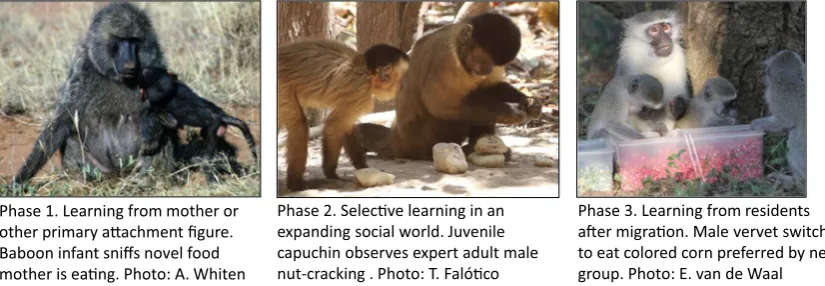
Within this body of work, attention to developmental di-mensions has been just one component. However, we believe sufficient material has now accumulated in diverse pockets of the primate literature to merit and sustain what we believe is the first wide-ranging review of the field, complementing an earlier developmental review focused only on the great apes (Russon2003). We structure this review in relation to three major phases we suggest can usefully be distinguished in the ontogenetic course of social learning as it unfolds in a majority of primates, illustrated in Fig.1.
The first phase of social learning:
B
mother
knows best
^
(and in some primates, other
primary caretakers)
In most species of monkeys and apes, mothers initially carry and breastfeed their infants. This appears a common pattern in primates, although it is not true of all: for example, in callitrichids, infants may be predominantly carried by the fa-ther and ofa-ther family members (a topic treated furfa-ther below) and some Strepsirrhine primates initially leave the infant in a nest. Nevertheless, in the majority of primates maternal care and carriage is initially the norm, even if the extent to which
maternal interactions dominate and thus shape opportunities for social learning varies. One extreme is well illustrated by orangutans, whose typical, semi-solitary social structure means that for as much as the first 10 years or so, the mother is the primary and frequently only model for social learning, sometimes with the accompaniment of an elder sibling (van Noordwijk et al.2009). Juveniles spend most of their time in the same tree as their mother until they are 6–8 years of age. Even for infant chimpanzees, who will typically experience a greater variety of conspecifics in small fission-fusion parties, a majority of their time will be spent in a focused relationship with their mother. By the age of 4 years, they are still spending most of their time within 3 m of their mother and only around 6% (males) or 3% (females) of their time traveling indepen-dently beyond 15 m (Lonsdorf et al.2014).
Some of the most detailed observational studies of this phase have been achieved in the context of the relatively ex-clusive mother infant relationship of orangutans, mentioned above. For example, Jaeggi et al. (2008) tested whether the principal function of mother-offspring food-sharing is (a) to provide nutrition or (b) to gain adaptive information about foraging. The authors concluded that their results favored the informational hypothesis, because sharing failed to peak at weaning as the nutritional hypothesis would predict; the article was accordingly entitled Bbegging for information.^ Jaeggi et al. (2010) additionally recorded substantial variance in the diets of multiple mothers, with the dietary profiles of infants found to be essentially identical to their mothers’ pro-files; immature individuals focused attention on the most dif-ficult of the mothers’techniques, and then tended to practice these rather than manipulating other objects, indicating observational learning of the skills involved. Schuppli et al. (2016) labeled such focused visual attention Bpeering,^ in which an infant may bring their face up close to the activity of interest. Building on the studies by Jaeggi et al. (2008, 2010), Schuppli et al. showed that a quantitative index of the complexity of maternal food-processing actions predicted this close peering behavior, especially when the food source was a
Phase 1. Learning from mother or other primary aachment figure. Baboon infant sniffs novel food mother is eang. Photo: A. Whiten
Phase 2. Selecve learning in an expanding social world. Juvenile capuchin observes expert adult male nut-cracking . Photo: T. Falóco
Phase 3. Learning from residents aer migraon. Male vervet switches to eat colored corn preferred by new group. Photo: E. van de Waal
[image:3.595.86.499.556.699.2]rare one. Peering was typically followed by a juvenile_s ac-tions on the same target items in the hour following. In parallel fashion, peering at maternal nest building was recorded over the peak acquisition period for nest-building skill, and such peering was followed by a rise in nest-building attempts in the subsequent hour. van Noordwijk et al. (2009) also observed youngsters beginning to perform nest-making actions while their mother made her nest, long before the youngster could make its own nest. As authors of these studies concluded, all the quantified observations logged are those predicted by the hypothesis that observational learning pervades a young orangutan’s construction of its foraging preferences, food pro-cessing and other skills, including nest building.
Primate studies that investigate social learning in this way across a breadth of foraging and nesting activities appear to remain rare. However in chimpanzees, in which infants’early experiences are more maternally focused than one might ex-pect from chimpanzees’general sociability (Inoue-Nakamura and Matsuzawa1997), a study of one specific form of tool use has been telling. Young female chimpanzees spend signifi-cantly longer periods observing the termite fishing of their mother than do their male siblings, and these females go on to master the requisite techniques as much as a year earlier than their male peers (Lonsdorf et al.2004; Lonsdorf2005, 2006). This difference is likely to be of functional signifi-cance, since when females reach adulthood, tool-assisted insectivory plays a more important role in their diet than for males, who gain more animal protein from hunting other mammalian prey (McGrew1979). As in the orangutan analy-ses, these are correlational findings, so the conclusion that most researchers draw, that they indicate social learning, needs to be tempered by the possibility of a genetic mother-offspring link, such as through biases in manipulative propensities. However, the finding of an even higher mother-daughter matching of the length to which stem tools are inserted into termite mounds (a fidelity tellingly not found for the male offspring that have displayed less peering at the termiting process) are harder to reconcile with an effect of genetic in-heritance (Lonsdorf et al.2004). A now very large corpus of experimental and other studies demonstrate a motivation and a capacity for social learning in young apes consistent with these results from the wild (reviewed in Whiten2017b,c). Matsuzawa et al. (2008), in a graphic phrase, described such acquisition of skills in chimpanzees as a system ofBmaster and apprentice.^In monkeys living in the wild, selective at-tention by juveniles has been documented in some detail in white faced capuchins and as in the orangutan studies, found to be focused on relatively rare, large and difficult to process foods (Perry and Ordoñez Jiménez2006; Perry et al.2017). Moreover in monkeys, the proposed causal role of social learning has begun to be more directly and rigorously tested by field experiments. van de Waal et al. (2013) studied wild vervet monkeys in several groups that once a month were
provisioned with a box of maize corn in order to reveal mon-keys’ ranks and alliance dynamics. For the social learning experiments, the corn was divided into two boxes presented side by side and died either pink or blue, with one color of corn having an additive that made it too bitter to eat in two of the four groups studied, and the other color so treated in two other groups. It took three trials at monthly intervals for the monkeys to learn to avoid the locally unpalatable color. This was done around the birth season so that the new crop of suckling infants were not yet feeding on such solid food so did not test it. After a 4-month follow-up period allowing infants to mature, the same pink- and blue-colored corn op-tions were presented again but now with no additive, so it could be tested whether infants who were now starting to eat solid food learned what to eat by trial and error exploration or were instead biased by maternal preferences. The answer re-soundingly confirmed the latter, with 26 of 27 infants starting to take the color preferred in their group. The mother of the other infant was of very low rank, so fed on the alternative food box while higher ranked animals continued with their now long-standing preference, and this infant preferentially took corn of the same color as its mother. Accordingly, 27 of the 27 infants ate the option their mothers ate, even though both colors of corn were now equally palatable.
In another experiment, groups of wild vervet monkeys were provisioned with sand-covered grapes (van de Waal et al.2014). Mothers adopted one of four different techniques to clean them (such as rubbing the grapes in their hands or rubbing them on the ground) and infants showed a significant matching to the technique displayed by their mother. An ear-lier report showed that such differences are correlated across matrilines (van de Waal et al.2012), suggesting that the pre-ferred techniques tend to pass down vertically along these kin lines.
any depth consideration of the psychological processes in-volved in the social learning of these young primates.
Some primates, most significantly callitrichids, deviate from the above picture of an initially primarily maternal con-text for social learning. In common marmosets, for example, the father typically begins to carry the normally twin infants from birth and later starts to share food with them, while the mother is more limited to the necessarily high burden of lac-tation for these twins. Other individuals in the group, who are reproductively inhibited, may also care for the infants in what is described as a cooperative breeding system (Schiel and Souto2016). The corresponding context for early social learn-ing has been examined through complementary observational studies in the wild and experimental investigations in captivity. In the wild, Schiel and Huber (2006) found that observation of adult or subadult foraging (which principally involves locating, catching and consuming invertebrate prey) peaked in 3–4-month-old infants, occurring in close to 50% of all 10-min observation bouts. Half these cases resulted in Bmodel-dependent foraging^ in which infants responded within 10 s of watching a model. This took one of three main forms, involving either manipulating the same object within 5 s, foraging closer together, or approaching and acting syn-chronously, as in feeding on the same food source. Older juveniles of 5–10 months observed others at lower frequencies as they became generally more competent hunters, but when they did attend to others’actions, they were still likely to then perform model-dependent foraging.
The role of social learning in marmosets was more system-atically investigated through experiments in captivity, which contrasted conditions allowing or preventing observation of a model, in naturalistic foraging challenges that involved catch-ing relatively large prey (grasshoppers or crickets) or extracting embedded prey from within covered holes (Dell’mour et al. 2009). Infant observation of adults (their mother, in this study) peaked at a similar age to that earlier recorded by Schiel and Huber (2006) in the wild, and these infants were 15 times more likely than non-observers to tackle the problem presented. They also needed significantly fewer trials to achieve mastery. Infants were able to successfully catch and kill insect prey within 5 months so long as they observed their mother hunting the same species. Further be-low, we discuss whether modifications of parental behavior in this context may represent a simple form of teaching.
The pattern of early social learning focused on primary caretakers is also apparent in the human primate, from feeding behavior to language acquisition. For example, Hewlett and Cavalli-Sforza (1986) conducted in-depth interviews with Aka hunter gatherers in the Central African Republic, asking from whom each of 50 very different skills, ranging from foraging to food sharing to infant care, had been learned. Respondents were reported to offer detailed descriptions of whom they watched performing the skill or the few things
the person said to transmit the skill knowledge. From these responses, the authors concluded thatBunquestionably, par-ents are the primary contributors^ (Hewlett and Cavalli-Sforza1986, p. 928), their average contribution being reported as 81% overall, and as much as 89% on average in the case of food-processing skills. These figures might be somewhat in-flated in favor of vertical transmission through the self-report methodology (Aunger2000), but Aunger’s own data based on inter-household versus inter-clan cultural similarities in food taboos concurred in describing an initial phase of cultural learning from parents.
These results echo a general conclusion with which we close this section, namely that for juvenile non-human pri-mates, it is crucial to have mastered subsistence skills suffi-ciently well to sustain the independence required by the age of weaning, and the primary caretaker or caretakers, typically the mother, are those providing the main models. In the wild the importance of the latter derives from the fact that what may be a complex dietary array needs to be selected from a massive range of potential options in the natural environment that vary much in their nutritional payoffs as well as being noxious or toxic in many cases. Over a year, a community of chimpan-zees may exploit over 300 different kinds of food items, in-cluding only certain parts of plants such as the peeled pith, the peel itself being toxic; in Lope, Gabon, for example, fruit alone is harvested from 114 different plant species (Inskipp 2005). The preferred items are selected from among hundreds if not thousands of alternative species and parts (flowers, fruits, pith, storage organs). A similar task is faced by gorilla and orangutan infants (Whiten 2017b) and to a greater or lesser extent, all primates.
Given such complexities and dangers in primate feeding niches, trial-and-error learning is likely to be inefficient, if not overtly dangerous given the distribution of poisonous el-ements adapted to deter consumption, whereas social learning instead taps an existing knowledge base of the community. The importance of social learning may nevertheless vary ac-cording to food type. In a preliminary study of howler mon-keys, Whitehead (1986) noted that in the case of mature leaves, that often contain toxins, mothers would often wait until their infant joined them before selecting leaves to eat, and infants always waited for adults to feed first and observed them. By contrast in the case of fruits, that depend on being eaten for seed dispersal, and so are more rarely toxic, infants were more likely to initiate their own feeding activities (Whitehead1986).
close apprenticeship to a mother who daily displays her knowledge of such a large but selective diet-set likely provide an important means of achieving an adaptive response to this challenging complexity.^ Schuppli and van Schaik (2017) used the metaphor of an iceberg to describe this situation: they suggest we have tended initially to identify only the iceberg’s most visibleBtip^ of socially learned repertoires, especially salient items like tool use, neglecting the greater proportion of more mundane behavior such as what to eat, where to sleep, and what are things and places to beware of. Relatively, simple social learning processes, such as stimulus and local enhance-ment of the relevant items, or overt negative responses to them, may suffice to permit much of this scale of information acquisition, whether in visual, vocal, or olfactory modes (see Fig.1).
Widening circles of influence:
B
learning
from the best nutcrackers
^
and other
functional biases
In the case of human childhood, Henrich and Broesch (2011, p. 1140) proposeBa two-stage learning model in which indi-viduals first acquire information from their parents…and then later update this information based on information from their preferred models.^These authors provide a range of lines of evidence supporting this basic model from a field study in small-scale Fijian villages, where in the second stage pro-posed above, individuals begin to obtain information from those judged better models than their parents for specialist activities such as fishing, growing yams or medicine. This basic two-phase model maps to what we proposed earlier in this paper for non-human primates: initial learning from pri-mary caregivers, typically the mother (as reviewed in the sec-tion above), followed by a progressively widening circle of learning from others (Fig.1). Experimental evidence consis-tent with a developmental shift from an initial preference of children to learn from parents to models with alternative ex-pertise has come from controlled studies of both acquisition of manipulative expertise (Lucas et al.2017) and trust in verbal informants (Harris and Corriveau2011). In non-human pri-mates, the quantitative study of young orangutans’ peering behavior mentioned earlier (Schuppli et al.2016) showed that by about age 5, close to weaning, peering at the mother tipped below 50% and became focused more toward others from whom there may yet be something new to learn.
Henrich and Broesch (2011) predict the second of the two broad phases to be selective, and they propose and provide evidence from their Fiji studies for a suite of such learning biases, all of which are argued to achieve adaptive outcomes. Emphasizing such inferred functionality, these biases have been referred to in comparative research asBsocial learning strategies^ (Laland2004), although labeled elsewhere by
other, more neutral terms like Btransmission biases^ (Boyd and Richerson1985). Recent years have seen an escalation of published reports about these biases in humans, non-human primates and other species (Rendell et al.2011; Hoppitt and Laland2013; Price et al.2017). As yet, only a small propor-tion of this work has a developmental focus in non-human primates, but sufficient studies are now available for us to address a number of the biases listed by Henrich and Broesch (2011), and we shall add further to these. In what follows, for brevity, we describe selectivity in terms of biased Bcopying^ but we do not necessarily imply high-level pro-cesses like imitation by this: if a juvenile is biased to eat what dominant individuals eat, for example, we might express the rule asBcopy high rankers^even though the process may be as simple as stimulus enhancement of a particular food type.
models were those who had been trained to succeed, and the authors speculated that what observing chimpanzees may thus have discriminated was these individuals’confident and pur-posive approach to the task, given that other potential models were just as successful. However, this study also did not target juveniles as observing subjects, and we look forward to more studies on this topic that do so.
Henrich and Broesch (2011) also found a bias to learn from older models, model age thus likely acting as an indirect pre-dictor of the best individuals to learn from. Reflecting a sim-ilar bias, in field experiments introducing novel nuts to nut-cracking chimpanzees in the wild, Biro et al. (2003, p. 213) found that juveniles wereBhighly specific in their selection of conspecifics as models for observation, attending to the nut-cracking activities in the same age group or older, but not younger than themselves.^ Similarly, Barrett et al. (2017), after introducing a new hard-shelled fruit to wild white-faced capuchins, reported a similar bias to observe models older than oneself.
A bias to prefer one sex of model over the other was also investigated by Henrich and Broesch (2011), given the divi-sion of labor common in Fijian societies. It was found that all subjects were biased to prefer males as models in relation to fishing and yam cultivation, whereas female models were pre-ferred for medicinal expertise. One area where one might ex-pect related biases in primates is when young male primates may need to learn male-related skills that they cannot learn from their mother. In one such example, wild male tufted capuchin monkeys were found to eat more animal foods and forage more for invertebrates along large branches, while fe-males ate more fruits and fed more on leaves and bamboo m i c r o h a b i t a t s ( A g o s t i n i a n d Vi s a l b e r g h i 2 0 0 5) . Correspondingly, juvenile males were found to progressively spend more time with male adults, focusing their food-related attention on them and eventually adopting the typical male array of foraging preferences. In similar fashion but in a dif-ferent study, only male capuchins acquired stick-probe use, with young males preferentially observing older male experts (Falótico and Ottoni2014). Mörchen et al. (2017) confirmed the earlier observation of Schuppli et al. (2016) that young orangutans showed a clear dependence on peering at their mother’s activities, whereas as they developed, older individ-uals showed a preference for watching immigrant unflanged (not fully mature) adult males’activities, especially in the nesting and social context. The authors speculate that unflanged males may thus act as cultural vectors, facilitating the transfer of traditions between orangutan populations.
In some cases, the functional reasons for an attentional bias to one sex may not arise from diet divergence so much as local expertise. In experimental tests of learning to open an artificial fruit by wild vervet monkeys, van de Waal et al. (2010) found there was evidence for social learning only when the model was an adult female. This may make functional sense insofar
as females are permanently resident in their ranges while males disperse, so females are likely to be the local ecological experts to preferentially learn from. However, this study did not focus on juvenile observers of these female models.
A final bias not considered by Henrich and Broesch (2011) (perhaps surprisingly given the many theoretical and model-ing studies of Henrich on this topic) is conformity—copymodel-ing a majority of one’s group. Perry (2009) painstakingly logged the frequencies of young white-faced capuchins watching ei-ther of two different ways of processing Luehea fruits (pounding versus scrubbing) over their first 5 years, starting with mothers and extending to others and found that individ-uals tended to adopt whichever technique they had witnessed occurring with the greatest frequency overall.
All of the above biases are conceptualized as preferences of the learner. However, whom a growing individual may learn from will also be constrained by the tolerance for close prox-imity by the potential model. This varies between species (van Schaik et al.1999; van Schaik2003), and also in relation to intra-specific learner-model pairings, graphically illustrated by Russon’s (2003) tabulation of over 50 such potential per-mutations of age-sex classes in orangutans. Both inter-specific and intra-specific variations may shape constraints on, and opportunities for, social learning.
A life-long ontogenetic perspective: social
learning at the time of dispersal
In the course of the experiment described earlier that used trained group preferences for eating pink or blue corn to test for social learning in infancy, as many as ten male vervet monkeys happened to conduct their dispersal so they moved from a group that mostly ate one color of corn to one that habitually preferred the other color (van de Waal et al. 2013). With a surprising degree of alacrity, all but one of the ten adopted the local preference as soon as they were not outranked at the food source and were free to decide which color to eat (see Fig.1), a switch also found in avian cultural diffusion experiments where birds similarly dispersed be-tween ranges in which different foraging behaviors had been experimentally created (Aplin et al.2015). A similar switch to behavior matching that of residents has been described in chimpanzees living in neighboring ranges of the Tai Forest where details of their nut-cracking techniques differ (Luncz et al.2012). Females transfer between these communities, yet come to behave as do the residents, which in one community involves a year round preference for stone hammers that oc-curs only seasonally in two others (Luncz and Boesch2014; Luncz et al.2015). Similarly, a female chimpanzee migrating to a neighboring community displaying a different style of hand-clasp grooming tended to conform to the new local habit (Nakamura and Uehara2004).
All these cases appear to reflect a disposition to abandon existing personal preferences or behaviors and instead con-form to the new local norms. One possible functional expla-nation is that such a disposition is adaptive in a context of uncertainty about what are the optimal local foraging behav-iors to utilize, a good guide to which is offered by the existing residents. A second and quite different adaptive explanation is that by matching the behavior of residents, an incomer may be better accepted into their new group (and social affiliation with those who copy one’s behavior has been experimentally demonstrated in macaques by Paukner et al.2009). At present, it seems not possible to clearly distinguish between these two explanations, but in the case of the vervet monkeys, further ongoing tests in overlap ranges that males would already be familiar with may show whether the first, ecological explana-tion can be discounted if conformity occurs in such regions.
Conformity in social behavior is less likely to be consistent with an ecological explanation in any case. Evidence for one such adjustment came in a study of wild baboons in which stealing of infected human food by the most dominant males led to their death (from TB), engendering low levels of ag-gression in the group. Sapolsky and Share (2004) presented evidence that in later years, as new males entered the group, the peaceful tenor was maintained and hence described as a Bpacific culture^adopted by the immigrants.
Cases of the alternative scenario in which instead, immi-grant behavior prevails and is adopted by residents appear rare. A case where the inference that this must have happened in the past is offered by nut cracking in chimpanzees. This
occurs only in an area spanning about 500 km in West Africa and not elsewhere in the entire range. It has been iden-tified in at least eight communities across that Western region (Carvalho and McGrew 2010). Presumably, it must have spread through the dispersal of mainly female culture bearers. When Biro et al. (2003) introduced a new nut species into one of these communities, the nuts were cracked only by a chim-panzee who had migrated from a region where these nuts were already known and cracked. Her practice was progressively adopted by other members of her adopted community, al-though this process took several years to play out. In one case the technique of ant-fishing spread in a chimpanzee commu-nity in which it had not been seen over decades of prior study, following the immigration of a female from a community in which the behavior was habitual (O’Malley et al.2012).
Socio-cognitive transmission processes
in primate ontogeny
The principal focus of the present review is on the role and scope of social learning in the behavioral ecology of develop-ing primates, irrespective of the underlydevelop-ing mechanisms. However, just what a juvenile primate can acquire by obser-vation, given the particular social learning capacities at its disposal, will constrain its adaptive flexibility. A primate that can copy adults’foraging or tool-use skills through a process such as imitation is in a different adaptive situation compared with one that cannot, and is instead restricted only to such simpler processes as stimulus enhancement, that focus its at-tention on relevant entities such as the optimal objects to feed on. Accordingly, we here offer an overview of some core relevant findings. Table1lists some of the principal psycho-logical processes underlying primate social learning, investi-gations of which have been reviewed in recent years by Whiten (2012), Whiten (2017a,b,c) and Galef and Whiten (2017).
spreading within and even between chimpanzee communities, but these have been largely composed of adults (reviewed in Whiten2012).
The now extensive corpus of experimental studies dissect-ing social learndissect-ing processes have principally focused on whether imitation, defined as copying the form of another’s actions (Whiten and Ham1992) and assumed to be the most complex and/or specialized process, is in operation, or some simpler alternative. The latter include stimulus enhancement and local enhancement, which draw the attention of the learner to particular objects or locations respectively, and emulation, in which an observer learns about the environmental results of actions rather than the form of the actions themselves (Table 1). Perhaps bizarrely, relatively little experimental work has accordingly focused specifically on the supposed simpler processes, despite the real possibility that they may play the major role in much of juvenile primates’social learn-ing in the wild. The findlearn-ings we reviewed indicatlearn-ing extensive social learning about what species, and which parts of them, to eat, require only a role for stimulus enhancement, while local enhancement could engineer learning about beneficial forag-ing locations, sleepforag-ing sites and associated travel routes. Much circumstantial, correlational evidence is consistent with this as reviewed in earlier sections of this paper, yet the only field experiment directly testing such effects we are aware of is our own, in which as described earlier, mothers were trained to prefer either pink or blue corn, a preference their infants did indeed follow faithfully when they began to sample these foods (van de Waal et al.2013). Scrounging food scraps from the mother or others may help funnel infants’ focus on the selectivity of experienced models, as shown by experimental tests (Caldwell and Whiten2003). However, given that sever-al studies with captive primates have reported a lack of such discrimination (Fragaszy et al.1997), more tests in the wild are needed to clarify whether such apparently conflicting find-ings reflect the effects of captive rearing (discussed further by Perry and Ordoñez Jiménez2006).
The enhancement effects outlined above have a positive valence (i.e. are positively valued by the animal concerned), which may also apply to domains other than foraging, drink-ing and sleepdrink-ing, such as in mate choice copydrink-ing, for which there is evidence in fish (Dugatkin1996). However, the cor-responding experiments needed to test such effects are rather intractable in primates. Other enhancement effects may have negative valence (i.e., be actively avoided by the animal). The most obvious functional example and perhaps the most critical one is avoidance of predators, where laboratory experiments have shown juvenile macaques quickly developing fear re-sponses to objects that their mother showed fear of (Mineka and Cook1988; see Russell et al.1997, for chimpanzees). In an apparent parallel in the vocal domain, Cheney and Seyfarth (1990) described how juvenile vervet monkeys, although ap-parently having innate biases to use different alarm calls for
aerial and terrestrial predators, nevertheless showed a progres-sive convergence on the specific targets eliciting alarm calls by experienced group members, initially calling when sighting (harmless) vultures but later ignoring them, whereas the response to martial eagles, with which adult calls are as-sociated because they are the true danger, became the stron-gest, suggesting learning from these experienced adults. Equivalents to such negative valence in non-predator contexts such as foraging appear less prevalent. One potential example comes from observations on a mother chimpanzee responding to her infant reaching for leaves of a non-food tree:Bher moth-er, FT, took PN’s hand and moved it away from the leaves. As PN continued…FT took the leaves from PN’s hand, plucked all the leaves within her arm’s reach and dropped them to the ground^ (Haraiwa-Hasegawa 1990, p. 280). Other mothers behaved similarly and theyBprohibited…infants only from feeding on the individual trees that they themselves never fed on^.
Turning to focus on the role of imitation in primate devel-opment, it is generally assumed that this is the most cognitive-ly complex of the social learning processes. This is because imitation requires the transformation of forms of action by others that are perceived in some sensory modality (the visual modality being most analyzed, but imitation can also refer to vocal copying) into appropriately matching motor outputs by oneself (Whiten and Ham 1992). Imitation is also often as-sumed to permit the highest fidelity of transmission of action patterns, thus providing strong support to the spread and main-tenance of cultural traditions, and in the view of numerous authors, key in the emergence of human cumulative culture (Tomasello et al.1993; Henrich and Tennie2017). Both cu-mulative culture and imitation itself have been argued to be limited only to our own species (Tennie et al.2009). Such conclusions assert that non-human primates’most complex social learning is limited to emulation, characterized by learn-ing only about the environmental results of actions rather than the actions themselves.
envisage a continuum in the causal sequence of bodily and environmental happenings that may be copied, possibly with associated tool-based happenings in between.
Just what parts of this causal cascade of bodily and external happenings are copied (and in particular whether details of bodily movements are imitated) may not necessarily constrain the long-term life of a tradition. For example, we have archeological evidence that tool-based nut-cracking by chim-panzees has been transmitted for over 4000 years (Mercader et al.2007), a long period of faithful transmission compared with most contemporary human traditions one can think of, and we also have experimental evidence that the transmission of this skill to juveniles rests on social learning (Marshall-Pescini and Whiten2008; Whiten2015). High fidelity motor matching may not be essential to such cases (see also Fragaszy and Visalberghi2001): so long as a rough copy of the ham-mering action is refined through extensive cycles of practice and observation, and delivers important nutritional payoffs, nut-cracking may well be sustained with adequate fidelity down the ages, as every generation of juveniles copies what they see existing experts do, and confirm it delivers great rewards.
Nevertheless, ghost experiments in which environmental effects are made to occur with no agent visible indicate that seeing another individual do actions facilitates learning of their consequences in the more elaborate cases (Hopper et al.2007,2008,2015). Direct evidence that apes can imitate bodily actions, even if with lower fidelity than children, comes fromBDo-as-I-do^experiments in which the subject is taught to try to replicate a training set of bodily actions when request-ed, then tested on a novel battery of manual, facial and gross bodily movements. These were first reported for a young home-reared chimpanzee by Hayes and Hayes (1952), then later replicated with non-enculturatedBlab^chimpanzees by Custance et al. (1995) and Pope et al. (2018) as well as with an enculturated adult orangutan by Call (2001). Evidence that chimpanzees observing others are cognitively encoding what they see in terms of actions comes from a case where in one juvenile thisBspilled over^the normal inhibition that occurs while watching an act that may later be imitated. This young-ster instead acted out the nut cracking actions while watching the older chimpanzee perform, sometimes even in approxi-mate synchrony (Marshall-Pescini and Whiten 2008; Fuhrmann et al.2014). The youngster had no hammer or nut, so this could not be emulation.
Similarly, young enculturated chimpanzees and orangutans observed a model and, after a 10-min delay, they often repli-cated the actions the model had performed (Bering et al.2000; Bjorklund et al.2000). These studies tested copying of a large range of actions on many different objects, demonstrating matching in such witnessed acts as holding a drill in one hand and turning the crank to make it drill or putting a nail in a form board and using a hammer to hammer it.
Such copying can be selective in ways that may be regarded as rational. Horner and Whiten (2005) showed that young chimpanzees tended to copy all parts of an action se-quence used to extract food from an opaque artificial fruit, but when some parts of the action sequence could be seen to be ineffective in a transparent version, these were likely to be omitted from the apes’own efforts. Children, by contrast, tended to copy these, a response later labeledBover-imitation^ (Lyons et al. 2007), which has spawned a now-substantial research literature in developmental psychology, as well as two replications of the ape results (Nielsen and Susianto 2011; Clay and Tennie2018).
Evidence of bodily imitation in primates is not restricted to apes, although to our knowledge, experimental tests with monkeys have not included juvenile subjects, as the ape re-search has. Voelkl and Huber (2000) showed that compared with a sample of marmosets that typically used their hands to open an artificial food canister, those who witnessed a model use her mouth were more likely to apply that method. Since this had the same effects on the canister, the difference could not be explained by emulation but rather bodily imitation, even if at a crude level of manual versus oral manipulation. Similar evidence for imitation in birds using either their beaks or feet to produce the same environmental effects have been demonstrated in more than one species of bird (Zentall2004) and the same mouth/hand copying was replicated for wild-born vervet monkeys in a sanctuary in South Africa by van de Waal and Whiten (2012), followed by spread of the pref-erence for different techniques within models’ respective groups.
In a very different experimental approach, de Waal and Johanowicz (1993) managed to cross-foster two species of macaque, only one of which naturally displays a strong dis-position for reconciliatory responses after aggression, and found that such behavior became more common in the mon-keys reared with the conciliatory species. It is difficult to see how this could come about by a process that fits the concep-tion of emulaconcep-tion, suggesting it rested on copying the behav-ioral dispositions of the adult society the youngsters were cross-fostered in.
Perhaps surprisingly, emulation behavior has been little tested explicitly, instead tending to be the default explanation offered for social transmission where there is little or no evi-dence of imitative matching. An interesting exception is an experiment by Tennie et al. (2010), who showed (adult) chim-panzees how to pour water from a bottle into a tube, so that a peanut inside rose high enough to be extracted. Nearly a third of the subjects, who were then presented with a dry tube and peanut but no bottle, took water into their mouths from their dispenser and spat it into the tube to create the same effect, demonstrating emulation in the original sense suggested by Wood (1989) and Tomasello (1990).
Teaching, defined functionally rather than intentionally as any behavior performed at a cost to the teacher that benefits the development of competence in the pupil, has been increas-ingly documented in a variety of species in recent years (Hoppitt et al.2008; Thornton and Raihani2008). In mam-mals, this is often in predatory species where the young need to make a big leap from nutrition based on maternal suckling to catching and dispatching elusive prey. We suggest that the best evidence for teaching in primates fits this context, as illustrated in the behavior of callitrichid adults that on finding their typical invertebrate prey such as insects, emit vocaliza-tions that attract the young but themselves desist from prey capture, soBscaffolding^ the youngster’s initial attempts at predation (Rapaport and Ruiz-Miranda2002; Rapaport and Brown2008; Dell’mour et al.2009). Perhaps the closest to this in other primates is displayed in the tolerance of mothers to allow young to take their tools and food targets, such as in chimpanzee nut cracking (Boesch2012) and termite fishing (Musgrave et al. 2016). We judge that the suggestion of Hoppitt et al. (2008) that teaching is not as elaborate in chim-panzees as one might expect from the sophistication of some aspects of their social cognition appeals to the functional con-text: unlike for predatory species, the transition from suckling to foraging on items like fruits can be an easier and more direct one, that can be adequately achieved by observational learning alone.
The roles of juveniles in primate culture:
social learning, play, innovation, and practice
In a remarkably prescient early paper,BThe nature and uses of immaturity,^Bruner (1972, p. 688) suggested that understand-ing the nature of primate development and in particular the Bevolution of educability^ requires analysis of both social learning and play, the latter occupying so much of a juvenile primate’s life. Despite decades of research (Bruner et al.1976; Fagen1981; Bateson and Martin2013), the function or func-tions of play have yet to be compellingly demonstrated, per-haps in large part because play cannot be easily experimental-ly manipulated, limiting our ability to clearexperimental-ly establish
causation with respect to its proposed benefits. Nevertheless, there is something of a consensus among the authors cited above that play provides a form of uniquely flexible (rather than rote) practice. Fagen (1976) proposed an insightful anal-ogy with what engineers can discover by running programs to guide a model aeroplane’s extreme (Bplayful^) explorations of its actions in a wind tunnel, feedback from which can be utilized to make the program more sophisticated in its re-sponse to future challenges that cannot be predicted in all detail in advance. Accordingly, Fagen (1976, p. 99) described play asBoptimal generic learning by experimentation.^ The essence of Bruner’s linkage of observational learning to this conception of play was elaborated upon by Whiten (2015) in a graphic designed to model the ontogeny of nut-cracking be-havior and similar difficult skills in chimpanzees (Fig. 2). Here, following a bout of observational learning, the juvenile applies what it has learned in playful exploration and practice. Then, with the benefits of such actions and the feedback they generate available, the youngster returns to observe an adult model again, now being able to extract more applicable infor-mation than before. This cycle continues until the skill is ef-fective and the benefits of further observation attenuate. A further Btwist^ to this helical model is suggested by Russon’s (2003) point that changes in age-related competen-cies (and strength) can change an individual’s approach to a task such as complex manipulative or tool-based foraging problems, so these need to beBre-solved^ in different ways
[image:11.595.309.542.405.601.2]through development, potentially with the aid of further ob-servational learning from skilled individuals.
Apart from its potential role in individual ontogeny, the innovative aspect of play suggests a potential role for juveniles and their playful explorations in the population-level phenom-ena of cultural evolution, because innovation is necessary for evolutionary change. Such effects might in principle extend to cumulative culture, in which innovation builds on earlier in-ventions that have already been incorporated into current tra-ditions. Early and famous examples are due to Imo, the juve-nile female Japanese macaque who first invented sweet-potato washing and later wheat grain sluicing, that led to some of the first reports of primateBproto-cultures^(Hirata et al.2001, for a review). Imo’s inventions first spread to her juvenile peers and eventually to adult females, thence being transmitted ver-tically down to offspring, in line with the picture we presented in the first section of this review.
Innovation, whether playful or not, has been subjected to little systematic study in the field, perhaps in part due to dif-ficulties in defining and measuring it. However a major and rigorous onslaught on the topic has recently been completed by Perry and her colleagues, in a 10-year study of ten groups of white-faced capuchins, extending to the lives of 234 indi-viduals (Perry et al.2017). Innovations were defined and re-corded in the latter 5 years of the project as those behaviors that no researcher had seen in the group in the prior 5 years, with each of these two periods yielding over 35,000 h of observation. In total, 187 such innovations were identified across the domains of foraging, social, investigative and self-directed behaviors. The majority of these were never tak-en up by others, with no more than 22% being later socially transmitted. For example, using the tail tip to sponge water out of tree holes arose in four groups over the whole 10-year period but only spread socially in one of them. That a majority of novel behaviors are not necessarily picked up by others echoes the results of a retrospective analysis of records of innovation in Mahale chimpanzees, reporting that only 11 of 32 behaviors never seen in the first 15 years of a 40-year study spread significantly among others (Nishida et al.2009). These authors conclude that BIt appears to be difficult for a new behavioral pattern to propagate from a single newcomer to many members of a society…In contrast, it seems to be easy for a newcomer to acquire an established pattern, as was seen for subadult female immigrants who quickly became habitu-ated to human observers after immigration^ (p. 34; see Samuni et al. (2014) for documentation of the latter effect in a different chimpanzee community). Nishida et al. (2009) comments thatBfrom many to single, that is, socialization^ may be a relatively easy process, by contrast with the launching and spread of a new innovation. As we remarked in reporting our pink-and-blue corn experiment, this would be the consequence of a social learning bias to copy the majority in one’s community, and perhaps explains why social learning
appeared potent in our colored corn experiment, compared with other field experiments that instead seeded new foraging techniques in only single initial models.
Perry et al. (2017) found that juveniles were responsible for a majority of innovations overall, spanning domains of forag-ing, investigation and self-directed behavior, whereas adults generated more innovations in the social domain, such as the Bbond-testing^ behaviors involving mutual insertion of fin-gers into each others’nostrils and eye-sockets. The authors argue that these biases are functional, as juveniles’learning and exploration is principally focused on foraging and other survival skills, whereas in adulthood social dynamics, including bond testing through changing social customs, become more critical for reproductive success. The quantitative results of this study thus appear to confirm the early speculations of Bruner (1972) outlined above, that the playful and exploratory mode of primate juvenility plays a significant role in innovation, interacting with processes of social learning both at the individual level (Bthe helical curriculum^: Fig.2) and transmission at the broader cultural level (as innovations are necessary to cultural change).
These results do differ, however, from a large-scale survey of the primate literature undertaken earlier by Reader and Laland (2001). Scoring the literature up to this date for records of behavior described as novel or innovative, these authors logged 533 instances, 45% of which concerned foraging. The significant finding for our present discussion is that they reported a majority of innovations by adults rather than juve-niles, which as the authors noted,Bruns counter to contempo-rary thinking^(Reader and Laland2001, p. 801). However, this survey had to depend on what primate researchers each deemedBinnovative^orBnovel,^with little hope of standard-izing this. The contrast with the rigorous and prospective collection of relevant data in the study of Perry et al. (2017) could hardly contrast more. More data of this kind will be needed to clarify the significance of juveniles’innovations.
Summary and conclusions
primary attachment figures and a subsequent phase of learning from an expanding array of others is likely to be more graded and vary between and within species, in part modulated by variations in competition and tolerance (van Schaik2003). For example, the unusually committed role of fathers in callitrichidae was mentioned; and just how the ontogeny of social learning is distributed in many other taxa, such as mo-nogamous gibbons, appears to remain largely undocumented. Accordingly, given the patchiness of the data we have been able to draw together in this review, we propose our overarch-ing three-phase scheme should be regarded as a workoverarch-ing heu-ristic hypothesis. We hope that expressed in these tentative terms, our review will help researchers fill the major gaps that still exist in our knowledge of the ontogeny of primate social learning.
Acknowledgments We are grateful to Federica Amici and Anja Widdig for their editing of this Topical Collection,BAn evolutionary perspective on the development of primate sociality.^For fact checking across differ-ent taxa of primates and commdiffer-ents on manuscript drafts, we are grateful to Dora Biro, Elizabeth Lonsdorf, Bill McGrew, Julia Mörchen, Eduardo Ottoni, Susan Perry, Caroline Schuppli, and Nicola Schiel. Thanks to Jason Zampol for chimpanzee drawings used in Fig.2.
Funding EvdW is grateful for the support of the Swiss National Science Foundation (PP03P3_170624) during the writing of this review.
Compliance with ethical standards
Conflict of interests The authors declare they have no conflict of interests.
Ethical approval No original data were collected for this paper, thus the matter of ethical approval does not arise.
Open AccessThis article is distributed under the terms of the Creative C o m m o n s A t t r i b u t i o n 4 . 0 I n t e r n a t i o n a l L i c e n s e ( h t t p : / / creativecommons.org/licenses/by/4.0/), which permits unrestricted use, distribution, and reproduction in any medium, provided you give appro-priate credit to the original author(s) and the source, provide a link to the Creative Commons license, and indicate if changes were made.
References
Agostini I, Visalberghi E (2005) Social influences on the acquisition of sex-typical foraging patterns by juveniles in a group of wild tufted capuchin monkeys (Cebus nigritus). Am J Primatol 65:335–351 Aplin LM, Farine DR, Morand-Ferron J, Cockburn A, Thornton A,
Sheldon BC (2015) Experimentally induced innovations lead to persistent culture via conformity in wild birds. Nature 518:538–541 Aunger R (2000) The life history of culture learning in a face-to-face
society. Ethos 28:445–481
Barrett BJ, McElreath RL, Perry SE (2017) Pay-off-biased social learning underlies the diffusion of novel extractive foraging traditions in a wild primate. Proc R Soc B 284:20170358
Bastian M, Zweifel N, Vogel ER, Wich SA, van Schaik CP (2010) Diet traditions in wild orangutans. Am J Phys Anthropol 143:175–187 Bateson P, Martin P (2013) Play, playfulness, creativity and innovation.
Cambridge University Press, Cambridge
Bering JM, Bjorklund DF, Ragan P (2000) Deferred imitation of object-related actions in human-reared juvenile chimpanzees and orangu-tans. Dev Psychobiol 36:218–232
Biro D, Inoue-Nakamura N, Tonooka R, Yamakoshi G, Sousa C, Matsuzawa T (2003) Cultural innovation and transmission of tool use in wild chimpanzees: evidence from field experiments. Anim Cogn 6:213–223
Bjorklund DF, Bering JM, Ragan P (2000) A two-year longitudinal study of deferred imitation of object manipulation in a juvenile chimpan-zee (Pan troglodytes) and orangutan (Pongo pygmaeus). Dev Psychobiol 37:229–237
Boesch C (2012) Wild cultures. Cambridge University Press, Cambridge Boyd R, Richerson P (1985) Culture and the Evolutionary Process.
University of Chicago Press, Chicago
Brosnan SF, de Waal FBM (2004) Socially learned preferences for dif-ferentially rewarded tokens in the brown capuchin monkey (Cebus apella). J Comp Psychol 118:133–139
Bruner JS (1972) Nature and uses of immaturity. Am Psychol 27:687– 708
Bruner JS, Jolly A, Syvla K (eds) (1976) Play—its role in development and evolution. Penguin, New York
Caldwell CA, Whiten A (2003) Scrounging facilitates social learning in common marmosets,Callithrix jacchus. Anim Behav 65:1085– 1092
Call J (2001) Body imitation in an enculturated orangutan (Pongo pygmaeus). Cybern Syst 32:97–119
Call J, Carpenter M, Tomasello M (2005) Copying results and copying actions in the process of social learning: chimpanzees (Pan troglo-dytes) and human children (Homo sapiens). Anim Cogn 8:151–163 Caro TM, Hauser MD (1992) Is there teaching in nonhuman animals? Q
Rev Biol 67:151–174
Carvalho S, McGrew W (2010) The origins of the Oldowan: why chim-panzees are still good models for technological evolution in Africa. In: Domínguez-Rodrigo M (ed) Stone tools and fossil bones. Cambridge University Press, Cambridge, pp 201–221
Cheney DL, Seyfarth RM (1990) How monkeys see the world. Chicago University Press, Chicago
Clay Z, Tennie C (2018) Is overimitatiion a uniquely human phenome-non? Insights from human children as compared to bonobos. Child Dev (published online.https://doi.org/10.1111/cdev.12857) Coelho CG, Falotico T, Izar P, Mannu M, Resende BD, Siqueira JO,
Ottoni EB (2015) Social learning strategies for nut-cracking by tuft-ed capuchin monkeys (Sapajusspp.). Anim Cogn 18:911–919 Custance DM, Whiten A, Bard KA (1995) Can young chimpanzees (Pan
troglodytes) imitate arbitrary actions? Hayes and Hayes 1952 revisited. Behaviour 132:837–859
de Waal FBM, Johanowicz DL (1993) Modification of reconciliation behavior through social experience: an experiment with two ma-caque species. Child Dev 64:897–908
Dell’mour V, Range F, Huber W (2009) Social learning and mother’s behavior in manipulative tasks in infant marmosets. Am J Primatol 71:503–509
Dindo M, de Waal FBM, Whiten A (2009) In-group conformity sustains different foraging traditions in capuchin monkeys (Cebus apella). PLoS One 4:e7858
Dindo M, Stoinski T, Whiten A (2011) Observational learning along cultural transmission chains in orangutans. Biol Lett 7:181–183 Dugatkin LA (1996) Copying and mate choice. In: Heyes CM, Galef BG
(eds) Social learning in animals: the roots of culture. Academic Press, New York, pp 85–105
Fagen R (1976) Modelling how and why play works. In: Bruner JS, Jolly A, Syvla K (eds) Play—its role in development and evolution. Penguin, New York, pp 96–115
Falótico T, Ottoni EB (2014) Sexual bias in probe tool manufacture and use by wild bearded capuchin monkeys. Behav Process 108:117– 122
Fragaszy DM, Visalberghi E (2001) Recognizing a swan: socially biased learning. Psychologia 44:82–98
Fragaszy DM, Visalberghi E, Galloway A (1997) Infant tufted capuchin monkeys' behaviour with novel foods: Opportunism, not selectivity. Anim Behav 53:1337–1343
Fragaszy DM, Eschar Y, Visalberghi E, Resende B, Laity K, Izar P (2017) Synchronised practice helps bearded capuchin monkeys learn to extend attention while learning a tradition. Proc Natl Acad Sci U S A 114:7798–7805
Fuhrmann D, Ravignani A, Marshall-Pescini S, Whiten A (2014) Synchrony and motor mimicking in chimpanzee observational learning. Sci Rep 4:5283
Galef BG, Whiten A (2017) The comparative psychology of social learn-ing. In: Call J (ed) APA handbook of comparative psychology. American Psychological Association, Washington, pp 411–440 Grüter C, Leadbeater E (2015) Insights from insects about adaptive social
information use. Trends Ecol Evol 29:177–184
Gunhold T, Whiten A, Bugnyar T (2014) Video demonstrations seed alternative problem-solving techniques in wild common marmosets. Biol Lett 10:20140439
Haraiwa-Hasegawa M (1990) A note on the ontogeny of feeding. In: Nishida T (ed) The chimpanzees of the Mahale Mountains. University of Tokyo Press, Tokyo, pp 277–283
Harris PL, Corriveau KH (2011) Young children’s selective trust in infor-mants. Philos Trans R Soc B 366:1179–1187
Haslam M, Luncz LV, Staff RA, Bradshaw F, Ottoni EB, Falótico T (2016) Pre-Columbian monkey tools. Curr Biol 26:R521–R522 Haun DB, Rekers Y, Tomasello M (2012) Majority-biased transmission
in chimpanzees and human children, but not orangutans. Curr Biol 22:727–731
Hayes KJ, Hayes C (1952) Imitation in a home-raised chimpanzee. J Comp Physiol Psychol 45:450–459
Henrich J, Broesch J (2011) On the nature of cultural transmission net-works: evidence from Fijian villages for adaptive learning biases. Philos Trans R Soc B 366:1139–1148
Henrich J, Tennie C (2017) Cultural evolution in chimpanzees and humans. In: Muller MN, Wrangham RW, Pilbeam DR (eds) Chimpanzees and human evolution. Belknap Press, Cambridge, pp 645–702
Hewlett B, Cavalli-Sforza LL (1986) Cultural transmission among Aka pygmies. Am Anthropol 88:922–934
Heyes CM (1994) Social learning in animals: Categories and mecha-nisms. Biol Rev 69:207–231
Hirata S, Watanabe S, Kawai M (2001)BSweet-potato washing^ revisited. In: Matsuzawa T (ed) Primate origins of human behavior and cognition. Springer Verlag, Tokyo, pp 487–508
Hobaiter C, Poiset T, Zuberbühler K, Hoppitt W, Gruber T (2014) Social network analysis shows direct evidence for social transmission of tool use in wild chimpanzees. PLoS Biol 12:e1001960
Hopper LM (2010) 'Ghost' experiments and the dissection of social learn-ing in humans and animals. Biol Rev 85:685–701
Hopper LM, Spiteri A, Lambeth SP, Schapiro SJ, Horner V, Whiten A (2007) Experimental studies of traditions and underlying transmis-sion processes in chimpanzees. Anim Behav 73:1021–1032 Hopper LM, Lambeth SP, Schapiro SJ, Whiten A (2008) Observational
learning in chimpanzees and children studied through‘ghost’ con-ditions. Proc R Soc Lond B 275:835–840
Hopper LM, Lambeth SP, Schapiro SJ, Whiten A (2015) The importance of witnessed agency in chimpanzee social learning of tool use. Behav Process 112:120–129
Hoppitt W, Laland KN (2013) Social learning: an introduction to mech-anisms, methods and models. Princeton University Press, Princeton
Hoppitt WJE, Brown GE, Kendal R, Rendell L, Thornton A, Webster MM, Laland KN (2008) Lessons from animal teaching. Trends Ecol Evol 23:486–493
Horner VK, Whiten A (2005) Causal knowledge and imitation/emulation switching in chimpanzees (Pan troglodytes) and children. Anim Cogn 8:164–181
Horner V, Whiten A, Flynn E, de Waal FBM (2006) Faithful replication of foraging techniques along cultural transmission chains by chim-panzees and children. Proc Natl Acad Sci U S A 103:13878–13883 Inoue-Nakamura N, Matsuzawa T (1997) Development of stone tool use by wild chimpanzees (Pan troglodytes). J Comp Psychol 111:159– 173
Inskipp T (2005) Chimpanzee (Pan troglodytes). In: Caldecott J, Miles L (eds) World Atlas of Great Apes and their Conservation. University of California Press, Berkeley, pp 53–81
Jaeggi AV, van Noordwijk MA, van Schaik CP (2008) Begging for in-formation: mother-offspring food-sharing among wild Bornean orangutans. Am J Primatol 70:533–541
Jaeggi AV, Dunkel LP, van Noordwijk MA, Wich SA, Sura AAL, van Schaik CP (2010) Social learning of diet and foraging skills by wild immature Bornean orangutans: implications for culture. Am J Primatol 72:62–71
Kendal RM, Hopper LM, Whiten A, Brosnan SF, Lambeth SP, Schapiro SJ, Hoppitt W (2015) Chimpanzees copy dominant and knowledge-able individuals: implications for cultural diversity. Evol Hum Behav 36:65–72
Laland KN (2004) Social learning strategies. Learn Behav 32:4–14 Leca J-B, Gunst N, Huffman MA (2007) Japanese macaque cultures:
inter- and intra-troop behavioral variability of stone-handling pat-terns across 10 groups. Behaviour 144:251–281
Lonsdorf EV (2005) Sex differences in the development of termite-fishing skills in the wild chimpanzees, Pan troglodytes schweinfurthii, of Gombe National Park, Tanzania. Anim Behav 70:673–683
Lonsdorf EV (2006) What is the role of mothers in the acquisition of termite-fishing behaviors in wild chimpanzees (Pan troglodytes schweinfurthii)? Anim Cogn 9:36–46
Lonsdorf EV, Eberly LE, Pusey AE (2004) Sex differences in learning in chimpanzees. Nature 428:715–716
Lonsdorf EV, Anderson KE, Stanton MA, Shender M, Heintz MR, Goodall J, Murray CM (2014) Boys will be boys: sex differences in wild infant chimpanzee social interactions. Anim Behav 88:79– 83
Lonsdorf EV, Bonnie KE, Grim M, Krupnick A, Prestipino M, Whyte J (2016) Seeding an arbitrary convention in capuchin monkeys: the effect of context. Behaviour 153:633–654
Lucas AJ, Burdett ERR, Burgess V, Wood L, McGuigan N, Harris PL, Whiten A (2017) Children’s selective copying of their mother versus an expert. Child Dev 88:2026–2042
Luncz LV, Boesch C (2014) Tradition over trend: neighboring chimpan-zee communities maintain differences in cultural behaviour despite frequent immigration of adult females. Am J Primatol 76:649–657 Luncz LV, Mundry R, Boesch C (2012) Evidence for cultural differences
between neighboring chimpanzee communities. Curr Biol 22:922– 926
Luncz LV, Wittig RM, Boesch C (2015) Primate archaeology reveals cultural transmission patterns in wild chimpanzees (Pan troglodytes verus). Philos Trans R Soc B 370:20140348
Lyons DE, Young AG, Keil FC (2007) The hidden structure of overimitation. Proc Natl Acad Sci U S A 104:19751–19756 Marshall-Pescini S, Whiten A (2008) Social learning of nut-cracking
behaviour in East African sanctuary-living chimpanzees (Pan trog-lodytes schweinfurthii). J Comp Psychol 122:186–194