Fault Diagnosis Based on ANN for Turn-to-Turn
Short Circuit of Synchronous Generator Rotor
Windings
H. Z. MA, L. PU
Electrical Engineering Department, Hohai University, Nanjing, China. Email: [email protected], [email protected]
Received March 15th, 2009; revised June 8th, 2009; accepted June 26th, 2009.
ABSTRACT
Rotor winding turn-to-turn short circuit is a common electrical fault in steam turbines. When turn-to-turn short circuit fault happens to rotor winding of the generator, the generator terminal parameters will change. According to these parameters, the conditions of the rotor winding can be reflected. However, it is hard to express the relations between fault information and generator terminal parameters in accurate mathematical formula. The satisfactory results in fault diagnosis can be obtained by the application of neural network. In general, the information about the severity level of the generator faults can be acquired directly when the faulty samples are found in the training samples of neural net-work. However, the faulty samples are difficult to acquire in practice. In this paper, the relations among active power, reactive power and excitation current are discovered by analyzing the generator mmf with terminal voltage constant. Depending on these relations, a novel diagnosis method of generator rotor winding turn-to-turn short circuit fault is proposed by using ANN method to obtain the fault samples directly, without destructive tests.
Keywords: Generator, Rotor Winding, Turn-to-turn Short Circuit, ANN, Diagnosis
1. Introduction
The statistical material form China Electric Power Re-search Institute indicated that the rotor winding turn-t- o-turn short circuit is a common electrical fault in a gen-erator [1,2]. However, minor turn-to-turn short circuit will not affect the normal operation of generator unit, so it is often ignored. But if this fault develops, something serious will appear, such as remarkable increasing of ro-tor current, higher temperature of winding, deceasing of reactive power, distortion of voltage, vibration of gen-erator unit and many other mechanical faults. Therefore, estimation of the early signs of failure severity and its develop trends can be made based on the identification of the fault’s early signals, and this task has gradually be-come important in condition-based maintenance of gen-erators [2,3].
At present, there have been many scholars studying in the monitoring of rotor winding turn-to-turn short circuit worldwide [2–5]. Albright proposed differential search-c- oil test method: Its diagnosing effect is good for a gen-erator under on-load and three phase short circuit, but
one-time location is difficult to make under load and it is not sensitive to minor turn-to-turn short circuit. Russian scholar B. T. Carsman proposed to detect turn-to-turn short circuit based on the circulating current in stator par-allel branch, but this method depends on the structure of stator winding. Travelling-wave method based on online diagnosing technique for rotor winding turn-to-turn short circuit is immature. The alternating impedance method and loss method are often-adopted in experiment, but the method can not give an accurate conclusion in monitor-ing miner rotor windmonitor-ing turn-to-turn short circuit all the time. Further more, it is difficult to realize with the affec-tion of the factors like slot wedge etc. [6–8].
This paper analyses the fault mechanism and mmf (magnetomotive force) for generator rotor winding turn-to-turn short circuit. It discovers that when the ma-chine terminal voltage is in the condition of constant, there exist certain relations among active power, reactive power and field current. Thus it finds a kind of experi-ment on the electrical engineering which does not need to carry on a destructiveness experiment, but can obtain fault sample. And then it makes use of artificial neural network to carry out fault diagnosis for generator rotor winding turn-to-turn short circuit.
* This work project was supported by National Natural Science Foundation
Fault Diagnosis Based on ANN for Turn-to-Turn Short Circuit of Synchronous Generator Rotor Windings 188
2. Causes of Rotor Winding Turn-to-Turn
Short Circuit
The causes of rotor winding turn-to-turn short circuit mainly include manufacture and operation. For example, the mounting of rotor end winding is not firm; spacer block becomes loose; the trimming of leading wire sol-dered joint is not good; there are remaining metal scales inside rotor protective ring; the dynamic forces such as centrifugal force cause displacement deformation of high-speed rotating rotor winding; the choking of rotor winding causes local overheating, which makes turn-to -turn insulation to burn down.
Otherwise, while the generator is operating or con-verting from the static state to the dynamic state, due to the abrasion of the turn-to-turn insulation or the relative dislocation caused by the relative motion between the turns in rotor, the turns may contact each other. When this fault has developed to a certain extent, the turn-to- turn shot circuit will happen. As a result of the emergence of this, the Effective magnetic field of generator will de-crease, and the generator reactive power will be affected. Those lead to imbalance in the magnetic circuit which causes vibration, and then “monopole potential” and “monopole current” will be produced to magnetize the generator shaft seriously. In addition, partial over heating in fault point may be extended to grounding fault in rotor windings.
3. Mmf Based Analysis of Electromagnetic
Characteristics of Generator Rotor Winding
Turn-to-Turn Short Circuit
3.1 Analysis of Mmf under Rotor Winding Turn-to-Turn Short Circuit
Spatial distribution of mmf in rotor windings is shown in Figure 1 Just like Figure 1(b), while the generator units are operating normally, the spatial distribution of Mmf is trapezoidal-like, ignoring the minor intermittent of mmf which is caused by the grooves. The mmf will loss par-tially, while short-circuit happens in rotor windings. This kind of loss will result in partial loss of shorted magnetic pole, so that the average and amplify of shorted magnetic pole will decrease as shown in Figure 1(c). Therefore, the spatial distribution of mmf in the turn-to-turn short circuit can be considered as that in demagnetization. So the equivalent effect of short-circuit can be considered as a mmf with the opposite direction adding on the main mmf of short circuit.
The mmf of rotor winding under normal condition is represented byF0, the mmf caused by short-circuited turns is represented byF, after short circuit, the rotor mmf is 0
'
[image:2.595.314.532.86.273.2]F F F
Figure 1. Spatial distribution of mmf in rotor windings
a F
1
f F
f F
F
'
F
'
a
F Fa
E
a
r
I
x
I
j
I
U
0E
Figure 2. Magnetic-electronic potential vector of generators considering saturation
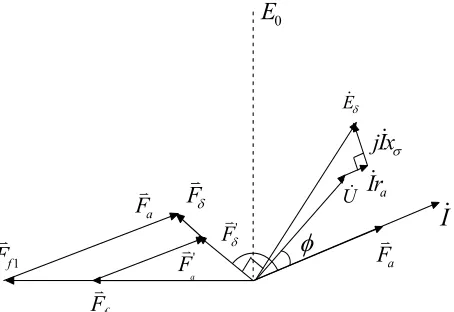
The mmf-emf vector diagram of non-salient poles gen-erator considering saturation is shown in Figure 2 .
The air-gap mmf fundamental component F
is esta- blished by exciting mmf fundamental componentFf1
and ar- mature reaction mmf fundamental componentFa, i.e.
1
f a
F F F
(1) Reduced to the exciting mmf wave, it can be got:
'
f
'
a
F F F
(2)
where,Ff w If f , is the turn number of rotor winding; is exciting current; the phase angle of
f
w
f
I
, smaller than the former value. 1.35 1 w a
w k I F
p
[image:2.595.311.538.323.479.2]in time-space vector diagram is the same asI, w1 is the series number of stator winding phase, is the coeffi-cient of stator winding.
w k
Suppose terminal voltageU, active output and reac-tive output are invariants, then stator current
P
Q
I
andpower factor angle become invariable. And
x
has little relation to the saturation level. E U I(ra jx). Then the angle betweenE'
and is unchangeable. So that the angle between
I F
and '
a
F will not change. Be-cause of this, Ff is unchangeable. If the working condi-tion of a generator before and after rotor winding fault remains unchanged, in order to satisfy the air-gap com-posite flux condition, Ifwill increase, but does not change, from this it can be see: the relation betweenU, , , not only manifest the state of the rotor winding, but also reflects the effective turn number of the rotor winding.
f
w If
P Q If
3.2 Impact of Exciting Current on Rotor Winding Turn-to-Turn Short Circuit Diagnosis
The relation betweenU,P,Q,If can manifest the state of the rotor winding. The exciting current of a gen-erator under normal operation can be calculated by the mathematical Equation, and then compared with meas-ured exciting current , the existence of rotor winding turn-to-turn short circuit can be determined, furthermore
the calculation of relative deviation 0
f
i
fc
i
0
0
%
fc f
f
i i
i
can be used to estimate the severity of the fault.
100%
4. ANN Diagnosis Method for Generator
Rotor Winding Turn-to-Turn
Short Circuit
Recently it is mainly according to the measurement of the generator terminal parameters which namely generator active power , reactive power , the generator ter-minal voltage U, current , field voltage and other generator parameters, uses a formula calculation to ac-quire the field current
P Q
I
0
f
I which operates under nor-mally flows, and then compare the measurement of actual electric current '
f
I with to diagnose rotor Winding Turn-to-turn Short Circuit fault of generators.
0
f
I
This kind of method needs to consider the influence of magnetic field saturation, and it needs accurate mathe-matics model and the parameter of generator in the meantime. The parameter of generator will also have va-riety change along with the operating way and the vava-riety
change of operating conditions. The accuracy of online recognition is not very high, therefore there exists a cer-tain error margin.
The artificial neural network (ANN) does not need ac-curate mathematics model and the detailed parameters of generator, and it has no interference to the operation of generator in the meantime. It only needs to measure the generator terminal parameters accurately, and depends on a great deal of training samples. Through sufficient net-work trains, diagnosis can be directly carried out of the faults operated under dissimilar ways. By having faulty sample, we can not only diagnose the faults, but also es-timate the seriousness of short-circuit.
The terminal voltage U of generator is generally a rated voltage, which could be supposed to be constant. According to the analysis of the basis generator magnetic field, certain ,P Q will correspond to certainFf , namely certain ofw If f . So the relation of P Q, andIf can reflect the turn-to-turn short circuit fault, with the gen-erator parameter P,Q,If as the ANN importation, and circles of turn-to-turn short circuit have the percent of total number of full circles % as the output.
The key of the fault diagnosis which carries on with ANN to is to obtain the train samples. The selection of normal samples can take in various samples in normally operation in the P-Q diagram of generator, but in the ac-tual power station for guaranteeing the “ergodicity” of samples, we could detect the generator parameters with long hours at normal operation conditions.
In order to estimate the severity of generator faults and the number of short-circuit turns, the faulty samples of generators are needed. Relatively speaking, to acquire the samples of the generators under normal operation condi-tion is still easy, but to obtain generator fault samples is usually very difficult. The general method is to do a de-structive experiment in dynamic simulation laboratory, short connecting several turns of the rotor windings of generator factitiously. This kind of method can barely be carried out on the engineering.
This paper uses the method of balancing the mmf to obtain fault sample of the generator under turn-to-turn short circuit of rotor winding. Suppose turn-to-turn short circuit fault occurs to generator at the rated condition, before and after the short-circuit, , ,U are constant. By analysing the magnetic field we can know the mag-netic field will maintain constant, and suppose the short-circuit turns of the total rotor winding number is
P Q
f f
w I
%, after the fault, the field current is: 1
1 %
f fN
I I
Fault Diagnosis Based on ANN for Turn-to-Turn Short Circuit of Synchronous Generator Rotor Windings 190
Changing the number of short-circuit turns, we will get a series of faulty samples. And also we can acquire faulty samples under different operation conditions.
5. Simulation
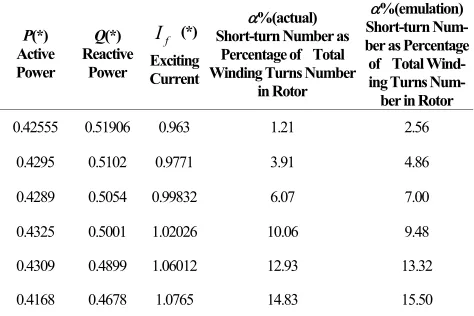
To verify the credibility of this method, we can adopt cultural heritage [9] generator parameters, see Table 1; and then take its normal operating samples. The rated operate conditions of the fault sample can be seen in Table 2. In Table 2, α % is the short-turns as percentage of the total rotor winding turns number. We can carry out network training, and then carry out fault diagnosis; the fault samples can be seen in Table 3. From Table 3,
α%(actual) is the factitiousness number of short-turns as percentage of the total number of rotor winding turns in dynamic simulation laboratory. a%(emulation) is the number of short-turns simulated by computer as percent-age of the total number of rotor winding turns.
The back propagation artificial neural network(BP) is used here, and the active function adopts S type function. The BP network adopts 3 layers. As it is shown in Figure 3, the first layer has three importation nodes, hide layer has four nodes, and exportation layer has one node. The generator parameters contain active power, reactive power, exciting current, and all these parameters are nor-malized values. Table 3 shows the results simulated by MATLAB. According to this, the actual results con-firmed the BP network diagnoses.
In a word, this method has realized the direct acquisi-tion of fault’s seriousness and the soluacquisi-tion of fault sam-ples’ acquisition which are difficult to get.
In particular process, the current and the terminal voltage of stator windings are measured by CT (Cur-rent Transformer) and PT(Potential Transformer), and the exciting current
I U
f
I is measured by current converter. Here, select the CT and PT used to measure system pa-rameters as the measure equipment. The generator capac-ity and voltage level decide the selection of them. And the hall current converter produced by Swiss company LEM is used to measure in rotor winding. The pa-rameters andU are used to calculate both the active power and reactive powerQ.
f
I I
P
After training, this method is applied to all kinds of load. By measuring andU of normal generator in all running states, we can obtain the corresponding
andQ by calculating. The training of ANN needs , and to obtain the relationship among the parame-ters( , and
I
P Q
P
f
I
P Q If) in all the running states.
5. Conclusions
[image:4.595.304.552.84.436.2]While ANN is applied to the fault diagnosis of generator, the most difficult part is the acquirement of the
Figure 3. Schematic diagram of ANN
Table 1. Parameters of synchronous machine
Model number MJF-30-6
Rated Voltage/V 400
Rated Current/A 43.3
Power Factor 0.8
Rotor Current/A 2
f
[image:4.595.308.539.87.189.2]w
/turn 100Table 2. Diagnostic patterns in neural training
P(*) Active Power
Q(*) Reactive
Power f
I (*) Exciting Current
α % Short-turn Number as
Percentage of Total Winding turns Number
in Rotor
1 1 1.053 5
1 1 1.111 10
1 1 1.25 20
1 1 1.429 30
Table 3. The comparison between the output of the neural network and the actual output
P(*) Active Power
Q(*) Reactive
Power f
I (*) Exciting Current
%(actual) Short-turn Number as
Percentage of Total Winding Turns Number
in Rotor
%(emulation) Short-turn Num-ber as Percentage
of Total Wind-ing Turns Num-ber in Rotor
0.42555 0.51906 0.963 1.21 2.56
0.4295 0.5102 0.9771 3.91 4.86
0.4289 0.5054 0.99832 6.07 7.00
0.4325 0.5001 1.02026 10.06 9.48
0.4309 0.4899 1.06012 12.93 13.32
0.4168 0.4678 1.0765 14.83 15.50
fault samples among training samples. This paper analy-ses generator turn-to-turn short circuit of rotor winding fault and according to the certain operation of generator, namely active power , reactive powerQ, terminal voltageU keep constant, and the field current in reases, but the mmf
P
f
I
f f f
[image:4.595.307.544.465.623.2]Faulty samples are obtained through direct calculation, turn-to-turn short circuit fault of rotor winding is diag-nosed by making use of artificial neural network, and we could obtain seriousness level of fault information di-rectly. That method can avoid damage experimenting and it is convenient in engineering.
The shortcoming of this method is that it could not lo-cate the faulty position. After diagnosing and confirming the existence of the fault, if we assist it with other ways such as traveling wave method, location of fault can be carried out.
REFERENCES
[1] W. J. Wang and L. Gui, “Present situation and improve-ment of relay protection for large sized generator trans-former set of 600~1000MW,” Huadian Technology, Vol. 30, No. 1, pp. 5–8, 2008.
[2] W. Q. Li, “Prevention and fault diagnosis of turbogen-erator,” Beijing: Chinese electric power publisher, 2002. [3] S. Wan, H. M. LI and Y. G. LI, “Analysis of generator
vibration characteristic on rotor winding inter-turn short circuit fault,” Proceedings of the CSEE, Vol. 25, No. 10, pp. 122–126, 2005.
[4] H. W. Fang, C. L. Xia and J. Xiu, “Analysis of generator electro-magnetic torque on armature winding inter-turn
short circuit fault,” Proceedings of the CSEE, Vol. 27, No. 15, pp. 83–87, 2007.
[5] G. G. Mao, “Reasons of failures occurred in large capac-ity turbogenerators in China,”Power System Technology, Vol. 24, No. 11, pp. 1–7, 2000.
[6] R. J. Streifel, R. J. Marks II, and M. A. EI-Sharkawi, “De-tection of shorted-turns in the field winding of turbine -generator rotors using novelty detectors development and field test,” IEEE Trans on Energy Conversion, Vol. 11, No. 2, pp. 312–317, 1996.
[7] A. S. Kulkarni, M. A. El-Sharkawi, R. J. Marks II, G. Andexler, X. Jian, and I. Kerszenbaum, “Development of a technique for on-line detection of shorts in field wind-ings of turbine-generator rotors: Circuit design and test-ing,” IEEE Trans on Energy Conversion, Vol. 15, No. 1, pp. 8–13, 2000.
[8] S. E. Guttormsson, R. J. Marks II, and M. A. EI-Sharkawi, “Elliptical novelty grouping for on-line short-turn detec-tion of excited running rotors,” IEEE Transacdetec-tions on En-ergy Conversion, Vol. 14, No. 1, pp. 16–22, 1999. [9] D. W. Auckl, I. E. D. Pickup, and R. Shuttleworth,