Automatically Annotating A Five-Billion-Word Corpus of Japanese Blogs
for Affect and Sentiment Analysis
Michal Ptaszynski † Rafal Rzepka ‡ Kenji Araki ‡ Yoshio Momouchi §
† JSPS Research Fellow/High-Tech Research Center, Hokkai-Gakuen University
‡ Graduate School of Information Science and Technology, Hokkaido University
{kabura,araki}@media.eng.hokudai.ac.jp
§ Department of Electronics and Information Engineering, Faculty of Engineering, Hokkai-Gakuen University
Abstract
This paper presents our research on automatic annotation of a five-billion-word corpus of Japanese blogs with information on affect and sentiment. We first perform a study in emotion blog corpora to discover that there has been no large scale emotion corpus available for the Japanese language. We choose the largest blog corpus for the language and annotate it with the use of two systems for affect anal-ysis: ML-Ask for word- and sentence-level affect analysis and CAO for detailed anal-ysis of emoticons. The annotated informa-tion includes affective features like sentence subjectivity (emotive/non-emotive) or emo-tion classes (joy, sadness, etc.), useful in affect analysis. The annotations are also general-ized on a 2-dimensional model of affect to ob-tain information on sentence valence/polarity (positive/negative) useful in sentiment analy-sis. The annotations are evaluated in several ways. Firstly, on a test set of a thousand sen-tences extracted randomly and evaluated by over forty respondents. Secondly, the statistics of annotations are compared to other existing emotion blog corpora. Finally, the corpus is applied in several tasks, such as generation of emotion object ontology or retrieval of emo-tional and moral consequences of actions.
1 Introduction
There is a lack of large corpora for Japanese ap-plicable in sentiment and affect analysis. Although there are large corpora of newspaper articles, like Mainichi Shinbun Corpus1, or corpora of classic lit-erature, like Aozora Bunko2, they are usually un-suitable for research on emotions since spontaneous
1http://www.nichigai.co.jp/sales/mainichi/mainichi-data.html 2http://www.aozora.gr.jp/
emotive expressions either appear rarely in these kinds of texts (newspapers), or the vocabulary is not up to date (classic literature). Although there ex-ist speech corpora, such as Corpus of Spontaneous Japanese3, which could become suitable for this kind of research, due to the difficulties with com-pilation of such corpora they are relatively small. In research such as the one by Abbasi and Chen (2007) it was proved that public Internet services, such as forums or blogs, are a good material for af-fect analysis because of their richness in evaluative and emotive information. One kind of these services are blogs, open diaries in which people encapsu-late their own experiences, opinions and feelings to be read and commented by other people. Recently blogs have come into the focus of opinion mining or sentiment and affect analysis (Aman and Szpakow-icz, 2007; Quan and Ren, 2010). Therefore creating a large blog-based emotion corpus could help over-come both problems: the lack in quantity of corpora and their applicability in sentiment and affect anal-ysis. There have been only a few small Japanese emotion corpora developed so far (Hashimoto et al., 2011). On the other hand, although there exist large Web-based corpora (Erjavec et al., 2008; Baroni and Ueyama, 2006), access to them is usually allowed only from the Web interface, which makes addi-tional annotations with affective information diffi-cult. In this paper we present the first attempt to au-tomatically annotate affect on YACIS, a large scale corpus of Japanese blogs. To do that we use two sys-tems for affect analysis of Japanese, one for word-and sentence-level affect analysis word-and another espe-cially for detailed analysis of emoticons, to annotate on the corpus different kinds of affective informa-tion (emotive expressions, emoinforma-tion classes, etc.).
3http://www.ninjal.ac.jp/products-k/katsudo/seika/corpus/public/
The outline of the paper is as follows. Section 2 describes the related research in emotion corpora. Section 3 presents our choice of the corpus for anno-tation of affect- and sentiment-related information. Section 4 describes tools used in annotation. Sec-tion 5 presents detailed data and evaluaSec-tion of the annotations. Section 6 presents tasks in which the corpus has already been applied. Finally the paper is concluded and future applications are discussed.
2 Emotion Corpora
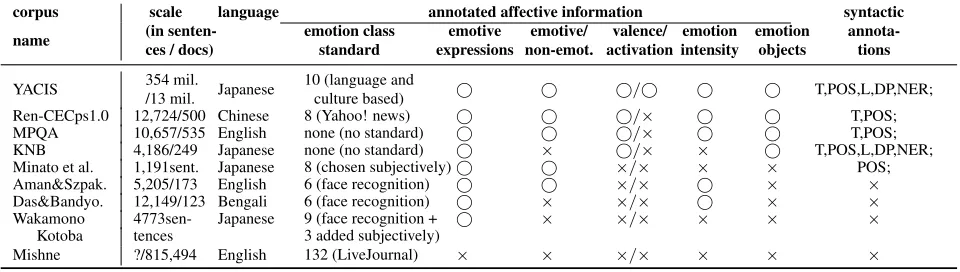
Research on Affect Analysis has resulted in a number of systems developed within several years (Aman and Szpakowicz, 2007; Ptaszynski et al., 2009c; Matsumoto et al., 2011). Unfortunately, most of such research ends in proposing and evaluat-ing a system. The real world application that would be desirable, such as annotating affective informa-tion on linguistic data is limited to processing a usu-ally small test sample in the evaluation. The small number of annotated emotion corpora that exist are mostly of limited scale and are annotated manually. Below we describe and compare some of the most notable emotion corpora. Interestingly, six out of eight emotion corpora described below are created from blogs. The comparison is summarized in Table 1. We also included information on the work de-scribed in this paper for better comparison (YACIS). Quan and Ren (2010) created a Chinese emotion blog corpus Ren-CECps1.0. They collected 500 blog articles from various Chinese blog services, such as sina blog (http://blog.sina.com.cn/), qq blog (http://blog.qq.com/), etc., and annotated them with a large variety of information, such as emotion class, emotive expressions or polarity level. Although syn-tactic annotations were simplified to tokenization and POS tagging, this corpus can be considered a state-of-the-art emotion blog corpus. The motiva-tion for Quan and Ren is also similar to ours - deal-ing with the lack of large corpora for sentiment anal-ysis in Chinese (in our case - Japanese).
Wiebe et al. (2005) report on creating theMPQA
corpus of news articles. The corpus contains 10,657 sentences in 535 documents4. The annotation
schema includes a variety of emotion-related
infor-4
The new MPQA Opinion Corpus version 2.0 contains ad-ditional 157 documents, 692 documents in total.
mation, such as emotive expressions, emotion va-lence, intensity, etc. However, Wiebe et al. focused on detecting subjective (emotive) sentences, which do not necessarily convey emotions, and classifying them into positive and negative. Thus their annota-tion schema, although one of the richest, does not include emotion classes.
A corpus of Japanese blogs, calledKNB, rich in the amount and diversification of annotated informa-tion was developed by Hashimoto et al. (2011). It contains 67 thousand words in 249 blog articles. Al-though it is not a small scale corpus, it developed a certain standard for preparing corpora, especially blog corpora for sentiment and affect-related stud-ies in Japan. The corpus contains all relevant gram-matical annotations, including POS tagging, depen-dency parsing or Named Entity Recognition. It also contains sentiment-related information. Words and phrases expressing emotional attitude were anno-tated by laypeople as either positive or negative. One disadvantage of the corpus, apart from its small scale, is the way it was created. Eighty one students were employed to write blogs about different topics especially for the need of this research. It could be argued that since the students knew their blogs will be read mostly by their teachers, they selected their words more carefully than they would in private.
Aman and Szpakowicz (2007) constructed a small-scale English blog corpus. They did not in-clude any grammatical information, but focused on affect-related annotations. As an interesting remark, they were some of the first to recognize the task of distinguishing between emotive and non-emotive sentences. This problem is usually one of the most difficult in text-based Affect Analysis and is there-fore often omitted in such research. In our research we applied a system proved to deal with this task with high accuracy for Japanese.
sen-Table 1: Comparison of emotion corpora ordered by the amount of annotations (abbreviations: T=tokenization, POS=part-of-speech tagging, L=lemmatization, DP=dependency parsing, NER=Named Entity Recognition).
corpus scale language annotated affective information syntactic
name (in
senten-ces / docs)
emotion class standard
emotive expressions
emotive/ non-emot.
valence/ activation
emotion intensity
emotion objects
annota-tions
YACIS 354 mil.
/13 mil. Japanese
10 (language and
culture based) ⃝ ⃝ ⃝/⃝ ⃝ ⃝ T,POS,L,DP,NER;
Ren-CECps1.0 12,724/500 Chinese 8 (Yahoo! news) ⃝ ⃝ ⃝/× ⃝ ⃝ T,POS;
MPQA 10,657/535 English none (no standard) ⃝ ⃝ ⃝/× ⃝ ⃝ T,POS;
KNB 4,186/249 Japanese none (no standard) ⃝ × ⃝/× × ⃝ T,POS,L,DP,NER;
Minato et al. 1,191sent. Japanese 8 (chosen subjectively)⃝ ⃝ ×/× × × POS;
Aman&Szpak. 5,205/173 English 6 (face recognition) ⃝ ⃝ ×/× ⃝ × ×
Das&Bandyo. 12,149/123 Bengali 6 (face recognition) ⃝ × ×/× ⃝ × ×
Wakamono 4773sen- Japanese 9 (face recognition + ⃝ × ×/× × × ×
Kotoba tences 3 added subjectively)
Mishne ?/815,494 English 132 (LiveJournal) × × ×/× × × ×
tence contains at least one word from a slang lexicon and one word from an emotion lexicon, with addi-tional emotion class tags added per sentence. The emotion class set used for annotation was chosen subjectively, by applying the 6 class face recogni-tion standard and adding 3 classes of their choice.
Mishne (2005) collected a corpus of English blogs from LiveJournal (http://www.livejournal.com/) blogs. The corpus contains 815,494 blog posts, from which many are annotated with emotions (moods) by the blog authors themselves. The LiveJournal service offers an option for its users to annotate their mood while writing the blog. The list of 132 moods include words like “amused”, or “angry”. The LiveJournal mood annotation standard offers a rich vocabulary to describe the writer’s mood. However, this richness has been considered troublesome to generalize the data in a meaningful manner (Quan and Ren, 2010).
Finally, Minato et al. (2006) collected a 14,195 word, 1,191 sentence corpus. The corpus was a col-lection of sentence examples from a dictionary of emotional expressions (Hiejima, 1995). The dictio-nary was created for the need of Japanese language learners. Differently to the dictionary applied in our research (Nakamura, 1993), in Hiejima (1995) sen-tence examples were mostly written by the author of the dictionary himself. The dictionary also does not propose any coherent emotion class list, but rather the emotion concepts are chosen subjectively. Al-though the corpus by Minato et al. is the smallest of all mentioned above, its statistics is described in detail. Therefore in this paper we use it as one of the Japanese emotion corpora to compare our work to.
All of the above corpora were annotated manu-ally or semi-automaticmanu-ally. In this research we per-formed the first attempt to annotate a large scale blog corpus (YACIS) with affective information fully au-tomatically. We did this with systems based on pos-itively evaluated affect annotation schema, perfor-mance, and standardized emotion class typology.
3 Choice of Blog Corpus
Although Japanese is a well recognized and de-scribed world language, there have been only few large corpora for this language. For example, Er-javec et al. (2008) gathered a 400-million-word scale Web corpusJpWaC, or Baroni and Ueyama (2006) developed a medium-sized corpus of Japanese blogs
jBlogscontaining 62 million words. However, both research faced several problems, such as character encoding, or web page metadata extraction, such as the page title or author which differ between do-mains. Apart from the above mentioned medium sized corpora at present the largest Web based blog corpus available for Japanese is YACIS or Yet
[image:3.612.80.560.81.217.2]Figure 1: The example of YACIS XML structure.
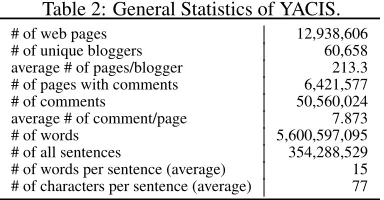
Table 2: General Statistics of YACIS.
# of web pages 12,938,606
# of unique bloggers 60,658
average # of pages/blogger 213.3 # of pages with comments 6,421,577
# of comments 50,560,024
average # of comment/page 7.873
# of words 5,600,597,095
# of all sentences 354,288,529
# of words per sentence (average) 15 # of characters per sentence (average) 77
taken from Google (response to one simple query: ‘site:ameblo.jp’). They saved all pages to disk as raw HTML files (each page in a separate file) and afterward extracted all the posts and comments and divided them into sentences. The original structure (blog post and comments) was preserved, thanks to which semantic relations between posts and com-ments were retained. The blog service from which the corpus was extracted (Ameba) is encoded by de-fault in Unicode, thus there was no problem with character encoding. It also has a clear and stable HTML meta-structure, thanks to which they man-aged to extract metadata such as blog title and au-thor. The corpus was first presented as an unanno-tated corpus. Recently Ptaszynski et al. (2012b) an-notated it with syntactic information, such as POS, dependency structure or named entity recognition. An example of the original blog structure in XML is represented in Figure 1. Some statistics about the corpus are represented in Table 2.
4 Affective Information Annotation Tools
[image:4.612.98.290.219.319.2]Emotive Expression Dictionary(Nakamura, 1993) is a collection of over two thousand expressions de-scribing emotional states collected manually from a wide range of literature. It is not a toolper se, but
Figure 2: Output examples for ML-Ask and CAO.
Table 3: Distribution of separate expressions across emo-tion classes in Nakamura’s dicemo-tionary (overall 2100 ex.).
emotion nunber of emotion nunber of class expressions class expressions
dislike 532 fondness 197
excitement 269 fear 147
sadness 232 surprise 129
joy 224 relief 106
anger 199 shame 65
sum 2100
was converted into an emotive expression database by Ptaszynski et al. (2009c). Since YACIS is a Japanese language corpus, for the affect annotation we needed the most appropriate lexicon for the lan-guage. The dictionary, developed for over 20 years by Akira Nakamura, is a state-of-the art example of a hand-crafted emotive expression lexicon. It also proposes a classification of emotions that re-flects the Japanese culture: ki/yorokobi5 (joy),
d¯o/ikari (anger), ai/aware (sorrow, sadness, gloom), fu/kowagari (fear), chi/haji (shame, shyness), k¯o/suki (fondness), en/iya (dislike),
k¯o/takaburi(excitement), an/yasuragi(relief), and ky¯o/odoroki(surprise). All expressions in the dictionary are annotated with one emotion class or more if applicable. The distribution of expressions across all emotion classes is represented in Table 3.
ML-Ask(Ptaszynski et al., 2009a; Ptaszynski et al., 2009c) is a keyword-based language-dependent sys-tem for affect annotation on sentences in Japanese. It uses a two-step procedure: 1)specifying whether an utterance is emotive, and2)annotating the partic-ular emotion classes in utterances described as emo-tive. The emotive sentences are detected on the ba-sis ofemotemes, emotive features like: interjections, mimetic expressions, vulgar language, emoticons
[image:4.612.339.530.228.300.2]Table 4: Evaluation results of ML-Ask and CAO.
emotive/ emotion 2D (valence non-emotive classes and activation)
ML-Ask 98.8% 73.4% 88.6%
CAO 97.6% 80.2% 94.6%
ML-Ask+CAO 100.0% 89.9% 97.5%
and emotive markers. The examples in Japanese are respectively: sugee (great!), wakuwaku (heart pounding), -yagaru (syntactic morpheme used in verb vulgarization), (ˆ ˆ) (emoticon expressing joy) and ‘!’, ‘??’ (markers indicating emotive engage-ment). Emotion class annotation is based on Naka-mura’s dictionary. ML-Ask is also the only present system for Japanese recognized to implement the idea of Contextual Valence Shifters (CVS) (Zaenen and Polanyi, 2005) (words and phrases like “not”, or “never”, which change the valence of an evalua-tive word). The last distinguishable feature of ML-Ask is implementation of Russell’s two dimensional affect model (Russell, 1980), in which emotions are represented in two dimensions: valence (posi-tive/negative) and activation (activated/deactivated). An example of negative-activated emotion could be “anger”; a positive-deactivated emotion is, e.g., “relief”. The mapping of Nakamura’s emotion classes on Russell’s two dimensions was proved re-liable in several research (Ptaszynski et al., 2009b; Ptaszynski et al., 2009c; Ptaszynski et al., 2010b). With these settings ML-Ask detects emotive sen-tences with a high accuracy (90%) and annotates af-fect on utterances with a sufficiently high Precision (85.7%), but low Recall (54.7%). Although low Re-call is a disadvantage, we assumed that in a corpus as big as YACIS there should still be plenty of data.
CAO (Ptaszynski et al., 2010b) is a system for affect analysis of Japanese emoticons, called kao-moji. Emoticons are sets of symbols used to con-vey emotions in text-based online communication, such as blogs. CAO extracts emoticons from in-put and determines specific emotions expressed by them. Firstly, it matches the input to a predeter-mined raw emoticon database (with over ten thou-sand emoticons). The emoticons, which could not be estimated with this database are divided into seman-tic areas (representations of “mouth” or “eyes”). The areas are automatically annotated according to their
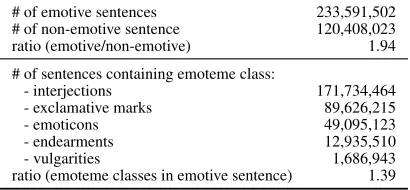
Table 5: Statistics of emotive sentences.
# of emotive sentences 233,591,502 # of non-emotive sentence 120,408,023
ratio (emotive/non-emotive) 1.94
# of sentences containing emoteme class:
- interjections 171,734,464
- exclamative marks 89,626,215
- emoticons 49,095,123
- endearments 12,935,510
- vulgarities 1,686,943
ratio (emoteme classes in emotive sentence) 1.39
co-occurrence in the database. The performance of CAO was evaluated as close to ideal (Ptaszynski et al., 2010b) (over 97%). In this research we used CAO as a supporting procedure in ML-Ask to im-prove the overall performance and add detailed in-formation about emoticons.
5 Annotation Results and Evaluation
It is physically impossible to manually evaluate all annotations on the corpus6. Therefore we applied three different types of evaluation. First was based on a sample of 1000 sentences randomly extracted from the corpus and annotated by laypeople. In sec-ond we compared YACIS annotations to other emo-tion corpora. The third evaluaemo-tion was applicaemo-tion based and is be described in section 6.
Evaluation of Affective Annotations: Firstly, we needed to confirm the performance of affect anal-ysis systems on YACIS, since the performance is often related to the type of test set used in evalu-ation. ML-Ask was positively evaluated on sepa-rate sentences and on an online forum (Ptaszynski et al., 2009c). However, it was not yet evaluated on blogs. Moreover, the version of ML-Ask sup-ported by CAO has not been evaluated thoroughly as well. In the evaluation we used a test set cre-ated by Ptaszynski et al. (2010b) for the evaluation of CAO. It consists of thousand sentences randomly extracted from YACIS and manually annotated with emotion classes by 42 layperson annotators in an anonymous survey. There are 418 emotive and 582 non-emotive sentences. We compared the results on those sentences for ML-Ask, CAO (described in detail by Ptaszynski et al. (2010b)), and both sys-tems combined. The results showing accuracy,
cal-6
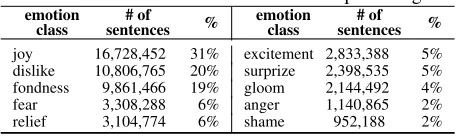
[image:5.612.80.311.67.120.2]Table 6: Emotion class annotations with percentage.
emotion
class sentences# of % emotionclass sentences# of % joy 16,728,452 31% excitement 2,833,388 5% dislike 10,806,765 20% surprize 2,398,535 5% fondness 9,861,466 19% gloom 2,144,492 4%
fear 3,308,288 6% anger 1,140,865 2%
relief 3,104,774 6% shame 952,188 2%
culated as a ratio of success to the overall number of samples, are summarized in Table 4. The perfor-mance of discrimination between emotive and non-emotive sentences of ML-Ask baseline was a high 98.8%, which is much higher than in original eval-uation of ML-Ask (around 90%). This could indi-cate that sentences with which the system was not able to deal with appear much less frequently on Ameblo. As for CAO, it is capable of detecting the presence of emoticons in a sentence, which is par-tially equivalent to detecting emotive sentences in ML-Ask, since emoticons are one type of features determining sentence as emotive. The performance of CAO was also high, 97.6%. This was due to the fact that grand majority of emotive sentences con-tained emoticons. Finally, ML-Ask supported with CAO achieved remarkable 100% accuracy. This was a surprisingly good result, although it must be re-membered that the test sample contained only 1000 sentences (less than 0.0003% of the whole corpus). Next we verified emotion class annotations on sen-tences. The baseline of ML-Ask achieved slightly better results (73.4%) than in its primary evalua-tion (Ptaszynski et al., 2009c) (67% of balanced F-score with P=85.7% and R=54.7%). CAO achieved 80.2%. Interestingly, this makes CAO a better affect analysis system than ML-Ask. However, the condi-tion is that a sentence must contain an emoticon. The best result, close to 90%, was achieved by ML-Ask supported with CAO. We also checked the results when only the dimensions of valence and activation were taken into account. ML-Ask achieved 88.6%, CAO nearly 95%. Support of CAO to ML-Ask again resulted in the best score, 97.5%.
Statistics of Affective Annotations: There were nearly twice as many emotive sentences than non-emotive (ratio 1.94). This suggests that the cor-pus is biased in favor of emotive contents, which could be considered as a proof for the assumption that blogs make a good base for emotion related
re-Table 7: Comparison of positive and negative sentences between KNB and YACIS.
positive negative ratio
KNB* emotional 317 208 1.52
attitude
opinion 489 289 1.69
merit 449 264 1.70
acceptation 125 41 3.05
or rejection
event 43 63 0.68
sum 1,423 865 1.65
YACIS** only 22,381,992 12,837,728 1.74 only+mostly 23,753,762 13,605,514 1.75 * p<.05, ** p<.01
search. When it comes to statistics of each emo-tive feature (emoteme), the most frequent class were interjections. Second frequent was the exclamative marks class, which includes punctuation marks sug-gesting emotive engagement (such as “!”, or “??”). Third frequent emoteme class was emoticons, fol-lowed by endearments. As an interesting remark, emoteme class that was the least frequent were vul-garities. As one possible interpretation of this re-sult we propose the following. Blogs are social space, where people describe their experiences to be read and commented by other people (friends, colleagues). The use of vulgar language could dis-courage potential readers from further reading, mak-ing the blog less popular. Next, we checked the statistics of emotion classes annotated on emotive sentences. The results are represented in Table 6. The most frequent emotions were joy (31%), dislike (20%) and fondness (19%), which covered over 70% of all annotations. However, it could happen that the number of expressions included in each emotion class database influenced the number of annotations (database containing many expressions has higher probability to gather more annotations). Therefore we verified if there was a correlation between the number of annotations and the number of emotive expressions in each emotion class database. The verification was based on Spearman’s rank corre-lation test between the two sets of numbers. The test revealed no statistically significant correlation between the two types of data, withρ=0.38.
Comparison with Other Emotion Corpora:
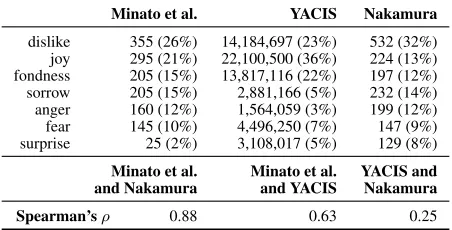
Table 8: Comparison of number of emotive expressions in three different corpora including ratio within this set of emotions and results of Spearman’s rank correlation test.
Minato et al. YACIS Nakamura
dislike 355 (26%) 14,184,697 (23%) 532 (32%) joy 295 (21%) 22,100,500 (36%) 224 (13%) fondness 205 (15%) 13,817,116 (22%) 197 (12%) sorrow 205 (15%) 2,881,166 (5%) 232 (14%) anger 160 (12%) 1,564,059 (3%) 199 (12%) fear 145 (10%) 4,496,250 (7%) 147 (9%) surprise 25 (2%) 3,108,017 (5%) 129 (8%)
Minato et al. Minato et al. YACIS and
and Nakamura and YACIS Nakamura
Spearman’sρ 0.88 0.63 0.25
information on specific emotion classes. However, it is annotated with emotion valence for different categories valence is expressed in Japanese, such as emotional attitude (e.g., “to feel sad about X” [NEG], “to like X” [POS]),opinion(e.g., “X is won-derful” [POS]), orpositive/negative event (e.g., “X broke down” [NEG], “X was awarded” [POS]). We compared the ratios of sentences expressing posi-tive to negaposi-tive valence. The comparison was made for all KNB valence categories separately and as a sum. In our research we do not make additional sub-categorization of valence types, but used in the com-parison ratios of sentences in which the expressed emotions were of only positive/negative valence and including the sentences which were mostly (in ma-jority) positive/negative. The comparison is pre-sented in table 7. In KNB for all valence categories except one the ratio of positive to negative sentences was biased in favor of positive sentences. Moreover, for most cases, including the ratio taken from the sums of sentences, the ratio was similar to the one in YACIS (around 1.7). Although the numbers of com-pared sentences differ greatly, the fact that the ratio remains similar across the two different corpora sug-gests that the Japanese express in blogs more posi-tive than negaposi-tive emotions.
Next, we compared the corpus created by Minato et al. (2006). This corpus was prepared on the ba-sis of an emotive expression dictionary. Therefore we compared its statistics not only to YACIS, but also to the emotive lexicon used in our research (see section 4 for details). Emotion classes used in Mi-nato et al. differ slightly to those used in our re-search (YACIS and Nakamura’s dictionary). For
example, they use class name “hate” to describe what in YACIS is called “dislike”. Moreover, they have no classes such as excitement, relief or shame. To make the comparison possible we used only the emotion classes appearing in both cases and unified all class names. The results are summarized in Ta-ble 8. There was no correlation between YACIS and Nakamura (ρ=0.25), which confirms the results cal-culated in previous paragraph. A medium correla-tion was observed between YACIS and Minato et al. (ρ=0.63). Finally, a strong correlation was observed between Minato et al. and Nakamura (ρ=0.88), which is the most interesting observation. Both Mi-nato et al. and Nakamura are in fact dictionaries of emotive expressions. However, the dictionaries were collected in different times (difference of about 20 years), by people with different background (lexi-cographer vs. language teacher), based on differ-ent data (literature vs. conversation) assumptions and goals (creating a lexicon vs. Japanese language teaching). The only similarity is in the methodol-ogy. In both cases the dictionary authors collected expressions considered to be emotion-related. The fact that they correlate so strongly suggests that for the compared emotion classes there could be a ten-dency in language to create more expressions to de-scribe some emotions rather than the others (dislike, joy and fondness are often some of the most frequent emotion classes). This phenomenon needs to be ver-ified more thoroughly in the future.
6 Applications
6.1 Extraction of Evaluation Datasets
6.2 Generation of Emotion Object Ontology
One of the applications of large corpora is to extract from them smaller sub-corpora for specified tasks. Ptaszynski et al. (2012a) applied YACIS for their task of generating an robust emotion object ontology. They used cross-reference of annotations of emotional information described in this paper and syntactic annotations done by Ptaszynski et al. (2012b) to extract only sentences in which expression of emotion was proceeded by its cause, like in the example below.
Kanojo ni furaretakarakanashii...
Girlfriend DAT dump PAS CAUS sad ... I’m sadbecausemy girlfriend dumped me... The example can be analyzed in the following way. Emotive expression (kanashii, “sad”) is related with the sentence contents (Kanojo ni furareta, “my girlfriend dumped me”) with a causality morpheme (kara, “because”). In such situation the sentence contents represent the object of emotion. This can be generalized to the following meta-structure,
OE CAU S XE,
where OE=[Emotion object], CAU S=[causal
form], andXE=[expression of emotion].
The cause phrases were cleaned of irrelevant words like stop words to leave only the object phrases. The evaluation showed they were able to extract nearly 20 mil. object phrases, from which 80% was extracted correctly with a reliable signifi-cance. Thanks to rich annotations on YACIS corpus the ontology included such features as emotion class (joy, anger, etc.), dimensions (valence/activation), POS or semantic categories (hypernyms, etc.).
6.3 Retrieval of Moral Consequence of Actions
Third application of the YACIS corpus annotated with affect- and sentiment-related information has been in a novel research on retrieval of moral con-sequences of actions, first proposed by Rzepka and Araki (2005) and recently developed by Komuda et al. (2010)7. The moral consequence retrieval agent was based on the idea of Wisdom of Crowd. In particular Komuda et al. (2010) used a Web-mining
7
See also a mention inScientific American, by Anderson and Anderson (2010).
technique to gather consequences of actions apply-ing causality relations, like in the research described in section 6.2, but with a reversed algorithm and lexicon containing not only emotional but also eth-ical notions. They cross-referenced emotional and ethical information about a certain phrase (such as “To kill a person.”) to obtain statistical probability for emotional (“feeling sad”, “being in joy”, etc.) and ethical consequences (“being punished”, “being praised”, etc.). Initially, the moral agent was based on the whole Internet contents. However, multiple queries to search engine APIs made by the agent caused constant blocking of IP address an in effect hindered the development of the agent.
The agent was tested on over 100 ethically-significant real world problems, such as “killing a man”, “stealing money”, “bribing someone”, “help-ing people” or “sav“help-ing environment”. In result 86% of recognitions were correct. Some examples of the results are presented in the Appendix on the end of this paper.
7 Conclusions
Acknowledgments
This research was supported by (JSPS) KAKENHI Grant-in-Aid for JSPS Fellows (Project Number: 22-00358).
References
Ahmed Abbasi and Hsinchun Chen. ”Affect Intensity Analysis of Dark Web Forums”, Intelligence and Security Informatics 2007, pp. 282-288, 2007
Saima Aman and Stan Szpakowicz. 2007. “Identifying Ex-pressions of Emotion in Text”. InProceedings of the 10th International Conference on Text, Speech, and Dialogue (TSD-2007), Lecture Notes in Computer Science (LNCS), Springer-Verlag.
Michael Anderson and Susan Leigh Anderson. 2010. “Robot be Good”,Scientific American, October, pp. 72-77.
Dipankar Das, Sivaji Bandyopadhyay, “Labeling Emotion in Bengali Blog Corpus ? A Fine Grained Tagging at Sentence Level”, Proceedings of the 8th Workshop on Asian Language Resources, pages 47?55, 2010.
Marco Baroni, Silvia Bernardini, Adriano Ferraresi, Eros Zanchetta. 2008. “The WaCky Wide Web: A Collection of Very Large Linguistically Processed Web-Crawled Cor-pora”, Kluwer Academic Publishers, Netherlands.
Marco Baroni and Motoko Ueyama. 2006. “Building General-and Special-Purpose Corpora by Web Crawling”, In Pro-ceedings of the 13th NIJL International Symposium on Language Corpora: Their Compilation and Application, www.tokuteicorpus.jp/result/pdf/2006 004.pdf
J¨urgen Broschart. 1997. “Why Tongan does it differently: Cate-gorial Distinctions in a Language without Nouns and Verbs.” Linguistic Typology, Vol. 1, No. 2, pp. 123-165.
Eugene Charniak, Don Blaheta, Niyu Ge, Keith Hall, John Hale and Mark Johnson. 2000. “BLLIP 1987-89 WSJ Corpus Release 1”, Linguistic Data Consortium, Philadelphia, http://www.ldc.upenn.edu/Catalog/CatalogEntry.jsp?catalog Id=LDC2000T43
Paul Ekman. 1992. “An Argument for Basic Emotions”. Cogni-tion and EmoCogni-tion, Vol. 6, pp. 169-200.
Irena Srdanovic Erjavec, Tomaz Erjavec and Adam Kilgarriff. 2008. “A web corpus and word sketches for Japanese”, Infor-mation and Media Technologies, Vol. 3, No. 3, pp.529-551. Katarzyna Głowi´nska and Adam Przepi´orkowski. 2010. “The
Design of Syntactic Annotation Levels in the National Cor-pus of Polish”, InProceedings of LREC 2010.
Peter Halacsy, Andras Kornai, Laszlo Nemeth, Andras Rung, Istvan Szakadat and Vikto Tron. 2004. “Creating open lan-guage resources for Hungarian”. In Proceedings of the LREC, Lisbon, Portugal.
Chikara Hashimoto, Sadao Kurohashi, Daisuke Kawahara, Keiji Shinzato and Masaaki Nagata. 2011. “Construction of a Blog Corpus with Syntactic, Anaphoric, and Sentiment An-notations” [in Japanese],Journal of Natural Language Pro-cessing, Vol 18, No. 2, pp. 175-201.
Ichiro Hiejima. 1995.A short dictionary of feelings and emo-tions in English and Japanese, Tokyodo Shuppan.
Paul J. Hopper and Sandra A. Thompson. 1985. “The Iconic-ity of the Universal Categories ’Noun’ and ’Verbs’”. In Ty-pological Studies in Language: Iconicity and Syntax. John Haiman (ed.), Vol. 6, pp. 151-183, Amsterdam: John Ben-jamins Publishing Company.
Daisuke Kawahara and Sadao Kurohashi. 2006. “A Fully-Lexicalized Probabilistic Model for Japanese Syntactic and Case Structure Analysis”,Proceedings of the Human Lan-guage Technology Conference of the North American Chap-ter of the ACL, pp. 176-183.
Radoslaw Komuda, Michal Ptaszynski, Yoshio Momouchi, Rafal Rzepka, and Kenji Araki. 2010. “Machine Moral De-velopment: Moral Reasoning Agent Based on Wisdom of Web-Crowd and Emotions”,Int. Journal of Computational Linguistics Research, Vol. 1 , Issue 3, pp. 155-163.
Taku Kudo and Hideto Kazawa. 2009. “Japanese Web N-gram Version 1”, Linguistic Data Consortium, Philadelphia, http://www.ldc.upenn.edu/Catalog/CatalogEntry.jsp?catalog Id=LDC2009T08
Vinci Liu and James R. Curran. 2006. “Web Text Corpus for Natural Language Processing”, InProceedings of the 11th Meeting of the European Chapter of the Association for Computational Linguistics (EACL), pp. 233-240.
Maciejewski, J., Ptaszynski, M., Dybala, P. 2010. “Developing a Large-Scale Corpus for Natural Language Processing and Emotion Processing Research in Japanese”, InProceedings of the International Workshop on Modern Science and Tech-nology (IWMST), pp. 192-195.
Kazuyuki Matsumoto, Yusuke Konishi, Hidemichi Sayama, Fuji Ren. 2011. “Analysis of Wakamono Kotoba Emotion Corpus and Its Application in Emotion Estimation”, Interna-tional Journal of Advanced Intelligence, Vol.3,No.1,pp.1-24. Junko Minato, David B. Bracewell, Fuji Ren and Shingo Kuroiwa. 2006. “Statistical Analysis of a Japanese Emotion Corpus for Natural Language Processing”,LNCS4114. Gilad Mishne. 2005. “Experiments with Mood Classification in
Blog Posts”. InThe 1st Workshop on Stylistic Analysis of Text for Information Access, atSIGIR 2005, August 2005. Akira Nakamura. 1993. “Kanjo hyogen jiten” [Dictionary of
Emotive Expressions] (in Japanese), Tokyodo Publishing, Tokyo, 1993.
Jan Pomik´alek, Pavel Rychl´y and Adam Kilgarriff. 2009. “Scal-ing to Billion-plus Word Corpora”, InAdvances in Computa-tional Linguistics,Research in Computing Science, Vol. 41, pp. 3-14.
Michal Ptaszynski, Pawel Dybala, Wenhan Shi, Rafal Rzepka and Kenji Araki. 2009. “A System for Affect Analysis of Ut-terances in Japanese Supported with Web Mining”,Journal of Japan Society for Fuzzy Theory and Intelligent Informat-ics, Vol. 21, No. 2, pp. 30-49 (194-213).
Michal Ptaszynski, Pawel Dybala, Wenhan Shi, Rafal Rzepka and Kenji Araki. 2009. “Towards Context Aware Emotional Intelligence in Machines: Computing Contextual Appro-priateness of Affective States”. InProceedings of Twenty-first International Joint Conference on Artificial Intelligence (IJCAI-09), Pasadena, California, USA, pp. 1469-1474. Michal Ptaszynski, Pawel Dybala, Rafal Rzepka and Kenji
the 2channel Forum -”, In Proceedings of the Conference of the Pacific Association for Computational Linguistics (PACLING-09), pp. 223-228.
Michal Ptaszynski, Rafal Rzepka and Kenji Araki. 2010a. “On the Need for Context Processing in Affective Computing”, InProceedings of Fuzzy System Symposium (FSS2010), Or-ganized Session on Emotions, September 13-15.
Michal Ptaszynski, Jacek Maciejewski, Pawel Dybala, Rafal Rzepka and Kenji Araki. 2010b. “CAO: Fully Automatic Emoticon Analysis System”, InProc. of the 24th AAAI Con-ference on Artificial Intelligence (AAAI-10), pp. 1026-1032. Michal Ptaszynski, Rafal Rzepka, Kenji Araki and Yoshio Mo-mouchi. 2012a. “A Robust Ontology of Emotion Objects”, In Proceedings of The Eighteenth Annual Meeting of The Asso-ciation for Natural Language Processing (NLP-2012), pp. 719-722.
Michal Ptaszynski, Rafal Rzepka, Kenji Araki and Yoshio Mo-mouchi. 2012b. “Annotating Syntactic Information on 5.5 Billion Word Corpus of Japanese Blogs”, In Proceedings of The 18th Annual Meeting of The Association for Natural Language Processing (NLP-2012), pp. 385-388.
Changqin Quan and Fuji Ren. 2010. “A blog emotion corpus for emotional expression analysis in Chinese”, Computer Speech & Language, Vol. 24, Issue 4, pp. 726-749. Rafal Rzepka, Kenji Araki. 2005. “What Statistics Could Do
for Ethics? - The Idea of Common Sense Processing Based Safety Valve”, AAAI Fall Symposium on Machine Ethics, Technical Report FS-05-06, pp. 85-87.
James A. Russell. 1980. “A circumplex model of affect”.J. of Personality and Social Psychology, Vol. 39, No. 6, pp. 1161-1178.
Peter D. Turney and Michael L. Littman. 2002. “Unsupervised Learning of Semantic Orientation from a Hundred-Billion-Word Corpus”, National Research Council, Institute for In-formation Technology,Technical Report ERB-1094. (NRC #44929).
Masao Utiyama and Hitoshi Isahara. 2003. “Reliable Mea-sures for Aligning Japanese-English News Articles and Sen-tences”.ACL-2003, pp. 72-79.
Janyce Wiebe, Theresa Wilson and Claire Cardie. 2005. “An-notating expressions of opinions and emotions in language”. Language Resources and Evaluation, Vol. 39, Issue 2-3, pp. 165-210.
Theresa Wilson and Janyce Wiebe. 2005. “Annotating Attribu-tions and Private States”, InProceedings of the ACL Work-shop on Frontiers in Corpus Annotation II, pp. 53-60. Annie Zaenen and Livia Polanyi. 2006. “Contextual Valence
Shifters”. InComputing Attitude and Affect in Text, J. G. Shanahan, Y. Qu, J. Wiebe (eds.), Springer Verlag, Dor-drecht, The Netherlands, pp. 1-10.
Appendix. Examples of emotional and ethical consequence retrieval.
SUCCESS CASES
emotional
conseq. results score
ethical
conseq. results score
“To hurt somebody.”
anger 13.01/54.1 0.24 penalty/ 4.01/7.1 0.565 fear 12.01/54.1 0.22 punishment
sadness 11.01/54.1 0.2 “To kill one’s own mother.”
sadness 9.01/35.1 0.26 penalty/ 5.01/5.1 0.982 surprise 6.01/35.1 0.17 punishment
anger 5.01/35.1 0.14 “To steal an apple.”
surprise 2.01/6.1 0.33 reprimand/ 3.01/3.1 0.971 anger 2.01/6.1 0.33 scold
“To steal money.”
anger 3.01/9.1 0.33 penalty/punish.3.01/6.1 0.493 sadness 2.01/9.1 0.22 reprimand/sco. 2.01/6.1 0.330 “To kill an animal.”
dislike 7.01/23.1 0.3 penalty/ 36.01/45.1 0.798 sadness 5.01/23.1 0.22 punishment
“To drive after drinking.”
fear 6.01/19.1 0.31 penalty/punish.24.01/36.1 0.665 “To cause a war.”
dislike 7.01/15.1 0.46 illegal 2.01/3.1 0.648 fear 3.01/15.1 0.2
“To stop a war.”
joy 6.01/13.1 0.46 forgiven 1.01/1.1 0.918 surprise 2.01/13.1 0.15
“To prostitute oneself.”
anger 6.01/19.1 0.31 illegal 12.01/19.1 0.629 sadness 5.01/19.1 0.26
“To have an affair.”
sadness 10,01/35.1 0.29 penalty/punish.8.01/11.1 0.722 anger 9.01/35.1 0.26
INCONSISTENCY BETWEEN EMOTIONS AND ETHICS
“To kill a president.”
joy 2.01/4.1 0.49 penalty/ 2.01/2.1 0.957 likeness 1.01/4.1 0.25 punishment
“To kill a criminal.”
joy 8.01/39.1 0.2 penalty/ 556/561 0.991 excite 8.01/39.1 0.2 punishment
anger 7.01/39.1 0.18
CONTEXT DEPENDENT
“To act violently.”
anger 4.01/11.1 0.36 penalty/punish.1.01/2.1 0.481 fear 2.01/11.1 0.18 agreement 1.01/2.1 0.481
NO ETHICAL CONSEQUENCES
“Sky is blue.”
joy 51.01/110,1 0.46 none 0 0