A Lexical Network with a Morphological Model in It
Nabil Gader MVS Publishing Solutions 395, chemin de la Cartonnerie 88100 Sainte-Marguerite, France
Aurore Koehl ATILF CNRS
44, avenue de la Libération, BP 30687 54063 Nancy Cedex, France
Alain Polguère
Université de Lorraine & ATILF CNRS 44, avenue de la Libération, BP 30687
54063 Nancy Cedex, France
Abstract
The French Lexical Network (fr-LN) is a global model of the French lexicon presently under construction. The fr-LN accounts for lexical knowledge as a lexical network structured by paradigmatic and syntagmatic relations holding between lexical units. This paper describes how morphological knowledge is presently being introduced into the fr-LN through the implemen-tation and lexicographic exploiimplemen-tation of a dynamic morphological model. Section 1 presents theoretical and practical justifications for the approach which we believe allows for a cogni-tively sound description of morphological data within semantically-oriented lexical databases. Section 2 gives an overview of the structure of the dynamic morphological model, which is constructed through two complementary processes: a Morphological Process—section 3—and a Lexicographic Process—section 4.
1 Introduction
We present a morphological model implemented in order to feed the French Lexical Network database— hereafter fr-LN—, presently under development at the ATILF CNRS lab. The fr-LN belongs to the broad family of lexical resources designed as networks of lexical units (Fellbaum, 1998; Bakeret al., 2003; Ruppenhoferet al., 2010; Spohr, 2012). Its design, content and mode of construction has already been documented in various publications (Lux-Pogodalla and Polguère, 2011; Gaderet al., 2012; Polguère, 2014; Polguère, to appear) and we strictly focus here on its newly developed morphological component. The morphological description of French lexemes discussed below possesses two main characteristics:
1. it is dynamically created from a full-fledged grammatical model of French inflectional morphology;
2. it is meant to be used in the context of a lexicographic project where morphological tables are indi-vidually associated to senses of (polysemic) vocables, thus accounting for potential morphological discrepancies between senses within a given vocable.
We believe that our approach allows for a cognitively sound implementation of morphology in lexical databases that are primarily oriented towards the description of senses (rather than forms). Indeed, we do not simply inject lists of lexical forms into the fr-LN database but describemorphological knowledgeby
means of a “true” model of French inflectional morphology.
This work is licenced under a Creative Commons Attribution 4.0 International License. Page numbers and proceedings footer are added by the organizers. License details:http://creativecommons.org/licenses/by/4.0/
1.1 Interconnection between lexical and morphological models
There are at least two main characteristics that a cognitively sound lexical model of a given language has to possess.
• First and foremost, it must account for the Speaker’s knowledge of lexical rules (a lexical unit and all its properties being considered here as being a cluster of lexical rules).
• Second, it must be structured in a way that makes it possible to support the modeling of (i) “natural” processes of lexical knowledge evolution—acquisition, consolidation, relativization, loss of lexical knowledge—and (ii) linguistic processes of speech, understanding, paraphrase, translation, word association (Dunbar, 2012), etc.
Lexical knowledge, however, is intricately related to grammatical knowledge, to the point that it is not necessarily possible to radically separate lexical information from grammatical information in a cognitive lexicon. This is particularly true for language morphology, that can be said to belong simultaneously to both the lexical and grammatical modules of natural languages. Consequently, a lexical model that aims at cognitive relevance has to take the morphological bull by the horns and handle morphological properties and behavior of lexical units by modeling actual morphological knowledge.
Not all lexical resources link a lexical unit to its forms and morphology is often “externalized,” using separate dedicated resources (see section 1.2 below). However, for a language that is rather rich in terms of inflectional morphology, such as French, it is particularly interesting to embed in lexical resources an explicit morphological model. The purpose of such model is to allow lexicographers to account for inflected forms of lexical units by associating each individual unit (= sense) to inflectional classes and dynamically obtain in the process morphological tables of all corresponding lexical forms.
Before we proceed, let us enumerate the basic terminology that will be used throughout the paper. • Lexical units are of two kinds: (i) lexemes—CHEVALI.1a ‘horse’ ∼ CHEVALI.1b ‘horse riding’—
are monolexemic lexical units; (ii)idioms—CULOTTE DE CHEVAL‘saddlebags’—are syntagmatic
lexical units.
• Vocables—CHEVAL—are (potentially) polysemic words. They are modeled in the fr-LN as sets of
lexical units connected by a relation of copolysemy.
• Wordformsare linguistic signs expressing lexemes—singularchevalI.1aand pluralchevauxI.1aare
the two wordforms for theCHEVALI.1a lexeme. Because wordforms are linguistic signs, each
in-dividual wordform has to be described as a<signified, signifier, restricted combinatorics>triplet (Mel’ˇcuk, 2012, Chapter 1).
1.2 Current approaches to morphology in sense-oriented lexical databases
In this section, we briefly summarize the treatment of morphological information in major sense-oriented lexical databases and explain why we decided to elaborate an approach of our own.
Our initial constraints were that we wanted to truly handle forms related to lexemes with respect to general rules of inflectional morphology. Additionally, we wanted to model in an elegant way phenomena such as spelling variation (cuillère‘spoon’∼cuiller), euphony (j’aime‘I love’∼aimé-je), alternative inflected forms (je m’assois∼je m’assieds) or defectiveness (je fris du lard‘I fry bacon’, but there is no corresponding 1stperson plural; one has to saynous faisons frire du lardlit. ‘We make bacon fry’).
To our knowledge, no current general purpose lexical database—for French or other languages— currently meet these requirements. WordNet, for instance, only stores base forms of lexemes and has no embedded morphological model of English. An external lemmatizer, Morphy,1is used to access lexical
senses via inflected forms. The situation is different in FrameNet. As indicated in (Ruppenhofer et al., 2010, p. 93–94), lemmas are stored in theLexical Databasecomponent of FrameNet, together with corresponding wordforms. However, no grammatical model of inflection is embedded in the database and made available for lexicographic purposes.
2 Dynamic approach to morphological description
This section is devoted to the presentation of the morphological model embedded in the fr-LN. We pro-ceed in two steps. Firstly (section 2.1), we detail the limitations of existing morphological databases for French, which explain why we decided to not “inject” their content in the fr-LN. Secondly (section 2.2), we present the general design of our morphological model and detail its dynamic nature.
2.1 Limitations of existing morphological resources for French
In order to model “morphological knowledge” within a lexical database, one can either make use of an already existing morphological ressource (that will be connected to or embedded into the database), or develop a specific, tailor-made morphological database module—see (Issac, 2010) for a detailed discus-sion. There exist indeed several morphological resources for French that, in principle, could have been used as embedded morphological modules in the fr-LN. We will explain why limitations found in these resources have led us to choose the second option and design our own morphological model.
We have mainly examined six morphological resources for French, all developed during the past ten years: Manulex, Morphalou, Lexique 3, Lefff, Flexique and Morfetik.2 Here is a brief recap of the
observations we have made, based on our specific needs and expectations. For lack of space, we cannot make a detailed presentation of these resources and our evaluation will by necessity be rather sketchy.
Manulex was designed for psycholinguistic research (Lété et al., 2004). It contains 48,886 French wordforms. The list of wordforms results from a “grade-based word frequency list extracted from a corpus of first to fifth grade readers used in French elementary schools” (Lété et al., 2004, p. 159).
Manulexhas therefore a limited coverage, when compared to other existing resources that target the bulk of the French lexicon and can store up to 500,000 forms.
But coverage is not the only issue. The quality of data can vary greatly from database to database. In
Morphalou(Romaryet al., 2004), for instance, one can find a lot of miscategorizations and misspellings. ReusingMorphalou’s data would thus raise many maintenance issues.
While having a larger coverage than Manulexand data of better quality thanMorphalou,Lexique 3
(New, 2006) poses several problems of its own. First, inflectional paradigms are not complete, because
Lexique 3’s wordlist was extracted from the Frantext corpus (Montémont, 2008), that contains only part of the lexicon of contemporary French. Second, pairs likechat ‘cat’∼chatte‘female cat’ have been encoded as one entry, which contradicts our theoretical and descriptive choices. Following (Mel’ˇcuk, 2000; Delaite and Polguère, 2013), we consider that no inflectional mechanism is involved here. There are two distinctCHAT∼CHATTEnominal lexemes in French; the feminine is morphologicallyderived
(i.e. produced by morphological derivation) from the masculine and has to be accounted for separately. Both aspects—incompleteness and inapropriate descriptive postulates such as in the case of Nmasc ∼
Nfempairs—disqualifiedLexique 3in our quest for an already-existing resource.
Flexique (Bonami et al., 2013) is derived from Lexique 3, but the problems we just mentioned are solved: paradigms are now complete and pairs likeCHAT∼ CHATTEhave been encoded as two
sepa-rate entries. However,Flexique—just as the two remaining resourcesLefff3 (Sagot, 2010) andMorfetik
(Mathieu-Colas, 2009)—lacks alternative forms for inflections4or orthographic variants, as reported by
the authors themselves.
Last but not least, all resources cited above associate a morphological description to a lexical entry, not to a specific sense. However, not all senses of a given polysemic vocable necessarily possess the same morphological behavior, and this is valid for most of natural languages. For instance, the sense ‘flag or other symbolic object’ of theCOLORvocable is plural only (to raise the colors). In other words: 2These resources are all available for research. The dictionaries of theAntidotesuite incorporate a powerful morphological model for French (Antidote, 2014). However,Antidoteis a commercial product; we cannot examine its internal design and its morphological model is of course not available for embedding in a lexical database such as fr-LN, whose linguistic content will be freely available.
3Lexique des Formes Fléchies du Français.
4For instance, these resources do not indicate that Fr.AIL‘garlic’ has two alternative plural formsails∼aulx(section 4.1 below) or thatS’ASSEOIR‘to sit’ has two alternative forms for most of its inflections—je m’assoie∼je m’assieds,tu t’assois
A morphological model encapsulated in a lexical database should describe actual wordforms: linguistic signs made up of a signified, a signifier and combinatorial properties. Signifiers should not remain disconnected from the signified they express.
In this respect, and to our knowledge, there exists no sense-based morphological model available for French prior to our work. This left us with no choice but to design a model of our own, that would be specially designed to accompany our lexicographic project and be better suited for applications such as word sense identification backed by lexical knowledge (Leacock and Chodorow, 1998).
2.2 General design of the fr-LN dynamic morphological model
The core of our morphological model is a set of Morphological Templates that define corresponding
in-flection classes as Prototypical Tables of inflection. These latter tables are named after a lexeme that prototypically represents the corresponding morphological paradigm: Prototypical Table of nouns of the
CHAT‘cat’ family, of verbs of theDANSER‘dance’ family, etc. The association of a Prototypical Table to
a given lexeme automatically generates one or moreLexeme Table(s), i.e. tables that contain the descrip-tion of all wordforms expressing this lexeme. Wordforms themselves are defined as reladescrip-tions holding between three database elements: (i) a given Lexeme Table, (ii) a set of grammatical features (mainly, grammemes) associated to the wordform and (iii) a given signifier.
The integration of morphological knowledge into the fr-LN database is performed through two com-plementary processes, as visualized in Figure 1:
1. aMorphological Process—construction of Morphological Templates from which Prototypical Tables
are generated;
[image:4.595.150.444.435.730.2]2. aLexicographic Process—creation of Lexeme↔Prototypical Table(s) associations, from which Lex-eme Tables are automatically derived.
Morphological Templates and Prototypical Tables are the core modules of our dynamic morpholog-ical model. In section 3 below, we describe the Morphologmorpholog-ical Process that leads to the creation of Morphological and Prototypical Tables. We then proceed, in section 4, with the Lexicographic Process that leads to the generation of individual Lexeme Tables. In both sections, we use examples to illustrate the descriptive power and flexibility of the approach in the context of our lexicographic enterprise.
3 Morphological Process→Morphological Templates and Prototypical Tables
The construction of the morphological model—Morphological and Lexicographic Processes—is per-formed with theDicet editor (Gaderet al., 2012), the same lexicographic editor used to built the fr-LN
lexical graph through weaving of lexical relations. Illustrative figures in this section and the next one are screen dumps of access to the morphological model by means of Dicet.
3.1 Morphological Templates
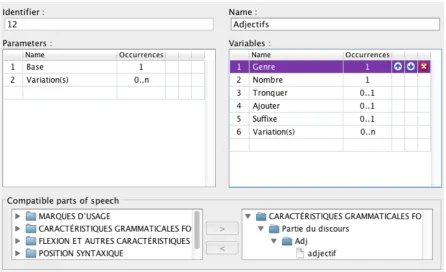
[image:5.595.76.523.288.560.2]The role of Morphological Templates is to establish parameter and variable slots that are common to sets of related Prototypical Tables. For instance, theAdjectifs‘Adjectives’ template, shown in Figure 2, is used to generate all adjectival Prototypical Tables.
Figure 2: TheAdjectifsMorphological Template
Figure 2 indicates that all Prototypical Tables that are created from theAdjectifstemplate will have the same set of columns, defined in the table calledVariables: gender, number, truncation performed on the string of characters that corresponds to the stem, addition to it, suffixation and variation(s).
More generally, variables correspond to either: • grammemes expressed by the wordforms;
• formal adjustments to be performed on the stem (truncation from/addition to the stem, suffixation); • possible variations of given wordforms in the table.
Each wordform is related to a particular set of variables. For example, the wordformactives—which means ‘active’⊕feminine⊕plural5and whose stem isactif—is associated to the following set of
able instanciations:Genre=feminine,Nombre=plural,Tronquer=1,Ajouter=-v-,Suffixe=-es, Variation(s)=∅.
TheParameterstable specifies the characteristics that are shared by all tables of a given template. For instance, all adjectival tables contain aBase‘stem’ field and aVariation(s)field. This means that an adjectival table will force the lexicographer to declare the stem used to generate all the wordforms of the adjective and will allow her to declare possible variants for all wordforms of the table, which will condition the generation of more than one Lexeme Table.
Let us illustrate this with the lexemeABÎMÉ‘damaged’. Declaring the morphology of this lexeme will
trigger the generation of two morphological tables: one for the (default) “traditional” spelling (1.) and one for the “rectified” spelling (2.).6
1. ABÎMÉ{abîmé(masc, sing),abîmés(masc, plur),abîmée(fem, sing),abîmées(fem, plur)};
2. ABÎMÉ{abimé(masc, sing),abimés(masc, plur),abimée(fem, sing),abimées(fem, plur)}
Variation(s)=rectified spelling.
Because of the rather rich morphology of French verbs, verbal templates require more parameters and variables than nominal or adjectival ones. For instance, verbal templates require two additional parameters in order to deal with (i) choice of auxiliary for compound tenses and (ii) possible use of the
SEreflexive pronoun if the verb is pronominal (e.g.SE SUICIDER‘to commit suicide’)—see section 4.3.
Notice that the rationale behind the use of Morphological Templates is the need to design a generic approach that will allow us to work on typologically unrelated languages—cf. final remarks in section 5. It is at the level of Morphological Templates that general principles of word construction are encoded, for each individual language.
3.2 Prototypical Tables
[image:6.595.115.486.517.678.2]As mentioned earlier, Prototypical Tables are generated from Morphological Templates: they feature actualizations of all characteristics (parameters and variables) defined in their source template.In other words, Prototypical Tables represent morphological classes. At the time of writing, 15 Prototypical Tables have been created using theNoms‘Nouns’ template, 34 usingAdjectifsand almost a hundred Prototypical Tables have been created to account for French verbal morphology.
Figure 3 illustrates the approach with thepetit‘small’ Prototypical Table. This table instantiates theAdjectifsMorphological Template withBase=petitandVariation(s)=∅as parameters.
Figure 3: Thepetit‘small’ Prototypical Table
In Figure 3, the Rules table displays the result of the creation of the Prototypical Table, where each line corresponds to a given dynamically created wordform of PETIT. In each individual “rule”
(i.e. grammatical characterization of the corresponding wordform) the gender and number features are instantiated with one grammeme of the pairs masculine∼feminine and singular∼plural, respectively. The rule corresponding to the wordform that functions as lexicographic name for the lexeme is checked on the left-hand side. (The lexicographic name of a lexeme is the default form that will be used to name this lexeme in dictionary wordlists, articles, etc.)
Remember that thepetitPrototypical Table (Figure 3) is distinct from the Lexeme Table ofPETIT:
this latter is the model of an adjectivalinflectional classidentified as being, prototypically, that ofPETIT.
Actual Lexeme Table are produced in the context of a Lexicographic Process, that is our next topic.
4 Lexicographic Process→Lexeme Tables
The Lexicographic Process is operated through the creation of an association between given lexemes and given Prototypical Tables. Each association performed on a lexeme by the lexicographer produces the generation of one or more Lexeme Table(s) for this lexeme. We detail this process successively for nouns (4.1), adjectives (4.2) and verbs (4.3).
4.1 Nominal Lexeme Tables
[image:7.595.76.524.392.455.2]French nouns carry grammatical number—singular or plural. The singular is expressed by a∅-suffix (no addition to the stem). Canonical nominal plural in French is formed by suffixing the-s suffix to the nominal stem. As an example, the two wordforms ofACTEUR‘actor’ are singularacteurand plural acteurs. All nominal lexemes inflecting in the canonical way are associated with the Prototypical Table chat. Figure 4 illustrates how this association is performed with the Dicet editor.
Figure 4:ACTEURlexeme↔chatPrototypical Table association
There are however cases where the nominal plural is not formed by suffixing -s. Four cases can be mentioned.
1. There are unmarked nominal plurals. This concerns nouns ending with-s,-zor-x, likeABUS‘[an]
abuse’, PRIX ‘price’ or RIZ ‘rice’, which are invariable. The Prototypical Table nez ‘nose’ has
been created to handle such cases. The association of the Prototypical Tablenezwith a nominal stem generates two wordforms (one for singular and one for plural) which have an identical signifier (namely, that of the stem).
2. Some nouns are irregular: their inflected forms cannot be computed by means of general morpho-logical rules. For instance, the plural form ofAIL ‘garlic’ isaulx, though it can also be expressed
by the regular formails. To account for this, the lexeme AIL has been connected to the special
Prototypical Tableailwhich generates a Lexeme Table containing both the regular and irregular plurals: {ail(sing),ails(plur),aulx(plur)}.
3. Lexemes can be defective: there is an “empty cell” (or more) in their table of wordforms (Baerman
et al., 2010). For nouns, the defective form is of course either the singular or the plural: • defective singular: COULEURSIII.1b‘colors (= flag or other symbolic object)’;
• defective plural: CIGARETTEII ‘habit of smoking’ (Je devrais arrêter la cigarette ‘I should
4. Some nouns can have spelling variants for their stem. (Catach, 1995) and (Sebba, 2003) studied spelling variations concerning the use of accents, the hyphen, archaic forms, the plural of compound words and double consonants. These possible orthographic variants are recorded as spelling variants in our resource. For example, the nounCUILLÈRE ‘spoon’ has two spellings,cuillèreandcuiller.
Consequently, the lexemeCUILLÈREhas been coupled with two tables, generating respectively the
wordforms {cuillère(sing),cuillères(plur)} and {cuiller(sing),cuillers(plur)}. Most of the time, spelling
variation of the stem follows the last orthographic reform of 1990 (footnote 6 above); in this case, the form recommended by the reform is labelled as “rectified spelling.”
Unmarkedness (ABUS), irregularity (AIL), defectiveness (COULEURSIII.1b) and spelling variation (CUILLÈRE) concern not only nouns but also lexemes of other parts of speech, as will be seen in the
next sections.
4.2 Adjectival Lexeme Tables
As shown earlier in section 3.1, French adjectives carry both grammatical gender (masculine∼feminine) and number (singular∼plural). A few associations of Prototypical Tables with adjectival lexemes are used as illustrations in what follows.
Canonical inflection of French adjectives—namely, feminine formed by -esuffixation and plural by -s suffixation—is modeled in thepetit‘small’ Prototypical Table. The association of this table with an adjectival lexeme such as ABSENTAdj ‘absent’ dynamically generates the table of all corresponding
wordforms: {absent(masc, sing),absents(masc, plur),absente(fem, sing),absentes(fem, plur)}.
Additionally, a significant number of French adjectives are unmarked for gender—e.g. EFFICACE
‘efficient’ {efficace(masc, sing), efficaces(masc, plur), efficace(fem, sing), efficaces(fem, plur)}. Their wordforms
are generated using theaimablePrototypical Table.
Beside the two above-mentioned regular cases, many adjectives have rather idiosyncratic behavior. This includes invariability, allomorph stems or spelling variations.
1. Invariable adjectives are lexemes whose wordforms (inflected forms) are based on the same signi-fier. For example, the adjectiveDEBOUT‘standing up’ possesses the formally identical wordforms
{debout(masc, sing), debout(masc, plur), debout(fem, sing), debout(fem, plur)}, that are generated using the
carmin‘of carmine color’ Prototypical Table.
2. Stem allomorphy can be exemplified withSECAdj‘dry’ {sec(masc, sing),secs(masc, plur),sèche(fem, sing), sèches(fem, plur)} orBREFAdj‘brief’ {bref(masc, sing),brefs(masc, plur),brève(fem, sing),brèves(fem, plur)}. It
is dealt with on a case-by-case basis, with the generation of specific Lexeme Tables.
3. As for nouns, we have to deal with spelling variation of adjectival stems—see the case ofABÎMÉ
‘damaged’ mentioned in section 3.1 above. This implies the creation of two (or more) Lexeme Tables for the same lexeme, one for each possible stem.
Another difficulty we had to deal with comes from the fact that adjectives may have a particular form when they are linearized before a vowel-initial noun (Bonami and Boyé, 2005). Such is the case of
VIEUX‘old’:
(1) a. Ugo, c’était unvieux copaind’enfance.
‘Ugo was an old childhood friend’
[Frantext, IZZOJean-Claude,Total Khéops, 1995, p. 41]
b. Après tout, je suis ton plusvieil ami.
‘After all, I’m your oldest friend’
[Frantext, BEAUVOIR(de) Simone,Les Mandarins, 1954, p. 364]
In order to handle such cases, the lexemeVIEUXAdj is related to thefiverather than four wordforms in
Figure 5: Lexeme Table ofVIEUX‘old’
Finally, we have included in adjectival Lexeme Tables wordforms that arelinguisticallypossible and attested, though they may seem deviant forconceptualreasons. For instance,ENCEINTEAdj‘pregnant’
is naturally related to two feminine wordforms: enceinte(fem, sing) ∼enceintes(fem, plur); but in the
even-tuality that one does want to talk about a pregnant man (for instance, in order to state that this would be a challenging situation), two distinct pairs of masculine wordforms can be usedenceinte(masc, sing) ∼ enceintes(masc, plur) or enceint(masc, sing) ∼ enceints(masc, plur). See the following examples found on the
Internet:
(2) a. Des jeunesgarçons enceintes, c’est ce que voient les habitants de Chicago sur leurs pan-neaux publicitaires.
‘Young pregnant boys, that’s what people in Chicago see on advertisement billboards’ [ http://www.grazia.fr/societe/news/etats-unis-des-hommes-enceintes-pour-promouvoir-la-contraception-551492]
b. À Chicago, les affiches publicitaires mettant en scène de jeunesgarçons enceintsont rem-placé celles, plus classiques, sur les préservatifs et la pilule.
‘In Chicago, advertisements showing pregnant teenage boys have replaced more traditional ones, about condoms and the birth control pill’
[http://www.terrafemina.com/vie-privee/sexo/articles/
27026-contraception-des-garcons-enceints-pour-sensibiliser-les-ados-de-chicago.html]
These forms, that are amply attested, are labelled aspossiblein the Lexeme Table ofENCEINTEAdj,
[image:9.595.84.521.63.208.2]where the feminine singular wordform is of course identified as naming form; cf. Figure 6.
This approach reflects actual usage and is more valid from a linguistic point of view than the alternative solution that consists in encodingENCEINTEAdjas defective adjective.
4.3 Verbal Lexeme Tables
For lack of space, we provide only an outline of how the rich inflectional morphology of French verbs is being handled in our model. We focus on the most significant aspects of the question only.
The pairing of a Prototypical Table with a verbal lexeme implies that information is provided on (i) which auxiliary (avoirorêtre) is selected by the verb for compound tenses and (ii) whether the verb is pronominal (S’AMÉLIORER‘to become better’) or not (AMÉLIORER‘to improve (something)’). This is
[image:10.595.78.520.208.427.2]illustrated in Figure 7, which shows a short sample of the Lexeme Table of the verbAGACERI‘to annoy’.
Figure 7: Lexeme Table (sample) ofAGACERI‘to annoy’
At present, 34 different Prototypical Tables—such asdanser‘to dance’—have been constructed in order to generate Lexeme Tables for French verbs of the first conjugation class (premier groupe, in French grammatical terminology), i.e. verbs that take the -erinfinitive suffix. Most of these tables were created in order to handle stem alternations, such as the alternationagac-∼agaç- forAGACERIin Figure 7.
The first conjugation class has the highest cardinality and it is basically the only productive one in con-temporary French. (Neologisms normally belong to this class.) There are two other conjugaison classes. Verbs of the second conjugation class are dealt with using 3 Prototypical Tables, and 52 Prototypical Tables have been constructed for verbs of the third class.
As for nouns and adjectives, verbs can be defective—11 Prototypical Tables handle defective paradigms—and can have spelling variants. In addition, the morphological model has to deal with sup-pletive verbs—on suppletion, see (Mel’ˇcuk, 1994; Bonami and Boyé, 2003; Corbett, 2007).
To conclude our description of the morphological Lexicographic Process, it is important to mention the fact that an inheritance mechanism has been implemented in the Dicet editor. Senses that are created inside an already existing vocable automatically inherit their morphological description from the basic lexical unit of the vocable (the sense controlling the vocable’s polysemic structure). Inherited morpholog-ical data get a default measure of confidence of 50%. It has to later be either validated by lexicographers (measure of confidence pushed to 100%) or manually overwritten, if the sense in question has a specific morphological behavior.
5 Concluding remarks
being, approximatively 10% of the vocables (= entries) currently present in the database have been morphologically described.7
We expect to have finished the morphological work “on back order” in the fr-LN database within a few months. Future developments include:
• the treatment of compounds such asBOULANGER-PÂTISSIERlit. ‘baker-pastry maker’ { boulanger-pâtissier(sing),boulangers-pâtissiers(plur)} (Mathieu-Colas, 2011);
• the computation of inflected forms of idioms using the encoding of their lexico-syntactic structure; • the application of our dynamic approach to the modeling of morphology of languages other than French within their lexical networks, starting with the English Lexical Network (en-LN) presented in (Gaderet al., 2014).
Acknowledgments
Work on the fr-LN is supported by a grant from the Agence de Mobilisation Économique de Lorraine (AMEL) and Fonds Européen de Développement Régional (FEDER). We thank Cogalex 2014 anony-mous reviewers for their comments on a first version of this paper.
References
Antidote. 2014.Antidote 8[software]. Druide informatique inc., Montreal, QC.
Matthews Baerman, Greville G. Corbett and Dunstan Brown. 2010. Defective Paradigms: missing forms and what they tell us. Oxford University Press, Oxford, UK.
Collin F. Baker, Charles J. Fillmore and Beau Cronin. 2003. The Structure of the FrameNet Database. Interna-tional Journal of Lexicography, 16(3):281–296.
Olivier Bonami and Gilles Boyé. 2003. Supplétion et classes flexionnelles dans la conjugaison du français. Langages, 37(152):102–126.
Olivier Bonami and Gilles Boyé. 2005. Construire le paradigme d’un adjectif. Recherches linguistiques de
Vincennes, 34:77–98.
Olivier Bonami, Gauthier Caron and Clément Plancq. 2013. Flexique: an inflectional lexicon for spoken French.
Technical documentation [http://www.llf.cnrs.fr/flexique/documentation.pdf].
Nina Catach. 1995. Le problème des variantes graphiques: variantes du passé, du présent et de l’avenir. Langue française, 25–32.
Conseil supérieur de la langue française. 1990. Les rectifications de l’orthographe. Journal officiel de la République française No100. Édition des documents administratifs. Direction des journaux officiels, Paris.
Greville G. Corbett. 2007. Canonical Typolgy, Suppletion, and Possible Words. Language, 8–42.
Candice Delaite and Alain Polguère. 2013. Sex-Based Nominal Pairs in the French Lexical Network: It’s
Not What You Think. Proceedings of the 6th International Conference on Meaning-Text Theory (MTT’13),
Valentina Apresjan, Boris Iomdin, Ekaterina Ageeva (Eds.), Prague, 29–40.
George Dunbar. 2012. Adaptive Resonance Theory as a model of polysemy and vagueness in the cognitive lexicon.Cognitive Linguistics, 23(3):507–537.
Christiane Fellbaum (Ed.). 1998. WordNet: An Electronic Lexical Database. The MIT Press, Cambridge, MA.
Nabil Gader, Veronika Lux-Pogodalla and Alain Polguère. 2012. Hand-Crafting a Lexical Network With a Knowledge-Based Graph Editor. Proceedings of the Third Workshop on Cognitive Aspects of the Lexicon (Co-gALex III), The COLING 2012 Organizing Committee, Mumbai, 109–125.
7More than 5% of these vocables required separate morphological characterization for their senses (cf. the case of
COULEURSIII.1bmentioned in section 4.1). This is a rather high proportion—considering the fact that many of the
Nabil Gader, Sandrine Ollinger and Alain Polguère. 2014. One Lexicon, Two Structures: So What Gives?. Proceedings of the Seventh Global Wordnet Conference (GWC2014), Heili Orav, Christiane Fellbaum, Piek Vossen (Eds.), Global WordNet Association, Tartu, 163–171.
Fabrice Issac. 2010. A framework for representing lexical resources. Proceedings of the 23rd International
Conference on Computational Linguistics, Chu-Ren Huang, Dan Jurafsky (Eds.), Beijing, China, 490–497. Claudia Leacock and Martin Chodorow. 1998. Combining Local Context with WordNet Similarity for Word Sense
Identification. WordNet: An Electronic Database, Christiane Fellbaum (Ed.), The MIT Press, Cambridge, MA, 265–283.
Bernard Lété, Liliane Sprenger-Charolles and Pascale Colé. 2004. MANULEX: A grade-level lexical database
from French elementary school readers. Behavior Research Methods, Instruments and Computers, 36(1):156–
166.
Veronika Lux-Pogodalla and Alain Polguère. 2011. Construction of a French Lexical Network: Methodological Issues. Proceedings of the First International Workshop on Lexical Resources, WoLeR 2011. An ESSLLI 2011 Workshop, Ljubljana, 2011, 54–61.
Michel Mathieu-Colas. 2009. Morfetik: une ressource lexicale pour le TAL. Cahiers de Lexicologie, 94:137–146. Michel Mathieu-Colas. 2011. Flexion des noms et des adjectifs composés: Principes de codage. Technical
documentation [http://halshs.archives-ouvertes.fr/halshs-00635018/].
Igor Mel’ˇcuk. 1994. Suppletion: toward a logical analysis of the concept.Studies in Language, 18(2):339–410. Igor Mel’ˇcuk. 2000. UnFOU/uneFOLLE: un lexème ou deux? Bulag, hors-série:95–106.
Igor Mel’ˇcuk. 2012.Semantics: From meaning to text(vol. 1). Studies in Language Companion Series 129, John Benjamins, Amsterdam/Philadelphia.
Véronique Montémont. 2008. Discovering Frantext. New Beginnings in Literary Studies, Jan Auracher, Willie
van Peer (Eds.), Cambridge Scholars Publishing, Newcastle, UK, 89–107.
Boris New. 2006. Lexique 3: Une nouvelle base de données lexicales. Proceedings of TALN 2006, Chu-Ren
Huang, Dan Jurafsky (Eds.), Leuven, Belgium, 490–497.
Alain Polguère. 2014. Principes de modélisation systémique des réseaux lexicaux. Proceedings of TALN 2014, Brigitte Bigi (Ed.), Marseille, France, 79–90.
Alain Polguère. To appear. From Writing Dictionaries to Weaving Lexical Networks. International Journal of Lexicography.
Laurent Romary, Susanne Salmon-Alt and Gil Francopoulo. 2004. Standards going concrete: from LMF to
Morphalou. Workshop on Electronic Dictionaries, Coling 2004, Geneva [http://hal.inria.fr/docs/
00/12/14/89/PDF/LRSSAGFFinal.pdf].
Josef Ruppenhofer, Michael Ellsworth, Miriam R. L. Petruck, Christopher R. Johnson and Jan Scheffczyk. 2010. FrameNet II: Extended Theory and Practice. International Computer Science Institute, Berkeley, CA.
Benoît Sagot. 2010. The Lefff, a freely available and large-coverage morphological and syntactic lexicon for French. Proceedings of the 7thInternational Conference on Language Resources and Evaluation (LREC’10),
Istanbul.
Mark Sebba. 2003. Spelling rebellion. Pragmatics and beyond, 151–172.