A Logical Characterization of Extended TAGs
Uwe M¨onnich
Theoretische Computerlinguistik Universit¨at T¨ubingen
Wilhelmstr. 19 72074 T¨ubingen
Abstract
Context-free tree grammars, originally in-troduced by Rounds ((Rounds, 1970)), are powerful grammar devices for the defini-tion of tree languages. In the present pa-per, we consider a subclass of the class of context-free tree languages, namely the class of monadic simple context-free tree languages. For this class of context-free tree languages, a faithful rendering of ex-tended TAGs, we show that it can be given a simple logical characterization in terms of monadic second-order transductions.
1 Introduction
The monadic simple context-free tree languages belong to the class of mildly context-sensitive lan-guages. The intuitive notion of mild context-sensitivity has led to two competing candidates claiming to be an exact formal rendering of the intentions Joshi (1985) was trying to cap-ture when introducing this concept. On the one hand multiple context-free grammars and their equivalents exhibiting a variety of wildly different specifications provide impressive evidence that this precise counterpart of the informal descrip-tion of mild context-sensitivity constitutes a nat-ural class. On the other hand the well-nested subclass of the multiple context-free grammars has recently been advertised as a formalization more in accordance with Joshi’s original inten-tions ((Kanazawa, 2009; Kuhlmann, 2007)). Both candidates have counterparts in the realm of tree languages and it is in this context that they are eas-ily recognized to provide a mathematically pre-cise framework for the characterization of two leading linguistic models, minimalist syntax and
tree adjoining grammars (cf. (Harkema, 2001), (Michaelis, 2001), (Kepser and Rogers, 2007), (M¨onnich, 1997; M¨onnich, 2007)).
The tree languages in question are the multi-ple regular tree languages ((Raoult, 1997)) and the simple context-free tree languages ((Engel-friet and Maneth, 2000)). Both language fami-lies are proper subfamifami-lies of the tree languages generated by context-free hyperedge-replacement graph grammars and the latter family is iden-tical with the output languages of logical tree-to-tree transductions applied to regular tree lan-guages. The obvious question that poses it-self is whether the two restricted rule formats or their corresponding tree transducers, finite-copying top-down tree transducers and simple macro/attributed tree transducers, respectively, can be given an equivalent logical characteriza-tion in terms of restriccharacteriza-tions on the logical formu-las defining the relations in the target structures of logical transductions. This is indeed the case. A central result in a paper by Bloem and Engelfriet (2000) states that the tree languages which are the output of finite-copying top-down tree transduc-ers applied to regular tree languages are exactly the output tree languages of logical tree transduc-ers which are direction preserving in the sense that edges in the output trees correspond to di-rected paths in the input trees. As a first step towards an analogous result for simple context-free tree languages the main theorem of the pa-per shows that their monadic subclass, which pro-vides a formalization of the extended version of classical tree adjoining grammars (T AGs), has
indeed an easy logical characterization that puts them on the same footing as their multiple regu-lar counterparts and thereby closes the gap that
has remained with respect to a model-theoretic description ofT AGs.
The logical approach to the specification of lan-guage classes involves a lot of advantageous prop-erties that have paved the way to its application to linguistic issues. Of particular importance in the present context is the restricted translational power of logical transductions. Monadic second-order definable tree translations are, by definition, of linear size increase. An output tree is at mostk
times as large as its input tree wherekdenotes the
cardinality of the set of copy names. This bound on the copying power of transduction devices that are motivated by the model-theoretic idea of se-mantic interpretation is the main reason why the output languages of tree transductions definable in terms of monadic second-order logic satisfy in a particular perspicuous way the crucial crite-ria Joshi has suggested for the family of mildly context-sensitive languages.
One of our reviewers pointed out that there are recent attempts at relaxing the linearity condition of multiple context-free grammars and thus ar-riving at a larger class of languages for which it is claimed that they are still in accordance with the intuitions behind the notions of mild context-sensitivity. This extended class allows for a limited amount of copying (Cf.(Bourreau et al., To appear; Kallmeyer, 2010)). Whether such a formalization violates the criterion that poses a bound on cross-serial dependencies seems to be an open question. We favor a strong interpretation of this criterion and therefore are inclined to con-sider the realm of languages covered by logical translations as the the currently leading contender for an exact specification of Joshi’s proposal.
There are two main sources that have influ-enced the ideas reported in this paper. Apart from the fundamental work on graph structure and monadic second-order logic due to Courcelle and Engelfriet (2012) we have to mention a previous attempt at giving a logical description of linear inside-out context-free tree languages (cf. (Kolb et al., 2000; Kolb et al., 2003)). This attempt relied on a particular technique of regularizing context-free tree grammars and does not lend it-self to a treatment of arbitrary regular tree lan-guages as input. The other principal source is pro-vided by the characterization of tree transductions that are specifiable in monadic second-order logic in terms of attributed tree transducers with
look-ahead. This result was established by Bloem and Engelfriet (2000) and constitutes together with our own earlier proof of the equivalence between simple context-free tree grammars and simple at-tributed tree transducers (M¨onnich, 2010) the ba-sis for the main result of the present paper.
We have been at pains to expound the central notions of this paper in an informal way. Our em-phasis has been on motivating examples and con-nections with recent work on syntax-directed se-mantics. We hope not to have traded formal rigour for transparency in the proof sketches below. 2 Preliminaries
This section defines familiar notions from the the-ory of syntax-directed semantics together with its model-theoretic counterpart, the theory of monadic second-order transductions.
For any setA,A∗is the set of all strings overA. εis the empty string,|w|is the length of a string
w.N denotes the set{0,1,2,3, . . .}of nonnega-tive integers.
A single-sorted or ranked alphabet is a finite setΣgiven with a mappingrank : Σ → N (the
rankmapping). We usually write Σ(n) to denote
the (unique) set of operators of rankn ∈ N; we also write σ(n) to indicate that rank(σ) = n.
The elements of Σ(0) are also called constants.
The set of treesTΣ is defined recursively as
fol-lows. Each constant of Σ, i.e., each symbol of
rank0, is a tree. Ifσ is of rank kandt1, . . . , tk
are trees, then σ(t1, . . . , tk) is a tree. A tree
language L ⊆ TΣ over Σ is a subset of TΣ.
With each treet ∈ TΣ we can associate a string s ∈ Σ(0)∗ by reading the leaves of t from left to right. This string is called theyield oft,
de-noted by yd(t). More formally, yd(t) = t if t ∈ Σ(0), and yd(t) = yd(t
1)· · ·yd(tk)
when-evert = σ(t1, . . . , tk) with k ≥ 1. The yield
of tree languageLis defined straightforwardly as yd(L) ={yd(t)|t∈L}.
If A is a set (of symbols) disjoint from Σ,
then TΣ(A) (alternatively T(Σ, A)) denotes the
set of trees TΣ∪A where all elements of A are
taken as constants. Let X = {x1, x2, x3, . . .} be a fixed denumerable set of input variables and Y = {y1, y2, y3, . . .} be a fixed
denumer-able set of parameters. Let X0 = Y0 = ∅ and, fork ≥ 1, Xk = {x1, . . . , xk} ⊂ X, and
Yk = {y1, . . . , yk} ⊂ Y. Fork ≥0, m≥ 0, t ∈
t[t1, . . . , tk]the result ofsubstituting ti for xi in
t. Note thatt[t1, . . . , tk]is inTΣ(Xm). Note also
that fork= 0,t[t1, . . . , tk] =t.
Definition 1. A context-free tree (CF T)
gram-mar is a tupleG= (F,Ω, S, P)whereF andΩ
are ranked alphabets of non-terminals and termi-nals, respectively, S ∈ F(0) is the start symbol
andP is a finite set of productions of the form
F(y1, . . . , ym)→ξ
whereF ∈ F andξis a tree overF,ΩandYm.
If for every F ∈ F(m) each y ∈ Y
m occurs
exactly once on the right-hand side of the cor-responding rule then the context-free tree gram-mar is calledsimple in the parameters (sp). The family of tree languages which is generated by context-free tree grammars which are simple in their parameters is designated asCF Tsp. Of
par-ticular interest to us is the situation where all the non-terminals in a simple context-free tree gram-mar are at most of arity 1. We call this class of grammarsmonadic simplecontext-free grammars
CF Tmon,sp.
Attributed tree transducers are a variant of at-tribute grammars in which all atat-tribute values are trees. Besidesmeaning nameswhich transmit in-formation in a top-down manner, attributed tree transducers contain explicitcontext nameswhich allow information to be passed up from a node to its mother. Consequently, arbitrary tree walks can be realized by attributed tree transducers.
Definition 2. Anattributed tree transducer(AT T)
is a tuple
A= (Syn, Inh,Σ,Ω, αm, R),
whereSynandInhare disjoint alphabets of
syn-thesizedandinherited attributes, respectively, Σ
and Ω are ranked alphabets of input and
out-putsymbols, respectively,αm is a synthesized
at-tribute, and R is a finite set of rules of the
fol-lowing form: For every σ ∈ Σ(m), for every (γ, ρ) ∈ insσ (the set of inside attributes of σ),
there is exactly one rule inRσ:
(γ, ρ)→ξ
whereξ ∈TΩ∪outσ andoutσ is the set of outside
attributes ofσ. Rules whereξis(γ0, ρ0)are called
copy rules.
Definition 3. For every σ ∈ Σ(m), the set of
inside attributes is the setinsσ = {(α, π)|α ∈
Syn} ∪ {(β, πi)|β ∈Inh, i≤m}and the set of outsideattributes is the set outσ = {(β, π)|β ∈
Inh} ∪ {(α, πi)|α ∈ Syn, i ≤m}. πandρare path variables ranging over node occurrences in the input tree.
AT T swith rulesRσ at an input symbolσ in
which each outside attribute occurs exactly once are calledsimpleattributed tree transducers. We denote this class byAT Tss,si.
The dependencies between attribute occur-rences in an input treescan be represented with the help of Rσ. An instance of an attribute
oc-currence (α0, π0) depends on another occurrence (α, π)ifσlabels nodeuins,Rσcontains the rule
(α0, π0)→ξand(α, π)labels one of the leaves in ξ. Thedependency graph D(s) of an input tree s∈TΣconsists of the set of attribute occurrences
together with the dependencies according to the rules in R. Reversing the direction of these
de-pendencies leads to the notion of asemantic graph
S(s)of an input trees∈TΣ.
An attributed tree transducer is noncircular if the paths of attribute dependencies are noncircu-lar. It is well known that noncircularAT Ts have
unique decorations dec, functions which assign each attribute occurrence a tree overΩ∪outσ in
accordance with the productionsRσ.
Definition 4. Thetransductionrealized by a non-circular attributed tree transducer A is the func-tion
τA={(s, t)|s∈Tσ, t∈TΩ, t=decs(αm, )}
Declarative tree transductions are inspired by the model-theoretic technique of semantic inter-pretation (Rabin, 1965). The idea is to define a re-lational structure inside another structure in terms of monadic second-order formulas. Both the input and the output structures are finite trees regarded as finite models.
The language to be used for the specification of properties and relations satisfied by finite tree structures is a straightforward extension of first-order logic: monadic second-first-order logic (M SO).
The language of this logic contains variables that range over subsets of the universe of discourse and quantifiers that bind these (monadic) predi-cate variables.
Given a ranked signature Σ the monadic
atomic formulas labσ(x) (σ ∈ Σ), childi(x, y),
x =yandx ∈X to convey the idea that nodex
has labelσ, that nodeyis thei-th child of nodex,
thatxandyare the same node and that nodexis
a member of the set of nodesX.
Besides this extension of the classical first-order logic the concept of a monadic second-first-order definable tree transducer (M SOT T) differs in two further aspects from the method of semantic interpretation as originally introduced by Rabin. First, an MSO formulaφserves to define the do-main of the transducer. The second modification of the original method of semantic interpretation provides for a fixed numberk of disjoint copies of the input tree. It is inside these disjoint copies that the output tree is to be defined.
Definition 5. Given two ranked alphabetsΣand Ω and a finite set C of copy names, a monadic
second-order definabletree transducerT fromTΣ
toTΩis specified by the following formulas of the
monadic second-order language overΣ: (i) a closed formulaϕ, thedomainformula (ii) formulasνc(x)withc∈C, thenode
formu-las
(iii) formulasψδ,c(x)withc∈C andδ ∈Ω, the
labellingformulas
(iv) formulasχi,c,d(x, y)withc, d ∈ C andi≤
maximal arity of symbols inΩ, theedge
for-mulas
In sharp contrast with the syntax-directed trans-formation devices a logic based tree transducerT
does not translate its input trees in a recursive top-down manner. The translationτT realized by such
a declarative transducer has to be defined in terms of the familiar ingredients of a relational structure.
Definition 6. Thetree translationτT realized by
a monadic second-order definable tree transducer
T fromTΣ toTΩis a partial functionτT :TΣ → TΩdefined as follows. The domain ofτT is{s∈
TΣ | s |= ϕ}. For every s ∈ TΣ in its domain τT(s)is the tree structuret∈TΩsuch that:
Dt={(c, x)∈C×Ds|s|=νc(x)}
is the tree domain oft
Et={((c, x), i,(d, y))∈Dt×ar(Ω)×Dt|
s|=χi,c,d(x, y)} is the edge relation oft
wherear(Ω)denotes the rank ofΩ
Lt={((c, x), δ)∈Dt×Ω|s|=ψc,δ(x)}
is the labeling function oft
Logic based transducers are called relabeling if they just relabel the nodes of an input tree. Of particular interest regarding the logical anal-ysis of monadic simple context-free tree gram-mars are logic based tree transducers that pre-serve or reverse the direction of the paths in the input tree in their definitions of edges of output trees. This family of tree transducers is designated byM SOT Tdir,rev. We depart slightly from this
definition in allowing defining upwards paths be-tween a leaf node and the daughter of a dominat-ing branchdominat-ing node. In this situation we speak of aslight modificationofM SOT Tdir,rev.
3 FromCF Tmon,sp to1S,1I−AT Tss,si
The proof of the logical characterization of monadic simple context-free tree languages is based on a procedural characterization of sim-ple context-free tree languages as the output lan-guages of simple attributed tree transducers with one synthesized attribute only (Cf. M¨onnich, 2010). The simulation of attributed tree trans-ducers by monadic second-order tree transtrans-ducers along the lines of Bloem and Engelfriet (2000) then leads to the logical characterization of the ( formal representation of ) extended T AGs in
terms of extremely simple edge definitions on the input trees.
The translation below of a givenCF Tmon,spG
into an equivalent AT TspA is inspired by the
proofs of Lemma 5.11 in (F¨ul¨op and Vogler, 1998) and of Lemma 6.1 in (Engelfriet and Maneth, 1999).
Example 1. Consider the CF Tmon,spG =
h{S, S0, S, E, a, b, c, d},{a, b, c, d, ε, St, St0}, S0, Pi
withP given as follows:
S0 −→St(a, S(S(E)), d) a−→a
S(y)−→St(a, S(S(y)), d) b−→b
S(y)−→S0t(y) c−→c
S(y)−→St(b, y, c) d−→d
E −→ε
This grammar generates the language L =
{anbn, cn, dn}. A derivation of the string
aabbccddis shown in figure 1. We simplified the
S’ =⇒ St
d S
S
E a
=⇒
St
d St
d S
S
S
E a a
=⇒
St
d St
d S
St
c S
E b a a
=⇒
St
d St
d S0
t
St
c St
[image:5.595.92.510.70.212.2]c ε b b a a
Figure 1: Derivation of yieldaabbccdd
.
Inspecting the rules of the example grammar it turns out that they exhibit a particular nor-mal form with a terminal symbol as head and a possibly empty string of non-terminals. This is not an accidental feature of our grammar, but a general characteristic of monadic simple context-free tree grammars. Context-context-free tree grammars in which the root of the right-hand side of each rule is labelled with a terminal symbol are in Greibachnormal form. It is well known that there are context-free tree languages that do not admit grammars in Greibach normal form. In the case of tree languages generated by monadic simple context-free tree grammars, however, the classi-cal proof for context-free word grammars goes through without any modification because of the isomorphism between strings and monadic trees. The preceding considerations lead to the follow-ing lemma:
Lemma 1. For any monadic context-free tree grammarG, there is a monadic context-free tree
grammarG0in Greibach normal form such that
L(G0) =L(G)
Given these preparations we arrive at the fol-lowing translation procedure from monadic sim-ple context-free tree grammars to simsim-ple at-tributed tree transducers.
Lemma 2. For every CF Tmon,sp G, there is an
1S,1I−AT Tss,siAGthat outputs the same
lan-guage when applied to the derivation trees ofG.
Proof For a given CF Gmon,sp G =
(F,Ω, S, P) an 1S,1I − AT Tss,si =
(Syn, Inh,Σ,Ω, αm, R)AG that outputs the
same language is defined from the rules of Gin
the following way.
• Syn={0,1}withα=αmat the root node
• Inh={y}
• Every symbol in the derivation trees is as-signed one synthesized attribute.
• Ifp :N → ξis an element ofP thenR0p is
specified for both the synthesized and inher-ited attributes by structural induction on the right-hand sideξ:
(q, π)→ϑ(ξ),
whereq = 0orq= 1depending on the arity
ofN andϑsubstitutes a non-terminalM in ξ by(q, πi)if the non-terminalM occurs in the i-th non-terminal position inξ andy by (y, π)
(yj, πi)→ϑ0(ξ0),
whereξ0 occurs in the argument position of
some non-terminalLinξthat itself occupies
the i-th non-terminal position on the right-hand side ofpandϑ0 is identical withϑ
ex-cept for erasing everyyinξ0.
a Example 2. Applying the construction just out-lined to the context-free tree grammar of the last example we obtain the following attributed tree transducerA= (Syn, Inh,Σ,Ω, q0, R0):
• Syn={0,1}
• Inh={y}
• Σ ={p0, . . . , p9}
• q0 = 0
• R0 =S
pi R0pi
R0p1 ={(0, π)→St((0, π1),(1, π2),(0, π4)),
(y, π2)→(1, π3)}
R0p2 ={(1, π)→St((0, π1),(1, π2),(0, π4)),
(y, π2)→(1, π3), (y, π3)→(y, π)}
R0p3 ={(1, π)→St0((y, π))}
R0p4 ={|1, π)→St((0, π1),(y, π)(0, π2))}
R0p5 ={(0, π)→a}
R0p6 ={(0, π)→b}
R0p7 ={(0, π)→c}
R0p8 ={(0, π)→d}
R0p9 ={(1, π)→ε}
Given the constructed attributed tree transducer
A that is equivalent to the previously considered monadic simple context-free tree grammarGwe
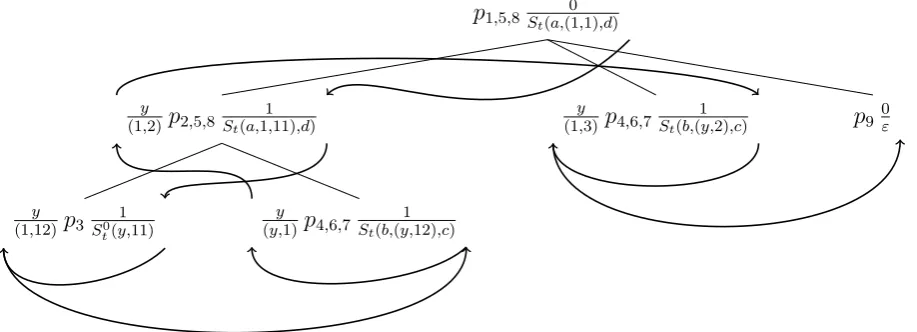
can now repeat the example derivation displayed in figure 1. We follow the conventional graphical representation for drawing attributed derivation trees together with the dependencies obtaining be-tween synthesized and inherited attributes. Oc-currences of synthesized and inherited attributes in conjunction with their tree values appear to the right and left, respectively, of the labelled nodes of the input tree. Dependencies among the at-tribute occurrences are indicated by arrows. Since dependency graphs indicate the connection be-tween an attribute leaf and the tree which is to be substituted for it by building the output tree bottom-up we will depart from the conventional graphical representation in this respect and adopt instead the tradition of semantic graphs which construct the output tree top-down and therefore are direction preserving as far as relations be-tween attribute values are concerned.
Under the stated conventions the graphical rep-resentation of the information transport in terms of the constructed attributed tree transducerAthat
corresponds to the example derivation of figure 1 looks as shown in figure 2. We have again sim-plified the presentation in the sense that the appli-cation of the “barred” rules is contracted into one single step.
4 Equivalence ofCF Tmon,spwith (a
slight modification of) Non-Copying M SOT Tdir,rev
It was mentioned above that attributed tree trans-ducers are attribute grammars with all their at-tribute values restricted to trees and their seman-tic functions to substitution of trees for depen-dent leaves. Second–order substitution for inter-nal nodes of trees is achieved through the upward information transport that is made possible by the inherited attributes. An analysis of the paths in the semantic dependency graph of the attributed tree transducer that corresponds to a monadic sim-ple context-free tree grammar inGreibachnormal form reveals that these paths are either direction preserving as in the case of minimalist grammars or direction reversing.
Lemma 3. For every CF Tmon,spG there is (a
slight modification of) an equivalent non-copying reducedM SOT Tdir,revT.
Proof (Sketch) The main idea of the proof is a careful case analysis of the translation procedure that produces an equivalent attributed tree trans-ducer from a given monadic simple context-free tree grammar G. Inspection of this translation procedure in the proof of Lemma 2 reveals the fol-lowing types of right-hand sides in the rules of a monadic simple context-free tree grammar. W.l.g we consider only terminals with at most arity one:
• F −→ a The synthetic meaning
at-tribute gets the value a at the node
corre-sponding to the application of this rule.
• F −→ a(N) The synthetic meaning
attribute gets the value a(α, π) establishing
a dependency on the synthetic value of the daughter.
• F −→ a(N(M)) In addition to the previous case a further dependency is estab-lished on the value of the sibling node corre-sponding to the application of a production with left-hand sideM. This dependency is
mediated by a copy rule at the inherited con-text attribute of the node corresponding to an application of a production with left-hand sideN.
p1,5,8 St(a,(10,1),d)
p9 0ε
y
(1,3)p4,6,7 1
St(b,(y,2),c)
y
(1,2)p2,5,8 1
St(a,1,11),d)
y
(y,1)p4,6,7 1
St(b,(y,12),c)
y
(1,12)p3 1
S0
[image:7.595.73.532.74.240.2]t(y,11)
Figure 2: Attributed derivation tree with semantic dependency relations
of nullary non-terminals F(y) are rewritten the
parametery mediates an one-step upwards
infor-mation transport by means of inherited copy rules. From this case analysis it follows immediately that all inherited rules are copy rules whereas all synthetic rules add material to the output tree. Furthermore, all upwards dependencies are me-diated by an inherited rule establishing a depen-dency on the synthetic value of a sibling node.
Based on this intermediate simpleAT T we can
now define the equivalentM SOtree transducerT
by specifying the edge formulasχ1,γ,γ0(x, y)that
represent the dependencies between the attributes and the node formulasψd,γ(x)that define the
la-bels of the output tree. We assume again for sim-plicity that the terminals of the given grammarG
are of arity at most one and that the copy rules in-troduce a new output symbolid. The set of copy
nodes consists of the synthetic and the inherited attribute. The edge formulas mirror the informa-tion transport of rules of the form
(∗) (γ, ρ)→a(γ0, ρ0)
where (γ, ρ) is an inside, (γ0, ρ0) an outside attribute and a an output symbol or the new
symbol id. Such an edge formula χ1,γ,γ0(x, y)
is the disjunction of all formulas ∃z(labσ(z) ∧
edgej(z, x)∨edgej0(z, y))for all input symbols σwithj, j0 equal to 0 or 1 and(γ, πj)depending
on(γ0, πj0)inRσ. In the situation wherej, j0 = 0
edge0(x, y)is shorthand forx=y.
The node formulaψd,γ(x)is the disjunction of
all formulas∃z(labσ(z)∧edgej(z, x))for all
in-put symbols σ where the same stipulations hold
as for the edge formulas andRσcontains the rule
(*).
This easy transfer of the translation technique developed by Bloem and Engelfriet (2000) to the context of simple tree transducers with only one synthesised and one inherited attribute reveals im-mediately that the defined monadic second-order tree translation fulfills the condition of being di-rection preserving/reversingapart from the infor-mation flow to and fro between the the synthetic and inherited copies of the input trees.
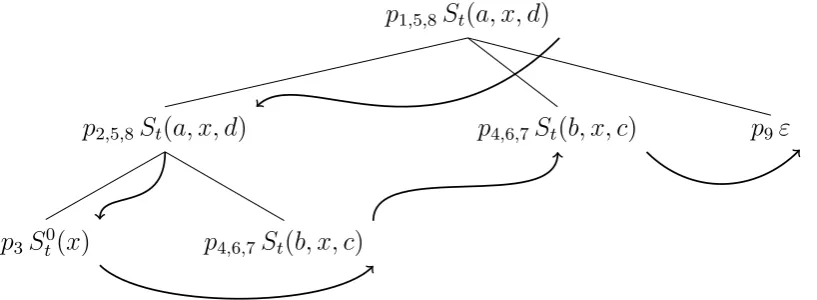
Bloem and Engelfriet show how to prune all oc-currences of these transitions. Since this makes the ”inherited” copy of the input tree superflu-ous we can erase it completely and arrive thus at areduced non-copying MSO-transduction in the sense that every node is the head or tail of an edge. The pruning step has introduced a slight modifica-tion of the upward paths by linking some leafs to the first daughter of a dominating branching node. a Applying the construction just outlined to the information transport illustrated by figure 2 we obtain the defined edges in the output of an MSO-transduction shown in figure 3.
Lemma 4. For every (slight modification of a) non-copying reduced M SOT Tdir,revT there is
an equivalentCF Tmon,spGT.
Proof (Sketch) We adapt again to the present situation the method of proof developed by Bloem and Engelfriet (2000). We assume with them that the root of the defined output tree of a given di-rection preserving/reversing MSO tree transducer
as-p
1,5,8S
t(a, x, d)
p
9ε
p
4,6,7S
t(b, x, c)
p
2,5,8S
t(a, x, d)
p
4,6,7S
t(b, x, c)
[image:8.595.95.504.72.222.2]p
3S
t0(x)
Figure 3: MSO-defined edges
sume furthermore that edges originate or end at every node of the input tree. For nodes occurring between endpoints of edges that correspond to di-rection preserving paths this assumption could be avoided by eliminating spurious rules likeN −→ Mfrom the equivalent context-free tree grammar.
Finally we observe that the upward edges of the output tree may still be established between nodes that are not immediate neighbours.
This non-local feature can be excluded by ap-plying the inverse of the pruning action of the previous lemma. If there is a non-local upward edge from the leaf of the input tree to a sibling of the first daughter of a dominating branching node then we define a local path on an ”inherited” copy of the input tree that connects the endpoints of the original non-local upward edge.
The specification of the equivalent AT T
re-lies on information about the configuration of the (local) edges in its immediate neighbourhood. This information can be stored in the node la-bels by means of a relabeling M SOT T T0 that
extends each label by a vector of truth values of the formulas for top-down and bottom-up edges and for edges between nodes and their twins in the other copy. To illustrate the simplest case for a unary output symbolaand a ”synthesized”
copy name γ : If the formula ψa,γ(x) is true at
a node with extended label σ0 and the only true
edge formula isχ1,γ,γ(x, y)thenRσ0contains just (γ, ρ)→a(γ, ρ1).
From this intermediate attributed tree trans-ducer the equivalent monadic simple context-free tree grammarGT is then defined as follows where
we use the notational conventions introduced in the preliminary section (cf. (M¨onnich, 2010)):
• F = Σ where the arity of non-terminals
is either zero or one depending on the oc-currence of an inherited attribute assigned to them in the input tree.
• Ω = Ω
• S ={σ(0)}withσ ∈ Σlabeling the root of
an input tree.
• For everyσ∈Σwe construct a rule σ(y1, . . . , yn)→t
where t = COM P(ξ) and ξ is the
right-hand side of the only synthesized attributeα
in Rσ. The right-hand sides of rules in Rσ
are designated by rhs(γπ, σ)in the
follow-ing:
(i) Ifξ=απithen
σ(y1, . . . , yn)→t
where t = COM P(ξ) and ξ is the
right-hand side of the only synthesized attributeα
in Rσ. The right-hand sides of rules in Rσ
are designated by rhs(γπ, σ)in the
follow-ing:
(i) Ifξ=απithen
COM P(ξ) =ρ(t)
whereρlabels the ith daughter ofσand
t=COM P(rhs(βπi, σ))
(ii) Ifξ =βπthen
(iii) Ifξ =f(ξ1, . . . , ξr)forf ∈Ω(r)
COMP(ξ) =f(COM P(ξ1), . . . , COM P(ξr))
By a routine inspection it is easy to verify that the resulting grammar GA is indeed simple and
that it generates exactly the output language ofT.
a By lemmas 4 and 4 we obtain our main result.
Theorem 1. The monadic simple context-free tree languages are exactly the output languages (of a slight modification) of non-copying direction pre-serving/reversing MSO definable tree transduc-tions.
5 Envoi
The question of how to extend the logical char-acterization given in the present paper to the full class of simple context-free languages or to the family of well-nested tree languages, for that mat-ter, is still open. Our conjecture is that a similar characterization holds for these languages. The main step towards such a result would consist in establishing a Greibach normal form for this larger class of languages.
References
Roderick Bloem and Joost Engelfriet. 2000. A Com-parison of Tree Transductions Defined by Monadic Second-Order Logic and by Attribute Grammars. J. Comp. System Sci., 61:1–50.
Pierre Bourreau, Sylvain Salvati, and Laura Kallmeyer. To appear. On io-copying and mildly context-sensitive formalisms. In Proceed-ings of Formal Grammar 2012. Lecture Notes in Computer Science.
Bruno Courcelle and Joost Engelfriet. 2012. Graph Structure and Monadic Second-Order Logic. A Language-Theoretic Approach.Cambridge Univer-sity Press.
Joost Engelfriet and Sebastian Maneth. 1999. Macro Tree Transducers, Attribute Grammars, and MSO Definable Tree Translations. Information and Com-putation, 154:34–91.
Joost Engelfriet and Sebastian Maneth. 2000. Tree Languages Generated by Context-Free Graph Grammars. In Hartmut Ehrig et al., editor,Graph Transformation, number 1764 in LNCS, pages 15– 29. Springer.
Zolt´an F¨ul¨op and Heiko Vogler. 1998. Syntax-Directed Semantics - Formal Models Based on Tree Transducers. Springer, New York and Berlin.
Hendrik Harkema. 2001. Parsing Minimalist Lan-guages. Ph.D. thesis, University of California at Los Angeles.
Laura Kallmeyer. 2010. On mildly-context-sensitive non-linear rewriting. Research on Language and Computation, 8:341–363.
Makoto Kanazawa. 2009. The convergence of well-nested mildly context-sensitive grammar for-malisms. In14th Conference on Formal Grammar. Slides available at http://research.nii.jp/˜kanazawa/. Stephan Kepser and James Rogers. 2007. The equiv-alence of tree adjoining grammars and monadic linear context-free tree grammars. In M. Kracht, G. Penn, and E. Stabler, editors, Mathematics of Language 10.
Hans-Peter Kolb, Uwe M¨onnich, and Frank Morawi-etz. 2000. Descriptions of cross-serial dependen-cies.Grammars, 3(2/3):189–216.
Hans-Peter Kolb, Jens Michaelis, Uwe M¨onnich, and Frank Morawietz. 2003. An operational and deno-tational approach to non-context-freeness. Theoret-ical Computer Science, 293:261–289.
Marco Kuhlmann. 2007. Dependency Structures and and Lexicalized Grammars. Ph.D. thesis, Saarland University.
Jens Michaelis. 2001. On Formal Properties of Mini-malist Grammar, volume 13 ofLinguistics in Pots-dam. Universit¨at Potsdam.
Uwe M¨onnich. 1997. Adjunction as substitution. In G-J. M. Kruijff, G. Morill, and R. Oehrle, editors,
Formal Grammar ’97, pages 169–178.
Uwe M¨onnich. 2007. Minimalist syntax, multiple regular tree grammars and direction preserving tree transductions. In J. Rogers and S. Kepser, editors,
Proceedings Model Theoretic Syntax at 10. Uwe M¨onnich. 2010. Well-nested tree languages
and attributed tree transducers. In Srinivas Ban-galore, Robert Frank, and Maribel Romero, ed-itors, TAG+10. Proceedings of the 10th Interna-tional Workshop on Tree Adjoining Grammars and Related Formalims.
Michael O. Rabin. 1965. A simple method for unde-cidability proofs and some applications. In Y. Bar-Hillel, editor, Logic Methodology and Philosophy of Science II, pages 58–68. North-Holland, Amster-dam.
Jean-Claude Raoult. 1997. Rational Tree Relations.
Bull. Belg. Math. Soc., 4:149–176.