Munich Personal RePEc Archive
May the Soul of the IFS Financial
System Definition RIP in Developing
Countries
Asongu, Simplice
11 January 2014
Online at
https://mpra.ub.uni-muenchen.de/63156/
1
AFRICAN GOVERNANCE AND DEVELOPMENT
INSTITUTE
A G D I Working Paper
WP/14/021
May the Soul of the IFS Financial System Definition RIP in Developing
Countries
Simplice A. Asongu
African Governance and Development Institute, Yaoundé, Cameroon.
2 © 2014 African Governance and Development Institute WP/21/14
AGDI Working Paper
Research Department
May the Soul of the IFS Financial System Definition RIP in Developing
Countries
Simplice A. Asongu1
January 2014
Abstract
In this paper, we dissect with great acuteness contemporary insufficiencies of the IFS
(2008) definition of the financial system and conclude from sound theoretical underpinnings
and empirical justifications that the foundation, on which it is based, while solid for
developed countries, holds less ground in developing countries. Perhaps one of the deepest
empirical hollows in the financial development literature has been the equation of financial
depth in the perspective of money supply to liquid liabilities. This equation has put on the
margin (and skewed) burgeoning phenomena of mobile banking, knowledge economy (KE),
inequality…etc. We conclude that the informal financial sector, a previously missing
component in the IFS conception and definition of the financial system can only be
marginalized at the cost of misunderstanding recent burgeoning trends in mobile phone
penetration, KE and poverty. Hence, the IFS definition has incontrovertibly fought its final
dead battle and lost in the face of soaring trends highlighted above. Despite the plethora of
econometric and policy-making sins the definition has committed in developing countries
through bias estimates and misleading inferences, may its soul RIP.
JEL Classification: E00; G20; I30; O17; O33
Keywords: Banking; Mobile Phones; Shadow Economy; Financial Development; Poverty
Acknowledgement
The author is highly indebted to the editor and referees for useful comments.
1
3
1. Introduction
The title of this paper will strike some as fanciful and earthshaking, heartbreaking and
eye-catching for others. The International Financial Statistics (IFS, 2008) definition by the
International Monetary Fund (IMF)? To rest in peace (RIP)? Surely not. Or at least surely not
for developed countries. However, this lamentation is a subject to controversy in developing
countries and motivates no tears or elements of consolation. Not least, because one of the
deepest empirical hollows in the financial development literature has been the equation of
financial depth in the perspective of money supply to liquid liabilities. This equation has put
on the margin, some burgeoning phenomena in the informal financial sectors of developing
countries. Among others, mobile banking and microfinance (or in one conception ‘informal
finance’) are elements of consolation for developing countries as the soul of the IFS
conception and definition of the financial system RIP.
In this paper we dissect with great acuteness and contextualize the IFS definition of
the financial system in developing countries in order to provide an updated account of the
circumstances surrounding the definition in these countries. Hence, we present theoretical
justifications and empirical validity as to why, the conception and definition of the financial
system by the IFS from a macroeconomic perspective is anachronistic and antagonistic. To
this effect, we present recent findings on the weight of the informal financial sector (that is
neglected in the definition); notably its nexuses with mobile banking, knowledge economy
(KE) and inequality. Recent findings on the dynamics of the KE-finance nexuses have
shown: (1) the informal financial sector (a previously missing component in the definition by
the IFS) significantly affects dimensions of KE; (2) disentangling the existing measurement
(of the financial system) into its constituent components of formal (banking) and semi-formal
(or other financial institutions) sector indicators improves dynamics of the KE nexus; (3)
introducing measures of sector importance (competition) is relevant in understanding the
4 prompted a complete rethinking of the definition of financial depth in developing countries
after the burgeoning phenomenon of mobile banking could not be effectively appreciated with
traditional financial development indicators. Accordingly, with a relaxation of the IFS
assumption on the marginality of the informal sector adopted, the informal financial sector
has been found to be endogenous to how mobile phone penetration has positively affected
financial development in developing countries (Asongu, 2013). Sound empirical evidence has
also shown that, the informal financial sector significantly mitigates poverty through its
positive income redistributive effect on household income (Asongu, 2013, 2014a).
In light of the weight of sound theoretical underpinnings (to be detailed below) and the
empirical justifications highlighted above, the IFS (2008) definition for the financial system
in developing countries has fought its final dead battle and lost2. Accordingly, even before the
strong advent of information & communication technologies (ICT) and KE in developing
countries, it was factual that: “a great chunk of the monetary base (M0) in developing
countries does not transit through the formal banking sector, hence, the equation of money
supply (M2) to liquid liabilities fails to take account of the informal financial sector which
substantially contributes to the circulation of currency”. The rest of the paper is organized as
follows. Section 2 discusses recent trends on linkages between informal finance and
burgeoning phenomena. Section 3 states the problem, rethinks financial development
indicators and presents first generation solutions. Second generation solutions are discussed in
Section 4. We conclude with Section 5.
2. The burgeoning phenomena of informal finance, KE, mobile banking
and, poverty
2.1 Informal finance and Knowledge Economy (KE)
Consistent with the World Bank (2007, p.73), a KE cannot be built without finance.
5 small (informal) and microfinance mechanisms are sufficient. Hence, the need for
sector-importance (and informal financial) measurements which appreciate microfinance
mechanisms. Spreading rapidly throughout the world following the pioneering initiative of the
Bangladesh Grameen Bank, microfinance hinges on the social responsibility of borrowers
belonging to a narrow group to ensure repayment (Asongu, 2012). Other entrepreneurial
projects require a great amount of development capital. Indeed a broad range of financial
services (formal, semi-formal and informal) are necessary to support growth and
entrepreneurship in knowledge-based economies in the developing world, as elsewhere
(World Bank, 2007). But why is KE relevant in developing countries?
It has become crystal clear that for any country, region or continent to be actively
involved in the global economy it has to be competitive in KE. Europe and North America
have mastered the dynamics of KE and inexorably driving development in the global and
international arena. Other regions like Asia and South America are reacting in calculated steps
that underscore the role of KE in the current pursuit of national, regional and international
initiatives (Tchamyou, 2014). The governments of The Newly Industrialized Economies
(Hong Kong, Korea, Taiwan & Singapore, Malaysia and China) led by Japan are playing a
substantial role in their moving towards KE from the ‘product economy’ in the post
-industrialization period (Chandra & Yokoyama, 2011). The main idea is that the process of
creation and diffusion of knowledge is contingent on financial sectors that are the outcome of
financial policies. Hence, it is important to identify how financial sectors promote the
diffusion of knowledge.
2.2 Informal finance and mobile banking
The mobile revolution has transformed the lives of many people in developing
countries, providing not just communications but also basic financial access in the forms of
phone-based money transfer and storage (Jonathan & Camilo, 2008; Demombynes &
6 transforming cell phones into pocket-banks in developing countries is providing opportunities
to increase affordable and cost-effective means of bringing on board a large chunk of the
population that hitherto has been excluded from formal financial services for decades. Such a
transformation is the focus of interest not only to banks and Micro Financial Institutions
(MFIs) but also to governments, financial regulators as well as development partners who are
providing support to improve the livelihoods of the poor through poverty reduction and
sustained economic growth. There are four principal avenues along which the incidence of
mobile phone penetration on mobile banking could be discussed. The first strand captures the
usefulness of mobile financial informal transactions (store of value, conversion of cash and,
transfer of stored value). In the second strand, the concepts of savings (basic or partially
integrated) in mobile banking are elucidated. The third strand relates mobile banking to GSM
phones whereas the fourth presents some statistics on the proliferation of mobile banking in
some developing countries (Asongu, 2015ab).
In the first strand, Jonathan & Camilo (2008) have emphasized, most mobile
transactions3 in the developing world enable users to do three things. (a) Store and preserve
value (currency) in an account accessible through a handset. When the user already has a bank
account, this is generally an issue of linking to a bank account. If the user does not have an
account, then the process creates a bank account for him/her or creates a pseudo bank account,
held by a third party or the user’s mobile operator (Asongu, 2013). (b) Convert cash into and
out of the account that stores value. When the account is linked to a bank account, then users
can visit banks to cash-out and cash-in. In many cases, users can also visit the GSM
3 “
In order to have a mobile money account and make a deposit, a customer must own a cell phone SIM card with the mobile operator and register for a mobile money account. The customer then makes cash deposits at the physical offices of one of the operator’s mobile money agents. These cash deposits create electronic money credit in the account. Customers can make person-to-person transfers of mobile money credit to the accounts of other mobile money users in the same network. They can also use their mobile money credit to pay bills and to buy phone airtime. Withdrawals (conversion to cash) could be made at the offices of the network’s mobile money agents. There is also a possibility for a mobile money customer to make a transfer to someone who is not registered with the same network. In this case, when notice of the transfer is received through an SMS text message, the recipient can receive the cash at a mobile money agent (Demombynes, & Thegeya, 2012)”
7
providers’ retail stores. In most flexible services, a user can visit a corner kiosk or grocery
store (maybe the same one where he/she purchases airtime) and perform a transaction with an
independent retailer working as an agent for the transaction system. (c) Transfer of stored
value between accounts. Users can generally transfer funds between accounts linked to two
mobile phones, by using a set of SMS (or menu commands) and PIN codes. The new services
offer a way to move money from place to place and present a genuine alternative to the
payments system offered by banks, pawn shops, remittance firms…etc. The growth of
m-banking (payments) systems has been particularly significant in the Philippines (where three
million customers use systems offered by mobile operators Smart & Globe; Neville, 2006);
Kenya (where nearly two million users registered with Safaricom M-PESA system within a
year of its nationwide rollout, Vaughan, 2007; Ivatury & Mas, 2008) and South Africa where
450, 000 people use Wizzit (‘the bank in your pocket’; Ivatury & Pickens, 2006) or one of
two other national systems (Porteous, 2007).
The second strand elucidates the concept of savings. Demombynes & Thegeya (2012)
have tackled the mobile-finance nexus through this concept. They distinguish two types of
mobile savings. (a) Basic mobile savings; that is purely and simply the use of a standard
mobile money system such as M-PESA to store funds. These basic mobile savings are not
subject to interest. Bank-integrated mobile savings approaches have received a great deal of
attention as a way to provide banking services to the poor. They have the edge of offering
access to basic banking services without requiring substantial proximity to a physical bank
branch. Therefore, with a bank-integrated mobile savings account, basic banking services can
be accessed via network of mobile phone agents, which in Kenya outnumber the weight of
bank branches significantly (Mas & Radcliffe, 2011). (b) The term ‘partially integrated’
mobile savings system is also used to describe situations where bank account access through
mobile phones depends on the establishment of a traditional account at a physical bank.
8 more competitive bargaining standpoint in accessing mobile service platforms. Fully and
partially integrated savings present different types of contracts between the partnering bank
and mobile service provider. Consistent with Demombynes & Thegeya (2012); on the one
hand, a partially integrated product clearly delineates the role of the bank (which provides and
owns banking services) from that of the mobile service provider (which provides mobile
telephony infrastructure and controls the agent network). Hence, the bank compensates the
mobile service provider for access to the network and enjoys the remaining profits. This type
of contract more closely looks like a debt contract between parties (Asongu, 2013). On the
other hand, a fully integrated solution may not account for the same distinction between bank
and mobile service providers. In this case, the distribution of surplus depends on the relative
bargaining power of the bank and mobile service provider. This type of contract more closely
looks like an equity contract between two parties. Equity-oriented contracts are more likely to
be complex and therefore more difficult to negotiate than debt-like contracts, there-by
presenting a potential hurdle towards the goal of increasing access (Asongu, 2015ab).
In the third strand, we analyze how mobile banking is linked to GSM phones. Ondiege
(2010), Chief Economist of the African Development Bank has looked at the mobile-finance
nexus from four perspectives. Firstly, the mobile phone can serve as a virtual bank card where
customer and institution information can be securely stored, thereby mitigating the cost of
distributing cards to customers. In fact he suggests, the subscriber identity module (SIM) card
inside most (if not all) GSM phones is in itself a smartcard (similar to the virtual bank card).
Hence, the banks customer’s PIN and account number can be stored on this SIM card to
perform the same functions as the virtual card of the bank. Secondly, the mobile phone could
also serve as a point of sale (POS) terminal. Accordingly, a mobile phone could be used to
transact and communicate with the appropriate financial institution to solicit transaction
authorization. These are similar functions of a POS terminal at mails, retail or other stores. A
9 also be genuinely used as an ATM. A POS is therefore used to pay for goods and services at
the store. If cash and access to savings were to be acknowledged as ‘goods and services’, that
customers buy and store, then the POS will also serve as a cash collection and distribution
point that basically is the function of an automatic teller machine (ATM). Fourthly, the
mobile phone could be used as an Internet banking terminal. This implies, it offers two
fundamental customer services: a) ability to make payments and transfers remotely and; b)
instant access to any account. Ultimately, the mobile phone device and wireless connectivity
bring the internet terminal into the hands of otherwise unbanked customers (Asongu, 2015ab).
For a clearer perspective, it is worthwhile blending the above facts (on the
proliferation of mobile banking) with figures and statistics in the fourth strand. Consistent
with Mbiti & Weil (2011), the story of the growth of mobile phones in Africa is one of a
tectonic and unexpected change in communications technology. From virtually unconnected
in the 1990s, over 60% of Africa now has mobile phone coverage and there are now more
than 10 times as many mobiles as landline phones in use (Aker & Mbiti, 2010). In
accordance with Aker & Mbiti (2010), mobile phone coverage in Africa has soared at
staggering rates over the past decade. In 1999, only 11% of the African population had mobile
phone coverage, in Northern Africa for the most part (Egypt, Algeria, Libya, Morocco and
Tunisia), with also significant coverage in Sothern Africa (Kenya and South Africa). By
2008, 60% of the population (477 million) could get a telephone signal and an area of 11.2
million square kilometers had mobile phone coverage: equivalent to the United Sates and
Argentina combined. By the end of 2012, it is estimated that most villages in Africa will have
coverage with only a handful of countries relatively unconnected. In line with Demombynes
& Thegeya (2012), Kenya has undergone a remarkable ICT revolution. Towards the end of
the 1990s, less than 3% of Kenyan households owned a telephone and less than 1 in 1000
10 households owned a mobile phone. This substantial soar is largely credited to the M-PESA
mobile-banking network (Demombynes & Thegeya, 2012, pp. 23-25; Asongu, 2015ab).
2.3 Informal finance and poverty
The role of informal finance in poverty alleviation is too obvious to be discussed
owing to space constraint (Asongu, 2014a). It would be interesting however to devote space
in discussing how mobile penetration mitigates poverty through a form of informal finance.
Many lives have been transformed by the mobile revolution, which is providing not just
communication but also basic financial access in the forms of phone-based money transfer
and storage (Jonathan & Camilo, 2008; Demombynes & Thegeya, 2012; Asongu, 2015ab). At
the 2007 ‘Connect Africa’ summit, Paul Kagame, president of Rwanda eloquently
emphasized: “in ten short years, what was once an object of luxury and privilege, the mobile
phone has become a basic necessity in Africa” (Aker & Mbiti, 2010, p. 208). An article in The
Economist (2008) had earlier made this claim: “a device that was a yuppie toy not so long ago
has now become a potent for economic development in the world’s poorest countries”. As far
as we have reviewed, one of the most exhaustive accounts on the ‘mobile penetration’
development literature concludes: “Existing empirical evidence on the effect of mobile phone
coverage and services suggest that the mobile phone can potentially serve as a tool for
economic development in Africa. But this evidence while certainly encouraging remains
limited. First, while economic studies have focused on the effects of mobile phones for
particular countries or markets, there is little evidence showing that this has translated into
macroeconomic gains…” (Aker & Mbiti, 2010, p. 224). Empirical validity for these slogans
is presented in the second part of Section 4.2.3.
Consistent with Asongu (2015ab), the equalizing and ‘poverty mitigating’ incidences
of mobile phone penetration could be explained from several angles. Firstly, many lives have
been transformed by the mobile revolution thanks to basic financial access in the form of
11 Thegeya, 2012; Asongu, 2015a). Therefore, the significant growth and penetration rates of
mobile telephony that is transforming cell phones into pocket-banks in Africa is providing
countries in the continent with increase affordable and cost-effective means of bringing on
board a large part of the population that have until now been excluded from formal financial
services for decades.
Secondly, mobile phones can assist households’ budget when confronted with
unpredictable shocks which drive poverty. The probability of a poor family incurring drastic
loss due to an unpredictable shock is certainly mitigated and lowered when families are able
to respond to the shock in a more timely fashion. Therefore, the mobile phone could have the
greatest effects on poverty reduction during vulnerable shock experiences via driving down
costs associated to the shock. Better financial management and coping with shock include:
incurring lower travel costs, less trauma, more efficient action and, improved access to
information. Immediate positive feedbacks of income saving and cost mitigation are found
particularly during vulnerable situations like death or illness within the family. It is also
worthwhile to cite security increases for poor families through reduced loss of poverty. For
instance, a family’s ability to scale-down the number of overnight hospital days or capacity to
avoid transport cost during desperate situations are some major cost saving strategies
implemented with the quick dial of the mobile phone (Asongu, 2015a). In a nutshell, the
communication device provides a means of timely response, reduced surprises, multi-task and
plans during shocks, as well as less time required to physically search individuals during
difficult ordeals.
Thirdly, mobile phones could empower women to engage in small businesses (and/or
run existing businesses more efficiently), thus enabling them to bridge the gap between
gender income inequality. It is also worthwhile to point-out that mobile phones represent
long-term economic growth investments for the disadvantaged in income-distribution.
12 reduction in food consumption or sanitation in the perceived short-term) in the hope that, the
mobile phone would improve their opportunities with income and jobs in the long-run
(Asongu, 2015b).
3. Problem statement and solutions
A bias in the definition of the financial system by the IMF is core to this problem
statement because it is biased toward the developed world. According to the IFS, the financial
system is made-up of the formal and semi-formal sectors; that is, deposit money banks and
other financial institutions (see lines 24, 25 and 45 of the IFS, 2008). Whereas this definition
could be quasi-true for developed countries, it fails to take account of the informal financial
sector in undeveloped countries. This begs the concern of knowing if the roles of the informal
sector (in economic development) discussed in Section 2 above is not just thin air. In this
section, we first provide the IFS conception of the financial system in the context of
developing countries, before rethinking the premises on which the definition is based and,
finally discussing first generation solutions.
3.1 The International Financial Statistics’ (2008) conception of the financial system
As detailed in Table 1 below (by Asongu (2012) inspired by Steel (2006)), formal
finance refers to services that are regulated by the central bank and other supervisory
authorities. Semi-formal finance provides a distinction between formal and informal finance.
This is the segment of finance that occurs in a formal financial environment but not formally
recognized. A good example is microfinance. Informal finance is one that is not arranged
through formal agreements and not enforced through the legal system. From the fourth
column, the last two types of ‘saving and lending’ are very common in developing countries,
particularly among the financially excluded or those on low incomes. Unfortunately, the IFS
13 available evidence, informal finance should no longer be undermined in the definition of the
financial system.
Table 1: Segments of the financial system by degree of formality in Paper’s context Paper’s context Tiers Definitions Institutions Principal Clients
Formal financial system IMF Definition of Financial System from International Financial Statistics (IFS) Formal Financial sector (Deposit Banks) Formal banks Licensed by central bank Commercial and development banks Large businesses, Government Semi-formal and informal financial systems Semi-formal financial sector (Other Financial Institutions) Specialized non-bank financial institutions Rural banks, Post banks, Saving and Loan Companies, Deposit taking Micro Finance banks Large rural enterprises, Salaried Workers, Small and medium enterprises Other non-bank financial institutions Legally registered but not licensed as financial institution by central bank and government Credit Unions, Micro Finance NGOs Microenterprises, Entrepreneurial poor Missing component in IFS definition Informal financial sector Informal banks Not legally registered at national level (though may be linked to a registered association) Savings collectors, Savings and credit associations, Money lenders Self-employed poor
Source (Asongu, 2012)
3.2 Rethinking financial development indicators
Consistent with Asongu (2012, 2013), financial development indicators have been
universally employed without due regard to regional/country specific financial development
realities (contexts). The employment of some indicators simply hinge on the presumption that
they are generally valid (Gries et al., 2009)4. As far as we have reviewed, but for Beck et al.
(1999) and Asongu (2012, 2013, 2014abc), the absence of studies that underline the quality of
financial development indicators with regard to contextual development is a significant
missing component in the financial development literature. Some studies have identified the
4
14 issue, but fallen short of addressing it. Hence, it has been well documented that the financial
depth indicator as applied to developing countries is very misleading as it does not integrate
the realities and challenges of financial intermediary development (Demetriades & Hussein,
1996; Khumbhakar & Mavrotas, 2005; Ang & McKibbin, 2007; Abu-Bader & Abu-Qarn;
2008). Therefore, a motivation of this work hinges on an existing debate over the contextual
quality of financial development indicators. Indeed, as we shall cover in the section on second
generation solutions, recent findings have shown that traditional financial indicators based on
the IFS definition of the financial system do not capture certain dimensions of KE (e.g mobile
banking).
3.3 First generation solutions
Consistent with Asongu (2014a), reforms of the first generation embody a stream of
the literature that has raised the concern in the IFS definition but failed to substantially
address it because the informal financial sector is not incorporated into the measurement of
the financial system. The fundamental concern raised in this strand is that the principal
measurement of financial development in the literature has been money supply (M2): an
indicator that has been substantially used over the decades to proxy for liquid liabilities
(World Bank, 1989; King & Levine, 1993). While M2 can proxy for liquid liabilities in
advanced countries, there are a number of shortcomings in the equation of the former to the
latter in developing countries. The basis for the criticism is that in nations with less developed
financial systems, growth in M2 may not necessarily represent an improvement in bank
deposits or liquid liabilities. We discuss proposed solutions in three main strands.
First, Demetriades & Hussein (1996) have addressed the issue by deducting currency
that flows outside of the banking system from M2. This new measurement of liquid liabilities
reflects the situation of developing countries. While this form of adjustment has been used
15 problem, the authors have failed to incorporated the missing informal financial sector that has
been traditionally neglected by the IFS financial system definition.
Second, the concern has been tackled by another stream of authors using principal
components analysis. In this process, financial depth is combined with other financial
development indicators to derive a composite index (Ang & McKibbin, 2007; Gries et al.,
2009; Khumbhakar & Mavrotas, 2005; Asongu, 2014a). The fundamental draw-back in this
approach is that M2 is mixed with a plethora of financial development variables which in
conception and definition may not be directly related to financial depth. For instance, some
variables that are combined with M2 include, inter alia financial dynamics of activity (private
domestic credit), efficiency (bank credit/bank deposits), size (deposit bank assess/total assets).
Third, Asongu (2012, 2013, 2014abc) has proposed a solution to the problem in which
neither financial concepts are mixed nor is the informal financial sector neglected. The author
has documented a pragmatic method of articulating the effects of various financial sectors
incorporated in M2. Given the substantial weight of the informal financial sector discussed in
Section 2, we present the third strand in detail as a second generation solution.
4. Second generation solutions
There are three main justifications for qualifying these solutions as ‘second
generation’ (Asongu, 2014a). First, the missing element of the informal financial sector in the
financial system is clearly articulated. Second, the existing indicator of financial system is
decomposed into formal and semi-formal financial sectors. Third, this solution clearly
incorporates contemporary financial development tendencies like KE dynamics, mobile
banking and the burgeoning phenomenon of mobile phone penetration that is substantially
positively (negatively) correlated with the informal (formal) sector.
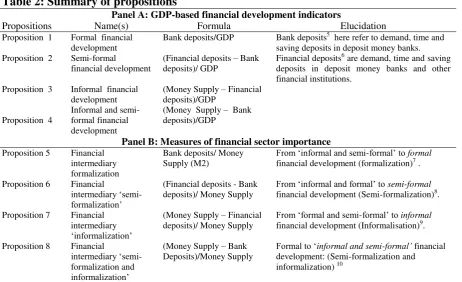
16 4.1 Propositions
Table 2: Summary of propositions
Panel A: GDP-based financial development indicators
Propositions Name(s) Formula Elucidation
Proposition 1 Formal financial development
Bank deposits/GDP Bank deposits5 here refer to demand, time and saving deposits in deposit money banks. Proposition 2 Semi-formal
financial development
(Financial deposits – Bank deposits)/ GDP
Financial deposits6 are demand, time and saving deposits in deposit money banks and other financial institutions.
Proposition 3 Informal financial development
(Money Supply – Financial deposits)/GDP
Proposition 4
Informal and semi-formal financial development
(Money Supply – Bank deposits)/GDP
Panel B: Measures of financial sector importance
Proposition 5 Financial intermediary formalization
Bank deposits/ Money Supply (M2)
From ‘informal and semi-formal’ to formal
financial development (formalization)7 .
Proposition 6 Financial
intermediary ‘semi
-formalization’
(Financial deposits - Bank deposits)/ Money Supply
From ‘informal and formal’ to semi-formal
financial development (Semi-formalization)8. Proposition 7 Financial
intermediary
‘informalization’
(Money Supply – Financial deposits)/ Money Supply
From ‘formal and semi-formal’ to informal
financial development (Informalisation)9.
Proposition 8 Financial
intermediary ‘semi
-formalization and
informalization’
(Money Supply – Bank Deposits)/Money Supply
Formal to ‘informal and semi-formal’ financial
development: (Semi-formalization and informalization) 10
N.B: Propositions 5, 6, 7 add up to unity (one); arithmetically spelling-out the underlying assumption of sector importance. Hence, when their time series properties are considered in empirical analysis, the evolution of one sector is to the detriment of other sectors and vice-versa.
Financial development can either by direct or indirect. Whereas, the former is through
financial markets and the latter is via the banking sector or financial intermediary
development. In this study, we are limited to the latter dimension, which according to Beck et
al. (1999) can be further classified into financial development components of depth (M2),
allocation efficiency11, activity12 and size13. We have already seen that among the indicators,
M2 is the most widely employed in the financial development literature.
5
Lines 24 and 25 of the IFS (October 2008).
6
Lines 24, 25 and 45 of the IFS (2008).
7
In undeveloped countries M2 is not equal to liquid liabilities (liquid liabilities equal bank deposits: bd). Whereas, in undeveloped countries bd/M2<1, in developed countries bd/M2 is almost equal to 1. This indicator measures the rate at which money in circulation is absorbed by the banking system. Financial formalization here is defined as the propensity of the formal banking system to absorb money in circulation.
8
This indicator measures the level at which the semi-formal financial sector evolves to the detriment of formal and informal sectors.
9
This proposition shows the rate at which the informal financial sector is developing at the cost of formal and semi-formal sectors.
10
The proposition appreciates the deterioration of the formal banking sector to the benefit of other sectors (informal and semi-formal). From common sense, propositions 5 and 8 should be perfectly antagonistic, meaning the former (formal financial development at the expense of other sectors) and the later (formal sector deterioration) should display a perfectly negative coefficient of correlation (See Appendix 2). Proposition 7 has a high positive correlation with Proposition 8 and therefore, only the former will be used in the empirical section.
11
17 After decomposing M2 into financial sector components and extending the IFS
financial system definition, propositions in Table 2 from Asongu (2012) are obtained. These
proportions are founded on insufficiencies of the financial system definition presented in
Table 1 and discussed in Section 3.2. Therefore, the previously missing informal financial
sector has been incorporated in Asongu (2012, 2013, 2014a). The author has disentangled the
existing indicator into formal and semi-formal financial sectors. Moreover, the new
measurements proposed could also be used as indicators of financial sector competition. The
following sections discuss recent empirical evidence based on the new financial system
definition and corresponding indicators.
4.2 Recent empirical evidence
4.2.1 Knowledge economy and informal finance
Based on the propositions above, Asongu (2012) has assessed how financial sector
competition plays-out in the development of knowledge economy (KE). He has contributed at
the same time to the macroeconomic literature on measuring financial development and
responded to the growing field of KE by means of informal sector promotion, micro finance
and mobile banking. The study has indeed tested the feasibility of disentangling the effects of
various financial sectors on different components of KE. The variables identified under the
World Bank’s four knowledge economy index (KEI) have been employed in testing three
main hypotheses based on seven propositions in Table 2.
Hypothesis 1: The informal financial sector (a previously missing component in the definition
of the financial system) significantly affects KE. Propositions 3 & 4 have tackled this
hypothesis.
Hypothesis 2: Disentangling different components of the existing measurement (financial
system) into formal (banking) and semi-formal (other financial institutions) sector indicators
12
Private domestic credit.
13
18 could improve understanding of the KE-finance nexus. Propositions 1 & 2 have addressed this
hypothesis.
Hypothesis 3: Introducing measures of sector importance is relevant to understand financial
sector competition in KE 14. Propositions 5, 6 & 7 have examined this hypothesis.
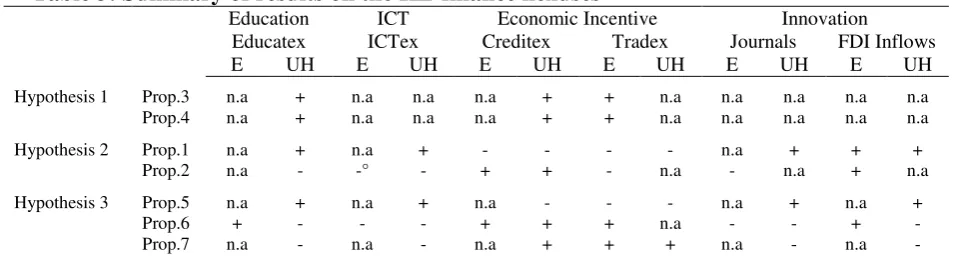
Results summarized in Table 3 below have shown that: (1) the informal financial
sector, a previously missing component in the definition of the financial system by the IMF
significantly affects KE dimensions; (2) disentangling different components of the existing
measurement of the financial system improves dynamics in the KE-finance nexus and; (3)
introduction of measures of sector importance provides relevant new insights into how
financial sector competition affects KE. These finding are broadly consistent with theoretical
[image:19.595.55.534.385.516.2]underpinnings covered in Section 2.1
Table 3: Summary of results on the KE-finance nexuses
Education ICT Economic Incentive Innovation
Educatex ICTex Creditex Tradex Journals FDI Inflows
E UH E UH E UH E UH E UH E UH
Hypothesis 1 Prop.3 n.a + n.a n.a n.a + + n.a n.a n.a n.a n.a Prop.4 n.a + n.a n.a n.a + + n.a n.a n.a n.a n.a Hypothesis 2 Prop.1 n.a + n.a + - - - - n.a + + +
Prop.2 n.a - -° - + + - n.a - n.a + n.a Hypothesis 3 Prop.5 n.a + n.a + n.a - - - n.a + n.a +
Prop.6 + - - - + + + n.a - - + - Prop.7 n.a - n.a - n.a + + + n.a - n.a -
E: Controlling for Endogeneity. UH: Controlling for the Unobserved Heterogeneity. Prop: Proposition. n.a: not applicable due to insignificance of estimated coefficient. °: invalid instruments. Educatex is the first principal component of primary, secondary and tertiary school enrolments. ICTex: first principal component of mobile, telephone and internet subscriptions. Creditex: first principal component of Private credit and Interest rate spreads. Tradex: first principal component of Trade and Tariffs. Results are based on robust panel 2SLS to control for endogeneity and panel fixed effects to control for the unobserved heterogeneity.
4.2.2 Mobile phone penetration and informal finance
In the first macroeconomic empirical assessment of the relationship between mobile
phones and finance, Asongu (2013) has examined the correlations between mobile phone
penetration and financial development using two conflicting definitions of the financial
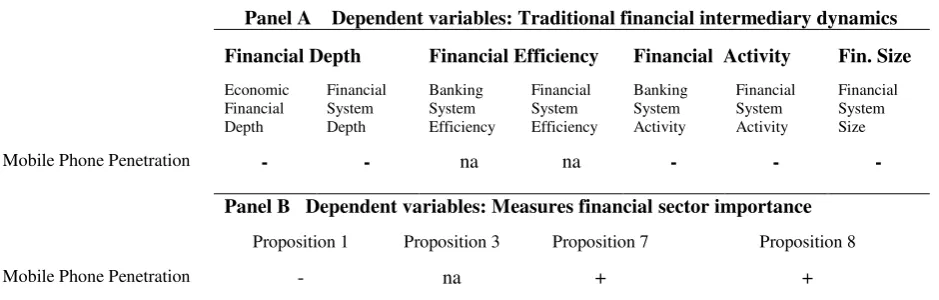
system in the financial development literature. As presented in Table 4 below, with the
traditional IFS (2008) definition, mobile phone penetration has a negative correlation with
14
19 traditional financial intermediary dynamics of depth, activity and size (Panel A). Conversely,
when a previously missing informal-financial sector component is integrated into the
definition, mobile phone penetration has a positive correlation with informal financial
development (Panel B). Three implications have resulted from the findings: there is a growing
role of informal finance; mobile phone penetration may not be positively assessed at a
macroeconomic level by traditional financial development indicators and; it is a wake-up call
for scholarly research on informal financial development indicators which will guide
monetary policy. These finding are broadly in accordance with theoretical underpinnings
[image:20.595.68.538.336.486.2]covered in Section 2.2.
Table 4: Impact of mobile phone penetration on financial development
Panel A Dependent variables: Traditional financial intermediary dynamics
Financial Depth Financial Efficiency Financial Activity Fin. Size
Economic Financial Depth
Financial System Depth
Banking System Efficiency
Financial System Efficiency
Banking System Activity
Financial System Activity
Financial System Size
Mobile Phone Penetration - - na na - - -
Panel B Dependent variables: Measures financial sector importance
Proposition 1 Proposition 3 Proposition 7 Proposition 8 Mobile Phone Penetration - na + +
Fin: Financial. Results are based on cross-sectional OLS with robust HAC standard errors and specified with RAMSEY RESET. n.a: not applicable due to insignificance of estimated coefficient.
4.2.3 Inequality and informal finance
a) From the propositions
In assessing the effects of the propositions on inequality, Asongu (2014a) has tested
the following hypotheses.
Hypothesis 1: The informal financial sector (a previously missing component in the definition
of money supply) is good for the poor.
Hypothesis 2: Disentangling different components of the existing measurement (financial
system) into formal (banking sector) and semi-formal (other financial institutions) financial
20
Hypothesis 3: Introducing measures of sector importance provides interesting dynamics of
financial sector competition in the finance-inequality nexus.
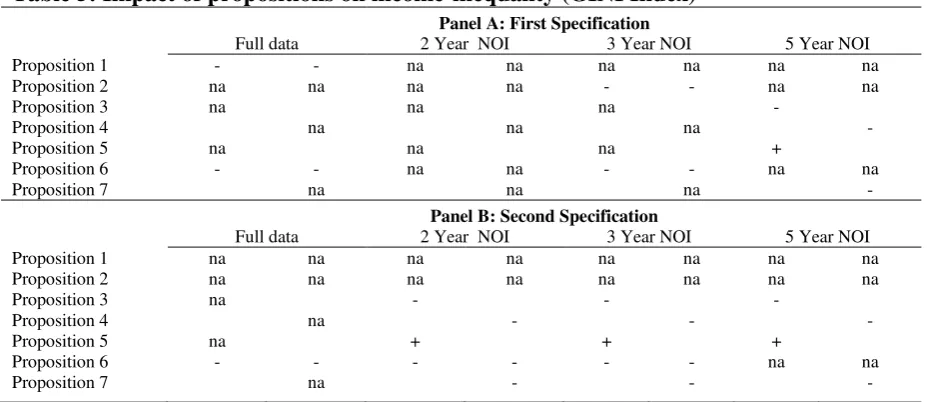
The main finding as summarized in Table 5 shows that, from an absolute standpoint
(GDP base measures), all financial sectors are pro-poor. From specific standpoints, three
interesting findings are drawn from measures of sector importance: (1) the expansion of the
formal financial sector to the detriment of other financial sectors has a disequalizing
income-effect; (2) growth of informal and semi-formal financial sectors at the expense of the formal
financial sector has an income equalizing effect; (3) the positive income redistributive effect
of semi-formal finance in financial sector competition is higher than the corresponding impact
[image:21.595.65.529.357.558.2]of informal finance. These findings broadly corroborate the postulations in Section 2.3.
Table 5: Impact of propositions on income-inequality (GINI Index) Panel A: First Specification
Full data 2 Year NOI 3 Year NOI 5 Year NOI Proposition 1 - - na na na na na na Proposition 2 na na na na - - na na
Proposition 3 na na na -
Proposition 4 na na na -
Proposition 5 na na na +
Proposition 6 - - na na - - na na
Proposition 7 na na na -
Panel B: Second Specification
Full data 2 Year NOI 3 Year NOI 5 Year NOI Proposition 1 na na na na na na na na Proposition 2 na na na na na na na na
Proposition 3 na - - -
Proposition 4 na - - -
Proposition 5 na + + +
Proposition 6 - - - na na
Proposition 7 na - - -
NOI: Non Overlapping Intervals. na: not applicable because of insignificant estimates. Results are based on dynamic system panel GMM. The blank spaces indicate propositions that were not taken into account in the specifications owing to issues of multicolinearity. Different control variables are used in the two specifications.
b) From mobile phone penetration
To provide additional insights into the effect of Propositions 3 & 4 on
income-inequality, Asongu (2015a) has examined how the sentiments and slogans discussed in
Section 2.3 are reflected in the incidence of ‘mobile phone penetration’ on income
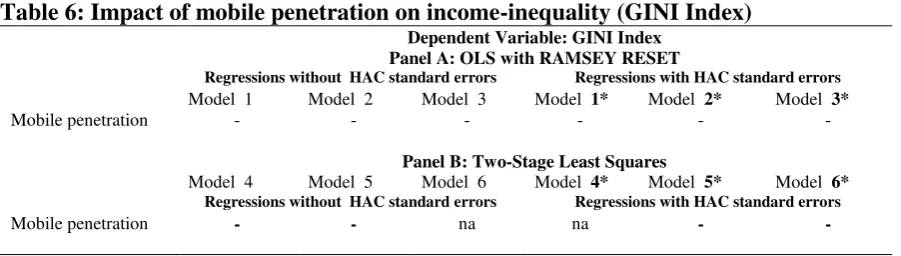
-redistribution in 52 African countries. The findings shown in Table 6 overwhelmingly suggest
-21 oriented poverty reduction channels have already been covered in Section 2.3. The study is
significant because it deviates from mainstream country-specific and microeconomic
survey-based approaches in the literature and provides a macroeconomic assessment of the ‘mobile
[image:22.595.71.522.182.310.2]phone’-inequality nexus.
Table 6: Impact of mobile penetration on income-inequality (GINI Index) Dependent Variable: GINI Index
Panel A: OLS with RAMSEY RESET
Regressions without HAC standard errors Regressions with HAC standard errors
Model 1 Model 2 Model 3 Model 1* Model 2* Model 3*
Mobile penetration - - - -
Panel B: Two-Stage Least Squares
Model 4 Model 5 Model 6 Model 4* Model 5* Model 6* Regressions without HAC standard errors Regressions with HAC standard errors
Mobile penetration - - na na - -
na: not applicable because of insignificant estimates.
5. Conclusion and policy recommendations
In this paper, we have dissected with great acuteness contemporary insufficiencies of
the IFS (2008) definition of the financial system and concluded from sound theoretical
underpinnings and empirical justifications that, the foundation on which it is based, while
solid for developed countries, holds no ground in developing countries. Perhaps one of the
deepest empirical hollows in the financial development literature has been the equation of
financial depth in the perspective of money supply to liquid liabilities. This equation has put
on the margin (and skewed) burgeoning phenomena of mobile banking, knowledge economy
(KE), inequality…etc. We conclude that the informal financial sector, a previously missing
component in the IFS conception and definition of the financial system can only be
marginalized at the cost of misunderstanding recent burgeoning trends in mobile phone
penetration, KE and poverty. Hence, the IFS definition has incontrovertibly fought its final
dead battle and lost in the face of soaring trends highlighted above because, it is inherently
antagonistic and anachronistic. Despite the plethora of econometric and policy-making sins
the definition has committed in developing countries through bias estimates and misleading
22 References
Abu-Bader, S., & Abu-Qarn, A. S., (2008). “Financial Development and Economic Growth: Empirical Evidence from Six MENA countries”, Review of Development Economics, 12(4), pp. 803-817.
Aker, J., & Mbiti, I., (2010). “Mobile Phones and Economic Development in Africa”.
Journal of Economic Perspectives, 24(3), pp. 207-232.
Ang, J. B., & McKibbin, W. J., (2007). “Financial Liberalization, financial sector
development and growth: Evidence from Malaysia”, Journal of Development Economics, 84, pp. 215-233.
Asongu, S. A., (2012). “Financial Sector Competition and Knowledge Economy: Evidence from SSA and MENA Countries”, Journal of the Knowledge Economy
http://link.springer.com/article/10.1007/s13132-012-0141-4
Asongu, S. A., (2013). “How has mobile phone penetration stimulated financial development
in Africa”, Journal of African Business, 14(1), pp. 7-18.
Asongu, S. A., (2014a). “New financial development indicators: with a critical contribution to
inequality empirics”, International Journal of Economic Behavior, 4(1), pp. 33-50.
Asongu, S. A., (2014b). “Liberalization and financial sector competition: a critical
contribution to the empirics with an African assessment”, South African Journal of Economics. http://onlinelibrary.wiley.com/doi/10.1111/saje.12048/abstract
Asongu, S. A., (2014c). “Knowledge economy and financial sector competition in African countries”, African Development Review, 26(2), pp. 333-346.
Asongu, S. A., (2015a). “The impact of mobile phone penetration on African Inequality”,
International Journal of Social Economics: Forthcoming.
Asongu, S. A., (2015b). “Mobile banking and mobile phone penetration: which is more
pro-poor in Africa?”, African Finance Journal: Forthcoming.
Beck, T., Demirgüç-Kunt, A., & Levine, R., (1999). “A New Database on Financial
Development and Structure”, Financial Sector Discussion Paper No. 2.
Chandra, D. S., & Yokoyama, K., (2011). “The role of good governance in the knowledge -based economic growth of East Asia – A study on Japan, Newly Industrialized Economies,
Malaysia and China”, Graduate School of Economics, Kyushu University.
Demetriades, P. O., & Hussein, K. A., (1996). “Does Financial Development Cause Economic Growth? Time-Series Evidence from Sixteen Countries,” Journal of Development Economics, 51, pp. 387-411.
Demombynes, G., & Thegeya, A., (2012, March). Kenya’s Mobile Revolution and the
23 Gries, T., Kraft, M., & Meierrieks, D., (2009). “Linkages between financial deepening, trade openness, and economic development: causality evidence from Sub-Saharan Africa”, World Development, 37(12), pp. 1849-1860.
IMF (2008, October). “International Financial Statistics Yearbook, 2008”, IMF Statistics
Department.
Ivatury, G., & Mas, I., (2008). The early experience with branchless banking. Washington, DC:CGAP.
Ivatury, G., & Pickens, M., (2006). Mobile phone banking and low-income customers: Evidence from South Africa. Washington, DC: Consultative group to assist the poor (CGAP) andthe United Nations Foundation.
Jonathan, D., & Camilo, T., (2008). “Mobile banking and economic development: Linking adoption, impact and use”. Asian Journal of Communication, 18(4), pp. 318-322.
Kumbhakar, S. C. & Mavrotas, G., (2005). “Financial Sector Development and Productivity
Growth”. UNUWIDER Research Paper: 2005/68, World Institute for Development Economics Research at the United Nations University.
King, R. G., & Levine, R., (1993). “Finance and Growth: Schumpeter Might Be Right”,
Quarterly Journal of Economics, 108, pp. 717-737.
Mas, I., & Radcliffe, D., (2011). Mobile Payments Go Viral: M-PESA in Kenya.
Capco Institute’s Journal of Financial Transformation, No. 32, p. 169, August 2011
YES AFRICA CAN: SUCCESS STORIES FROM A DYNAMIC CONTINENT, P. Chuhan-Pole and M. Angwafo, eds., World Bank, August 2011.
Mbiti, I., & Weil, D. N., (2011, June). “Mobile Banking: The Impact of M-Pesa in Kenya”.
NBER Working Paper No.17129.
Neville, W., (2006). “Micro-payment systems and their application to mobile networks”. Washington, D.C: infoDev/World Bank. Available at:
http://www.infodev.org/en/Publication.43.html.
Ondiege, P., (2010). “Mobile Banking in Africa: Taking the Bank to the People”. Africa Economic Brief, 1(8), pp. 1-16.
Porteous, D., (2007). Just how transformational is m-banking? Retrieved 10 January, 2008, http://www.finmarktrust.org.za/accessfrontier/Documents/transformational_mbanking.pdf
Steel, W. F., 2006. “Extending Financial Systems to the poor: What strategies for Ghana”, Paper presented at the 7th ISSER-Merchant Bank Annual Economic Lectures, University of Ghana, Legon.
Tchamyou, S. V., (2014). “The Role of Knowledge Economy in African Business”, HEC-Ulg University of Liege.
The Economists (2008). Halfway There: How to promote the spread of mobile phones among
24 The World Bank (2007). Building Knowledge Economies. Advanced Strategies for Development. World Bank Institute Development Studies. Washington DC.
Vaughan, P. (2007). Early lessons from the deployment of M-PESA, Vodafone‟s own mobile transactions service. In D. Coyle (Ed.), The transformational potential of m-transactions (pp. 6-9). London: Vodafone Group.