that the corresponding crest factors are bounded by 3 dB, which corresponds to the crest factor of a single sine wave. This low crest factor resulted in a lower power loss and a lower out-of-band power spectrum due to clipping when the time-domain signal was subjected to a typical nonlinear power amplifier, in comparison to those of Walsh code and orthogonal Gold code-spread MC-CDMA signals.
Index Terms—Complementary set, crest factor (CF), Golay codes, multicarrier code-division multiple-access (MC-CDMA), Shapiro–Rudin sequence, subcomplementary set.
I. INTRODUCTION
T
HE fundamental problem of reducing the dynamic range of the sum of trigonometric series has been studied in numerous fields, such as in mathematics [1], [2], in radar engi-neering [3], [4], in measurement science [5], and in the context of orthogonal frequency-division multiplexing (OFDM) [6]. As a result, various binary and polyphase codes, such as Barker codes [7], Shapiro–Rudin sequences [1], Frank codes [8], Newman phases [2], Schroeder phases [9], and Zadoff–Chu codes [10], [11] have been investigated in order to arrive at a low crest factor.The crest factors of multicarrier code-division multiple-ac-cess (MC-CDMA) [12], [13] signals have also been studied in [14] and [15], where each user is assigned a different subcarrier offset. The envelope power of the multicode MC-CDMA signal was also analyzed in [16] and it was shown that the combined aperiodic correlation properties of the spreading sequences em-ployed characterize the envelope power, which can be viewed as a direct extension of Schroeder’s early findings [9] in the context of a single-code scenario. A desirable set of spreading sequences designed for multicode MC-CDMA is expected to exhibit low values of aperiodic correlations, while exhibiting orthogonality between the sequences. While investigating the crest factor properties of multicode MC-CDMA employing various spreading sequences, it was found in [16] that the crest factors of multicode MC-CDMA employing Walsh codes can
Manuscript received November 17, 2001; revised May 20, 2002; accepted June 4, 2002. The editor coordinating the review of this paper and approving it for publication is C. Tellambura.
The authors are with the Department of Electronics and Computer Sci-ence, University of Southampton, Southampton SO17 1BJ, U.K. (e-mail: [email protected]).
Digital Object Identifier 10.1109/TWC.2003.819040
resulted in considerably lower crest factors. Even though Zadoff–Chu codes indeed do produce an ideal crest factor of less than 3 dB in the context of single-code MC-CDMA, the crest factor values of neither Zadoff–Chu codes, Frank codes, nor those of OGold codes are bounded by 3 dB in the context of two- and four-code-based MC-CDMA. It is widely recognized that complementary sequences, also known as Golay codes [17], produce crest factors bounded by 3 dB [18], [19], when they are applied to single-code MC-CDMA as in our context of interest [20], [21]. Ochiai and Imai [21] also reported that the employment of orthogonal complementary sequences in the context of multicode MC-CDMA resulted in low crest factors, which was shown using simulation studies. However, the crest factor properties of Shapiro–Rudin-based codes in the context of two- and four-code MC-CDMA signal have not been documented in the literature to the best of our knowledge.
In this letter, we characterize the advantageous crest factor (CF) properties of three complementary-sequence-based spreading sequences [17], namely those of a complemen-tary-sequence pair [17], a complemencomplemen-tary-sequence-based subcomplementary pair [3], and those of a Sivaswamy’s com-plementary set [3], in the context of both two- and four-code binary phase-shift keying (BPSK) modulated MC-CDMA schemes in order for transmitting two and four bits simultane-ously. The scenario investigated can also be encountered in the context of multipulse radar signals [4].
The letter is organized as follows. Section II introduces the multicode MC-CDMA system model considered. Section III presents the crest factor properties of three complementary-se-quence-based spreading sequences. The effects of clipping in terms of the output power reduction and the out-of-band spu-rious power of multicode MC-CDMA signals employing com-plementary-sequence-based spreading sequences are presented in Section IV in comparison to those of other spreading se-quences, followed by our conclusions in Section V.
II. SYSTEMMODEL ANDENVELOPEPOWER
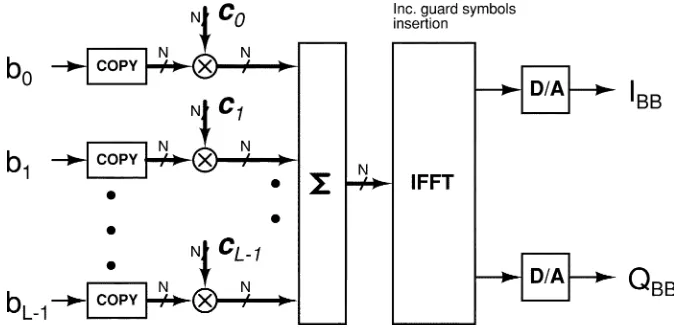
The simplified transmitter structure of the multicode MC-CDMA system considered is portrayed in Fig. 1. Each of the number of input bits is spread with the aid of an -chip spreading code selected from the
set . Then the resultant number of
modulated spreading codes are superimposed and each of
Fig. 1. Multicode MC-CDMA transmitter schematic.
the composite chips is mapped to one of the subcarriers. Finally, -point inverse fast Fourier transform (IFFT)-based modulation is used for generating the modulated in-phase ( ) and quadrature-phase ( ) signals of Fig. 1. The system model described above may correspond to the downlink scenario of an MC-CDMA base station or to the uplink scenario of mobiles transmitting multiple bits combined with time-division multiple-access or orthogonal frequency-division multiple-ac-cess. Although the attractive family of quadrature amplitude modulation schemes [22] can be readily used for generating the information symbols from the source data bits, here we limit the symbol mapping scheme to BPSK. Furthermore, we limit our choice of the spreading sequences to those having elements satisfying . The normalized complex envelope of a BPSK modulated multicode MC-CDMA signal may be represented for the duration of a symbol period as
(1)
where is the number of simultaneously transmitted symbols and is the subcarrier separation parameter [12] invoked for mapping the -chip spread information symbol to subcar-riers that are sufficiently far apart in the frequency domain, in order to experience independent fading of the different subcarriers.
The CF of the multicode MC-CDMA signal is defined as the ratio of the peak to the root mean square amplitude [18]
(2)
where and
. The CF values are often represented in terms of decibels as . Sometimes the peak factor (PF) or peak-to-mean envelope power ratio (PMEPR) is used instead of the CF, which
are defined as .
III. COMPLEMENTARY SEQUENCE-BASED
SPREADINGSEQUENCES
Let us denote the -transform of a sequence as , which is de-fined as . Then, we can readily verify
that , where is
the aperiodic crosscorrelation between the sequences and
, defined as . When
the two sequences are identical, i.e., we have , the -transform of the corresponding autocorrelation function can be represented as . Then, a pair of equally long sequences is said to be a complementary pair, if and only if [17], [19]
(3)
on the boundary of the unit disc in the complex plane, i.e., at .
A. Two-Code Case
Let and be two spreading sequences of length , em-ployed for transmitting the information bits and , respec-tively. Then, the normalized complex envelope of the BPSK modulated two-code MC-CDMA signal of (1) can be expressed as
(4)
(5)
where the superscript in was used for denoting the number of simultaneously transmitted codes and we
used .
Lemma 1: The crest factor of the two-code BPSK
MC-CDMA signal employing a complementary pair of sequences as its spreading sequence is bounded by 3 dB.
Proof: Let and be the pair of complementary se-quences of length . Then, the envelope power of given in (5) can be expressed as
(6)
by 6 dB in the same scenario as that in Lemma 1.
Sivaswamy introduced subcomplementary sequences in the context of radar signal design [3]. A pair of sequences of length , , is referred to as a subcomplementary pair, if the sum of their aperiodic autocorrelations is zero for
. A method of constructing subcomplementary pairs was also given in [3] as follows. Let be an arbitrary sequence of length . Then, a subcomplementary pair of sequences and is constructed as [3]
(8)
where denotes a concatenated sequence of the two identical sequences , while represents a negated version of the orig-inal sequence . Sivaswamy’s subcomplementary pairs exhibit similar crest factor characteristics to those of the complemen-tary-sequence pair in the context of two-code BPSK modulated MC-CDMA systems.
Lemma 2: If we apply a complementary sequence [17] of
length as the base sequence , then the subcomplementary pair [3] and of (8) produces a crest factor of less than or equal to 3 dB, provided that they are applied in two-code BPSK modulated MC-CDMA systems.
Proof: The -transforms of and can be expressed as
(9)
(10)
where is the -transform of a complementary sequence of length . Hence, of (5) is given as
(11) when
otherwise. (12)
The envelope power , evaluated at , is given as
(13)
where we exploited the fact that on [19]. Hence, the corresponding PF is bounded by two.
1The authors would like to thank Prof. C. Tellambura for pointing out this
extension.
where, again, the superscript denotes the number of simulta-neously transmitted codes and we used .
Tseng and Liu [23] introduced a wider range of complemen-tary sets of sequences. A set of sequences of equal length is said to be a complementary set, if the sum of autocorrelations of all the sequences in the set is zero, except for the peak term at the zero-shift position [23]. Sivaswamy [3] proposed a method for constructing a complementary set of number of sequences of length , where and is the length of the base com-plementary pair. When , we can obtain a complementary set of four sequences of length from a base complementary pair and of length using the following method [3]:
(15)
Lemma 3: If we apply a pair of complementary sequences
[17] of length as the base sequences and , the set of four complementary sequences, given by (15), produces a crest factor of less than or equal to 3 dB, provided that the sequences , , , and are applied to four-code BPSK modulated MC-CDMA systems.
Proof: The corresponding -transforms of the spreading
sequences employed can be expressed as
(16)
(17)
(18)
(19)
Upon substituting (16) – (19) into (14), we have four possible expressions of depending on the four information bits, which are given as
when and
when and
when and
when and .
(20)
Considering that the length of the sequences and is , it can be readily shown that the corresponding envelope power satisfies
(21)
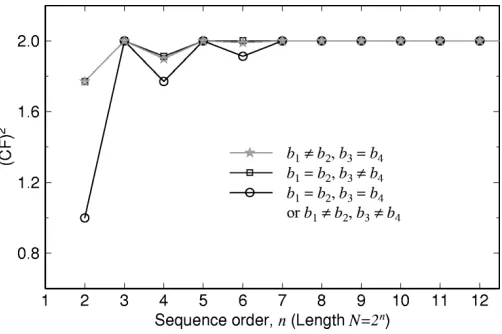
Fig. 2. Crest-factors of Sivaswamy’s complementary set of sequences. The number of simultaneously used sequences isL = 4 and the sequence length of
N = 2 is between 2 = 4 and = 2 = 8192.
. Since the average power of is , the PF is bounded by two.
Fig. 2 depicts the PFs of some of Sivaswamy’s complemen-tary sets constituted by sequences, where the oversam-pling factor of eight was employed to calculate accurate PF values [24]. Depending on the relationship between the mes-sage sequences depicted in (20), the corresponding crest factors exhibit three different values, as seen in Fig. 2. Half the number of the message sequences belong to the case represented by the marker “ ” and a quarter to those denoted by each of the marker “ ” and “ .” We can observe in Fig. 2 that the PFs associated with the marker “ ” are the lowest among the three values, when the sequence length is , , or . An ideal PF of one was achieved for the sequence length of , rep-resenting a constant power envelope. The fact that all the crest factors in Fig. 2 are bounded by 3 dB corroborates Lemma 3.
It remains, however, an open question, whether there exists a large set of complementary spreading sequences, where the number of codes is higher than four, exhibiting low crest factors. For example, we can construct a set of eight orthog-onal subcomplementary sequences from the Kronecker product of base complementary sequences and a 4 4 Walsh matrix [4]. However, the corresponding maximum PF of BPSK mod-ulated eight-code MC-CDMA was 3.49, which is considerably higher than that of the best-case Walsh code spread MC-CDMA scheme, as seen in Fig. 3. In fact, Walsh spreading codes rep-resented by the 16 16 Walsh–Hadamard matrix constitute an orthogonal complementary set [4]. As the number of codes increases in multicode MC-CDMA, the interaction of the mes-sage bits with the pair-wise crosscorrelation property of the se-quences becomes complex [16]. Hence, it becomes an arduous task to arrive at a predictable behavior in terms of the corre-sponding envelope power.
IV. EFFECTS OFCLIPPING
In the previous section, we observed that two- and four-code BPSK modulated MC-CDMA signals employing complemen-tary-sequence-based spreading sequences result in low values of the corresponding crest factor, which are bounded by 3 dB. Some of the practical consequences of this low crest factor will
Fig. 3. Maximum PF (CF ) when using various spreading codes for BPSK modulated multicode MC-CDMA. The spreading factor was
N = 16. The markers “?” represent the corresponding maximum PFs of
complementary-sequence-based spreading sequences investigated.
be investigated here in comparison to other sequences used for spreading MC-CDMA signals. When they are subjected to non-linear amplification, they produce spurious out-of-band emis-sions. The extreme peaks of the signal inevitably suffer from so-called “clipping effects,” when they enter the saturation re-gion of the amplifier, resulting in the loss of effective transmis-sion power as well as in signal distortion unless the gain of the amplifier is reduced to a level, where the amplifier’s maximum output level is sufficiently high for the signal peaks not to be clipped. Many portable wireless devices use solid-state power amplifiers (SSPA). The amplitude transfer characteristics or the amplitude modulation–amplitude modulation curve of an SSPA can be modeled as [25], [26]
(22)
where is the input magnitude and is the smoothness factor during its transition from the linear region to the saturation re-gion. Considering that the output power of typical SSPAs at the 1-dB compression point is about 0.7 dB below the satura-tion power, the value of the smoothness factor in (22) becomes
.
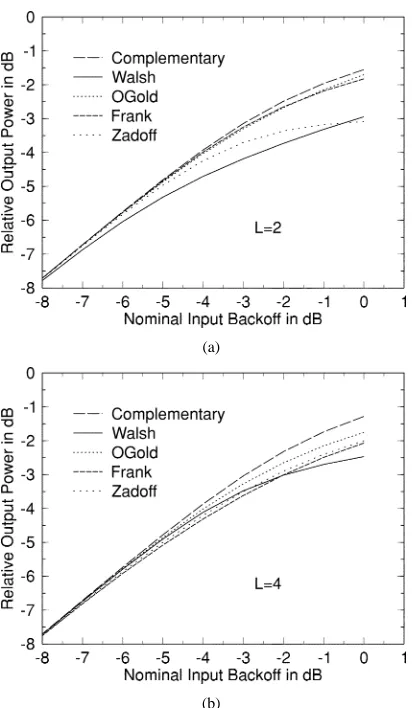
The power loss due to the above-mentioned “clipping effects” of the nonlinear amplifier model of (22) can be observed in Figs. 4 and 5. For the two-code BPSK modulated MC-CDMA schemes characterized in Fig. 4(a), the MC-CDMA signal em-ploying a complementary pair of sequences showed the lowest power loss of 1.6 dB for the set of five different spreading codes investigated. A pair of OGold codes and a pair of Frank codes also exhibited a similar behavior, showing an associated power loss of 1.7 and 1.8 dB, respectively. Finally, the Walsh codes and Zadoff–Chu codes exhibited a high power loss of around 3 dB at 0-dB input backoff. The spreading code pairs were selected on the basis of maintaining the lowest crest-factors for each family of spreading codes.
[image:4.612.41.292.60.227.2](a)
[image:5.612.62.268.57.411.2](b)
Fig. 4. Relative output power versus input backoff in multicode BPSK modulated MC-CDMA employing various spreading codes of lengthN = 16.
Fig. 5. Relative output power versus input backoff in four-code BPSK modulated MC-CDMA employing OGold codes and Sivaswamy’s complementary set of sequences having the length ofN = 16.
1.8 dB for OGold codes, 2.0 dB for Zadoff–Chu codes, 2.1 dB for Frank codes, and 2.5 dB for Walsh codes. Considering that the best combination of Walsh codes exhibited a lower max-imum CF than that of the OGold codes, as seen in Fig. 3, the Walsh-code-related high power loss is surprising. This implies that the Walsh-spread four-code MC-CDMA signal still exhibits a relatively poor magnitude distribution.
V. CONCLUSION
The advantageous crest factor properties of complementary sequences recorded in the context of single-code MC-CDMA as well as OFDM have been widely recognized. In this letter, the crest factor values of two- and four-code BPSK modulated MC-CDMA signals employing three different complementary-sequence-based spreading sequences, namely a complementary pair, a complementary code-based sub-complementary pair and one of Sivaswamy’s sub-complementary sets, were shown to be bounded by 3 dB, regardless of the sequence length. It was demonstrated that the corresponding low crest factor of the MC-CDMA signal employing comple-mentary-sequence-based spreading sequences, in comparison to Walsh- and OGold-spread MC-CDMA signals, is practically important, since signals exhibiting a low crest factor result in lower power loss and lower out-of-band emissions, when the signal is subjected to nonlinear amplification. However, the investigated scenario is limited to two- and four-code-based MC-CDMA signals employing BPSK modulation, and hence, further research efforts are required for finding a sufficiently large set of spreading sequences having desirable crest factor properties.
ACKNOWLEDGMENT
The authors would like to thank the anonymous reviewers for their valuable suggestions. Furthermore, the authors are partic-ularly grateful to Prof. C. Tellambura for suggesting elegant and simple proofs of Lemmas 1–3, which substantially improved the presentation of the letter.
REFERENCES
[1] W. Rudin, “Some theorems on Fourier coefficients,” in Proc. Ame.
Math-ematics Society, vol. 10, Dec. 1959, pp. 855–859.
[2] D. J. Newman, “AnL extrimal problem for polynomials,” in Proc.
Ame. Mathematics Society, vol. 16, Dec. 1965, pp. 1287–1290.
[3] R. Sivaswamy, “Digital and analog subcomplementary sequences for pulse compression,” IEEE Trans. Aerosp. Electron. Syst., vol. AES-14, pp. 343–350, Mar. 1978.
[4] F. F. Kretschmer, Jr. and K. Gerlach, “Low sidelobe radar waveforms derived from orthogonal matrices,” IEEE Trans. Aerosp. Electron. Syst., vol. 27, pp. 92–101, Jan. 1991.
[5] E. Van der Ouderaa, J. Schoukens, and J. Renneboog, “Peak factor min-imization using a time-frequency domain swapping algorithm,” IEEE
Trans. Instrum. Meas., vol. 37, pp. 145–147, Mar. 1988.
[image:5.612.53.276.452.621.2][7] R. H. Barker, “Group synchronizing of binary digital systems,”
Commun. Theory, pp. 273–287, 1953.
[8] R. L. Frank, “Polyphase codes with good nonperiodic correlation prop-erties,” IEEE Trans. Inform. Theory, vol. IT-9, pp. 43–45, Jan. 1963. [9] M. R. Schroeder, “Synthesis of low-peak-factor signals and binary
se-quences with low autocorrelation,” IEEE Trans. Inform. Theory, vol. IT-16, pp. 85–89, Jan. 1970.
[10] D. C. Chu, “Polyphase codes with good periodic correlation properties,”
IEEE Trans. Inform. Theory, vol. IT-18, pp. 531–532, July 1972.
[11] R. L. Frank, “Comments on polyphase codes with good correlation prop-erties,” IEEE Trans. Inform. Theory, vol. IT-19, p. 244, Mar. 1973. [12] N. Yee, J. P. Linnartz, and G. Fettweis, “Multicarrier CDMA in indoor
wireless radio networks,” in Proc. PIMRC, 1993, pp. 109–113. [13] K. Fazel and L. Papke, “On the performance of convolutionally-coded
CDMA/OFDM for mobile communication system,” in Proc. PIMRC, 1993, pp. 468–472.
[14] V. Aue and G. P. Fettweis, “Multicarrier spread spectrum modulation with reduced dynamic range,” in Proc. VTC, Apr./May 1996, pp. 914–917.
[15] B. M. Popovic´, “Spreading sequences for multicarrier CDMA systems,”
IEEE Trans. Commun., vol. 47, pp. 918–926, June 1999.
[16] B. J. Choi, E. L. Kuan, and L. Hanzo, “Crest-factor study of MC-CDMA and OFDM,” in Proc. VTC (Fall), 1999, pp. 233–237.
[17] M. J. E. Golay, “Complementary series,” IRE Trans. Inform. Theory, vol. IT-7, pp. 82–87, Apr. 1961.
[18] S. Boyd, “Multitone signals with low crest factor,” IEEE Trans. Circuits
Syst., vol. CAS-33, pp. 1018–1022, Oct. 1986.
[19] B. M. Popovic´, “Synthesis of power efficient multitone signals with flat amplitude spectrum,” IEEE Trans. Commun., vol. 39, pp. 1031–1033, July 1991.
[20] T. F. Ho and V. K. Wei, “Synthesis of low-crest waveforms for multicar-rier CDMA system,” in Proc. GLOBECOM, 1995, pp. 131–135. [21] H. Ochiai and H. Imai, “OFDM-CDMA with peak power reduction
based on the spreading sequences,” in Proc. ICC, 1998, pp. 1299–1303. [22] L. Hanzo, W. T. Webb, and T. Keller, Single- and Multi-carrier
Quadra-ture Amplitude Modulation. New York: IEEE Press–Wiley, 2000. [23] C.-C. Tseng and C. L. Liu, “Complementary sets of sequences,” IEEE
Trans. Inform. Theory, vol. IT-18, pp. 644–652, Sept. 1972.
[24] C. Tellambura, “Computation of the continuous-time PAR of an OFDM signal with BPSK subcarriers,” IEEE Commun. Lett., vol. 5, pp. 185–187, May 2001.
[25] E. Costa, M. Midrio, and S. Pupolin, “Impact of amplifier nonlinearities on OFDM transmission system performance,” IEEE Commun. Lett., vol. 3, pp. 37–39, Feb. 1999.
[26] G. Santella and F. Mazzanga, “A model for performance evaluation in M-QAM-OFDM schemes in presence of nonlinear distortions,” in Proc.