http://dx.doi.org/10.4236/ijcns.2015.87025
PAPR Reduction Based on Proposed
Rotating Phase Shift Technique
in MC-CDMA Using FPGA
Ali Kareem Nahar
1,2, Kamarul H. Bin Gazali
11Faculty of Electrical and Electronic Engineering, University Malaysia Pahang, Pekan, Malaysia 2Department of Electrical Engineering, University of Technology, Baghdad, Iraq
Email: [email protected]
Received 17 June 2015; accepted 14 July 2015; published 17 July 2015
Copyright © 2015 by authors and Scientific Research Publishing Inc.
This work is licensed under the Creative Commons Attribution International License (CC BY). http://creativecommons.org/licenses/by/4.0/
Abstract
FPGA implementation used of Rotating phase shift (RPS) for peak-to-average power ratio (PAPR) reduction in Multi Carrier Code Division Multiple Access (MC-CDMA) signals. Because, MC-CDMA is still suffering from PAPR which is a major drawback in most of the multi carrier communication systems. In addition, the implementation of the system in an FPGA becomes more flexible and scalable. It eliminates the search for optimum phase factors from a given set, which manifests im-proved PAPR at reduced computational complexity as compared to conventional PTS and SLM. The amplitude of the signal is reduced by rotating each of the partially transmitted sequence anti- clockwise by a π/2 degree and the peak power is reduced by circularly shifting the quadrature component of the partially transmitted sequence after phase rotation. A brief description of PTS, SLM is compared with the RPS, which best reduces PAPR from PTS and SLM. It is also presented that VHDL code of the RPS is designed by Xilinx ISE 14.1 implements of FPGA. The peak-to-average power ratio performance of the proposed method has been investigated.
Keywords
MC-CDMA, PAPR, RPS and FPGA
1. Introduction
The 4G wireless technology has approved MC-CDMA transmission supporting high data rate communications
MC-CDMA systems are facing problems cast by PAPR due to the nature of the multicarrier OFDM and CDMA
[3]. The high PAPR drives the power amplifier to operate in the nonlinear area that causes distortions between inter-modulation and out-of-range radiation. Therefore, it is highly essential to reduce PAPR. In addition, sever-al techniques have been proposed like clipping and filtering, coding, active constellation extension, Tone Injec-tion (TI), Tone ReservaInjec-tion (TR), partial transmit sequence (PTS), and selected mapping (SLM) [4]. Among all these approaches, SLM is considered to be appropriate to reduce the PAPR, whereas its computational complex-ity is very high [5] [6].
In [7], the authors have proposed a lower complexity PAPR reduction scheme, which at the transmitter side a single IFFT block is used without any sub-block partitioning or phase factors. FPGA implementation of DS-CDMA transmitter has been proposed in [8], which research complicated two phases—simulation and thesis of the Verilog codes. The Xilinx Synthesis Technology (XST) of Xilinx ISE 12.3 tool was used for syn-thesis of the transmitter and simulates a design’s reaction to different stimuli. In [9], the authors suggested a low complexity PTS, which includes cyclic shifting of time domain sequences and combining them which leads to reduced computational complexity. In addition, Low Complexity VLSI Architecture for DS-CDMA Communi-cation System uses FPGA [10]. In [11], the error control code makes each sequence more random and reduces the probability of in phase addition of sub-carriers by interleaved. Thus, it is an improved SLM method with n-tuple PAPR control bits followed by an interleaved and an error control code. The PAPR reduction in the MC-CDMA system increases the probability of PAPR reduction.
In this present paper, the use of phase factors is eliminated, which is originally employed in SLM and PTS, by introducing the method of rotating each time domain sub-block symbol by a predetermined degree and circular shifting of partially transmitted quadrature phase components. Moreover, the Very High Speed Integrated Cir-cuits Hardware Description Language (VHDL) implementation of Rotating Phase shifted technique is achieved where parallel processing of symbols is carried out instead of serial processing. Furthermore, the multiplicative complexity is reduced by shift-and-add algorithm. VHDL implementation of PAPR calculation is also per-formed which provides the PAPR of the respective symbol transmitted.
This paper is organized as: Section 2 discussed a brief review of PAPR in MC-CDMA system. It proposed method Rotating Phase Shift display in Section 3. In Section 4, RPS-PAPR is implemented in Xilinx ISE 14.1 using VHDL. Finally, results of simulation performed are provided in Section 5. Section 6 presents the con-cluding remarks.
2. The PAPR of an MC-CDMA Signal
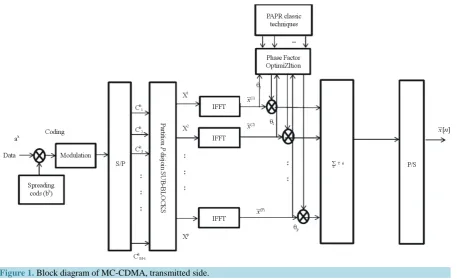
The MC-CDMA is a multi-carrier transmission, which has a high data rate and greater flexibility for voice, data, and video and internet services for future wireless systems. This is multiplied by the first of the original data load, with the spreading code and then the chips of spread data are modulated onto orthogonal subcarriers [12]. Figure 1 shows the MC-CDMA signal generation in transmitting side of a complex data symbol an assigned to user h. In the transmitter of data symbol ah is first multiplied with the user specific spread code by =
T 1, 2, , 1
h h h
M b b b −
of spread factor M. The spread code ch obtained after spreading can be given in vector scheme as:
T 1, 2, , 1
h h h h h h
M
c =a b = C C C − (1)
The ch is converted to parallel h m
C , where m=0,1,,M −1, and modulated onto M subcarriers followed by IDFT of size N = ×1 M to obtain a multi-carrier spread spectrum signal. A time domain baseband trans-mission signal xh
( )
t , after IDFT, for one MC-CDMA symbol, 0≤ ≤t Ts , has:( )
2π( 1)1 1 e
s
M H j m t T
h h h
m
m h
x t =
∑ ∑
= =a b − (2)where Ts is the MC-CDMA symbol period and H the total number of users.
Formerly, the PAPR [13] of MC-CDMA signals x t
( )
is defined as the ratio between the maximum instan-taneous power and average output power( )
{ }
2 0 1 peack 2 average maxPAPR n m
x P
P E x
≤ ≤ −
Figure 1. Block diagram of MC-CDMA, transmitted side.
average
P can be calculated as:
( )
2 1{
( )
2}
average 0 0 1
1 1
d s
T N H h
n h
s
P x t t E x n
T N
−
= =
=
∫
=∑
∑
(4)where N is the number of sub-carriers and E
{}
. denotes expectation. Also, PAPR in the discrete time domain can be expressed as:( ) ( )
max 10
PAPR =10 log N dB (5)
As one of the characteristics of the PAPR, which bears stochastic characteristics in MC-CDMA systems, of-ten can be expressed in terms of Complementary Cumulative Distribution Function (CCDF). Which is described as the probability of the PAPR exceeding a certain level w [14] [15], that can calculate as:
(
)
{
}
(
)
CCDF PAPR =prob PAPR>w = − −1 1 e−w N (6)
where, N total number of sub-carrier and w is the level of exceed.
3. Proposed Method
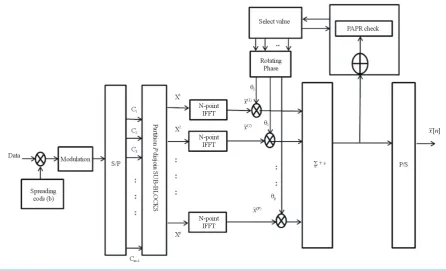
RPS takes away the use of phase factors and reduces PAPR. After multiple data by spreading code, then mod-ulation, the data symbols are partitioned into sub-blocks which generate the frequency domain symbols [16]. These frequency domain symbols are converted to time domain symbols by N-point IFFT operation on each sub-block. Figure 2 shows the block diagram of the transmitter system of proposed RPS-PAPR. Now, instead of combining phase factor and the rotation phase of the work in phase and beating by rotating phase is employed, to suppress the amplitude of a signal. Phase rotation adjusts the amplitude of the samples, but the power of the samples has not changed. Moreover, the quadrature components of the output samples of symbols after rotation stage and turned carousel by the equation of shift where the transformation of each quadrature component p times. In a joint operation of the phase rotation and circular shift results in reducing PAPR.
Figure 2. Bloc diagram of the MC-CDMA with RPS PAPR reduction technique.
then multiplied by a valid phase shift θ=
[
θ θ1, 2,,θP+1]
chosen from a given symbols ξ, that is generally{ }
1 or{
1, j}
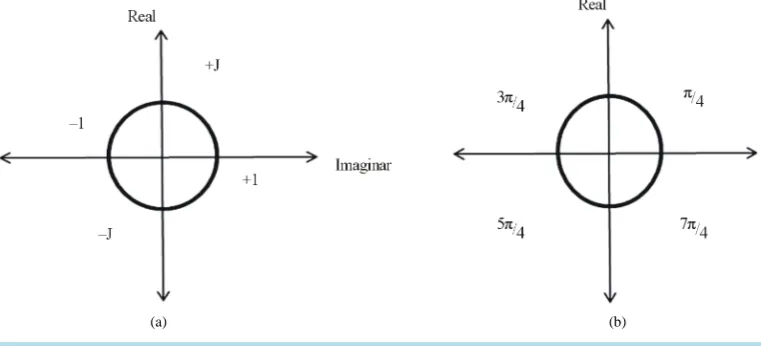
ξ = ± ξ = ± ± , where ξ the rotating facto. Also can be shifted the phase on the circumference of a circle to any value such as π 4 that is shown in Figure 3. Similarly, this results in a rotating MC-CDMA sig-nal vector xw = x x0w 1wxNw−1T given as
1
P
w w
p p p
x =
∑
= r x (7)where,
1
1 2 , 1 , and
p
w w w w
p
r =r r r ≤ ≤w W W =
ξ
+ (8)The PAPR of xw is computed for rotating vectors and compared, which has the minimum PAPR is selected for transmission. The index w of the corresponding rotating vector rw is selected according to
1 0 1 1 ,
arg min w Wmax n N Pp pw p n
w = ≤ ≤ ≤ ≤ −
∑
= r x(9)
The receiver must know the index information to recover the original input vector. The PAPR reduction per-formance and the computational complexity of the RPS structure depend on the method of sub-block separating. Furthermore, a search is a strategy that works well on optimization problems with the minimize PAPR show in Algorithm. 1 the search algorithm For algorithm, let X be the MC-CDMA signal and θ be a set of valid phase shifts [17].
Algorithm 1: GVS Search
Let: θ=
{
θ θ1, 2,,θP}
be phase at partition limit. Require: X >0,P>0,k>0,ϕ>0;
Inialize: xop
( )
t =X[ ]
0 ;θ ϕ= M,Rm =0. For p=1:P do
[ ]
[ ]
, 1 1, ,0, otherwise
p p
p
X n n r r
X n = = − +
• For m=1:M do
(
)( )
1 1 1 2 p p m m r rR + =R + + −
[ ]
[ ]
e 1 ;m p m m m R j R R m p p
X n X n
θ ϕ + + − =
• IF n<rp then
( )
( )
0
m m
p x t =ifft X
• Else empty Rm+1, otherwise n
• End
( )
( )
(
)
(
)
1: 0
arg min Max m ;
op m M t op
m = = ≤ ≤τ x t +x t
( )
( )
mop( )
;op op
x t =x t +x t
1 op;
P P m
θ =θ − +ϕ
End
Return xop
( )
t , ,θ RmIn addition, to define the effect of each factor is compared to the performance of the RPS algorithm by select-ing one of the factors are constant and change the rest of the factors in order to measure the effectiveness of that factor in the reduction of PAPR and then change with all cases the same method and each parameter triple
(
NR,Zθ,Rph)
. As a zero phase shift is always one of the valid phase shifts, the relationship of these factors canbe defined as:
2 1 R N ph R Z R N θ ξ − =
(10)
where NR is the number of valid phase shifts, ξ the rotating factor Rph the rotate a range of possible phase shifts, M number of partition phase and Z∅ the step size of the phase shifts. Phase delay values for RPS algo-rithm are in
(
Rph, 0)
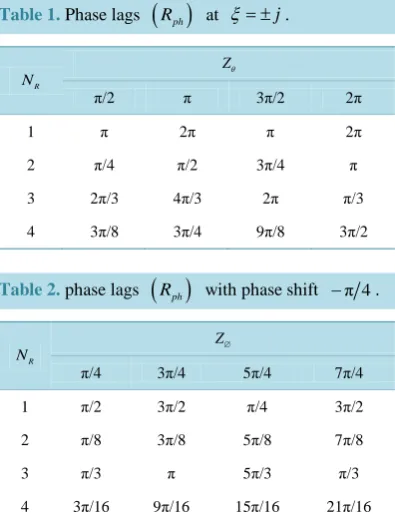
. This can be illustrated calculating the previous equation, taking into account all or mostof the possible cases, according to the following shown in Table 1. Besides, Table 2 turns of the other cases with phase shift e.g. −π 4.
4. VHDL Implement Based on the RPS-PAPR Reduction
Implement the RPS-MC transmitter system and its peak to average power ratio calculation in VHDL. The archi-
[image:5.595.124.505.536.709.2](a) (b)
Table 1. Phase lags
( )
Rph at ξ = ±j.R N
Zθ
π/2 π 3π/2 2π
1 π 2π π 2π
2 π/4 π/2 3π/4 π
3 2π/3 4π/3 2π π/3
4 3π/8 3π/4 9π/8 3π/2
Table 2. phase lags
( )
Rph with phase shift −π 4.R N
Z∅
π/4 3π/4 5π/4 7π/4
1 π/2 3π/2 π/4 3π/2
2 π/8 3π/8 5π/8 7π/8
3 π/3 π 5π/3 π/3
4 3π/16 9π/16 15π/16 21π/16
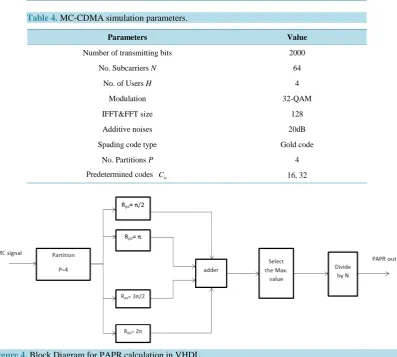
tecture proposed in this paper was coded in VHDL and then simulated and synthesized in Xilinx ISE 14.1. The computational complexity which arises due to IFFT operation is reduced by its VHDL implementation [18]. Where, the MC-CDMA signal partition according rotation factor Rps the rotate a range of possible phase shifts shown in Table 3, for parallel processing of the time domain symbols, a multiplexer is incorporated where the select inputs are selected by a select maximum value. In addition, the PAPR calculation of this MC-CDMA symbol is calculated and the symbol with minimum peak-to average power ratio is transmitted. The same can be evaluated in VHDL as per the block diagram shown in Figure 4. At this point, the operations are performed in-dividually on Rotating Phases Shift components. The inputs are taken in integer representation upon which squaring, adding and division operations are performed. Figure 5 shows the overall for RPS-PAPR calculation of an MC symbol after implementing in FPGA that shows the input IFFT for 64-bits, real and imaginary, then the output after PAPR reduction with enable control in order to build RTL circuits. Moreover, Figure 5 shows the PAPR architecture in the ISE 14.1 RTL circuit for more details.
5. Simulation Results
Simulations were performed to compare the performance of PAPR reduction in MC-CDMA system SLM, PTS and RPS at phases 3π/2 and 3π/8, with N = 64 subcarriers. The CCDF plots of the PAPR of the MC-CDMA signals inFigure 6 are shown for four users. Number of partitions for proposed technique RPS and classic PTS is four while predetermined codes for SLM method take 32 and 64. The performances for proposed at both shift registers is best an author’s technique as shown in Figure 7. The PAPR reduction performance is measured us-ing simulation parameters for MC-CDMA as in Table 4
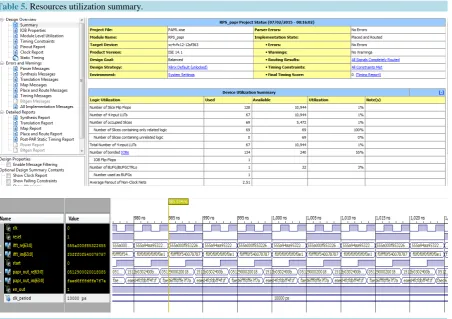
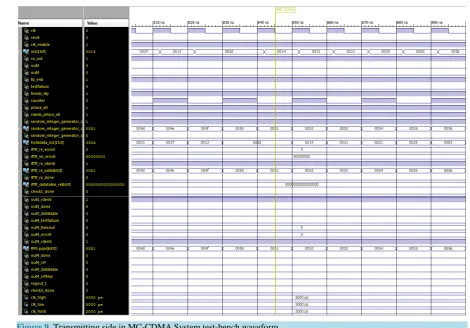
RPS-PAPR calculation of the MC-CDMA system is calculated and the symbol with minimum peak-to aver-age power ratio is transmitted. Table 5 represents the resources utilization summary of the RPS. In addition, Figure 8 shows the test-bench waveform for PAPR calculation of an MC-CDMA symbol. It can be observed that for each transmitted symbol a PAPR is calculated. Moreover, the test-bench waveform of the transmit side as shown in Figure 9.
6. Conclusion
Table 3. Control registers values.
Rph Rps With shiftπ/4 Register Value
π/2 π/4 01
π 3π/4 10
3π/2 5π/4 11
2π 7π/4 00
Table 4. MC-CDMA simulation parameters.
Parameters Value
Number of transmitting bits 2000
No. Subcarriers N 64
No. of Users H 4
Modulation 32-QAM
IFFT&FFT size 128
Additive noises 20dB
Spading code type Gold code
No. Partitions P 4
[image:7.595.116.514.180.537.2]Predetermined codes Cm 16, 32
Figure 4. Block Diagram for PAPR calculation in VHDL.
(b)
Figure 5. Top level view (a) with all inputs & outputsof the RPS-PAPR and (b) details for RTL circuits.
Figure 6. A CCDF of the PAPR of 4 users MC-CDMA signals compares an SLM Cm = 16, Cm = 32 and PTS and RPS, P = 4, 32-QAM.
1 2 3 4 5 6 7 8 9 10
10-3 10-2 10-1 100
PAPR vs CCDF for 4 users
papr(dB)
c
c
d
f
Original MC-CDMA PTS(4)
[image:8.595.153.473.429.697.2]Figure 7. A CCDF of the PAPR for 4 users of MC-DMA signals compares an SLM Cm = 16, Cm = 32 and PTS P = 4, and RPS Rph = 3π/2, Rph = 16π/21.
Table 5. Resources utilization summary.
Figure 8. PAPR calculation test-bench waveform.
1 2 3 4 5 6 7 8 9 10
10-3 10-2 10-1 100
PAPR vs CCDF for 4 users
papr(dB)
c
c
d
f
Original MC-CDMA pts(4)
[image:9.595.90.543.393.712.2]Figure 9. Transmitting side in MC-CDMA System test-bench waveform.
VHDL, which reduces the complexity by eliminating the difficult multiplication. Matlab simulations are done for 1000 samples of the MC-CDMA system with N = 64 subcarriers to plot the CCDF, which shows that RPS is the best method compared with the ways in various cases. The same idea is implemented in VHDL to calculate PAPR, and it can also be a simulation of subcarriers equal to 16 and 32 using the same process. This system eliminates the phase combined factor with lower PAPR better.
References
[1] Mahore, A.S., Singh, B. and Tanwar, P.S. (2014) A Review 4G System QAM MC-CDMA Higher Data Rates Trans-mission Systems in Impulsive Noise. International Journal of Electrical, Electronics Computer Engineering, 3, 177- 182.
[2] Sarala, B., Venketeswarlu, D.S., Bhandari, B.N. and Srinivas, B. (2014) Discrete Transforms based MC-CDMA PAPR Reduction using MECCT and Bit Error Rate Performance Analysis over Mobile Radio Channels. Proceedings of In-ternational Conference on Recent Trends in Information, Telecommunication and Computing, ITC, 238-247.
[3] Sarala, B., Venkateswarulu, D.S. and Bhandari, B.N. (2012) Overview of MC-CDMA PAPR Reduction Techniques.
International Journal of Distributed and Parallel Systems (IJDPS), 3, 193-206.
http://dx.doi.org/10.5121/ijdps.2012.3217
[4] Hernandez, L.A.P. and Otero, M.G. (2009) User Reservation Approach for Peak-to-Average Power Ratio Reduction in MC-CDMA Systems. Proceedings of IEEE 69th Vehicular Technology Conference VTC, Barcelona, 26-29 April 2009, 1-5.
[5] Xia, J., Li, Y., Zhang, Z., Wang, M., Yu, W. and Wang, S. (2013) A Suboptimal TR Algorithm with Fixed Phase Rota-tion for PAPR ReducRota-tion in MC-CDMA System. IET International Conference on Information and Communications Technologies, Beijing, 27-29 April 2013, 415-420.
[6] Ohkubo, N. and Ohtsuki, T. (2002) A Peak to Average Power Ratio Reduction of Multicarrier CDMA Using Selected Mapping. IEEE 56th Vehicular Technology Conference, 4, 2086-2090.
OFDM Systems. IEEE Transactions on Signal Processing, 60, 3657-3669. http://dx.doi.org/10.1109/TSP.2012.2191779
[8] Mahbub, T.S., Ahmed, S. and Rokon, I.R. (2011) Transmitter Implementation Using DS-CDMA Technique in FPGA Using Verilog HDL. International Conference on Electrical, Electronics and Civil Engineering (ICEECE), Pattaya, 204-207.
[9] Yang, L., Soo, K., Li, S. and Siu, Y. (2011) PAPR Reduction Using Low Complexity PTS to Construct of OFDM Sig-nals without Side Information. IEEE Transactions on Broadcasting, 57, 284-290.
[10] Amsavalli, A. and Kashwan, K.R. (2012) FPGA Implementation of Low Complexity VLSI Architecture for DS-CDMA Communication System. International Journal of Computer Applications, 42, 27-34.
[11] Ali, S., Chen, Z. and Yin, F. (2015) A Peak-to-Average Power Ratio Reduction Using N-Tuple Selective Mapping Method for MC-CDMA. ETRI Journal, 37, 338-347. http://dx.doi.org/10.4218/etrij.15.0114.0646
[12] Hernández, L.A.P. and Otero, M.G. (2009) User Reservation Approach for Peak-to-Average Power Ratio Reduction in MC CDMA Systems. IEEE Vehicular Technology Conference, Barcelona, 26-29 April 2009, 1-5.
[13] Shinsuke, H. and Ramjee, P. (2003) Principle and History of MCM/OFDM in Multicarrier Techniques for 4G Mobile Communication. Artech House, London.
[14] Yang, D.K., Yu, X., Liu, K.F. and Zhang, Q.S. (2009) Performance Analysis of PAPR in MC-CDMA System. IEEE 1st International Conference on Information Science and Engineering (ICISE), 26-28 December 2009, Nanjing, 2676- 2679.
[15] Sarala, B. and Venkateswarlu, D.S. (2011) MC-CDMA PAPR Reduction Techniques Using Discrete Transforms and Companding. International Journal of Distributed and Parallel Systems, 2, 253-270.
http://dx.doi.org/10.5121/ijdps.2011.2622
[16] Saxena, P. and Kumar, S. (2014) Challenges & Evolution of Next Generation in Mobile Communication Network.
In-ternational Journal of Advanced Research in Computer Science and Software Engineering, 4, 348-356.
[17] Othman, R.R., Zamli, K.Z. and Nugroho, L.E. (2012) General Variable Strength t-Way Strategy Supporting Flexible Interactions. Maejo International Journal of Science and Technology, 6, 415-429.