Preparation of Ionic Liquid Functionalized Silica
Nanoparticles for Oral Drug Delivery
Mehrdad Mahkam, Fatemeh Hosseinzadeh, Mohammad Galehassadi
Department of Chemistry, Azarbaijan Shahid Madani University, Tabriz, Iran. Email: [email protected], [email protected]
Received December 24th,2011; revised April 20th, 2012; accepted June 4th, 2012
ABSTRACT
The objective of this study is to utilize the pH sensitivity of modified silica nanoparticles (SNIL) by imidazole-based ionic liquid for oral delivery of insulin. In the first time, the imidazole was covalently attached to the 3-trimethoxysily- lpropyl chloride with replacement of all the chlorine atoms. Then, a silica nanoparticle was modified by N-(3-trimeth- oxysilylpropyl) imidazole. The nanocapsule (NCIL) was achieved after the etching of the modified silica nanoparticle template with hydrofluoric acid. The nanoparticles connected through an ionic liquid-like network were characterized by FTIR and SEM. Insulin was entrapped in these carriers and the in vitro release profiles were established separately in both enzyme-free simulated gastric and intestinal fluids (SGF, pH 1) and (SIF, pH 7.4), respectively. When these drug- loaded nanoparticles was placed in physiological buffer solution (pH 7.4), a partial negative surface charge on the modified silica nanoparticle was generated due to the deprotonation of silanol groups, and the strong electrostatic repul-sion triggered a sustained release of the loaded molecules.
Keywords: Silica Nanoparticles; Nanocapsule; pH-Sensitive; Insulin; Oral Drug Delivery
1. Introduction
Oral delivery of drugs, especially therapeutic proteins, is the preferred route of administration because it offers advantages over injection, which is the presently ac- cepted route of therapeutic protein administration. The oral delivery route is more natural and less invasive. The protein drug can be self-administered and the method is less expensive. However, there exist several problems for the development of oral protein delivery systems. One major problem is the degradation of proteins by proteo- lytic enzymes and the acidic environment of the sto- mach [1,2]. To reduce the non-specific absorption along the delivery path and to deliver the active form of thera- peutic drug to the lower section of the gastrointestinal tract (GI tract), oral drugs should be formulated to be acid resistant to first pass through the stomach and to reduce non-specific adsorption in upper section of the intestine before the drugs can effectively reach colon tissue. Although several approaches have been studied to deliver drugs to colon tissue, their efficiency in the de- livery still encounters a lot of challenges. Our response to this challenge was to design a porous nano carrier with a controlled-release function that decreased not only the degradation but also the non-specific release of drug molecules in the GI tract. Mesoporous silica materials have generated vast interest ever since they were synthe-
sized by Beck and co-workers in 1992 [3]. Because of the large surface area, large pore volume, highly ordered pore structure, and adjustable pore size, mesoporous si- lica material have wide and interesting applications in the fields of chemical catalysts [4] and biotechnology [5]. For example, mesoporous silica material can be used as a drug carrier for the controlled release of pre-loaded therapeutic drugs [6]. Recently, mesoporous silica nano- particles (MSN) have been synthesized using a two steps co-condensation process with cetyltrimethylammonium bromide (CTAB) as structure directing agent. Due to its nano size, MSN has much higher cellular uptake effi- ciency than the micron-sized mesoporous silica particle [7], thus therapeutic drugs or tracing molecules that are not easily membrane-transportable could be incorporated into the nano channels of SN to be delivered into cells.
also incorporate contrast agent for in vivo cell-tracking purpose [9]. Silica has abundant silanol groups (Si-OH) on the pore surface, which facilitate their conjugation with different functional groups to increase the adsorp- tion and conjugation of relevant biological molecules [10]. Several research groups have studied the sustained- release properties of drugs loaded in conventional meso- porous silica micro sized particles (i.e., MCM-41, MCM- 48, and SBA-15) [11]. Vallet-Regi and co-workers [12] used aminopropyl groups modified MCM-41 with dif- ferent pore sizes to regulate the release rate of ibuprofen from the siliceous matrix. Stucky and co-workers [13] also indicated that the anionic proteins could be adsorbed in the nano channels of aminopropyl group-modified mesoporous silica, and then released by changing the environmental ionic strength. In addition to amine-mo- dified mesoporous silica, hollow mesoporous silica (HMS) nano spheres with pore channels penetrating from the outside to the inner hollow core can store signifi- cantly more aspirin molecules than conventional meso- porous silica [14]. Besides the sustained and spontaneous release system, a stimuli-responsive release system has been designed, for example, a cap formed by disulfide bond can be opened by cleavage of the disulfide bond with reducing agent to trigger the release of the en- trapped molecules [15,16]. Xiao et al. designed a pH stimuli-responsive controlled release system composed of oppositely charged ionic interaction between carboxy- late modified SBA-15 and cationic polyelectrolyte. When the solution condition is of mild acidity, the caps (polye- lectrolyte) on the channel opening dissolve and cause loaded vancomycin to steadily release from the pores of SBA-15 [17].
Drug loading efficiency usually relies on the affinity between the nano carrier and the drug molecules. When a drug molecule is loaded inside of the non-functionalized silica matrix through a weak attraction (i.e., hydrogen bonding), a low loading capacity and a fast releasing pro- file are usually observed. For charge carrying drug mole- cules, we propose to increase the drug-loading efficiency by strengthening the electrostatic attraction through a modification of the mesoporous silica material’s surface to bear more opposite charges.
In this paper, we report a synthesis of positively charged SN by attaching imidazole ionic liquid to silica nanopar- ticles. The nanocapsule was achieved after the etching of the modified silica nanoparticle template with hydroflu- oric acid. The positive charge of ionic liquid groups ge- nerated a strong electrostatic attraction between the sur- face of SN and the polar groups of the drug molecule.
2. Experimental
The insulin used was recombinant human insulin (AK2U Nobel France; lot # 821156, Batch L-00023822). 3-
trimethoxysilylpropyl chloride and imidazole were pur- chased from Fluka Co. All the other chemicals used were of analytical reagent grade.
The IR spectra were recorded using a Perkin Elmer 1710 spectrophotometer. The amount of released drug was measured by a Shimadzu UV-265 FW, UV spectro- photometer at the absorption maximum of the free drug in pH 7 (λmax = 272 nm) using a 1 cm quartz cell.
2.1. Synthesis of Silica Nanoparticles
In a 250 mL round bottom flask, 60 mL (10 mmol) am- monia solution (32%) and 1.98 g (110 mmol) water are added to 100 mL absolute methanol. The solution is stirred for 5 min before adding dropwise 10.41 g (500 mmol) TEOS. The final solution is stirred for three days at ambient temperature.
2.2. Synthesize of N-(3-Propyltrimethoxysilane) Imidazole: (NPSiI)
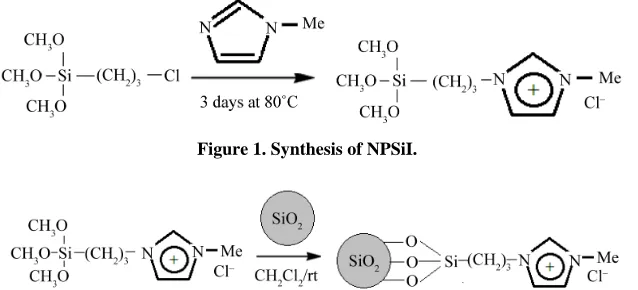
The synthesis is carried out under argon atmosphere. 1- Methylimidazole (2.060 g, 25.085 mmol) and (3-chlo- ropropyl) trimethoxysilane (6.042 g, 25.091 mmol) were refluxed for three days at 80˚C. The orange suspension is filtered off and the solvent evacuated. By addition of 150 mL dry dichloromethane a precipitate appears and is fil- tered off under argon atmosphere. The product is then separated by distillation at 150˚C under vacuum (1 mbar) and N-(3-propyltrimethoxysilane) imidazole was obtained with a honey-like consistency at room temperature (in 98% yield) (Figure 1). 1H NMR (300 MHz, CDCl3): δ
(ppm) 10.22 (1H, NCHN), 7.59 (1H, NCHCH), 7.26 (1H, NCHCH), 4.06 (2H, CH2N), 3.86 (3H, NCH3), 3.30 (9H,
OCH3), 1.74 (2H, CH2CH2), 0.37 (2H, SiCH2).
2.3. Immobilized Ionic Liquid: (SNIL)
Then silica nanoparticles suspension are precipitated with n-hexane and extracted through centrifugation (twice at 6000 rpm) before being re-dissolved in dichloromethane. Silica (1.016 g) was suspended in CH2Cl2 (5 mL) and
NPSiI (300 mg, 0.929 mmol) dissolved in CH2Cl2 was
then added. After stirring the mixture for 3 days at am- bient temperature, the silica was allowed to settle. The supernatant solution was decanted and the modified silica was extracted with CH2Cl2 prior to being dried for se-
veral hours in vacuo (Figure 2).
2.4. Synthesis of Nanocapsule: (NCIL)
Figure 1. Synthesis of NPSiI.
Figure 2. Synthesis of functionalized nanoparticles.
2.5. Insulin Loading in NCIL Table 1. Drug loading numbers. Nano carriers Percent of insulin loading (%)
SNIL 35
NCIL 43 One gr of each functionalized nanoparticle or nanocap-
sule was placed in 5 ml of solution containing 70 IU of insulin in 4˚C to suck up the total amount of the drug solution. After 24 h, the product was filtered off, washed thoroughly with distilled water and dried under vacuum
at room temperature. at a retention time of 5.5 min and the detection limit was 0.3 µg/mL. These results indicated that all insulin was degraded immediately after insulin was in contact with gastric fluid and the main cause of degradation was the proteolytic enzyme, pepsin. After being treated with gas- tric fluid, each of NCIL demonstrated a protective effect on insulin and the biological activity remained after the treatment with gastric fluid of NCIL. Studies of NCIL showed that when the NCIL content increased, degrada- tion of insulin decreased.
2.6. Amount of Insulin Entrapped
The amount of insulin entrapped in the nanoparticle was determined by an indirect method. After the loading, the washings with distilled water were collected and tested using UV-Vis spectroscopy. The difference between the amount of insulin initially employed and the drug content in the washings is taken as an indication of the amount of drug entrapped. The loading numbers shows in Table 1.
2.8. Insulin Release from Nano Carriers 2.7. Insulin Stability during Release Studies from
NCIL Insulin release from the delivery systems was tested in
the pyrex glasses. The powdered nanocomposite (10 mg) was poured in 5 ml of aqueous buffer solution (pH = 1 and 7.4) at 37˚C. The rotation speed was adjusted with stirrer. The amount of released drug was determined on UV spectrophotometer by using a standard calibration curve obtained under the same conditions.
In order to study the stability of insulin in contact with NCIL, two different conditions were chosen: 37˚C and darkness, 37˚C and light. Insulin was loaded in NCIL as described and then the peptide stability was investigated during release under the above mentioned conditions at two different pH values of 1 and 7.4. Samples were ana- lyzed under each condition after 24 and 48 h. In this con- dition insulin remained fairly stable at both pH values during the course of experiments, indicating that adsorp- tion of the peptide to the NCIL and their release after- wards did not substantially influence the stability of this peptide drug. To investigate the protective ability of the NCIL for insulin in the harsh environment of the stomach, insulin and insulin-incorporated were treated with a si- mulated gastric solution that contained endopeptidase pepsin. After the treatment in gastric solution, the bio- logical activity of insulin was determined with HPLC- UV at 210 nm. The flow-rate and injection volume were 1 mL/min and 60 µL, respectively. Insulin was detected
3. Results and Discussion
The silica nanoparticle was stirred for 24 h at room tem- perature after HF was added. To validate the complete etching of the silica, the FTIR technique was used. In the FTIR spectrum of the products treated with HF, the ab- sorption bands at 1105 cm–1 of the Si−O−Si symmetric
stretching mode and Si−O at 464 cm–1 disappeared. It
indicated that the silica nanoparticle had been etched completely.
[image:3.595.309.536.280.328.2][image:4.595.57.288.86.189.2]
(a) (b)
Figure 3. Scanning electron microscopic (SEM) images of SNIL (a) and NCIL (b).
average diameter of the composite particle is about 100 nm; the particle size is also uniform.
The loading numbers in Table 1 shows which that the hollow NCIL with pore channels penetrating from the outside to the inner hollow core can store significantly more insulin molecules than conventional silica.
4. Insulin Release
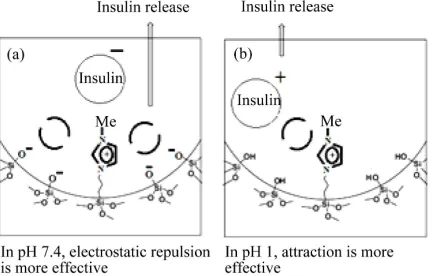
The drug release behavior of the as prepared positive charged porous silica particles is studied to reveal their potential use in drug delivery system. In order to better mimic the vitro release of insulin from the as prepared porous silica, simulated intestinal fluid (SIF, phosphate buffersolution, pH = 7.4), and simulated gastric fluid (SGF, HCl aqueous solution, pH = 1) are chosen as the release fluids. A large amount of insulin could be ad- sorbed in a natural pH because the insulin, which has pI of 5 was negatively charge and consequently, the elec- trostatic attraction between the positive charge of porous silica and negative insulin molecule. The degree of hy- drolysis of insulin as a function of time is shown in Fig-ure 4. In pH 1 and 7.4, outcome both repulsion and at- traction effects in drug delivery is effective. At physio- logical buffer (pH around 7.4), the silanol groups (Si−OH) in the positive charge nano carrier would become depro- tonated, and a strong electrostatic repulsion between the negative charges of (SiO– groups) and the negative
charge of insulin molecule would be generated. The ele- ctrostatic attraction between the drug molecules and the positive charge surface was stronger than the hydrogen bonding (−NH2 δ–… δ+ HOOC−) but the weaker ionic
attraction (−NH3+…OOC−). Because of the large number
of deprotonated SiO– groups the amount of repulsion is a
far more attractions. Consequently, the pH value of 7.4 in the physiological buffer promoted the releasing rate of the anionic molecules. The residual drug molecules may be occluded in the channels and therefore could not achieve the overall release.
In the simulated gastric fluid (pH 1), the Si−OH groups in the positive charged nano carrier were fully protonated, so the surface predominantly carried positive charges. In
this pH, insulin molecules have a tendency to attach to polar silanol groups due to hydrogen-bonding caused a decrease in the release rate. But the electrostatic repul-sion between the positive charge of porous silica and positive insulin molecule in acidic condition caused an increase in the release rate. This time due to high vol- ume of attraction interactions, drug release reduced. The mechanism insulin release from nano carriers is shows in (Scheme 1).
5. Conclusion
A pH-responsive controllable drug release system has been designed by incorporating positive charges in the framework of silica nanoparticles so that anionic mole- cules can be efficiently adsorbed inside of the nanochan- nels with minimal release under acidic pH value. At neu- tral pH because of the deprotonation of surface silanol groups, while giving strong electrostatic repulsion, the release rate of the adsorbed drug molecules becomes much increased. This controlled-release mechanism takes advantage of the changing pH value and ionic strength in our physiological buffer. Hence, this kind of the carrier could be designed as oral drug delivery system that im- proves site specificity and release kinetics to accommo- date different therapeutic purposes.
Figure 4. Release of insulin from nano carriers as a function of time at 37˚C.
[image:4.595.310.533.413.505.2] [image:4.595.314.531.549.687.2]6. Acknowledgements
The office of research vice chancellor Azarbaijan Uni-versity of Tarbiat Moallem has supported this work.
REFERENCES
[1] V. H. L. Lee and A. Yamamoto, “Penetration and Enzy- matic Barriers to Peptide and Protein Absorption,” Ad- vanced Drug Delivery Reviews, Vol. 4, No. 2, 1990, pp. 171-207. doi:10.1016/0169-409X(89)90018-5
[2] J. F. Woodley, “Enzymatic Barriers for GI Peptide and Protein Delivery,” Critical Reviews in Therapeutic Drug Carrier Systems, Vol. 11, 1994, pp. 61-95.
[3] J. S. Beck, M. E. Leonowicz and W. J. Roth, “Ordered Mesoporous Molecular-Sieves Synthesized by a Liquid- Crystal Template Mechanism,” Nature, Vol. 359, 1992, pp. 710-712. doi:10.1038/359710a0
[4] D. E. De Vos, M. Dams and B. F. Sels, “Dielectric Prop-erties of BNT Ferroelectrics in Paraelectric Phase,” Chemical Reviews, Vol. 102, 2002, pp. 3615-3640. doi:10.1021/cr010368u
[5] A. Vinu, M. Miyahara and K. Z. Hossain, “Lysozyme Adsorption onto Mesoporous Materials: Effect of Pore Geometry and Stability of Adsorbents,” Journal of Na- noscience and Nanotechnology, Vol. 7, No. 3, 2007, pp. 828-832. doi:10.1166/jnn.2007.511
[6] J. Salonen, L. Laitinen and A. M. Kaukonen, “Mesopor-ous Silicon Microparticles for Oral Drug Delivery: Load- ing and Release of Five Model Drugs,” Journal of Con- trolled Release, Vol. 108, No. 2-3, 2005, pp. 362-374. doi:10.1016/j.jconrel.2005.08.017
[7] I. I. Slowing, B. G. Trewyn and S. Giri, “Mesoporous Silica Nanoparticles for Drug Delivery and Biosensing Applications,” Advanced Functional Materials, Vol. 17, No. 8, 2007, pp. 1225-1236.
doi:10.1002/adfm.200601191
[8] J. Lu, M. Liong and J. I. Zink, “Mesoporous Silica Nanoparticles as a Delivery System for Hydrophobic Anticancer Drugs,” Small, Vol. 3, No. 8, 2007, pp. 1341- 1346. doi:10.1002/smll.200700005
[9] J. Gu, W. Fan and A. Shimojima, “Organic-Inorganic
Mesoporous Nanocarriers, Integrated with Biogenic Li- gands,” Small, Vol. 3, No. 10, 2007, pp. 1740-1744. doi:10.1002/smll.200700311
[10] A. Vinu, K. Z. Hossain and K. Ariga, “Recent Advances in Functionalization of Mesoporous Silica,” Journal of Nanoscience and Nanotechnology, Vol. 5, No. 3, 2005, pp. 347-371. doi:10.1166/jnn.2005.089
[11] F. Y. Qu, G. S. Zhu and S. Y. Huang, “Effective Con-trolled Release of Captopril by Silylation of Mesoporous MCM-41,” Physical Chemistry Chemical Physics, Vol. 7, No. 2, 2006, pp. 400-406. doi:10.1002/cphc.200500294 [12] P. Horcajada, A. Ramila and J. Perez-Pariente, “Influence
of Pore Size of MCM-41 Matrices on Drug Delivery Rate,” Microporous and Mesoporous Mater, Vol. 68, No. 1-3, 2004, pp. 105-109.
doi:10.1016/j.micromeso.2003.12.012
[13] Y. J. Han, G. D. Stucky and A. Butler, “Mesoporous Silicate Sequestration and Release of Proteins,” Journal of the American Chemical Society, Vol. 121, No. 42, 1999, pp. 9897-9898. doi:10.1021/ja992138r
[14] Y. F. Zhu, J. L. Shi and Y. S. Li, “Storage and Release of Ibuprofen Drug Molecules in Hollow Mesoporous Silica Spheres with Modified Pore Surface,” Microporous and Mesoporous Mater, Vol. 85, No. 1-2, 2005, pp. 75-81. doi:10.1016/j.micromeso.2005.06.015
[15] D. R. Radu, C.Y. Lai and K. Jeftinija, “A Polyami-doamine Dendrimer-Capped Mesoporous Silica Nano-sphere-Based Gene Transfection Reagent,” Journal of the American Chemical Society, Vol. 126, No. 41, 2004, pp. 13216-13217. doi:10.1021/ja046275m
[16] S. Giri, B. G. Trewyn and M. P. Stellmaker, “Stimuli- Responsive Controlled-Release Delivery System Based on Mesoporous Silica Nanorods Capped with Magnetic Nanoparticles,” Angewandte Chemie International Edi- tion, Vol. 44, 2005, pp. 5038-5044.
doi:10.1002/anie.200501819