http://www.scirp.org/journal/jss ISSN Online: 2327-5960
ISSN Print: 2327-5952
DOI: 10.4236/jss.2018.64008 Apr. 20, 2018 82 Open Journal of Social Sciences
The School Violence in the Coexistence
Programs of the Spanish Educational
System
Gladys Merma-Molina, María Alejandra Ávalos Ramos, María Ángeles Martínez Ruiz
Department of General Didactics and Specific Didactics, University of Alicante, Alicante, Spain
Abstract
One of the great problems of Spanish education is the increase in conflict and violence inside and outside schools. The Spanish educational administration, in order to reduce and eradicate these problems, has implemented coexistence programs in schools, which have not had the expected results. The objective of this study is to analyze and evaluate the integration of school violence in the coexistence programs that are being implemented in Secondary Education schools in Spain. For this, a sample of N = 806 Spanish schools has been taken. The evaluation matrix of coexistence programs was used, validated through expert judgment; the valuations of the selected items have been operationa-lized with the Osterlind Method (1989). The reliability of the instrument ob-tained an Alpha of Cronbach of 0.876 of consistency; the statistical analyzes of the data are carried out with the SPSS 23.0 program. For the evaluation of the coexistence programs, the participatory methodology was used (De Miguel, 2009), where 5 experts and 30 student-researchers intervened. The findings show that the coexistence programs, mostly, do not incorporate the preven-tion or the intervenpreven-tion of the different types of school violence, being only the objectives and the activities related to the behaviors related to the insults, threats, aggressions and vandalism that have presence with acceptable quality criteria, while the objectives and activities linked to the prevention and inter-vention of bullying, cyberbullying, gender violence, assaults on teachers and staff, child abuse and situations of school violence, which occur outside the school, have very little presence and poor quality criteria.
Keywords
School Violence, Education for Peace, Educational Project of the School, Prevention, Coexistence Program
How to cite this paper: Merma-Molina, G., Ramos, M.A.Á. and Ruiz, M.Á.M. (2018) The School Violence in the Coexistence Programs of the Spanish Educational Sys-tem. Open Journal of Social Sciences, 6, 82-97.
https://doi.org/10.4236/jss.2018.64008
Received: February 28, 2018 Accepted: April 17, 2018 Published: April 20, 2018
Copyright © 2018 by authors and Scientific Research Publishing Inc. This work is licensed under the Creative Commons Attribution International License (CC BY 4.0).
http://creativecommons.org/licenses/by/4.0/
DOI: 10.4236/jss.2018.64008 83 Open Journal of Social Sciences
1. Introduction
Violence has become a crucial problem in European countries. Some studies carried out in Spain [1][2][3][4][5] also show an increase in violence among young people and have verified the presence of variables that affect coexistence in schools, both in Primary Education and in Secondary Education. Likewise, new problems of school violence have been identified, such as cyberbullying, gender violence, aggression towards teachers, alcohol consumption, addictions to videogames and mobile phones, and sexting and grooming [6]. The growing number of news stories reflects this dangerous reality: in Madrid, La Cadena Ser, on November 14, 2016, interviews the parents of a girl who suffered bullying for seven years. The story of Carmen (not her real name) begins when she was in elementary school. During all this time, he is a victim of physical and verbal ag-gressions. When parents, impotent that nothing was done at the school, ask for help from the police, the school activates a protocol that concludes that there is no bullying. Carmen is currently suffering from post-traumatic stress disorder. On January 10, 2017, a thirteen-year-old girl, in the hamlet of Aljucer (Murcia), hanged herself in her room; it is known that her classmates insulted her because of her physical appearance. On January 30, 2017, a 17-year-old student, with a brilliant academic record, caused panic in an Institute in Villena (Alicante), wounding five classmates; Subsequent investigations conclude that he was a vic-tim of bullying. What seems evident, in the cases mentioned, is that the proto-cols in the schools were either not activated or, if implemented, they were not effective.
A large part of the studies carried out in recent years in Spain have to do with violence between peers or peers that occurs in school, with special mention be-ing made of bullybe-ing. This is characterized because it includes behaviors of various kinds such as ridicule, threats, intimidation, physical aggression, exclu-sion, carried out in a systematic way and that suppose abuse of power, since it is provoked by one or several students against a victim who is defenseless, while that other people are passive observers of the facts and do not intervene to pre-vent such situations [7].
so-DOI: 10.4236/jss.2018.64008 84 Open Journal of Social Sciences cial exclusion and the aggressions carried out through the properties (hide them). The incidence of robbery, of threats, followed by direct physical ag-gressions (hitting) and destruction of material, and a small percentage of schoolchildren—less than 1%—allude to blackmail, harassment sexual and the threat with weapons. However, although the last Report of the Ombudsman [8]
states “that maltreatment between equals has decreased in recent years”, the teachers perceive a notable increase especially in violent behaviors that generate a series of personal problems, psychological, academic and social in the students. School violence has a series of consequences on victims such as low self-esteem, depression, anxiety, rejection of the school, etc., but also in those who show vio-lent behavior [9].
Martín, Pulido and Vera [10] analyze different situations of school violence and exclusion at different educational levels. Based on a sample of 1635 students whose ages were between 14 and 18 years, they conclude that the most frequent situations of violence are associated with passive exclusion (“ignore me”), followed by verbal violence (“they insult me, “They speak ill of me”, “they call me by nicknames that ridicule me”) and that exerted on property (“they hide things”). A considerable percentage declared suffering more serious situations such as intimidation with phrases or insults of a sexual nature, physical attacks, and threats, even with weapons. The aforementioned authors observe that the victims end up considering that the cause of what happens is in them, while the aggressors seek justifications for the type of violence they exercise, giving it the appearance of legitimacy. All these problems have become one of the main challenges of the international and Spanish educational system [11].
Based on the situation and the foregoing background, the general objective of this study is to identify whether the coexistence programs designed and imple-mented in Spain, according to current regulations, incorporate the prevention and intervention of different types of school violence and know which are the quality criteria of such integration. For a more precise study, the following spe-cific objectives are proposed:
Analyze whether the different types of violence that affect students have been incorporated into the PCs of the Secondary Education schools.
Identify whether there are specific objectives related to school violence in the PCs of Secondary Education schools and with which quality criteria this in-tegration has been carried out.
Analyze whether there are specific activities related to school violence in the PCs of secondary schools, and which are the quality criteria with which they have been integrated.
2. School Violence in Coexistence Programs
Research on school violence and coexistence already have a certain trajectory in Spain. In the nineties, Ortega [12] and Díaz-Aguado, Segura, Royo and Andrés
DOI: 10.4236/jss.2018.64008 85 Open Journal of Social Sciences to aggression and peer harassment, and propose programs to improve these problems. The term coexistence is used in the academic-educational field by Carbonell [14]; nevertheless, it was Jares [15] who focuses on coexistence as a transformative model of society that is promoted in educational centers. Later, Boqué [16] adds the concept of culture of peace as the denomination of any program that promotes the improvement of school coexistence, and Torrego
[17]defends the importance of a specific regulation based on dialogue measures. Thus, in the 21st century, coexistence has gone from being a fact required by pioneering educational institutions or sensitized to a front-line objective that is included in the educational projects of the centers (hereinafter, PEC), creating specific programs to promote it [18].
In 2006, the Organic Law of Education (LOE) [19] projects coexistence as a priority educational objective. As a result, new Orders and Decrees are being le-gislated in the 17 autonomous communities of Spain to implement PCs; thus, in a period of three years practically all schools incorporate them into their admin-istrative and management documents [18]. Subsequently, the Organic Law of Improvement of Educational Quality (LOMCE) [20] explicitly recognizes the need to educate for coexistence as a fundamental basis to achieve personal, social and academic success of students. The norm takes into account the principles of equity, inclusion, equality of rights and opportunities, elimination of discrimina-tion, conflict prevention and peaceful resoludiscrimina-tion, non-violence, and the preven-tion of bullying and violence against children. gender; Despite this, cases of violence, bullying, aggression, disruption and indiscipline remain high, especial-ly in the first and second years of ESO [21] and teachers complain about violent incidents and the lack of collaboration of the students and their families [22]. Why is this problem? It is likely that in this study we find some answers.
There are multiple protocols for prevention and intervention, especially in cases of school bullying that have been launched such as the Learning to be a person and to live together program: a program for secondary school [23] Se-villas antiviolencia escolar [24], Andalusia School Violence [25] or the Inte-grated Model [17], as well as the programs developed by public administrations, which translate into coexistence programs (hereinafter PC).
Article 124 of the LOMCE [20]regulates the organization, operation and coexistence in schools; it is ordered that all centers prepare a PC where all the activities they program will be collected in order to foster a good atmosphere of coexistence within the school, the realization of the rights and duties of the stu-dents, and the applicable corrective measures in case of non-compliance These projects, despite being interesting proposals, have not had the expected results.
DOI: 10.4236/jss.2018.64008 86 Open Journal of Social Sciences less common the implementation of actions to improve coexistence; They argue that there is an evolution towards strategies based on the imposition and disse-mination of norms and sanctions to the detriment of educational strategies such as conflict resolution, the consensus of norms and education in values. This is contrary to what might be expected, since the benefits of these measures are known in the classroom and center climate, and in academic performance [27]. Also Álvarez-García, Rodríguez, González-Castro, Núñez and Álvarez [28] and Penalva, Hernández and Guerrero [29] highlight the low importance attributed to the rules on school coexistence and Cerezo [22] argues that parents are not informed conveniently about the actions planned in the PC. Lately, Conde, Azaustre and Delgado [30], based on the model of the European Foundation Quality Magnagement, have analyzed the coexistence in 46 Andalusian schools with the aim of describing the management of coexistence, confirming the va-lidity of the model.
The increase in school violence that negatively affects coexistence and conse-quently to learning, and that calls into question the effectiveness of PC, has mo-tivated the approach of the following research questions:
How has the prevention and intervention of school violence been integrated into the PCs of the Secondary Education centers?
Have specific objectives linked to the different types of school violence been included in the PCs of the Secondary Education schools?
What quality criteria do the objectives that have been included in the PCs have?
Have specific activities linked to the different types of school violence been designed and planned in the PC of the Secondary Education centers?
What quality criteria do the activities that have been integrated have?
3. Method
3.1. Sample
The sample consisted of 806 PCs of Compulsory Secondary Education Institutes of the 17 Autonomous Communities of Spain and was selected considering the availability of PCs in the web addresses of the centers themselves (Graph 1).
3.2. Instruments
In the absence of other similar studies, an ad hoc instrument was designed, the Evaluation Matrix of the Coexistence Program (hereinafter MPC). An initial version was prepared, consisting of 22 items, with reference to other research and relevant literature on the subject [17][18][22][31][32].
DOI: 10.4236/jss.2018.64008 87 Open Journal of Social Sciences Graph 1. Percentage of the sample by autonomous communities.
operative way the GIE valuations on the adequacy of the selected indicators, the Osterlind Method [33] was used with a scale of three levels of congruence (−1 if it is low, 0 = if it is medium and 1 if it is high). 17 items reached a congruence of Osterlind greater than O, 5; each item had five possible valuations, based on the Likert Scale, with values ranging from 1 to 5, with 1 being the lowest score and 5 being the highest: 2 items for diagnosis, 3 for objectives, 2 for activities, 1 for the temporalization, 1 for those responsible for the activities, 1 for the evaluation and 7 items for the objectives and activities related to the prevention and inter-vention of bullying and cyberbullying, with the behaviors that alter the coexis-tence in a serious and recidivist way (insults, threats, aggressions, fights and/or vandalism), with child abuse, with gender violence, with aggressions towards teachers and administrative and services staff, and with situations of violence outside the educational center that imply Some member of the center. In this study, the last 7 variables are analyzed.
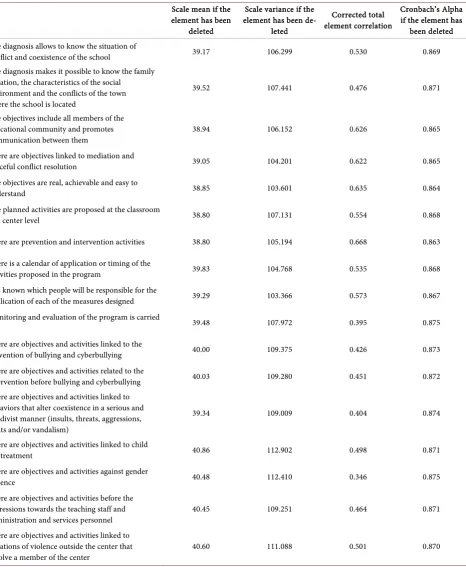
Once the items of the questionnaire were determined, the reliability test was performed, which shows the constancy and precision of the measure. For this, Cronbach’s Alpha was used, which resulted in a coefficient of 0.876, concluding that the information collection instrument is optimal and reliable (Table 1).
3.3. Procedure
DOI: 10.4236/jss.2018.64008 88 Open Journal of Social Sciences Table 1. Reliability statistics of the total elements.
Scale mean if the element has been
deleted
Scale variance if the element has been
de-leted
Corrected total element correlation
Cronbach’s Alpha if the element has
been deleted The diagnosis allows to know the situation of
conflict and coexistence of the school 39.17 106.299 0.530 0.869 The diagnosis makes it possible to know the family
situation, the characteristics of the social environment and the conflicts of the town where the school is located
39.52 107.441 0.476 0.871
The objectives include all members of the educational community and promotes
communication between them 38.94 106.152 0.626 0.865 There are objectives linked to mediation and
peaceful conflict resolution 39.05 104.201 0.622 0.865 The objectives are real, achievable and easy to
understand 38.85 103.601 0.635 0.864
The planned activities are proposed at the classroom
and center level 38.80 107.131 0.554 0.868
There are prevention and intervention activities 38.80 105.194 0.668 0.863
There is a calendar of application or timing of the
activities proposed in the program 39.83 104.768 0.535 0.868 It is known which people will be responsible for the
application of each of the measures designed 39.29 103.366 0.573 0.867 Monitoring and evaluation of the program is carried
out 39.48 107.972 0.395 0.875
There are objectives and activities linked to the
prevention of bullying and cyberbullying 40.00 109.375 0.426 0.873 There are objectives and activities related to the
intervention before bullying and cyberbullying 40.03 109.280 0.451 0.872 There are objectives and activities linked to
behaviors that alter coexistence in a serious and recidivist manner (insults, threats, aggressions, fights and/or vandalism)
39.34 109.009 0.404 0.874
There are objectives and activities linked to child
maltreatment 40.86 112.902 0.498 0.871
There are objectives and activities against gender
violence 40.48 112.410 0.346 0.875
There are objectives and activities before the aggressions towards the teaching staff and
administration and services personnel 40.45 109.251 0.464 0.871 There are objectives and activities linked to
situations of violence outside the center that
involve a member of the center 40.60 111.088 0.501 0.870
regula-DOI: 10.4236/jss.2018.64008 89 Open Journal of Social Sciences tions on the PC and the design, development and execution of the PC.
Once the EPC were selected, following the criteria of the participatory evalua-tion [34], a training program was carried out, consisting of 4 modules (Table 2), with the objective that the EPC acquire sufficient knowledge and skills to analyze the PCs in a coherent manner and responsible.
Subsequently, the GIE collected and selected the PC of the websites of the schools following the following criteria: 1) that the centers were of Secondary Education, 2) that the PC were valid in the academic courses 2014-2015 or 2015-2016 and 3) that the PC was a complete document and not just a summary or a partial publication. Initially, a first sample of 875 PCs was obtained, of which 69 were excluded because they did not meet any of the aforementioned criteria. Between the months of January and March 2017, PCs were analyzed, using the MPC validated by the GIE.
In order that the information was objective, reasoned and that the evaluations are the product of personal reflection [34], in June and July of 2017 three more workshops were conducted, led by the GIE, where the EPC participated with In order to share experiences and/or to raise doubts about the PC evaluation process.
The GIE conducted a meta-evaluation on participatory-evaluative work [35]
through a process of triangulation and critical review of the information pro-vided by the EPC, achieving 95% of both quantitative and qualitative coinci-dences. Subsequently, the process of storing and organizing the information in a database was carried out, and the respective statistical analyzes were carried out with the SPSS program. v. 23.0.
4. Results
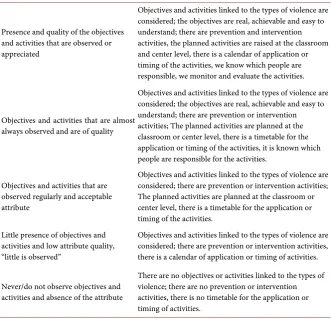
From the analysis of the CPs, a map of codes was obtained consisting of five categories that assess the presence and quality of the objectives and activities re-lated to school violence, ranging from the “presence and quality of the objectives and activities that are observed” to “Never/no objectives and activities are ob-served, and there is absence of the attribute”. The attributes of each category are shown in Table 3.
Table 2. EPC training program.
Modules Content
Module 1 Theoretical-practical perspective of the disconventional factors that affect class-room climate (conflict, school violence, bullying, cyberbullying, indiscipline, dis-ruption, absenteeism, school failure, sexting, grooming).
Module 2 Analysis of the regulations on coexistence and coexistence programs in the Auto-nomous Communities of Spain. Structure and elements of coexistence programs.
DOI: 10.4236/jss.2018.64008 90 Open Journal of Social Sciences Table 3. Quality criteria of the attributes of the objectives and activities.
Presence and quality of the objectives and activities that are observed or appreciated
Objectives and activities linked to the types of violence are considered; the objectives are real, achievable and easy to understand; there are prevention and intervention activities, the planned activities are raised at the classroom and center level, there is a calendar of application or timing of the activities, we know which people are responsible, we monitor and evaluate the activities.
Objectives and activities that are almost always observed and are of quality
Objectives and activities linked to the types of violence are considered; the objectives are real, achievable and easy to understand; there are prevention or intervention activities; The planned activities are planned at the classroom or center level, there is a timetable for the application or timing of the activities, it is known which people are responsible for the activities.
Objectives and activities that are observed regularly and acceptable attribute
Objectives and activities linked to the types of violence are considered; there are prevention or intervention activities; The planned activities are planned at the classroom or center level, there is a timetable for the application or timing of the activities.
Little presence of objectives and activities and low attribute quality, “little is observed”
Objectives and activities linked to the types of violence are considered; there are prevention or intervention activities, there is a calendar of application or timing of activities.
Never/do not observe objectives and activities and absence of the attribute
There are no objectives or activities linked to the types of violence; there are no prevention or intervention activities, there is no timetable for the application or timing of activities.
Also, the findings determine a value of 3 for median, which means that “ob-jectives and activities are observed regularly and have acceptable attributes. Consequently, 6 of the 7 variables analyzed represent the value of “never/no ob-jectives and activities are observed and there is absence of the attribute” and only “almost always” is observed and the objectives linked to the behaviors that alter the quality have quality attributes. cohabitation in a serious and recidivist way (Table 4).
More specifically, the results show that in 41.5% of PCs there are no objectives or prevention or intervention activities linked to bullying and cyberbullying; in 21.5% there is a scarce presence of these, and only in 9.2% the inclusion of pre-vention objectives and activities is observed and in 12.3% of interpre-vention activi-ties before bullying and cyberbullying (Table 5 and Table 6).
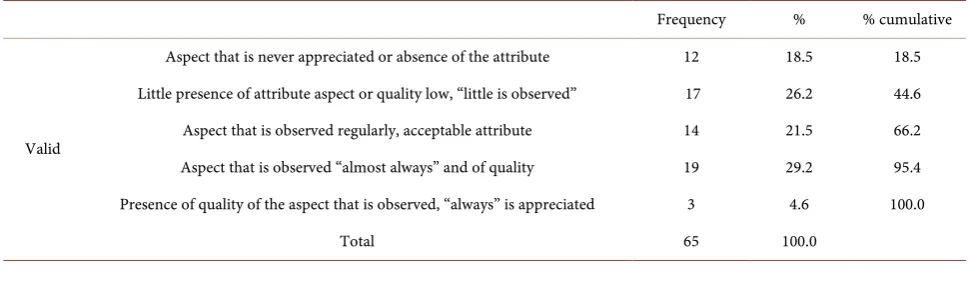
On the other hand, in 18.5% of the analyzed cases there are no objectives or activities related to the behaviors that alter the coexistence in a serious and re-peated manner, such as insults, threats, aggressions, fights and vandalism; 26.2% of PCs have such objectives and activities, but they are of low quality, while 33.8% of PCs have these objectives and activities and have been included with quality criteria (Table 7).
DOI: 10.4236/jss.2018.64008 91 Open Journal of Social Sciences Table 4. Median of the specific objectives and activities.
There are objectives and activities to prevent bullying and cyberbullying
There are objectives and intervention activities in the face
of bullying and cyberbullying
There are objectives and activities linked to behaviors that alter coexistence in
a serious and repeated manner
There are objectives and activities linked
to child maltreatment
There are objectives and activities linked to the prevention of gender violence
There are objectives and activities in the face of aggressions
towards the teaching staff and administration and
services personnel
There are objectives and activities linked
to situations of violence outside the
center that involve some member of
the school
806 806 806 806 806 806 806
0 0 0 0 0 0 0
2.00 2.00 3.00 1.00 1.00 1.00 1.00
[image:10.595.59.541.273.396.2]1 1 4 1 1 1 1
Table 5. Objectives and activities linked to the prevention of bullying and cyberbullying.
Frequency % % cumulative
Valid
Aspect that is never appreciated and absence of the attribute 27 41.5 41.5 Little presence of attribute aspect or quality low, “little is observed” 14 21.5 63.1 Aspect that is observed regularly, acceptable attribute 18 27.7 90.8 Aspect that is observed “almost always” and of quality 5 7.7 98.5 Presence of quality of the aspect that is observed, “always” is appreciated 1 1.5 100.0
Total 65 100.0
Table 6. Objectives and activities linked to intervention in bullying and cyberbullying.
Frequency % % cumulative
Valid
Aspect that is never appreciated or absence of the attribute 27 41.5 41.5 Little presence of attribute aspect or quality low, “little is observed” 14 21.5 63.1 Aspect that is observed regularly, acceptable attribute 16 24.6 87.7 Aspect that is observed “almost always” and of quality 7 10.8 98.5 Presence of quality of the aspect that is observed, “always” is appreciated 1 1.5 100.0
Total 65 100.0
Table 7. Objectives and activities linked to behaviors that alter coexistence in a serious way.
Frequency % % cumulative
Valid
Aspect that is never appreciated or absence of the attribute 12 18.5 18.5 Little presence of attribute aspect or quality low, “little is observed” 17 26.2 44.6 Aspect that is observed regularly, acceptable attribute 14 21.5 66.2 Aspect that is observed “almost always” and of quality 19 29.2 95.4 Presence of quality of the aspect that is observed, “always” is appreciated 3 4.6 100.0
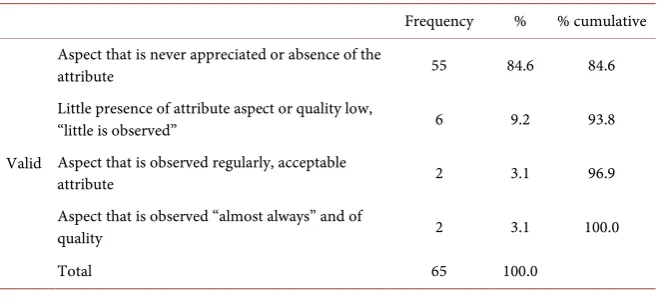
[image:10.595.56.541.431.560.2] [image:10.595.55.541.594.737.2]DOI: 10.4236/jss.2018.64008 92 Open Journal of Social Sciences presence of these objectives and activities and their attributes are low quality, and only in 3.1% of PC the attributes that are observed are of quality (Table 8).
Likewise, in 63.08% of PC there are no objectives or activities related to gender violence, in the 16.92%, these are of low quality and only in 4.62% the objectives and activities have quality criteria (Table 9).
On the other hand, 61.5% of PCs do not have objectives or activities related to the aggressions towards the teaching staff and the administration and services personnel; 21.5% includes this type of objectives and activities, but the attribute is of low quality, and only 7.7% have objectives and activities and their attributes are of quality (Table 10).
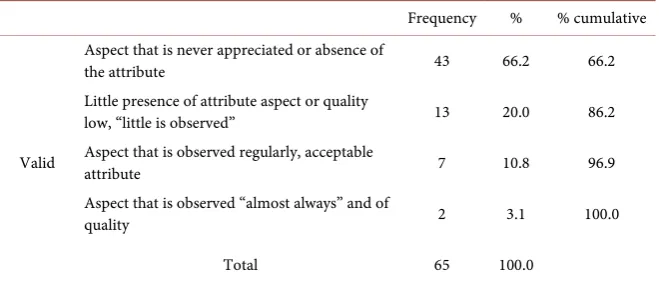
Finally, 66.2% of PCs do not take into account situations of violence outside the center involving a member of the center, in 20% of PCs consider these ac-tions, but their attributes are of low quality and only in 3.1% of PC the attribute has a certain quality (Table 11).
5. Discussion and Conclusions
The general objective of this study was to identify if the coexistence programs designed and implemented, in Secondary Education in Spain, incorporate the prevention and intervention of the different types of school violence and know which are the criteria of quality of said incorporation.
[image:11.595.211.541.578.731.2]The findings lead us to propose general and specific conclusions. In the first place, PCs, mostly, do not incorporate in their design and planning, the preven-tion or intervenpreven-tion of different types of school violence. This is alarming, not only because of the negative consequences in classroom climate and learning but because it has repercussions in society, since behavioral problems that manifest from adolescence can continue with more serious forms in adulthood [36] [37]. The investigation leads us to conclude that PC are, mostly, documents of a for-mal and bureaucratic nature, little or nothing strategic, being only the objectives and activities related to the behaviors related to insults, threats, aggressions, fights and vandalism which they have an almost permanent presence in these programs and have acceptable quality criteria.
Table 8. Objectives and activities linked to child maltreatment.
Frequency % % cumulative
Valid
Aspect that is never appreciated or absence of the
attribute 55 84.6 84.6
Little presence of attribute aspect or quality low,
“little is observed” 6 9.2 93.8 Aspect that is observed regularly, acceptable
attribute 2 3.1 96.9
Aspect that is observed “almost always” and of
quality 2 3.1 100.0
DOI: 10.4236/jss.2018.64008 93 Open Journal of Social Sciences Table 9. Objectives and activities against gender violence.
Frequency % % cumulative
Valid
Aspect that is never appreciated or absence of
the attribute 41 63.1 63.1
Little presence of attribute aspect or quality low,
“little is observed” 11 16.9 80.0 Aspect that is observed regularly, acceptable
attribute 10 15.4 95.4
Aspect that is observed “almost always” and of
quality 2 3.1 98.5
Presence of quality of the aspect that is observed,
“always” is appreciated 1 1.5 100.0
[image:12.595.212.539.284.457.2]Total 65 100.0
Table 10. Objectives and activities in the face of aggressions towards teachers and PAS.
Frequency % % cumulative
Valid
Aspect that is never appreciated or absence of
the attribute 40 61.5 61.5
Little presence of attribute aspect or quality
low, “little is observed” 14 21.5 83.1 Aspect that is observed regularly, acceptable
attribute 6 9.2 92.3
Aspect that is observed “almost always” and of
quality 3 4.6 96.9
Presence of quality of the aspect that is
observed, “always” is appreciated 2 3.1 100.0
Total 65 100.0
Table 11. Objectives and activities linked to situations of violence outside the center.
Frequency % % cumulative
Valid
Aspect that is never appreciated or absence of
the attribute 43 66.2 66.2
Little presence of attribute aspect or quality
low, “little is observed” 13 20.0 86.2 Aspect that is observed regularly, acceptable
attribute 7 10.8 96.9
Aspect that is observed “almost always” and of
quality 2 3.1 100.0
Total 65 100.0
[image:12.595.211.541.490.634.2]DOI: 10.4236/jss.2018.64008 94 Open Journal of Social Sciences cyberbullying (41.54%). Faced with this reality it is not surprising that cases of violence and harassment inside and outside the school are increasing excessively. On the other hand, the criteria with which the objectives and activities have been incorporated to tackle school violence, if any, are of low quality; it has been found that the objectives are especially intervention and not prevention, al-though it has been shown that prevention has long-term effects that are more positive than intervention. Also, the objectives are not real and achievable. The planned activities are only planted at the classroom level and not at the center, there is no timing calendar and it is not known who are responsible for these ac-tivities; all this suggests that in reality these programs are not developed and are not met in schools. Schools have the potential to reduce the occurrence of problems of these behaviors, which is why a serious, coordinated, planned and effective educational action is necessary [38].
The findings of the research also allow us to infer that teachers have little knowledge of resources for prevention and treatment of school violence problems, as Álvarez-García et al.[28] and González-Gil et al.[39] have shown. We em-phasize the importance of initial and ongoing teacher training in prevention and intervention strategies that promote knowledge and mastery of specific actions to foster positive coexistence in the center (for example, awareness-raising ac-tivities, emotional education, incorporation of coexistence as a cross-cutting theme in the curriculum, training in values and conflict management).
Based on these results of the study, it is argued that a holistic, real and prac-tical approach to school coexistence is necessary, led by educational administra-tions, by the school management and by teachers oriented to change in school culture.
This study can be a contribution to the investigation of school coexistence to prevent school violence; a guide to rethink a more realistic and contextualized design, and a supervised and controlled execution, that allows achieving the ex-pected impact in the school and in the Spanish society.
Based on the findings and conclusions, the following recommendations are made:
• It is a priority to change the role of the educational administration that should go from being the supervising entity that centers have the PC to sup-port and accompany the process of design and implementation of PC. • The center’s management has to establish the appropriate mechanisms, based
on dialogue [40], so that the entire educational community gets involved in the actions envisaged in the PC.
• Encourage initial teacher training and teacher professional development, in-corporating specific contents on coexistence in the Bachelor’s Degree and Secondary Education Master’s programs, such as the learning of mediation, negotiation and conflict resolution techniques, the acquisition of communi-cation skills, emotional competences and cooperative learning.
DOI: 10.4236/jss.2018.64008 95 Open Journal of Social Sciences Develop intervention actions and, especially, actions to prevent violence in schools, promoting prosocial behaviors and socio-emotional skills, preventing disruptive behaviors and fostering the resilience of students and teachers [41] [42][43].
References
[1] Álvarez-García, D., Dobarro, A., Álvarez, L., Núñez, J.C. and Rodríguez, C. (2014) La Violencia Escolar en los Centros de Educación Secundaria de Asturias desde la Perspectiva del Alumnado. Educación XX1, 17, 337-360.
https://doi.org/10.5944/educxx1.17.2.11494
[2] Gázquez, J.J., Pérez-Fuentes, M.C., Lucas, F. and Fernández, M. (2011) Análisis de la Convivencia Escolar por los Docentes Europeos. Aula Abierta, 39, 51-58.
[3] Merma, G., Peiró, S. and Gavilán, D. (2013) Perspectivas sobre Educación en Va-lores en Tiempos de Crisis. Barataria: Revista Castellano-Manchega de Ciencias So-ciales, 15, 151-160.
[4] Musitu, G., Suárez, C., Del Moral, G. and Villareal, M.E. (2015) El Consumo de Alcohol en Adolescentes: El Rol de la Comunicación, el Funcionamiento Familiar, la Autoestima y el Consumo en la Familia y Amigos. Búsqueda, 14, 45-61.
https://doi.org/10.21892/01239813.58
[5] Piñero, E., Arense, J.J., López, J.J. and Torres, A.M. (2014) Incidencia de la Violencia y Victimización Escolar en Estudiantes de Educación Secundaria Obligatoria en la Región de Murcia. Revista de Investigación Educativa, 32, 223-241. [6] Merma, G., Gavilán, D. and Rico, M.L. (2018) From Indiscipline to the Addictions
and Sexting: New Problems that Affect Spanish Adolescents. The European Confe-rence on Educational Research. Inclusion and Exclusion, Resources for Educational Research? EERA, Bolzano (In Press).
[7] Díaz-Aguado, M.J. (2005) La Violencia entre Iguales en la Adolescencia y su Pre-vención desde la Escuela. Psicothema, 17, 549-558.
[8] Defensor del Pueblo (2007) Informes, Estudios y Documentos. Violencia escolar: El Maltrato entre Iguales en la Educación Secundaria Obligatoria 1999-2006. Nuevo estudio y Actualización del Informe 2000. Defensor del Pueblo, Madrid.
[9] Rodríguez, J.M., Martínez, R., Díaz-Aguado and Morentín, R. (2008) Comporta-miento Violento en Adolescentes: Su Relación con las Estrategias Cognitivas y el Rendimiento Académico. Psicología Educativa, 14, 63-81.
[10] Martín, G., Pulido, R. and Vera, R. (2008) Maltrato entre Iguales y Exclusión Social en la Comunidad de Madrid. Análisis y Posibilidades de Intervención. Psicología Educativa, 14, 103-113.
[11] Gázquez, J.J., Pérez, M.C., Lucas, F. and Fernández, M. (2009) Análisis de la Convi-vencia Escolar por los Docentes Europeos. Aula Abierta, 37, 11-18.
[12] Ortega, R. (1997) Es la Violencia un Problema Emergente en la Infancia? In: Ponce, J.A., Muriel, R. and Gómez de Terreros, I., Eds., Informe Salud, Infancia, Adoles-cencia y Sociedad. Sección de Pediatría Social. Asociación Española de Pediatría, Sevilla, 76-82.
[13] Díaz-Aguado, M.J., Segura, M.P., Royo, P. and Andrés, M. (1996) Programas de Educación para la Tolerancia y Prevención de la Violencia en los Jóvenes. Instrumentos de Evaluación e Investigación (Vol. IV). Ministerio de Trabajo y Asuntos Sociales, Madrid.
DOI: 10.4236/jss.2018.64008 96 Open Journal of Social Sciences [15] Jares, X. (1997) El Lugar del Conflicto en la Organización Escolar. Revista
Iberoamericana de Educación, 15, 53-73.
[16] Boqué, M.C. (2002) Guía de Mediación Escolar. Programa Comprensivo de Activi-dades, Etapas Primaria y Secundaria. Octaedro, Barcelona.
[17] Torrego, J.C. (2006) Modelo Integrado de Mejora de la Convivencia. Graó, Barcelona.
[18] Zaitegi, N. (2010) La Educación en y para la Convivencia Positiva en España. Revista Iberoamericana sobre Calidad, Eficacia y Cambio en Educación, 8, 93-132. [19] Orgánica, L. (2006) de 3 de mayo, de Educación. Boletín Oficial del Estado 106. [20] Orgánica, L. (2013) de 9 de diciembre, para la Mejora de la Calidad Educativa.
Boletín Oficial del Estado 295.
[21] Gil, F., Delgado, M.A. and Chillón, P. (2016) Percepción de las Conductas Contrarias a la Convivencia en el Profesorado de Educación Secundaria Obligatoria. SPORT TK-Revista EuroAmericana de Ciencias del Deporte, 5, 167-178.
[22] Cerezo, F. (2011) Políticas de Convivencia Escolar: Percepción y Eficacia desde la Perspectiva Familiar. Revista Electrónica Interuniversitaria de Formación del Pro-fesorado, 14, 313-323.
[23] Trianes, M.V. and Fernández-Figarés, C. (2001) Aprender a Ser Personas y a Convivir. Un programa para Secundaria. Descleé de Brouwer, Bilbao.
[24] Ortega, R. (1997) El Proyecto Sevilla Anti-violencia Escolar. Un Modelo de intervención Preventiva contra los Malos Tratos entre Iguales. Revista de Educación, 313, 143-161.
[25] Ortega R. and Del Rey, R. (2001) Aciertos y Desaciertos del Proyecto Sevilla Anti-violencia Escolar (SAVE). Revista de Educación, 324, 253-270.
[26] Álvarez-García, D., Dobarro, A., Rodríguez, C., Núñez, J.C. and Álvarez, L. (2013) El Consenso de Normas de Aula y su Relación con Bajos Niveles de Violencia Esco-lar. Infancia y Aprendizaje, 36, 199-217.
https://doi.org/10.1174/021037013806196229
[27] Pérez-Fuentes, M., Álvarez-Bermejo, J.A., Molero, M., Gázquez, J.J. and Vicente, M. (2011) Violencia Escolar y Rendimiento Académico (VERA): Aplicación de Reali-dad Aumentada. European Journal of Investigation in Health, Psychology and Education, 1, 71-84.https://doi.org/10.30552/ejihpe.v1i2.19
[28] Álvarez-García, D., Rodríguez, C., González-Castro, P., Núñez, J.C. and Álvarez, L. (2010) La Formación de los Futuros Docentes Frente a la Violencia Escolar. Revista de Psicodidáctica, 15, 35-56.
[29] Penalva, A., Hernández, M.A. and Guerrero, C. (2014). Percepción de los Expertos de la Necesidad de la Formación del Profesorado en Convivencia. Revista Fuentes, 15, 281-304.https://doi.org/10.12795/revistafuentes.2014.i15.13
[30] Conde, S., Azaustre, C. and Delgado, M. (2015) Análisis Integral de la Gestión de la Convivencia Escolar. Una Propuesta de Evaluación. International Journal for 21st Century Education,2, 39-59.
[31] Burton, B. (2012) Peer Teaching as a Strategy for Conflict Management and Student Re-Engagement in Schools. Australian Educational Researcher, 39, 45-58.
https://doi.org/10.1007/s13384-011-0046-4
Educa-DOI: 10.4236/jss.2018.64008 97 Open Journal of Social Sciences tion, 3, 207-213.https://doi.org/10.30552/ejihpe.v3i3.50
[33] Osterlind, S.J. (1989) Constructing Test Ítems. Kluwer Academic Publishers, Bos-ton.
[34] De Miguel, M. (2009) Evaluación de Planes y Programas de Ciudadanía y Convivencia. Praxis, 13, 47-69.
[35] Stufflebeam, D. (2001) The Metaevaluation Imperative. American Journal of Evaluation,22, 183-209.https://doi.org/10.1177/109821400102200204
[36] Kim, B.E., Gilman, A.B., Hill, K.G. and Hawkins, J.D. (2016) Examining Protective Factors against Violence among High-Risk Youth: Findings from the Seattle Social Development Project. Journal of Criminal Justice, 45, 19-25.
https://doi.org/10.1016/j.jcrimjus.2016.02.015
[37] Loeber, R., Capaldi, D.M. and Costello, E. (2013) Gender and the Development of Aggression, Disruptive Behavior, and Delinquency from Childhood to Early Adulthood. In: Tolan, P. and Leventhal, B., Eds., Disruptive Behavior Disorders, Springer, New York, 137-160.https://doi.org/10.1007/978-1-4614-7557-6_6
[38] Gavine, A.J., Donnelly, P.D. and Williams, D.J. (2016) Effectiveness of Universal School-Based Programs for Prevention of Violence in Adolescents. Psychology of Violence, 6, 390-399.https://doi.org/10.1037/vio0000052
[39] González-Gil, F., Martín-Pastor, E., Flores, N., Jenaro, C., Poy, R. and Gómez-Vela, M. (2013) Inclusión y Convivencia Escolar: Análisis de la Formación del Profesorado. European Journal of Investigation in Health, Psychology and Educa-tion, 3, 125-135.https://doi.org/10.30552/ejihpe.v3i2.41
[40] Padrós, M. (2014) A Transformative Approach to Prevent Peer Violence in Schools: Contributions from Communicative Research Methods. Qualitative Inquiry, 20, 916-922.https://doi.org/10.1177/1077800414537217
[41] Stoiber, K.C. and Gettinger, M. (2011) Functional Assessment and Positive Support Strategies for Promoting Resilience: Effects on Teachers and High-Risk Children. Psychology in the Schools, 48, 686-706.https://doi.org/10.1002/pits.20587
[42] Taub, J. and Pearrow, M. (2013) Resilience Through Violence and Bullying Preven-tion in Schools. In: Goldstein, S. and Brooks, R.B., Eds., Handbook of Resilience in Children, Springer US, Boston, 371-386.
https://doi.org/10.1007/978-1-4614-3661-4_21