ISSN Online: 2151-4771 ISSN Print: 2151-4755
DOI: 10.4236/ce.2018.98091 Jun. 29, 2018 1221 Creative Education
Influence of Expert Video Feedback, Peer Video
Feedback, Standard Video Feedback and Oral
Feedback on Undergraduate Medical Students’
Performance of Basic Surgical Skills
Marieke Lehmann
1, Jasmina Sterz
1, Maria-Christina Stefanescu
2, Julian Zabel
1,
Kenan Dennis Sakmen
1, Miriam Ruesseler
1*1Department of Trauma, Hand and Reconstructive Surgery, University Hospital Frankfurt, Goethe University Frankfurt, Theodor Stern Kai, Frankfurt, Germany
2Centre of Surgery, University Hospital Frankfurt, Goethe University, Theodor Stern Kai, Frankfurt, Germany
Abstract
Purpose: In daily clinical practice, sterile working conditions, as well as pa-tient safety and self-protection, are essential. Thus, these skills should be taught appropriately during undergraduate training. Receiving constructive feedback can significantly improve future performance. Furthermore, review-ing one’s performance usreview-ing video tools is a useful approach. This study in-vestigates the impact of different modes of video feedback on the acquisition of practical surgical skills, including wound management and a bedside test. Methods: Third-year medical students completed a structured training of practical skills as part of their mandatory surgery rotation. All students re-ceived the same practical skills training for performing wound management and a bedside test. However, for feedback regarding their performance, stu-dents were assigned to one of four study groups: expert video feedback (re-ceiving feedback by an expert after reviewing the recorded performance), peer video feedback (receiving feedback by a fellow student after reviewing the recorded performance), standard video (giving feedback to a standardized video of the skill), or oral feedback (receiving feedback by an expert without a video record). Afterwards, students completed two 5-minute OSCE stations in which they were assessed with respect to their acquired competencies. Effects on long-term retention were measured at two further measurement points. Results: A total of 199 students were included in the study (48 for expert vid-eo feedback, 49 for peer vidvid-eo feedback, 52 for standard vidvid-eo feedback, and How to cite this paper: Lehmann, M.,
Sterz, J., Stefanescu, M.-C., Zabel, J., Sak-men, K. D., & Ruesseler, M. (2018). Influ-ence of Expert Video Feedback, Peer Video Feedback, Standard Video Feedback and Oral Feedback on Undergraduate Medical Students’ Performance of Basic Surgical Skills. Creative Education, 9, 1221-1236. https://doi.org/10.4236/ce.2018.98091
Received: April 29, 2018 Accepted: June 26, 2018 Published: June 29, 2018
Copyright © 2018 by authors and Scientific Research Publishing Inc. This work is licensed under the Creative Commons Attribution International License (CC BY 4.0).
http://creativecommons.org/licenses/by/4.0/
DOI: 10.4236/ce.2018.98091 1222 Creative Education 50 for oral feedback). All teaching methods were feasible in the given time-frame of 210 minutes for each module. There were nearly no statistically sig-nificant differences among the groups with regard to the technical and non-technical ratings for the three measurement points. Conclusion: In the present study, video-assisted feedback in various forms offered no significant benefit over oral feedback alone during simulation-based patient encounters.
Keywords
Oral Feedback, Video Feedback, Expert Video Feedback, Undergraduate Medical Training, Surgery, Prospective Comparative Effectiveness Analysis
1. Introduction
A medical expert should have the technical, procedural, and interpersonal com-petencies in order to maintain patient safety and provide quality medical care (Frank et al., 2015). In particular, sterile working conditions are fundamental to the daily clinical routine, especially in surgery. Also in highly developed medical systems, hospital-acquired infections are a major problem (Brennan et al., 2004). Moreover, other important issues are patient safety and self-protection, espe-cially when blood products are concerned. Negligence can lead to severe conse-quences; for example, graft-versus-host-disease in patients and needle-stick in-juries for physicians (Gerberding, 2003). To avoid these failures and their con-sequences in clinical practice, sterile methodologies and safety should be part of undergraduate training prior to clinical rotations. Learning these skills can be accomplished in various ways.
Simulation-based learning provides a safe environment in which mistakes can be evaluated without putting patients at risk (Issenberg, McGaghie, Petrusa, Lee Gordon, & Scalese, 2005). Another important aspect is feedback, which is known as an essential device in medical education (Cantillon & Sargeant, 2008; van de Ridder, Stokking, McGaghie, & ten Cate, 2008). Feedback can be distinguished by the quality, quantity, and method of delivery (Fanning & Gaba, 2007). It can be delivered by an expert or by a peer (meaning a person of the same rank or standing). Peer feedback has become a popular tool in medical education, which can lead to better comprehension of tasks and increased self-confidence, motiva-tion, and camaraderie (Beard, O’Sullivan, Palmer, Qiu, & Kim, 2012; Yeh et al., 2015). Despite this, the literature is mixed regarding the learners’ appreciation of the effectiveness of peer feedback (Burgess & Mellis, 2015; English, Brookes, Avery, Blazeby, & Ben-Shlomo, 2006).
DOI: 10.4236/ce.2018.98091 1223 Creative Education Sawyer et al., 2012) or, in some cases, a worse outcome in comparison to oral feedback alone (Savoldelli et al., 2006). However, video feedback combined with peer or expert feedback improved students’ communication skills (Krause,
Schmalz, Haak, & Rockenbauch, 2017). Aside from that, Nesbitt et al.(Nesbitt,
Phillips, Searle, & Stansby, 2015) found that “unsupervised video feedback” fol-lowed by reviewing video of an expert demonstrating a suturing task combined with a video including “hints and tips” was similar to individual “supervised video feedback.”
Another aspect might be a debriefing watching a video of the task being per-formed by another person in order to improve a student’s skills, as “in the field of motor learning, visual learning strategies, such as learning by observation or by imitation, as well as by video demonstration, are well-established” (Sigrist, Rauter, Riener, & Wolf, 2013).
Although there are different ways to integrate feedback, especially video feed-back as above, into the learning process, which have been described in the lite-rature, we were unable to identify a study comparing the effect of these different methodologies in general or in specific cases pertaining to the acquisition of sur-gical skills.
The aim of this study was to assess the influence of application modes of video feedback (in particular, standardized video versus oral feedback) on the acquisi-tion of competency in sterile working skills and bedside test that included in-formed consent and a blood transfusion. Furthermore, we explored whether a standardized video can substitute for individual feedback.
2. Methods
2.1. Study Design
This prospective, comparative study of effectiveness with four parallel study arms analyzed the influence of individual video feedback by experts or peers, standardized video feedback, and oral feedback on the acquisition of basic sur-gical skills.
2.2. Participants
Study participants were 3rd-year undergraduate medical students in a 6-year
cur-riculum completing a mandatory 1-week surgical skills training prior to a 2-week traineeship in a surgical clinic. All students were asked to participate vo-luntarily in the study, and written informed consent was obtained. By using an online survey, we collected basic data concerning a student’s age, sex, and dura-tion of academic studies.
The study was performed according to the ethical principles of the Declara-tion of Helsinki (Ethical Principles for Medical Research Involving Human Sub-jects). Consistent with the Ethics Board at the medical faculty from Goethe Uni-versity, no ethics approval was necessary for implementing this study.
DOI: 10.4236/ce.2018.98091 1224 Creative Education learning groups each training week by the deanery. This was done independently of the authors and study participation. For study purpose, these learning groups were randomly assigned to one of the four feedback methods, independently of study participation.
2.3. Interventions
The 1-week surgical training is designed to achieve general and basic surgical skills, which is referred to as “training of practical clinical skills in surgery.” Stu-dents participate in 12 training modules that involve skill labs, role-playing, and simulation (Russeler et al., 2010).
The study was conducted on the modules “Wound Management” and “Punc-ture and Injection,” which consisted of small groups of students (a maximum of six per group). All students received the same standardized slide presentations for each module explaining the theoretical background of the tasks for wound management and the bedside test.
The module “Wound Management” simulated an entire systematic sequence in wound management on a mannequin with authentic hospital supplies, which a healthcare provider would typically encounter in the clinic. Here, a major learning objective was to employ a correct sterile approach, which involved cleaning the wound, preparing and injecting local anesthesia, preparing a sterile working surface for suturing the wound, putting on sterile gloves, covering the wound with a sterile surgical incise drape, and, finally, after a deep inspection and bypassed suturing, covering the wound with plaster.
The module “bedside test” included performing a bedside test, obtaining in-formed consent for and performing a blood-transfusion, particularly valuing pa-tients’ safety and self-protection.
Initially, each task in the modules was demonstrated by a specially trained peer-tutor. Afterwards, students practiced together in groups of two. One stu-dent played the “doctor,” and the other played either the “assistant” or, in case of the bedside test, the “patient.” Afterwards, students received feedback using one of the feedback methods described below based on their randomly assigned study group.
2.4. Feedback Methods
Group 1—Expert video feedback
In the expert video feedback group, each student was videotaped while per-forming the task and as student pairs, were reviewed immediately after comple-tion of the task. Feedback was given by an expert using a five-step feedback sheet. These five steps in the feedback protocol assessed what went well, what could be improved, what went badly, what was missing, and what was the take-home message for each student. The videotape was deleted immediately af-ter review for reasons associated with data privacy.
DOI: 10.4236/ce.2018.98091 1225 Creative Education The peer video feedback group, each student was videotaped and reviewed immediately after completion of the task. However, feedback was given by the peers within the learning group performance. Therefore, students received the five-step feedback sheet, as described above. The videotape was deleted imme-diately after review.
Group 3—Standard video
For the standard video group, students received no individual feedback after completing the task. Instead, each pair of students was shown a standardized video of an expert performing the respective task. This standard video contained mistakes, which are common difficulties for trainees, e.g. releasing the needle incorrectly into the disposal box. After watching the video, each student was in-structed to give feedback according to the five-step feedback protocol for the video shown. Finally, the tutor concluded with additional feedback and added points not mentioned using the five-step feedback sheet, which ensured that all students received the same feedback for the standard video.
Group 4—Oral feedback
Students in the oral feedback group received feedback from the tutor imme-diately after completing the task using the five-step feedback sheet. However, the students in this group were not videotaped.
After receiving feedback according to the respective method, all students had the opportunity to practice again while being supervised by the tutor in order to improve their performance.
2.5. Measurements
To assess the competencies of the students, the objective structured clinical ex-amination (OSCE) format was used, which is a valid and reliable instrument for assessing clinical competence (Hodges, 2003; Regehr, MacRae, Reznick, & Sza-lay, 1998). Students had to complete two stations within 5 minutes each, and they then received a brief feedback afterwards. One station evaluated the stu-dents’ wound management skills according to those learned in the module. The second station evaluated the bedside test, which included providing informed consent and a blood transfusion on a trained Simulated Patient as patient. The first measurement of the task “Bedside Test” took place immediately after the training, and the task “Wound Management” took place on the same day or in the morning of the day after the training was completed.
The second measurement was part of a voluntary OSCE training, and it took place 2 weeks before the third measurement, which was part of a mandatory summative 10-Station OSCE assessment at the end of the semester (approx. 6 - 12 weeks after initial training).
DOI: 10.4236/ce.2018.98091 1226 Creative Education
2.6. Statistical Methods
The assessment of the data was performed using Microsoft Excel (Version 2016) and IBM SPSS 19 (IBM Corp., in Armonk, New York, USA). Data are presented as the means ± standard deviation of the percentage, and the Gaussian distribu-tion was verified using the Kolmogorov-Smirnov test. If a Gaussian distribudistribu-tion was present in the data for the variable, parametric tests were applied. If not, non-parametric tests were used. To analyze differences among the groups, the mean scores from all groups were assessed using the parametric ANOVA or the non-parametric Kruskal-Wallis-test. For comparisons between single groups, the Tukey-test was used as a post hoc test when using the ANOVA. In the ab-sence of variance homogeneity, the Games-Howell-test was used. When using the Kruskal-Wallis-test for comparisons between single groups, the Bonferro-ni-Dunn-test was used as a post hoc test.
For comparisons among the three measurements, parametric t-tests were used for dependent samples if data were normally distributed, and non-parametric Wilcoxon-tests were used if data were not normally distributed. Concerning the calculated p-scores, the tests comparing three measurements employed the Bon-ferroni correction to solve the multiple-test problem. Significance was recog-nized when p < 0.05, except with the Bonferroni correction. Here, the signific-ance level for the tests between the three measurements was corrected to 0.017. Checklist score reliability was estimated using the Cronbach’s alpha coefficient. The educational effect sizes were analyzed using Cohen’s d.
3. Results
A total of 199 students agreed to participate in the study, and the characteristics of the study’s participants and number of participating students at each time point in each group are shown in Table 1.
All feedback methods were feasible within 210 minutes for each module. While oral feedback took about 15 minutes during the feedback round, individ-ual video feedback by experts or peers took about 20 to 30 minutes (for the bed-side test) or 30 to 40 minutes (for the wound management test), which included watching video of the student’s performance. The standard video feedback took about 15 to 20 minutes, which included watching the video.
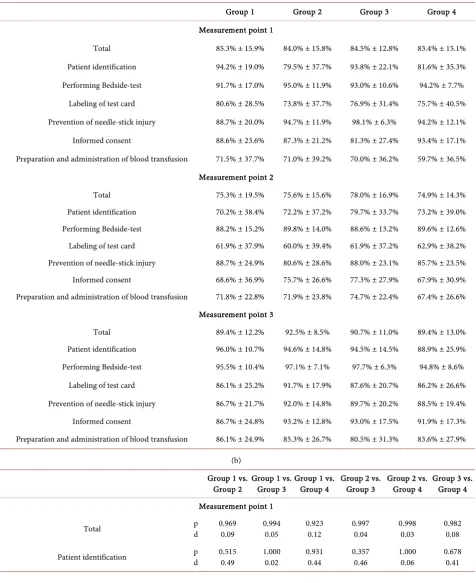
There were nearly no statistically significant differences and small educational effect sizes among the groups with respect to the technical (Table 2(a) and
Ta-ble 2(b), Table 3(a) and Table 3(b)) and non-technical ratings for the three
measurement points. When comparing students’ performance among the three cohorts, there were significant improvements in all groups (Table 4(a) and Ta-ble 4(b)).
4. Discussion
DOI: 10.4236/ce.2018.98091 1227 Creative Education Table 1. Characteristics of the groups. Group 1: Expert video feedback; Group 2: Peer video feedback; Group 3: Standard video; Group 4: Oral feedback. For the items “age,” “duration of study” and “number of previous OSCE,” the data are presented as the means.
Study Group Group 1 Group 2 Group 3 Group 4 Total
Number of participants 48 49 52 50 199
Male 17 (37.5%) 17 (34.7%) 17 (32.7%) 18 (36.0%) 69 (34.7%)
Age (years) 24.2 22.9 23.8 23.5 23.6
Duration of study (years) 3.0 2.9 2.9 3.0 3.0
Number of previous OSCEs 1 1 1 1 1
Number of previous clinical electives 0.4 0.5 0.5 0.4 0.5
Duration of previous clinical electives
(Total mean in weeks) 3.9 3.6 3.3 3.3 3.5
Professional qualification as
-Nurse 3 1 1 1 6
-OTA 0 0 0 0 0
-Other (medical/nursing) 2 2 2 1 7
-Other (social science/psychological) 1 0 0 2 3
Table 2. (a) Wound management: Results of checklist rating for Measurement points 1 - 3. Results of the checklist rating in total and for each checklist part. Given are the mean scores in % of the total score ± standard deviation. Group 1: Expert video feed-back; Group 2: Peer video feedfeed-back; Group 3: Standard video; Group 4: Oral feedfeed-back; (b) Wound management: Differences and educational effect sizes between study groups for Measurement points 1 - 3. Group 1: Expert video feedback; Group 2: Peer video feedback; Group 3: Standard video; Group 4: Oral feedback.
(a)
Group 1 Group 2 Group 3 Group 4
Measurement point 1
Total 68.7% ± 18.1% 67.9% ± 18.6% 64.6% ± 19.4% 76.7% ± 14.6% Preparation of hygienic working 56.9% ± 23.0% 68.7% ± 21.2% 61.9% ± 21.5% 65.3% ± 26.8% Preparation of sterile material 86.7% ± 12.9% 87.8% ± 11.6% 86.1% ± 14.3% 85.7% ± 12.4% Putting on sterile gloves 83.9% ± 25.0% 77.0% ± 30.6% 81.7% ± 32.1% 89.3% ± 17.7% Wound desinfection 60.0% ± 39.9% 58.6% ± 41.4% 53.1% ± 42.9% 76.9% ± 33.1% Covering wound with sterile drape 46.6% ± 47.9% 37.0% ± 44.7% 32.5% ± 41.7% 58.4% ± 44.7%
Measurement point 2
Total 83.1% ± 10.2% 89.3% ± 6.6% 86.4% ± 9.6% 85.5% ± 6.4%
Preparation of hygienic working 59.4% ± 23.9% 71.9% ± 25.5% 63.2% ± 19.8% 60.0% ± 26.1% Preparation of sterile material 85.6% ± 12.8% 93.6% ± 8.5% 89.0% ± 9.8% 88.0% ± 10.8% Putting on sterile gloves 81.3% ± 22.0% 80.2% ± 17.2% 90.7% ± 14.5% 81.7% ± 20.7% Wound desinfection 89.3% ± 13.7% 91.7% ± 12.3% 89.5% ± 21.8% 94.2% ± 8.7% Covering wound with sterile drape 84.0% ± 26.4% 90.8% ± 13.5% 89.2% ± 18.6% 83.8% ± 22.3%
Measurement point 3
[image:7.595.75.539.417.731.2]DOI: 10.4236/ce.2018.98091 1228 Creative Education (b)
Group 1 vs.
Group 2 Group 1 vs. Group 3 Group 1 vs. Group 4 Group 2 vs. Group 3 Group 2 vs. Group 4 Group 3 vs. Group 4 Measurement point 1
Total p d 1.000 0.04 1.000 0.22 0.524 0.49 1.000 0.17 0.312 0.52 0.023 0.71
Preparation of hygienic working p d 0.063 0.53 0.715 0.22 0.288 0.34 0.449 0.32 0.886 0.14 0.878 0.14
Preparation of sterile material p d 0.977 0.09 0.996 0.04 0.982 0.08 0.918 0.13 0.861 0.17 0.999 0.03
Putting on sterile gloves p d 0.626 0.24 0.983 0.07 0.608 0.25 0.876 0.15 0.080 0.49 0.457 0.29
Wound desinfection p d 1.000 0.04 1.000 0.17 0.284 0.46 1.000 0.13 0.201 0.49 0.048 0.62
Covering wound with sterile drape p d 1.000 0.21 1.000 0.32 1.000 0.25 1.000 0.11 0.196 0.48 0.040 0.60
Measurement point 2
Total p d 0.150 0.72 1.000 0.33 1.000 0.28 1.000 0.36 0.582 0.58 1.000 0.10
Preparation of hygienic working p d 0.197 0.51 0.958 0.17 1.000 0.02 0.484 0.38 0.258 0.46 0.980 0.14
Preparation of sterile material p d 0.054 0.74 1.000 0.30 1.000 0.20 0.447 0.50 0.324 0.58 1.000 0.10
Putting on sterile gloves p d 0.999 0.06 0.173 0.51 1.000 0.02 0.088 0.66 0.997 0.08 0.227 0.51
Wound desinfection p d 0.965 0.19 1.000 0.02 0.712 0.43 0.971 0.12 0.968 0.23 0.706 0.28
Covering wound with sterile drape p d 0.687 0.33 0.871 0.23 1.000 0.01 0.993 0.10 0.564 0.38 0.802 0.28
Measurement point 3
Total p d 0.174 0.61 1.000 0.26 0.875 0.53 1.000 0.36 1.000 0.10 1.000 0.27
Preparation of hygienic working p d 0.195 0.49 0.628 0.33 0.979 0.15 0.940 0.19 0.444 0.39 0.934 0.19
Preparation of sterile material p d 1.000 0.25 1.000 0.29 0.474 0.39 1.000 0.04 1.000 0.18 1.000 0.15
Putting on sterile gloves p d 0.268 0.46 0.998 0.09 0.957 0.18 0.526 0.35 0.625 0.32 0.999 0.08
Wound desinfection p d 0.401 0.41 0.988 0.13 0.302 0.45 0.764 0.27 1.000 0.02 0.659 0.31
DOI: 10.4236/ce.2018.98091 1229 Creative Education Table 3. (a) Bedside test: Results of checklist rating for Measurement points 1 - 3. Results of the checklist rating in total and for each checklist part. Given are the mean scores in % of the total score ± standard deviation. Group 1: Expert video feedback; Group 2: Peer video feedback; Group 3: Standard video; Group 4: Oral feedback; (b) Bedside test: Differences and educational effect sizes between study groups for Measurement points 1 - 3. Group 1: Expert video feedback; Group 2: Peer video feedback; Group 3: Standard video; Group 4: Oral feedback.
(a)
Group 1 Group 2 Group 3 Group 4
Measurement point 1
Total 85.3% ± 15.9% 84.0% ± 15.8% 84.5% ± 12.8% 83.4% ± 15.1% Patient identification 94.2% ± 19.0% 79.5% ± 37.7% 93.8% ± 22.1% 81.6% ± 35.3% Performing Bedside-test 91.7% ± 17.0% 95.0% ± 11.9% 93.0% ± 10.6% 94.2% ± 7.7% Labeling of test card 80.6% ± 28.5% 73.8% ± 37.7% 76.9% ± 31.4% 75.7% ± 40.5% Prevention of needle-stick injury 88.7% ± 20.0% 94.7% ± 11.9% 98.1% ± 6.3% 94.2% ± 12.1% Informed consent 88.6% ± 23.6% 87.3% ± 21.2% 81.3% ± 27.4% 93.4% ± 17.1% Preparation and administration of blood transfusion 71.5% ± 37.7% 71.0% ± 39.2% 70.0% ± 36.2% 59.7% ± 36.5%
Measurement point 2
Total 75.3% ± 19.5% 75.6% ± 15.6% 78.0% ± 16.9% 74.9% ± 14.3% Patient identification 70.2% ± 38.4% 72.2% ± 37.2% 79.7% ± 33.7% 73.2% ± 39.0% Performing Bedside-test 88.2% ± 15.2% 89.8% ± 14.0% 88.6% ± 13.2% 89.6% ± 12.6% Labeling of test card 61.9% ± 37.9% 60.0% ± 39.4% 61.9% ± 37.2% 62.9% ± 38.2% Prevention of needle-stick injury 88.7% ± 24.9% 80.6% ± 28.6% 88.0% ± 23.1% 85.7% ± 23.5% Informed consent 68.6% ± 36.9% 75.7% ± 26.6% 77.3% ± 27.9% 67.9% ± 30.9% Preparation and administration of blood transfusion 71.8% ± 22.8% 71.9% ± 23.8% 74.7% ± 22.4% 67.4% ± 26.6%
Measurement point 3
Total 89.4% ± 12.2% 92.5% ± 8.5% 90.7% ± 11.0% 89.4% ± 13.0% Patient identification 96.0% ± 10.7% 94.6% ± 14.8% 94.5% ± 14.5% 88.9% ± 25.9% Performing Bedside-test 95.5% ± 10.4% 97.1% ± 7.1% 97.7% ± 6.3% 94.8% ± 8.6% Labeling of test card 86.1% ± 25.2% 91.7% ± 17.9% 87.6% ± 20.7% 86.2% ± 26.6% Prevention of needle-stick injury 86.7% ± 21.7% 92.0% ± 14.8% 89.7% ± 20.2% 88.5% ± 19.4% Informed consent 86.7% ± 24.8% 93.2% ± 12.8% 93.0% ± 17.5% 91.9% ± 17.3% Preparation and administration of blood transfusion 86.1% ± 24.9% 85.3% ± 26.7% 80.5% ± 31.3% 83.6% ± 27.9%
(b) Group 1 vs.
Group 2 Group 1 vs. Group 3 Group 1 vs. Group 4 Group 2 vs. Group 3 Group 2 vs. Group 4 Group 3 vs. Group 4 Measurement point 1
Total p d 0.969 0.09 0.994 0.05 0.923 0.12 0.997 0.04 0.998 0.03 0.982 0.08
DOI: 10.4236/ce.2018.98091 1230 Creative Education Continued
Performing Bedside-test p d 0.535 0.23 0.954 0.09 0.735 0.19 0.831 0.18 0.989 0.08 0.954 0.14
Labeling of test card p d 0.744 0.20 0.927 0.12 0.900 0.14 0.969 0.09 0.995 0.05 0.998 0.03
Prevention of needle-stick injury p d 1.000 0.37 0.030 0.64 1.000 0.34 1.000 0.36 1.000 0.04 1.000 0.40
Informed consent p d 1.000 0.06 1.000 0.29 1.000 0.23 1.000 0.24 1.000 0.32 0.089 0.53
Preparation and administration of blood transfusion p d 1.000 0.01 0.997 0.04 0.408 0.32 0.999 0.03 0.437 0.30 0.515 0.28
Measurement point 2
Total p d 1.000 0.02 1.000 0.15 1.000 0.02 1.000 0.15 1.000 0.05 1.000 0.20
Patient identification p d 0.999 0.05 0.811 0.26 0.998 0.08 0.900 0.21 1.000 0.03 0.952 0.18
Performing Bedside-test p d 0.990 0.11 1.000 0.03 0.995 0.10 0.995 0.09 1.000 0.02 0.998 0.08
Labeling of test card p d 1.000 0.05 1.000 0.001 1.000 0.02 0.999 0.05 0.998 0.07 1.000 0.03
Prevention of needle-stick injury p d 1.000 0.30 1.000 0.03 1.000 0.12 1.000 0.29 1.000 0.20 1.000 0.10
Informed consent p d 1.000 0.22 1.000 0.27 1.000 0.02 1.000 0.06 1.000 0.27 1.000 0.32
Preparation and administration of blood transfusion p d 1.000 0.004 0.985 0.13 0.955 0.18 0.984 0.12 0.945 0.18 0.712 0.30
Measurement point 3
Total p d 1.000 0.29 1.000 0.11 1.000 0.00 1.000 0.19 1.000 0.28 1.000 0.11
Patient identification p d 1.000 0.11 1.000 0.12 1.000 0.36 1.000 0.00 1.000 0.27 1.000 0.27
Performing Bedside-test p d 0.951 0.19 0.822 0.26 1.000 0.07 0.998 0.08 0.735 0.29 0.453 0.38
Labeling of test card p d 1.000 0.26 1.000 0.06 1.000 0.00 1.000 0.21 1.000 0.24 1.000 0.06
Prevention of needle-stick injury p d 1.000 0.28 1.000 0.14 1.000 0.09 1.000 0.13 1.000 0.20 1.000 0.06
Informed consent p d 1.000 0.33 1.000 0.30 1.000 0.25 1.000 0.01 1.000 0.08 1.000 0.06
DOI: 10.4236/ce.2018.98091 1231 Creative Education Table 4. (a) Wound management: Differences and educational effect sizes between Measurement points 1 - 3 for each group. Group 1: Expert video feedback; Group 2: Peer video feedback; Group 3: Standard video; Group 4: Oral feedback; (b) Bedside test: Differences and educational effect sizes between Measurement points 1 - 3 for each group. Group 1: Expert video feedback; Group 2: Peer video feedback; Group 3: Standard video; Group 4: Oral feedback.
(a)
Group 1 Group 2
point 1 vs.
point 2 point 1 vs. point 3 point 2 vs. point 3 point 1 vs. point 2 point 1 vs. point 3 point 2 vs. point 3
Total p d 0.001 0.92 0.015 0.49 0.686 0.29 <0.001 1.31 <0.001 1.24 0.090 0.07
Preparation of hygienic working p d 0.735 0.10 <0.001 0.96 0.004 0.84 0.766 0.14 <0.001 1.13 0.002 0.82
Preparation of sterile material p d 0.656 0.09 0.584 0.22 0.072 0.31 0.002 0.56 0.050 0.48 0.866 0.08
Putting in sterile gloves p d 0.549 0.11 0.317 0.15 0.378 0.28 0.189 0.12 0.001 0.69 <0.001 1.03
Wound desinfection p d 0.002 0.83 0.069 0.35 0.612 0.47 <0.001 0.90 <0.001 0.78 0.793 0.20
Covering wound with sterile drape p d 0.003 0.90 0.452 0.16 0.028 0.76 <0.001 1.36 <0.001 0.97 0.068 0.45
Group 3 Group 4
Total p d <0.001 1.29 <0.001 0.99 0.966 0.22 0.009 0.69 <0.001 0.74 0.134 0.14
Preparation of hygienic working p d 0.621 0.06 <0.001 1.25 <0.001 1.25 0.607 0.20 <0.001 0.75 <0.001 0.99
Preparation of sterile material p d 0.267 0.23 0.007 0.57 0.094 0.44 0.197 0.19 <0.001 0.76 0.006 0.61
Putting in sterile gloves p d 0.033 0.32 0.106 0.27 0.941 0.06 0.202 0.39 0.665 0.12 0.225 0.49
Wound desinfection p d <0.001 0.98 0.002 0.64 0.337 0.36 0.030 0.58 0.088 0.36 0.302 0.34
Covering wound with sterile drape p d <0.001 1.57 <0.001 0.70 0.001 0.69 0.020 0.65 0.240 0.27 0.431 0.41
(b)
Group 1 Group 2
point 1 vs.
point 2 point 1 vs. point 3 point 2 vs. point 3 point 1 vs. point 2 point 1 vs. point 3 point 2 vs. point 3
Total p d <0.001 0.56 0.185 0.29 <0.001 0.83 0.032 0.53 0.001 0.63 <0.001 1.25
Patient identification p d 0.005 0.72 0.713 0.11 0.001 0.75 0.601 0.19 0.013 0.46 0.017 0.69
Performing Bedside-test p d 0.340 0.22 0.444 0.25 0.001 0.54 0.035 0.40 0.568 0.20 0.021 0.60
DOI: 10.4236/ce.2018.98091 1232 Creative Education Continued
Prevention of needle-stick injury p d 0.646 0.00 0.662 0.09 0.723 0.08 0.015 0.57 0.439 0.19 0.394 0.46
Informed consent p d 0.001 0.62 0.703 0.08 0.002 0.56 0.019 0.48 0.175 0.32 <0.001 0.76
Preparation and administration
of blood transfusion p d 0.214 0.01 0.035 0.44 0.001 0.60 0.861 0.03 0.093 0.41 0.006 0.53
Group 3 Group 4
Total p d 0.013 0.43 0.056 0.51 <0.001 0.85 0.018 0.58 0.038 0.42 0.001 1.06
Patient identification p d 0.041 0.48 0.959 0.04 0.014 0.51 0.105 0.23 0.416 0.23 0.144 0.46
Performing Bedside-test p d 0.025 0.36 0.013 0.51 <0.001 0.79 0.167 0.42 0.729 0.07 0.179 0.47
Labeling of test card p d 0.012 0.43 0.090 0.39 <0.001 0.80 0.055 0.33 0.231 0.29 0.038 0.69
Prevention of needle-stick injury p d 0.010 0.49 0.006 0.47 0.560 0.08 0.228 0.42 0.053 0.34 0.854 0.13
Informed consent p d 0.087 0.14 0.010 0.49 0.002 0.64 0.001 0.95 0.372 0.08 0.002 0.90
Preparation and administration
of blood transfusion p d 0.426 0.15 0.099 0.31 0.064 0.21 0.145 0.24 0.004 0.72 0.016 0.59
the literature are mixed concerning the effectiveness and appreciation of peer oral feedback compared with expert oral feedback (Burgess & Mellis, 2015; Eng-lish et al., 2006; Krause et al., 2017; Yeh et al., 2015). In addition to the debriefing process, reviewing one’s performance using a video may be a useful instructional supplement, but the literature regarding the effectiveness of video-enhanced learning is inconclusive (Birnbach et al., 2002; Farquharson et al., 2013; Oseni et al., 2017; Ruesseler et al., 2017; Savoldelli et al., 2006; Sawyer et al., 2012).
Ten Cate et al. stated that peer-assisted learning offers educational value to students on their own cognitive level, and it creates a comfortable and safe edu-cational environment to enhance the efficiency of the learning process (Ten Cate & Durning, 2007). However, peers should not simply replace an expert, but could instead complement a professional instructor’s know-how and experience.
DOI: 10.4236/ce.2018.98091 1233 Creative Education In the present study, we did not find any differences between peer video feed-back, expert video feedfeed-back, oral feedback and viewing a standard video. How-ever, we were able to demonstrate an increase in the students’ competence after their feedback. Thus, for undergraduate learners, expert feedback, video feed-back, or the use of a standard video might be useful when beginning to learn a complex skill.
Despite of the feedback method outcomes, there are clearly obstacles related to the available resources and time intensiveness of video feedback. Additional technical equipment is required, such as cameras, laptops, memory cards, and tripods. Furthermore, supplementary staff was needed for recording and re-viewing the videos with participants. Admittedly, the standard video took less time. The standard video required non-recurring time for its production with actors and equipment, which requires extra preparation prior to the surgical training weeks.
A learning method is also characterized by its long-term effects. In the present study, this effect was evaluated in the second and third measurement time points. Previous studies suggest long-term learning improvements are associated with video feedback (Birnbach et al., 2002). However, in this study, all four me-thods of feedback led to clear improvements. The third measurement was part of a mandatory summary assessment. As a consequence, students learned inten-sively prior to this assessment, so the results may not reflect actual long-term ef-fects when comparing the feedback methods, and this needs to be considered when interpreting these results (Raupach, Brown, Anders, Hasenfuss, & Ha-rendza, 2013). To minimize this bias, we measured students at a second time point 2 weeks prior to the summary assessment. At this time point, there was no difference among the feedback groups. Keeping this in mind, the learning effect of all four feedback methods seems similar with respect to long-term retention.
In our study, the videos were deleted immediately after the review due to data privacy concerns, but previous studies found that taking the video home to watch repetitively enhanced the learning benefit of video feedback (Farquharson et al., 2013).
DOI: 10.4236/ce.2018.98091 1234 Creative Education Since this study was conducted within a single cohort of medical students at a single medical school, its explanatory power and transferability to other medical schools might be limited. However, the sample sizes for both tasks for all three measurements were large, especially considering the available literature. Addi-tionally, the effects observed did not negate these results.
A notable advantage of our work is that the study was performed within the students’ curriculum, and the mandatory training recapitulated what might oc-cur in real training scenarios, such as changing tutors and different motivations for each participant. Moreover, the feasibility of the video-enhanced feedback methods could be analyzed in the context of a surgical training curriculum and in its defined setting.
The strengths of this study include the large sample size, three measurements for short- and long-term retentiveness, an established training environment, a defined feedback structure, trained tutors, and instructed and blinded OSCE examiners.
5. Conclusion
Within the context of the curricular surgical training in the present study, vid-eo-assisted feedback in forms of expert feedback, peer feedback and standard video offered no significant benefit over oral feedback alone during simula-tion-based patient encounters.
Declaration of Interest
This work was supported by the German Federal Ministry of Education and Re-search (Grant 01PL12038A) as part of the joint reRe-search project, “Practical clini-cal competence—A joint program to improve training in surgery.” All authors declare that they have no conflicts of interest.
References
Beard, J. H., et al. (2012). Peer Assisted Learning in Surgical Skills Laboratory Training: A Pilot Study. Medical Teacher, 34, 957-959.
https://doi.org/10.3109/0142159X.2012.706340
Birnbach, D. J., et al. (2002). The Effectiveness of Video Technology as an Adjunct to Teach and Evaluate Epidural Anesthesia Performance Skills. Anesthesiology, 96, 5-9. https://doi.org/10.1097/00000542-200201000-00007
Brennan, T. A., et al. (2004). Incidence of Adverse Events and Negligence in Hospitalized Patients: Results of the Harvard Medical Practice Study I. Quality & Safety Health Care, 13, 145-151. https://doi.org/10.1136/qshc.2002.003822
Burgess, A., & Mellis, C. (2015). Receiving Feedback from Peers: Medical Students’ Per-ceptions. Clinical Teacher, 12, 203-207. https://doi.org/10.1111/tct.12260
Byrne, A. J., et al. (2002). Effect of Videotape Feedback on Anaesthetists’ Performance While Managing Simulated Anaesthetic Crises: A Multicentre Study. Anaesthesia, 57, 176-179. https://doi.org/10.1046/j.1365-2044.2002.02361.x
DOI: 10.4236/ce.2018.98091 1235 Creative Education https://doi.org/10.1136/bmj.a1961
English, R., et al. (2006). The Effectiveness and Reliability of Peer-Marking in First-Year Medical Students. Medical Education, 40, 965-972.
https://doi.org/10.1111/j.1365-2929.2006.02565.x
Fanning, R. M., & Gaba, D. M. (2007). The Role of Debriefing in Simulation-Based Learning. Simulation in Healthcare, 2, 115-125.
https://doi.org/10.1097/SIH.0b013e3180315539
Farquharson, A. L., et al. (2013). Randomized Trial of the Effect of Video Feedback on the Acquisition of Surgical Skills. British Journal of Surgery, 100, 1448-1453.
https://doi.org/10.1002/bjs.9237
Frank J. R., et al., eds. (2015). CanMeds Physician Competency Framework. Ottawa: Roy-al College of Physicians and Surgeons of Canada.
http://www.royalcollege.ca/rcsite/documents/canmeds/canmeds-full-framework-e.pdf Gerberding, J. L. (2003). Clinical Practice. Occupational Exposure to HIV in Health Care
Settings. New England Journal of Medicine, 348, 826-833. https://doi.org/10.1056/NEJMcp020892
Hodges, B. (2003). Validity and the OSCE. Medical Teacher, 25, 250-254. https://doi.org/10.1080/01421590310001002836
Issenberg, S. B., et al. (2005). Features and Uses of High-Fidelity Medical Simulations That Lead to Effective Learning: A BEME Systematic Review. Medical Teacher, 27, 10-28. https://doi.org/10.1080/01421590500046924
Krause, F., et al. (2017). The Impact of Expert and Peer Feedback on Communication Skills of Undergraduate Dental Students: A Single-Blinded, Randomized, Controlled Clinical Trial. Patient Education & Counselling, 100, 2275-2282.
https://doi.org/10.1016/j.pec.2017.06.025
Mahmood, T., & Darzi, A. (2004). The Learning Curve for a Colonoscopy Simulator in the Absence of Any Feedback: No Feedback, No Learning. Surgical Endoscopy and Other Interventional Techniques, 18, 1224-1230.
https://doi.org/10.1007/s00464-003-9143-4
Nesbitt, C. I. et al. (2015). Randomized Trial to Assess the Effect of Supervised and Un-supervised Video Feedback on Teaching Practical Skills. Journal of Surgical Education, 72, 697-703.https://doi.org/10.1016/j.jsurg.2014.12.013
Oseni, Z. et al. (2017). Video-Based Feedback as a Method for Training Rural Healthcare Workers to Manage Medical Emergencies: A Pilot Study. BMC Medical Education, 17,
149.https://doi.org/10.1186/s12909-017-0975-3
Raupach, T. et al. (2013). Summative Assessments Are More Powerful Drivers of Student Learning than Resource Intensive Teaching Formats. BMC Medicine, 11, 61.
https://doi.org/10.1186/1741-7015-11-61
Regehr, G. et al. (1998). Comparing the Psychometric Properties of Checklists and Global Rating Scales for Assessing Performance on an OSCE-Format Examination. Academic Medicine, 73, 993-997. https://doi.org/10.1097/00001888-199809000-00020
Rizzolatti, G., & Sinigaglia, C. (2007). Mirror Neurons and Motor Intentionality. Func-tional Neurology, 22, 205-210.
Ruesseler, M. et al. (2017). The Effect of Video-Assisted Oral Feedback versus Oral Feed-back on Surgical Communicative Competences in Undergraduate Training. European Journal of Trauma and Emergency Surgery, 43, 461-466.
https://doi.org/10.1007/s00068-016-0734-x
DOI: 10.4236/ce.2018.98091 1236 Creative Education Concept for Medical Students. Zentralblatt Fur Chirurgie, 135, 249-256.
https://doi.org/10.1055/s-0030-1247355
Savoldelli, G. L. et al. (2006). Value of Debriefing during Simulated Crisis Management: Oral versus Video-Assisted Oral Feedback. Anesthesiology, 105, 279-285.
https://doi.org/10.1097/00000542-200608000-00010
Sawyer, T. et al. (2012). The Effectiveness of Video-Assisted Debriefing versus Oral De-briefing alone at Improving Neonatal Resuscitation Performance: A Randomized Trial.
Simulation in Healthcarec, 7, 213-221. https://doi.org/10.1097/SIH.0b013e3182578eae
Sigrist, R. et al. (2013). Augmented Visual, Auditory, Haptic, and Multimodal Feedback in Motor Learning: A Review. Psychonomic Bulletin & Review, 20, 21-53.
https://doi.org/10.3758/s13423-012-0333-8
Ten Cate, O., & Durning, S. (2007). Peer Teaching in Medical Education: Twelve Reasons to Move from Theory to Practice. Medical Teacher, 29, 591-599.
https://doi.org/10.1080/01421590701606799
Van de Ridder, J. M. et al. (2008). What Is Feedback in Clinical Education? Medical Edu-cation, 42, 189-197. https://doi.org/10.1111/j.1365-2923.2007.02973.x