/
.
SCIENCE
Be
TECHNOLOGY
September, 1971
Vol.
2
0, No.9
CDI ••
puters
and automation
IN THIS ISSUE: Management, the Computer, and Society
-
Martin
Ernst
Computers and the Nation
-
Dr. Edward
E. David, Jr.
Security
in
On-Line Systems
-
Richard
A.
Hirschfield
Information Systems in Urban Governments -
Dr. Robert Keston
~ '-.
PERl180
IP02121 9904 7112
b
PERIUDICAL
f
1[2
'
III-
01572
*0
180
W SAN
CARLOS ST
SA
J
SE CA
95113
Computer
Announcement
The Most Important of All Branches of Knowledge
(Based on the editorial in the April 1971 issue of Computers and Automation)
It may be that there is a branch of knowledge which is the most important of all.
I[ so, I would maintain that it is a subject which used to have the name "wisdom" but nowadays does not have a recognized scientific name, or in any college a recognized department or faculty to teach it. This subject currently is a compound of common sense, wisdom, good judgment, maturity, the scientific method, the trained capacity to solve problems, systems analysis, operations research, and some more besides. Its earmark is that it is a general subject, not a special one like chemistry or psychology or astronautics. Useful names for this subject at this time are "generalogy" or "science in general" or "common sense, elementary and advanced".
Many editorials published in <'Computers and Automa-tion" have in one way or another discussed or alluded to this subject:
Examples, Understanding, and Computers / Decem-berl964
The Barrels and the Elephant: Crackpot vs. Pioneer / May 1965
Some Questions of Semantics / August 1965 Perspective / April 1966
Computers and Scientific Models / May 1967 New Ideas that Organize Information / December
1967-How to Spoil One's Mind - As Well as One's Computer / August 1968
The Catching of Errors by Inspection / September 1968
Tunnel Vision / January 1969 The Cult of the Expert / May 1969
Computers, Language, and Reality / March 1970 Computers and Truth / August 1970
The Number of Answers to a Question/March 1971 In the editorial "The Cult of the Expert" we offered a leaflet that belongs in this subject, "Right Answers - A Short Guide for Obtaining Them". More than 600 readers asked for a copy; so clearly this subject is interesting to the readers of C&A.
This subject is related to computers and the computer field in at least two ways:
First, many of the general principles which this subject contains can be investigated in experimental or real situa-tions by means of a computer. In fact, far more can be investigated by computer than can possibly be investigated by ordinary analytical mathematics.
Second, since computer professionals are in charge of computing machines, many people consider these profes-sionals responsible for the worthwhileness of the results of computers. Because of "garbage in, garbage out", computer professionals have a responsibility to apply common sense and wisdom in at least three ways:
Input - in the selection and acceptance of the data with which they begin;
Processing - in the processing through a system;
Output - in the interpretation and use of the an-swers.
Then the computerized systems will produce stIOng struc-tures that human beings can use and rely on, and not weak structures which will crash with false information or ridicu-lous results.
"
'C~mputers
and Automation" for April 1971 contains an article, "Common Sense, Wisdom, General Science, and Com-puters", which deals with this subject. For more t~an a doz-en years I have bedoz-en studying this subject - ever SInce I search-ed in avery large and good public library for a textbook ?n common sense or wisdom and found none at all. There IS, however, a great deal of Information to be gathered on this subject because a large number of great men, ancient, med-ieval, and modern, have made remarks and comments (usual-ly while talking or writing about something else) that belongin this subject. . . ,
. The subject of wisdom is parttcularly Important III these modern days. The subject has been neglected, while special sciences have been cultivated. Investigators have pursued the special sciences with the enthusiasm of a child with a new toy. Specialized science and specialized technology have rendered our earthly world almost unrecognizable:
All major cities on the planet are only a few hours
apart by jet plane. .
Millions upon millions of people who otherwIse would be dead are alive because of miracle drugs, - thus creating a population explosion;
Nuclear weapons if used can destroy mankind and civilization in a few hours; etc.
To deal with so many diverse, vast ,problems we need wisdom. To use wisdom we should study it.
The staff of "Computers and Automation" have decided that it is desirable to make the drawers full of information we have been collecting on this subject more accessible and more widely distributed. We have decided to publish twice a month a publication of newsletter type called "The C&A Notebook on Common Sen~e, Elementary and Advanced". For more details, see the announcement on page 3 opposite. (The first few issues of the Notebook are free.)
We invite you, our readers, to join us in the pursuit of this subject, as readers of the Notebook, and as partici-pators with us in the research and study.
DO YOU WANT TO
PREVENT MISTAKES BEFORE THEY- HAPPEN?
- avoid pitfalls?
- find new paths around old obstacles?
- see new solutions to old problems? distinguish between sense and nonsense? increase your accomplishments? improve your capacities? - apply in practical situations the observations and
wisdom of great scientists and wise men? - stimulate your resourcefulness?
IF SO,
TRY-The C&A Notebook on
dE
+
+
Editor: Edmund C. Berkeley, author, businessman, actuary, scientist, computer professional first secretary of the Associatio for Computing Machinery 194J
editor of Computers and Auton
RETURNABLE IN 7 DAYS FOR FULL REFUND, IF NOT SATISFACTORY
-WHY NOT TAKE A LOOK? ... HOW CAN YOU LOSE?
To: COMPUTERS AND. 815 Washington St. , YES, please e
San Jose
Public Library
fOR OVERllME A GHARGE Of 5 GENTS
~
DAY
\ND ADVANCED
le of the most important
f -\IT=
+
+
:oupon - THE NEXT 16 ISSUES ARE: ?reventing Mistakes from Failure
to Understand
['he Stage of Maturity and Judgment in any Field of Knowledge and Experience
'oomsday in St. Pierre, Martinique - Common Sense vs. Catastrophe he History of the Doasyoulikes dividuality in Human Beings, .••
)w to be Silly
Ie Three Earthworms .e Cochrans vs. Catastrophe
I of books is expected and any soiling, Careful usu~e . b uid for by the borrower,
damage or loss 1S to c P
___ ~~uUHVll .::len'se at $12 a year,
24 issues , ___ .. ~.L"'''''C.L· :;LYle), and extras.
Please send me (as FREE premiums for subscribing) the first six issues:
1. Right Answers - A Short Guide to Obtaining Them 4. Strategy in Chess
2. The Empty Column 5. The Barrels and the Elephant 3. The Golden Trumpets of Yap Yap 6. The Argument of the Beard I enclose $ ( ) Please bill me ) Please bill my organization
Name ____________________________________________________ __ Title ______________________ _ Organization ______________________________________________________________________________________ __ Address ____________________________ ----__________________________________________________________ ___ Signature __________________________________________________ _ Purchase Order No, ____________________ __
Vol. 20,
NO.9
September, 1971
Editor Edmund C. Berkeley
Assistant Editors Linda Ladd Lovett Neil D. Macdonald
Software Editor Stewart B. Nelson
Advertising
Director Edmund C. Berkeley
Art Directors Ray W. Hass Daniel T. Langdale
Contributing
Editors John BenneH
Advisory Committee
Editorial Offices
Advertising Contact
Moses M. Berlin Andrew D. Booth John W. Carr III Ned Chapin
Alston S. Householder Leslie Mezei
Ted Schoeters Richard E. Sprague
James J. Cryan Alston S. Householder Bernard Quint
Berkeley Enterprises, Inc. 815 Washington St., Newtonville, Mass. 02160
617-332-5453
THE PUBLISHER' Berkeley Enterprises, Inc. 815 Washington St., Newtonville, Mass. 02160 617-332-5453
Computers and Automation is published monthly (except two issues in June) at 815 Washington St., Newtonville, Mass. 02160, by Berkeley En-erprises, Inc. Printed in U.S.A.
SUDscription rates: United States, 11 monthly issues and two issues in .June (one of which is a directory issue) - $18.50 for 1 year, $36.00 for 2 years; 12 monthly issues (without directory issue in June) - $9.50 for 1 year; $18.00 for 2 years. Canada, add 50¢ a year for postage; foreiqn, add $3.50 a year for postage. Address all U.S. subscription mail to: Berkeley Enterprises,
Inc., 815 Washington St., Newtonville, Mass.
02160. Second Class Postage paid at Boston, Mass. Postmaster: Please send all forms 3579 to Berkeley Enterprises, Inc., 815 Washington St.,
Newtonville, Mass. 02160. © Copyright 1971, by
Berkeley Enterprises, Inc.
Change of address: If your address changes, please send us both your new addre~~ and your old address (as it appears on the magazine address imprint), and allow three weeks for the change to be made.
4
corn
I?nHE!,!:i!
The magazine of the design, applications, and implicat?:ons
of infoTmation pTocessing systems.
Computers and Security of the Business
15 SECURITY IN ON-LINE SYSTEMS - A PRIMER FOR
MANAGEMENT [T A]
by Richard A. Hirschfield, Executive Vice President, Computer Audit Systems, Inc.
How an on-line computer system can be protected by: prevent-ing illegal access to data; controllprevent-ing the data received at the computer from remote locations; providing for back-up systems; and auditing the system.
Compu ters and Cities
21 INFORMATION SYSTEMS IN URBAN GOVERNMENTS [T A]
by Dr. Robert Keston, President, Keston Associates
The integration and reorganization of various units of local government permits successful use of computerized informa-tion systems for solving urban problems.
Computers Abroad
18 THE JAPANESE COMPUTER MARKET - CHARACTERISTICS ADVERSELY AFFECTING U.S. TRADE INTERESTS
.... Part Two [T A]
by Stephen T. McClellan, Analyst, U.S. Department of Commerce How the Japanese government protects its computer industry by financial controls on foreign computers.
Computers and Society
8 MANAGEMENT, THE COMPUTER, AND SOCIETY [T A]
12
by Martin Ernst, Arthur D. Little, Inc., Cambridge, Mass.
Large groups of people can be hurt by expansion in the range of computer activities ... and it is desirable for businessmen to recognize these problems, and make an effort to overcome them.
COMPUTERS AND THE NATION
by Dr. Edward E. David, Jr., Science Adviser to President Richard M. Nixon
[NT A]
How computers might become a major resource for the nation.
Computers, Common Sense, Wisdom, and Science in General
6 NINE AND NI-YEN [NT E]
2
3
7
by Edmund C. Berkeley, Editor, Computers and Automation Human beings are able to function with many kinds of inaccu-racies, confusions, and perplexities. Computers can't. The interaction is producing a desirable pressure on the conven-tional behavior of human beings.
THE MOST IMPORTANT OF ALL BRANCHES OF KNOWLEDGE
Common sense, wisdom, and science in general.
THE C&A NOTEBOOK ON COMMON SENSE, ELEMENTARY
[NT F]
AND ADVANCED [NT F]
Announcement
Computers, Communications, and Cryptography
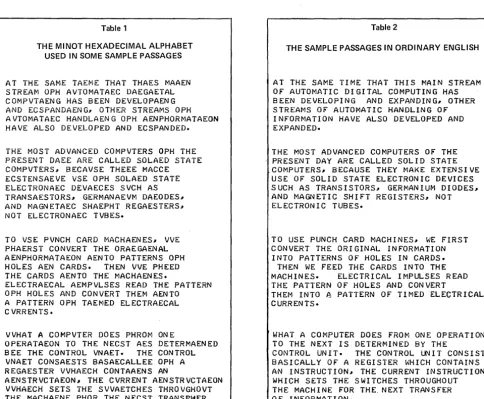
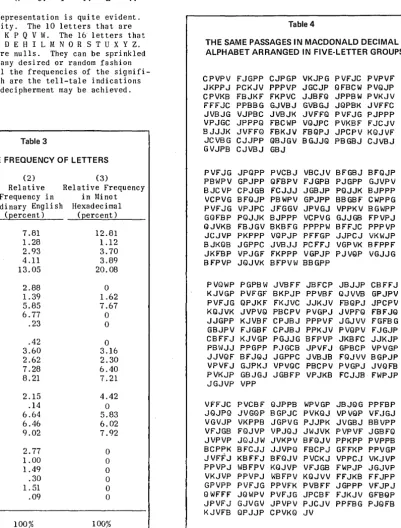
36 COMMUNICATION AND CIPHERS, WITH A HEXADECIMAL
ALPHABET AND VARIATIONS [T A]
by O. N. Minot, Lexington Research, the Editor, and Neil Macdonald, Assistant Editor
The use of computers to produce ciphers, to perform encipher-ing and decipherencipher-ing, and to solve cipherencipher-ing systems, probably allows a new level of complexity in ciphering systems to be-come practical.
Computers, Science, and Assassinations
26 THE FEDERAL BUREAU OF INVESTIGATION AND THE
ASSASSINATION OF PRESIDENT KENNEDY [NT A]
by Bernard Fensterwald, Jr., Attorney
How J. Edgar Hoover and the FB I withheld much pertinent in-formation from the Warren Commission, flooded them with irrelevant information, and altered some important evidence, thus concealing Oswald's connections with the FBI.
Computers and Unemployment
30 THE UNEMPLOYED COMPUTER PROFESSIONAL TURNED
BUSINESSMAN: PRODUCTS AND SERVICES WHICH A
NEW SMALL BUSINESS MIGHT PRODUCE OR OFFER [NT A] by Edmund C. Berkeley, Editor
How an unemployed computer professional might go into business for himself and earn a reasonable income as his own employer.
The Golden Trumpet
32 "90 Million People Fully Employed in 80 Million Jobs"
- Comments [NT G]
Computers in an Anti-Ballistic Missile System
33 I Believe in an Anti-Ballistic Missile System [T F]
by R,obert L. Glass and the Editor
33 A Publication that Thinks About the Profession and the
Relation of the Profession to Society [T F]
by Michael Lipp, Cybermatics Inc.
34 One Computer Professional for the Anti-Ballistic Missile System [T F] by Ronald G. Windsor, Harford Junior College
34 Seven More Computer Experts Become Sponsors of Group
Against ABM [T F]
by M. Kozikowski, Computer Professionals Against ABM
35 "The Anti-Ballistic Missile System is Defensive" [T F] from Patrick M. Cooney to Daniel D. McCracken
35 Gathering Force Against the ABM [T F]
based on a report by Victor K. McElheny, "The Boston Globe"
Computers and Puzzles
7 Problem Corner, by Walter Penney, COP
48 Numbles, by Neil Macdonald
COMPUTERS and AUTOMATION for September, 1971
[T C]
[T C]
Front Cover Picture
The front cover shows an im-pact printer which, together with a keyboard attachment, can input or output to a computer over 10,000 different characters. These may be ideographic, alphabetic, or symbolic, including Kanji ideo-grams (shown in the background), the Hiragana and Katakana alpha-bets, the Roman alphabet (upper or lower case), Arabic numerals, and other symbols. The two peri-pherals will be manufactured in Japan by I BM Japan Ltd. For more information, see page 43.
NOTICE
*0 ON YOUR ADDRESS IMPRINT MEANS THAT YOUR SUBSCRIP-TION INCLUDES THE COMPUTER DIRECTORY. *N MEANS THAT YOUR PRESENT SUBSCRIPTION :DOES NOT INCLUDE THE
COM-PUTER DIRECTORY.
Departments
40 Across the Editor's Desk 40 Applications
41 Education News 42 Mi scell aneous 48 Advertising Index 49 Calendar of Coming
Events 32, 48 Corrections
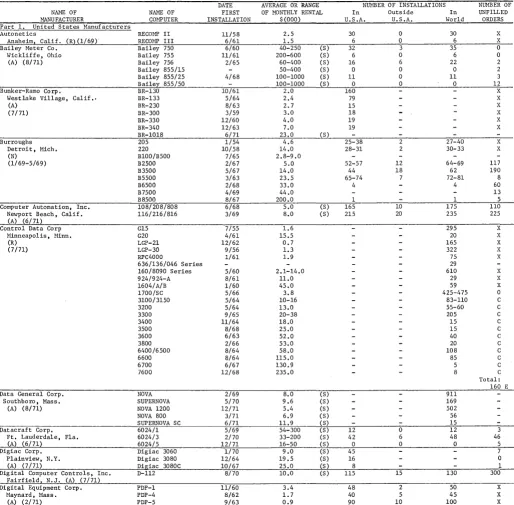
45 Monthly Computer Census
43 New Contracts 44 New Installations
Key
[A] - Article
[C] - Monthly Column [E] - Editorial
[F] - Forum
[G] - Golden Trumpet [NT] - Not Technical
[T] - Technical Computer Information
c. a
EDITORIAL
NINE AND NI-YEN
The use of computers is having a wholesome and beneficial influence on a number of strands of the conven-tional behavior of human beings. In this respect, computers are exerting an influence like the influence of big capital cities, and like mass communication systems such as radio and TV; these have caused the decline of linguistic dialects and the decrease of provincialism, among other things. Computers are exerting profound influences on the human uses of symbols and language.
More Systematic Symbols
For example, mathematicians have had until recently a habit of designating various rather simple mathematical ideas with ideographic symbols that are rather strange and forbidding to ordinary human b,eings. For example, an integral is often designated by the ideogram
J ;
an ideogram is a single picture, a diagram, or nonalphabetic symbol for an idea; the biggest ideographic system in existence is the system of Chinese characters. The ideogramJ
is derived from an old form of capital letter S, and Was chosen in order to allude to the initial letter of the word sum; it refers to the fact that an integral is a certain kind of sum. The symbol has an exact meaning that usually takes about twenty words to express, but is often read aloud by mathematicians as "the integral of'.But if a mathematician wishes to use this concept in a computer programming language, he regularly has to submit to the diScipline of a regular typewriter keyboard with 42 keys and two shifts for producing 84 letters, figures, and signs. And so he is compelled to use the far more general and basically much more sensible alphabetic system of symbolizing which employs a string of several letters to-gether, such as INT or INTG to stand for "the integral of". In trigonometry the alphabetic system has been used for more than 70 years; the usual trigonometric symbols are SIN, COS, TAN, COT, SEC, and CSC.
The alphabetic form of symbolizing will increase, the ideographic form will decrease, as the result of the use of computers.
More Distinguished Sounds
When we turn to spoken symbols, we notice that the use of machines to understand spoken words is just beginning. Among the first words which a listening machine (or listening peripheral for a computer) will need to distinguish are the spoken words for the ten decimal digits: ONE, TWO, THREE, FOUR, FIVE, SIX, SEVEN, EIGHT, NINE, ZERO (or OH). Nowadays even human beings listening often have trouble deciding whether a speaker is saying FIVE or saying NINE. So the telephone company has suggested using the pronunciation NI-YEN.
This suggestion often calls forth from many human beings the silly laughter and ridicule which expresses their resistance to change. These are the people who would rather believe what they already believe than make any effort to change their minds for valid reasons. In other words, they would rather die than think - and often do. It is an unusual person who can reply like the famous Irishman who, when asked why he had changed his mind and run away from a battle, replied, "I'd r-r-ruther be a cowar-r-rd for five minutes than a cor-r-rpse for the r-r-rest of me life."
NI-YEN is a good suggestion, and there are many more like it. Everybody who is interested in a better future - one which holds less confusion than our days do _. should try to implement NI-YEN and its relatives. In this way we give the listeners the breaks, rather than the dictionaries, which regularly report only good current usage - and do not add such a remark as "the recommended new pronunciation is
NI-YEN".
Less Sloppiness
Another significant influence of computers on conven-tional human behavior is the increased requirement com-puters place on human beings to be more accurate and more complete - less sloppy. Nowadays, computer pro-grams only rarely apply common sense to words and figures, and "recognize from the context" that certain
words must be wrong. In the printing of an article to be read by human beings, a proofreader can let slip by the word "bandwith" instead of "bandwidth" (as we unfor-tunately did on page 30 of "Computers and Automation" for April). Human beings (though not computers) are likely to guess the correction needed, in fact may not even detect the error.
But a computer is sensitive to the spelling of the symbols that its program works with. There is on record the miss of a Mariner space probe to Mars; it missed Mars, as I recollect, because at one point in the computer program there was a hyphen instead of a blank.
Human beings are able to function with ideograms, insufficiently distinct pronunciations, incorrect spellings, imprecise words, and many other kinds of inaccuracies, confusions, and perplexities. This occurs mainly because human beings come equipped with a built-in evaluating function which uses observations, context, surroundings, experience, judgement, and capacity to decide. So a human being can easily say, "She told me 'I hate you', but I know she did not mean that." A computer program can't behave that way at all easily.
This evaluating function clearly is derived from more than 300 million years of evolution, during which living species developed capacities to solve problems of finding food, judging food, finding shelter, escaping from danger, etc. I would like to call the evaluating function "the old brain". The evaluating function does not include symbolic language, a facility which probably has not evolved for much more than 3 million years, although the evaluating function can of course be applied to symbolic language. The handling of symbolic language is in "the new brain", in the human brain and perhaps in the dolphin's brain.
Computers behave very differently. Within a computer there is a very close correspondence between ideas and strings of symbols. Computer programming for reasonable operations, and computer representations for reasonable data, are very systematic. And so computers require from human beings behavior which is more sensible, reasonable, accurate, complete, and systematic than human beings have ever been accustomed to providing. This is a desirable pressure.
Edmund C. Berkeley Editor
PROBLEM CORNER
Walter Penney, CDP Problem Editor
Computers and Automation
PROBLEM 719: MESSAGES IN MATH?
"Abe is a queer combination of mystic and computer
man'~, Pete said. "He sees all sorts of meanings in things
we'd never give a second thought to."
"What is he seeing now?" asked Dick. "Not some more hexadecimal output spelling out his name, I hope."
"No, not this time. He's trying to figure out why he got the number of this year as a solution to one of his problems. He's sure there's something significant there."
"What problem is that?"
"Well, he decided he would try to disprove. Fermat's Last Theorem by fmding an integral solution of
Y!
+
y3
=z3. He had the crazy idea that he might be able to creep up on it by easy stages, first solving x2
+
y2=
Z3, then x2+
y3=
Z3, and fmally x3+
y3=
r."
"Did he ever succeed?" Dick was beginning to get interested.
"No, of course not. Actually he got sidetracked and never got beyond the first equation. The first solution he got for x2
+
y2=
r
had x=
1971 and he was sure the computer was trying to tell him something. I don't know how much machine time he's wasted trying to figure this out.""What were the values of y and z?"
"Suppose we leave that as an exercise for the student", said Pete with a smile.
What were the values of y and z?
Solution to Problem 718: Odds on Aces
The probability of getting an Ace in the first seven cards 24-23-22-21-20-19-18 154 . is 1 - 26-25-24-23-22-21-20
=
325 or .474approxl-mately. Hence the odds were against Joe.
Readers are invited to submit problems (and their solutions) for publication in this column to: Problem Editor, Computers and Automation, 815 Washington St., Newtonville, Mass. 02160.
The C&A Notebook on COMMON SENSE, ELEMENTARY AND ADVANCED - NEWS AND DEVELOPMENTS
We are much encouraged by the subscription enrollment so far in "The C &A Notebook on Common Sense, Elementary and Advanced". Although no subscription solicitations have been mailed so far, our subscribers to the Notebook (at present writing almost 200) include many very thoughtful people and a number of large, important organizations.
As a result, it seems clear: first, that the Notebook is fill-ing a definite need; and second, that we can do some thfill-ings that we had hoped to do, but were not at the start ready to promise to do, namely:
(1) Include as dividends in the first volume at least 6 more issues, making the total issues in Volume 1 at least 30; (2) Focus from time to time on ideas that are worth their
weight in gold;
(3) Continue to mail all issues by first class mail; and (4) Continue to start all subscribers at Vol. 1, No.1, so
that no one loses earlier published information. The contributions of essays and reports that have so far been received from the two dozen Participators in the project are in general much more interesting and much more squarely on the subj ect than we had anticipated.
So the project of investigating common sense, wisdom, and science in general, and their relations to computers ap-pears to be one of the most interesting and important projects that "Computers and Automation" and its supporters have ever undertaken. Of course, computers are an ideal resource for in-vestigating situations, environments, and problems in general.
MANAGEMENT, THE COMPUTER, AND SOCIETY
"It is important to recognize the existence of many factors which can operate
to make the compu ter socially unpalatable. "
Martin
Ernst
Arthur
D. Little,Inc.
25 Acorn Park
Cambridge, Mass. 02140
(Based on a talk to businessmen in Boston, Mass., June 9, 1971)
Seventeen years ago the first attempt was made to put a computer to routine industrial use. In 1953, General Elec-tric tried to place their local payroll on a computer at Appliance Park. From all accounts, they had a terrible time. It took many months; major difficulties were encountered; and, all in all, it was a very painful process.
If you want to buy a computer today, Neiman-Marcus will be glad to supply you with a Honeywell machine for home use - if you can figure out what you want to do with it. So, computers have moved from a rarity to something we encounter almost every day in one form or another.
Cost Reductions
Growth in the computer business has been fed by technological advances that have made computing
equip-Martin L. Ernst pioneered in operations analysis and systems development. As Associate Director, he was responsible for most of the research done by the Operations Analysis Group operated by Massachusetts Institute of Technology for the Chief of Naval Operations. His projects at Arthur D. Little include one of the world's largest non-government on-line systems and the currept attack on Wall Street's paper crisis. Mr. Ernst is a past President of the Operations Research Society of America.
ment cheaper and better each year; and technological progress is defmitely going to continue at a high rate for at least another decade. For example, we can expect approxi-mately a doubling in speed of large central processors, during the next five years or so and a halving in cost per unit of computer power. Even more dramatic improve-ments in mini-computer cost-effectiveness seem assured. Gains by a factor of as high as ten may be possible prior to 1980.
For a long time, high speed core memory has been an expensive item in computer configurations. These memories will probably improve in access time by a factor of four in the next decade, and their costs will probably decrease by a factor of between four and eight. Low speed memory in the past has tended to be monopolized by magnetic tapes or by fairly clumsy random access equipment. Now it is tech-nically possible to build devices that, for all practical purposes, have infinite memory capacity and modest costs, although they will be relatively slow of access.
Cheaper Peripherals
With these equipment cost reductions under way, peripherals such as input/output terminals have become a major factor in the cost of modern installations; but even these are going to become cheaper as we move from mechanical devices, with their high production and main-tenance costs, to all-electronic systems. Finally, there is a strong likelihood that the entire data insertion process will
inexpensive, broadly useful character recognition equip-ment.
Stage Three
As equipment is becoming more diverse, efficient and cheaper, we are entering what sometimes is called Stage Three of computer usage. We have passed through the earlier periods, when the computer's capability was limited to performing 'simple clerical operations, or to producing routine decisions in areas such as inventory control. Now the primary excitement is in how computers can aid in major management decisions.
Social Problems of Computers
I could devote considerable space to discussing the problems of using computers for management decision-making, but there is another family of problems that is even more deserving of attention - what I will call the social problems associated with the use of computers. First, let me explain
why
I have selected this subject. Fundamen-tally, I happen to be a believer in computers - in the sense that I think they can help us perform a great range of tasks better, while relieving us of a lot of boring, routine, human operations. However, I think it important to recognize the existence of many factors which can operate to make the computer socially unpalatable.There are large groups of people who can be hurt by expansion in the range of computer activities and there is a lot of fear - both justified and unjustified - of such developments. Many of the sources of concern arise in a business context and businessmen can alleviate some of them. So, I seek to call the attention of businessmen to these problems in the hope that you will recognize them in your own use of computers and will make the effort to overcome them. By doing this it will be possible to tay-e relatively full advantage of computers without paying un-due social penalties.
Although I repeatedly refer to the computer, I am concerned not with the computer itself but with the many activities and operations which it makes possible and economical. The computer is a tool and no more respon-sible for its use than the gun employed in a murder; however, in both instances, those who build and sell these tools, and those who have legitimate and desirable uses for them, have an obligation to participate actively in measures to prevent their misuse. The problem of personification of computers is not a theoretical one: a small society of professionals has already been organized to combat this tendency. Somewhat related, a major computer manu-facturer is placing advertisements devoted to the question of whether computers are "for or against us."
Early Warnings of Social Dangers
We have had early warnings of the social dangers in the growth of computer usage; for example, Norbert Weiner raised important questions many years ago in his first book on cybernetics. However, until recently these warnings meant very little - computers played too small a role in society to make their unpleasant aspects very painful. Our period of grace is now coming to an end. It would be good to give you a well structured and orderly statement of the origins of our problems and their potential cures. But, I don't believe we have reached a stage in understanding that permits this. The best I can do is to share with you some
examples, ideas, and suggestions that are still in a formative stage, in an effort to begin more productive thinking.
To help present these tentative ideas, I have divided computer impact into three broad areas: depersonalization, talent bias and vulnerability. These terms can best be explained by citing some examples.
Depersonalization
The origins of depersonalization lie in the high degree of standardization needed to use computers efficiently. As computer activities spread their influence, individuals tend to feel that they are being molded to fit the computer's needs rather than that the computer is being employed to meet their needs. It probably is no accident that, during the first of the major campus riots at Berkeley, resentment was directed to the punch cards and computers that students claimed made them feel more like numbers than like people.
Airlines Systems
A more concrete example lies in airlines reservations systems. A few of the largest airlines have been able to plan and develop computer reservations systems tailored to meet their own particular needs, but this process is difficult and expensive. Smaller airlines have no choice but to select an existing package of programs and attempt to modify them to fit their own character and style. I know of one case where a review indicated a need for some 60 significant program changes in an available package if the resulting system was to match the operating procedures and philos-ophy of the airline. When the effort for performing such a surgical operation was investigated, the airline decided it could afford almost none of these desirable changes. It now operates like every other airline employing the same basic system and has lost a bit of its special personality and flavor.
Billing Operations
Another unpleasant encounter with computers, which I am sure we all face, involves dealing with a company that has automated its billing operations. At first I had faith that this would be a transient situation but during the prepara-tions for this talk I found that this is not the case. One associate of mine is currently going through the excruciat-ing process of unsnarlexcruciat-ing his financial obligations to a successful, widely known and highly efficient organization, while another associate went through exactly the same process - and for the same reasons - with the same company as much as six years ago. The problem arises from the fact that it is always difficult to insert an exception into a computer run. This difficulty is compounded if an organization seeks to get by with minimum training of the clerical staff that examines the customer input of payments and complaints about misbilling. The final result is that the customer writes letter after letter into a non-answering void, with resentment growing at each cycle.
Dealing With Exceptions
I regard this as a real business failure. Planning to deal with exceptions has been completely inadequate in the design of most computer billing systems and their associ-ated manual procedures. There seems to be little excuse for this. Very few companies have difficulty picking up changes of address in the blank spaces provided for this purpose on most bills. No company with which I have had contact has similarly provided a set of blank spaces for their customers to register disagreement with the billing data reported to them!
Load Balancing
There are many other examples associated with standard customer-business relationships. We are all subject to some of the penalties of load balancing, which has become an important requirement of all major computer installations. Instead of consistently getting bills to be paid by the ttmth of the month, as was the case in my father's day, bills keep streaming in throughout the month as various service installations attempt to keep their computers loaded evenly. With delays in computer output and mail delivery, and interest penalties for slow payment, one has to keep the checkbook constantly on hand.
These are all minor matters if viewed singly, but, when accumulated, they boost our frustration level alarmingly and seem to chip away at our individuality and personality.
Privacy
A second area of depersonalization concerns privacy. Privacy considerations occur most frequently in regard to credit information, though even more serious invasions may occur in the collection and transmission of health, employ-ment and other information. We have collected and em-ployed credit information for a very long time, but neyer with the degree of completeness and nationwide access made possible by high speed communications and elec-tronic data processing equipment. I wonder how many of you are completely satisfied that the information concern-ing your own credit is based on appropriate inputs? How many of you would like to see this information, to make sure that failure to pay a bill during some past period because the circumstances justified your delay does not appear on your records as a negative mark.
Rights to Individuals to Discover what Credit Organizations Have on File About Them
Fortunately, some solid steps have been taken in this area of credit information. A national law now gives significant rights to individuals to discover what informa-tion concerning themselves is being held on file. S('me of the better credit associations took equivalent or even stronger steps prior to the passage of this law. Unfortu-nately, as with most legal steps, there are a number of loopholes; and we again face the problem that the least sophisticated among us are not apt to discover and apply their rights even though they are the ones who probably suffer most from the system.
Further, credit information is by no means the only area of concern. There are many reasons for developing good medical data banks but the issues of privacy and access must be solved before these banks can be made effective. The subject of psychiatric information is a particularly
difficult one since, without proper safeguards it could be used for blackmail purposes.
Displacement by Computers
A third area of depersonalization has to do with the opportunities for white collar workers to get started in business. The current situation, as most of you are aware, is one wherein more and more clerks are being displaced by computers. So far, this displacement has been largely made up for by the increasing numbers of people needed to handle the input and output information, to design com-puter programs, and to undertake the variety of services necessary to use computers effectively. However, one very large component of this work force - the personnel responsible for preparing input - is threatened by the development of efficient and economical character recogni-tion devices. I feel that in the next decade a significant component of the current work force in this area will be eliminated. This means that a certain type of starting job for the white collar worker will disappear in much the sense that the automatic elevator removed a kind of starting opportunity for the least trained blue collar workers. We do not seem to have particularly good alternatives available for the starting clerical worker, so a certain range of opportuni-ties is going to be cut off and there undoubtedly will be resentment about this process.
Disenfranchisement of People Through Credit Cards
Finally, and an extreme case, the use of computers can lead to a form of disenfranchisement of people. This possibility shows up most clearly in the area of credit cards, a phenomenon whose growth is closely tied to computers. The use of these cards is increasing at a rapid rate, and over a period of time, we can visualize approaching an almost cashless society. One can ask the question: what happens then to a man who cannot get credit and cannot obtain a credit card? Will he, in a valid sense, be banned from a form of equal opportunity in our society?
We have other examples of indirect forms of disenfran-chisement already operating and some of them are quite painful. People who, because of age or disability, are not able to drive private automobiles, are disenfranchised from a considerable portion of our social activity because they have almost completely lost a mobility on which our society depends as our public transport degenerates.
They fmd themselves limited as to where they can live and where they can work; they are not only restricted in activities but very likely must pay more for the basic elements of living because of these restrictions.
The beginnings of this type of disenfranchisement in the credit card area are already beginning to be evident. When one registers at a hotel in a number of U.S. cities, there is a sign behind the registration desk to the effect that the local innkeepers' association "requires" that guests either provide an acceptable credit card or pay for their room in advance. This may make good business sense for the hotels, but it is also a minor indignity. The passing of blame for the act to an innkeepers' association has a ring of phoniness and deprives the consumer - and, at least in theory, the hotels - of their freedom of choice in the market.
Talent Bias
A second broad area of social impact by computers concerns the extension of an existing talent bias - a bias in
favor of technical training and experience as opposed to the humanities. As we move into Stage Three of the computer revolution, there will be changes in the requirements for talent to serve business effectively. Previously, computers have been devoted to clerical areas which, by their nature, already had to be routinized within a given company. Management decisions are not standard and we rarely have a library of procedures available that can be programmed into a computer. If we wish to use the computer effec-tively, we are going to have to develop new techniques. We
will have to acquire large numbers of personnel for develop-ing these techniques and analyzdevelop-ing the output of computer runs. For example, a lot has been written and some excellent work has been done on the role of simulations in the decision-making process. But just a few minutes of time on a computer, running a complex simulation, can call for many man-months of analysis to understand the implica-tions of the output. One result will be enormous require-ments for analytical skills in business staffs.
Analytical Skills Not Backed With Practical Experience
Analytical skills unbacked with realistic experience can lead to a variety of difficulties. Our military organization has often been a leader in trying new techniques; so it is worthwhile taking a quick look at what has been happening recently in the Pentagon. During the McNamara era, enor-mous emphasis was placed on employing analytical tech-niques to establish and justify expenditure levels. There were many cases in which these techniques were not well employed because we did not have the skills available yet. Failures due to misapplication have approached a very strong reaction to the analytical approach for developing expenditure budgets. These skills are now being employed far less by the military.
We face a situation where competition will demand effective employment of skills in short supply. Either the performance will be poor, leading to backtracking and loss of efficiency, or new procedures will be necessary for providing both a larger supply of technical skills and a basis for combining these skills with practical experience.
Addiction of Playing Games With Computers
Another area of talent bias arises in training and educa-tion. Some months ago Datamation Magazine published a rather interesting science fiction-type article which, among other things, discussed a future period where playing games with computers had become a sociological disease very equivalent to narcotics addiction. It was an amusing article but it lost some of its humor when we made a recent survey for a major university concerned with planning for their development and use of computers. We encountered a number of students who had become so fascinated with the computers made available to them that they lost all interest in their courses and were devoting essentially all of their time to playing with the computers!
New Demands for Skills
We face a number of problems in educational institu-tions in that the future demands of business call for certain talents to a greater extent than they probably are naturally present in the human race. These demands tend to cut down the stature and role of the student studying humani-ties as he visualizes his position in future society. The new
demands place great emphasis on mathematical and analyti-cal skills and tend to split the student body into two components - technically-oriented and humanities-oriented. I believe this split is resented, and some evidence of a rather emotional getting-together of the segments of the student body was quite visible in the recent riots and protests. It should also be pointed out that a significant number of faculty members in most of our schools have an extreme distaste or even fear of the computer. Some of this will begin to come through to the students that they train, as the computer develops a bigger and bigger role in university and daily life.
Loss of a Training Ground for Management
The talent bias also has an impact on management training. The use of computers has often led to elimination of some echelons in the organization of companies. This may achieve greater efficiency, but you also can lose a very important training ground for future management. The result may be an increasing trend for progress to senior managerial positions to come through staff rather than line positions. There are some reasons to suspect that over time, this trend could have disastrous results. As the computer plays more and more of a role, there will be less and less opportunity to develop junior and intermediate manage-ment skills. This must be faced as a real threat for the future.
VulneraJ>ility
The third general topic is that of vulnerability. There are a number of forms which this can take. First, I do not think we have even begun to see the extent to which fraud can take place through the use of computers. There have been a limited number of examples, but skills in manipulating computers can unquestionably be employed in ways we have not yet visualized to milk companies and to perpetrate fraud or thefts. This subject has not received adequate and serious study.
Reliability Problems
Second, we are going to face a variety of reliability problems. I was once told of an occasion when the head of the American Airlines automated reservations systems paid a visit to the U.S. Air Defense Command. During a discussion, one of the officers turned to him and said in effect: "You know, you people really have the reliability problem. Our equipment can go down for an hour or so, and if the Russians don't choose that period to attack, we bring it up again and nobody knows anything has hap-pened! But if you go down for an hour or so, you have got a lot of angry customers who are aware that you have been having difficulties." We can extrapolate this further. There has been a lot of attention paid to the problems of floor automation on Wall Street. To my mind, one of the most legitimate barriers to progress has been the reliability of equipment. An airline may get into difficulty if its reserva-tions equipment goes down for an hour. On the trading floor, a five minute failure of a computer can lead to nearly disastrous results.
I ncreased Vulnerability
In the future we are going to be faced with problems as our banking system, our mutual funds, our stock exchange
COMPUTERS AND THE NATION
"We all have an awesome task to convert the image of computers from the image
of an unwelcome intruder and a disagreeable agent of change, to the image of a
benevolent helper and resource for our country. "
Dr. Edward E. David, Jr.
Science Adviser to President Richard M. Nixon The White House
Washington, D.
c.
(Based on a talk to the Computer Science and Engineering Board of the National Academy of Sciences, June 25, 1971, Washington, D.C.)
What can computers do for the nation as a whole? I am eager that the best minds in the computer field look upon the computing field as a national resource, and not as a closed community for disciplinary effort with only financial connections to the outside world.
The future wellbeing of computing depends at least in part upon the resolution of questions of communication about computers to the general public and to potential users - for in my present position I find a profound skepticism of projected beneficial uses of computers.
People Unwilling to Accept Computers
It seems very clear that the most frequent barrier to the use of computers in imaginative ways is that people and institutions are not ready for them.
For example, I understand that physicians and hospital personnel in some places have shown themselves unwilling to accept the complete change in their professional habits that effective computer usage requires. This seerris to arise primarily because these people seem not to understand the nature of their own work. Such a situation is often a precursor to rejection of automated techniques. In effect, people want simply to mechanize their usual ways of going about their jobs, rather than asking how computers will enable them to do things differer.tly and more efficiently. I know that this is a familiar story to most computer people, but it is ill understood by officialdom, whether in government, industry, or universities and coJIeges.
Adapting to Rapid Social Change
The computer is indeed a catalyst for change and people tend to resist change when they do not control it them-selves.
Change as a social phenomenon is something which has been addressed by Alvin Toffler in his book, Future Shock. Toffler's thesis in that book is that when the rate of change is too great, people are not able to adapt and go into a
12
condition which he calls "future shock". Actually, my social scientist friends tell me that there is little evidence for the existence of this phenomenon. However, there is good evidence that people can adapt to change when they themselves are controlling it. They do not adapt when change is imposed upon them by some outside force. As all good computer people know, this observation provides the key to using the computer efficiently as a catalyst for change in institutions, This process involves communication about computers to the layman, to the person who is wary of computers, or who has encountered them only as an impediment to correct department store billing. It is no easy task.
I look upon the computer as a resource for the nation; and indeed there are many national problems to which it seems central.
Decline in Productivity Increase
One of these is the area of productivity. As many of you know, the rate of productivity increase in our economy in the past few years has been slowly declining. This means that the output per worker is not increasing as rapidly as it did in the past. The figures are something like this: The average yearly productivity increase from 1948 through 1968 was about 3.2%. Since that time it has dropped to between 1 and 2%, although recently we have observed a higher rate. Some economists have said that the lag in increase of productivity is a cause of inflation, since wages have been going up more rapidly than productivity. When one looks into the structure of the economy, the impor-tance of the computer in the productivity context becomes evident.
Service I ndustries Increasing
indus-tries as opposed to those which produce real goods. If we look into the future, we find an even more startling situation. In 1980 it is estimated that 65% will be in the service industries. Taken with the growth of jobs, this implies a rather startling fact: namely, nine out of every ten new jobs which are created between now and 1980 will be in the service industries.
Improving Productivity in Service Industries
If we are to improve productivity markedly, therefore, a substantial part of that improvement must come in the service industries as opposed to improvements in manufac-turing productivity. I might add that since only 5% of the work force is engaged in agriculture, and that figure is still shrinking, productivity improvements in agriculture will have little overall effect on productivity figures.
Now, computers and computer-related technologies have a high potential for improving productivity ~n services; but as you well know, to do so is not simple. In addition to the necessity for allowing users to participate in the process of computer-induced change, there are several other necessities.
One clear-cut necessity concerns economies of scale. Often and often the prospective economies leading to improved productivity depend upon high levels of traffic, and this involves system considerations including (1) com-munication techniques to cover geographically-distributed populations and (2) multi-programming as an aid to sharing facilities among many users. Finding a critical mass of users to generate the necessary traffic is only one of the many impediments to applying computers in the service sector.
Another necessity is reduction of the cost of terminals. This is a major hurdle. The point is that we clearly need focussed efforts to solve such problems. Needless to say, their solutions would be good for the computer industry but also, of course, good for the nation.
Disquieting Performance in Foreign Trade
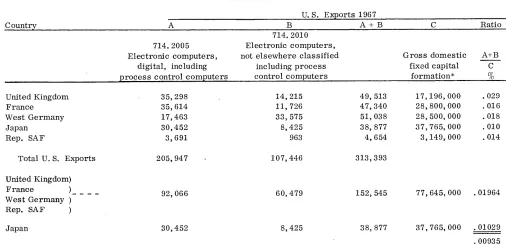
A similar situation exists in foreign trade. Here again our index of performance as a nation is disquieting. We have seen our foreign trade balance dwindle to about $1 billion out of about $40 billion of total exports. We do best in high technology products; we run a large deficit in labor-intensive products. This story is also undoubtedly well-known, but again a close examination of the anatomy of the problem indicates that many of our manufacturing industries cannot compete because of (1) the differential· in wage rates and (2) antiquated plant. Here again computers can provide a way of overcoming the differential, but there are the difficulties in gaining the necessary rapport with traditional industries. The labor unions as well look with some suspicion on computers. Solving this set of problems in a humanitarian and effective way is a real challenge to the computer community.
Improving the Quality of Life
So far I have been talking about using computers to improve the performance of our economy and our eco-nomic situation in the world. But the nation requires also that computers be used to improve the quality of life. Here one can think of many possible applications, but the one that appeals to me the most lies in the areas of privacy and individuality.
COMPUTERS and AUTOMATION for September, 1971
Computers Protecting Individuality
Now, it is often said that computers are a challenge to the privacy of the individual and to individuality itself. Indeed, it cannot be denied that computers have been used in just these ways in the past. However, .these effects are not intrinsic to the computer itself. Computers can be used to protect people's privacy. In fact, a well-designed com-puter system can be made more nearly private than the manual filing methods used today. The technology and technique to accomplish this is in hand or nearly so. Some further innovative effort can provide further advances, but the problem is that system designers and their customers have not seen fit to utilize the available technology to protect people's privacy. Again, in this area the question of efficiency and costs arises. It may well be true that special hardware will have to be incorporated into computing systems to facilitate the elaborate protective mechanisms which in the end will be required for adequate privacy. The impetus for these developments has been slow in coming, but I believe we will see incentives by government for such developments. Senator Ervin has held hearings at which issues concerning privacy and computers have been ex-amined.
Establishing Privacy Standards
The executive branch of the government also is looking at these problems, and it may be that the day will come when we will see privacy standards established and pub-lished. This should not be necessary, but many people believe that it is. It is not too much to say that the government will not shirk its duty in this regard.
As for individuality, again computers can be the key to the individually-tailored service or product. Yet, we do not see a widespread attempt to use computers in this fashion. Again, I think that the future health of the computer industry depends upon successful attempts in this direction.
Malevolent Effects of Technology
I feel strongly about all these matters because we as scien tists and engineers are getting clear signals from the public about the malevolent effects of technolorr. ~s y~u
know, computers are in the forefront of people s mmds ill
this regard; This syndrome has led some to conclude that there is a strong wave of anti-technology overtaking us. They point to the vote on the supersonic transport and to environmental extremism and other supposed evidences. It
is easy to identify some people who are negative about technology. There are some highly-respected people such as Lewis Mumford and Marshall McLuhan whose utterances range from rational attacks on rationality to extolling the irrational and occult. Movements in this spirit can succeed at times, particularly when we as a community show our technological teeth rather than displaying our human val-ues but overall I find no wave of anti-technology in the
exe~utive
or legislative branches. In fact, quite the opposite. I find people in responsible positions very receptive to responsible proposals for advancing science and technology.Collisions re Energy Supply
solution he proposes is a pluralistic one based on research and development aimed at new technology. The nuclear breeder reactor is the centerpiece of the new effort because it today holds. the greatest near-term promise for the generation of clean energy. Recognizing that other technol-ogies will be needed, however, the President has proposed two other initiatives related to recovery of clean energy from fossil fuels. In addition, he has asked me to evaluate longer-range possibilities, among them fusion power and solar power.
It is interesting and significant that this energy message was, as nearly as I can determine, the first message from a President to a Congress whose thrust was an R&D effort aimed at solving a national problem. I hope and.expect that this is but the first of many others to follow, and it seems clear to me that computers must play an important role in many of them.
Presidential Message on Computers
A criterion of success for ambition to "communicate about computers" is this: success will be achieved when there is a Presidential message recognizing computing as a resource to solve national problems. Unfortunately, we are not close to this result at present.
In fact, in my office's forthcoming annual report on science and technology, there is no chapter on computing. Of course, computing is referred to in other chapters.
What should such a chapter say if there were to be one? The report is intended to be a report to the Congress and the nation at large. The standard format we have adopted is first a recital of significant accomplishments; second, expo-sure of the issues confronting the field; and finally a projection of the possibilities for resolving them, coupled with a discussion of the attendant policies. I invite com-puter people to write to me concretely about this matter.
Communicating to the Public About Computers
It is necessary to communicate with the public so that computers become more acceptable and less frightening to them. It is necessary to gain the participation of people whose lives and jobs will be affected by computers, if they are to accept computers and if they are to use them wisely and effectively. Many opportunities exist for the infusion of computing into the service and manufacturing industries. In fact, I believe this infusion is a necessity if productivity and our foreign trade are to be kept healthy.
In addition, as computers become more and more a part of our society, the reliability of both hardware and soft-ware must be geared to avoid human tragedies. Computers must be used to protect people's privacy and to insure their individuality.
Changing the I mage of Computers
We all have an awesome task to convert the image of computers from the image of an unwelcome intruder and a disagreeable agent of change; to the image of a benevolent helper and resource for our country. Changing this image will require the computing community to communicate about ·computers in ways which it has not done before.
In addition, there must be communication within the computer community to increase its level of profession-alism and its responsibility for its own impact on society. 0
Ernst - Continued from page 11
and other institutions make increasing use of electronic records. We already have cases where records were de-stroyed by mistake or were lost; a small mutual fund, for example, has had the embarrassment of having to write its customers to find out how many shares they owned! No system is perfect in reliability; and no matter what steps we take, sooner or later there are going to be errors and failures. As we build bigger systems and become more dependent on them, we faced increased vulnerability. The size of the largest organization in a given field of endeavor tends to approach the maximum that is manageable. The use of the computer increases the manageable size of a company; but it also increases the vulnerability of that company if something happens to the computer.
Sabotage
There is also the question of sabotage. It is probably no accident that quite a number of efforts of the radical left and students in their bombing attempts, building seizures and such, have involved computer systems. We are not too vulnerable now, but in the future these actions can cause far greater difficulties.
I ndustrial Espionage
In addition to straightforward sabotage, I think we have to look forward to problems of increased industrial espio-nage. If it is known that a company bases its marketing plans very heavily on a simulation it has developed, the simulation itself can become a target for a competitor. And it is not too difficult in normal situations to arrange for the disappearance of a program or the disappearance of input data from most of our current computer systems.
More Filtering of Data for Decision Making
Finally, we face the fact that management itself will
become more vulnerable in its decision-making:' As we use more complex decision-making tools, and as we rely more heavily on large data banks, there will be more flltering of information by management staffs before materials for decisions are presented to the senior management. Even today, I feel that a large fraction of the decisions of senior managers are not made by them. They are forced on them by the selectivity of their staffs in providing data and in presenting arguments. As the staffs grow bigger and the data base more complex, the ftltering mechanism will expand and senior managers will find it more difficult to exercise effective personal control.
Business Will Suffer from Failures to Deal with Problems
In this brief review, I have described some of the problems of computers I have encountered in a variety of work for business, universities and governmental organiza-tions. The list is obviously not complete. Though the examples range from fairly trivial to moderately serious, all are characterized by the fact that they will become far more extensive and very likely far more dangerous as our use of computers broadens. At the moment, these problems don't hurt us very much. I don't believe they will be painless for much longer, however, and I do believe businessmen have an important responsibility for helping solve these prob-lems. If they do not, business will certainly be among the first groups to suffer from our failure to deal with them. 0