© 2019, IRJET | Impact Factor value: 7.211 | ISO 9001:2008 Certified Journal
| Page 7166
RFID based smart Dustbin for smart cities
V.Ranichandra
1, Antony Sundar.H
2, Gautam Sandeep KT
3,Krithin Rajesh
41
Assistant Professor, Dept. of Computer Science and Engineering, Easwari Engineering College, Tamil Nadu, India
2,
Pursuing B.E Computer Science Degree from Easwari Engineering College, Tamil Nadu,India
3,
Pursuing B.E Computer Science Degree from Easwari Engineering College, Tamil Nadu,India
4,
Pursuing B.E Computer Science Degree from Easwari Engineering College, Tamil Nadu,India
---***---Abstract -
The Internet of Things (IoT) is a system of interrelated processing instruments, mechanical and digital apparatus, objects, living beings that are provided with unique attributes and the ability to transfer data over a network without requiring human or human-to-computer interaction. IoT paves the way for many philanthropic services, one of these services provided would be waste management enabled by smart devices. The main concerns with today’s waste management techniques are unsanitary practices and security. The motivation for this project is to work on some of these key issues faced by IoT and to improve human life by improving the efficiency of waste management by automating the process of monitoring waste Radio-frequency identification(RFID) uses electromagnetic fields to automatically identify and track tags attached to objects. The tags contain electronically-stored information. The RFID based garbage bin enables smarter and more efficient waste management via the use of ultrasonic depth sensing techniques that work on the principles of sound and acoustics Security is provided via the use of RFID tags. Labor performance is monitored over the Internet through the web server and an application. The RFID based garbage bin can be applied in residential communities, water tanks, travel luggage and payload delivery vehicles.Key Words: RFID, IoT, Waste Management, Depth Sensing, GSM
1.INTRODUCTION
IoT(Internet of Things) is an interconnection of many electronic, mechanical, digital, biological apparatus that can communicate with each other via the internet . A thing could be described as a person with a heart monitor implant or an animal on a farm with an implanted biochip transponder or an automobile with sensors or any sort of man made object that can be assigned IP addresses and is capable of transmitting data via a network.
IoT is evolving from smart devices to bigger scale integration of metropolitan areas , this is known as smart cities with IoT .Smart Cities can be defined as a smart combination of citizens infrastructure , activities and components such as smart government ,environment and quality of life. An efficient waste management system is a
requirement to maintain a safe and green environment. There are many technologies that can be used for waste collection as well as for recycling.
Waste management involves a lot of steps such as generating waste, handling, storing ;etc. In order to make this more efficient , the proposed system will take care of storage , monitoring and disposal. A method to improve quality of life would be to improve the management of waste , the ‘RFID based smart garbage monitoring system’ in this proposed system will enable us in reaching that goal.
This paper presents a developed system which performs storage , monitoring and disposal with the use of various IoT components and sensors such as ultrasonic sensors and RFID sensors . The ultrasonic sensor monitors for waste level whereas the RFID sensor is used to monitor and make sure the dustbins are not tampered with.
2. LITERATURE SURVEY
Abhay Shankar Bharadwaj et al [2017] proposed several techniques that could be used for IoT based solid waste management systems. Those techniques used are LoRa technology for data communication and message queue telemetry transport protocol. The result he achieved by using these techniques were a long distance data transmission coupled with low power consumption. There was only one issue that was posed here and that was the system possessed a minor failure rate.
© 2019, IRJET | Impact Factor value: 7.211 | ISO 9001:2008 Certified Journal
| Page 7167
applied to the sensor data leveraged by the system to gainuseful insights to improve the efficiency of the garbage monitoring. The issue faced by this system proposed is that it cannot identify who is cleaning the bin.
Arkady Zalslavsky et all [2018] made a proposal for a stochastic optimization framework for planning of waste collection and value recovery operations in smart and sustainable cities. The proposal problems in smart cities by focusing on new sensor based IoT ( Internet of things) technologies. It focuses on minimizing transport cost while a maximum recovery of waste is done. Data acquisition using new data acquiring technologies that can enable municipalities to monitor the mix of recyclables in individual trash bins could be developed to help the same. Aayush Tripathi et all [2018] made a proposal for a prototype of an RFID smart bin for metro stations in Delhi. The main focus here was on security. RFID tags are used to access the RFID smart bin. A cloud based monitoring system for the bins along with an ultrasonic sensor at each bin there is no need for routine checking. A solar panel is used to make the system eco-energy friendly. There is no analysis of data and no waste management being performed in this system and that is the prevailing issues in the proposed system.
Alexey Medvedev et all [2017] published a survey on IoT- enabled waste management. The survey addresses the ways in which routes can be optimized and scheduling of waste collection within smart cities can be done better. Dynamic models on how to reduce total cost, distance and power are discussed with real time monitoring of waste bins trash level.
3. PROPOSED SYSTEM
The proposed system is capable of monitoring waste, ensuring security and also the management of waste and transporting waste. This is done via the use of the combined functions of the 3 modules . The first module handles Sensory Input and Security regulations, the second module handles data transmission and connectivity from the dustbin to web server, the third module takes care of calculation of waste level and notification system.
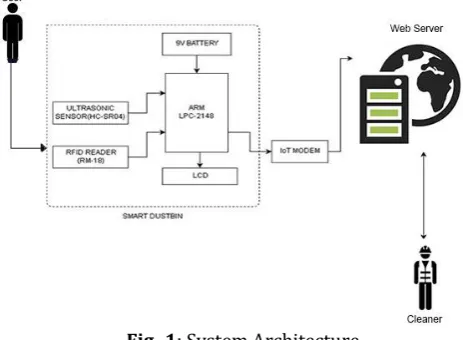
The Sensory and security module makes use of the on board LPC-2148 ARM processor, RM-18 RFID Reader and the HC-SR04 Ultrasonic Sensor . The User first scans their respective RFID tag that is issued by the local municipality , the data is then sent to the ARM processor to be verified, if the user is valid the ARM processor authenticates it and then opens the lid for the dustbin , the user throws the waste and closes the lid of the dustbin, the ultrasonic sensor uses the depth sensing technique and scans how much waste is present in the dustbin, this data is then sent to the data processing module.
The Data Processing module is integration between the sensors, the IoT modem and the web server. The Data from the sensors is first processed by the ARM processor
and then is sent to the IoT modem via UART communication, this data is then sent to the web server and is stored . The web server is updated every time there is a change in the level of waste at the dustbin , this new data overwrites the previous information and is then stored and checked whether the dustbin is full or not . Once the dustbin is full the web server sends this data to the notification system
[image:2.595.312.544.244.414.2]The notification system is the final integration of both the first and second module as well as a notification system .The system architecture for the proposed system is given below.
Fig -1: System Architecture
3.1 HARDWARE COMPONENTS
The table listed below gives the specifications of the components used for the proposed system.
Table -1: Hardware Specifications
COMPONENTS SPECIFICATIONS Microcontroller LPC 2148
RFID Sensor RM-18
Ultrasonic Sensor HC-SR04
LCD LCD Display(16x2)
IoT Modem RS-232 Communication
interface
3.1.1 ARM LPC2148
[image:2.595.302.567.514.637.2]© 2019, IRJET | Impact Factor value: 7.211 | ISO 9001:2008 Certified Journal
| Page 7168
communications interfaces ranging from a USB 2.0 FullSpeed device, multiple UARTs, SPI, SSP to I2Cs, and on-chip SRAM of 8 kB up to 40 kB, make these devices very well suited for communication gatewaysThe LPC21418 consists of an ARM7TDMI-S CPU with emulation support, the ARM7 Local Bus for interface to on-chip memory controllers, the AMBA Advanced High-performance Bus (AHB) for interface to the interrupt controller, and the VLS Peripheral Bus
3.1.2 RFID SENSOR
RFID tag is a small device which stores and sends data to RFID reader. They are categorized in two types – active tag and passive tag.RFID readers and tags need to be tuned in to a same frequency for communication.RFID system uses various frequencies but most common and popularly used frequency is low, high and ultra high frequency. Low frequency is around 125 KHz, high is around 13.56 MHz and ultra high varies between 860-960 MHz.RFID reader sends radio signals which is captured by the coil (working as antenna) for the tag. The coil receives these signals as alternating current and passes to the chip. The chip extracts both the power and the information from this alternating current. By communicating with the non volatile memory of the chip that stores unique id as well as other information, it sends back the required signal to the antenna which is then transmitted to the RFID reader. RFID belongs to a group of technologies referred to as Automatic Identification and Data Capture (AIDC). AIDC methods automatically identify objects, collect data about them, and enter those data directly into computer systems with little or no human intervention. RFID methods utilize radio waves to accomplish this. At a simple level, RFID systems consist of three components: an RFID tag or smart label, an RFID reader, and an antenna. RFID tags contain an integrated circuit and an antenna, which is used to transmit data to the RFID reader (also called an interrogator). The reader then converts the radio waves to a more usable form of data. Information collected from the tags is then transferred through a communications interface to a host computer system, where the data can be stored in a database and analyzed at a later time.
3.1.3 ULTRASONIC SENSOR
Ultrasonic sensors of module HC-SR04 is used for the purpose of detecting the distance from an object (not being in direct contact with the object) with a very high accuracy. The sensor has a basically four pins, namely VCC, trigger (input), echo (output), and ground. Also, this module has a ranging distance of 2–400 cm. The ultrasonic sensor sends an ultrasonic wave which on reaching an object reflects back to the sensor allowing it to determine the distance between the sensor and the object. The ultrasonic sensor in this paper senses the level of garbage
(wet or dry waste). The ultrasonic sensor can also work even if there is a thin layer of coating (dirt) on it.
3.1.4 LIQUID CRYSTAL DISPLAY
The liquid crystal display used in building this prototype is a 2X16(JHD-162A) flat panel display, which is a very basic module used in various devices and circuits. LCD utilizes the property of light modulation of crystals of liquid. In the type of LCD used in this paper, it can display 16 characters on each of the 2 lines. In this paper the LCD initially displays the prompt message to display the tag. Once the tag is scanned, the LCD displays the waste level as well as the unique user identification. On reaching a certain level of waste, the LCD displays the percentage of waste that is occupied by the waste in the dustbin.
3.1.5 INTERNET OF THINGS MODEM
Benefit of the huge processing power at our disposal to take care of large of requests coming from IOT devices. It provides secure, bidirectional communication between IOT devices and cloud. This enables us to collect telemetry data from multiple devices, and we can store and analyze the data.
4. MODULAR DESCRIPTION
4.1. SENSORY INPUT AND SECURITY REGULATION
© 2019, IRJET | Impact Factor value: 7.211 | ISO 9001:2008 Certified Journal
| Page 7169
Fig -2: Sensory Input and Security Regulation4.2. DATA COMMUNICATION
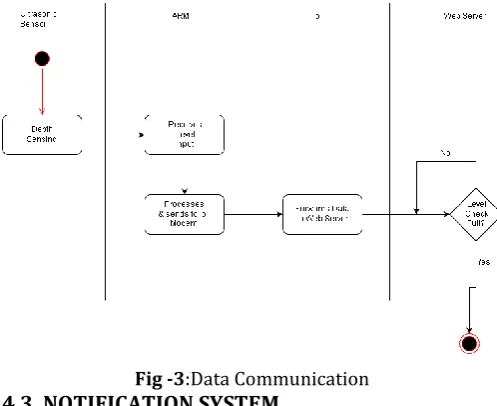
The second module is known as the data communications module , the main objective of this module is to send data from the dustbin to the server where data is monitored over the cloud , when the dustbin reaches the threshold the server sends this data to the next module . The waste level is monitored on the dustbin every time it is opened and used , this data is sent to the processor which in turn , sends it to the IoT modem via UART communication using a transmit and receive medium . The IoT modem then sends this data to the cloud server which monitors the level of the dustbins that are placed all around the city , once the level reaches its threshold the server sends this to the notification system
Fig -3:Data Communication
4.3. NOTIFICATION SYSTEM
The final module is known as the notification system this notification system is responsible for sending the message to the cleaner once the dustbin has been detected to be full The worker views this message and follows the
instructions on when to clean the dustbin thereby maintaining regular maintenance of the dustbins.
The notification System first takes in the input of the data from the previous module through the web server once the web server has decided that the dustbin is full it sends a call to the respective worker he then gets a notification in the mobile he can check the app for the location of the dustbin and pickup the waste
[image:4.595.308.557.357.534.2]The dustbin will give a call to the worker this call can either be rejected by pressing "1" on the key pad it means the worker has accepted the job and will clean it if he presses "2" on the key pad it will mean he has declined the job and the call is sent to the next laborer. Just like the other users the worker also has his own RFID tag which will be configured to dustbins in an area these dustbins can then be opened with the workers ID after he has picked up the waste a drop off location will be given to the laborer then he must drop it off in the specified location all his performance details will be tracked and then based on the information he can be given appropriate compensation.
Fig -4:Notification System
5. PERFORMANCE ANALYSIS
The proposed system has been designed based on the performance of the current system design. The current Greater Chennai corporation takes over a week to clean each dustbin , even on calling for waste cleaning it takes a minimum of 2-3 days for them to arrive. With our system the cleaning of the dustbin happens on the very same day .
[image:4.595.35.284.494.697.2]© 2019, IRJET | Impact Factor value: 7.211 | ISO 9001:2008 Certified Journal
| Page 7170
Chart -1: Proposed System vs Current SystemChart -2: Security vs Threat
6. RESULT
The output of the system is that , on dumping waste the dustbin recognizes the waste level . Once the dustbin reaches its full capacity then it gives a call to the respective cleaner and also sends a notification via an app along with the dustbins location . The dustbin is then cleaned the very same day and is maintained cleanly.
7. CONCLUSIONS
As India is densely populated and more number of smart cities would overhead in the upcoming years. Due to large population density in those cities efficient waste management systems are required. So, the proposed system will help us to keep our environment clean in residential areas as well as inside the city with keeping all security aspects in mind. The proposed system will also help us in waste management. The authorities would also have a track record of each and every user which would help them to monitor the cleanliness in the city.
This process of RFID based smart dustbin was mainly introduced to provide security to users and to prevent it from unwanted access by people with ill intent. Also this process increases the maintenance and helps provide improved cleanliness
There are many further improvements that could be implemented along with the proposed system to make it more robust. One such future work could be the introduction and use of a renewable energy source making the dustbin self- sufficient and more reliable as well as reduce carbon footprint . Another security measure that could be implemented is the introduction of a toxic gas sensor to detect toxic gas buildup that is emitted from decaying muscle tissues of human bodies that produce methane gas . Another future work could be a modification to the proposed system to monitor for movement or moderately large objects such as human fetuses .
REFERENCES
[1] Arkady Zaslavsky,Parth Jatinkumar Shah,Theodoros Anagnostoupolos, Sara Behdad,(2018),’A stochastic optimization framework for planning of waste collection and value recovery operations in smart and sustainable cities’,Elsevier-Waste Management ,Vol.78,pp:104-114
[2] Aayush Tripathi, Chinmay Pandey, Ankur Narwal, Devashish Negi, (2018) ‘Cloud Based Smart Dustbin System for Metro Station’,2018 3rd International Conference On Internet of Things: Smart Innovation and Usages (IoT-SIU), 2018 3rd International Conference On Internet of Things: Smart Innovation and Usages (IoT-SIU), Bhimtal, India, pp: 62-65 [3] Grewal Kaushal,Rishabh Mishra,Neelam
Chaurasiya,Paramdeep Singh,(2015),’RFID BASED SECURITY AND ACCESS CONTROL SYSTEM USING ARDUINO WITH GSM MODULE’, IJEEE-Vol. 2,No.2, pp:5-8
[4] Jeseok Yun, Sang-Shin Lee, (2014), ‘Human Movement Detection and Idengification Using Pyroelectric Infrared Sensors’, Sensors 2014-Vol 14, No.5, pp:5-23 [5] Abhay Shankar Bharadwaj, Rainer Rego(2017),’IoT
Based Solid Waste Management System’,IEEE Annual India Conference, Palladam,India,pp:27-29
[6] V.S.Velladurai ,M.Saravanan
,R.Vigneshbabu(2017),’Human Safety System in Drainage, Unused Well And Garbage Alerting System for Smart City’,International conference on I-SMAC, Palladam, India,pp:6-9
[7] Jetendra Joshi, Joshitha Reddy, Praneeth Reddy, Akshay Agarwal, Rahul Agarwal, Amrit Bagga, and Abhinandan Bhargava(2018),’Cloud computing based smart garbage monitoring system’ 3rd International
Conference on Electronic Design