A Tight Prediction Interval for
False Discovery Proportion under Dependence
Shulian Shang, Mengling Liu, Yongzhao Shao*
Division of Biostatistics,New York University School of Medicine, New York,USA Email: *[email protected]
Received February 1, 2012; revised March 5, 2012; accepted March 16, 2012
ABSTRACT
The false discovery proportion (FDP) is a useful measure of abundance of false positives when a large number of hy- potheses are being tested simultaneously. Methods for controlling the expected value of the FDP, namely the false dis- covery rate (FDR), have become widely used. It is highly desired to have an accurate prediction interval for the FDP in such applications. Some degree of dependence among test statistics exists in almost all applications involving multiple testing. Methods for constructing tight prediction intervals for the FDP that take account of dependence among test sta- tistics are of great practical importance. This paper derives a formula for the variance of the FDP and uses it to obtain an upper prediction interval for the FDP, under some semi-parametric assumptions on dependence among test statistics. Simulation studies indicate that the proposed formula-based prediction interval has good coverage probability under commonly assumed weak dependence. The prediction interval is generally more accurate than those obtained from ex- isting methods. In addition, a permutation-based upper prediction interval for the FDP is provided, which can be useful when dependence is strong and the number of tests is not too large. The proposed prediction intervals are illustrated using a prostate cancer dataset.
Keywords: Multiple Testing; False Discovery Proportion; False Discovery Rate; Weak Dependence; Correlated Test Statistics; High-Dimensional Data Analysis; Prediction Interval; Upper Prediction Bound;
Permutation-Based Method
1. Introduction
When a large number of hypotheses are tested simulta- neously, a direct measure of the abundance of false posi- tive findings is the false discovery proportion (FDP), defined as FDP, or
1 V Q
R
1 max ,1 R R
, where R denotes the total number of rejections, V denotes the number of rejections of true null hypotheses, and . Moti- vated by various genetic and genomic studies and other applications, many useful procedures have been proposed to control the expected value of FDP, namely the false discovery rate (FDR) [1-5]. Indeed, it is well known that controlling FDR has power advantages over the tradi- tional way of controlling family-wise type I error [1,2]. Suppose a study is properly designed to control the FDR at 5%. If such a study is independently repeated many times, the average of the FDPs in these repeated studies can be expected to be no more than 5%. However, for a particular study (without repetition), the FDP is more directly relevant than FDR. Therefore, when a study is designed to control FDR under common designs, it is
still very much desirable to assess FDP, e.g. to construct a prediction interval for the FDP. One can also consider designing a study controlling FDP instead of FDR. This approach has been less successful since FDP is a random variable and is less straightforward to control than the FDR. Indeed, researchers have proposed various proce- dures aimed at controlling the FDP [6-13], from which confidence envelopes for the FDP can be obtained si- multaneously for all possible rejection regions. However, confidence envelopes from the existing FDP controlling procedures are often too conservative for predicting a tight range for the FDP. In particular, when weak corre- lations exist among test statistics, methods for construct- ing tight prediction interval for the FDP are still limited.
In the multiple testing context, test statistics are often correlated, e.g. in microarray experiments and functional magnetic resonance imaging, correlations arise due to biological, spatial, temporal or technical factors. A major challenge for predicting FDP is to account for unknown correlations between test statistics. It has been shown via numerical studies that when test statistics are correlated, the variability of FDP can increase dramatically [14-17]. This can also be seen from the variance formula derived
in the next section (Formula (2)). Permutation-based me- thods are often considered in the presence of dependency, e.g. [15]. Permutation-based methods have several limita- tions. For instance, they are not applicable when no group structure (e.g., groups of cases and controls) is present as in some imaging studies [9]. Additionally, if the purpose of testing is to detect differences in means, then a per- mutation-based test can have an inflated Type I error rate by picking up signals due to unequal variances or skew- ness of two distributions [18]. Pan [3] and Xie et al. [19] also pointed out that permutation-based procedures tend to overestimate FDR. Finally, a permutation-based ap- proach is generally very computationally intensive; it often becomes not feasible when the number of tests is large.
Other works on FDP have been proposed with efforts to accommodate the correlations among test statistics. For example, Ge et al. [12,20] proposed a formula for the upper prediction bound of the FDP assuming that test statistics under true null hypotheses are independent and also proposed a permutation algorithm to obtain a simul- taneous upper prediction band of the FDP. Under the assumption that p-values are independent or follow a conditional equicorrelated multivariate normal model, Roquain and Villers [21] provided exact calculations for the cumulative distribution function (CDF) and moments of FDP for the step-up and step-down procedures. Ghosal and Roy [22] proposed a nonparametric Bayesian proce- dure to obtain the posterior distribution of FDP under the intraclass or autoregressive correlation structure. In all these studies on FDP under dependence, the correlation among test statistics is either ignored or assumed to fol- low some parametric models. A flexible semiparametric approach to modeling dependency among test statistics has not emerged.
In this paper, we first derive an explicit formula for the variance of the FDP under a semiparametric weak de- pendence assumption among the test statistics. The vari- ance formula is easily interpretable and elucidates the effect of correlation on the variability of FDP. Using the variance formula, we obtain an upper prediction interval for the FDP. This approach is semiparametric in nature because only the average of the pairwise Pearson correla-tion between test statistics needs to be estimated. The formula-based prediction interval is easy to evaluate even when testing a vast number of hypotheses where no other methods are computationally feasible. Simulation studies indicate that the formula-based prediction interval has good coverage probabilities under weak to moderate de-pendence. In many situations, as illustrated, the predic-tion interval is quite short (tight) and generally more ac-curate than competitors. In addition, we discuss a per-mutation-based upper prediction interval for FDP which is useful under strong dependence. We illustrate the
pro-posed prediction intervals using a prostate cancer data-set.
2. Methods
2.1. NotationConsider testing m hypotheses simultaneously. Rejec- tions are made based on p-values, with a fixed rejection region
0,
for some α. Denote the rejection status of the ith test by Ri
I p
i
, where pi denotes thep-value of the ith test and I
m
R R
is an indicator function. Denote the power of the ith test as 1 – βi.
Let V and U be the total number of incorrect and cor- rect rejections, respectively. The total number of rejec- tions or discoveries is i1 i . Let M0 denote
the index set of the m0 tests for which null hypotheses are true and M1 the index set of m1 = m – m0 tests for which alternative hypotheses are true. The proportion of true
null hypotheses is 0 0
π m
m
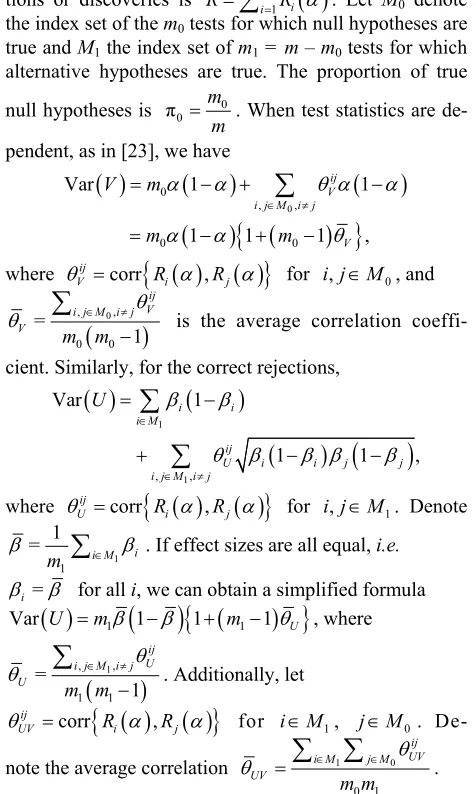
. When test statistics are de- pendent, as in [23], we have
0
0
, ,
0 0
Var 1 1
1 1 1 ,
ij V i j M i j
V
V m
m m
corr ,ij
V Ri Rj for i j M, 0, and where
0
, , 0 0
=
1
ij V i j M i j V
m m
is the average correlation coeffi- cient. Similarly, for the correct rejections,
1
1
, ,
Var 1
1 1 ,
i i
i M
ij
U i i j j
i j M i j
U
corr ,ij
U Ri Rj for i j, M1. Denote where
1
1
1
= m
i M i . If effect sizes are all equal, i.e.
=
i
for all i, we can obtain a simplified formula
1
1
Var U m 1 1 m 1U , where
1
, , 1 1
=
1
ij U i j M i j U
m m
. Additionally, let
corr ,
ij
UV Ri Rj for iM1, j M 0. De-
note the average correlation 1 0
0 1
ij UV
i M j M
UV
m m
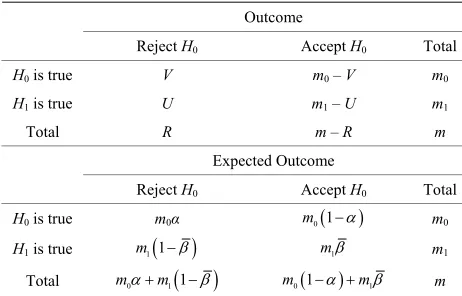
[image:2.595.305.543.260.657.2]Under some general regularity conditions including weak . Table 1 summarizes the outcomes of m tests and their expected values.
2.2. Formula-Based Prediction Interval
Table 1. Outcome and expected outcome of testing m hypo- theses.
Outcome
Reject H0 Accept H0 Total
H0 is true V m0 – V m0
H1 is true U m1 – U m1
Total R m – R m
Expected Outcome
Reject H0 Accept H0 Total
H0 is true m0α m01 m0
H1 is true m1
1
m1 m1Total m0m1
1
m01m1 mdependence among test statistics, Farcomeni [24] proved that the FDP, V ,
0,11 Q R
, as a stochastic
process indexed by α, is an asymptotically Gaussian
en
process (see Theorem 2 of [24]). In particular, for a fixed
α, the FDP has an asymptotically normal distribution under weak dependence as discussed in Farcomeni [24]. More specifically, assuming that 0π01, when test statistics are independent or weakly depend t, V 0,
0
U
and UV 0 as m , we show t P a Norm ution totically with special mean and variance (see Appendix A (A.1)). No assump- tions about higher-order correlation terms are required.
When effect sizes are all equal, explicit forms for the hat FD follows al di asym
m
strib p
ean
Q and variance
Q2 of the FDP can beeasily obtained using the delta method and are given by
0
π
0 0
π 1 π 1
Q
, (1)
2 0 0 2 0 0π 1 π
π 1 π
Q
4
1 1 1
, (2)
where
0 0 0 0 0 π 1 1 π 1 ππ U 2π 1 U
m 1 1 V V m
(3)
and 1
. For a moderate to large sample size n,
rag
the ave e Type II error 0. Then 2
0 0 0
π π 2π
Q c V U UV
m m
(4)
1 1 where 2 0 0 4 0 0 π 1 1 π π 1 πc
. From (4), it is evident
that when all the test statistics are independent, 2
Q
is
ly proportional to m; wh
dependent, correlations also contribute to the variance. ic inverse en some test statistics are The rejection threshold α in multiple testing is typ ally less than 0.05 and thus ω is small, making the last two terms of (4) small. The average correlation among true null test statistics, which is represented by V, can have
a large influence on the variance of FDP.
When all the parameters are known, a prediction in- terval could be derived based on the asymp ic distribu- tion of FDP. We shall discuss the estimat
tot
ion of parame- ters in details next section. In multiple testing we are primarily concerned about high FDPs so an upper predic- tion interval is of interest. A 100 1
% upper predic- tion interval for FDP is given by 0, QzQ, wherez is the 100 1
th quantile o standard normal distribution.f the ice, the distrib FDP under dependenc
ch as the log-transformation to be practi-ca
With finite sample size in pract ution of e is often skewed, suggesting trans-formations su
lly useful. Moreover, by the delta method (see Appen-dix A for more details), when the FDP is asymptotically normal, Y = log(FDP) is also asymptotically normal, i.e.,
2
~ Y, Y
Y N asymptotically, where formulas for Y
and 2
Y
are derived in Appendix A (A.2). Thus it is not surprising that Y = log(FDP) is closer to normal than the FDP itself, part
ima
icularly under weak dependence. The ap- prox te mean and variance of Y are:
0
0 0
π log log
π 1 π
Y Q 1
(5)
2 0 2 20 0 0
1 π 1 1
π π 1 π 1
Y where (6)
is in (3). Applying the expone mation, a
ntial transfor-
100 1 % upper prediction interval for the FDP can be constructed as 0,exp
z
.tion
sed prediction interv Y Y
2.2.2. Estima
To calculate the formula-ba al
0,exp YzY
, we need to estimate necessary
pa-rameters in Y and Y first. We adopt the estimator
0
π proposed
for by Storey [2]:
0 ˆ π 1 i m# p
for
0,1 with the choice of 0.5. We use t he od
meth of moment to estimate . Because
0 1 1E R mm , plugging in the estimate of
he o of rej
v
0
π and t bserved total number ections R, we ha e ˆ 1 R mπˆ0
0 ˆ 1 π
m
The resulting estimator ˆQ is
essentially the same as the FDR estimator proposed by Storey [2]: ˆ πˆ0
Q
m R
er
ce
ij
. However, the objective h e is to obtain a predictive interval or equivalently an upper bound for FDP sin we mainly care about large values of FDP.
The correlation between the ith and jth rejection indicators is
Var Var
i j i j
ij
Ri Rj
E R R E R E R
We here consider one-sided z-test for two-group com- parison to illustrate the estimation of correlation. Two- sided z-test and t-test are given in Appendix B. Follow-
.
ing the notation defined in Section 2.1, we have
2
, ;
1
ij ij
V
z z
, (7)
2 1ij
, ; 1
ij U
z z
, (8)
, ; ij ij
UV
z z 1
1 1
where Ψ is the CDF of the standard bivariate normal dis- tribution, and ρij denotes the Pearson correlati
the ith and jth test statistics. We propose the following
, (9)
on between procedure to estimate the average correlations. In prac- tice, when m is very large (m > 2000), we propose to run the procedure on a random subset of m tests to save computation time.
1) Estimate the correlations between test statistics ρij
using the sample correlations. As in [25], an empirical Bayes shrinkage estimator of sample correlations can be used.
2) For the ith test with z-score zi, estimate the condi-
tional probability of the corresponding hypothesis being a true alternative hypothesis:
0
10 0
1 π
1 π π
i z
i
i z i
z P i M z
z z
where
z is the density function of N
0,1 andz
is the mean of z-scores he alternative hy- pothesis is true. From e esti
when t mate ˆ
th we can get 1
ˆˆz z
.
3) Predict whether the tests belong to M1 or M0 by generating Bernoulli random variables with the estimated probability
iver correlations
1 P i M z .
ntity
4) After the ide of each test is predicted, the cor- ation θij between any two rejection indicators can be
calculated from Formulae (7)-(9). 5) Estimate the a age
rel
, U
V
and
UV
using the respective sample means of pairwise cor- relations.
6) Repeat steps 3 to 5 for a few times, and take the av-
er n
tation-Based Prediction Interval
iction The not age of these estimates of average correlatio s.
2.3. Permu
The permutation-based procedure proposed by Korn et al.
[6,7] can be adapted to construct an upper pred interval for the FDP under general dependence. method can be expected to be robust because it does depend on parametric or weak dependence assumptions, but it requires very intensive computation which may not be feasible for testing a very large number of hypotheses. Let n1 and n2 be the sample sizes of the two groups and suppose that unpaired t-test is performed. First, permute the group labels and calculate the two-sample t-statistic
p-values for all m tests under the permutated labels. If the number of possible permutations
1 2
1 2 ! ! !
n n
n n
is too large, perform w = 500 or 1000 random permutations. Second, for each permutation, order the p-values from smallest to largest. Let 1j , j2, , j
m
p p p denote the ordered p-val- ues for the jth permutation, j1, 2, , w. Write the ordered p-values in a w m matrix:
1 1 1 2
2
1 2
m
w w w
m
p p
p
p p p
.
Third, order the p-values within each co mn and put the smallest p-values on top. Denote the res lting matrix by
S, and its element at the jth row and lth column by
1m
p
21 22
p p
lu u
j l
S
where j1, 2, , w and l1, 2, , m.
To construct a 100 1
% upper prediction interval for the FDP, we first find an upper bound V for V. Find the [γw]th row of the matrix S where [a] denotes closest ller than othe integer sma r equal to a. The upper bound for V can be estimated as:
1
m w
l l
V
I S . By construction1j 2j mj
S S S for j1, 2, , w. Using Korn’s con- trolling procedure, 1
w k
S is the threshold for at most
k false discoveries with 1-γ probability. Hence, k is the
100 1 % upper bound for V at threshold 1
w k
S .
Given a rejection region
0,
, the definition of V
implies that w w 1
V V
S S . Then
S w 1
1
V
Therefore, is a conservative 100 1
% up- r V(α) at a er bound for the FDP can be calculated asper bound fo fixed α. Then the upp
1
V R
. Since the perm a- ch pre
ediction Intervals
the performance of the for- orrelation the me- thod considered m = 10,000 hy-
ut tion approa serves the correlation structure of the data, it works under potentially strong dependence struc- ture.
3. Numerical Studies
3.1. Simulation: Formula-Based Upper Pr
In this section, we evaluate
mula-based prediction interval under various c structures via simulations and compare it with
of Ge et al. [20]. We
potheses to be tested using one-sided z-test and π0 = 0.7. Results from two-sided z-tests were similar and not reported. For true null and true alternative hypotheses, z
scores were generated from N
0,n
and N
a,a
respectively, where a was 2.1, 2.7 or 4.3 and the cor-relation matrix will be specified below. The diagonal entries of both n and a were set to be 1. The thre-
shold α was fixed to be 0.0085
Two scenarios were considered: null test statistics were moderately dependent and alternative test statistics were weakly de endent; both null and alternative test statistics were weakly dependent. A proportion of test st
p
FB Ge
.
atistics were set to be correlated, with blockwise de- pendence or unstructured sparse dependence. In the blockwise dependence structure, tests were correlated within blocks and independent across blocks with the block-size of 50. We set 25% null test statistics to be correlated with correlation 0.8 and 5% alternative test statistics to be correlated with correlation 0.2; or 5% null test statistics to be correlated with correlation 0.2 and 5% alternative test statistics to be correlated with correlation 0.5.
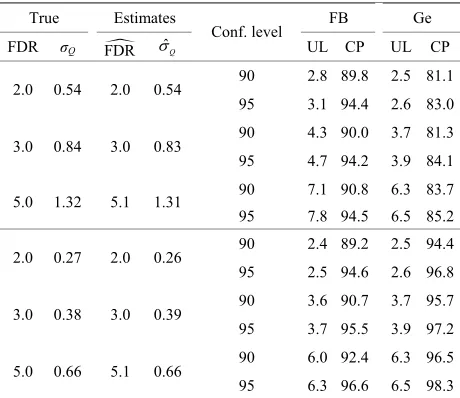
We evaluated the performance of the proposed predic- tion intervals using the true correlations between test statistics. Table 2 shows results from 1000 replications. When null test statistics are moderately correlated (upper panel), the coverage probabilities of our prediction inter- vals are close to the nominal levels. The interval with log transformation is more accurate than the one without transformation (results not shown). In comparison, Ge’s intervals have the problem of under-coverage because the required independence assumption is violated. When both null and alternative test statistics are weakly corre- lated (lower panel), our prediction intervals have good coverage probabilities and are tighter than Ge’s. The es- timates of the standard deviation of FDP are very close to the true values in both scenarios.
[image:5.595.308.538.121.320.2]For the general sparse dependence structure, we set
Table 2. Estimates of σQ, upper limits (UL) of prediction
intervals and coverage probabilities (CP) (all in %) under blockwise dependence.
True Estimates
FDR σQ FDR ˆQ
Conf. level
UL CP UL CP
90 2.8 89.8 2.5 81.1
2.0 0.54 2.0 0.54
95 3.1 94.4 2.6 83.0
90 4.3 .0 3.7 .3
3.0 0.84 3.0 0.83 90 81
95 4.7 94.2 3.9 84.1
90 7.1 90.8 6.3 83.7
5.0 1.32 5.1 1.31
95 7.8 94.5 6.5 85.2
90 2.4 89.2 2.5 94.4
2.0 0.27 2.0 0.26
95 2.5 94.6 2.6 96.8
90 3.6 90.7 3.7 95.7
3.0 0.38 3.0 0.39
95 3.7 95.5 3.9 97.2
90 6.0 92.4 6.3 96.5
5.0 0.66 5.1 0.66
95 6.3 96.6 6.5 98.3
σQ: sd(FDP); FB: formula-based predic interva ra m
G e dict in Upper l: 25% ll t ic e correlated with ρv = 0.8, 5% alternative tatisti at i
0.2; Lower panel: 5% null test statisti re cor ρ . al ti sta s a lated ρu = 0.
s simulated from
N(0.1, 0.1). The covariance matrix was computed as AAT,
e situation w
y and simulated the expres- d d with thod of Ge et al. [20] and the simultaneous
tion l with log t nsfor ation; e: G ’s pre ion terval; pane
test s nu cs are
est sta correl
tist ed w
s ar th ρu =
cs a with
related with
5. v
= 0 2, 5% terna ve test tistic re corre
aside a small proportion of test statistics to be correlated and the rest of test statistics independent. We first gener- ated a lower triangular matrix A with diagonal entries equal to 1 and lower off-diagonal entrie
and was normalized to be a correlation matrix for the dependent test statistics. Null tests and alternative tests can be correlated but with no dependence structure as-sumed. For the two scenarios, we set 750 null and 50 alternative test statistics to be correlated; or 100 null and 400 alternative test statistics to be correlated.
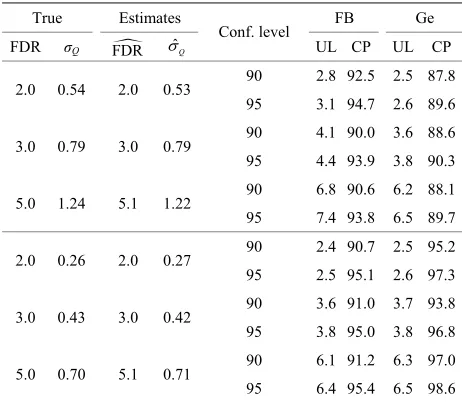
Results from 1000 replications are shown in Table 3. The upper panel shows the situation where more null test statistics are correlated. Our prediction intervals have good coverage probabilities, while Ge’s intervals under- cover the true FDP. The lower panel shows th
here more alternative test statistics are correlated. Our prediction intervals cover the true FDP well while Ge’s intervals are conservative.
3.2. Comparison with Simultaneous Prediction Band
We considered two-group mean comparison in the con- text of gene expression stud
sion data to assess the performance of formula-based an permutation-based prediction intervals. We compare
the me
Table 3. Estimates of σQ, upper limits (UL) of prediction
intervals and coverage probabilities (CP) (all in %) under sparse dependence.
True Estimates FB Ge
FDR σQ FDR ˆQ
Conf. level
UL CP UL CP
90 2.8 92.5 2.5 87.8
2.0 0.54 2.0 0.53
95 3.1 94.7 2.6 89.6
90 4.1 .0 3.6 .6
3.0 0.79 3.0 0.79 90 88
95 4.4 93.9 3.8 90.3
90 6.8 90.6 6.2 88.1
5.0 1.24 5.1 1.22
95 7.4 93.8 6.5 89.7
90 2.4 90.7 2.5 95.2
2.0 0.26 2.0 0.27
95 2.5 95.1 2.6 97.3
90 3.6 91.0 3.7 93.8
3.0 0.43 3.0 0.42
95 3.8 95.0 3.8 96.8
90 6.1 91.2 6.3 97.0
5.0 0.70 5.1 0.71
95 6.4 95.4 6.5 98.6
σQ: sd(FDP); FB: formula-based predict nterval m ;
G ’ rv r pane 50 (11% u tic e
ted with
ion i
l: 7 with ) nlog trall test stansfortis ations ar e: Ge
rrela
s prediction inte al; Uppe
co v = 0.33, 50 (1. lterna s i rrelated with
7%) a tive test tatist cs are co u = 0.16, and uv 096; L : )
t rre ith
= 0. ower panel 100 (1.4% null tes statistics are co lated w v = 0.19, 4 t
s i 00 (13%) al ernative test
statistic are correlated w th u = 0.13, and uv
g
p
0.6. The diagon n and a were 1.
es to be correlated with correlation
to be correl
an thr
ran- do
The formula-based pr
ur for- m
l Data Example
measured 13,935 mRNA ymphoblastoid cell lines
ge
FB Per Ge MN
= 0.05.
100, 150 or 200 and equally divided between two groups. The data were enerated from N
n,n
or
a, a
N for the two gro s, where u μn = 0 and μa =
al entries of both
Blockwise correlation structure was used and block-size was 50. We set 20% null gen
0.8 within block, and 3.3% alternative genes ated with correlation 0.2 within block. One-sided t-test was performed d the eshold α
was fixed at 0.01. For calculating the formula-based in- terval, correlations between test statistics were estimated from correlations between gene expression levels. Pair- wise Peason correlations were calculated from 500
mly chosen genes across all the subjects, after sub-
[image:6.595.58.540.599.717.2]tracting off each gene’s mean within each group as in [26]. Sample correlations were then shrunk using the
Table 4. Comparison of the upper limits (UL) and covera
True Estimates
empirical Bayes method [25] to correct the well known inflation of variability in correlation estimates. The co- relations θ between rejection status were then calculated using the procedure in Section 2.2.2, repeating the pro- cedure for 3 times. For calculating the permutation-based prediction intervals, a total of 500 randomly chosen per- mutations of the groups were used.
Coverage probabilities of four prediction intervals are given in Table 4 (200 replications).
ediction intervals cover the true FDP well and are slightly conservative. Since the sample correlations are still over-dispersed after shrinkage, the variance of FDP is over-estimated. The permutetion-based interval is more conservative than the formula-based ones. In contrast, Ge’s prediction interval is too liberal. The simultaneous prediction bands are about twice as high as the for-mula-based intervals. Hence it is not very useful when point-wise intervals are needed. In terms of computa-tional efficiency, when the sample size was 100, the cen-tral processor unit (CPU) time for calculating the for-mula-based and permutation-based prediction intervals in one run of simulation was 81 seconds and 20 minutes respectively, on a 2.66 GHz processor with 4 GB of memory. The permutation-based approach will become more computationally intensive as m gets larger.
We have also varied m, rejection region and correla- tion structures. When the dependence is weak, o
ula-based prediction interval works well in various scenarios. It is the tightest one among all intervals that we study.
3.3. A Rea
The study in Wang et al. [27] gene expression levels in 125 l
derived from 62 aggressive and 63 nonaggressive pros- tate cancer patients. The purpose is to identify candidate genes whose expression levels are associated with ag- gressive phenotype of prostate cancer. Two sample two-
probabilities (CP) of four prediction intervals (all in %).
FDR σQ FDR ˆQ UL CP UL CP UL CP UL CP
n Conf. level
90 5.3 92.0 6.5 95.5 4.0 85.0 10.0 100.0
3.2 1.22 3 .31 100
6.2 7.6 4.2 86.0 11.2
90 100.0
2.5 0.90 2.5 1.02 150
2.0 0.74 2.0 0.87 200
100.0 .1 1
95 94.5 99.0 100.0
4.3 93.0 5.3 97.5 3.3 86.5 8.2
95 5.0 95.0 6.2 98.0 3.4 89.5 9.1 100.0
90 4.0 94.0 5.0 99.0 3.1 86.0 7.3 100.0
95 4.6 96.5 5.8 3.2 88.5 8.0 100.0
σQ: sd(FDP); FB: formula-based prediction interval with log trans ation; Per: pe utatio sed up r pre boun e pred inte :
sid tes re p rmed ea ne, and pro- portion of null h theses was estim ted to be πˆ0
the ed t ts we
true
erfo ypo
for ch ge the a
= 0.60. The FDR controlling procedure in [2] was used to ontrol FDR at 3% or 5%, rejecting 1708 or 2208 hy- c
potheses respectively. Sample correlations were esti- mated from 2000 randomly sampled genes repeating estimation procedure for 3 times. The correlation is weak and the average of estimated ρV is very close to 0. The
estimated V is 0.0059 at α = 0.006. The formula-based
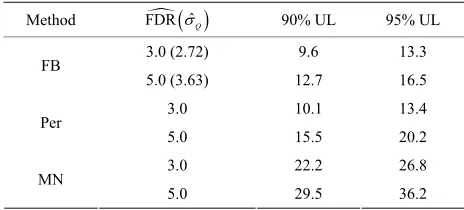
upper prediction intervals with log transformation (FB), permutation-based intervals (Per) and simultaneous pre- diction bands (MN) are shown in Table 5. When FDR is controlled at 5%, with 90% probability the actual FDP is as high as 12.7% (FB). Hence with the correlations in this dataset, FDP could far exceed its mean with high probability. Since the purpose of the study is to identify target genes for a large-scale validation study, a smaller rejection region may be more appropriate to avoid exces- sive false positives. The permutation-based approach gives more conservative intervals than the formula-based one. The simultaneous prediction bands are high and too con-servative for fixed rejection regions.
4. Discussion
It is feasible to construct a tight prediction interval for the FDP without specifying a parametric correlati
tatistics. When the dependence is iction interval for the FDP based on the
on w structure for test s
we derived a pred
[image:7.595.55.287.599.704.2]eak, variance formula which takes correlations into considera- tion. This formula-based approach is computationally efficient even when the number of tests is very large. The prediction interval could help investigators decide what rejection regions are suitable for a particular study to control FDR. If the upper limit of prediction interval is unacceptably high, then selecting a smaller rejection re- gion might be more appropriate. We also discussed a permutation procedure which can be employed to find a prediction interval for the FDP without assuming weak dependence. This approach can be computationally quite Table 5. Comparison of upper limits (UL) of prediction intervals for the prostate cancer data (all in %).
Method FDR ˆ
Q 90% UL 95% UL3.0 (2.72) 9.6 13.3
FB
5.0 (3.63) 12.7 16.5
3.0
MN
10.1 13.4
Per
5.0 15.5 20.2
3.0 22.2 5.0 29.5
26.8 36.2
FB: fo a-based predicti rvals with log t ormation; Pe tation-based prediction int MN: simultan rediction sing Meinshausen’s permutation algorithm.
es ially t um f t is l
thank the reviewers for their careful read of our pap his research was partia
ported by a Stony ld-Herbert F ation g and
NCES
tes,” Journal of the Royal Statistical Society Series B- Statistical Methodology, Vol.64, No. 3, 2002, pp. 479- 498. doi:10.11
rmul on inte
ervals; eous pransf bands ur: permu-
intensive, pec when he n ber o ests arge.
5. Acknowledgements
We would like to
ing er. T lly
sup-Wo ound rant
the NYU Cancer Center Supporting Grant (2P30 CA16087- 23), and by the NYU NIEHS Center Grant (5P30 ES00260- 44).
REFERE
[1] Y. Benjamini and Y. Hochberg, “Controlling the False Discovery Rate—A Practical and Powerful Approach to Multiple Testing,” Journal of the Royal Statistical Society Series B-Methodological,Vol.57, No. 1, 1995, pp. 289- 300.
[2] J. D. Storey, “A Direct Approach to False Discovery Ra
11/1467-9868.00346 e Use of Permutation
[3] W. Pan, “On th in and the Perfor- mance of a Class of Nonparametric Methods to Detect Differential Gene Expression,” Bioinformatics, Vol. 19, No. 11, 2003, pp. 1333-1340.
doi:10.1093/bioinformatics/btg167
[4] J. D. Storey, J. E. Taylor and D. Siegmund, “Strong Con-
gy, Vol. 66, No. 1, trol, Conservative Point Estimation and Simultaneous Conservative Consistency of False Discovery Rates: A Unified Approach,” Journal of the Royal Statistical So- ciety Series B-Statistical Methodolo
2004, pp. 187-205.
doi:10.1111/j.1467-9868.2004.00439.x
[5] X. D. Zhang, P. F. Kuan, M. Ferrer, X. Shu, Y. C. Liu, A. T. Gates, P. Kunapuli, E. M. S
et al., “Hit Selection with False Di
tec, M. Xu, S. D. Marine, scovery Rate Control in Genome-Scale Rnai Screens,” Nucleic Acids Research, Vol. 36, No. 14, 2008, pp. 4667-4679.
doi:10.1093/nar/gkn435
[6] E. L. Korn, J. F. Troendle, L. M. McShane and R. Simon, “Controlling the Number of False Discoveries: Appli- cation to High-Dime
Statistical Planning and Inference,Vol.
nsional Genomic Data,” Journal of
124, No. 2, 2004, pp. 379-398. doi:10.1016/S0378-3758(03)00211-8 [7] E. L. Korn, M. C. Li, L. M. McShane and R. Simon, “An
Investigation of Two Multivariate Permutation Methods for Controlling the False Discovery Proportion,” Statis- tics in Medicine,Vol. 26, No. 24, 2007, pp. 4428-4440. doi:10.1002/sim.2865
[8] C. R. Genovese and L. Wasserman, “A Stochastic Process Approach to False Discovery Control,” Annals of Sta- tistics, Vol. 32, No. 3, 2004, pp. 1035-1061.
doi:10.1214/009053604000000283
[10] M. J. van der Laan, S. Dudoit and K. S. Pollard, “Aug-mentation Procedures for Control of the Generalized Family-Wise Error Rate and Tail Probabilities for the Proportion of False Positives,” Statistical Applications in Genetics and Molecular Biology, Vol. 3, No. 1, 2004, Article 15.
[11] N. Meinshausen, “False Discovery Control for Multiple Tests of Association under General Dependence,” Scandi- navian Journal of Statistics, Vol. 33, No. 2, 2006, pp. 227-237. doi:10.1111/j.1467-9469.2005.00488.x
[12] Y. C. Ge, S. C. Sealfon and T. P. Speed, “Multiple Testing and Its Applications to Microarrays,” Statistical Methods in Medical Research,Vol. 18, No. 6, 2009, pp. 543-563. doi:10.1177/0962280209351899
[13] A. Farcomeni, “Generalized Augmentation to Control the False Discovery Exceedance in Multiple Testing,”
Scan-
isco-dence,” Bioin-dinavian Journal of Statistics, Vol. 36, No. 3, 2009, pp. 501-517.
[14] Q. Yang, J. Cui, I. Chazaro, L. A. Cupples and S. Demissie, “Power and Type I Error Rate of False D very Rate Approaches in Genome-Wide Association Stu- die,” BMC Genetics,Vol. 6, Suppl. 1, 2005.
[15] Y. Pawitan, S. Calza and A. Ploner, “Estimation of False Discovery Proportion under General Depen
formatics, Vol. 22, No. 24, 2006, pp. 3025-3031. doi:10.1093/bioinformatics/btl527
[16] R. Heller, “Correlated Z-Values and the Accuracy of Large-Scale Statistical Estimates Comment,” Journal of the American Statistical Association,Vol. 105, No. 491, 2010, pp. 1057-1059. doi:10.1198/jasa.2010.tm10240 [17] A. Schwartzman and X. H. Lin, “The Effect of Correlation
in False Discovery Rate Estimation,” Biometrika, Vol. 98, No. 1,2011, pp. 199-214. doi:10.1093/biomet/asq075 [18] Y. F. Huang, H. Y. Xu, V. Calian and J. C. Hsu, “To
Permute or Not to Permute,” Bioinformatics,Vol. 2 18, 2006, pp. 2244-2248.
2, No. doi:10.1093/bioinformatics/btl383
[19] Y. Xie, W. Pan and A. B. Khodursky, “A Note on Using
Permutation-Based False Discovery Rate Estimates to Compare Different Analysis Methods for Microarray Data,” Bioinformatics, Vol.
4288.
21, No. 23, 2005, pp. 4280- ti685
doi:10.1093/bioinformatics/b
Least Favorable [20] Y. C. Ge and X. Li, “Control of the False Discovery Proportion for Independently Tested Null Hypotheses,”
Journal of Probability and Statistics, 2012,in Press. [21] E. Roquain and F. Villers, “Exact Calculations for False
Discovery Proportion with Application to
Configurations,” Annals of Statistics, Vol. 39, No. 1, 2011, pp. 584-612. doi:10.1214/10-AOS847
[22] S. Ghosal and A. Roy, “Predicting False Discovery Proportion under Dependence,” Journal of the American Statistical Association,Vol. 106, No. 495, 2011, pp. 1208- 1218. doi:10.1198/jasa.2011.tm10488
[23] Y. Shao and C. H. Tseng, “Sample Size Calculation with Dependence Adjustment for FDR-Control in Microarray Studies,” Statistics in Medicine,Vol. 26, No. 23, 2007, pp. 4219-4237. doi:10.1002/sim.2862
[24] A. Farcomeni, “Some Results on the Control of the False Discovery Rate under Dependence,” Scandinavian Jour- nal of Statistics, Vol. 34, No. 2, 2007, pp. 275-297. doi:10.1111/j.1467-9469.2006.00530.x
[25] B. Efron, “Empirical Bayes Estimates for Large-Scale Prediction Problems,” Journal of the American Statistical Association,Vol. 104, No. 487, 2009, pp. 1015-1028. doi:10.1198/jasa.2009.tm08523
[26] B. Efron, “Correlation and Large-Scale Simultaneous Sig- nificance Testing,” Journal of the American Statistical Association,Vol. 102, No. 477, 2007, pp. 93-103. doi:10.1198/016214506000001211
[27] L. Wang, H. Tang, V. Thayanithy, S. Subramanian, A. L.
arch, 7.
Oberg, J. M. Cunningham, J. R. Cerhan, C. J. Steer and S. N. Thibodeau, “Gene Networks and MicroRNAs Impli- cated in Aggressive Prostate Cancer,” Cancer Rese
Vol. 69, No. 24, 2009, pp. 9490-949 doi:10.1158/0008-5472.CAN-09-2183
Appendix A. Asymptotic Distribution of
e FDP
.1. Under the general weak dependence assumptions e FDP is asymptotically normal (e.g. Theorem 2 of at that asymptotically normal. In particular, we also
[23], when test statistics under H0 are weakly dependent and
th
V 0 as m , the asymptotic normality im-plies A
th 0 0 0
1 1
~ π ,π 1 V π
V N
m m m
.
Farcomeni [24]). Thus in this appendix, we assume th some weak dependence assumption is satisfied so the FDP is
assume approximate joint normality of V and R. As in
Similarly, when test statistics under H1 are weakly de- pendent and U 0 as m , asymptotic normality
0
0
~ 1 π 1 , 1 π
U N
0
1 1 π 1
U
m m
1
m .
addition
In , if UV 0
as m , then
0 1
Co m m 1 1 UV 0 as ptotically uncorrelated.
al distribution, for R
> V > 0, FDP has an approximate Normal distribution. v U V,
m , so U and V are asym When V and R have a joint Norm
For large m, 1 2 P
FD V V V
R R R
Z V
R Z
, w
here V,
2
V
, R, R2 are the asymptotic mean and v of
V and
ariance
R, respectively.
Z Z1, 2
are jointly Normally distributed with mean 0, variance 1 and correlation
V R,
. Then by Taylor expansion,
1
2
1 2 2
1 1 V V V
R R R R R R
V V V V
1 V
2 2
1
1
R R R R
R
R R R
V V
R R R R R R
Z Z Z Z Z Z Z Z
Therefore, FDP has an approximate Normal dist bu-tion. Assume that effect sizes are all equal. The variance of FDP can be derived using the delta method.
ri
22 2 2
2 4 3
1
2 Cov ,
V V
Q V R
R R R
V R
where is in (3).
A.2. By the delta method, 2
0 0
4
0 0
π 1 π 1 1
π 1 π 1
0, 22Q
Q
N
log FDP log Q
in distribu n. The Y = log(FDP) are:
tio mean and variance of
0
0 0
π 1 π 1
log log π Y Q
2 0 2 21 π 1 1
Y
0 0 0
π π 1 π 1
where is in (3).
Appendix
B. Correlation Formulas for
θ
ij For a two sample two-sided z-test, the common ower is p
2
2
2
1 P zi z 1 z z z z .
t R, ˆ
From he observed can be estimated as in Sec- tion 2.2.2, and then ˆz is estimated from the ab
equation. For i j M, 0
ove
, the correlation is
2 1 ij V C 1 , where
12 z2,z2;ij z2 z2,z2;ij .
C
For i j M, 1,
2
2 1 1 C ij U , where
2 2 2 2 2
2 2 2
, ; , ;
2 , ; ,
ij ij
ij
C z z z z
z z z
2 2 z
z z and z2 z2z her situa-
tions, the correlation is
. For ot
3 1 1 1 ij UVC
, where
;
z ,z ; ij
.3 2 2 2 2 2
2 2 2 2 2
, ; , ;
,
ij ij
ij
C z z z z z
z z z
ed, we could convert the
tics to z-scores by a bijective quantile transformation as in [26].
If t-tests are perform t statis-
1 2
i n i