doi:10.4236/am.2011.29152 Published Online September 2011 (http://www.SciRP.org/journal/am)
A Strong Method for Solving Systems of
Integro-Differential Equations
Jafar Biazar, Hamideh Ebrahimi
Department of Applied Mathematics, Faculty of Mathematical Science, University of Guilan, Rasht, Iran E-mail: [email protected], [email protected]
Received June 5, 2011; revised June 28, 2011; accepted July 6, 2011
Abstract
The introduced method in this paper consists of reducing a system of integro-differential equations into a system of algebraic equations, by expanding the unknown functions, as a series in terms of Chebyshev wave- lets with unknown coefficients. Extension of Chebyshev wavelets method for solving these systems is the novelty of this paper. Some examples to illustrate the simplicity and the effectiveness of the proposed method have been presented.
Keywords:Systems of Integro-Differential Equations, Chebyshev Wavelets Method, Mother Wavelet, Op-erational Matrix
1. Introduction
In recent years, many different orthogonal functions and polynomials have been used to approximate the solution of various functional equations. The main goal of using or-thogonal basis is that the equation under study reduces to a system of linear or non-linear algebraic equations.This can be done by truncating series of functions with orthogonal basis for the solution of equations and using the operational matrices.In this paper, Chebyshev wavelets basis, on the interval [0, 1], have been considered for solving systems of integro-differential equations. There are some applications
of Chebyshev wavelets method in the literature [1-3]. Systems of integro-differential equations arise in ma- thematical modeling of many phenomena. Some tech- niques have been used for solving these systems such as, Adomian decomposition method (ADM) [4], He’s homo- topy perturbation method (HPM) [5,6], variational iteration method (VIM) [7], The Tau method [8,9], differential transform method (DTM ) [10], power series method, ra-tionalized Haar functions method and Galerkin method for linear systems [11-13]. The general form of these systems are considered as follows
1)Systems of Volterra integro-differential equations
1
2
1 1 1
1
, , 1 1
0 1
, , , , , ,
, , , , ,
0 1, 1, 2, , ,
m
m m
i i i k n
k m
x m m
i j i j n
j
u x f x F x u x u x u x u x
k x t G u t u t u t t
x i n
d ,m
d ,
m
(1)
2)Systems of Fredholm integro-differential equations
1
2
1 1 1
1
1
, , 1 1
0 1
( ) , , , , ,
, , , , ,
0 1, 1, 2, , ,
m
m m
i i i k n
k m
m m
i j i j n
j
u x f x F x u x u x u x u x
k x t G u t u t u t t
x i n
(2)
,
, 1, 2, ,i
f x i n are known functions, Fi k and
are linear or non-linear functions and are unknown functions.
ij
G
, 1, 2, ,i
u x i n,
This paper is organized as follows: in Section 2, Che-byshev wavelets method is explained. In Section 3, the application of the method for introduced systems (1) and (2) is studied. Some numerical examples are presented in Section 4, Conclusions are presented in Section 5.
2. Wavelets and Chebyshev Wavelets
Wavelets constitute a family of functions constructed from dilation and translation of a single function called the mother wavelet [14,15]. When the dilation parameter
a and the translation parameter b vary continuously we
have the following family of continuous wavelets
12, , , ,
a b
x b
x a a b a
a
0. (3)
Chebyshev wavelets n m,
x
k n m x, , ,
1, , 2 k
k
have four arguments, , is an arbitrary positive integer and m is the order of Chebyshev
polynomials of the first kind. They are defined on the interval [0,1], as fo
1, 2 n llows:
2 1 1 , , , 12 ( 2 2 1),
2 2
0, otherwise
nm
k k
m k k
x k n m x
n n
T x n x
, (4)
where
1 , 0
π 2 , 0 π m m m T x
T x m
, . 1, (5)
For and .
m are the famous Chebyshev
polynomials of the first kind of degree m, which construct
an orthogonal system with respect to the weight function 0,1, , 1
m M
, 0,1, ,T x m M
1 1, 2, , 2
k
n
2 1 1 W x x , on the interval
1,1
, and satisfy thefollowing recursive formula:
0 1 1 1 1, ,2 ,
m m m
T x T x x
T x x T x T x m
1, 2,
. (6)
The set of Chebyshev wavelets is an orthogonal set with respect to the weight function
2k 2 1
n
W x W x n
A function f x
defined on the interval [0, 1] maybe presented as
1 0
,
nm nm n m
f x c
x (7)where
,
nnm nm W x
c f x x . Series presentation
(7), can be approximated by the following truncated se-ries.
2 1 1
1 0 , k M T nm nm n m
f x c x C
x (8)where C and
x are2k1M1 matrices given by1 1
1
10 11 1 1 20 21 2 1 T
2 0 2 1
T
1 2 1 2
, , , , , , , , , , , , , , , , , C k k k M M M
M M M
c c c c c c
c c
c c c c c
, (9) and
1 1 110 11 1, 1 20 21
T
2, 1 2 0 2 , 1
T
1 2 1 2
, , , , , , , , , , , , , , , , , . k k k M M M
M M M
x
x x x x x
x x x
x x x x x
(10) Also a function f x y
,
defined on
0,1 0,1 can be approximated as the following
,
T
.f x y x K y (11)
Here the entries of matrix K kij 2k1M2k1M will be obtained by
,
1
, , ,
, 1, , 2 .
n n
i j i j W y
W x k
k x f x y y
i j M
, (12)
The integration of the vector
x , defined in (10),can be achieved as
0 d
x
t t P x
. (13) where P is the 2k1M2k1M operational matrix ofintegration [1,2]. This matrix is determined as follows.
,
L F F F
O L F
P O O L F
F
O O O L
where F, O and L are MM matrices given by
1 1
2
2 0
0 0
2 2
0 0
3
2 2 1 1 1 1
0 0
2 1 1
1 1 1 1
2 0 0
2 2
F
k r r
M M
r r
M M
0 0
,
3. Application of Chebyshev Wavelets
Method
In this section the introduced method will be applied to solve systems (1) and (2).
3.1. Application to Solve System (1)
Consider system of integro-differential Equations (1), with the following conditions
(15)
0 0 0
0 0 0
,
0 0 0
O
(16)
The property of the product of two Chebyshev wave-lets vector functions will be as follows
T
.x x Y Y x
(18) where Yis a given vector and is a Y 2k1M2k1M
matrix. This matrix is called the operational matrix of product. The integration of the product of two Cheby-shev wavelets vector functions with respect to the weight function Wn
x , is derived as1
0 d I
T n
W x x x x
,1.
(19)
s
0 , 1, , , 0, ,i i s
u a i n s m
n
.
(20)
First we assume the unknown functions
are approximated in the follow-ing forms
m
, 1, 2, , iu x i
m
T
, 1, 2, ,i i
u x C x i n (21)
Therefore we have
10 , ! 1, , , 0, , 1.
j
m s
s T m s
i i i s
j
x
u x C P x a
j
i n s m
(22)Using (20) and (21) other terms will be considered as the following general expansions
1 1 1
1 1
1 2
,
, , , , , , , ,
,
, , , , , , ,
, ,
1, 2, , , 1, 2, , , 1, 2, , .
T
i i
m m
ik n n
T ik
m m T
ij n n ij
T
ij ij
f x F x
F x u x u x u x u x u x
X x
G u t u t u t u t Y t
k x t x K t
i n k m j m
where I is an identity matrix.
1 1
2
1
1 0 0 0
2
2 1
0 0 0 0
4 4
2 1 1
0 0 0
3 2 6
2 ,
1 1
2 1
0 0 0
2 1 1 2 1 2 1
1 1
2 1
0 0 0 0
2 2 2 2
L
k
r r
M M
r r r r
M M M
0
1
where Fi and Kij are known matrices, Xij and
are column vectors of elements of the vectors .
ij
Y
, 1,,
i
C i n
Substituting these approximations into system (1), leads to
1 2 1 2 1 2 1 0 1 1 0 1 1 1 1 2( ) d
d
,
1, 2, , , 1, 2, , , 1, 2, , . T
m
T T T
i i i k
k m
x T T
ij ij
j
m
T T
i i k
k m
x
T T
i j i j
j
m m
T T T
i i k ij ij
k j
C x F x X x
x K t Y t t
F x X x
x K t Y t t
F x X x x K P x
i n k m j m
1 1 k k (23)where Tij are2 M2 M
T
W x x
matrices.
Multiplying n , in to both sides of the 1
system (23) and applying
0
. d ,x a linear or a non-linear system, in terms of the entries of , will be obtained and the elements of vectors
can be obtained by solving this sys-tem.
, 1, 2, , i
C i n
, 1, 2, , i
C i n
3.2. Solving the System (2)
Consider the system of integro-differential Equations (2) subject to the conditions (20). To solve this system, let’s considered the unknown functions
as a linear combination of Chebyshev wavelets, by the following
m
, 1, 2, , iu x i n
.
m
T
, 1, 2, ,i i
u x x C i n (24)
and we have
10 , !
1, , , 0, , 1
j m s m s
s T T
i i
j
x
u x x P C a
j
i n s m
is (25)Therefore the following general expansions are achieved.
1 1 1
1 1 1 2 , , , , , , , , , , , , , , , , , , ,
1, 2, , , 1, 2, , , 1, 2, , . T i i m m
i k n n
T i k
m m T
ij n n ij
T
i j ij
f x x F
F x u x u x u x u x u x x X
G u t u t u t u t x Y k x t x K t
i n k m j m
Substitution of these approximations into the system (2), would be obtained results in
1 2 1 2 1 2 1 1 0 1 1 1 0 1 1 1( ) d
d
,
1, 2,..., ,
mT T T
i i i k
k m
T T
i j ij
j
m
T T
i i k
k m
T T
i j i j
j
m m
T T T
i i k
k j
x C x F x X
x K t t Y t
x F x X
x K t t t Y
ij ij
x F x X x K
i n
D Y
(26)
where D is a 2k1M2k1M matrix.
Multiplying both sides of the system (26) by
n
W x x and applying
0
1. d ,x
the following linear or non-linear system will be obtained1 2
1 1
, 1, 2,..., ,
m m
i i i k i j ij
k j
C F X K DY i n
(27)Solving system (27) the entries of , will be obtained.
, 1, 2, ,
i
C i n
Also one can check the accuracy of the method. Since the truncated Chebyshev wavelets series are approximate the solutions of the systems (1) and (2), so the error function e u
i
x
is constructed as follows
2 1 1
1 0
.
k M
i
i i n m n m
n m
e u x u x c x
(28)If we set xxj where xj
0,1 , the error valuescan be obtained.
4. Numerical Results
In this section some systems of integro-differential equa-tions are considered and solved by the introduced method. Parameters and k M are considered to be 1
and 6 respectively.
Example 1: Consider the following linear system of
Fredholm integro-differential equations
1 0 2 1 2 02 3 d
3
3 8,
10
3 2 2 d
4
21 , 0 1.
5
u x v x x t u t v t t
x x
v x u x x t u t v t t
x x
1 Subject to initial conditions
and .The exact
solutions are and
[8].
0 1,
0 0, 0
1u u v
3 2u x x
0 2v
v x
x32x1
Let’s
1 2 1 2 2 2 1 2 1 0 2 2 2 2 0 2 1 2 2 1 2 , , , 2 , 1 , 2 1 ,2 , 3 2
3 4
3 8 , 21 ,
10 5 T T T T
T T T T T
T T
T T T
T T
T T T
T T
T T
u x x C v x x C
u x x P C
v x x P C x P C x V
u x x P C
x P C x U
v x x P C x
x P C x V
1
,
x t x K t x t x K t
x x x F x x F
Substituting into (28), the following linear system will be obtained
1 2 1
2 2
1 1 0 2 0
1 2
2 2
2 1 0 2 0
3 3
2( 2 .
T
T T
T
T T
C P C V
K D P C U P C V F P C C
1
2 ,
K D P C U P C V F
.
Solving this system; the solutions would be achieved as follows
2 21 1 3 1,
T T
u x x P C x
2 32 2 1 2 1
T T
v x x P C x x x
This is the exact solution.
Example 2: Consider the following non-linear system
of Fredholm integro-differential equations with the exact solutions
2 1 andu x x v x
ex and boundaryconditions u
0 1,u
0 0, v
0 1 and v
0 1.
1 2 0 1 3 02 3 3
4 2 d
2 13
4e 2e ,
15 6
1
3 d
2
7 1 1 19
e 3 e e e ,
6 6 9 18
0 1,
x
x
u x v x x t u t x t v t t
x x
v x u x x t u t v t x t v t t
x x x
x
(30)In this example, let’s take
1 2 1 2 2 2 2 1 1 , , , 1 , 1 T T T TT T T T T
T T T T T
u x x C v x x C u x x P C
v x x P C x P C x V u x x P C x P C x V
1 1
2 2 2 2 0 2 1 2 3 3 1 2 3 12 3 3
2 1
,
, ,
,
, 2 ,
,
2 13
4e 2e ,
15 6
7 1 1 19
e 3 e e e
6 6 9 18
T T
T T T
T T T T T T x T x T
v x x P C x x P C x V
u x x Y u x v x x Y v x x Y
x t x K t x t x K t x t x K t
x x x F
.
x x x x F
Applying the Chebyshev wavelets method, the fol-lowing non-linear system will be obtained
2
1 2 0 1 1 2 2 1
2
2 1 1 3 2 1 3
4 4 1 1 3 3 2 2 T T T
C P C V K DY K D P C V F
C P C V K DY K DY F
1 2 , .
Solving this system the following results would be achieved.
1,0 1,1
7
1,2 1,3
7 7
1, 4 1,5
2,0 2,1
2, 2 2,3
2.506705578, 0.00009696248441, 0.00001788458767, 5.080260046 10 ,
1.449170655 10 , 2.373895017 10 , 2.197451850, 0.7536322881, 0.09324678580, 0.0077327666 c c c c c c c c c c
2, 4 2,5
17, 0.0004818914245, 0.00002403741177.
c c
Therefore, the following approximate solutions will be achieved.
5 43 2
8
0.000001345778125 0.00001026370827 0.00001182646441 0.9999858747 1.336715265 10 1,
u x x x x x x
5 43 2
0.01391739110 0.03477166926
0.1704167644 0.4990585121 1.
x x x x v x x
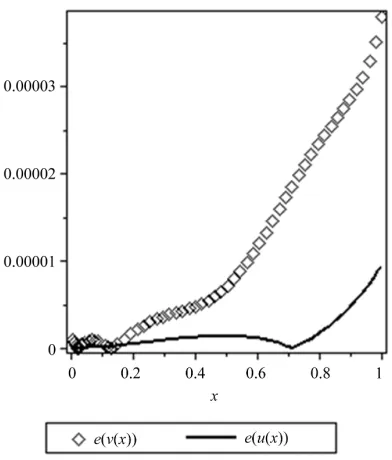
pre-sented in Figure 1 and also plots of error functions are
shown in Figure 2.
Example 3: consider non-linear system of Volterra
integro-differential equations with conditions
0 0,
0 1,
0 0,u u u . v
0 1,v
0 0 and
0 1.v
2 2
0
2 0
d ,
1
sin sin d , 0 1.
2
x
x
u x x u x u t v t t
v x x x u t v t t x
(31)The exact solutions are and
[7].
sin
u x x
C
cosv x x
Entries of vectors C1 and 2 are computed by solving a system of nonlinear equations with six un-knowns and six equations as follows
1,0 1,1
1,2 1,3
1, 4 1,5
2,0 2,1
2, 2 2,3
2,
1.032210259 .2058700709 0.04760379553 0.002178545560
0.0002500199685 0.000006823287551
.5638994174 .3768424359
0.0260060615
, ,
, ,
, ,
7 0.00398782176
, 0 ,
, 4,
0
c c
c c
c c
c c
c c
c
40.0001365887993, c2,5 0.0000141989 504 9. Therefore, one gets the following approximate solutions
3
3 2
7 1
5 4
0.007222202515 0.001672032401 0.1676491115 0.0002483913114
0.3210839427 10 ,
T
x x
x x
u x C P x x
x
3
24
3 2
5
2
0.003945506187 0.04597489600 1
0.002189489246 2 0.00004265668610
1 2
1.
T
x x
x x
x
x C
x
v P x
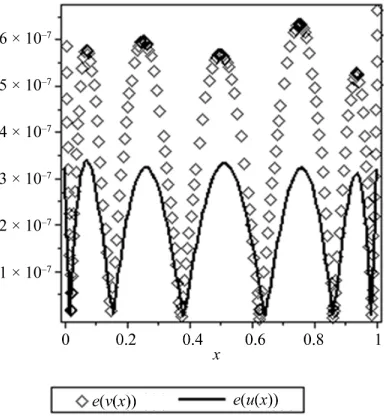
Approximate and exact solutions are plotted in Figure 3. Error functions are plotted in Figure 4.
Example 4: Consider the following non-linear system
of Volterra integro-differential equations with the exact solutions
2 ,u x x v x
x and w x
3x2 on 0 x 1 [5].
3 2 2
0
2
0
3 2 2
2 2 3
0
2 2 d
3 d
,
4
2 2
3
d ,
x
x
x
u x x x v x v t u t w t t
v x x x u t x t v t u t w t t
w x x u t u x
x v t u t t w t t
,
(32)
(a)
(b)
[image:6.595.325.520.69.439.2]Figure 1. (a) and (b) plots of exact and approximate solu-tions of Example 2.
[image:6.595.326.522.475.705.2](a)
(b)
[image:7.595.334.520.61.695.2]Figure 3. (a) and (b) plots of exact and approximate solu-tions of Example 3.
Figure 4. Plots of error functions of Examples 3.
(a)
(b)
(c)
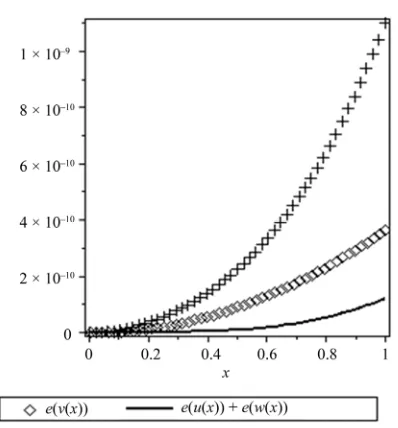
[image:7.595.73.279.73.453.2] [image:7.595.81.273.494.702.2]Figure 6. Plots of error functions of Examples 4.
Initial conditions are u
0 0,u
0 0,
0 0 and w
0 .
0 0,
0 1v v , w 0
The following approximate solutions would be achie- ved by using Chebyshev wavelets method.
11 5 10 4
11 3 2
2
5 1
3
1
8.527181902 10 2.509321144 10 4.653979568 10 3.641136902 10 6.551942965 10 ,
T
u x
x
x P
x
x
C x
1 x
11 5 10 4
1 2
2
0 3 10 2
14
7.880203686 10 1.637978948 10 1.014393404 10 3.511874249 10
1.461792049 10 ,
T
x x
x x
v x C P x x
x
14
10 5 9 4
10 3 2
2
1 3
2
4.043702026 10 1.228923763 10 7.249989732 10 3.000000001 1.753892960 10 2.955310652 10 .
T
w x C P
x x
x x
x x
Plots of the exact solution, approximate solution and error functions are shown in Figures 5 and 6.
5. Conclusions
This paper proposes a powerful technique for solving systems of integro-differential equations using Cheby-shev wavelets method. Comparison of the approximate solutions and the exact solutions shows that the proposed method is more efficient tool and more practical for solving linear and non-linear systems of integro-difieren- tial equations, and plots confirm. Researches for finding
more applications of this method and other orthogonal basis functions are one of the goals in our research group. The package Maple 13 has been used to carry the com-putations associated with these examples.
6. Acknowledgements
Authors are grateful to the anonymous reviewers for his (her) influential comments which have improved the quality of the paper.
7. References
[1] E. Babolian and F. Fattahzadeh, “Numerical Computation Method in Solving Integral Equations by Using Cheby-shev Wavelet Operational Matrix of Integration,” Applied Mathematics and Computations, Vol. 188, No. 1, 2007, pp. 1016-1022. doi:10.1016/j.amc.2006.10.073
[2] E. Babolian and F. Fattahzadeh, “Numerical Solution of Differential Equations by Using Chebyshev Wavelet Op-erational Matrix of Integration,” Applied Mathematics and Computations, Vol. 188, No. 1, 2007, pp. 417-426. [3] Y. Li, “Solving a Nonlinear Fractional Differential
Equa-tion Using Chebyshev Wavelets,” Communications in Nonlinear Science and Numerical Simulation, Vol. 15, No. 9, 2010, pp. 2284-2292.
doi:10.1016/j.cnsns.2009.09.020
[4] J. Biazar, “Solution of Systems of Integral-Differential Equations by Adomian Decomposition Method,” Applied Mathematics and Computation, Vol. 168, No. 2, 2005, pp. 1232-1238. doi:10.1016/j.amc.2004.10.015
[5] J. Biazar, H. Ghazvini and M. Eslami, “He’s Homotopy Perturbation Method for Systems of Integro-Differential Equations,” Chaos, Solitions and Fractals, Vol. 39, No. 3, 2009, pp. 1253-1258. doi:10.1016/j.chaos.2007.06.001
[6] E. Yusufoglu (Agadjanov), “An Efficient Algorithm for Solving Integro-Differential Equations System,” Applied Mathematics and Computation, Vol. 192, No. 1, 2007, pp. 51-55. doi:10.1016/j.amc.2007.02.134
[7] J. Biazar and H. Aminikhah, “A New Technique for Solving Integro-Differential Equations,” Computers and Mathematics with Applications, Vol. 58, No. 11-12, 2009, pp. 2084-2090. doi:10.1016/j.camwa.2009.03.042
[8] J. Pour-Mahmoud and M. Y. Rahimi-Ardabili and S. Sha- morad, “Numerical Solution of the System of Fredholm Integro-Differential Equations by the Tau Method,” Ap-plied Mathematics and Computation, Vol. 168, 2005, pp. 465-478.
[9] S. Abbasbandy and A. Taati, “Numerical Solution of the System of Nonlinear Volterra Integro-Differential Equa-tions with Nonlinear Differential Part by the Operational Tau Method and Error Estimation,” Journal of Computa-tional and Applied Mathematics, Vol. 231, No. 1, 2009, pp. 106-113. doi:10.1016/j.cam.2009.02.014
with Applications, Vol. 56, No. 9, 2008, pp. 2411-2417.
doi:10.1016/j.camwa.2008.05.017
[11] M. Gachpazan, “Numerical Scheme to Solve Integro- Difierential Equations System,” Journal of Advanced Re-search in Scientific Computing, Vol. 1, No. 1, 2009, pp. 11-21.
[12] K. Maleknejad, F. Mirzaee and S. Abbasbandy, “Solving Linear Integro-Differential Equations System by Using Rationalized Haar Functions Method,” Applied Mathe-matics and Computation, Vol. 155, No. 2, 2004, pp. 317- 328. doi:10.1016/S0096-3003(03)00778-1
[13] K. Maleknejad and M. Tavassoli Kajani, “Solving Linear Integro-Differential Equation System by Galerkin Meth-ods with Hybrid Functions,” Applied Mathematics and Computation, Vol. 159, No. 3, 2004, pp. 603-612.
doi:10.1016/j.amc.2003.10.046
[14] I. Daubeches, “Ten Lectures on Wavelets,” SIAM, Philadelphia, 1992.