DIALLEL CROSS ANALYSIS IN MAIZE
*,1
Maicon Nardino,
2Ivan Ricardo Carvalho,
5
Tiago Corazza da Rosa,
6Felipe Koch,
8
Vinicius J. Szareski
1
Pós doctor of Federal University of Pelotas
2Doctor student of Federal University of Pelotas
3,4Adjunct Professor of the
4
Adjunct Professor of the Federal University of Pampa (Universidade Federal do Pampa
UNIPAMPA). Rua 21 de abril, 80. Dom Pedrito, RS. Brazil. CEP 96450
5
Studying agronomy at the F
6
Doctor student of the Post Graduate Program in Science and Seed Technology,
7
Professor at the Federal University of Pelotas
7Master student student of Federal University of Pelotas
ARTICLE INFO ABSTRACT
The knowledge about genetic relation between crosses is extremely important for plant breeding, contributing as the main parameter for combination choosing. The selection based only on desirable characters is insuf
was developed from March to June 2016.The genotype x environment interaction is a significant variation source in maize hybrids testing. There are evidences that GCA and SC
interact with sites and years, and also that SCA includes dominance and epistasy deviations, as well a significant portion of the genotype x environment interaction. Maize is one of the most investigated crops within the field of genetics, s
importance is also given by the large amount of food provided for the entire productive chain, as well as the recent inclusion of maize products in the functional food market.
maize in both national and international scenarios, researches continue to be efficiently and reliably done by numerous scientists. Genetic breeding, in combination with other fields of science, progressively contributed in the genetic improv
responsible for genetic gains and the current genetic level of hybrids.
Copyright©2016, Maicon Nardino et al.This is an open access article distributed under the Creative Commons Att use, distribution, and reproduction in any medium, provided the original work is properly cited.
INTRODUCTION
Maize (Zea mays L.) is one of the most grown cereal in the world, and grain yield has constantly increased
2010). Over the past five years, functional components of great importance for human diet began to be identified in maize (MENEGALDO, 2013). Currently, Brazil is one of the largest maize producers surpassed only by the United States and China (USDA, 2012).
*Corresponding author: Maicon Nardino
Pós doctor of Federal University of Pelotas
ISSN: 0975-833X
Article History: Received 21st May, 2016 Received in revised form 18th June, 2016
Accepted 20th July, 2016 Published online 20th August, 2016
Key words:
Combining ability, Genotype x environment,
Zea mays L.
Citation: Maicon Nardino, Ivan Ricardo Carvalho, Willian Silva Barros
Research, 8, (08), 35686-35692.
RESEARCH ARTICLE
DIALLEL CROSS ANALYSIS IN MAIZE
Ivan Ricardo Carvalho,
3Willian Silva Barros,
4Velci Queiróz de Souza,
Felipe Koch,
6Geison Aisenberg,
7Tiago Zanata Aumonde,
Vinicius J. Szareski and
6Gustavo H. Demari
Pós doctor of Federal University of Pelotas
Doctor student of Federal University of Pelotas
Adjunct Professor of the Federal Universityof Pelotas
Adjunct Professor of the Federal University of Pampa (Universidade Federal do Pampa
UNIPAMPA). Rua 21 de abril, 80. Dom Pedrito, RS. Brazil. CEP 96450
Studying agronomy at the Federal University of Pelotas
Doctor student of the Post Graduate Program in Science and Seed Technology,
Federal University of Pelotas
Professor at the Federal University of Pelotas
Master student student of Federal University of Pelotas
ABSTRACT
The knowledge about genetic relation between crosses is extremely important for plant breeding, contributing as the main parameter for combination choosing. The selection based only on desirable characters is insufficient to produce a high genetic potential progeny.
was developed from March to June 2016.The genotype x environment interaction is a significant variation source in maize hybrids testing. There are evidences that GCA and SC
interact with sites and years, and also that SCA includes dominance and epistasy deviations, as well a significant portion of the genotype x environment interaction. Maize is one of the most investigated crops within the field of genetics, serving as a template for many other cross pollinated specie. Its importance is also given by the large amount of food provided for the entire productive chain, as well as the recent inclusion of maize products in the functional food market.
maize in both national and international scenarios, researches continue to be efficiently and reliably done by numerous scientists. Genetic breeding, in combination with other fields of science, progressively contributed in the genetic improvement of maize, however the first one is the main responsible for genetic gains and the current genetic level of hybrids.
is an open access article distributed under the Creative Commons Attribution License, which use, distribution, and reproduction in any medium, provided the original work is properly cited.
L.) is one of the most grown cereal in the world, and grain yield has constantly increased (KU et al., 2010). Over the past five years, functional components of great importance for human diet began to be identified in maize (MENEGALDO, 2013). Currently, Brazil is one of the largest only by the United States and
Among the Brazilian states, Paraná stands out as the national production leader with 16.75 million tons. However, the Brazilian yield average is 4808 kg ha
potential of some cultivars, and far below the largest producing countries (CONAB, 2013). The increasing researches from the early twentieth century enabled the maize hybrid development. Among several crops improved through genetic b
other species of economic importance
scientific research and selection progress as much as (PATERNIANI, 2001). According to Ramalho
through the inclusion of hybrid maize in the production system, plant breeding was responsible for about 58% of the
International Journal of Current Research Vol. 8, Issue, 08, pp.35686-35692, August, 2016
INTERNATIONAL
Maicon Nardino, Ivan Ricardo Carvalho, Willian Silva Barros et al. 2016. “Diallel cross analysis in Maize
Velci Queiróz de Souza,
Tiago Zanata Aumonde,
7Tiago Pedó,
Adjunct Professor of the Federal University of Pampa (Universidade Federal do Pampa –
UNIPAMPA). Rua 21 de abril, 80. Dom Pedrito, RS. Brazil. CEP 96450-000
Doctor student of the Post Graduate Program in Science and Seed Technology,
The knowledge about genetic relation between crosses is extremely important for plant breeding, contributing as the main parameter for combination choosing. The selection based only on desirable ficient to produce a high genetic potential progeny. This work of literature review was developed from March to June 2016.The genotype x environment interaction is a significant variation source in maize hybrids testing. There are evidences that GCA and SCA variance may interact with sites and years, and also that SCA includes dominance and epistasy deviations, as well a significant portion of the genotype x environment interaction. Maize is one of the most investigated erving as a template for many other cross pollinated specie. Its importance is also given by the large amount of food provided for the entire productive chain, as well as the recent inclusion of maize products in the functional food market. Due to the importance of maize in both national and international scenarios, researches continue to be efficiently and reliably done by numerous scientists. Genetic breeding, in combination with other fields of science, ement of maize, however the first one is the main responsible for genetic gains and the current genetic level of hybrids.
ribution License, which permits unrestricted
Among the Brazilian states, Paraná stands out as the national production leader with 16.75 million tons. However, the Brazilian yield average is 4808 kg ha-1, well below the genetic potential of some cultivars, and far below the largest producing The increasing researches from the early twentieth century enabled the maize hybrid development. Among several crops improved through genetic breeding, no other species of economic importance has been benefited from scientific research and selection progress as much as maize According to Ramalho et al. (2012), through the inclusion of hybrid maize in the production nt breeding was responsible for about 58% of the
INTERNATIONAL JOURNAL OF CURRENT RESEARCH
yield gains. The productivity increase may also be attributed to crop techniques enhancement, farmers technification, and higher flow of information about crops conducting and managing. Maize is grown throughout Brazil and it is the only Poaceae species of economic importance with monoic floral
organization (Sangoi et al., 2006). As affirmed by Fuzatto
et al. (2002) and Lorencetti et al. (2005), the success of a maize breeding program is conditioned by the efficiency of choosinggenitors, which will be crossed to produce superior hybrids. However, one issue faced by breeders working with hybrids is evaluating the combining ability of parental lines. As related by Cruz e Regazzi (1994), it is possible to verify the combining ability effects through the diallel method. The number of genitors used in a diallel cross is quite high, making the crossings among all lineages generally infeasible. For this reason, derivations were created to test the heterotic effects of two distinct groups of maize lines, as partial diallels (Carvalho
et al., 2004).
As stated by Bernini and Paterniani (2012); Cruz and Regazzi (1994); Paterniani and Viegas, (1987) and Vencovsky (1987), the diallel method of analysis allows to estimate useful genetic parameters to select parental lines and verify the combining ability effects, which are described as general or specific. General combining ability is characterized by the predominance of additive effect alleles, and specific combining ability evidences the effects of not additive alleles, as dominance and epistasis. In this context, diallel crosses are important to predict the best combinations, allowing the efficient management of financial and human resources in order to generate a constant genetic gain of elite hybrids (Valério et al., 2009). To maximize the breeding programs efficiency, aiming for a shorter period of elite lineages development, studies of association between characters are extremely important to enable faster progresses. On this regard, indirect selection becomes a useful alternative to low heritability characters, difficulty of measurement, or when selection is made in the first selection cycles. The knowledge about associations among traits is extremely important for genetic gain and selection of the best genitors, looking for the development of superior cultivars with high desirable traits performance (Hallauer, 2007). The path analysis, developed by Wright (1921, 1923), is a major tool for breeders. It enables to decompose the correlation or association between other characters and the character of interest, classifying the effects in direct or indirect (Cruz; Regazzi, 1997; Cruz; Carneiro, 2006), demonstrating the real cause and effect of associations between characters (Kurek et al., 2001), elevating the progress when compared to direct selection (Ferreira et al., 2007).
Maize history and origin
Archaeological studies indicate that maize is originally from Mexico (PATERNIANI, 1978). Evidences reveal that indigenous tribes from Mexico began the domestication instinctively, selecting phenotypes that presented promising characteristics as high vigor, high yield, diseases resistance and climatic conditions adaptation. Thus, a multiple stem grass with small spikelets and a few grains has evolved to become the current maize plant through a continuous selecting process (Miranda Filho; Viégas, 1987).
Although some controversies about the evolutionary origin of maize, it is known that teosinte (Zeamayss sp. parviglumis) is its closest wild relative (Ramalho, 2004) Teosinte plants present many lateral branches coming out of the central stem, ending in a male inflorescence. Each branch also has a female inflorescence which results in a small spike. Teosinte presents tillering, while maize only expresses this characteristic under biotic or abiotic stress conditions, although with fewer tillers than its ancestor. It has been identified more than 300 races and thousands of maize varieties being grown all over the world (Teixeira et al., 2005). The characterization of races endosperm type reports that 40 % are starchy, 30 % are hard crystalline, 20% are indentations, less than 10% are popcorn, and about 3% are sweet corn. It is estimated that 100,000 maize accessions are held in germplasm banks worldwide (Chang, 1992).The favorable characteristics as cycle and reproductive system have made the maize a model for genetic studies of out crossing species, and also contributed in the genetic breeding process (Paterniani et al., 1987).
Maize botanical description
Maize belongs to the Plantae kingdom, Magnoliophyta division, Liliopsida class, Poales order, Poaceae family, Panicoideaesubfamily, May deae tribe, Zea genus, and
Zeamays L. species, presenting 2n = 2x = 20 chromosomes (Paterniani; CAMPOS, 1999). According to Buckler and Stevens (2006), the five recognized species of the Zea genus are: Zeadiploperennis; Zeaperennis; Zealuxurians; Zeanicaraguensise; Zea mays L., and the four recognized subspecies of the mays species are:Zea mays L. ssp.
huehuetenangensis; Zea mays L. ssp. mexicana; Zea mays L. ssp. parviglumis; Zea mays L. ssp. Mays (cultivated maize). This work of literature review was developed from March to June 2016.
Maize morphological characteristics
Maize plants present an annual cycle, plant height may range between 1 and 4 meters, the roots are fasciculate spreading from 1.5 to 3 meters long. The leaves are alternately arranged, supported by the superposition of sheaths surrounding the stem. Usually, the plants have one to three ears, varying according to fertilization rates and management techniques (plant density and spatial arrangement). The female inflorescence corresponds to a stem with more condensed internodes, being the flower partially surrounded by palea and lemma. A functional pistil is present with a single basal ovary and long styles that are exposed to pollination. The male inflorescence is located in the steam terminal part, presenting a central axis with multiple lateral branches where the pollen grains are formed. These pollen grains will be scattered and deposited in the stigma-style, germinating and fertilizing the ovules. The majority of maize genotypes present the protandric reproductive system. Pollen grains become viable three to five days before the female inflorescences on the same plant, and wind is the main pollination mechanism, classifying maize as an anemophilus species (Paterniani, 1978).
ovary wall and can be colorless, red, brown, orange and variegated. Inside the grain are the endosperm and the embryo. The endosperm is responsible for approximately 85% of the total grain mass, embryo for 10%, and pericarp for 5%. Except for its most external layer constituted by aleurone cells. The embryo is located in a depression on the endosperm upper surface near the base of the grain. The scutellum consists of a leaf modification, which acts as a digestive organ during germination and seedling development. The coleoptile wraps and protects the edge of the shoots, while the coleorhiza surrounds the primary roots (Paterniani, 1978).
The hybrid maize
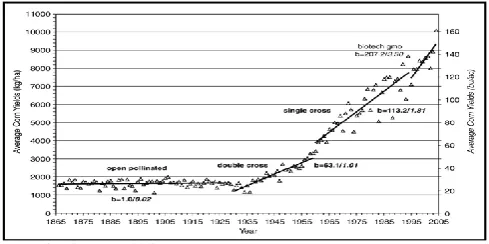
The hybrid maize development was started by Beal (1880), performing hybridizations between open-pollinated varieties, pointing hybridization as a method of increasing maize yield. Shull (1909) presented a basic scheme for hybrid maize seeds production that is valid until today. It is based on achieving inbred lines and using these inbred lines to produce hybrid maize seeds. In parallel, East (1908) studied the inbreeding and hybridization effects in maize. The researcher believed the method of pure lines was not economically viable because of the low seed production of inbred lines. Jones (1918) suggested the utilization of double-cross hybrids obtained through the crossing of two regular hybrids, making the production economically feasible. The first commercial hybrids were introduced around 1930 in the US region known as "Corn belt". After that, the open pollinated varieties were gradually replaced by hybrids. In 1960, less than 5% of the "Corn Belt" maize area was cultivated with open pollination varieties (Paterniani, 1978).The hybrid maize introduction, during the 1920 decade, broughta great boost to modern agriculture. East (1936) and Shull (1946) released the theoretical basis for hybrids development, but maize hybrids only appeared several years later, through the lineages utilization. However, due to low grain yield and high cost of inbred lines production, the double-cross hybrids dominated the United States market from 1934 to 1960. In 1940, 50% of maize fields in the United States were hybrids (TROYER, 2006).
[image:3.595.40.285.538.660.2]Source: (TROYER, 2006)
Figure 1. Maize evolution throughout decades (TROYER, 2006)
Considering the selection process and lineages genetic advance associated with better management techniques and higher productivity, the single-cross hybrid started to gain space (Figure 1) because of their higher yield, when compared to double-cross hybrids. The yield gains were even bigger with
the biotechnology advent during the mid-90s. In Brazil, the first maize breeding program was started in 1932 at the Agronomic Institute of Campinas (IAC), in Campinas – SP, where Krug and associates produced the first Brazilian double-cross hybrid (Krug et al., 1943). In addition, in 1935, Gladstone and Secundino, started a maize research at the Federal University of Viçosa, producing the first commercial hybrid in 1938 (Paterniani; Campos, 1999).
Hybrid maize production process
Generally, a hybrid crop production program consists of the following steps – Population selection, inbreed lines development, combining ability evaluation and extensive testing of hybrid combinations, commonly called Value for Cultivation and Use Testing (VCU). From all these steps, the selection of the population to be selfed is fundamentally important, because the entire program success depends on it (Paterniani; Campos, 1999). These populations are supposed to carry the favorable alleles for traits of agronomic interest, allowing the achievement of superior lineages (Hallauer et al., 2010). Choosing populations to develop superior lines is a crucial step in the breeding program, considering the several base population options for promising inbred lines extraction. An alternative that has been widely employed for the base population formation is the utilization of a narrow genetic base germplasm such as single cross hybrids. They present the advantage of being already evaluated for desirable phenotypes and tested in multiple environments, combining high productivity with a large proportion of favorable alleles already fixed in the populations that will be assembled (Amorim; Souza, 2005; Oliboni et al., 2013). According to Carvalho (2008), after the population assembling, self-fertilization of selected plants is the most used method to obtain inbred lines. Self-fertilization consists of pollinating the ear with pollen from the same plant, leading the plants to homozygosis – the loss of vigor is severe for maize. However, in order to improve the lineages, it is necessary to apply a selection process concomitantly with the lines endogamy increase. After achieving the elite breeding lines collection, several methods can be applied to evaluate the combination ability among pre-selected lines. Some methods are: complete diallel, partial diallel, circulantdiallel, and top cross. These methods are based on the concepts of general combining ability and specific combining ability. Although the lineages development process may seem complicated and slow, it does not constitute the greatest difficulty to produce hybrids. The obtaining of superior genetic combinations is extremely difficult because not every lineage will produce superior hybrids due to their lower combining ability with other selected lines (Carvalho et al., 2008).
Some advantages and disadvantages of maize hybrid utilization are described below, according to Paterniani (1974): Hybrid production advantages:
Distinct parental characteristics association in the shortest possible period of time;
To get superior genotypes in a relatively short period;
To use gene interactions in hybrid generation;
To obtain less environment interaction in the F1 generation;
To produce hybrid maize seeds on a commercial scale, with favorable effects on the region's economy.
Hybrid production disadvantages
Only a part of the useful genes is used, since there is no contest of methods for increasing the frequency of favorable genes.
The heterosis is randomly explored, reaching a difficult point to be surpassed.
The heterosis can only be explored in species of easy seeds production.
The hybrid seed production is only viable where there is facility for processing and distributing.
Diallel analysis
The strategies adopted in breeding programs depend on the genetic analysis of interest traits, because they lead to a better understanding of the genetic relationship between crossed lineages, thereby the diallel crosses are useful for predicting the best combinations between parents and segregating populations (Valério et al., 2009; Baldissera et al., 2012). In this contest, Sprague and Tatum (1942); Hayman (1954), and Griffing (1956) proposed the concept of diallel cross as the recombination of genetic variability available in the program, performing crosses among all lineages. Thus, n lineages will result in n² combinations. According to Veiga et al. (2000), and Carvalho et al. (2004), the complete diallel method presents a major issue when there are numerous genitors, resulting in a relatively large number of hybrid combinations to be evaluated. Such factor generates a high cost limiting the breeding program. However, if the researcher goal is to cross a genetic constitution group with one or more testers, it is employed the partial diallel cross. This is similar to a genetic factorial design, allowing between groups crossing rather than within groups crossing. The genetic constitutions must be contrasting and allocated in heterotic groups presenting common characteristics within the group,and divergent between heterotic groups (Vencovsky; Barriga, 1992; Miranda; Gorgulho, 2001). The partial diallel model was explained by Kempthorne and Curnow (1961), developed to increase the number of genitors in a diallel cross (Hallauer et al., 2010).As reported by Vencovsky (1987); Bernini and Paterniani (2012), the diallel cross methodenables to estimate useful genetic parameters to select genitors for hybridization, as the identification of gene action of character control. Besides, it allows to identify the best lineages combination to be used as male or female genitor in order to provide the maximum heterotic expression for the hybrids. Vencovsky (1987) also mentioned that diallel crosses allow the genetic parameters estimating, thereby increasing information to the breeder and contributing for decision making.
Combining ability
The knowledge about genetic relation between crosses is extremely important for plant breeding, contributing as the main parameter for combination choosing. The selection based
only on desirable characters is insufficient to produce a high genetic potential progeny. The identification of high combining ability genitors is necessary for maximum heterosis expression in maize hybrids. Diallel analysis is used to estimate the general and specific combining ability effects (Cruz; Regazzi, 1994). This methodology has been widely used in maize breeding revealing itself very efficient to detect genetic differences among strains, allowing their allocation in distinct heterotic groups (Han et al., 1991; Gonzalez et al., 1997; Terron et al., 1997). According to Sprague and Tatum (1942); Vencovsky (1987), and Makanda et al. (2010), the general combining ability (GCA) is related to additive effect genes, and it is defined as the lineage average behavior in hybrid combinations. This knowledge is greatly important for breeding programs revealing the best crosses and aiding on genitors choosing. The specific combining ability (SCA)is estimated as the crossing behavior deviation from the expected by the general combining ability of genitors. This behavior is related to non-additive genetic effects as complete dominance, partial dominance and/or epistasis, leading certain combinations to be superior or inferior than the involved lineages average.
The genotype x environment interaction is a significant variation source in maize hybrids testing. There are evidences that GCA and SCA variance may interact with sites and years, and also that SCA includes dominance and epistasy deviations, as well a significant portion of the genotype x environment interaction (Rojas; Sprague, 1952). Sprague e Eberhart (1977) recommend two repetitions per site, and three to five environments for maize crosses evaluation, because the additive effects interaction per environment is a significant factor for phenotypic variance manifestation. Increasing the number of environments reduces the error and the additive effects interaction per environment, while increasing the repetitions only reduces the error contribution for the phenotypic variance (Eberhart et al., 1995).
Genetic variance
The variability components estimative is extremely important for breeders, as they allow to infer how much of the variability is due to genetic or environmental effects (RAMALHO et al., 2012). Allard (1971) described that character variations are caused by genetic and environmental differences.
The genetic variance of a character can be obtained through the following equation (RAMALHO et al., 2012):
σG²= σP²- σE², where:
σG²= genetic variance;
σP²= phenotypic variance;
σE²= environmental variance;
Knapp et al. (1985) used the following model to identify the progenies variation within each environment:
σG²=
MSTR - MSE
Rep , where:
MSTR= mean square treatment (hybrids) for each environment; MSE= mean square error for each environment; Rep= Repetitions number for each environment.
Thus, all environment and error effects are withdrawn, leaving only the character genetic effects in the studied environment. The biological variation characterization is the basis of geneticists and plant breeders work. To distinguish and understand the character hereditary basis is necessary to differentiate two components: genetic and non-genetic (environmental), as well as their effects magnitude. In this regard, the genetic-statistic models have contributed to elucidate these variations, especially for quantitative traits. The efficiency and clarification of the models have brought a significant contribution for plant breeders (BUENO et al., 2006).
Heritability
The study of heritability is important in the decision making process about crossing methods, being a useful parameter for breeders. According to Fehr (1987), heritability is described in broad and narrow sense. Heritability in the broad sense is the total genetic variance, including additivity, dominance and epistasis related to phenotypic variance. Heritability in the narrow sense is the additive variance proportion present in the phenotype variance. The heritability concepts contribute in the analysis and identification of inconsistent behavior characters across different environments, allowing to predict the selection possibility, and also demonstrating the phenotypic variation proportion that can be inherited. It is obtained by the expression (Ramalho et al., 2012):
h² = σP² - σE²
σP² x 100
where:
h² = character heritability; σP²= phenotipic variation;
σE² = environmental variation.
As affirmed by Ramalho et al. (2012), the character heritability estimations are not immutable, as the trait expression might change due to genetic and environmental variation. Therefore, heritability estimates can be increased using a larger genetic variability population, and controlling environmental effects through better experimental conditions as a way of reducing the environmental contribution for total phenotypic variation. Due to the complex nature of character-gene relation, it is expected that environmental factors may obscure certain inheritance models, even if these factors are subtle and trivial. Most genes are expressed in fairly uniform and predictable manners, considering regular environmental conditions in which they will be exposed. Gene expressivity refers to the expression mode, generally ranging with different environmental conditions. It may be significantly modified by genetic and environmental factors. Penetrance refers to the expression or non-expression of a gene. Therefore, penetrance and expressivity are events that masquerade gene-character relationship and tend to obscure the correlation between
genotype and phenotype. It is an issue for breeders especially when the character presents in complete penetrance and variable expressivity (Allard, 1971).
Correlation between characters
Correlation is a statistical parameter that measures the degree of association between two characters. They are considered correlated when a change in one of them is followed by a simultaneous change in the other (Ramalho et al., 2012).The effects of genic correlation are explained by genetic mechanisms controlling the two characters combined variation, occurring pleiotropy and genetic linkage effects. The knowledge about phenotypic, genetic and environmental correlation between characters is essential for multiple traits simultaneous selection, and also when the character of interest reveals low heritability or mensuration difficulty (Falconer, 1996). In order to maximize the breeding program efficiency, studies of correlated traits may enable a faster progress than only the direct selection of desired characters (Carvalho et al., 2004). According to Cruz e Regazzi (1994), the phenotypic correlations can be directly obtained through the measurement of two characters of individuals in the population. This correlation has genetic and environmental causes, although only genetic involves an association of inheritable nature, being able to guide plant breeding programs. Considering this, it is essential to distinguish and quantify the degree of genetic and environmental association between characters. As reported by Ramalho et al. (2012), genetic correlation occurs when two genes are closely linked, thereby they tend to be transmitted in the same gamete originating an individual that may or may not express the inherited alleles corresponding phenotypes.
A similar situation occurs when the gene in question is pleiotropic. In this circumstance, the tendency is that phenotypes associated to the same allele will always occur together. Aiming to understand the association between characters, Wright (1921) proposed the Path Analysis method to slice the estimated correlations in direct and indirect effects of each character on a basic variable. This method also allows to understand whether the correlation between two variables is of cause and effect, or generated by the influence of other variables. According to Souza et al. (2008), the correlations between primary and secondary production components can provide different selection strategies, increasing the genetic progress with selection cycles for agronomic desirable traits. Magalhães et al. (2002) points out that maize grain yield and the primary production components positively correlate with germination speed and uniformity, prolificity, total number of leaves, number of leaves above the ear, and production efficiency. On the other hand, they negatively correlate with number of days to flowering, lodging, number of tassel branches, ear height / plant height ratio, and leaf insertion angle.
Final considerations
inclusion of maize products in the functional food market. Due to the importance of maize in both national and international scenarios, researches continue to be efficiently and reliably done by numerous scientists. Genetic breeding, in combination with other fields of science, progressively contributed in the genetic improvement of maize, however the first one is the main responsible for genetic gains and the current genetic level of hybrids. Clearly, the grain yield average is far shorter than the actual genetic hybrid potential, but gradually the technological level and management techniques of several growing systems are being improved, resulting in cost reduction and allowing the small producers inclusion, which significantly contribute to national scale production. Many researches are being conducted, and characters until then considered of small influence became the center of researches attention mainly about their correlation with grain yield.
REFERENCES
Allard, R. W. 1971. Princípios do melhoramento genético das plantas. São Paulo: Edgard Blücher Ltda., 485 p.
Amorim, E. P., Souza, J. C. 2005. Híbridos de milho inter e intrapopulacionais obtidos a partir de populações S0 de híbridos simples comerciais. Bragantia, Campinas, v.64, n. 3, p.561-567.
Baldissera, J. N. C., ValentinI, G., Coan, M. M. D., Almeida, C. B., Guidolin, A. F., Coimbra, J. F. M. 2012. Capacidade combinatória e efeito recíproco em características agronômicas do feijão. Semina: Ciências Agrárias, Londrina, v. 33, n. 2, p. 471-480.
Beal, W. J. In: Paterniani, E.; Viegas, G. P. Melhoramento e Produção de Milho. 1987. Campinas: Fundação Cargill, 795p.
Buckler, E. S., Stevens, N. M. 2006. Maize origins, domestication, and selection. In: Motley, T. J.; Zerega, N.; Cross, H. Eds. New York: Columbia, cap. 4, p. 67-90. Bueno, L. C. S., Mendes, A. N. G., Carvalho, S. P. 2006.
Melhoramento de plantas: princípios e procedimento. 2 ed. Lavras:UFLA, 319p.
Carvalho, F. I. F., Lorencetti, C., Marchioro, V. S. Silva, S. A. Condução de populações no melhoramento genético de plantas. Pelotas: UFPel,2 ed. 2008. 271p.
Carvalho, F. I. F.; Lorencetti, C., Benin, G. Estimativas e implicações da correlação no melhoramento vegetal. Pelotas: UFPel, 142p. 2004.
Chang, T. T. 1992. Availability of plant germplasm for use in crop improvement. In: Stalker, H. T.; Murphy, J. P. Plant breeding in the 1990s. Melksham: Redwood Press, p. 17-35.
Conab, 2013. Companhia Nacional de Abastecimento. Acompanhamento de safra brasileira: grãos, primeiro levantamento, março 2013 / Companhia Nacional de Abastecimento. Brasília: Conab, Disponível em: <http://www.conab.gov.br>. Acesso em 01 maio2013. Cruz, C. D., Carneiro, P. C. S. 2006. Modelos biométricos
aplicados ao melhoramento de plantas. 2 ed. Viçosa: UFV. 586 p.
Cruz, C. D., Regazzi, A. J. 1994. Modelos biométricos aplicados ao melhoramento genético. Viçosa: UFV, 380 p.
Cruz, C. D., Regazzi, A. J., 1997. Modelos Biométricos aplicados ao melhoramento genético. 2 ed. Viçosa: UFV, 390p.
East, E. M. 1909. The distinction between development and heredity in breeding. American Naturalist, v. 43, p. 173-181.
East, E. M. 1936. Heterosis. Genetics, v. 24, p. 375-397. Eberhart, S. A., Salhuana, W., Sevilla, R., Taba, S. 1995.
Principles for tropical maizebreeding. Maydica, Bergamo, v. 40, p. 339-355, 1995.
Falconer, D. S. Introdução à genética quantitativa. Viçosa: UFV, 4 ed. 1996. 464p.
Fehr, W. R. 1987. Principles of cultivar development. New York: MacMillan, 525p.
Ferreira, F. M., Barros, W. S., Silva, F. L., Barbosa, M. H. P., Cruz, C. D. 2007. Relações fenotípicas e genotípicas entre componentes de produção em cana de açúcar. Bragantia, Campinas, v. 66, n. 4, p. 605-610.
Fuzatto, S. R., Ferreira, D. F., Ramalho, M. A. P., Ribeiro, P. H. E. Divergência genética e sua relação com os cruzamentos dialélicos na cultura do milho. Ciência e Agrotecnologia, Lavras, v. 26, n. 1, p. 22-32, 2002.
Gonzalez, S., Córdova, H., Rodriguez, S., De Leon, H., Serrato, V. M. 1997. Determinacion de unpatrónheterotico a partir de laevaluacion de undialelo de diezlineas de maiz subtropical. Agronomia Mesoamericana, v. 8, p. 1-7. Griffing, B. 1956. Concept of general and specific ability in
relation to diallel crossing systems. Australian Journal of Biological Sciences, v. 9, n. 4, p. 462-493.
Hallauer, A. R. History, Contribution, and Future of Quantitative Genetics in Plant Breeding: Lessons From Maize. Crop Science, v. 47, n. 3, p. 4-19, 2007.
Hallauer, A. R., Carena, J. M., MirandaFilho, J. B. 2010. Quantitative genetics in maize breeding. New York: Springer, 500p.
Han, G. C., Vasal, S. K., Beck, D. L., Elias, E. 1991. Combining ability of inbred lines derived from Cimmyt maize (Zea mays L.) germplasm. Maydica, v. 36, p. 57-64. Hayman, B. I. 1954. The theory and analysis of diallel crosses.
Genetics, v. 39, p. 789-809.
Jones, D. F. 1918. The effect of inbreeding and crossbreeding upon development. Genetics. Connecticut Agricultural Experiment Station, 207, p. 246-250.
Kempthorne, O., Curnow, R. N. 1961. The partial diallel cross. Biometrics. v. 17, p. 50 – 229.
Knapp, S. J.; Stroup, W. W., Ross, M. W. 1985. Exact confidence intervals for heritability on a progeny mean basis. Crop Science, Madison, v. 25, p. 192-194.
Krug, C. A., Viégas, G. P., 1943. Paoliéri, L. Híbridos comerciais de milho. Bragantia, v. 3, p. 367-552.
Ku, L. X., Zhao, W. M., Zhanq, J., Wu, L. C., Wang, C. L., Wang, P. A., Zhang, W. Q. and Chen, Y. H. 2010. Quantitative trait loci mapping of leaf angle and leaf orientation value in maize (Zea mays L.). TheoreticalandAppliedGenetics, v. 121, p. 951-959. Kurek, A. L., Carvalho, F. I. F., Assmann, I. C., Marchioro,
Magalhães, P. C., Durães, F. O. M. 2002. Cultivo do milho, germinação e emergência. Comunicado Técnico 39, Ministério da Agricultura, Pecuária e Abastecimento,Sete lagoas, MG.
Menegaldo, J. G. 2013. A importância do milho na vida das pessoas. In: Grupo Cultivar de Publicações Ltda.Pelotas,. Disponível em: <http://www.grupocultivar.com.br>. Acesso em: 01 maio 2013.
Miranda Filho, J. B.; Gorgulho, E. P. Cruzamentos com testadores e dialelos. In: Nass, L. L.; Valois, A. C. C.; Melo, I. S.; Valadares, M. C. (Ed.) Recursos genéticos e melhoramento: plantas. Rondonópolis: Fundação MT, 2001. p. 650-671.
Oliboni, R.; Faria, M. V.; Neumann, M.; Resende, J. T. V.; Battistelli, G. M.; Tegoni, R. G.; Oliboni, D. F. Análise dialélica na avaliação do potencial de híbridos de milho para a geração de populações-base para obtenção de linhagens. Semina: Ciências Agrárias, Londrina, v. 34, n. 1, p. 7-18, jan./fev. 2013.
Paterniani, E. Estudos recentes sobre heterose. Boletim n°1. Fundação Cargill, São Paulo, 1974. 36p.
Paterniani, E. Melhoramento e produção do milho no Brasil. Campinas: Fundação Cargill, 1978. 650 p.
Paterniani, E.; Campos, M. S. Melhoramento do milho. In: BORÉM, A. (ed.). Melhoramento de espécies cultivadas. Viçosa: UFV, 1999. 429-486 p.
Paterniani, E.; Viegas, G. P. Melhoramento e Produção de Milho.Campinas: Fundação Cargill, 1987. 795p.
Paterniani, M. E. A. G. Z. Use of heteros is in maize breeding: History, Methods and Perspectives. Crop Breeding and Applied Biotechnology, v. 1, n. 2 p.159-178, 2001.
Ramalho, M. A. P., Lambert, E. S. Biometria e o melhoramento de plantas na era da genômica. Revista Brasileira de Milho e Sorgo, v. 3, n. 2, p. 228-249, 2004. Ramalho, M., Santos, J. B., Pinto, C. B., Souza, E. A.,
Gonçalves, F. M. A.; Souza, J. C. Genética na Agropecuária. 5 ed. Lavras: UFLA, 2012. 565p.
Rojas, B. A., Sprague, G. F. A. 1952. Comparison of variance components in corn yield trials. III. General and specific combining ability and their interaction with location and years. Agronomy Journal, Madison, v. 44, p. 462-466, 1952.
Sangoi, L., Guidolin, A. F., Coimbra, J. L. M., Silva, P. R. F. 2006. Resposta de híbridos de milho cultivados em diferentes épocas à população de plantas e ao despendoamento. Ciência Rural, Santa Maria, v. 36, n. 5, p. 1367-1373, set./out.
Shull, G. H. A pure-line method of corn breeding. Am. Breeders Assoc. Rep. v. 5, p. 51-59, 1909.
Shull, G. H. Hybrid Seed Corn. Science, V. 103, n. 2679, p. 547-550, 1946.
Souza, A. R. R., Miranda, G. V., Pereira, M. G., Ferreira, P. L. 2008. Correlação de caracteres de uma população crioula de milho para sistema tradicional de cultivo. Caatinga, Mossoró, v.21, n.4, p.183-190.
Sprague, G. F., Tatum, L. A. 1942. General and specific combining ability in single crosses of corn. Journal of American Society of Agronomy, Madison, v.34, n.10, p.923-932.
Sprague, G. F.; Eberhart, S. A. 1977. Corn breeding. In: SPRAGUE, W. F. (Ed.). Corn and Corn Improvement. Madison: Journal of American Society of Agronomy, p.
335-336.
Teixeira, F. F.; Souza, B. O.; Andrade, R. V.; Padilha, L.Boas Práticas na Manutenção de Germoplasma e Variedades Crioulas de Milho. Sete Lagoas - MG. Comunicado Técnico, n. 113, p. 1-8, 2005.
Terron, A.; Preciado, E.; Córdova, H.; Mickelson, H.; López, R. Determinacion Del patronheterotico de 30 lineas de maiz derivadas de lapoblacion 43SR del CIMMYT. Agronomia Mesoamericana, v. 8, p. 26-34, 1997.
Troyer, A. F. 2006. Adaptedness and Heterosis in Corn and Mule Hybrids. Crop Science, v. 46, n. 2, p. 528-543. USDA -Agência Norte-Americana para o Desenvolvimento
Internacional. Disponível em: <http://http://www.usda. gov>. Acessado em:21 de jan. 2013.
Valério, I. P., Carvalho, F. I. F., Oliveira, A. C., Lorencetti, C., Souza, V. Q., Silva, J. A. G., Harwing, I., Schmidt, A. M., Bertan, I., Ribeiro, G. 2009. Estabilidade da produção e da capacidade de combinação de diferentes populações de aveia. Semina: Ciências Agrárias, Londrina, v. 30, n. 2, p. 331-346, abr./jun.
Veiga, R. D., Ferreira, D. F., Ramalho, M. A. P. 2000. Eficiência dos dialelos circulantes na escolha de genitores. Pesquisa Agropecuária Brasileira, Brasília, v. 35, n. 7, p. 1395-1406, jul.
Vencovsky, R. 1987. Herança quantitativa. In: Paterniani, E.;Viegas, G. P. (Ed.). Melhoramento e produção de milho. Campinas: Fundação Cargill, p. 137-209.
Vencovsky, R., Barriga, P. 1992. Genética biométrica no fitomelhoramento. Ribeirão Preto: Sociedade Brasileira de Genética, 496 p.
Wright, S. 1921. Correlation and causation. Journal of Agricultural Research. Washington, v. 20, p.557-585. Wright, S. 1923. The theory of path coefficients: a replay to
Niles’ criticism. Genetics, Austin, v. 8, n. 3, p. 239-255.