EFFECT OF DIETARY PROTEIN MODULATION AND ASCORBIC ACID SUPPLEMENTATION ON
THE RECTAL TEMPERATURE, HEAMATOCRIT VALUE AND BLOOD ASCORBIC
ACID LEVEL OF
1,*
Sudhamay Ghosh and
1
Department of Physiology, Midnapore College
2
Biochemistry and Nutrition Laboratory, Department of Physiology, Calcutta University, 92,
Acharya Prafulla Chandra Road, Kolkata
ARTICLE INFO ABSTRACT
Present study was carried out with the aim of investigating the effect of ascorbic acid supplementation and altered dietary protein level on the rectal temperature, haematocrit value and blood ascorbic acid status of rats exposed to chronic and acute heat
temperature of adequately (18%) protein fed rats was quite higher (37.41 ± 0.12 protein restricted (6%) rats (36.65 ± 0.12
supplementation of ascorbic acid. It was further observed that the stabilizing tendency of rectal temperature took more than 3 days of heat exposure when rats were under protein restriction. Decrease in haematocrit value after chronic heat exposure and an
were observed. Haematocrit values of both control and treated groups of animals were also observed went down to a great extent as a result of protein restriction. Plasma ascorbic acid level was observed to be increased
exposure in 6% protein
was found to be diminished after acute heat exposure in protein
Copyright © 2016, Sudhamay Ghosh and Ajay Kumar Chatterjee
which permits unrestricted use, distribution, and reproduction in any medium, provided the original work is properly cited.
INTRODUCTION
Temperature is an important environmental factor which plays a vital role in the reproduction, growth, development and destruction of all living organisms. Again, when an individual is exposed to temperature above the zone of thermal neutrality, heat appears as a stress and changes occur in different physiological systems, such as cardiovascular, respiratory, endocrines, neural etc. (Lee-Chiong and Stitt, 1995). Heat stress is one of the most important stressors especially in the tropical regions of the world (Altan, 2003). Adaptation to heat stress requires the physiological integration of many organs and systems viz. endocrine, cardio respiratory and immune system. Although humans have the capability to withstand large variations in environmental temper relatively small increases in internal temperature can lead to injury, heatstroke and even death (Crandall and Gonzalez Alonso, 2010. It was estimated that between 1979 and 2002, heatstroke claimed more American lives than the combined
*Corresponding author: Sudhamay Ghosh, Department of Physiology, Midnapore College Midnapore, Paschim Medinipur-721101, West Bengal,
ISSN: 0975-833X
Article History:
Received 25th December, 2015 Received in revised form 19th January, 2016
Accepted 17th February, 2016 Published online 31st March,2016
Key words: Heat stress, Ascorbic acid, Rectal temperature, Haematocrit value, Wister rat, Dietary protein level.
Citation: Sudhamay Ghosh and Ajay Kumar Chatterjee
temperature, heamatocrit value and blood ascorbic acid level of in vivo heat exposed rat
RESEARCH ARTICLE
EFFECT OF DIETARY PROTEIN MODULATION AND ASCORBIC ACID SUPPLEMENTATION ON
THE RECTAL TEMPERATURE, HEAMATOCRIT VALUE AND BLOOD ASCORBIC
ACID LEVEL OF
IN VIVO
HEAT EXPOSED RAT
Sudhamay Ghosh and
2Ajay Kumar Chatterjee
Department of Physiology, Midnapore College (Autonomous), Midnapore, Paschim Medinipur
Biochemistry and Nutrition Laboratory, Department of Physiology, Calcutta University, 92,
Acharya Prafulla Chandra Road, Kolkata-700 009, India
ABSTRACT
Present study was carried out with the aim of investigating the effect of ascorbic acid supplementation and altered dietary protein level on the rectal temperature, haematocrit value and blood ascorbic acid status of rats exposed to chronic and acute heat stress. It was observed that the normal rectal temperature of adequately (18%) protein fed rats was quite higher (37.41 ± 0.12
protein restricted (6%) rats (36.65 ± 0.12 C) which was observed to be further augmented by the prior supplementation of ascorbic acid. It was further observed that the stabilizing tendency of rectal temperature took more than 3 days of heat exposure when rats were under protein restriction. Decrease in haematocrit value after chronic heat exposure and an
were observed. Haematocrit values of both control and treated groups of animals were also observed went down to a great extent as a result of protein restriction. Plasma ascorbic acid level was observed to be increased after acute heat exposure in 18% as well as 6% protein
exposure in 6% protein-fed rats. But, when the ascorbic acid content was estimated in erythrocytes it was found to be diminished after acute heat exposure in protein-restricted rats only.
y Kumar Chatterjee. This is an open access article distributed under the Creative Commons Att use, distribution, and reproduction in any medium, provided the original work is properly cited.
Temperature is an important environmental factor which plays a vital role in the reproduction, growth, development and destruction of all living organisms. Again, when an individual is exposed to temperature above the zone of thermal neutrality, ars as a stress and changes occur in different physiological systems, such as cardiovascular, respiratory, Chiong and Stitt, 1995). Heat stress is one of the most important stressors especially in the rld (Altan, 2003). Adaptation to heat stress requires the physiological integration of many organs and systems viz. endocrine, cardio respiratory and Although humans have the capability to withstand large variations in environmental temperatures, relatively small increases in internal temperature can lead to injury, heatstroke and even death (Crandall and Gonzalez-Alonso, 2010. It was estimated that between 1979 and 2002, heatstroke claimed more American lives than the combined
Department of Physiology, Midnapore College (Autonomous), West Bengal, India.
effects of hurricanes, lightning, earthquakes, floods, and tornadoes (Leon and Helwig, 2010). Heat stress,
passive or via the metabolic heat of exercise, results in pronounced cardiovascular adjustments that might involve the interplay of both local and central reflexes in humans (Crandall and Gonzalez-Alonso, 2010). Central and peripheral fatigue was found to be manifested in reduction of force production that was measured immediately after passive and exercise Induced heat (Periard et al., 2011). These results agree well with those showing that an elevated core temperature is the primary factor contributing to central fatigue during isometric contractions and hyperthermia (Morrison
with rats have shown that body temperature elevation during exercise is important for induction of exercise
protein 72 level in rat plasma (Ogura
were exposed to high environmental temperature (e.g., 43 hyperthermia, hypotension, and cerebral ischemia and damage occurred during heat stroke were associated with increased production of free radicals resulting ox
brain of heat stroke-affected rats (Chang
the magnitude of heat stress depends on the counter ability of antioxidant defence mechanism of the tissues to
International Journal of Current Research Vol. 8, Issue, 03, pp.28928-28932, March, 2016
y Kumar Chatterjee, 2016. “Effect of dietary protein modulation and ascorbic acid supplementation on the rectal
, heamatocrit value and blood ascorbic acid level of in vivo heat exposed rat”, International Journal of Current Research
EFFECT OF DIETARY PROTEIN MODULATION AND ASCORBIC ACID SUPPLEMENTATION ON
THE RECTAL TEMPERATURE, HEAMATOCRIT VALUE AND BLOOD ASCORBIC
(Autonomous), Midnapore, Paschim Medinipur-721101, India
Biochemistry and Nutrition Laboratory, Department of Physiology, Calcutta University, 92,
Present study was carried out with the aim of investigating the effect of ascorbic acid supplementation and altered dietary protein level on the rectal temperature, haematocrit value and blood ascorbic acid stress. It was observed that the normal rectal temperature of adequately (18%) protein fed rats was quite higher (37.41 ± 0.12 C) than that of the C) which was observed to be further augmented by the prior supplementation of ascorbic acid. It was further observed that the stabilizing tendency of rectal temperature took more than 3 days of heat exposure when rats were under protein restriction. Decrease in haematocrit value after chronic heat exposure and an increase in it in acute heat-exposure were observed. Haematocrit values of both control and treated groups of animals were also observed went down to a great extent as a result of protein restriction. Plasma ascorbic acid level was observed after acute heat exposure in 18% as well as 6% protein-fed rats and after chronic heat fed rats. But, when the ascorbic acid content was estimated in erythrocytes it
stricted rats only.
is an open access article distributed under the Creative Commons Attribution License, use, distribution, and reproduction in any medium, provided the original work is properly cited.
effects of hurricanes, lightning, earthquakes, floods, and tornadoes (Leon and Helwig, 2010). Heat stress, whether passive or via the metabolic heat of exercise, results in pronounced cardiovascular adjustments that might involve the interplay of both local and central reflexes in humans (Crandall Alonso, 2010). Central and peripheral fatigue ound to be manifested in reduction of force production that was measured immediately after passive and
exercise-2011). These results agree well with those showing that an elevated core temperature is the uting to central fatigue during isometric contractions and hyperthermia (Morrison et al., 2004). Studies with rats have shown that body temperature elevation during exercise is important for induction of exercise-increased shock sma (Ogura et al., 2008). When rats were exposed to high environmental temperature (e.g., 43 C), hyperthermia, hypotension, and cerebral ischemia and damage occurred during heat stroke were associated with increased production of free radicals resulting oxidative stress in the affected rats (Chang et al., 2007). Again, the magnitude of heat stress depends on the counter-acting ability of antioxidant defence mechanism of the tissues to
OF CURRENT RESEARCH
Effect of dietary protein modulation and ascorbic acid supplementation on the rectal
neutralize the detrimental effect of free radicals generated (Akinwande and Adebule, 2003). Antioxidant supplementation may, therefore, provide beneficial effects against heat- stress-induced physiological hazards (Sen, 2001; Yavuz et al., 2004; Walingo, 2005; Hesta et al., 2009). In addition, dietary protein level is also known to have profound influence on antioxidant system, thermal tolerance and cell membrane composition and stability. Accordingly, the aim of the present investigation is to study the effect in vivo of heat stress on rectal temperature, haematocrit value and blood ascorbic acid level under dietary protein adequacy and inadequacy. It is also intended to note whether ascorbic acid supplementation has any protective effects against such heat-induced changes.
MATERIALS AND METHODS
Male growing rats of Wistar strain weighing 100-120g were used for the present study. The animals were kept in a well ventilated room with 12 hrs. day-light cycle. The animals were accustomed with this condition for 7 days with adequate amount of food containing protein 18%, carbohydrate 71%, fat 7%, salt mixture 4% and adequate amount of vitamins mixture as reported elsewhere (Chatterjee et al., 1984). Then the animals were divided into four groups of equal average body weight. The animals of half of the groups were continued with diet containing 18% protein, while those of the remaining groups were maintained on the diet containing 6% protein, and 83% carbohydrate. The 18% protein was used as it was considered as an adequate (normal) dietary protein level which was used on earlier occasions (Chatterjee et al., 1984; Ghosh
et al., 1992). The 6% protein was used as an inadequate dietary
protein level to study the influence of dietary protein inadequacy. After maintaining for three weeks on experimental diets, rats of experimental groups were exposed to heat stress. From one week before the onset of heat exposure, body weight, food intake and rectal temperature had been recorded on every alternate day till the termination of the heat-exposure period. Rats were exposed to heat stress in a well maintained climatic chamber. Ascorbic acid was supplemented to the rats at a dose of 20mg per 100g of body weight intraperitoneally. Effective thermal stress was determined by varying the duration of heat exposure and keeping the exposure temperature constant and vice versa. Finally, temperature of 430C with 2 hrs. duration per day for 15 successive days and 430C temperature with 3 hrs. duration in one day were considered optimum to produce the effect of chronic and acute heat exposure, respectively. The entire study was carried out with several sets of experiments involving different groups of rats and keeping all the above conditions identical. At the end of experimental period rats were kept fasting for 18 hrs. and then sacrificed by cervical dislocation. Blood was collected immediately from the hepatic vein with a heparinized syringe and kept in polypropylene vials at 40C, taking proper care to prevent any chance of haemolysis. To obtain erythrocytes, heparinized blood was centrifuged (1000g at 40C for 10 mins.). Plasma was collected and stored in deep freeze. The buffy layer was removed completely by aspiration. The erythrocytes were washed three times with 20mM Tris-buffered-saline solution. The washed and packed erythrocytes were used for the estimation of ascorbic acid content.
Rectal temperature of each rat of both the treated and control groups was measured with the help of a clinical thermometer. Proper care was taken to avoid faulty measurement due to varied depth of penetration, defication and accumulated feces in the rectum at the time of temperature study. In case of treated rats rectal temperature was measured twice a day – before and at the end of heat exposure period. Rats were sacrificed by cervical dislocation and blood was collected from hepatic vein in EDTA-containing polypropylene vials. The whole blood was centrifuged at 3000 r.p.m. (2300g) for 30 mins. at 40C in Wintrobe’s haematocrit tube to determine haematocrit value. Ascorbic acid was estimated in plasma and erythrocytes following the method of Roe and Kuether (1943). The data obtained from each experiment described above (N<30) were subjected to statistical analysis. The level of significance of the observed changes between the control and treated groups of animals was calculated according to two-tail student’s ‘t’-test and the probability of chance of occurrence (p) was determined according to the Table (Level of significance for two-tail ‘t’-test) of Fisher and Yates (1974). Differences were considered significant at p<0.05.
RESULTS
Rectal Temperature
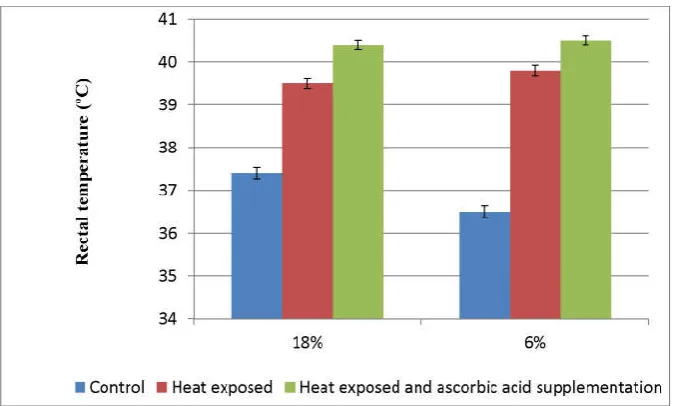
The results presented in Figs. 1A and 1B demonstrate that the normal rectal temperature of adequately (18%) protein-fed rats was quite higher (37.410.130C) than that of the protein-restricted (6%) rats (36.650.120C). But, when the rats were exposed to heat (both chronic and acute), a comparatively higher elevation of temperature was observed in 6% protein-fed group of rats. The results also reveal that, increased reserve of ascorbic acid by its prior supplementation to the rats augmented the elevation of rectal temperature to a higher degree during heat exposure. It was further observed that after 3rd day of chronic heat exposure (2 hrs. daily at 430C for 15 successive days), the elevation of rectal temperature of 18% protein-fed rats during heat exposure began to decrease gradually to reach a constant level which tended to be maintained throughout the subsequent days of heat exposure. But, when the rats were under protein restriction, such stabilizing tendency of rectal temperature took more than 3 days to be established.
Haematocrit Value
Figs. 2A and 2B show a decrease in haematocrit value after chronic heat exposure and an increase in it in acute heat-exposure. Prior supplementation of ascorbic acid tended to reverse the change in haematocrit value to some extent following chronic exposure to heat. Figs. 2A and 2B also demonstrate that the haematocrit values of both control and treated groups of animals went down to a great extent as a result of protein restriction.
Ascorbic Acid Status of Blood
The results presented in Table 1 reveal the decrease in plasma ascorbic acid level following acute heat exposure in 18% protein-fed rats as well as 6% protein-fed rats.
Table 1. Effect of heat-exposure on the ascorbic acid content of plasma and erythrocytes
Chronic Acute
Dietary protein levels
Groups of animals Ascorbic acid (g/ml plasma)
Ascorbic acid (g/ml packed RBC)
Ascorbic acid (g/ml plasma)
Ascorbic acid (g/ml packed RBC)
18% Control (6) 15.01 1.32 6.00 0.83 15.01 1.32 6.00 0.83
Heat-exposed (8) 12.53 0.81 (pa>0.5)
7.86 0.58 (pa>0.5)
10.44 0.88 (pa<0.05)
5.44 0.06
Heat exposed + Ascorbic acid supplementation (8)
24.39 1.35 (pb<0.001) (pc<0.001)
11.59 1.65 (pc<0.05)
22.32 1.39 (pb<0.001) (pc<0.001)
9.62 0.57 (pb<0.001) (pc<0.01)
6% Control (6) 13.66 0.28 4.81 0.12 13.66 0.28 5.95 0.25
Heat-exposed (7) 10.52 0.14
(pa<0.001) 4.93 0.29 (p10.00 a<0.001)0.28 4.81 (pa<0.05)0.38 Heat-exposed + Ascorbic
acid supplementation (8)
18.4 0.76 (pb<0.001) (pc<0.001)
6.37 0.05 (pb<0.001) (pc<0.001)
17.06 0.98 (pb<0.01) (pc<0.01)
8.79 0.34 (pb<0.001) (pc<0.001)
[image:3.595.137.468.262.486.2]Values are means SEM; pa – Compared with control; pb – Compared with heat-exposed; pc – Compared with control; Figures in the parentheses of the column of Groups of animals indicate the number of animals.
Fig.1A. Effect of chronic heat exposure on rectal temperature of rats fed on an 18% and a 6% protein diets. The vertical line on the top of the bar graph indicates ±SEM
[image:3.595.134.471.534.737.2]The decrease in plasma ascorbic acid level was also observed after chronic heat exposure in 6% protein-fed rats. But, when the ascorbic acid content was estimated in erythrocytes it was found to be diminished after acute heat exposure in protein-restricted rats only.
DISCUSSION
The elevation of rectal temperature and its maintenance at a constant level by controlling the exposure temperature and the duration of exposure ascertain the effectiveness of our experimental design of heat exposure. The reduction of rectal temperature to a more or less constant level and its maintenance throughout the later days of heat exposure are indication of heat acclimatory response. The data obtained (Figs. 1A and 1B) establish that the dietary protein level has a clear influence on the degree and rate of acclimation against heat stress. Comparatively higher elevation of rectal temperature and the prolonged time taken by the rats of protein-restricted group for the development of acclimation
against heat stress indicate that dietary protein deficiency somehow weakens the heat-regulatory and acclimatory processes of the body. Further, supplementation of ascorbic acid prior to heat exposure was found only to elevate the rectal temperature as an immediate effect. It is probably due to the inducing effect of ascorbic acid on the overall increment of metabolic processes of the body presumably via stimulating the actions of metabolic hormones. Chronic heat exposure reduced the food intake of rats which appeared severe in protein-restricted group.
Therefore, to eliminate the effects of calorie deficiency on heat stress development, the control rats in the present study were pair-fed with heat-exposed rats. The haemotacrit values (Figs. 2A and 2B) decreased in both protein-restricted and adequately protein-fed rats in response to chronic heat exposure, and the decrease was greater in protein-restricted rats. Both dietary protein deficiency and heat stress induce oxidative stress in the body (Huang and Fwu, 1993; Lee Byung and Hanguk, 1982). Oxidative stress in turn influences the modulation of Fig.2A. Effect of chronic heat-exposure on the haematocrit values of rats fed on an 18% and a 6% protein diets.
The vertical line on the top of the bar graph indicates ±SEM
Fig.2B. Effect of acute heat-exposure on the haematocrit values of rats fed on an 18% and a 6% protein diets. The vertical line on the top of the bar graph indicates ±SEM
asymmetric distribution of phospholipid in the bilayer of erythrocyte membrane (Tanaka and Schroit, 1983). The membrane phospholipid organization in turn plays an important role in the trigger mechanism for the recognition and removal of senescent or oxidatively damaged erythrocytes by phagocytosis (Tanaka and Schroit, 1983). This may be one of the reasons underlying the decrease of haematocrit value following chronic exposure to heat. Haemodilution as a result of acclimatory response may be the another factor for the decrease of haematocrit value. This contention is also supported by the observations of Swaka (2000). Thus, the loss of plasma water through sweating and the release of erythrocytes from their reservoirs into circulation may be the reason of increased haematocrit value due to acute heat exposure. Alteration of ascorbic acid status of blood after heat exposure may be considered as an indication of heat-induced oxidative threat (Tanaka et al., 1997). The rate of entry and exit of dehydroascorbate to and from erythrocytes is more than 10 fold greater than that of ascorbate (May et al., 1995). So, higher the oxidant stress in plasma, the greater will be the conversion of plasma ascorbate and the entry of dehydroascorbate into the erythrocytes. Inside the erythrocytes, dehydroascorbate is converted to ascorbate to increase the intracellular concentration of ascorbic acid. In the present
experiment, the reduction of plasma ascorbic acid level (Table 1) correlated with the above phenomenon, and thereby
tended to maintain ascorbic acid concentration of erythrocytes but the decrease in ascorbic acid content (Table 1) of erythrocytes after acute heat exposure in protein-restricted rats cannot be explained with certainty.
Acknowledgement
We are grateful to the University Grants Commission, Government of India for funding this research work. We also acknowledge the great help and supporting assistance, received from the laboratory and library staff of theBiochemistry and Nutrition Laboratory, Department of Physiology, University of Calcutta, 92 APC Road, Kolkata-700009.
REFERENCES
Akinwande, A. I. and Adebule, A. O. A. Ascorbic acid and beta-carotene alleviate oxidative effect of London Kingsize® cigarette smoke on tissue lipids. Nig. J.Hlth
Biochem. Sci., 2003; 2(1): 12-15.
Altan, O., Pabuccuoglu, A., Konyalioglu, S. and Bayrackter, H. Effect of heat stress on oxidative stress,lipid peroxidation and somestress parameters in broilers. Brit.
Poult.Sci., 2003; 44:54-55.
Chang, C.K., Chang, C.P., Liu, S.Y., Lin, M.T. Oxidative stress and ischemic injuries in heat stroke. Prog. Brain Res., 2007; 162:525-546.
Chatterjee, A.K., Sadhu, U., Dalal, B.B., Chatterjee, T., Studies on certain drug metabolising enzymes in deoxypyridoxin treated rats. Japanese Journal of
Pharmacology, 1984; 34: 367–373.
Crandall, C.G., Gonzalez-Alonso, J. Cardiovascular function in
the heat-stressed human. Acta. Physiol., 2010; 199: 407-423.
Fisher, R.A. and Yates, F., Statistical Tables for Bio- logical,Agricultural and Medical Research, 6 th ed. London:Longman Group Ltd., 1974; pp.1-729.
Ghosh, S., Chatterjee, A.K., Gupta, M., Impact of lead toxicity in brain metabolisms of nucleic acid and catecholamine in protein malnourished rats. Journal of Nutritional Science
and Vitaminology, 1992; 38: 451–462.
Hesta, M., Otterman, S. C., Krammer-Lukas, S., Zentek, J., Hellweg, P., Buyse, J. and Janssens, G. P. J. The effect of vitamin C supplementation in healthy dogs on antioxidative capacity and immune parameters. J.Animal Physiol. and
Animal Nutr., 2009; 93: 26 - 34.
Huang, C. J. & Fwu, M. L. Degree of protein deficiency affects the extent of the depression of the antioxidative enzyme activities and the enhancement of tissue lipid peroxidation in rats. J. Nutr., 1993; 123: 803–810.
Lee Byung O. Studies on effect of heat and cold stress on blood picture, values of serum protein and blood glucose in rabbits. Hanguk, Otukson Hakhoechi, 1987; 29(5): 199-207.
Leon, L.R., Helwig, B.G. Heat stroke: Role of the systemic inflammatory response. J.Applied Physiol., 2010;109: 1980-1988.
May, J.M, Qu, Z.C.Whitesell, R.R. Ascorbic acid recycling enhances the antioxidant reserve of human erythrocytes.
Biochemistry, 1995; 34(39): 12721-12728.
Morrison, S., Sleivert, G.G., Cheung, S.S. Passive hyperthermia reduces voluntary activation and isometric force production. Eur.J. AppliedPhysiol., 2004;91:729-736. Ogura, Y., Naito, H., Akin, S., Ichinoseki-Sekine, N.,
Kurosaka, M., Kakigi, R., Sugiura, T., Powers, S.K., Katamoto, S., Demirel, H.A. Elevation of body temperature is an essential factor for exercise-increased extracellular heat shock protein 72 level in rat plasma. American Journal of Physiology - Regulatory, Integrative and Comparative
Physiology, 2008; 294, R1600-R1607.
Periard, J.D., Caillaud, C., Thompson, M.W. Central and Peripheral Fatigue during Passive and Exercise-Induced Hyperthermia. Medicine and Science in Sports and
Exercise, 2011; 43, 1657-1665.
Sawka, M.N., Convertino, V.A., Eichner, E.R., Schnieder, S.M., Young, A.J. Blood volume: importance and adaptations to exercise training, environmental stresses, and trauma/sickness. Med. Sci. Sports Exerc., 2000; 32: 332-348.
Sen, C. K. Antioxidant in exercise. Nutrition Sports Medicine,
2001;31:891 – 908.
Tanaka Y, Schroit, A.J. Insertion of fluorescent phosphatidylserine into the plasma membrane of red blood cells. Recognition by autologous macrophages, J Biol. Chem., 1983; 258(18):11335–11343.
Tanaka, K., Hashimoto, T., Tokumaru, S., Iguchi, H. and Kajo, S. Interactions between vitamin C and vitamin E are observed in tissues of inherently scorbutic rats. J. Nutr., 1997; 127: 2060- 2064.
Walingo, K. M. Role of vitamin C (ascorbic acid) on human health. African Journal of Food, Agriculture, Nutrition and
Development, 2005; 5(1): 1 – 14.
Yavuz, T., Altuntas, I., Delibas, N., Yildrim, B., Candir, O., Cora, A., Karahan, N., Ibrisim, E.and Kutsal, A. Cardiotoxicicty in rats induced by methidathhion and ameliorating effect of vitamins E and C. Human and
Experimental Toxicology, 2004; 23: 323 -329.