http://www.ijcmph.com pISSN 2394-6032 | eISSN 2394-6040
Review Article
Relation between serum uric acid and diabetes type II
Ghadeer Banjar
1*, Hanadi Abdulrahim
2, Jawaher Alomari
2, Reem Aldeijy
2,
Azzam Almalki
3, Sultan Alrabghi
3, Rawan AlMuhanna
4, Abdulhamid ALAMA
5,
Anwar Albalawi
6, Osama Almazrui
6INTRODUCTION
Incidence of diabetes mellitus type 2 has been increasing worldwide, making the disease of extreme importance. Recent reports have shown that more than 336 million people around the world had diabetes mellitus type 2 in 2011. This prevalence is expected to become even higher in 2030, with expected 552 million cases.1 Moreover, most researchers agree that this prevalence will continue to raise significantly as long as obesity levels remain high around the world.1, 2 Therefore, it is essential to identify risk factors responsible for the development of diabetes
mellitus type 2, in order to be able to prevent the disease. Recently, there have been some reports that have suggested the possible involvement of uric acid (which results from purines metabolism) in the development of several chronic diseases like diabetes mellitus type 2, hypertension, and renal failure.3-5
On a biological level, uric acid can have a negative impact on insulin resistance in animals due to its role in the inhibition of nitric oxide. Nitric oxide, on the other hand, is crucial in the glucose uptake mechanisms, thus its inhibition by uric acid will affect insulin role.6,7
ABSTRACT
Incidence of diabetes mellitus type 2 has been increasing worldwide, making the disease of extreme importance. Several reports have suggested a possible association between serum levels of uric acid (SUA) and higher incidence of diabetes mellitus type 2. On a biological basis, uric acid can negatively affect insulin resistance in animals. This occurs due to the inhibition of nitric oxide which is crucial to achieve glucose uptake. In this study, we aim to: report on previous literature on relation between serum uric acid and diabetes type II in Saudi and prevalence of association between them. PubMed database and EBSCO Information Services were used for articles selection. All relevant articles to our review with the topics regarding the relation between serum uric acid and diabetes type II, and other articles have been used. We excluded other articles, which are not related to this field. The data will be extracted according to specific form in which it is going to be reviewed by the group members. In this meta-analysis we found that SUA levels positively correlate with diabetes mellitus type 2. Future studies should try to determine the reliability of using SUA levels to predict diabetes mellitus type 2 and improve prevention.
Keywords: Uric acid, Diabetes mellitus type II, Saudi Arabia
1
Primary Health Care Centre, Ministry of Health, Jeddah, KSA
2
Ibn Sina National College, Jeddah, KSA
3
University of Jeddah, Jeddah, KSA
4
King Abdulaziz University, Jeddah, KSA
5
Alansar Hospital, Almadinah, KSA
6
King Salman North West Armed Forces Hospital, Tabuk, KSA
Received: 12 July 2018
Revised: 18 August 2018
Accepted: 20 August 2018
*Correspondence:
Dr. Ghadeer Banjar,
E-mail: [email protected]
Copyright: © the author(s), publisher and licensee Medip Academy. This is an open-access article distributed under the terms of the Creative Commons Attribution Non-Commercial License, which permits unrestricted non-commercial use, distribution, and reproduction in any medium, provided the original work is properly cited.
Moreover, insulin resistance will lead to the development of hyperinsulinoma, which will consequently increase serum levels of uric acid. This increase occurs as a results of several mechanisms including a reduction of secretion of uric acid through the kidneys, and accumulation of uric acid substrates.8 However, until now no solid evidence is present to establish an independent association between serum uric acid levels and diabetes mellitus type 2.9 This controversy made research on the correlation between diabetes mellitus type 2 and uric acid levels a trending topic among researchers. Several studies have been
published and concluded the presence of this association. However, this association does not yet reach the level of causality, which remains an area of debate until now. In addition, both alcoholism and metabolic syndrome, which are both independent risk factors for diabetes mellitus type 2, are associated with high uric acid levels, making the association between uric acid and diabetes mellitus type 2 even more complex to assess. Some authors suggest that uric acid levels could be risk markers rather than risk factors for diabetes mellitus type 2.
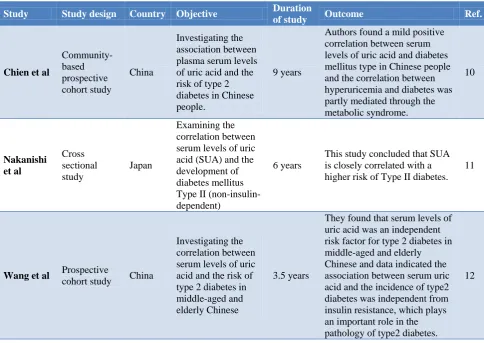
Table 1: Study, study design, country, objective, duration, outcome and reference number.
Study Study design Country Objective Duration
of study Outcome Ref.
Chien et al
Community-based prospective cohort study
China
Investigating the association between plasma serum levels of uric acid and the risk of type 2 diabetes in Chinese people.
9 years
Authors found a mild positive correlation between serum levels of uric acid and diabetes mellitus type in Chinese people and the correlation between hyperuricemia and diabetes was partly mediated through the metabolic syndrome.
10
Nakanishi et al
Cross sectional study
Japan
Examining the correlation between serum levels of uric acid (SUA) and the development of diabetes mellitus Type II (non-insulin-dependent)
6 years
This study concluded that SUA is closely correlated with a higher risk of Type II diabetes.
11
Wang et al Prospective
cohort study China
Investigating the correlation between serum levels of uric acid and the risk of type 2 diabetes in middle-aged and elderly Chinese
3.5 years
They found that serum levels of uric acid was an independent risk factor for type 2 diabetes in middle-aged and elderly Chinese and data indicated the association between serum uric acid and the incidence of type2 diabetes was independent from insulin resistance, which plays an important role in the pathology of type2 diabetes.
12
Chien et al published a prospective cohort study in which they included 2,690 individuals aged between 35 and 97 years old, who did not diabetes or any cardiovascular disease at the beginning of the study in 1990.10 After a nine—year follow up, about 548 of included patients developed diabetes mellitus type 2. When analyzing uric acid levels in the serum of all participants, it was found to have higher concentration in individuals who developed diabetes mellitus type 2, and was associated with the development of metabolic syndrome. When authors adjusted for different demographic factors like age, gender, BMI and other possible relevant factors, they found that the relative risk of developing diabetes mellitus type two in the presence of high uric acid levels in the serum was 1.63 (95% CI, 1.2-2.23, p<0.001). The findings of this study led to the suggestion of the
presence of a mild positive correlation between diabetes mellitus type 2, and higher serum levels of uric acid.
developing diabetes mellitus type 2, despite the absolute risk being significantly higher in obese individuals. These results can mean that a strong correlation is present between serum levels of uric acid and diabetes mellitus type 2.
Moreover, Wang et al performed a study where they examined the potential correlation between developing diabetes mellitus type 2 and having elevated levels of serum uric acid among adult Chinese individuals.12 In their study, they included 924 Chinese adults aged more than forty years, and without diabetes mellitus. Authors followed participants for 3.5 years, during which, 98 of them developed diabetes mellitus type 2. They then performed a covariate adjusted cox regression test that showed a significant association between higher levels of serum uric acid, and risk of developing diabetes mellitus type 2. In fact, patients who had higher levels of uric acid in their serum showed a risk of developing diabetes mellitus type 2 that is 2.71 higher than those with normal serum levels of uric acid.
DISCUSSION
Diabetes mellitus type 2 is considered to be one of the most common chronic diseases around the world. It is associated with significant long-term complications and comorbidities. Incidence and prevalence of diabetes mellitus type 2 has been significantly increasing around the world, making this issue a global health problem that requires immediate attention.13
Recent reports have suggested that there could be an association between high concentrations of serum uric acid, and diabetes mellitus type 2. In fact, serum uric acid levels have been suggested to be an independent risk factor for developing the disease. Several studies have found that patients who have higher levels of uric acid in their serum have a higher risk of developing diabetes mellitus type 2.5,14 These results have led to the belief that uric acid could possibly be used as an indicator for the presence of diabetes mellitus type 2 and its associated metabolic disorders.15,16
There are several mechanisms that may be responsible for this association between diabetes mellitus type 2 and uric acid serum levels. For example, a previous study on animal models have concluded that hyperuricemia caused by increased fructose levels can play a significant role in the pathogenesis of metabolic syndrome. Moreover, they found that metabolic syndrome signs and symptoms were relieved following the reduction of serum levels of uric acid.17,18 Another possible mechanism is the induction of endothelial dysfunction by high uric acid levels, which will lead to the reduction of nitric oxide levels.19,20 Nitric oxide has a crucial role in glucose intake, therefore, its reduction will lead eventually to less intake of glucose in skeletal muscles. The result of all these reactions is increased insulin resistance and the development of diabetes mellitus type 2. Additionally, oxidative stress
has been noticed to be increase in patients who have higher levels of uric acid in their serum.21,22 This oxidative stress can significantly affect tissues and aid in the development of diabetes mellitus type 2.
All this mentioned evidence and proposed mechanisms can support the causal effect of high uric acid levels on developing diabetes mellitus type 2. In a Turkish observational study that included 1,877 individuals of both sexes, authors found that higher serum uric acid levels were associated with significantly higher odds ratio for developing diabetes mellitus type 2 than patients with lower or normal uric acid levels (odds ratio was 1.89, 95% CI, 1.45-2.46).23 In another study on Japanese individuals that included 6,365 employees aged between 35 and 61 years old, and followed them for sixteen years, uric acid was found not to be associated with a statistically significant increase in the risk of diabetes mellitus type 2, and the relative risk was 1.21 (95% CI, 0.88–1.65, p=0.77).24 However, another study on 2,310 Japanese male individuals who were followed for six years has concluded that serum uric acid levels did correlate significantly with higher risk of developing diabetes mellitus type 2, with a relative risk of 1.78 (95% CI, 1.11–2.85, p=0.03).11
To summarize the association of serum uric acid levels and diabetes mellitus type 2 risk, a meta-analysis was performed and concluded that with each 1mg/dl elevation of serum uric acid levels, there is a 17% elevation in diabetes mellitus type 2 risk.9 In another meta-analysis on eight prospective observational studies, authors were able to conclude that in middle aged individuals and elderly, each 1 mg/dl elevation of serum uric acid was associated with a 6% elevation in diabetes mellitus type 2 risk.5
Another large population-based cohort studied 4,536 individuals without diabetes mellitus and followed them for ten years. Of included patients, 462 were found to develop diabetes mellitus type 2, with an incidence of 10.1 per 1,000 person-years.25
A case control observational study performed by Fouad et al on 986 adults in Egypt and divided into two groups: control group with 250 individuals without diabetes, and disease group with the other who had diabetes, found that serum uric acid levels were significantly associated with diabetes mellitus type 2.26 In addition, in 2006 and 2009, two Chinese population-based observational studies were conducted and concluded the presence of an association between uric acid levels and diabetes mellitus type 2 (p<0.001).14 However, another study conducted on participants of the National Health and Nutrition Examination Survey concluded that uric acid levels where negatively correlated with diabetes mellitus type 2.27
risk.28 Moreover, in the Finnish Diabetes Prevention study, authors studied 475 individuals with body mass indexes higher than 25, and dysfunctional glucose metabolism. They concluded that serum uric acid levels were proportionally associated with risk of diabetes mellitus type 2.29 Another study that included 566 individuals with a mean age of 68 years did find that for each 1 mg increase in uric acid levels, there is a 65% increase in diabetes mellitus type 2 risk.30 Lastly, the Rotterdam prospective cohort study on individuals older than 55 years, demonstrated that diabetes mellitus type 2 risk was significantly higher in patients who had uric acid higher than 6.2 mg/dl in their serum.
Funding: No funding sources Conflict of interest: None declared Ethical approval: Not required
REFERENCES
1. Whiting DR, Guariguata L, Weil C, Shaw J. IDF diabetes atlas: global estimates of the prevalence of diabetes for 2011 and 2030. Diabetes Res Clin Pract. 2011;94:311–21.
2. Wild S, Roglic G, Green A, Sicree R, King H. Global prevalence of diabetes: estimates for the year 2000 and projections for 2030. Diabetes Care. 2004;27:1047–53.
3. Grayson PC, Kim SY, LaValley M, Choi HK.
Hyperuricemia and incident hypertension: a systematic review and meta-analysis. Arthritis Care Res (Hoboken). 2011;63:102-10.
4. Li L, Yang C, Zhao Y, Zeng X, Liu F, Fu P. Is hyperuricemia an independent risk factor for new-onset chronic kidney disease?: A systematic review and meta-analysis based on observational cohort studies. BMC Nephrol. 2014;15:122.
5. Lv Q, Meng XF, He FF, Chen S, Su H, Xiong J. High serum uric acid and increased risk of type 2 diabetes: a systemic review and meta-analysis of
prospective cohort studies. PLoS One.
2013;8:e56864.
6. Khosla UM, Zharikov S, Finch JL, Nakagawa T,
Roncal C, Mu W, Krotova K, Block ER, Prabhakar S, Johnson RJ. Hyperuricemia induces endothelial dysfunction. Kidney Int. 2005;67:1739–42.
7. Quinones Galvan A, Natali A, Baldi S, Frascerra S,
Sanna G, Ciociaro D, Ferrannini E. Effect of insulin on uric acid excretion in humans. Am J Physiol. 1995;268:1–5.
8. Fox IH. Metabolic basis for disorders of purine nucleotide degradation. Metabolism. 1981;30:616– 34.
9. Kodama S, Saito K, Yachi Y. Association Between
Serum Uric Acid and Development of Type 2 Diabetes. Diabetes Care. 2009;32(9):37-42.
10. Chien KL, Chen MF, Hsu HC, Chang WT, Su TC,
Lee YT, Hu FB. Plasma uric acid and the risk of type 2 diabetes in a Chinese community. Clin Chem. 2008;54(2):310-6.
11. Nakanishi N, Okamoto M, Yoshida H, Matsuo Y,
Suzuki K, Tatara K. Serum uric acid and risk for development of hypertension and impaired fasting glucose or Type II diabetes in Japanese male office workers. Eur J Epidemiol. 2003;18(6):523-30. 12. Wang T, Bi Y, Xu M. Serum uric acid associates
with the incidence of type 2 diabetes in a prospective cohort of middle-aged and elderly Chinese. Endocrine. 2011;40:109-16.
13. Singh PP, Mahadi F, Roy A. Reactive oxygen
species, reactive nitrogen species and antioxidants in etiopathogenesis of diabetes mellitus type-2. Indian J Clin Biochem. 2009;24:324.
14. Xue B, Tan JB, Ning F, Sun JP, Zhang KY, Liu L,
et al. Association between serum uric acid and prevalence of type 2 diabetes diagnosed using HbA1c criteria among Chinese adults in Qingdao, China. Bio Environ Sci. 2015;28:884–93.
15. Qiu Q, Gong Y, Liu X, Dou L, Wang Y, Wang B, et
al. Serum Uric Acid and Impaired Glucose Tolerance: The Cardiometabolic Risk in Chinese (CRC) Study. Cell Biochem Biophys. 2015;73:155. 16. Sluijs I, Beulens JWJ, van der ADL, Spijkerman
AMW, Schulze MB, van der Schouw YT. Plasma Uric Acid Is Associated with Increased Risk of Type 2 Diabetes Independent of Diet and Metabolic Risk Factors. J Nutrition. 2013;143:80–5.
17. Nakagawa T, Hu H, Zharikov S, Tuttle KR, Short RA. A causal role for uric acid in fructose-induced metabolic syndrome. Am J Physiol Renal Physiol. 2006;290:625–31.
18. Reungjui S, Roncal CA, Mu W, Srinivas TR,
Sirivongs D. Thiazide diuretics exacerbate fructose-induced metabolic syndrome. J Am Soc Nephrol. 2007;18:2724–31.
19. Khosla UM, Zharikov S, Finch JL, Nakagawa T,
Roncal C. Hyperuricemia induces endothelial dysfunction. Kidney Int. 2005;67:1739–42.
20. Johnson RJ, Kang DH, Feig D, Kivlighn S, Kanellis
J. Is there a pathogenetic role for uric acid in hypertension and cardiovascular and renal disease? Hypertension. 2003;41:1183–90.
21. Butler R, Morris AD, Belch JJ, Hill A, Struthers AD. Allopurinol normalizes endothelial dysfunction in type 2 diabetics with mild hypertension. Hypertension. 2000;35:746–51.
22. Sautin YY, Nakagawa T, Zharikov S, Johnson RJ. Adverse effects of the classic antioxidant uric acid
in adipocytes: NADPH oxidase-mediated
oxidative/nitrosative stress. Am J Physiol Cell Physiol. 2007;293:584–96.
23. Onat A, Uyarel H, Hergenç G, Karabulut A,
Albayrak S, Sari I. Serum uric acid is a determinant of metabolic syndrome in a population-based study. Am J Hypertens. 2006;19:1055-62.
24. Taniguchi Y, Hayashi T, Tsumura K, Endo G, Fujii
S, Okada K. Serum uric acid and the risk for hypertension and type 2 diabetes in Japanese men:
the Osaka Health Survey. J Hypertens.
25. Dehghan A, van Hoek M, Sijbrands EJ. High serum uric acid as a novel risk factor for type 2 diabetes. Diabetes Care. 2008;31:361–2.
26. Fouad M. Serum uric acid and its association with hypertension, early nephropathy and chronic kidney disease in type 2 diabetic patients. J Bras Nefrol. 2016;38:403-10.
27. Bandaru P, Shankar A. Association between Serum
Uric Acid Levels and Diabetes Mellitus.
International J Endocrinol. 2011:604715.
28. Bhole V. Serum Uric Acid Levels and the Risk of Type 2 Diabetes: A Prospective Study. American J Med. 2010;123(10):957–61.
29. Niskanen L, Laaksonen D E, Lindstrom J. Serum uric acid as a harbinger of metabolic outcome in
subjects with impaired glucose tolerance: the Finnish Diabetes Prevention Study. Diabetes Care. 2006;29:709–11.
30. Kramer CK, von Muhlen D, Jassal SK. Serum uric acid levels improve prediction of incident type 2 diabetes in individuals with impaired fasting glucose: the Rancho Bernardo Study. Diabetes Care. 2009;32:1272–3.