Copyright © The Author(s). All Rights Reserved. Published by American Research Institute for Policy Development DOI: 10.15640/ijhs.v7n3a8 URL: https://doi.org/10.15640/ijhs.v7n3a8
Microbiological Study: What to Do with Ties?
José Humberto Cardoso Resende
1; Ana Letícia P. Guimarães
2; Fernando Augusto de Oliveira
2Jairo Ledra Garcia
2; Matheus B. de Souza
2; Milena P. de Araújo Oliveira
2; Natallia R. Eduardo
2Pedro Henrique M. Victor
2; Raphaela C. de Souza
2; Thamyris S. M. de Paiva
2AdryenneCallegaris C. Lopes
3; Emídio Silva Falcão Brasileiro
4.Abstract
It is known that social ties are worn by professionals as men's accessories. It is common among doctors, lawyers, politicians and other professionals. We decided to carry out a pathological and microbiological study to investigate whether this accessory, which is usually stored in cabinets or other closed spaces, is free of contamination. We randomly chose ten (10) ties from different people who had never been laundered. Collection was carried out through Swabs and Petri dishes. To our surprise, growth of fungi was already perceptible after 24 hours in all samples, including gram-positive and gram-negative bacteria, yeast and cocci. Based on this a result, we advise against the use of this accessory in order to avoid possible transfer of these microorganisms from one person to another through contact. They should be used only after washing or sterilization in sterilization wraps.
Keywords: Fungi; Bacteria; Virus; Necktie; Contamination; Yeast
Introduction
Besides being considered elegant accessories, it is known by people in Brazil and worldwide that ties are part of men's clothing. They are usually hung in closed wardrobes for years and years and are never washed and ironed by their users. One in 1,000 users sanitize their ties before or after wearing them. They do that for improving their visual appearance or even for impressing others. There are cases of fathers who keep their wedding ties to use on their sons' wedding day, either because of family tradition or even superstition. Lawyers, doctors, politicians and teachers were the professions that most used the ties of a research study. We believe that after this work, we are able to decree “the end of wearing ties” as complementary pieces of men's clothing. And if men decide to use a tie, they will be aware that it is the most contaminated item of their wardrobes.4,5,6 Gram-positive and gram-negative bacteria and other cocci and
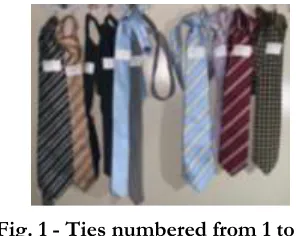
yeast were grown using petri dishes and swabbing, removed from ties. The ties used in the study were numbered from 1 to 10 for identification (fig. 1).
Fig. 1 - Ties numbered from 1 to 10.
1 UNIFAN, Goiânia, Goiás, Brazil; Phone: +556230949494, Fax: +556230908714, Mobile: +5562997014170 Email:
2 UNIFAN –Academic League of Microbiology.
3Laboratory of CLÍNICA BRASIL, Goiânia, Goiás, Brazil; Phone: +556235454000.
materials used in the process of isolation and pure culture were: Swabs;
Nutrient broth in tubes with growth; Inoculation loops;
Petri dishes with sterile nutrient agar.
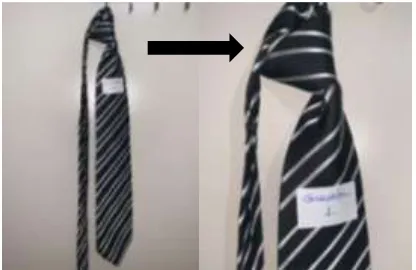
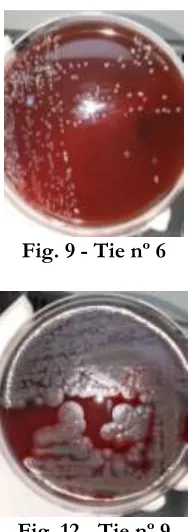
The material was collected at the indicated site (fig. 2), about 30 cm from the wide extremity, towards the tie knot. Method used: Swab, lightly soaked in saline solution and swabbed in the same site. The material was then inoculated in enriched medium (BHI) and left in an oven (30°C to 37°C) for 24 hours until the first reading and for 48 hours until the second reading. After 24 hours, sediment formation, homogeneous turbidity and/or a surface film were observed (fig. 3). The tie nº 2 was the only one presenting growth after 48 hours of inoculation. In the next step, with a previously sterilized loop, petri dishes (Blood Agar), numbered according to the corresponding tie, were inoculated by streaking on the surface of the plate to obtain pure colonies. After 24 hours in the oven, microbial growth was observed in all plates (Table 1).
Slides were prepared and stained by the gram method to differentiate bacterial species (gram-positive and gram-negative) (Table 2). Bacterial and fungal species were isolated and inoculated in specific media for identification of pathogens through microscopic analysis1,2 (Table 3).
Fig. 2 - Full view of the tie and detail of the collection
site.
Fig. 3 - Test tubes numbered and showing the growth of microorganisms.
Box 1
First report 24 h after inoculation in Petri dishes:
Fig. 7 - Tie nº 4 Fig. 8 - Tie nº 5 Fig. 9 - Tie nº 6
Fig. 10 - Tie nº 7 Fig. 11 - Tie nº 8 Fig. 12 - Tie nº 9
1 Gram-negative rods, yeast and rare gram-positive cocci.
2 Gram-negative rods, gram-positive rods and yeast.
3 Gram-positive cocci.
4 Gram-negative rods, gram-positive rods and yeast.
5 Gram-positive cocci, yeast.
6 Gram-positive cocci.
8 Gram-negative rods and gram-negative rods.
9 Gram-negative rods and gram-positive rods.
10 Gram-negative rods and gram-positive rods.
Box 3
Identification on specific media:
Ties Specific media Identification of microorganisms
1 Presence of yeast-like structures
2 structures and coagulase-Presence of yeast-like
3 Coagulase-negative staphylococci3
4 Presence of yeast-like structures
5 structures and coagulase-Presence of yeast-like
negative sthaphylocci3
6 Coagulase-negative staphylococci3
8 structures and coagulase-Presence of yeast-like negative staphylococci3
9 structures and coagulase-Presence of yeast-like
negative staphylococci3
10 structures and coagulase-Presence of yeast-like
negative staphylococci3
Discussion
We know that there will be people who, in defense, will dare to say that they have always washed their ties after use, which is understandable. The degree of contamination of the ties reached a level where all the pieces analyzed had parasite forms as seen in the petri dishes.7,8,9 As ties have always been accessories of clothing, researchers
have to offer an opportunity for knowledge hitherto unknown due to lack of interest in carrying out scientific research on the subject. It is worth mentioning that it is difficult to change well established habits and attitudes. Thus, we raised a question to be discussed and set precedents for future research that may further aggravate the use of this accessory. The slides will be stored for consultation by researchers.12,14
Conclusion
Although being a part of an elegant garment, we demonstrated through microbiological studies that ties have a degree of contamination that leads to the contraindication of their use to avoid the proliferation of bacteria and fungi, and even viruses. In view of this scientific conclusion, we advise users of ties, especially those who use them because of their profession, to wash and iron them, or even sterilize them using sterilization wraps before and after use.10,11,13
References
http://www4.unirio.br/dmp/microbiologia/nutricao-integral/aulas-teoricas/2-%20Caracteristicas%20Gerais%20das%20Bacterias%20-Morfologia-%2001-2017%20-1.pdf> acesso em 27/06/2019.
https://iow.unirg.edu.br/public/profarqs/2958/2425321/micro_aula_5_staf_e_strep.pdf> acesso em 27/06/2019. Santos, a. l., et al. Staphylococcus aureus: visitando uma cepa de importância hospitalar • J BrasPatolMedLab • v. 43 •
n. 6 • p. 413-423 • dezembro 2007.
ANVISA http://www.anvisa.gov.br/servicosaude/controle/rede_rm/cursos/rm_controle/opas_web/modulo3/gramp_staphylo.htm
Gelatti LC, Bonamigo RR, Becker AP, d’Azevedo PA. Staphylococcus aureus resistentes à meticilina: disseminação emergente na comunidade. AnBrasDermatol. 2009; 84(5), 501-506.
http://www.scielo.br/pdf/abd/v84n5/v84n05a09.pdf> acesso em 27/06/2019.
ROSA, Joice Lara; BARROS, Renata Ferreira; SANTOS, Mônica de Oliveira. Características da Escherichia coli enterohemorrágica (EHEC). Saúde e ciência em ação – Revista Acadêmica do Instituto de Ciências da Saúde. V.2,n.01:Jan-Julho 2016.
https://edisciplinas.usp.br/pluginfile.php/4075236/mod_resource/content/1/Carvalho2006%20Artigo_An alitica_1_As_Leveduras.pdf> acesso em 27/06/2019.
https://app.uff.br/riuff/bitstream/1/2742/1/TCC%20AMANDA%20FRAGA.pdf> acesso em 27/06/2019. Barbosa, Flávio Henrique Ferreira; Barbosa, Larissa Paula Jardim de Lima. Alternativas metodológicas em
Microbiologia - viabilizando atividades práticas. Revista de Biologia e Ciências da Terra, Volume 10 - Número 2 - 2º Semestre 2010.
file:///C:/Users/user/Downloads/art%C3%ADculo_redalyc_50016922015.pdf>acessoem 27/06/2019. ROSSI, F.; ANDREAZZI, D. B. Interpretando o antibiograma. 1. ed. São Paulo: Atheneu, 2005.
TORTORA, G. J. ; FUNKE, B. R. ; CASE, C. L. Microbiologia. 8. ed.Porto Alegre: Artmed, 2005. WOESE, C. R. Bacterial evolution.Microbiol Rev, 51:221-271, 1987.