ISSN (e): 2250-3021, ISSN (p): 2278-8719
Vol. 04, Issue 02 (February. 2014), ||V1|| PP 01-12
Performance Evaluation of Selected Search Engines
1
Ajayi, Olusola Olajide,
2Elegbeleye, Damilola Matthew
Department of Computer Science, Adekunle Ajasin University Akungba-Akoko, Ondo State, Nigeria Department of Computer Science, Adekunle Ajasin University Akungba-Akoko, Ondo State, Nigeria
Abstract: -Search Engines have become an integral part of daily internet usage. The search engine is the first stop for web users when they are looking for a product. Information retrieval may be viewed as a problem of classifying items into one of two classes corresponding to interesting and uninteresting items respectively. A natural performance metric in this context is classification accuracy, defined as the fraction of the system's interesting/uninteresting predictions that agree with the user's assessments. On the other hand, the field of information retrieval has two classical performance evaluation metrics: precision, the fraction of the items retrieved by the system that are interesting to the user, and recall, the fraction of the items of interest to the user that are retrieved by the system. Measuring the information retrieval effectiveness of World Wide Web search engines is costly because of human relevance judgments involved. However, both for business enterprises and people it is important to know the most effective Web search engines, since such search engines help their users find higher number of relevant Web pages with less effort. Furthermore, this information can be used for several practical purposes. This study evaluates the performance of three Web search engines. A set of measurements is proposed for evaluating Web search engine performance.
I.
INTRODUCTION
Search engines play a pivotal role in the process of retrieving information from the Web. A Web search engine is an information retrieval system (Salton & McGill, 1983), which is used to locate the Web pages relevant to user queries. A Web search engine contains indexing, storage, query processing, spider (or crawler, robot), and user interface subsystems.
The indexing subsystem aims to capture the information content of Web pages by using their words. During indexing, frequent words (that, the, this, etc.), known as stop words, may be eliminated since such words usually have no information value. Various statistics about words (e.g., number of occurrences in the individual pages or in all of the indexed Web pages) are usually stored in an inverted file structure. The storage technique deals with how to store the index data, that is whether information should be data compressed or filtered, the spider subsystem brings the pages to be indexed to the system. However, for Web users a search engine is nothing but its user interface that accepts queries and presents the search results.
When the user gives a Query, as a response, a Search engine returns a list of relevant results ranked in order. As a human, it is the tendency of the user to use top-down approach of the list displayed by the Search Engine and examines one result at a time, until the required information is found. The results on different subtopics or meanings of a query will be mixed together in the list, thus implying that the user may have to sift through a large number of irrelevant items to locate those of interest. On the other hand, there is no way to exactly figure out what is relevant to the user given that the queries are usually very short and their interpretation is inherently ambiguous in the absence of a context.
The growth of the World Wide Web is a unique trend. Four years after the Webs birth in 1990, a million or more copies of the first well-known Web browser, this growth was a result of the exponential increase of Web servers and the number of Web pages made accessible by these servers. In 1999 the number of Web servers was estimated at about 3 million and the number of Web pages at about 800 million (Lawrence & Giles, 1999).
There are millions of Web users and about 85% of them use search engines to locate information on the Web (Kobayashi & Takeda, 2000). It is determined that search engine use is the second most popular Internet activity next to e-mail (Jansen & Pooch, 2001). Due to high demand there are hundreds of general purpose and thousands of specialized search engines (Kobayashi & Takeda, 2000; Lawrence & Giles, 1999). Examples of General purpose search engines are, Google, Netscape, Lycos, AlltheWeb, AltaVista, HotBot, InfoSeek, Lycos, MSN, Netscape, and Yahoo, while that of specialized search engines are Adam, Labyrinth, Voice of the shuttle, Eric, FinAid, Medseek, Go Ask Alice, FindLaw, LawGure etc.
interfaces and performance, there could be many possible avenues to investigate. This study is majorly concerned with comparative analysis of the performance of search engines, the text retrieval performance in static document collections.
This study provides statistically, significant consistent results compared to human-based evaluations (Interview and questionnaire). The effectiveness of search engines measured in terms of precision and recall. The Methodology further emphasizes the elicitation of genuine information needs from genuine users, as well as relevant judgments made by those same individuals.
This study proposes a comprehensive survey on four selected Search Engines and their performance in the process of information retrieval from the Web, and not all search engines. Since the scope of Internet search engines, such as Google, yahoo, ask and bing is the entire Web, ideally, the experiments would be conducted using all the data on the Web is obviously impossible. What is needed is a relatively small subset that resembles the Web as a whole.
The scope of the study it to established a set of standard measurement for the evaluation of information retrieval system aside from the most commonly used recall and precision include performance stability in any Web search engine evaluation.
Criteria for Evaluating Search Engine’s Performance
Many publications compare or evaluate Web search engines (e.g. Notess, 2000). Perhaps the best known of these are Search Engine Watch (http://www.searchenginewatch.com) and Search Engine Showdown (http://www.searchengineshowdown.com). However, many of these publications did not employ formal evaluation procedures with rigorous methodology. Some papers that describe advances in search algorithms gave anecdotal evidence instead of formal evaluations (e.g. Brin & Page, 1998). Decades of research, from the classic Cranfield experiments to the ongoing TREC, have established a set of standard measurements for the evaluation of information retrieval systems. Only studies that used formal evaluation procedures are reviewed below.
Recall in Search Engine Performance Evaluation
While recall and precision have been the standard evaluation criteria for information retrieval since the Cranfield tests, recall has always been a difficult measure to calculate because it requires the knowledge of the total number of relevant items in the collection. This was possible in small laboratory studies such as the Cranfield tests. It becomes increasingly difficult as collection size grows. This problem is more acute in the Web environment. Chu and Rosenthal‟s Web search engine study omitted recall as an evaluation measure because they consider it „„impossible to assume how many relevant items there are for a particular query in the huge and ever changing Web systems‟‟ (Chu & Rosenthal, 1996, p. 127). Gwizdka and Chignell (1999) acknowledged the difficulty of calculating recall on the Web for the same reason. They did not include recall in their recommended measures of search engine evaluation. TREC (Text Retrieval Conference) Web track used a pooling method to find „„all‟‟ relevant documents to calculate recall. It was assumed that documents not in the pool were not relevant (Voorhees & Harman, 2001, p. 4). The study reported in this paper proposes a modified measurement similar to that of TREC in principle, i.e. it uses pooling, but it employs a continuous relevance ranking (from the most relevant to the least relevant) rather than the binary relevance judgment used in TREC. It should be noted that TREC‟s use of pooling method to calculate recall has been criticized because recall calculated this way „„will be higher-perhaps substantially higher-than what they actually are‟‟ (Blair, 2002, p. 449). Organizers of TREC agrees that the recall calculated this way would be higher but argues that this „„relative recall‟‟ is valid for comparing the relative performance of different systems (Saracevic, Voorhees, & Harman, 2003). The same argument applies to this study where the comparison of relative performance of search engines is the purpose.
Precision in Search Engine Performance Evaluation
without which it is simply impossible for a user to sift through the hundreds or even tens of thousands of items retrieved. „„Results ranking has a major impact on users_ satisfaction with Web search engines and their success in retrieving relevant documents. Yet, little research has been done in this area‟‟.
(Courtois & Berry, 1999). Gwizdka and Chignell (1999) acknowledged the importance of result ranking in Web information retrieval and developed the „„differential precision‟‟ to measure the quality of ranking produced by search engines. However, their approach is still based on a four point scale relevance judgment. Similarly, Su, Chen, and Dong (1998) used a five-point relevancy scale and then correlated these rankings with the rankings returned by search engines. The problem of using these discrete relevance scores is that two or more documents can easily receive the same score and be tied in the ranking. This scoring system is therefore not very effective in evaluating ranking results where there are usually no ties. The study reported here proposes a continuous ranking (from most relevant to least relevant) of the document set instead of the discrete relevance judgments. The correlation between human ranking and search engine ranking can be calculated instead of the traditional measure of precision.
Human Relevance Judgments
Not all search engine studies used human relevance judgment as the basis of evaluation, probably due to the difficulty and expense of such efforts. Courtois and Berry (1999) studied the first 100 items retrieved by five search engines. They did not use human relevance judgment, which would be extremely difficult to do given the total number of items for which relevance judgments need to be made in their study. Instead, they used a computer program to automatically check the location, proximity, etc. of the search terms in the retrieved documents and used this information to compare the search engines in the study.
When human relevance judgment was used, there was a variation in who makes the judgment. TREC leaves relevance judgments to experts or to a panel of experts (Voorhees & Harman, 2001). In other studies, relevance judgments were made by the researchers themselves (e.g. Chu & Rosenthal, 1996). Gordon and Pathak (1999) emphasized that relevance judgments can only be made by the individual with the original information need.
Table 1 Desirable features of Web search evaluation according to Gordon and Pathak (1999): features 1– 7 and Hawking et al. (2001): features 8–11
II.
DESIGN SPECIFICATION
The Underlying Logics
A typical search engine is composed of three pipelined components (Arasu, Cho,Garcia- Molina, & Raghavan, 2001): a crawler, an indexer, and a query processor. The crawler component is responsible for locating, fetching, and storing the content residing within the Web. The downloaded content is concurrently parsed by an indexer and transformed into an inverted index (Tomasic, Garcia-Molina, & Shoens, 1994; Zobel, Moffat, & Sacks-Davis, 2002), which represents the downloaded collection in a compact and efficiently queryable form. The query processor is responsible for evaluating user queries and returning to the users the pages relevant to their query. The web crawling (downloading of web pages) is done by several distributed crawlers. There is an URL server that sends lists of URLs to be fetched to the crawlers. The web pages that are fetched are then sent to the store server. The store server then compresses and stores the web pages into a repository. Every web page has an associated ID number called a docID which is assigned whenever a new URL is parsed out of a web page. The indexing function is performed by the indexer and the sorter. The indexer performs a number of functions. It reads the repository, uncompresses the documents, and parses them. Each document is converted into a set of word occurrences called hits. The hits record the word, position in document, an approximation of font size, and capitalization. The indexer distributes these hits into a set of "barrels", creating a partially sorted forward index. The indexer performs another important function. It passes out all the links in every web page and stores important information about them in an anchors file. This file contains enough information to determine where each link points from and to, and the text of the link. The URLresolver reads the anchors file and converts relative URLs into absolute URLs and in turn into docIDs. It puts the anchor text into the forward index, associated with the docID that the anchor points to. It also generates a database of links which are pairs of docIDs. The links database is used to compute PageRanks for all the documents.
On a less complicated level, search engines could simply be described as suites of computer programs interacting and communicating with each other. Different, or various terms for the particular components are used by search engines in their development and research. The components are: crawler/spider module, repository/database module, indexer/link analysis module, retrieval/ranking module, user query interface, crawler/spider module. Other components include: document routing, filtering, and selective dissemination systems, text clustering and categorization systems, summarization systems, information extraction systems, topic detection and tracking systems, expert search systems, question answering systems, multimedia information retrieval systems.
Algorithms For Search Engine
Unique to every search engine, and just as important as keywords, search engine algorithms are the why and the how of search engine rankings. Basically, a search engine algorithm is a set of rules, or a unique formula, that the search engine uses to determine the significance of a web page, and each search engine has its own set of rules. These rules determine whether a web page is real or just spam, whether it has any significant data that people would be interested in, and many other features to rank and list results for every search query that is begun, to make an organized and informational search engine results page. The algorithms, as they are different for each search engine, are also closely guarded secrets.
Each search engine has its own way of doing things. Discuss below is a typical algorithm for designing a search engine.
1. User interface send query to the search engine
2. Interface receive the query and parser parses the query 3. Convert the words into words IDs.
4. Seek to start searching through the doc-list in the short barrel for every word 5. Scan through the doc-list until there is a document that matches all the search terms 6. Compute the rank of that document for the query.
7. If we are in the short barrels and at the end, seek to start searching of the doc-list in the full barrel for every word and go to step 4
8. If we are not at the end of any doc-list go to step 4. Sort the documents that have matched by the rank and return to the top
Mathematical Algorithm for Designing Search Engine
The following design standards can be use, as design guidelines specified for search engines. S1: Programming Standard
Implementation: Actual system specifications, operating system and other software selection criterion, and application of software engineering procedures to realize the Search Engine as a product.
S2: Design Standard
Recency: Ensuring that each document di at SE has same timestamp as the original web site.
Relevancy: Exact document(s) di to be retrieved by SE that the user is looking for.
S3: Data Acquisition Standard
Robots/Spiders: Design, implementation and deployment mechanism and principles. S4: Data Submission Standard
Submission Types: User submission guidelines for directory search as well as for paid services. S5: Data Processing Standard
Page Ranking: Document the existing page rank techniques and look for improvisation.
Indexing Techniques: Research and documentation of indexing techniques. S6: Information Retrieval Standard
Search Algorithms: Detail the data structures, analyze the complexity of various algorithms and suggest the suitability for various domains.
Scope for Intelligence: Identify the scope for the intelligence and incorporate appropriately. S7: User Interface Standard
User Interface: Study and list the applicability of HCI findings for elegant, intuitive interface.
Natural Language Processing: A natural requirement for human interface.
Multimedia Search: Enlist various standards for multimedia and assess the ability of SEs to incorporate them. The benchmark metric is a weighted average of the following parameters. We give two level weights for the parameters.
Benchmark Metric (BM) for SE = W1 * UP + W2 * SP + W3 * QP, Where,
UP = w1*UPP1+ w2*UPP2+ w3*UPP3+ w4*UPP4+ w5*UPP5, SP = w1*SPP1+ w2*SPP2+ w3*SPP3+ w4*SPP4 and
QP = w1*QPP1+ w2*QPP2+ w3*QPP3
And the details of the parameters are given below. User Perspective (UP):
UPP1: Completeness: Indexing the entire available web repository.
UPP2: Precision: The ratio of relevant documents to retrieved documents
UPP3: Recall: The ratio of retrieved documents to relevant documents
UPP4: Recency: Maintaining the same timestamp at SE and the actual website.
UPP5: Relevancy: Retrieving the exact document(s) the user is looking for. System Perspective (SP):
Hardware:
SPP1: Infrastructure: Hardware and Software requirements and cost optimization.
Software:
SPP2: Indexing Algorithms: Efficiency, space and time complexity.
SPP3: Ranking Algorithms: Rank technology, efficiency and effectiveness.
SPP4: Robots Specification: Design, implementation, overhead and download capacity. Query Perspective (QP):
QPP1: Natural Language Processing (NLP): A natural interface to accept queries, for the users to specify the queries.(.pdf. doc. ppt. etc.)
QPP2: Multimedia Content Analysis: Ability to accept the query in multimedia format, search and the efficiency of the multimedia content classification an search algorithms are evaluated.
QPP3: Adjacency, Synonyms and Stemming: Ability to search for synonyms to yield relevant results is quantified by this parameter.
III.
IMPLEMENTATION
Measuring Performance of Search engines
Retrieval measures are used to measure the performance of IR systems and to compare them to one another. The main goal for search engine evaluation is to develop individual measures (or a set of measures) that are useful for describing the quality of search engines. Performance and quality of information retrieval are important components of search engine evaluation model.
frequent requests obtained from traffic monitors of major search engines. For example is the workload for a single query “information systems” search on three search engine on 29/10/2012
Workload Retrieved URL Query Type Google 762,000,000 Double Word Yahoo 325,000,000 Double Word Bing 21,100,000 Double Word
Table 2:Workload for query
Workload has strong semantic component and the quality of information retrieval can be fully analyzed only by experts in a specific area. For example, the recall of a query about “andness” should be evaluated by decision analysts, and the recall of a query about “Rituximab” should be evaluated by medical experts. A complete analysis of performance and quality of search engines for workload cannot be done automatically using a benchmark tool. Therefore, an automatic analysis of performance and quality of search is reasonable for workload in our tool for search engine benchmarking and for measurement of quality of information retrieval (IR). Following are main design goals:
1. Measurement of Precision
2. Measurement of search engine coverage 3. Search engine stability measurement
Precision measures the ability of Search Engine to produce only relevant results. Precision is the ratio between the number of relevant documents retrieved by the system and the total number of documents retrieved. An ideal system would produce a precision score of 1, i.e. every document retrieved by the system is judged relevant. Precision is relatively easy to calculate, which mainly accounts for its popularity. But a problem with precision in the search engine context is the number of results usually given back in response to typical queries. In many cases, search engines return thousands of results. In an evaluation scenario, it is not feasible to judge so many results. Therefore, cut-off rates (e.g. 20 for the first 20 hits) are used in retrieval tests.
The coverage of a search engine can be determined as the total number of pages returned by the search engine.
Stability measurements are to examine the stability of search engine performance over time. The measurements are:
(1) The stability of the number of pages retrieved;
(2) the number of pages among the top 20 retrieved pages that remain the same in two consecutive tests over a short time period (e.g. a week apart); and
(3) The number of pages among the top 20 retrieved pages that remain in the same ranking order in two consecutive tests over a short time period (e.g. a week apart). Essentially, a series of searches needs to be performed on a search engine over a period of time (e.g. one search a week over a 10-week period). The number of pages retrieved needs to be recorded. The top 10 pages retrieved is compared with those from the previous search to determine
(a) If the pages retrieved are the same; (b) If the ranking of the pages is the same.
The examination of the top 10 pages is carried out because it will be extremely time consuming to compare each page in the entire retrieved set, which is typically very large.
Table 3: Features available in the Three Selected Search Engines
0 0.2 0.4 0.6 0.8 1
1 2 3 4 5
precision
Query Number
Yahoo
Bing
Queries in the study were designed to test various search features including single word search, double word search, Boolean search and phrase search. All queries were English language. The five search topics and their corresponding search queries were:
1. Development communication. (Double word) 2. Communications. (Single word)
3. Performance and Evaluation (Boolean search) 4. School of information Technology (phrase search) 5. No knowledge is lost (phrase search)
A set of Web pages on each topic was retrieved using the three search engines and the top 10 pages retrieved by each engine were merged to form the set of pages to be ranked for that particular topic. It should be noted that „„pages‟‟ in this paper refers to the individual Web pages (or hits) retrieved, not the pages of search results (usually 10 hits are presented in a search results page). The decision to limit to the top 10 pages was based on the fact that human subjects may not be able to reliably rank (rather than making binary decision of relevant vs. non-relevant) more than 30 pages. Previous studies of Web search engines have used the pooling of top 10 (Schlichting & Nilsen, 1996) and top 7 pages (Hawking et al., 2001).
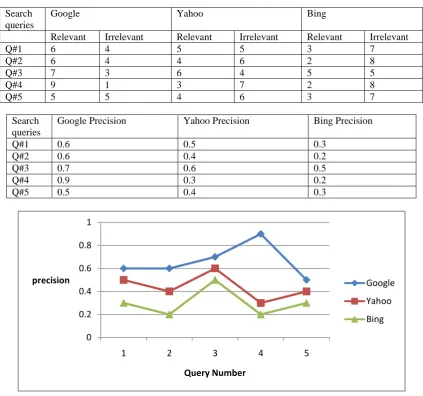
For each query, the first 10 results were analyzed from each search engine. A cut-off value had to be used because of the very large results sets produced by the search engines. From user studies, it was made clear that users only look at the first few results and ignore the rest of the result list. The first10 results per search engine was examined for each of the five query and the relevant and non- relevant was recorded in the table below and the precision of the three search engines was calculated.
Search queries
Google Yahoo Bing
Relevant Irrelevant Relevant Irrelevant Relevant Irrelevant
Q#1 6 4 5 5 3 7
Q#2 6 4 4 6 2 8
Q#3 7 3 6 4 5 5
Q#4 9 1 3 7 2 8
Q#5 5 5 4 6 3 7
Search queries
Google Precision Yahoo Precision Bing Precision
Q#1 0.6 0.5 0.3
Q#2 0.6 0.4 0.2
Q#3 0.7 0.6 0.5
Q#4 0.9 0.3 0.2
Q#5 0.5 0.4 0.3
Fig. 1: Precision values for the three search engines
0 100 200 300 400 500 600 700 800 900
1 2 3 4 5
Number of pages returned
Week
Yahoo
Bing
0 20 40 60 80 100 120 140 160
1 2 3 4 5
Number of pages returned
Week
Yahoo
Bing
This may be one reason why the general public regards Google as the best search engine. When users only observe the first few results, they may easily come to that conclusion.
IV.
MEASUREMENT OF COVERAGE
Search queries
Google Total Number of pages Returned
Yahoo Total Number of pages Returned
Bing
Total Number of pages Returned
Q#1 462,000,000 1,280,000,000 575,000,000 Q#2 767,000,000 390,000,000 150,000,000 Q#3 803,000,000 959,000,000 17,800,000 Q#4 1,550,000,000 497,000,000 4,290,000,000 Q#5 188,000,000 9,320,000 5,490,000
The coverage measurement result proves that Google retrieved more result for each type of query at a single search.
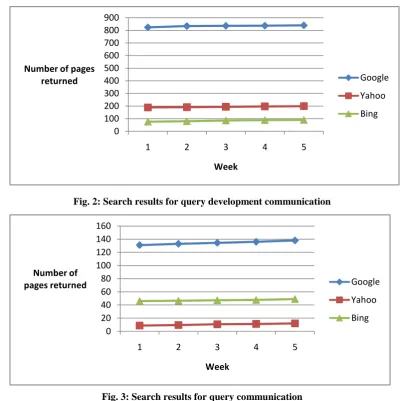
Search Engine stability Measurement. The stability of search engine performance was first examined by looking at the stability of the number of pages retrieved over the 5-week period. The comparisons of the three engines in this regard are shown from Figs. 1–5 for the five queries respectively. The three Figures present the same pattern and thus same conclusions:
(1) Google consistently retrieved more pages than Yahoo and Bing; and
(2) Google remained very stable over the 5-week period without any sudden increase or decrease in the number of pages retrieved. In contrast, all the search engines increase the number of result page.
Fig. 2: Search results for query development communication
0 20 40 60 80 100 120 140 160
1 2 3 4 5
Series1
Series2
Series3 0
20 40 60 80 100 120 140 160
1 2 3 4 5
Number of pages returned
Week
Yahoo
Bing
0 20 40 60 80 100 120 140 160
1 2 3 4 5
Number of pages returned
Week
Yahoo
Bing Fig. 4: Search Results for Query Performance and Evaluation
Fig. 5: Search Results for Query School of Information Technology
Fig. 6: Search Results for Query No knowledge is lost
V.
CONCLUSION
Today, nobody knows the real performance or accuracy of search engines. There are several studies dealing with a single aspect of quality measurement, but none that tries to evaluate search engine quality as a whole. It must be noted that the purpose of the experiment in this study is to illustrate how the proposed measurements should be applied and to test the ability of the measurements in distinguishing search engine performance. The relative performance of the three engines upon the five test queries are only suggestive of
their quality and should not be taken as conclusive evidence. To convincingly show that one engine is better than the other, a large and diverse set of queries is needed. Statistical tests should be performed on the large data set to determine if there are significant differences among the search engines examined.
One central question to our study was whether Google‟s perceived superiority in delivering relevant results could be confirmed by a systematic test. In this regard, we found that it makes no significant difference for a user to use one of the big search engines, Google or Yahoo.
When considering the first four results, Yahoo comes close to Google and then bing, and then Google leads in terms of precision for up to the seventh result. When considering more than seven results, the differences between Google and Yahoo are insignificant.
REFERENCES
[1] Bar-Ilan, J. (1999). Search engine results over time - a case study on search engine stability. Cyber-metrics, 2/3(1), Retrieved 15/12/2002 (http://www.cindoc.csic.es/cybermetrics/articles/v2i1p1.html). [2] Bar-Ilan, J. (2000). Evaluating the stability of the search tools Hot-Bot and Snap: A case study. Online
Information Review, 24(6), 439–449.
[3] Bar-Ilan, J. (2002). Methods for measuring search engine performance over time. Journal of the American
[4] Society for Information Science and Technology, 53(4), 308–319.
Blair, D. C. (2002). Some thoughts on the reported results of TREC. Information Processing & Management, 38(3), 445– 451.
[5] Brin, S. & Page, L. (1998). The anatomy of a large scale hypertextual Web search engine. Computer Networks and ISDN Systems, 30(1–7), 107–117.
[6] Chu, H., & Rosenthal, M. (1996). Search engines for the World Wide Web: a comparative study and evaluation methodology. In Proceedings of the 59th annual meeting of the American Society for Information Science (pp. 127– 135). Medford, NJ: Information Today.
[7] Courtois, M. P., & Berry, M. W. (1999). Results ranking in Web search engines. Online, 23(3), 39–46. [8] Chowdhury, A. & Soboroff, I. (2002). Automatic evaluation of World Wide Web search services. In
Proceedings of the ACM SIGIR conference, vol. 25 (pp. 421–422).
[9] Ding, W., & Marchionini, G. (1996). A comparative study of Web search service performance. In Proceedings of the 59th annual meeting of the American Society for Information Science (pp. 136–142). Medford, NJ: Information Today.
[10] Gordon, M. & Pathak, P. (1999). Finding information on the World Wide Web: the retrieval effectiveness of search engines. Information Processing and Management, 35(2), 141–180.
[11] Gwizdka, J., & Chignell, M. (1999). Towards information retrieval measures for evaluation of Web search engines. Retrieved 17/12/2002
[12] (http://www.imedia.mie.utoronto.ca/~jacekg/pubs/webIR_eval1_99.pdf).
[13] Hawking, D., Craswell, N., Thistlewaite, P., & Harman, D. (1999). Results and challenges in Web search evaluation. Computer Networks, 31(11–16), 1321–1330.
[14] Hawking, D., Craswel, N., Bailey, P., & Griffiths, K. (2001). Measuring search engine quality. Information Retrieval, 4(1), 33–59.
[15] Jansen, B. J., & Pooch, U. (2001). A review of Web searching and a framework for future research. Journal of the American Society for Information Science and Technology, 52(3), 235–246.
[16] Kobayashi, M., & Takeda, K. (2000). Information retrieval on the Web. ACM Computing Surveys, 32(2), 144–173.
[17] Lawrence, S., & Giles, C. L. (1999). Accessibility of information on the Web. Nature, 400, 107–109. [18] Mettrop, W., & Nieuwenhuysen, P. (2001). Internet search engines – fluctuations in document
accessibility. Journal of Documentation, 57(5), 623–651.
[19] Mowshowitz, A., & Kawaguchi, A. (2002). Assessing bias in search engines. Information Processing and Management, 35(2), 141–156.
[20] Notess, G. R. (2000). The never-ending quest: search engine relevance. Online, 24(3), 35–40. [21] Notess, G. R. (2002). Search engine statistics: relative size showdown. Retrieved 02/09/2012 (http://
[22] www.searchengineshowdown.com/stats/size.shtml). Salton, G., & McGill, M. (1983). Introduction to
modern information retrieval. New York: McGraw-Hill.
[23] Saracevic, T., Voorhees, E., & Harman, D. (2003). Letters to the editor. Information Processing & Management, 39(1), 153–156.
[24] Schlichting, C., & Nilsen, E. (1996). Signal detection analysis of WWW search engines. Presented at Microsoft‟s Designing for the Web: Empirical Studies Conference. Retrieved 17/12/2012
[25] (http://www.microsoft.com/usability/webconf/schlichting/schlichting.htm).
[27] perspective: a pilot study. In Proceedings of the 61st annual meeting of the American Society for Information Science (pp. 348–361).
[28] Soboroff, I., Nicholas, C., & Cahan, P. (2001). Ranking retrieval systems without relevance judgments. In Proceedings of the ACM SIGIR conference, vol. 24 (pp. 66–73).
[29] Sullivan, D. (2002). Nielsen//Net Ratings: search engine ratings. Retrieved 23/12/2012 (http://www.searchenginewatch. com/reports/netratings.html).
[30] Sullivan, D. (2007), “Major search engines and directories”, Search Engine Watch, available at http://searchenginewatch.com/showPage.html?page ¼ 2156221
[31] Thelwall, M. (2001). The responsiveness of search engine indexes. Cybermetrics, 5(1), Retrieved 17/12/2012 (http://www.cindoc.csic.es/cybermetrics/articles/v5i1p1.html).
[32] Thelwall, M. (2002). In praise of Google: finding law journal Web sites. Online Information Review, 26(4), 271–272.
[33] Vaughan, L., & Hysen, K. (2002). Relationship Between Links to Journal Web Sites and Impact factors. Aslib Proceedings: New Information Perspectives, 54(6), 356– 361.
[34] Vaughan, L., & Thelwall, M. (2003). Scholarly use of the Web: What are the key inducers of links to Journal Web sites? Journal of the American Society for Information Science and Technology, 54(1), 29– 38.
[35] Vaughan, L. (2004). New measurements for search engine evaluation proposed and tested. Information Processing & Management, 40(4), 677–691.
[36] Voorhees, E. M., & Harman, D. (2001). Overview of TREC 2001. NIST Special Publication 500-250: The