Husain et al. World Journal of Engineering Research and Technology
DESIGN OF MULTI-LEVEL ALGORITHM FOR DATA STORAGE
SECURITY IN CLOUD COMPUTING
Ismail Ahmed1 and Rashid Husain2*
1
Research Scholar, Department of Mathematics and Computer Science, UMYU, Katsina,
2
Lecturer, Department of Mathematics and Computer Science, UMYU, Katsina
Article Received on 16/04/2017 Article Revised on 07/05/2017 Article Accepted on 28/05/2017
ABSTRACT
Cloud computing is an Internet based technology where a large amount
of computing resources are shared as a services. Since data is shared in
cloud, security of the data is considered as the major concern in cloud
computing. However, privacy and security is the trending topic in
cloud computing technology, which leads to the abundant research in that area. In this study
the proposed multi-level algorithm that will enhance the data security in cloud computing
was designed by combining the multi-prime RSA and MD5 algorithms which will provide
integrity and confidentiality of data in cloud computing. In the algorithm, the multi-prime
RSA used for encrypting data and the MD5 used to provide a message digest and a digital
signature at the same time. The designed algorithm is implemented using a java netbeans
environment and we found out that, the algorithm is resistance to attacks such as
mathematical attacks, brute force attacks and a hacker cannot separate the signature and the
original message.
KEYWORDS: RSA, MD5, encryption, decryption, cloud computing.
INTRODUCTION
Cloud computing, to put it simply, means Internet computing. The Internet is commonly
visualized as clouds; hence the term “cloud computing” for computation done through the
internet. cloud computing can be considered a new computing paradigm that allows users to
temporary utilize computing infrastructure over the network, supplied as a service by the
World Journal of Engineering Research and Technology
WJERT
www.wjert.org
SJIF Impact Factor: 4.326*Corresponding Author
Rashid Husain
Lecturer, Department of
Mathematics and Computer
demanding and emerging technology throughout the world. Some of the major firms like
Amazon, Microsoft and goggle have implemented the “CLOUD” and have been using it to
speed up their business. With cloud computing users can access database resources via the
internet from anywhere, for as long as they need, without worrying about any maintenance or
management of actual resources (Rao, et. al., 2009).
RELATED WORK
Many algorithms have been used to provide the security in cloud computing, the proposed
algorithm used combination of two algorithms:
MULTI-PRIME RSA ALGORITHM
The Multi-Prime RSA algorithm is found to be the most secure variant when compared to
other variants. The Multi-Prime RSA algorithm involves three operations: Key Generation,
Encryption and Decryption. The procedure for the practical implementation of each of the
operations is discussed below (Zeren, 2011).
Key Generation
The steps which are followed in the implementation of key generation of multi-prime RSA
algorithm are described below:
i. Choose more than two primes p1, p2……. pr
ii. Check whether the primes are strong primes or not. If they are strong primes then proceed
further else generate another set of primes.
iii. Set n = the product of the chosen prime numbers and φ (n) = (p1– 1) x (p2– 1) x …….x
(pr– 1).
iv. Randomly choose an odd integer e such that gcd (e, φ (n)) = 1.
v. Then compute d = e-1 mod φ (n).
vi. Therefore the public key is (e, N) and the private key is (d, N)
Encryption
The encryption process is performed in the following way
i. The encryption key, that is, the public key is obtained.
ii. The message which is to be encrypted is divided into blocks.
iv. These padded blocks are then encrypted to obtain cipher text c = me mod n where m is the
message.
v. Once all the blocks have been encrypted they are converted into big-endian format.
vi. The blocks are then added together so as to restore the complete encrypted cipher text.
Decryption
The step by step process of decryption is carried out in the following manner
i. Obtain the cipher text which is to be decrypted.
ii. Read the cipher text and divide them into blocks.
iii. Get the decryption key (private key) from the key generation operation.
v. m, the original message can be obtained as m = cdmod n.
vi. The blocks are then unpadded so that we get back the original message.
vii. The blocks are added together in order to retrieve the complete message.
MD5 ALGORITHM
MD5 is a message digest algorithm developed by Ron Rivest at MIT. The algorithm takes as
input a message of arbitrary length and produces as output a 128-bit message digest of the
input. This is mainly intended for digital signature applications where a large file must be
compressed in a secure manner before being encrypted with a private (secret) key under a
public key cryptosystem (Michel and Ibrahim, 2014). MD5 processes a variable length
message into a fixed output of 128-bits. The input message is broken into chunks of 512-bit
blocks (sixteen 32 little endian integers); the message is padded so that length is divisible by
512. The padding works as follows, first a single bit 1, is appended to the end of the message.
This is followed by many zeros as are required to bring the length of the message up to 64
bits fewer than a multiple of 512. The remaining bits are filled up with a 64-bit integer
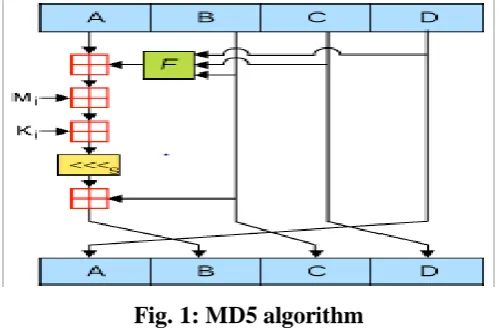
representing the length of the original message, in bits. The main MD5 algorithm operates on
a 128-bit state, divided into four 32-bit words, denoted A, B, C and D. These are initialized to
certain fixed constants. The main algorithm then operates on each512-bit message block in
turn, each block modifying the state. The processing of the message block consists of four
similar stages, termed round each round is composed of 16 similar operations based on the
non linear function F, modular addition, and left rotation. The following figure illustrates one
Fig. 1: MD5 algorithm
One MD5 operation, MD5 consists of 64 of these operations grouped in four rounds of 16
operations. F is a non linear function; one function is used in each round. Mi denotes a 32 bit
block of the message input and ki denotes a 32 bit constant, different for each operation.
Denotes a left bit rotation by s places; s varies for each operation denotes addition modulo.
There are four possible functions F; a different a different one is used in each round:
Where denote the XOR, AND, OR and NOT operations respectively.
Security issues in multiprime RSA and digital signature
In digital signature, we have one private key to encrypt the message it produce only message
digest, it is not producing the fully encrypted data. At the end of the process the sender sends
the original data along with this digital signature. There is no security for the original
message. The hacker may hack the message and separate the message from the signature. In
multi-prime RSA there are many possible attacks such as brute force attack, mathematical
attack, timing attack and chosen cipher attacks.
Proposed Multi-Level Algorithm
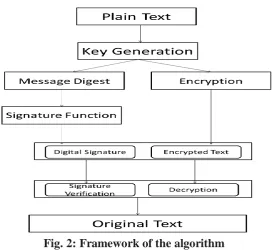
To enhance the security of data in cloud computing, two algorithms are combined and form a
Step 1: Key Generation
i.e
Step 2: Digital Signature
Step 3: Encryption
Step 5: Signature Verification
RESULT AND DISCUSSION
Fig. 2: Framework of the algorithm
The algorithm was implemented using a computer system with Java compiler (integrated
Fig.: iii. Encryption Fig.: iv. Decryption
Multi-Level Algorithm Operation
In the proposed Multi-level algorithm, the user first of all generates a key using a randomly
chosen prime numbers. The algorithm will generate a private key and a public key at the
same time. These private and public key would be used. The user may also decide to send a
plain text before generating the key, and then it will require him to set the public and private
key. After generating the key, the algorithm will generate the message digest of the text and a
digital signature at the same time using the private key generated. The message digest and the
digital signature of the plain text will be displayed by showing a randomly generated numbers
as the signature and characters as the digest. Also the algorithm will encrypt the plain text
using the public key by generating and displaying a cipher text at the same time. Having
generated the digest, signature and a cipher at the same, in order to get the original text back,
there is signature verification in the algorithm where by the signature will be verified using
the public key and also a comparison of the message digest. The verification is the process of
removing the signature provided using the private key and at the same time the decryption of
the cipher will be performed using the corresponding private key. After the verification of the
signature and the decryption process, then the original text will be obtained as the final
output.
The fig.(i) is showing the interface of the implementation (key setup) which requires user to
set two keys. In the fig.(ii) is where the user will generate the keys i.e public key and private
key. After generating the keys then he set them for a particular operation. In the encryption
fig.(iii) shows the encryption and digital signature of a particular operation. The original
message is obtained in the decryption fig.(iv) Having combined two strong algorithms to
factorizing the product of two prime numbers and collision attack. Above all the algorithm
can prevent a hacker from separating the original message from the signature. Since the
algorithm can encrypt and provide a digital signature to a data at the same time, therefore it
provides more integrity and authenticity of a data.
CONCLUSION
This research proposed a new cryptographic algorithm for encryption and decryption of data
in cloud environment, the algorithm was developed using Multi-prime RSA and MD5
algorithms. The algorithm makes data very secured by providing integrity and authenticity to
it. It also stands for some attacks that break the security of other algorithms. The algorithm
was implemented using java programming language.
REFERENCES
1. Apostu, A., Puncan, F., Ularu, G. and Todoran, G. (2008). Study on advantages and
disadvantages of Cloud Computing – the advantages of Telemetry Applications in the
Cloud. University Politehnica of Bucharest, ROMANIA.
2. Arora, R. and Parashan. Secure data in cloud computing using encryption algorithms.
International Journal of Engineering Research and Application, 2013; 3(4).
3. Banu, S. K. and Kausar, A. An approach secret sharing algorithm in cloud computing
security over single to multi clouds. International Journal of Scientific and Research
Publications, 2013; 3(4).
4. Ganeshkumar, K. and Arivazaghan. Generating a digital signature based on new
cryptographic scheme for user authentication and security. Journal of Science and
Technology, 2014; 7(6).
5. Hashemi, S. Data storage security challenges in cloud computing. International Journal of
Security, Privacy and Trust Management, 2013; 2(4).
6. Sudhansu, R. J. and Nayak, B. Enhancing data security in cloud computing using RSA
encryption and MD5 algorithm. International Journal of Computer Science Trends and
Technology, 2014; 2(3).
7. Sugunya, M., Boopal, M. E and Naveena, M. Implementing multiprime RSA algorithm to
enhance the data security in cloud computing. International Journal of Innovative
Research in Scienec, Engineering and Technology, 2015; 4(3).