QR CODE WATER MARKING ALGORITHM BASED
ON DWT AND COUNTERLET TRANSFORM FOR
AUTHENTICATION
A.S. Tonne1 and V.S.Bale2
I. INTRODUCTION
Increase in use of Digital Media, raises the problem of data protection and authentication. Data can be can be easily copied. Digital Watermarking Technique gives the best solution to protect data. In this technique the data is hidden within the cover image so stranger cannot get it without having proper guidance. Many methods used for the invisible Digital Watermarking required some information about the cover image. But we do not require it for secret image extraction, so it is more secure. We are using QR code which itself hide the information but which can be easily scanned .We can use this method to hide image in QR code and to hide QR code in an image. In both the cases the information is detectable under the influence of various attacks.
1
Department of ECE, M.S. Bidve Engineering College, Latur, INDIA 2
Department of ECE, M.S. Bidve Engineering College, Latur, INDIA
Vol.(7)Issue(4), pp.395-406
DOI: http://dx.doi.org/10.21172/1.74.055
e-ISSN:2278-621X
Abstract:
Digital Watermarking is a technology used for the copyright protection of digital applications. Watermarking is a concept of embedding a special symbol, watermark, into an electronic document so that a given piece of copyright information is permanently tied to the data. It is an effective way to protect copyright of multimedia data even after its transmission. In recent years image watermarking techniques are grown-up. In this science era with the development of technology and internet, the protection and authentication of data is essential. Watermarking techniques provide solution to this problem. QR code being so versatile because of its structural flexibility that it leads to so many diverse field for research such as increasing data capacity, security applications such as different kinds of watermarking . We have used QR code as cover image and as secret image to protect it from other users. This paper is representing a new watermarking technique with QR code to protect the secret image by using DWT and Counterlet Transform. In the method described here the image is first encrypted in random matrix, then it is invisibly watermarked in cover image and no information about the secret image and cover image is needed for extraction of secret image, so it more secure. Counterlet Transform is advance technique and its performance is higher than DWT for water mark embedding and extraction.It decomposes the image into different frequency ranges such as low frequency, middle frequency and high frequency. In same way the image can further be decomposed into n levels. Here we are using 3level decomposition for better result.
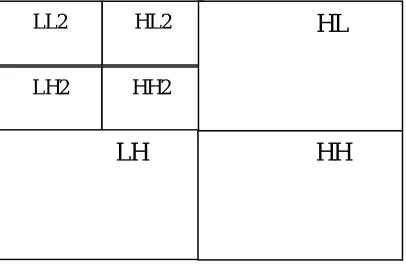
In two dimensional applications, for each level of decomposition, we first perform the DWT in the vertical direction, followed by the DWT in the horizontal direction. After the first level of decomposition, there are 4 sub-bands: LL, LH, HL, and HH. For each successive level of decomposition, the LL sub-band of the previous level is used as the input. To perform second level decomposition, the DWT is applied to LL and so on.
Figure 1: DWT decomposition
1.2 Quick Response Code
It is two dimensional barcode consists of black modules arranged in white background. It can store large alphanumeric information and easily readable by scanner. A QR code is capable of being read in 360 degree from any direction thus eliminating interference. The QR Code system has become admired outside the automotive industry due to its fast readability and greater storage capacity than that of the UPC barcode.
It is higher information density.
It is small in size than that of Barcode.
Data can be restored even if the symbol is partially dirty or damaged.
Some features that describe how QR code is better in comparison with conventional barcodes have been listed out in following table
Table 1: Comparison of QR code and Barcode
HL2 LL2
LH2 HH2
HL
LH
HH
QR Code Barcode
UPTO 7089 numeric digits
10-20 digits
40 digit Numeric (approx 5 mm 5mm)
10 digit Numeric (approx 50 mm 20 mm)
Supports 360d reading
QR code is used for Advertising, Business cards, Social networking, Branding, registration.
II. PROPOSED METHOD
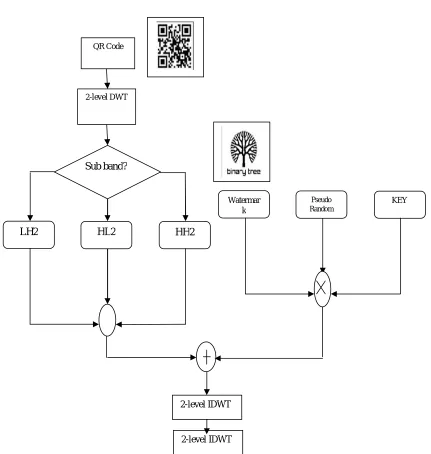
2.1 Watermark Embedding
The step of embedding process are outlined as follows
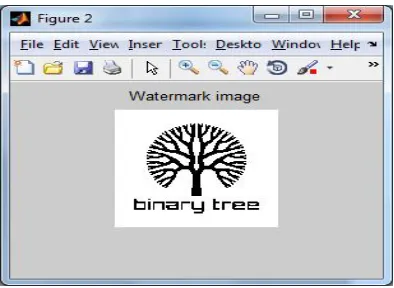
Step of watermark image with secret key
(1) The watermark image was produced as a bit sequence of watermark S. The data and background values were set to 1 and –1, respectively.
S (1)
Where, N is the total number of pixels in the watermark image
(2) The pseudo-random sequence (P) whose each number can take a value either 1 or –1 was randomly generated with a secret key for embedding and extracting of the watermark.
P (2)
Step of QR code image
(1) The two-level DWT of image i t was computed for QR code image.
(2) A watermark was then embedded in sub band LH2or HL2 or HH 2. According to the rule: (3)
Where, is input image, ′ is output image with watermark. α is a magnitude factor which is a constant determining
the watermark strength.
(3) After that, the inverse DWT (IDWT) was then applied to obtain the watermarked image. (4) Compute PSNR
Figure 2: Watermark Embedding Process
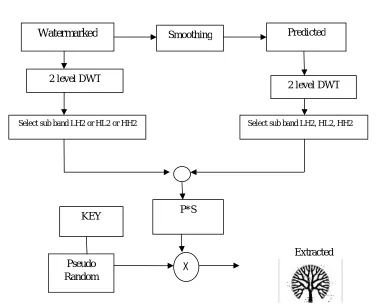
2.2 Watermark Extraction
The watermark extraction algorithm did not use the original QR code image. A prediction of the original value of the pixels is however needed. Thus, a prediction of the original value of the pixels was performed using noise
QR Code
2-level DWT
Sub band?
LH2 HL2 HH2
Watermar k
Pseudo Random
KEY
2-level IDWT
elimination technique. In this paper, we use an averaging3×3 mask whose elements were fixed to 1/9. The extraction process are outlined as follows
(1) The predicted image
could be obtained by smoothing the input image with a spatial convolution mask. The prediction of the original value can be defined as:
Where, c is the size of the convolution mask. The watermarked image and the predicted image were DWT transformed independently
(2) The estimate of the watermark is indicated by the difference between as: (5)
(3) The sign of the difference between the predicted and the actual value is the value of the embedded bit: (6)
(4) COMPUTE NC
To evaluate the performance of the algorithm, a similar measurement between the original watermark (S ) and the extract watermark (S′) was computed by using normalized correlation (NC).
Figure 3: Watermark Extracting Process using DWT
2 level DWT Smoothing Predicted
Select sub band LH2, HL2, HH2 Watermarked
2 level DWT
Pseudo Random
KEY
X Select sub band LH2 or HL2 or HH2
P*S
-
NC and PSNR having mathematical representation as,
IV. CONTOURLET TRANSFORM:
Contourlets form a multiresolution directional tight frame designed to efficiently approximate images made of smooth regions separated by smooth boundaries. The Contourlet transform has a fast implementation based on a Laplacian Pyramid decomposition followed by directional filter banks applied on each bandpass sub band. Contourlet transform is a double filter bank structure. It is implemented by the pyramidal directional filter bank (PDFB) which decomposes images into directional subbands at multiple scales. In terms of structure the contourlet transform is a cascade of a Laplacian Pyramid and a directional filter bank.
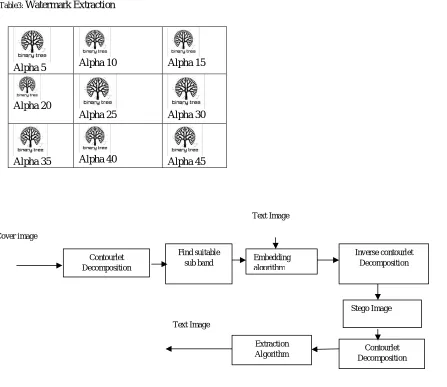
Block diagram of embedding and extraction of data in contourlet domain is shown in Fig.4.The secret data is first encrypted using proper algorithm and then embedding algorithm is applied.
4.1 CONTOURLET
Contourlet form a multiresolution directional tight frame designed to efficiently approximate images made of smooth regions separated by smooth boundaries. The Contourlet transform has a fast implementation based on a Laplacian Pyramid decomposition followed by directional filterbanks applied on each bandpass subband.
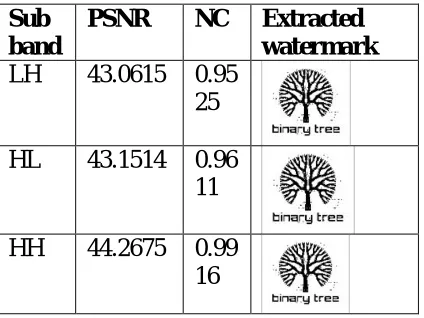
Table 2: PSNR vs. NC
Sub
band
PSNR
NC
Extracted
watermark
LH
43.0615
0.95
25
HL
43.1514
0.96
11
Table3: Watermark Extraction
Alpha 5 Alpha 10 Alpha 15
Alpha 20
Alpha 25 Alpha 30
Alpha 35 Alpha 40 Alpha 45
Figure 4:
Watermark Embedding & Extracting Process using COUNTOURLET TRANSFORMV. SIMULATION RESULTS
Table 3: PSNR and NC of QR decode Image using DWT
α PSNR NC DECODE QR
Code
5 46.1926 0.9794 10 40.1720 0.9903 15 36.6502 0.9942 20 34.1514 0.9963 25 32.3132 0.9972 30 30.6296 0.9981 35 29.2906 0.9991 40 28.1308 0.9993 45 27.1078 0.9994
Cover image
Contourlet Decomposition
Find suitable
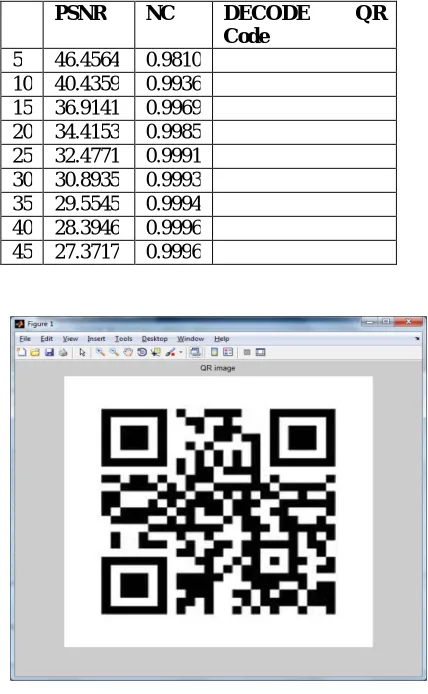
Table 4: PSNR and NC of QR decode Image using Contourlet Transform
α PSNR NC DECODE QR
Code
5 46.4564 0.9810 10 40.4359 0.9936 15 36.9141 0.9969 20 34.4153 0.9985 25 32.4771 0.9991 30 30.8935 0.9993 35 29.5545 0.9994 40 28.3946 0.9996 45 27.3717 0.9996
Figure 5: QR image
Figure 7: Watermarked QR image
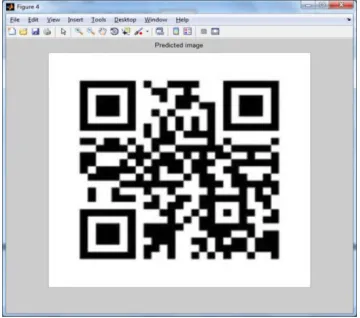
Figure 8: Predicted image
EXTENSION RESULTS
Figure 10: QR image (Contourlet transform)
Figure 11: Watermarked image (Contourlet transform)
Figure 13: Predicted image (Contourlet transform)
VI. CONCLUSION
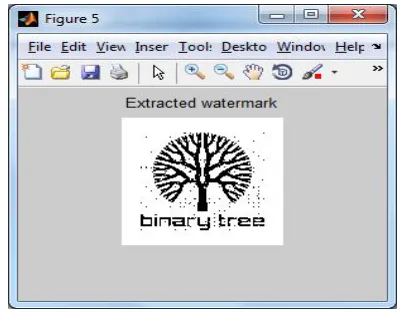
Figure 14: Extracted image (Contourlet transform)
This paper presented a digital watermarking technique which improves the characteristics of watermarking which is based on DWT & Counterlet Transform. Whereby a binary image is watermarked an embedded in a QR Code image. The embedding process is presented in a LH, HL or HH sub band based on wavelet transform. The experimental results demonstrated that the algorithm can be recovering the watermark with an acceptable visual quality. The objective measures such as PSNR, NC and MAE are subject to magnitude factor. As the future work, the quality of the watermarked video Compared to original video was measured based on the Peak Signal to Noise Ratio (PSNR), Normalized Correlation (NC) and Mean Absolute Error (MAE). Performance of Counterlet Transform as compared to DWT is better in noise reduction, edge preservation and image enhancement.
REFERENCES
[2] Lumini A and Maio D (2000) A wavelet-based image watermarking scheme In:Proc. Int.Conf. Information Technology: Coding and Computing. pp.122-127.
[3] Alattar AM(2004) Reversible watermark using the difference expansion of a generalized integer transform. IEEE Trans. Image Process. 13: 1147- 1156.
[4] Jun-Chou Chuang, Yu-Chen Hu & Hsien-Ju Ko. A Novel Secret Sharing Technique Using QR Code, International Journal of Image Processing (IJIP), Volume (4) : Issue (5), pp. 468-475, 2010.
[5] “QRCode,” http://en.wikipedia.org/wiki/QR_code.
[6] ENSO Wave Incorporated. What is a QR Code?, 2013. http://www.qrcode. com/en/. Accessed 10 Feb 2013. [7] M. J. Shensa, “The Discrete Wavelet Transform Wedding À Trouse and Mallat Algorithms,” IEEE Trans. on