Anitha.N
1,* and C. Vijayalakshmi
21Department of Mathematics, Kumaraguru College of Technology, Coimbatore, India.
2 SAS, Mathematics Division, VIT Chennai, India.
Abstract
Traveling Salesman Problem is one of the motivating problem in classical and advanced Optimization. In this work, theoretical analysis and relative study of Traveling Salesman Problem in Intuitionistic Fuzzy Optimization is examined with real examples.
Keywords: Symmetric Traveling salesman problem, Intuitionistic Fuzzy Optimization method, range of acknowledgement, range of rejection, range of uncertainty, Intuitionistic Fuzzy choice devising.
Received on 03 May 2018, accepted on 21 May 2018, published on 12 June 2018
Copyright © 2018Anitha.N and C. Vijayalakshmi, licensed to EAI. This is an open access article distributed under the terms of the Creative Commons Attribution licence (http://creativecommons.org/licenses/by/3.0/), which permits unlimited use, distribution and reproduction in any medium so long as the original work is properly cited.
doi: 10.4108/eai.12-6-2018.154817
*Corresponding author. Email:[email protected]
1. Introduction
Traveling salesman problem is a NP hard problem in classical combinative Optimization that has intrigued mathematicians and computer scientists for years. In TSP a salesman have to sojourn m cities where the interval (or expensive or duration or some other factor) of journey within some two cities is determined to him. The salesman should originate from a certain city and journey over each and every city preceding as well as coming to his beginning city. Thus the salesman possibly will decide (m-1)! Distinctive probable way. The dispute is toward hypothesizing the best. The optimal result is unconstrained of the choice of the origin city [10,16 ].
By governing in a Fuzzy neighbourhood represent a solving procedure in that the design and/or the limitations, however not at all necessary that the method to manipulate are in Fuzzy manner [11]. An index of literatures which was used Fuzzy set to determine the
traveling salesman problem is specified in table 1. (The index is no more of abundant role).
Table 1. Index of Literatures
Author(s) List of Literature (s)
Layout
Shweta
Rana et al. 2017
Improved Genetic Algorithm in Travelling
Salesman Problem
Hai-Tao Mei et al.
2016
Intuitionistic Fuzzy hybrid discrete particle
swarm Optimization Approach
Anitha et al. 2016 Intuitionistic Fuzzy Technique
Anitha et al. 2016,2017 Fmolp method
Chandrasek
aran et al. 2015
Fuzzy ranking Functions Method
R.N.Jat et al. 2015 Mixed Intuitionistic Fuzzy method Garai et al. 2013 Intuitionistic Fuzzy
Research Article
on
Energy Web and Information Technologies
problem is completed by means of executing objective level factors. In Intuitionistic Fuzzy neighborhood the range of rejection as well as the range of uncertainty ought to examine to obtain the optimal solution for the traveling salesman problem.
The proposed Intuitionistic Fuzzy approach is an extent and composite from FTSP [4],[5] and Intuitionistic Fuzzy choice devising method [2]. Angelov [2] introduced the Optimization method in Intuitionistic Fuzzy and it is widely studied. In that method, the range of acknowledgement is enhanced while the range of rejection is reduced. But in proposed Intuitionistic Fuzzy approach the range of acknowledgment is enhanced and the range of rejection is reduced other than also the range of uncertainty is reduced [7].
This effort is an explanation about the Intuitionistic Fuzzy approach and proposed Intuitionistic Fuzzy approach technique. An appropriate paradigm is studied for traveling salesman problem in Intuitionistic Fuzzy neighborhood.
2. Preliminaries
2.1 Definition [11]
A membership function for a Fuzzy subset à of X is given as , that assigns to every X, a real number in the closed unit interval [0, 1], where the value of at x represents the grade of membership of in Ã.
2.2 Definition [8]
An Intuitionistic Fuzzy set A in X is given as ,wherever and with the stipulation 0 ≤ ( + ) ≤ 1, wherever and symbolize the grade of membership and non-membership correspondingly. It is obvious to for every Fuzzy set à , there exist an Intuitionistic Fuzzy As well, for every Intuitionistic Fuzzy set in X,
Let the multiple-objective linear Programming form, max Z=CX
subject to
AX ≤ b (1) Zimmerman projection for Fuzzy multiple objective linear programming is specified as,
Max
~ 0
Z
CX Subject toAX
~
b (2)where Z0[z ,..., z ]01 0n are targets otherwise objective levels;
~
and~
are Fuzzy inequalities that are fuzzifications of ≥ and ≤ correspondingly. Zimmerman recommended simplest form of membership function specified by,0
k k k
0 0 0
1k k k k k k k k k
0
k k
0 if C X z t
(C X) 1 (z C X) / t if z t C X z , k 1, 2,...., n
1 if C X z
(3)
tk represent admissible infraction for objective zk which is determined by choice maker.
Zimmerman favoured another kind of Fuzzy membership function
2i(aiX)for ith
constraint as follows:
i i
i i i i i i i
i i i i
i 2
b X a if
1
m ,...., 2 , 1 i , d b X a b if d / ) b X a ( 1
d b X a if
0
) X a (
(4)
di is permitted infraction for Fuzzy source bi for ith limitation. At last the objective function becomes,
max CX
~
Z0n
,....,
2
,
1
k
;
t
/
)
X
C
z
(
1
k k k0 ~ ~
m
,....,
2
,
1
k
;
d
/
)
b
X
a
(
1
i i i~ ~
(6)~
0, X0where,
~
is on the whole approval level achieved with respect to the result.Think the condition while choice maker have to decide most good result of TSP with reduced expensive, interval, duration. The city from i to j could be linked as a
particular objective functions as
otherwise
,
0
)
j
(
city
)
i
(
city
,
1
x
ij (7)Let the expensive of traveling from the city i the city j is
defined as eij and 0 1
z
be the corresponding function for objective function for the reduction of expensive & t1 betoleration, then 10
n
1 i
~ ij n
1 j
ij
1
:
e
x
z
z
(8)Let the interval traveling from the city i to the city j is
defined as iij and
0 2
z
be the corresponding function for objective function for the reduction of interval & t2 betoleration, then 20
n
1 i
~
ij n
1 j
ij
2
:
i
x
z
z
(9)Let the duration spent in traveling from the city i to the
city j is defined as dij and
0 3
z
be the corresponding function for objective function for the reduction of total duration & t3 be toleration,then 30
n
1 i
~
ij n
1 j
ij
3
:
d
x
z
z
(10)Let the fuel expenses spent in traveling between the city i
to the city j is defined as feij and
0 4
z is the corresponding function for objective function for the reduction of total fuel expenses and t4 is the toleration then
0 4 n
1 i
~ ij n
1 j
ij 4
:
fe
x
z
z
(11) Let the vehicle maintenance expenses spent in traveling between the city i to the city j is defined as vmeij
and
z
50is the corresponding function for the reduction of total vehicle maintenance expenses and t5 is the toleration then0 5 n
1 i
~
ij n
1 j
ij
5
:
vme
x
z
z
(12)A limitation is forced that every city ought to enter exactly one of its nearest city and vice versa, that is
n
ij i 1
x
1, j
(13)
i , 1 x n
1 j
ij
(14)
Order should not be chosen more than one duration, that is
x
ij
x
ji
1
,
i
,
j
and non-negativelimitations
x
ij
0
. In vector mode, the membership functions in Fuzzy are defined by the limitations for being objective functions.4. Methodology of Proposed method
with Intuitionistic Fuzzy Optimization
In Intuitionistic Fuzzy set [8],[9] it is examine not simply the grade of membership to a definite set, however also the grade of rejection such that the summary of both these values is less than or equal to one. Complement of this sum to ‘1’ is known as Intuitionistic Fuzzy index (grade of uncertainty). Using this approach the Fuzzy Optimization problem was reformulated by Angelov [2] using this notion. In intuiotionistic Fuzzy sets the grade of rejection (non-membership) is defined concurrently with the grade of acknowledgement (membership) and while together these grades are neither complementary to one another.
Szmidt and Kacprzyk [18] considered the third parameter (grade of uncertainty) while scheming the Euclidean interval for Intuitionistic Fuzzy sets. In the finishing choice process the minimal uncertainty will be considered. Here T stands for targets and L stands for limitations in Optimization problem, then the choice C denoted by
C=T L= { }.
This operator can be easily generalized and applied to the Intuitionistic Fuzzy Optimization problem [2]:
C={
},
, with & .
1) stands for the highest grade of rejection of objectives and limitations and (0 ≤ 1) stands for the highest acceptable grade of uncertainty of objectives and limitations.
As a result, the problem in Intuitionistic Fuzzy Optimization is changed to the succeeding crisp Optimization problem which can be simply solved mathematically or else with means of some typical software:
Maximize αβ
Subject to the limitations
α , j=1,2,…,(p+q), (15)
β ≥ , j=1,2,…,(p+q), (16)
≥ 1 ,j=1,2,…,(p+q), (17)
(18)
β ≥ , (19)
(20)
α,
and other crisp limitations and non-negativity boundaries.
5. Mathematical Computations
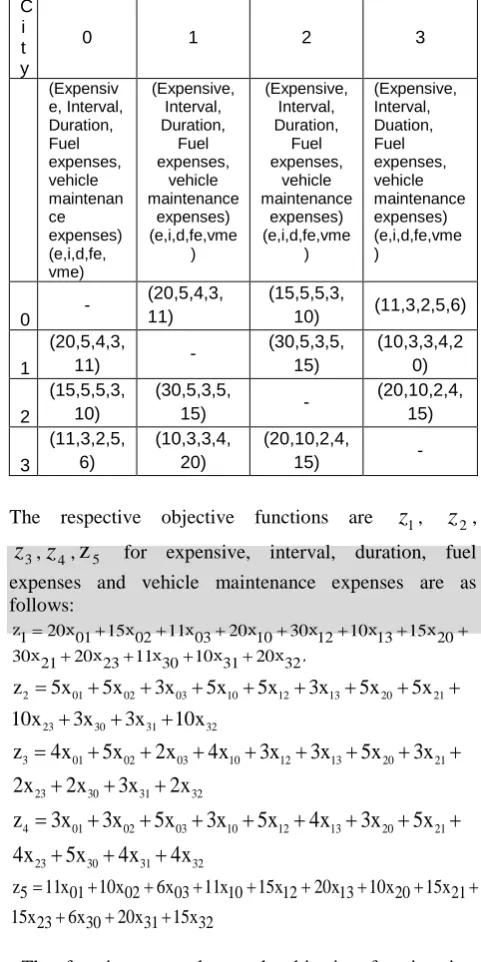
Symmetric Traveling Salesman Problem is determined in this work. The salesman have to enter the three cities exactly once and finally he must come back to his home city by take up a path with minimum expensive, interval covered, duration, fuel expenses and vehicle maintenance expenses. The cities are listed along with their expensive, interval, duration, interval, fuel expenses and vehicle maintenance expenses in a matrix below, where (e, d, i, fe, vme) represents: expensive (in hundreds), interval in kilo meters, duration in hours, fuel expenses and vehicle maintenance expenses (in hundreds) respectively for the corresponding set of cites.
(e,i,d,fe, vme)
) ) )
0 -
(20,5,4,3, 11)
(15,5,5,3,
10) (11,3,2,5,6)
1
(20,5,4,3,
11) -
(30,5,3,5, 15)
(10,3,3,4,2 0)
2
(15,5,5,3, 10)
(30,5,3,5,
15) -
(20,10,2,4, 15)
3
(11,3,2,5, 6)
(10,3,3,4, 20)
(20,10,2,4,
15) -
The respective objective functions are
z
1,z
2,3
z
,z
4,z
5 for expensive, interval, duration, fuel expenses and vehicle maintenance expenses are as follows:1 01 02 03 10 12 13 20
21 23 30 31 32
20 15 11 20 30 10 15
30 20 11 10 20
z x x x x x x x
x x x x x ,
2 01 02 03 10 12 13 20 21 23 30 31 32
z 5x 5x 3x 5x 5x 3x 5x 5x
10x 3x 3x 10x
3 01 02 03 10 12 13 20 21
23 30 31 32
z
4x
5x
2x
4x
3x
3x
5x
3x
2x
2x
3x
2x
4 01 02 03 10 12 13 20 21
23 30 31 32
z
3x
3x
5x
3x
5x
4x
3x
5x
4x
5x
4x
4x
5 01 02 03 10 12 13 20 21
23 30 31 32
z 11x 10x 6x 11x 15x 20x 10x 15x
15x 6x 20x 15x
The functions to solve each objective function in Traveling Salesman Problem are fixed as 65,14,12,14,51 and their equivalent tolerations level of acknowledgement or in other words the grades of acknowledgment are determined as 5, 4, 5, 6, 7 respectively (by the choice maker). The respective toleration levels for rejection or the grade of rejection of the objective functions are determined as 6, 5, 6, 8, 10. Therefore the certain membership and
non-membership of the objective functions
z
1,z
2,3
1
1 1 1
1
0 if z 70
(z ) 1 (z 65) / 5 if 65 z 70
1 if z 65
(21)
1
1 1 1
1
1 if z 71
(z ) (z 65) / 6 if 65 z 71
0 if z 65
(22) 2
2 2 2
2
0 18
1 14 4 14 18
1 14 if z
(z ) (z )/ if z
if z
(23)
2
2 2 2
2
1 if z 19
(z ) (z 14) / 5 if 14 z 19
0 if z 14
(24) 3
3 3 3
3
0 if z 17
(z ) 1 (z 12) / 5 if 12 z 17
1 if z 12
(25) 3
3 3 3
3
1 if z 18
(z ) (z 12) / 6 if 12 z 18
0 if z 12
(26) 14 z if 1 20 z 14 if 6 / ) 14 z ( 1 20 z if 0 ) z ( 4 4 4 4 4 (27) 4
4 4 4
4
1 if z 22
(z ) (z 14) / 8 if 14 z 22
0 if z 14
(28) 5
5 5 5
5
0 if z 58
(z ) 1 (z 51) / 7 if 51 z 58
1 if z 51
(29) 5
5 5 5
5
1 if z 61
(z ) (z 51) / 10 if 51 z 61
0 if z 51
(30)
Therefore the formulation of the Intuitionistic Fuzzy Traveling Salesman problem to enhance the range of acknowledgement, to reduce the range of rejection and to reduce the range of uncertainty is given by
Maximize αβ subject to the limitations
) (z1
≥ ,
(z2)≥ ,
(z3)≥
(z4) ≥ ,) (z5
≥ , (31)
(z1) ,
(z2)
,
(z3)
,
(z4)
, ,)
( 5
z (32)1(
(z1)
(z1))
,1(
(z2)
(z2))
,1(
(z3)
(z3))
, (33)1(
(z4)
(z4))
, 1(
(z5)
(z5))
(34)01 02 03 10 12 13
20 21 23 30 31 32
x x x 1, x x x 1,
x x x 1, x x x 1
(35)
10 20 30 01 21 31
02 12 32 03 13 23
x x x 1, x x x 1,
x x x 1, x x x 1
(36)
1
x
x
01
10
,x
02
x
20
1
, x03x301, (37)12 21
x x 1, x13x311,x23x321,
(38)
α ≥ , β ≥ , , (39)
α,
It is eminent that the membership, non membership functions be a linear one. Initially we determine only the Fuzzy function for the Traveling Salesman problem with Fuzzy multiple objectives as a linear programming problem which follows as
Maximize α
Subject to the limitations
1 2 3 4 5 1 (z 65) / 5
1 (z 14) / 4
1 (z 12) / 5
1 (z 14) / 6
1 (z 51) / 7
(40)
01 02 03 10 12 13
20 21 23 30 31 32
x x x 1, x x x 1,
x x x 1, x x x 1
(41)
10 20 30 01 21 31
02 12 32 03 13 23
x x x 1, x x x 1,
x x x 1, x x x 1
(42)
1 10 01x
x , x02x201, x03x30 1 (43)
1 21 12x x
,x13x311,x23x321, (44)
α
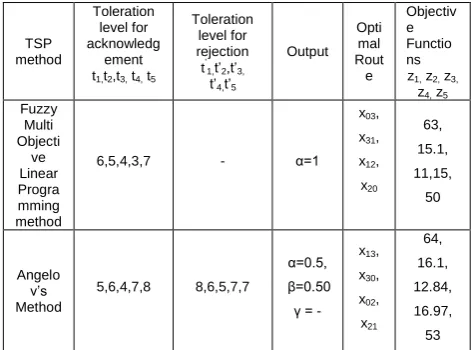
By solving the above equations we obtain the value of α = 1 and then z1= 63, z2 =15.1,z3 = 11,z4 = 15,z5 = 50.
6. Discussions in Comparative Study
3 4 5
(z 12) / 6
(z 14) / 8
(z 51) / 10
(46)
α ≥ , (47)
01 02 03 10 12 13
20 21 23 30 31 32
x x x 1, x x x 1,
x x x 1, x x x 1
(48)
10 20 30 01 21 31
02 12 32 03 13 23
x x x 1, x x x 1,
x x x 1, x x x 1
(49)
1 10 01x
x ,
x
02
x
20
1
,x03x301, (50)1 21 12 x
x ,x13x311,x23x321,
(51)
α, 3.
By solving the above equations we obtain the value of α = 0.50, β = 0.50 and z1= 64, z2 =16.1,z3 =12.84,z4 =16.97, z5 = 53.
At last in proposed Intuitionistic Fuzzy approach technique by inclusion of the range of uncertainty with the range of acknowledgement and the range of rejection is the problem be reformed as
Maximize αβ
Subject to the limitations
1 2 3 4 5 1 (z 65) / 5
1 (z 14) / 4
1 (z 12) / 5
1 (z 14) / 6
1 (z 51) / 7
(52)
α ≥ , β ≥ , , (55)
01 02 03 10 12 13
20 21 23 30 31 32
x x x 1, x x x 1,
x x x 1, x x x 1
(56)
10 20 30 01 21 31
02 12 32 03 13 23
x x x 1, x x x 1,
x x x 1, x x x 1
(57)
1 10 01x
x , x02x201, x03x301 (58)
1 31 13x
x ,x23x321,
(59)
α,
In consequence the Intuitionistic Fuzzy Linear Traveling Salesman Problem is improved into a linear programming and by solving the above equations we obtain the value α = 0.43, β = 0.41, = 0.16 and z1 = 62, z2 = 16, z3 = 12.84,z4 = 18, z5 = 53 which is preferable than Fuzzy decision and Angelov’s Intuitionistic Fuzzy decision.
Table 3. Comparison among the different methods
TSP method
Toleration level for acknowledg
ement t1,t2,t3, t4, t5
Toleration level for rejection t’1,t’2,t’3,
t’4,t’5
Output Opti mal Rout
e
Objectiv e Functio ns z1, z2, z3,
z4, z5
Fuzzy Multi Objecti
ve Linear Progra mming method
6,5,4,3,7 - α=1 x03,
x31,
x12,
x20
63, 15.1, 11,15,
50
Angelo v’s Method
5,6,4,7,8 8,6,5,7,7
α=0.5, β=0.50 γ = -
x13,
x30,
x02,
x21
Propos ed Method
-Fuzzy Intuition
istic TSP
5,2,4,6,7 8,4,5,7,8
α=0.43, β=0.41, γ=0.16
x20,
x01,
x13,
x32
62,16, 12.84, 18,53
7. Conclusion
This work has discussed the Symmetric Traveling Salesman Problem under Intuitionistic Fuzzy environment. Here the range of acknowledgement is more advanced in Angelov’s method comparing to the proposed method in Intuitionistic environment. But the expensive is reduced in proposed Intuitionistic Fuzzy approach technique comparing to the Angelov’s method. Proposed method is considered to be the appropriate model by considering the minimum cost, range of uncertainty and ignoring the small variations in range of acknowledgement. The tolerations are imported by choice maker to acclimate this ambiguity. A variety of results along distinct objective levels are obtained by regulating those tolerations. Among that choice deviser determines the one that foremost fit for the acceptable level among the given tolerations. Hence the proposed technique can be considered to be an appropriate model for the decision analysis.
References
[1] Rehmat,A. Saeed,H. and. Cheema,S. (2007). Fuzzy Multi-objective Linear Programming Approach for Traveling Salesman Problem, Pak.J.stat.oper.res, Vol.3 No.2, pp. 87 – 98. [2] Angelov, P. Plamen(1997). Optimization in an Intuitionistic Fuzzy environment, Fuzzy Sets and Systems, Vol. 86, pp. 299 – 306.
[3] Anitha,N. and Vijayalakshmi,C.(2016). Traveling Salesman problem Model with Fuzzy Multi-Objective linear programming,Global Journal of Pure and Applied Mathematics, Vol. 12, No.3, pp.538 – 543.
[4] Anitha,N. and Vijayalakshmi,C.(2016). Design of an Intuitionistic Fuzzy Model Configuration for Traveling Salesman Problem, Int.J.Pur.App.Mat, Vol 109, Issue No 8,pp.17-24.
[5] Anitha,N. and Vijayalakshmi,C.(2017).Implementation of Fuzzy Linear Programming Technique for Traveling Salesman Problem, Journal of Advanced Research in Dynamical and Control Systems, Vol. No.9 ,Sp-14, pp.789 –797.
[6] Chaudhuri,A. and Kajal De (2011). Fuzzy multi-objective linear programming for travelling salesman problem, African Journal of Mathematics and Computer Science Research. Vol. 4, No. 2, pp. 64 – 70.
[7] Garai,A. Roy,T.K.(2013). Intuitionistic Fuzzy Modeling to Travelling salesman problem, International Journal Of Computers and Technology, Vol. 11, No.9, pp. 3015 – 3024. [8] Atanassov,K.(1986). Intuitionistic Fuzzy sets, Fuzzy Sets and Systems,Vol. 20, pp.87–96.
[9] Atanassov,K.(1995). Ideas for Intuitionistic Fuzzy sets equations, inequalities and Optimization, Notes on Intuitionistic Fuzzy Sets, Vol. 1, No. 1, pp.17 – 24.
[10] Bektas and Tolga.(2006). The multiple travelling salesman
problems: an overview of formulations and solution procedures”, Omega, Vol. 34, pp. 209 – 219.
[11] Bellman,R.E and Zadeh,L.A.(1970). Decision making in a Fuzzy environment,Management Science, Vol. 17,pp.141 – 164. [12] Bindu and Tanwar,P.(2012).Fuzzy Inspired hybrid genetic approach to optimize travelling salesman problem, International journal of Computer Science and Communication Networks, Vol. 2, No. 3, pp. 416 – 420.
[13] Chandrasekaran, Kokila,G. and Saju,J.(2015). A new approach to solve Fuzzy travelling salesman problems by using ranking functions, International Journal of Science and Research, Vol. 4, No. 5, pp. 2258 – 2260.
[14] Mei,H.T, Hua,J. And Wang,Y. (2016) Intuitionistic Fuzzy Hybrid Discrete Particle Swarm Optimization for solving Traveling salesman problem, Proc. Of Fifth International Conf. on Advanced Materials and Computer Science, pp. 765 – 771. [15] Jat,R.N. Sharma,S.C, Jain,S. and Choudhary,A.(2015). A Fuzzy approach for solving mixed Intuitionistic Fuzzy travelling salesman problem, International Journal of Mathematical Archive, Vol. 6, No. 10, pp. 99 – 104.
[16] Fereidouni,S.(2011). Solving travelling salesman problem by using a multi-objective linear programming, African Journal of Mathematics and Computer Science Research, Vol. 4, No. 11, pp. 339 – 349.
[17] Rana.S and Srivastava,S.R(2017).Solving Travelling Salesman Problem Using Improved Genetic Algorithm, Indian Journal of Science and Technology, Vol. 10, No.30, pp. 1 – 6 . [18] Szmidt.E and Kacprzyk.J (1997), Distances between Intuitionistic Fuzzy sets, Fuzzy Sets and Systems, Vol. 114, pp. 505 – 518.
[19] Lu,Y. Yaodong,N.(2005), Fuzzy Random Traveling salesman problem, Proc. of the Fifth International Conf. on Electronic Business, Hong Kong, pp. 901 – 907.