R E S E A R C H
Open Access
Linear and non-linear vibration analysis of
moderately thick isosceles triangular FGPs
using a triangular finite p-element
SA. Belalia
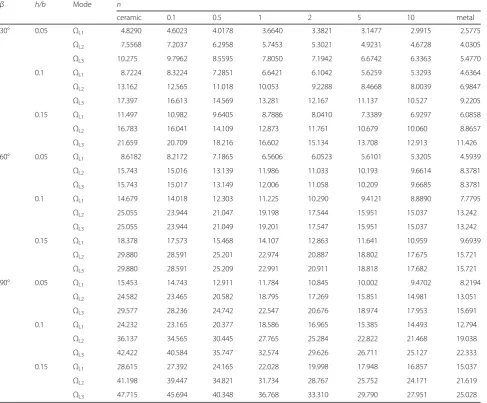
Abstract
Background:The geometrically non-linear formulation based on Von-Karman’s hypothesis is used to study the free vibration isosceles triangular plates by using four types of mixtures of functionally graded materials (FGMs - AL/ AL2O3, SUS304/Si3N4, Ti- AL-4V/Aluminum oxide, AL/ZrO2). Material properties are assumed to be temperature dependent and graded in the thickness direction according to power law distribution.
Methods:A hierarchical finite element based on triangular p-element is employed to define the model, taking into account the hypotheses of first-order shear deformation theory. The equations of non-linear free motion are derived from Lagrange's equation in combination with the harmonic balance method and solved iteratively using the linearized updated mode method.
Results:Results for the linear and nonlinear frequencies parameters of clamped isosceles triangular plates are obtained. The accuracy of the present results are established through convergence studies and comparison with results of literature for metallic plates. The results of the linear vibration of clamped FGMs isosceles triangular plates are also presented in this study.
Conclusion:The effects of apex angle, thickness ratio, volume fraction exponent and mixtures of FGMs on the backbone curves and mode shape of clamped isosceles triangular plates are studied. The results obtained in this work reveal that the physical and geometrical parameters have a important effect on the non-linear vibration of FGMs triangular plates.
Keywords:The mixtures effect of Ceramic-Metal, Linear and Non-linear vibration, Moderately thick FGM plates, p-version of finite element method
Background
In recent years, the geometrically non-linear vibration of functionally graded Materials (FGMs) for different struc-tures has acquired great interest in many researches. In 1984, The concept of the FGMs was introduced in Japan by scientific researchers (Koizumi 1993; Koizumi 1997). FGMs are composite materials which are microscopically inhomogeneous. The mechanical properties of FGMs are expressed with mathematical functions, and assumed to vary continuously from one surface to the other.
Since the variation of mechanical properties of FGM is nonlinear, therefore, studies based on the nonlinear deformation theory is required for these type of mate-rials. Many works have studied the static and dynamic
nonlinear behavior of functionally graded plates with various shapes. The group of researchers headed by (Reddy and Chin 1998; Reddy et al. 1999; Reddy 2000) have done a lot of numerical and theoretical work on FG plates under several effects (thermoelastic response, axi-symmetric bending and stretching, finite element models, FSDT-plate and TSDT-plate). Woo & Meguid (2001) analyzed the nonlinear behavior of functionally graded shallow shells and thin plates under temperature effects and mechanical loads. The analysis of nonlinear bending of FG simply supported rectangular plates sub-missive to thermal and mechanical loading was studied by (Shen 2002). (Huang & Shen 2004) applied the per-turbation technique to nonlinear vibration and dynamic response of FG plates in a thermal environment. Chen (2005) investigated the large amplitude vibration of FG plate with arbitrary initial stresses based on FSDT. An Correspondence:[email protected]
Faculty of Technology, Department of Mechanical Engineering, University of Tlemcen, B.P. 230, Tlemcen 13000, Algeria
analytical solution was proposed by Woo et al. 2006 to analyzed the nonlinear vibration of functionally graded plates using classic plate theory. Allahverdizadeh et al. (2008a, 2008b) have studied the non-linear forced and free vibration analysis of circular functionally graded plate in thermal environment. Thep-version of the FEM has been applied to investigate the non-linear free vibra-tion of elliptic sector plates and funcvibra-tionally graded sec-tor plates by (Belalia & Houmat 2010; 2012). Hao et al. 2011 analyzed the non-linear vibration of a cantilever functionally graded plate based on TSDT of plate and asymptotic analysis and perturbation method. Duc & Cong 2013 analyzed the non-linear dynamic response of imperfect symmetric thin sandwich FGM plate on elastic foundation. Yin et al. 2015 proposed a novel approach based on isogeometric analysis (IGA) for the geometric-ally nonlinear analysis of functiongeometric-ally graded plates (FGPs). the same approach (IGA) and a simple first-order shear deformation plate theory (S-FSDT) are used by Yu et al. 2015 to investigated geometrically nonlinear analysis of homogeneous and non-homogeneous function-ally graded plates. Alinaghizadeh & Shariati 2016, investi-gated the non-linear bending analysis of variable thickness two-directional FG circular and annular sector plates rest-ing on the non-linear elastic foundation usrest-ing the gen-eralized differential quadrature (GDQ) and the Newton–Raphson iterative methods.
The p-version FEM has many advantages over the classic finite element method (h-version), which includes the ability to increase the accuracy of the solution with-out re-defining the mesh (Han & Petyt 1997; Ribeiro 2003). This advantage is suitable in non-linear study because the problem is solved iteratively and the non-linear stiffness matrices are reconstructed throughout each iteration. Using the p-version with higher order polynomials, the structure is modeled by one element while satisfying the exactitude requirement. Inp-version, the point where the maximum amplitude is easy to find it as there is a single element, contrary to theh-version this point must be sought in every element of the mesh which is very difficult. The advantages of the p-version mentioned previously, make it more powerful to the nonlinear vibration analysis of plates. So far, no work has been published to the study of linear and nonlinear vibration of FGMs isosceles triangular plate by using the
p-version of FEM.
In the present work, the non-linear vibration ana-lysis of moderately thick FGMs isosceles triangular plates was investigated by a triangular finite p -elem-ent. The shape functions of triangular finite p-element are obtained by the shifted orthogonal polynomials of Legendre. The effects of rotatory inertia and trans-verse shear deformations are taken into account (Mindlin 1951). The Von-Karman hypothesis are used
in combination with the harmonic balance method (HBM) to obtained the motion equations. The result-ant equations of motion are solved iteratively using the linearized updated mode method. The exactitude of the p-element is investigated with a clamped me-tallic triangular plate. Comparisons are made between current results and those from published results. The effects of thickness ratio, apex angle, exponent of vol-ume fraction and mixtures of FGMs on the backbone curves and mode shape of clamped isosceles triangu-lar plates are also studied.
Methods
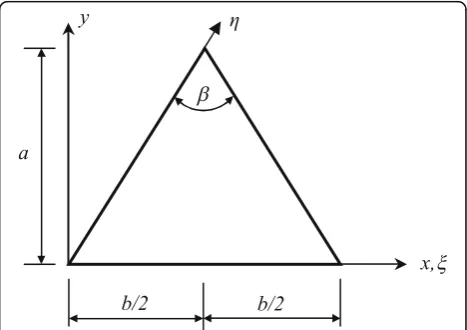
Consider a moderately thick isosceles triangular plate with the following geometrical parameters thickness
h, base b, height a and apex angle β (Fig. 1). The triangular p-element is mapped to global coordinates from the local coordinates ξ and η. The differential relationship between the two coordinates systems is given as a function of the Jacobian matrix ( J ) by
∂ ∂ξ
∂ ∂η
8 > > < > > :
9 > > = > > ;¼J
∂ ∂x
∂ ∂y 8 > < > :
9 > = >
; ð1Þ
whereJis given by
J¼
∂x ∂ξ
∂y ∂ξ
∂x ∂η
∂y ∂η
2 6 6 4
3 7 7 5¼
b 0
b=2 b=2tg β
2
" #
ð2Þ
In first-order shear deformation plate theory, the displacements (u, v and w) at a point with coordinate (x,y,z) from the median surface are given as functions of
midplane displacements (u0,v0,w) and independent rota-tions (θxandθy) about thexandyaxes as
u xð ;y;z;tÞ ¼u0ðx;y;tÞ þzθyðx;y;tÞ v xð ;y;z;tÞ ¼v0ðx;y;tÞ−zθxðx;y;tÞ w xð ;y;z;tÞ ¼w xð ;y;tÞ
ð3Þ
The in-plane displacements (u, v) and out-of-plane displacements (w, θx andθy) will be expressed using the p-version FEM as
u
v ¼
Nðξ;ηÞ 0 0 Nðξ;ηÞ
qu
qv ð4Þ
w θy θx 8 < : 9 = ;¼
Nðξ;ηÞ 0 0
0 Nðξ;ηÞ 0
0 0 Nðξ;ηÞ
2 4
3 5 qqθwy
qθx 8 < : 9 = ;
ð5Þ
wherequ,qvare the vectors of generalized in-plane dis-placements,qw,qθy andqθx are the vectors of generalized transverse displacement and rotations, respectively,
N(ξ,η) are the hierarchical shape functions of triangular
p-element (Belalia & Houmat 2010).
Using FSDT of plate in combination with Von-Karman hypothesis, the nonlinear strain–displacement relationships are expressed as
ε
f g ¼ εL þεNL ð6Þ
where the linear and the non-linear strains can be expressed as,
εL
¼ εLP
0 þ
zεb
εs
and εN L ¼ ε
N L P
0
ð7Þ
the components of linear and the non-linear strains given in Eq. (7) are defined as
εL P ¼ ∂u ∂x ∂v ∂y ∂u ∂yþ ∂v ∂x 8 > > > > > < > > > > > : 9 > > > > > = > > > > > ;
; f g ¼εb ∂θy
∂x −∂θx
∂y ∂θy
∂y− ∂θx
∂x 8 > > > > > < > > > > > : 9 > > > > > = > > > > > ;
ð8Þ
εs f g ¼
∂w ∂xþθy ∂w
∂y−θx
8 > < > : 9 > = > ; ε NL P ¼ 1 2 ∂w ∂x 2 1 2 ∂w ∂y 2 ∂w ∂x ∂w ∂y 8 > > > > > > > < > > > > > > > : 9 > > > > > > > = > > > > > > > ;
ð9Þ
The differential relationship used in Eqs. 8–9 is obtained by inversing Eq. 1 as
∂ ∂x ∂ ∂y 8 > < > : 9 > = > ;¼J
−1 ∂ ∂ξ ∂ ∂η 8 > > < > > : 9 > > = > > ; ð 10Þ
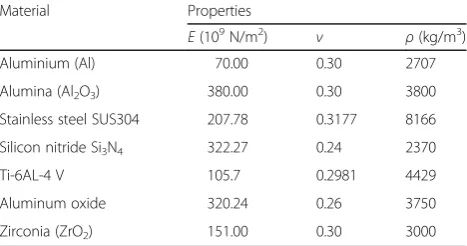
Table 1Mechanical properties of FGMs components Yang et al. (2003) and Zhao et al. (2009)
Material Properties
E(109N/m2) ν ρ(kg/m3) Aluminium (Al) 70.00 0.30 2707
Alumina (Al2O3) 380.00 0.30 3800
Stainless steel SUS304 207.78 0.3177 8166
Silicon nitride Si3N4 322.27 0.24 2370
Ti-6AL-4 V 105.7 0.2981 4429
Aluminum oxide 320.24 0.26 3750
Zirconia (ZrO2) 151.00 0.30 3000
Table 2Convergence of the first three linear frequency parameters for clamped metallic isosceles triangular plate (β= 90°)
h/b Mode p
6 7 8 9 10 11
0.05 Ω1 166.3 164.6 164.4 164.3 164.3 164.3
Ω2 277.2 265.7 261.9 261.1 260.9 260.9
Ω3 330.4 321.2 316.3 314.3 313.8 313.7 0.1 Ω1 128.2 127.9 127.9 127.9 127.9 127.9
Ω2 195.1 191.2 190.5 190.2 190.2 190.2
Ω3 227.9 225.0 223.6 223.3 223.2 223.2 0.15 Ω1 100.3 100.2 100.2 100.2 100.2 100.2
Ω2 146.1 144.3 144.1 144.0 144.0 144.0
Ω3 168.7 167.4 166.8 166.7 166.7 166.7
Table 3Comparison of the first three linear frequency parameters for clamped metallic isosceles triangular plate
h/b Mode β
30° 60° 90°
Present Liew et al. (1998)
Present Liew et al. (1998)
Present Liew et al. (1998) 0.05 Ω1 51.55 51.55 91.86 91.86 164.3 164.4
Ω2 80.60 80.61 167.5 167.5 260.9 260.9 Ω3 109.5 109.5 167.5 167.5 313.7 313.7
0.1 Ω1 46.35 46.35 77.76 77.79 127.9 127.9 Ω2 69.82 69.81 132.3 132.3 190.2 190.3 Ω3 92.16 92.17 132.3 132.3 223.1 223.2
The strain energy ES and kinetic energy EK of the functionally graded moderately thick plate can expressed as
ES ¼ 1 2∬ εp
T
Aij εp
þ εp T
Bij f gεb h
þf gεb T Bij εp
þf gεb T Dij f gεb þf gεs T Sij f gεs
i
dxdy ð11Þ
EK¼ 1 2∬
" I1 ∂u
∂t 2
þ ∂v ∂t 2
þ ∂w ∂t 2!
þI3 ∂θ
x ∂t
2
þ ∂θy ∂t
2
!# dxdy
ð12Þ
where [Aij], [Bij] and [Dij], are extensional, bending-extensional and bending stiffness constants of the FG plate and are given by
Aij;Bij;Dij
¼ Z
−h
2 þh
2
Qij 1;z;z2
dz ði;j¼1;2;6Þ ð13Þ
Sij ¼k Z
−h
2 þh
2
Qijdz ði;j¼4;5Þ ð14Þ
wherekis a shear correction factor and is equal toπ2/12
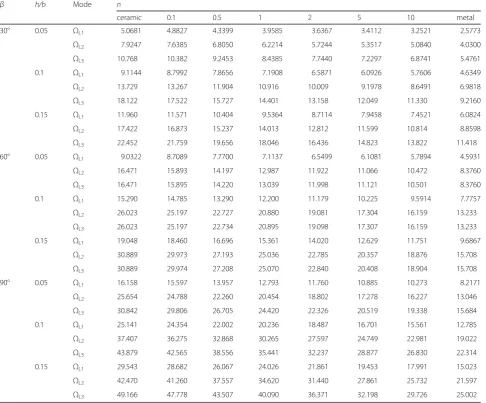
Table 4The first three linear frequency parameters of clamped FG AL/AL2O3isosceles triangular plate
β h/b Mode n
ceramic 0.1 0.5 1 2 5 10 metal
30° 0.05 ΩL1 5.0681 4.8827 4.3399 3.9585 3.6367 3.4112 3.2521 2.5773
ΩL2 7.9247 7.6385 6.8050 6.2214 5.7244 5.3517 5.0840 4.0300
ΩL3 10.768 10.382 9.2453 8.4385 7.7440 7.2297 6.8741 5.4761 0.1 ΩL1 9.1144 8.7992 7.8656 7.1908 6.5871 6.0926 5.7606 4.6349
ΩL2 13.729 13.267 11.904 10.916 10.009 9.1978 8.6491 6.9818
ΩL3 18.122 17.522 15.727 14.401 13.158 12.049 11.330 9.2160 0.15 ΩL1 11.960 11.571 10.404 9.5364 8.7114 7.9458 7.4521 6.0824
ΩL2 17.422 16.873 15.237 14.013 12.812 11.599 10.814 8.8598
ΩL3 22.452 21.759 19.656 18.046 16.436 14.823 13.822 11.418 60° 0.05 ΩL1 9.0322 8.7089 7.7700 7.1137 6.5499 6.1081 5.7894 4.5931
ΩL2 16.471 15.893 14.197 12.987 11.922 11.066 10.472 8.3760
ΩL3 16.471 15.895 14.220 13.039 11.998 11.121 10.501 8.3760 0.1 ΩL1 15.290 14.785 13.290 12.200 11.179 10.225 9.5914 7.7757
ΩL2 26.023 25.197 22.727 20.880 19.081 17.304 16.159 13.233
ΩL3 26.023 25.197 22.734 20.895 19.098 17.307 16.159 13.233 0.15 ΩL1 19.048 18.460 16.696 15.361 14.020 12.629 11.751 9.6867
ΩL2 30.889 29.973 27.193 25.036 22.785 20.357 18.876 15.708
ΩL3 30.889 29.974 27.208 25.070 22.840 20.408 18.904 15.708 90° 0.05 ΩL1 16.158 15.597 13.957 12.793 11.760 10.885 10.273 8.2171
ΩL2 25.654 24.788 22.260 20.454 18.802 17.278 16.227 13.046
ΩL3 30.842 29.806 26.705 24.420 22.326 20.519 19.338 15.684 0.1 ΩL1 25.141 24.354 22.002 20.236 18.487 16.701 15.561 12.785
ΩL2 37.407 36.275 32.868 30.265 27.597 24.749 22.981 19.022
ΩL3 43.879 42.565 38.556 35.441 32.237 28.877 26.830 22.314 0.15 ΩL1 29.543 28.682 26.067 24.026 21.861 19.453 17.991 15.023
ΩL2 42.470 41.260 37.557 34.620 31.440 27.861 25.732 21.597
Q11¼Q22¼ E zð Þ
1−ν2ð Þz Q12¼νð ÞzQ11 Q44¼Q55
¼Q66¼ E zð Þ
2 1ð þνð ÞzÞ
ð15Þ
I1;I3 ð Þ ¼Z
−h=2 þh=2
ρð Þz 1;z2dz ð16Þ
The material propertiesE(z),ν(z), and ρ(z) of the func-tionally graded triangular plate assumed to be graded only in the thickness direction according to a simple power law distribution in terms of the volume fraction of the constituents which is expressed a
E zð Þ ¼ ðEc−EmÞ 1
2þ
z h
n
þEm ð17Þ
νð Þ ¼z ðνc−νmÞ 1 2þ
z h
n
þνm ð18Þ
ρð Þ ¼z ρc−ρm
1
2þ
z h
n
þρm ð19Þ
where c and m index designate the ceramic and the metal, respectively,nis the exponent of the volume fraction (n≥0), z is the thickness coordinate variable, E elastic modulus,ρmass density,his the thickness of the plate and
νis the Poisson’s ratio. The bottom layer of the functionally graded triangular plate is fully metallic material and the top layer is fully ceramic material. The constants of material for four types of FGMs considered in this study (AL/AL2O3
,-SUS304/Si3N4, Ti-6AL-4 V/Aluminum oxide, AL/ZrO2)
are shown in Table 1.
Inserting Eqs. (11–12) in Lagrange’s equations the equations of free motion are obtained as:
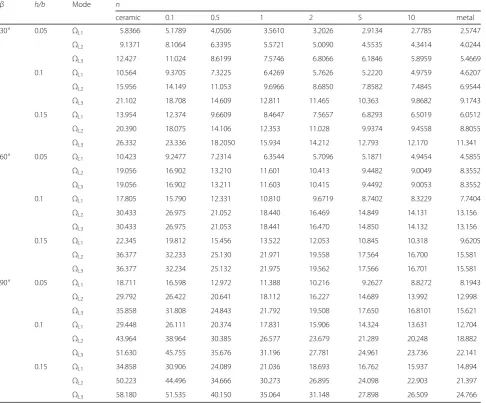
Table 5The first three linear frequency parameters of clamped FG SUS304/Si3N4isosceles triangular plate
β h/b Mode n
ceramic 0.1 0.5 1 2 5 10 metal
30° 0.05 ΩL1 5.8366 5.1789 4.0506 3.5610 3.2026 2.9134 2.7785 2.5747
ΩL2 9.1371 8.1064 6.3395 5.5721 5.0090 4.5535 4.3414 4.0244
ΩL3 12.427 11.024 8.6199 7.5746 6.8066 6.1846 5.8959 5.4669 0.1 ΩL1 10.564 9.3705 7.3225 6.4269 5.7626 5.2220 4.9759 4.6207
ΩL2 15.956 14.149 11.053 9.6966 8.6850 7.8582 7.4845 6.9544
ΩL3 21.102 18.708 14.609 12.811 11.465 10.363 9.8682 9.1743 0.15 ΩL1 13.954 12.374 9.6609 8.4647 7.5657 6.8293 6.5019 6.0512
ΩL2 20.390 18.075 14.106 12.353 11.028 9.9374 9.4558 8.8055
ΩL3 26.332 23.336 18.2050 15.934 14.212 12.793 12.170 11.341 60° 0.05 ΩL1 10.423 9.2477 7.2314 6.3544 5.7096 5.1871 4.9454 4.5855
ΩL2 19.056 16.902 13.210 11.601 10.413 9.4482 9.0049 8.3552
ΩL3 19.056 16.902 13.211 11.603 10.415 9.4492 9.0053 8.3552 0.1 ΩL1 17.805 15.790 12.331 10.810 9.6719 8.7402 8.3229 7.7404
ΩL2 30.433 26.975 21.052 18.440 16.469 14.849 14.131 13.156
ΩL3 30.433 26.975 21.053 18.441 16.470 14.850 14.132 13.156 0.15 ΩL1 22.345 19.812 15.456 13.522 12.053 10.845 10.318 9.6205
ΩL2 36.377 32.233 25.130 21.971 19.558 17.564 16.700 15.581
ΩL3 36.377 32.234 25.132 21.975 19.562 17.566 16.701 15.581 90° 0.05 ΩL1 18.711 16.598 12.972 11.388 10.216 9.2627 8.8272 8.1943
ΩL2 29.792 26.422 20.641 18.112 16.227 14.689 13.992 12.998
ΩL3 35.858 31.808 24.843 21.792 19.508 17.650 16.8101 15.621 0.1 ΩL1 29.448 26.111 20.374 17.831 15.906 14.324 13.631 12.704
ΩL2 43.964 38.964 30.385 26.577 23.679 21.289 20.248 18.882
ΩL3 51.630 45.755 35.676 31.196 27.781 24.961 23.736 22.141 0.15 ΩL1 34.858 30.906 24.089 21.036 18.693 16.762 15.937 14.894
ΩL2 50.223 44.496 34.666 30.273 26.895 24.098 22.903 21.397
M q€u € qv
þ K qu qv
þ ½K^þK^ qqθwy qθx 8 < :
9 =
;¼0 ð20Þ
M
½ €
qw € qθy € qθx 8 < :
9 =
;þ K~þK
qw
qθy qθx 8 < :
9 =
;þ 2K^þK qquv ¼0 ^
"
ð21Þ
The vector of generalized displacement in free motion will be given as
qw qθy qθx
8 < :
9 =
;¼
Qw Qθy Qθx
8 < :
9 =
;cosð Þ ¼ωt Qcosð Þωt ð22Þ
By neglecting the in-plane inertia, and taking into ac-count the effects of the transverse shear deformation
and inertia of rotation. Inserting Eqs. (20) and (22) into Eq. (21) and applying the HB-method, the final equation of free motion are of the form
½−ω2MþK−K^TK−1K^
Qw Qθy Qθx
8 < :
9 = ;
þ3
4
Ke−2K^TK−1K^ 0 0
0 0 0
0 0 0
2 6 4
3 7 5
Qw Qθy Qθx
8 < :
9 = ;¼0
ð23Þ
WhereMis the out-of-plane inertia matrices,K,KandK^ are the extension, bending and coupled extension-rotation linear stiffness matrices, K~ andK^ represent the nonlinear stiffness matrices. These matrices are given in Appendix A.
The system of equations given in Eq. (23) are solved iteratively using the linearized updated mode method. This
Table 6The first three linear frequency parameters of clamped FG Ti-6AL-4 V/Aluminum oxide isosceles triangular plate
β h/b Mode n
ceramic 0.1 0.5 1 2 5 10 metal
30° 0.05 ΩL1 4.8290 4.6023 4.0178 3.6640 3.3821 3.1477 2.9915 2.5775
ΩL2 7.5568 7.2037 6.2958 5.7453 5.3021 4.9231 4.6728 4.0305
ΩL3 10.275 9.7962 8.5595 7.8050 7.1942 6.6742 6.3363 5.4770 0.1 ΩL1 8.7224 8.3224 7.2851 6.6421 6.1042 5.6259 5.3293 4.6364
ΩL2 13.162 12.565 11.018 10.053 9.2288 8.4668 8.0039 6.9847
ΩL3 17.397 16.613 14.569 13.281 12.167 11.137 10.527 9.2205 0.15 ΩL1 11.497 10.982 9.6405 8.7886 8.0410 7.3389 6.9297 6.0858
ΩL2 16.783 16.041 14.109 12.873 11.761 10.679 10.060 8.8657
ΩL3 21.659 20.709 18.216 16.602 15.134 13.708 12.913 11.426 60° 0.05 ΩL1 8.6182 8.2172 7.1865 6.5606 6.0523 5.6101 5.3205 4.5939
ΩL2 15.743 15.016 13.139 11.986 11.033 10.193 9.6614 8.3781
ΩL3 15.743 15.017 13.149 12.006 11.058 10.209 9.6685 8.3781 0.1 ΩL1 14.679 14.018 12.303 11.225 10.290 9.4121 8.8890 7.7795
ΩL2 25.055 23.944 21.047 19.198 17.544 15.951 15.037 13.242
ΩL3 25.055 23.944 21.049 19.201 17.547 15.951 15.037 13.242 0.15 ΩL1 18.378 17.573 15.468 14.107 12.863 11.641 10.959 9.6939
ΩL2 29.880 28.591 25.201 22.974 20.887 18.802 17.675 15.721
ΩL3 29.880 28.591 25.209 22.991 20.911 18.818 17.682 15.721 90° 0.05 ΩL1 15.453 14.743 12.911 11.784 10.845 10.002 9.4702 8.2194
ΩL2 24.582 23.465 20.582 18.795 17.269 15.851 14.981 13.051
ΩL3 29.577 28.236 24.742 22.547 20.676 18.974 17.953 15.691 0.1 ΩL1 24.232 23.165 20.377 18.586 16.965 15.385 14.493 12.794
ΩL2 36.137 34.565 30.445 27.765 25.284 22.822 21.468 19.038
ΩL3 42.422 40.584 35.747 32.574 29.626 26.711 25.127 22.333 0.15 ΩL1 28.615 27.392 24.165 22.028 19.998 17.948 16.857 15.037
ΩL2 41.198 39.447 34.821 31.734 28.767 25.752 24.171 21.619
method needs two type of amplitudes, the first is the spe-cific amplitude which depends on the plate thickness, the second is the maximum amplitude to be calculated for each iteration. The new system of equations is solved using any known technique with an accuracy of around (e.g.10−5).
The maximum amplitudewmaxis evaluated as
wmax¼ N ξ0;η0
0 0
Qw
Qθy Qθx 8 < :
9 = ;
i¼1;2;…ðpþ1Þðpþ2Þ=2
ð Þ
ð24Þ
Results
Study of convergence and comparison for linear vibration
In this part a convergence and comparison study is made for the linear vibration of clamped metallic
isosceles triangular plates to validate the current formu-lation and methods proposed.
Table 2 shows the convergence of the first three frequencies parameter Ω¼ωb2pffiffiffiffiffiffiffiffiffiffiffiρh=D of metallic
clamped isosceles triangular plate (β= 90°) for the three following different thickness ratio (h/b= 0.05, 0.1 and 0.15). The convergence of results can be ac-celerated by increasing the polynomial order p from 6 to 11. To validate the accuracy of the present solu-tion, a comparison, listed in Table 3, is made between the present results and the results of p-version Ritz method (Liew et al. 1998) of first three linear fre-quency parameters for metallic clamped isosceles tri-angular plate, the geometric parameters of this plate are taken (β= 30°, 60° and 90°) for apex angle and (h/ b= 0.05, 0.1 and 0.15) for thickness ratio. From this table, it can be found that the present results are in good agreement with the published results. From this
Table 7The first three linear frequency parameters of clamped FG AL/ZrO2isosceles triangular plate
β h/b Mode n
ceramic 0.1 0.5 1 2 5 10 metal
30° 0.05 ΩL1 3.0021 2.9572 2.8416 2.7888 2.7883 2.8317 2.8112 2.5773
ΩL2 4.6942 4.6257 4.4505 4.3711 4.3692 4.4266 4.3896 4.0299
ΩL3 6.3787 6.2869 6.0482 5.9351 5.9251 5.9981 5.9503 5.4760 0.1 ΩL1 5.3989 5.3268 5.1359 5.0398 5.0174 5.0496 5.0015 4.6348
ΩL2 8.1325 8.0301 7.7590 7.6194 7.5751 7.5901 7.5050 6.9816
ΩL3 10.735 10.604 10.250 10.056 9.9768 9.9757 9.8654 9.2158 0.15 ΩL1 7.0850 7.0016 6.7739 6.6473 6.5896 6.5742 6.4964 6.0823
ΩL2 10.320 10.207 9.8999 9.7224 9.6219 9.5516 9.4211 8.8596
ΩL3 13.300 13.161 12.769 12.526 12.368 12.251 12.086 11.418 60° 0.05 ΩL1 5.3502 5.2734 5.0781 4.9894 4.9857 5.0425 4.9975 4.5931
ΩL2 9.7566 9.6227 9.2739 9.1052 9.0780 9.1532 9.0675 8.3758
ΩL3 9.7566 9.6232 9.2816 9.1224 9.0985 9.1668 9.0741 8.3758 0.1 ΩL1 9.0573 8.9471 8.6541 8.4990 8.4407 8.4359 8.3353 7.7755
ΩL2 15.415 15.244 14.774 14.500 14.358 14.268 14.081 13.233
ΩL3 15.415 15.244 14.777 14.509 14.362 14.270 14.082 13.233 0.15 ΩL1 11.283 11.165 10.838 10.642 10.517 10.414 10.266 9.6865
ΩL2 18.297 18.125 17.627 17.299 17.040 16.784 16.532 15.707
ΩL3 18.297 18.125 17.632 17.310 17.056 16.797 16.538 15.707 90° 0.05 ΩL1 9.5715 9.4422 9.1085 8.9487 8.9212 8.9816 8.8897 8.2169
ΩL2 15.196 15.003 14.502 14.254 14.185 14.215 14.050 13.045
ΩL3 18.269 18.040 17.419 17.086 16.970 17.004 16.829 15.684 0.1 ΩL1 14.892 14.732 14.291 14.033 13.882 13.769 13.580 12.785
ΩL2 22.158 21.938 21.319 20.930 20.650 20.390 20.091 19.022
ΩL3 25.992 25.741 25.014 24.537 24.177 23.847 23.505 22.313 0.15 ΩL1 17.500 17.340 16.880 16.571 16.314 16.039 15.785 15.023
ΩL2 25.157 24.943 24.305 23.848 23.428 22.966 22.596 21.596
table, it can be found that the present results are in good agreement with the published results.
Linear vibration of FGMs isosceles triangular plate
This part of study present the linear free vibration of thick FGMs isosceles triangular plates designed by four different mixtures (FGM 1: AL/AL2O3, FGM 2:
SUS304/Si3N4, FGM 3: Ti-6AL-4 V/Aluminum oxide
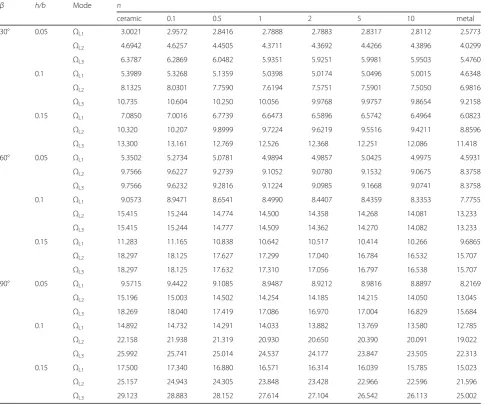
and FGM 4: AL/ZrO2). Tables 4, 5, 6, 7 display the
first three linear frequency parametersffiffiffiffiffiffiffiffiffiffiffiffiffiffiffiffiffiffiffiffiffiffiffiffiffiffiffiffiffiffiffiffi ΩL¼ωb2
12ρmð1−ν2Þ=E m p
for a clamped FGMs isosceles tri-angular plate, three apex angles (β= 30°, 60° and 90°) and three thickness ratio (h/b= 0.05, 0.1 and 0.15) are considered. The exponent of volume fraction vary from 0 to ∞and it takes the values presented in tables. The re-sults presented in this section comes to enrich the rere-sults of literatures. The tables visibly show that the linear fre-quency parameters is proportional to the angle and thick-ness and inversely proportional to the volume fraction exponent. For the triangular plate with apex angle (β = 60°), it is noted that the second and third modes are double modes for cases purely metal or purely ceramic, but varied the volume fraction exponent there is a small spacing between the two modes, the maximum spacing is the round ofn= 1.
Non-linear vibration of isosceles triangular FG-plate
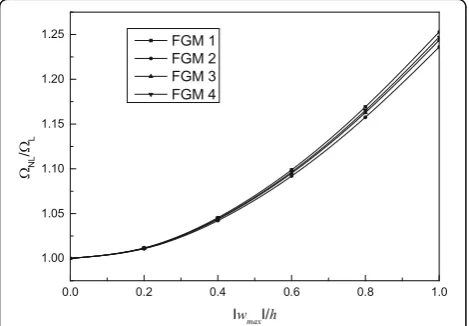
The investigation of the effects of the FGM mixtures, volume fraction exponent, thickness ratio, apex angle and boundary conditions on the hardening behavior are investigated in this part. The resultant backbone curves which shows the change in the nonlinear-to-linear frequency ratio ΩNL/ΩL according to maximum amplitude-to-thickness ratios |wmax|/h are plotted in Figs. 2, 3, 4, 5 for clamped FG isosceles triangular plate. In Fig. 2, four different mixtures of FGM
(FGM 1: AL/AL2O3, FGM 2: SUS304/Si3N4, FGM 3:
Ti-6AL-4 V/Aluminum oxide and FGM 4: AL/ZrO2)
are considered for volume fraction exponent n= 0.5. The thickness ratio and the apex angle of FG isosceles triangular plate are taken respectively as h/b
= 0.1, β= 60°. The effect of apex angle and thickness on the backbone curve for the first mode of the func-tionally garded AL/AL2O3 clamped triangular plate
with (β= 60°) and n =1 are presented in Figs. 3, 4. The effects of mixtures, thickness ratio and apex angle are clearly shown on the plot of these figures. The plots clearly show that if the thickness and angle increases the effects of the hardening behavior in-creases automatically. Also, the nonlinear vibration of the triangular plate with mixture FGM 4 presents the greatest hardening behavior compared to others mix-tures of FGM.
The boundary conditions effects on the fundamental backbone curves for FG AL/AL2O3 isosceles triangular
Fig. 4The apex angle effects on the fundamental backbone curves for clamped FG AL/AL2O3isosceles triangular plate (h/b= 0.1andn=1)
Fig. 3The thickness effects on the fundamental backbone curves for clamped FG AL/AL2O3isosceles triangular plate (β= 60° and n =1)
plate are investigated in Fig. 5. Four different boundary conditions are considered in this part of study SSS, CSS, SCC and CCC (S: simply supported edge and C : clamped edge). The volume fraction exponent, thickness ratio and the apex angle of FG isosceles triangular plate are taken respectively as n =1, h/b= 0.05 and β= 90°. The figure clearly show that the FG plate with simply supported boundary conditions presents a more accen-tuated hardening behavior than the other boundary con-ditions. It is noted that the hardening effect increases when the plate becomes more free (SSS) and decreases as the plate becomes more fixed (CCC), this difference in the results is due to the rotation of the edges.
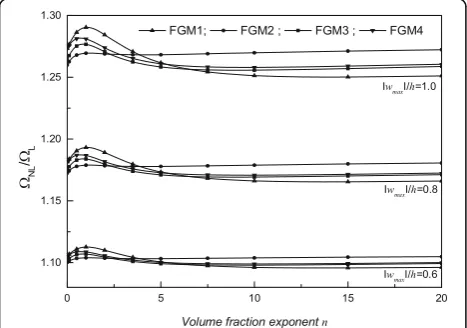
The variation of frequency ratioΩNL/ΩL according to volume fraction exponent for clamped isosceles triangu-lar plate with four different mixtures of FGMs is shown in Fig. 6. The exponent of volume fraction take values from 0 to 20 and maximum amplitude-to-thickness
a
b
Fig. 8Section of normalized non-linear fundamental mode shapes of FG isosceles triangular plate :a) along ofξ;b) alone ofη(β= 30°, n= 1,h/b= 0.05)
Fig. 7Material mixtures effects on the variation of the nonlinear-to-linear fundamental frequency ratio with the volume fraction expo-nent for clamped FG isosceles triangular plate (|wmax|/h= 1, h/b= 0.1,β= 90°)
Fig. 6Material mixtures effects on the variation of the nonlinear-to-linear fundamental frequency ratio with the volume fraction expo-nent for clamped FG isosceles triangular plate (h/b= 0.1,β= 90°)
Fig. 5The boundary conditions effects on the fundamental backbone curves for FG AL/AL2O3isosceles triangular plate (β= 90°,
ratios take three values |wmax|/h= 0.6, 0.8 and 1. The geometric parameters of the plate are (β= 90°) and h/b
=0.1. Noted that the shape of the graph is similar for three values of the maximum amplitude-to-thickness ra-tios of this fact and to understand the phenomenon and good interpretation, Fig. 7 plot only the results of the largest value of the maximum amplitude |wmax|/h= 1. It can be seen for volume fraction exponent which varied betweenn= 0 to n= 4 the hardening effect is maximum for the first mixture (AL/AL2O3), for values n≥4 the
second mixture (which SUS304/Si3N4) presents the
greatest hardening effect. For third and fourth mixtures (Ti-6AL-4 V/Aluminum oxide and AL/ZrO2) the shape
of the two curves are parallel with superiority of the values obtained for the fourth mixture FGM 4. Note that the peak of the hardening behavior for four curves is ob-tained for volume fraction exponentn= 1, at which cor-responds to a linear variation of constituent materials of the mixture. By comparing the spacing between curves FGM1 (Al/Al2O3) and FGM4 (Al/ZrO2) we see clearly
the influence of physical properties of the two ceramic (Al2O3and ZrO2) on hardening behavior. This influence
is not due to metal (Al) since the same metal is used in both mixtures.
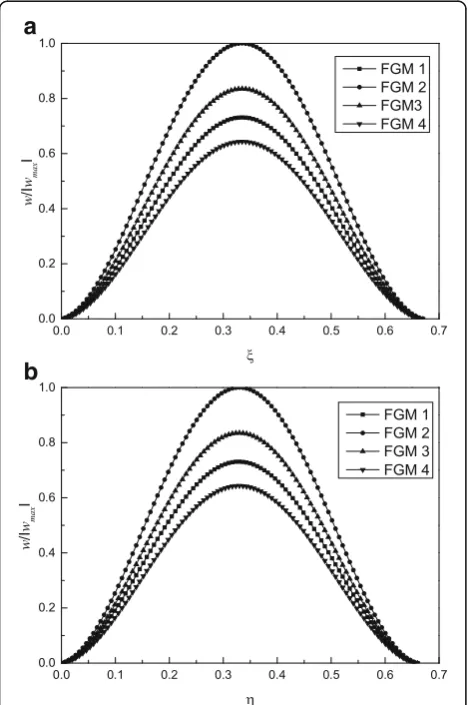
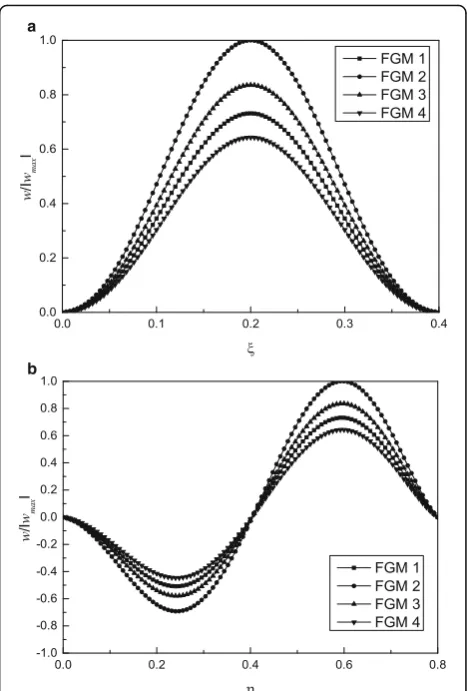
Figures 8, 9, 10 shows the normalized non-linear fun-damental mode shape of isosceles triangular plate for four different mixtures of FGM along the line passes through the point of maximum amplitude (ξ0,η0).
The mode shape are normalized by dividing by their own maximum displacement. Three apex angles and thickness ratio of FG plate are considered (β= 30°, 60° and 90°), (h/b= 0.05) respectively, volume fraction exponent n= 1 and the maximum amplitude |wmax|/h= 1. It can see from these graphs that the displacement is maximum for the FGM 2 (SUS304/ Si3N4) then comes FGM3 (Ti-6Al-4 V/Aluminum
oxide) with a percentage of displacement 83% of max-imum displacement, FGM 1 (AL/AL2O3) with 72%
and lastly FGM 4 (AL/ZrO2) with 64%. The
normal-ized non-linear of second and third modes shape of
a
b
Fig. 10Section of normalized non-linear fundamental mode shapes of FG isosceles triangular plate:a) along ofξ;b) alone ofη(β= 90°, n= 1,h/b= 0.05)
a
b
isosceles triangular plates for the same mixtures used early are plotted in Figs. 11, 12, respectively. The geo-metric parameters used are h/b= 0.05, β= 90° and |wmax|/h= 0.8. It can be seen from this plot the effect of mixtures on normalized non-linear first three fun-damental mode shape of isosceles triangular plate. This is due to fact that the composition of mixtures contribute to various in-plane forces in the isosceles triangular plate.
Conclusions
The non-linear free vibration of moderately thick FGMs clamped isosceles triangular plates was analyzed by a triangular p-element. The material properties of the functionally graded triangular plate assumed to be graded only in the thickness direction according to a simple power law distribution in terms of the volume fraction of the constituents. The shape functions of tri-angular finite p-element are obtained by the shifted or-thogonal polynomials of Legendre. The components of
stiffness and mass matrices were calculated using nu-merical integration of Gauss-Legendre. The equations of motion are obtained from Lagrange's equation in combination with the harmonic balance method (HBM). Results for linear and non-linear frequency for the lowest three modes of FGMs clamped isosceles tri-angular plates were obtained. The parametric studies show that the boundary conditions have a great influ-ence on the shape of the backbone curves, the harden-ing sprharden-ing effect decreases for clamped FG plate. For simply supported FG plate and by increasing thickness ratio and sector angle of FG plates the hardening spring effect increases. A increase in the volume fraction ex-ponent produces a variation in the hardening spring ef-fect with an increasing part and another decreasing part, the peak in the curves of the nonlinear-to-linear fundamental frequency ratio FG triangular plate is ob-tained around of n = 1 at which the hardening behavior is maximum, and is obtained for AL/AL2O3 FG plate.
This value of volume fraction exponent corresponds a
b
Fig. 12Section of normalized non-linear third mode shapes of FG isosceles triangular plate:a) along ofξ;b) alone ofη(β= 90°, n= 1,h/b= 0.05)
a
b
to equal mixtures of metal and ceramic in the com-position of the FG plate. Not only the hardening behavior is influenced by this mixture but the non-linear mode shape of FG isosceles triangular plate is also influenced.
Appendix A
Kα;β¼
K2α−1;2β−1 K2α−1;2β
K2α;2β−1 K2α;2β
" #
ðA:1Þ
Kα;β¼
K3α−2;3β−2 K3α−2;3β−1 K3α−2;3β K3α−1;3β−2 K3α−1;3β−1 K3α−1;3β
K3α;3β−2 K3α;3β−1 K3α;3β
2 4
3
5 ðA:2Þ
Mα;β¼
M3α−2;3β−2 M3α−2;3β−1 M3α−2;3β M3α−1;3β−2 M3α−1;3β−1 M3α−1;3β M3α;3β−2 M3α;3β−1 M3α;3β
2 4
3
5 ðA:3Þ
^
Kα;β¼ K^^2α−1;3β−2 K^2α−1;3β−1 K^2α−1;3β
K2α;3β−2 K^2α;3β−1 K^2α;3β
" #
ðA:4Þ
K ^
α;β¼
K^2α−1;3β−2 K ^
2α−1;3β−1 K ^
2α−1;3β K^2α;3β−2 K
^
2α;3β−1 K ^
2α;3β 2
4
3
5 ðA:5Þ
~
Kα;β¼ ~
K3α−2;3β−2 K~3α−2;3β−1 K~3α−2;3β ~
K3α−1;3β−2 K~3α−1;3β−1 K~3α−1;3β
~
K3α;3β−2 K~3α;3β−1 K~3α;3β
2 4
3
5 ðA:6Þ
The non-zero elements of the matrices M,K, K,K, K^ ^ andK are expressed as~
M3α−2;3β−2¼ Z1
0 Z1−ξ
0
I1NαNβj jJ dξdη ðA:7Þ
M3α−1;3β−1¼M3α;3β¼
Z1
0 Z1−ξ
0
I3NαNβj jJ dξdη ðA:8Þ
K3α−2;3β−2¼
Z1
0
Z1−ξ
0
k A44∂ Nα
∂ξ ∂Nβ
∂ξ þA55∂ Nα
∂η ∂Nβ
∂η
J j jdξdη
ðA:9Þ
K3α−2;3β−1¼− Z1
0 Z1−ξ
0
k A44∂ Nα
∂η Nβj jJ dξdη ðA:10Þ
K3α−2;3β¼
Z1
0 Z1−ξ
0
k A55∂ Nα
∂ξ Nβj jJdξdη ðA:11Þ
K3α−1;3β−2¼− Z1
0 Z1−ξ
0
k A44Nα∂∂Nηβj jJ dξdη ðA:12Þ
K3α−1;3β−1¼
Z1
0
Z1−ξ
0
D22∂
Nα
∂η ∂Nβ
∂η þD66∂
Nα
∂ξ ∂Nβ
∂ξ þk A44NαNβ
J
j jdξdη
ðA:13Þ
K3α−1;3β¼−
Z1
0
Z1−ξ
0
D12∂Nα
∂η ∂Nβ
∂ξ þD66 ∂Nα
∂ξ ∂Nβ
∂η
J j jdξdη
ðA:14Þ
K3α;3β−2¼ Z1
0 Z1−ξ
0
k A55Nα
∂Nβ
∂η j jJ dξdη ðA:15Þ
K3α;3β−1¼−
Z1
0
Z1−ξ
0
D12∂Nα
∂ξ ∂Nβ
∂η þD66 ∂Nα
∂η ∂Nβ
∂ξ
J j jdξdη
ðA:16Þ
K3α;3β¼
Z1
0
Z1−ξ
0
D11∂
Nα
∂ξ ∂Nβ
∂ξ þD66∂
Nα
∂η ∂Nβ
∂η þk A55NαNβ
J
j jdξdη
ðA:17Þ
K2α−1;2β−1¼
Z1
0
Z1−ξ
0
A11∂∂Nξα∂∂NξβþA66∂∂Nηα∂∂Nηβ
J j jdξdη
ðA:18Þ
K2α−1;2β¼
Z1
0
Z
01−ξ
A12∂Nα
∂ξ ∂Nβ
∂η þA66 ∂Nα
∂η ∂Nβ
∂ξ
J j jdξdη
ðA:19Þ
K2α;2β−1¼
Z1
0
Z1−ξ
0
A12∂Nα
∂η ∂Nβ
∂ξ þA66 ∂Nα
∂y
∂Nβ
∂η
J j jdξdη
ðA:20Þ
K2α;2β¼
Z1
0 Z1−ξ
0
A22∂Nα ∂η
∂Nβ
∂η þA66∂Nα ∂ξ
∂Nβ ∂ξ
J j jdξdη
ðA:21Þ
^
K2α−1;3β−2 ¼
1 2
Xr
δ¼1 Z1
0 Z1−ξ
0
A11∂Nα ∂ξ
∂Nβ ∂ξ
∂Nδ
∂ξ þA12∂Nα ∂ξ ∂Nβ ∂η ∂Nδ ∂η 0 @
þ2A66∂Nα ∂η ∂Nβ ∂ξ ∂Nδ ∂η J j jdξdη
! Q3δ−2
^ K2α;3β−2 ¼
1 2
Xr
δ¼1 Z1
0 Z1−ξ
0
A22∂Nα ∂η
∂Nβ
∂η ∂N∂ηδþA12∂Nα ∂η
∂Nβ ∂ξ ∂N∂ξδ
0 @
þ2A66∂Nα ∂ξ
∂Nβ ∂ξ ∂N∂ηδ
J j jdξdη
! Q3δ−2
ðA:23Þ
K
^
2α−1;3β−1¼
Z1
0
Z1−ξ
0
B12∂Nα
∂ξ ∂Nβ
∂η −B66∂
Nα
∂η ∂Nβ
∂ξ
J j jdξdη
ðA:24Þ
K
^
2α−1;3β¼
Z1
0
Z
01−ξ
B11∂Nα
∂ξ ∂Nβ
∂η þB66 ∂Nα
∂η ∂Nβ
∂ξ
J j jdξdη
ðA:25Þ
K ^
2α;3β−1¼
Z1
0
Z1−ξ
0
B22∂
Nα
∂η
∂Nβ ∂η −B66∂
Nα
∂ξ
∂Nβ ∂ξ
J j jdξdη
ðA:26Þ
K ^
2α;3β¼
Z1
0
Z1−ξ
0
B12∂
Nα
∂η
∂Nβ
∂ξ þB66∂
Nα
∂ξ
∂Nβ
∂η
J j jdξdη
ðA:27Þ
~
K3α−2;3β−2 ¼
1 2
Xr
δ¼1
Xr
γ¼1
Z1
0
Z1−ξ
0
A11∂Nα
∂ξ ∂Nβ
∂ξ ∂Nδ
∂ξ ∂Nγ
∂ξ
0 @
þA22∂Nα
∂η ∂Nβ
∂η ∂Nδ
∂η ∂Nγ
∂η
þðA12þ2A66Þ∂Nα
∂ξ ∂ Nβ ∂ξ ∂ Nδ ∂η ∂ Nγ ∂η
þðA12þ2A66Þ∂Nα
∂η ∂Nβ
∂η ∂
Nδ
∂ξ ∂Nγ
∂ξ
J j jdξdη
!
Q3δ−2;Q3γ−2
ðA:28Þ
Competing interests
The author declare no significant competing financial, professional or personal interests that might have influenced the performance or presentation of the work described in this manuscript.
Author details
Laboratory of Computational Mechanics, Faculty of Technology, Department of Mechanical Engineering, University of Tlemcen, B.P. 230, Tlemcen 13000, Algeria.
Received: 2 September 2016 Accepted: 12 January 2017
References
Alinaghizadeh F, Shariati M (2016) Geometrically non-linear bending analysis of thick two-directional functionally graded annular sector and rectangular plates with variable thickness resting on non-linear elastic foundation. Compos Part B 86:61–83
Allahverdizadeh A, Naei MH, Bahrami MN (2008a) Nonlinear free and forced vibration analysis of thin circular functionally graded plates. J Sound Vib 310: 966–984
Allahverdizadeh A, Naei MH, Bahrami MN (2008b) Vibration amplitude and thermal effects on nonlinear behavior of thin circular functionally graded plates. Int J Mech Sci 50:445–454
Belalia SA, Houmat A (2010) Nonlinear free vibration of elliptic sector plates by a curved triangularp-element. Thin-Walled Struct 48:316–326
Belalia SA, Houmat A (2012) Nonlinear free vibration of functionally graded shear deformable sector plates by a curved triangularp-element. Eur J Mech A Solids 35:1–9
Chen CS (2005) Nonlinear vibration of a shear deformable functionally graded plate. Compos Struct 68:295–302
Duc ND, Cong PH (2013) Nonlinear dynamic response of imperfect symmetric thin S-FGM plate with metal–ceramic–metal layers on elastic foundation. J Vib Control 21:637–646
Han W, Petyt M (1997) Geometrically nonlinear vibration analysis of thin, rectangular plates using the hierarchical finite element method-I: The fundamental mode of isotropic plates. Comput Struct 63:295–308 Hao YX, Zhang W, Yang J (2011) Nonlinear oscillation of a cantilever FGM
rectangular plate based on third-order plate theory and asymptotic perturbation method. Compos Part B 42:3,402–413
Huang XL, Shen HS (2004) Nonlinear vibration and dynamic response of functionally graded plates in a thermal environment. Int J Solids Struct 41: 2403–2427
Koizumi M (1993) The concept of FGM: functionally gradient material. Ceram Trans 34:3–10
Koizumi M (1997) FGM activities in Japan. Compos Part B 28:1–4 Liew KM, Wang CM, Xiang Y, Kitipornchai S. Vibration of Mindlin plates:
programming thep-version Ritz method. Elsevier: 1998.
Mindlin RD (1951) Influence of rotary inertia and shear on flexural vibrations of isotropic, elastic plates. J Appl Mechanics 12:69–77
Reddy JN (2000) Analysis of functionally graded plates. Int J Numer Methods Eng 47:663–684
Reddy JN, Chin CD (1998) Thermo-mechanical analysis of functionally graded cylinders and plates. J Therm Stresses 21:593–626
Reddy JN, Wang CM, Kitipornchai S (1999) Axisymmetric bending of functionally graded circular and annular plates. Eur J Mech A Solids 18:185–199 Ribeiro P (2003) A hierarchical finite element for geometrically nonlinear vibration
of thick plates. Meccanica 38:115–130
Shen HS (2002) Nonlinear bending response of functionally graded plates subjected to transverse loads and in thermal environments. Int J Mech Sci 44:561–584
Woo J, Meguid SA (2001) Nonlinear behavior of functionally graded plates and shallows shells. Int J Solids Struct 38:7409–7421
Woo J, Meguid SA, Ong LS (2006) Nonlinear free vibration behavior of functionally graded plates. J Sound Vib 289:595–611
Yang J, Kitipornchai S, Liew KM (2003) Large amplitude vibration of thermo-electro-mechanically stressed FGM laminated plates Comput. Methods Appl Mech Engrg 192:3861–3885
Yin S, Yu T, Bui TQ, Nguyen MN (2015) Geometrically nonlinear analysis of functionally graded plates using isogeometric analysis. Eng Computation 32(2):519–558
Yu T, Yin S, Bui TQ, Hirose S (2015) A simple FSDT-based isogeometric analysis for geometrically nonlinear analysis of functionally graded plates. Finite Elem Anal Des 96:1–10