SCIENCEDOMAIN international
www.sciencedomain.org
Physicians' Perspectives Toward Shared
Decision Making in Developing Countries
Mohammad Ali Haj Ebrahimi
1, Sakineh Hajebrahimi
2, Hadi Mostafaie
3,
Fariba Pashazadeh
2and Ahmad Hajebrahimi
2*1
Students’ Research Committee, Shahid Beheshti University of Medical Sciences, Tehran, Iran. 2
Iranian Evidence-Based Medicine Center of Excellence, Tabriz University of Medical Sciences, Iran. 3Students’ Research Committee,Iranian Evidence-Based Medicine Center of
Excellence, Tabriz University of Medical Sciences, Iran.
Authors’ contributions
This work was carried out in collaboration between all authors. Authors SH and AH designed the study. Authors HM and MAHE collected the data. Author FP conducted the data analysis; the article is written by author MAHE and critically edited by authors SH and AH.
All authors read and approved the final manuscript.
Received 31st December 2013 Accepted 23rd February 2014 Published 2nd April 2014
ABSTRACT
Aims: To evaluate Iranian physicians’ perspectives on shared decision making by
validating and translating the physician version of a shared decision making questionnaire (SDM-Q-DOC).
Place and Duration: Iranian Evidence-Based Medicine Center of Excellence, Tabriz
University of Medical Sciences, Tabriz, Iran, from June 2012 to July 2013.
Methods: The physician version of a shared decision making questionnaire
(SDM-Q-DOC) was translated and validated through a pilot study among urologists in one of the hospitals of Tabriz University of Medical Sciences. A validated questionnaire was handed out among Iranian physicians in three main hospitals of Urmia. The results were analyzed using factorial analysis SPSS 16 software. To assess reliability, Cronbach’s alpha coefficient was calculated. Pearson correlation coefficient was used to assess test-retest value.
Results: The Persian version of the questionnaire showed an acceptable level of
reliability (Cronbach alpha=0.901). In the implementation phase, Iranian physicians were generally in favor of the SDM process ( mean score=74.4%) but their perspective on different phases of SDM were different, with 93% answering questions evaluating physicians’ clinical explanations to their patients and only 68% agreeing with questions evaluating physicians’ attitudes regarding involving patients in the last treatment option.
Conclusion: The physician version of SDM-Q-DOC is a valid and reliable questionnaire
assessing physicians’ attitudes toward the SDM process. In this study, Iranian physicians showed a positive view to SDM.
Keywords: Shared decision making; patient-centeredness; Person-centeredness; evidence-based medicine; developing countries.
1. INTRODUCTION
In recent decades, there has been a strong move toward shared decision making (SDM) in medical literature, medical encounters [1]and even in countries’ health care systems [2]. Despite numerous studies in the field, SDM implementation still faces various barriers [3]. Measuring SDM from different viewpoints might clarify the health care system’s status for SDM implementation.
SDM is defined as presenting information for patients to involve them in finalizing the suitable treatment option [4,5]. Several instruments are used to assess the SDM process, varying from questionnaire-based to audiovisual-based instruments. The Instruments can be classified as those that assess SDM from a third observer perspective [6–8], the physician’s perspective [9],and the patient’s perspective [10]. Despite many studies discussing various options for assessing shared decision making, most of them are not able to address social and cultural differences in decision making encounters [11]. Some SDM processes could be viewed negatively by patients in countries with different cultures and levels of health knowledge [12]. A study by Charles et al. points out the importance of considering confounding factors in different possible contexts of shared decision making [11].
Because studies evaluating SDM processes have been designed in developed countries, they often fail to consider different contexts of this process in countries with lower socioeconomic levels. SDM implementation could be completely different in different cultures resulting in different perspectives of their physicians toward an SDM process.
We figured that measuring Iranian physicians’ attitudes toward SDM could clarify the level of perceived SDM in Iran, a country posing barriers to SDM implementation similar to other developing countries; this necessitates consideration of cultural influences, as pointed out by Charles et al., as well as other potential barriers in SDM perception and utilization. In this study, we adapted SDM-Q-DOC “an instrument for assessing physicians’ points of view on SDM” in order to address the knowledge gap regarding SDM implementation in countries with different social contexts, economy, and culture.
2. METHODOLOGY
2.1 Developing the Instrument
version of the questionnaire for the process of validation. The author’s consent was obtained to use the English version instead of German. SDM-Q-Doc was translated from English to Persian by two bilingual experts, one of whom was a physician and the other a researcher who was aware of the research objectives. Back-translation was performed by a native English speaker (fluent in Persian) who was unaware of research aims. The translation methodology was checked by sending the back-translation to the original authors, to ensure that the content of the translation conforms to the original version and the author’s recommendations were considered.
To assess reliability, we conducted a pilot study on 18 physicians from the department of urology in a teaching hospital of Tabriz University of Medical Sciences. Questionnaires were answered by physicians at two separate times with a one-week interval. This was to reduce recall-induced agreement.
The results of the pilot study were analyzed and the reliability of the questionnaire was assessed by Cronbach's alpha using the factorial analysis in SPSS16 software. Pearson correlation coefficients were calculated to evaluate test-retest value.
2.2 Implementing the Instrument
After validation, the new questionnaire was administered among 81 physicians in teaching hospitals of Urmia University of Medical Sciences (Shahid Motahari Hospital, Imam Khomeini Hospital, and Taleghani Hospital) to assess physicians’ perspectives on shared decision making. An oral consent was obtained from physicians and study aims and their role in its design were explained to each doctor when handing out the questionnaires. Hospital administrators’ consents were acquired before the questionnaires were distributed. Physicians participating in the study were from the departments of anesthesia, urology, gynecology and emergency (all departments present in each hospital were asked to take part in the study, but only these departments agreed to participate).
To evaluate physicians’ general perception of SDM, the scoring system of the original questionnaire was implemented; it was a nine-item questionnaire with six items for each question, with a scoring range from 0 (completely disagree) to 5 (completely agree). The total score for each questionnaire was calculated and mean scores (ranging from a minimum of 0 to a maximum of 45) of whole questionnaires were determined to estimate perceived level of SDM among Iranian physicians in general.
The results were analyzed using SPSS16 software. Frequencies of answers for each question were calculated and analyzed separately.
3. RESULTS
In the first phase of the study (validation), 18 physicians from the urology department were involved. The Cronbach’s alpha coefficient was 0.9, indicating that the questionnaire had a high degree of internal consistency. The Pearson correlation coefficient was 0.70, showing a large and positive linear relationship between two variables. Pearson coefficient was 0.5–0.7 in questions 1, 2, 4, and 5, which showed a large relationship. We attributed this to different understanding of Iranian physicians due to the differences in medical scenarios in Iran compared to Western countries.
departments. The mean score was 31.18 (7.45 SD), which was calculated as 74.40% level of perceived SDM (Table 1).
Table 1. Scores noted based on questionnaire’s scoring system
Number of questionnaires Mean score
Mean score (%)
Standard Deviation
Maximum Minimum
81 31.18 74.40 7.45 45.00 14.00
This table demonstrates level of perceived general SDM by Iranian physicians by reporting scores derived from original questionnaire’s proposed scoring system
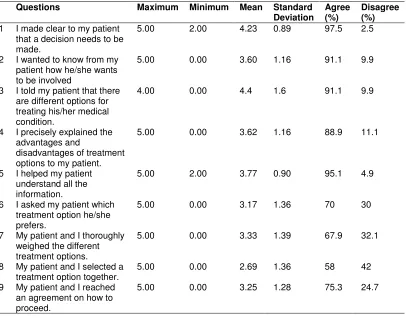
Approximately 97% of physicians declared they make clear to their patients the necessity of making a medical decision. Almost 90% agreed that they would like to know how their patient wants to be involved in the process of shared decision making. Likewise, 90% said that they explain different treatment options to their patients and 89% believed that they explain the advantages and disadvantages of different options to their patients. Most of the doctors (94%) agreed that they help their patients to understand all the information related to their health problem. On the other hand, 30% of physicians declared that they disagree about asking the patients about their treatment preferences and 32% were unlikely to have patients weigh different treatment options. Interestingly, 42% indicated that they select the final decision alone, not with their patients, and 25% do not reach an agreement with their patients on how to proceed in the process of treatment (Table 2).
Table 2. Questions and scores noted by participants for each question
Questions Maximum Minimum Mean Standard Deviation
Agree (%)
Disagree (%) 1 I made clear to my patient
that a decision needs to be made.
5.00 2.00 4.23 0.89 97.5 2.5
2 I wanted to know from my patient how he/she wants to be involved
5.00 0.00 3.60 1.16 91.1 9.9
3 I told my patient that there are different options for treating his/her medical condition.
4.00 0.00 4.4 1.6 91.1 9.9
4 I precisely explained the advantages and
disadvantages of treatment options to my patient.
5.00 0.00 3.62 1.16 88.9 11.1
5 I helped my patient understand all the information.
5.00 2.00 3.77 0.90 95.1 4.9
6 I asked my patient which treatment option he/she prefers.
5.00 0.00 3.17 1.36 70 30
7 My patient and I thoroughly weighed the different treatment options.
5.00 0.00 3.33 1.39 67.9 32.1
8 My patient and I selected a treatment option together.
5.00 0.00 2.69 1.36 58 42
9 My patient and I reached an agreement on how to proceed.
4. DISCUSSION
T
his study evaluated physicians’ points of view on shared decision making (SDM) in a developing country by adapting the English version of SDM-Q-Doc scale to the Persian language. To our best of knowledge, this questionnaire is the first valid scale assessing physicians’ perspectives on SDM in developing countries. In the adaptation phase, the instrument showed an acceptable level of internal consistency and a good level of reliability of the questionnaire. In the implementation, phase physicians showed positive attitudes towards SDM generally (with 74.40% level of perceived SDM) but their perspectives in different stages of SDM, as defined by Heghland and colleagues (2012) [13] (information dissemination, formulation of options, and integration of information and control), were different.Studies evaluating physicians’ points of view on SDM reported positive attitudes of physicians toward shared decision making in general. Some of these studies provide stages [13] and special frameworks [4] for SDM process. A study by Charles et al. discussed SDM in four models: paternalistic (in which the physician is the only decision maker); some sharing (in which the physician shares information with patients but ignores their views when making the final treatment option; informed (the physician shares information and the patient decides about the treatment option); and shared (in which the physician shares the information with the patient and they make the final decision together). In the study, Charles et al. found that 93% of physicians agreed with a shared approach, 28.2% agreed with some sharing, 26.8% with the informed approach, and 5.3% with the paternalistic approach [4,14]. In another study, Heghland et al. assessed physicians’ perspectives on different stages of shared decision making [13]. This study showed that 80% of physicians agreed with sharing information but only 65% and 70% of them agreed in formulation of options and control process, respectively, when assessing physicians’ attitudes toward involving patients in choosing the final treatment option. These studies were performed in developed countries, where positive points of view on SDM are expected due to a high level of literacy in their societies and SDM implementation by physicians is much easier than in developing countries. Other studies report the influence of culture in the SDM process [11,12,15].
Although there is a difference in culture and level of literacy in Iran’s society, fortunately Iranian physicians’ points of view on SDM were positive and their perspective in different stages of SDM were similar to Western countries—with 94% of physicians agreeing with an information exchange and 68% agreeing that physicians should involve patients in selecting a treatment option. We attributed this similarity to an educational system for Iranian physicians similar to that in the West, bringing better information to Iranian physicians on SDM.
5. CONCLUSION
It can be concluded that the Persian version of SDM-Q-DOC is a valid and reliable questionnaire that can be implemented in health care systems to assess SDM from the physician’s view. Iranian physicians had a positive view of SDM, but they were more likely to disseminate information to their patients than involve them in choosing the treatment option.
CONSENT
At the beginning of the study, the aims and scopes of the research were explained to all physicians and according to the nature of the study design, their acceptance for filling the forms was counted as informed consent.
ETHICAL APPROVAL
The local ethical committee of Tabriz University of Medical Sciences approved the research proposal. All authors hereby declare that the study has been performed in accordance with the ethical standards laid down in the 1964 Declaration of Helsinki.
ACKNOWLEDGMENTS
The study is granted by Iranian EBM Center of Excellence, Tabriz University of Medical Sciences, and their great support is appreciated. In addition we would like to thank the physicians, hospital administrators and staff who helped us during the study process.
COMPETING INTERESTS
Authors have declared that no competing interests exist.
REFERENCES
1. Kon AA. The shared decision-making continuum. JAMA. 2010;304(8):903-4. PMID:20736477
2. Braddock CH. The emerging importance and relevance of shared decision making to clinical practice. Med Decis Making. 2010;30(5 suppl):5S-7S. PMID: 20881148. 3. Gravel K, Légaré F, Graham ID. Barriers and facilitators to implementing shared
decision-making in clinical practice: A systematic review of health professionals' perceptions. Implement Sci. 2006;1(1):16. PMID: 16899124.
4. Charles C, Gafni A, Whelan T. Shared decision-making in the medical encounter: What does it mean? (or it takes at least two to tango). Soc Sci Med. 1997;44(5):681-92. PMID: 9032835.
5. Charles C, Gafni A, Whelan T. Decision-making in the physician–patient encounter: revisiting the shared treatment decision-making model. Soc Sci Med. 1999;49(5):651-61. PMID:10452420
6. Braddock IC, Edwards KA, Hasenberg NM, Laidley TL, Levinson W. Informed decision making in outpatient practice: Time to get back to basics. JAMA. 1999;282(24):2313-20. PMID:10612318
8. Guimond P, Bunn H, O’Connor AM, Jacobsen MJ, Tait VK, Drake ER, et al. Validation of a tool to assess health practitioners’ decision support and communication skills. Patient Educ Couns. 2003;50(3):235-45. PMID: 12900093.
9. Scholl I, Kriston L, Dirmaier J, Buchholz A, Härter M. Development and psychometric properties of the Shared Decision Making Questionnaire – physician version (SDM-Q-Doc). Patient Educ Couns. 2012;88(2):284-90. PMID: 22480628.
10. Kriston L, Scholl I, Hölzel L, Simon D, Loh A, Härter M. The 9-item Shared Decision Making Questionnaire (SDM-Q-9). Development and psychometric properties in a primary care sample. Patient Educ Couns. 2010;80(1):94-9. PMID: 19879711.
11. Charles C, Gafni A, Whelan T, O’Brien MA. Cultural influences on the physician– patient encounter: The case of shared treatment decision-making. Patient Educ Couns. 2006;63(3):262-7. PMID: 17000073.
12. Moazam F. Families, Patients, and Physicians in Medical Decisionmaking: A Pakistani Perspective. Hastings Cent Rep. 2000;30(6):28-37. PMID: 11475993.
13. Heggland L-H, Mikkelsen A, Ogaard T, Hausken K. Measuring patient participation in surgical treatment decision-making from healthcare professionals' perspective. J Clin Nurs. 2013:n/a-n/a.
14. Charles CA, Whelan T, Gafni A, Willan A, Farrell S. Shared treatment decision making: what does it mean to physicians? J Clin Oncol. 2003;21(5):932-6. PMID: 12610196.
15. Koenig HG. Religion, spirituality, and medicine: research findings and implications for clinical practice. South Med J. 2004;97(12):1194-200. PMID: 15646757.
16. Murray E, Pollack L, White M, Lo B. Clinical decision-making: physicians' preferences and experiences. BMC Fam Pract. 2007;8(1):1-10.
© 2014 Ebrahimi et al.; This is an Open Access article distributed under the terms of the Creative Commons Attribution License (http://creativecommons.org/licenses/by/3.0), which permits unrestricted use, distribution, and reproduction in any medium, provided the original work is properly cited.
Peer-review history:
The peer review history for this paper can be accessed here: