RESEARCH ARTICLE
TWO STAGE MULTI-RATE ASYNCHRONOUS SUB-NYQUIST SAMPLING
IN COGNITIVE RADIOS
* Sabitha R.
Department of ECE, Sri Krishna Coll. of Eng. & Technol., Coimbatore, India
ARTICLE INFO
ABSTRACT
Multi-rate asynchronous sub-Nyquist sampling (MASS) followed by a two stage sensing scheme for cognitive radios where energy detection is used in the first stage and cyclostationary detection in the second stage is proposed. The detection parameters in both the stages are used s to maximize Probability of detection and to minimize the probability of false alarm. Compared to previous approaches, two-stage MASS offers lower sampling rate, robust against lack of time synchronization, more accuracy and is more robust to fading environments. Also it is an attractive approach for cognitive radio networks.
Copyright © 2014 Sabitha R. This is an open access article distributed under the Creative Commons Attribution License, which permits unrestricted use, distribution, and reproduction in any medium, provided the original work is properly cited.
INTRODUCTION
The economical problem with fixed spectrum assignment policy has the suboptimal use of spectrum resource leading to overutilization in some bands and under utilization in others [2-4].This observation has lead to the recent spectrum reforms by the U.S. Federal Communication Commission (FCC). The Dynamic Spectrum Access (DSA) for enhanced spectrum utilization for adaptive networks is achieved via the CR[5,6]. CR is an emerging wireless communication technology aims at using DSA to allow the unused, licensed TV frequency spectrum to be used by unlicensed users on a non-interfering basis[7,10]. Cognitive radio (CR) is one of the promising solutions for addressing this spectral under-utilization problem [1]. In [8], Y.-C. Liang, K.-C et al. provided systematic overview of CR networking at the physical and MAC layers. In [9], S. Chaudhari et al. introduced computationally efficient signal system schemes for multicarrier based primary user signal. In [12] H. Sun et al. exposed a point that CR with a broader spectral awareness could potentially explain more spectral opportunities and achieve greater capacity. In [13] Z. Tian et al. Wavelet based detection and in [14] Z. Quan S. multiband joint detection was specified for sensing wideband spectrum. The addition of [13] is that the flexibility in adapting to a dynamic wide band spectrum. The advantage is that it performs well when applied to practical conditions. In [11] E. Axell et al. defined the concept of CR to explain the underutilized spectral resources
*Corresponding author: Sabitha R.
Department of ECE, Sri Krishna Coll. of Eng. & Technol., Coimbatore, India
of reusing unused spectrum in an opportunistic manner and creates awareness about the existence of PU in a given geographical area. In [16] B. Farhang et al.proposed a filter band method and in [17] D. Donoho, and in [18] E. Candes et al. proposed compressive signal reconstruction from in complete to implement wide band SS. Also in [19-21] and in [17-24] and in [23] the authors developed a cooperative approach to wideband SS using compressive sampling mechanism. In [25] H. Sun et al. defined the approximation of the average probability of detection over a slow fading channel. All the above mentioned techniques (samples the transmitted signal at operation) use sub Nyquist sampling rates. In this paper we develop a new combined two-stage MASS applied to wideband spectrum sensing. The proposed combined MASS differs from [28] in two ways. First in [28], after spectral reconstruction of compressive sampling only the traditional energy detection technique is used. But in this proposed method detection is accomplished by both energy detection and cyclostationary detection. Second, accuracy in sensing the spectrum is measured in terms of FFT size and down sampling factor. Hence, combined MASS or two-stage MASS can be used interchangeably. The proposed two stage MASS system has superior compression capability compared with the Nyquist sampling system. Compared with existing wideband spectrum sensing approaches ,the new combined two-stage MASS has lower implementation complexity, higher energy efficiency, better data compression capability, show good accuracy and is more applicable to CR networks. The rest of the paper is organized as follows. We briefly introduce the CS-based sensing scheme in Section II. We then propose the MASS system in Section III. Simulation results
ISSN: 0976-3376
Asian Journal of Science and Technology Vol. 5, Issue 7, pp. 378-383, July, 2014SCIENCE AND TECHNOLOGY
Article History: Received 06th April, 2014
Received in revised form 28th May, 2014
Accepted 04th June, 2014
Published online 31st July, 2014
are presented in Section IV, followed by conclusions in Section V.
Problem Statement
The assumptions used in this paper are 1)all CRs keep quiet during the spectrum sensing interval as enforced by protocols, e.g., at the medium access control (MAC) layer. Therefore, the observed signal at a CR arises only from PUs and background noise. 2) The continuous time signal
x
c(t
)
is received at a CR, and the frequency range ofx
c(t
)
is0
~
W
(
Hz
)
. The signalx
c(t
)
is sampled at the sampling ratef
s(Hz
)
for an observation timeT
.The discrete Fourier transform (DFT)spectrum of it can be calculated by
X
F
x
,
whereF
denotes an
N
-by-N
DFT matrix If Shannon-Nyquistsampling theorem is followed, the sampling rate needs to be at least twice the bandwidth of the signal, i.e.,
f
s
2
W
which results in excessive memory requirements and prohibitive energy costs. To overcome these disadvantages the researchers have to search for technologies to reduce the sampling rates
f
while maintainingW
by using CS theory. First stage of spectrum sensing approach is spectral domain energy detection. As shown in Fig. 1, this approach extracts thereconstructed spectrum
X
in the frequency range of interest, e.g.,
f
, and then calculates the signal energy in the spectral domain. The output energy is compared with a detection threshold (denoted by
ᵞ) to decide whether the corresponding frequency band is occupied or not, i.e., choosing between hypothesesH
1(presence of PUs) andH
0(absence of PUs). In the second stage of cyclostationary detection the FFT of the received signal is used to decide the presence (H1) or absence (H1) of Pus. In this paper, we will present a novel system, i.e., two-stage MASS, to sample the signal using sub-Nyquist sampling techniques, while enabling the detection to be more accurate even at low SNR with two-stage detection.System and Signal Model
Suppose that a CR has
v
sub-Nyquist sampling branches as shown in Fig. 2.The spectrum of interest is taken from the output of wideband filter with bandwidth W. At thei
-th branch, the low-rate sampler samples the received signal at thesub-Nyquist rate
f
i(Hz
)
. In the observation timeT
(second), the numbers of samples in these
v
sampling branchesare
M
1,
M
2,
,
M
v, respectively where Mi fiT(i[1,v]).In addition,
M
1,
M
2,
,
M
vare chosen to be differentprime numbers that are of the order of
N
,i.e.,)
(
~
N
M
i
, by controlling the sampling rate])
,
1
[
(
i
v
f
i
. The DFT spectra are used to reconstruct thewideband spectrum. Suppose that the received signal
x
c(t
)
is of finite support and absolutely summable. Using thesub-Nyquist rate
f
i
2
W
, we obtain the sampledsignal
[
]
MmT,
0
,
,
i
1
c f m c
i
m
x
x
m
M
y
i
i
. TheDFT spectrum of
y
i is then calculated byY
iF
sy
i
, wheres
F
denotes theM
i-by-M
i DFT matrix. The DFT spectrum ofy
i is related to the continuous-time Fourier transform ofx
c(t
)
by)
(
)
(
f
fi
Xc
f
lfi
Yi
t
(1)
Where
x
t
e
dt
f
X
c(
)
c(
)
j2tf is the Fourier transformof
x
c(t
)
Furthermore, if
x
c(t
)
is sampled at or above the Nyquist rate,i.e.,
f
TNW
s
2
, the sampled signal can bewritten as
x
[
n
]
x
c(
nf)
x
c(
nTN),
n
0
,
1
,
,
N
1
.
s
Thespectrum of
x
will be related to the continuous-time Fouriertransform of
x
c(t
)
by
l c s
s
X
f
lf
f
f
X
(
)
(
)
. Asthe signal
x
c(t
)
is band-limited toW
and the sampling ratef
s
2
W
, there will be no spectral aliasing phenomenain
X
( f
)
; thus, we can rewrite this relationshipby
(
)
(
),
W2,
W2
c
s
X
f
f
f
f
X
. BecauseX
( f
)
has allinformation in
W2,
W2
, we assume thatX
( f
)
is zeroeverywhere except
f
W2,
W2
. Substituting)
(
)
(
f
f
X
f
X
s c into, we can obtain.
lW
W
fi
f
lfi
f
X
fs
fi
f
Yi
2
,
2
),
(
)
(
, (2)
lN
N
lMi
m
lMi
m
X
N
Mi
m
Yi
2
,
2
],
[
]
[
, (3)
X
[
n
]
[
n
(
m
lMi
)],
N
Mi
l l
2
,
2
i iM
M
m
(4)Where
a
is the floor function that gives the largest integer not greater than a, and
n
denotes the Dirac delta function that is zero everywhere except at the origin, where it is one. In matrix form, we writeX
N
M
Y
i ii
, (5)Where the elements of
i
R
MiN(
M
i
N
)
can berepresented by
l i N Mi
m
n
n
m
lM
i
1
,
1
22 .
Multi-Rate Asynchronous Sub-Nyquist Sampling
Due to the sub-Nyquist sampling in each sampling branch, we have to consider the effects of spectral aliasing. Even then, when the spectral sparsity
k
N
and the sampling ratesatisfy
M
i~
O
(
N
)
, the probability of signal overlap is very small [28]. In such case, consider two cases: no signal at a particular valuem
and one signal atm
. For a signal to be non- overlapped, the following equation has to be satisfied:X
N
M
X
N
M
Y
i ii i i
, (6)The elements of
i are either zeros or ones, hence each frequency bin ofY
i has no signal overlap fromX
.The proposed system doesn’t require exact synchronization between sub-Nyquist samplers. The time offset between sampling branches need to be sufficiently small. Because energy detection is used in the first stage for spectrum recovery, there is an advantage of applying the proposed technique to co-operative CR networks with same spectral environments. For successful spectrum reconstruction Mutual
coherence [17]
to be minimum N l z
z
l
max
ˆ
,
ˆ
, 1
(7)Mutual coherence of the measurement matrix
atv
samplesis given by,
Fig.2. Schematic Illustration of the Two-stage Multirate Asynchronous sub-Nyquist sampling system in one CR node
v
z l z l1
ˆ
,
ˆ
max
, (8)When
2k11, thek
-sparse signal can be successfully recovered. Thus, we know that if
1v
2k11, i.e.,1
2
k
v
, the spectral magnitudeX
can be exactlyreconstructed. The number of sampling branches
1
2
k
v
in order to reconstruct the spectrum. Sensing erroris also been calculated as the ratio of addition of difference between the estimated spectrum and the actual spectrum in both upper and lower bounds and the difference between the upper and lower bands.
Simulation Results
It is assumed that there are
v
sub Nyquist sampling branches used for sampling the received signalx
c(t
)
at various sub Nyquist rates. In thei
th sampling branch the received signal denoted asx
c(t
)
is sampled at sub Nyquist ratef
i, and is deserved for time T.x
c(t
)
is denoted as,
t
E
B
c
B
t
f
t
z
t
x
lN
l
l l
l c
b
2
cos
*
sin
*
1
(9)
Where
sin
c
(
x
)
sin(xx),
denotes a random time offsetbetween sampling branches, and
z
(t
)
is unit additive whiteGaussian noise (AWGN). The received power
E
ldon’tchange for the entire T but vary randomly from branch to branch. We assume there are
N
b
30
non-overlapping sub bands, whose bandwidthsB
l
0
.
5
~
5
MHz
, with carrierfrequencies
f
l
0
~
20
GHz
. Here fix u=23 samplingbranches with different sub Nyquist rates
M
i~
O
(
N
)
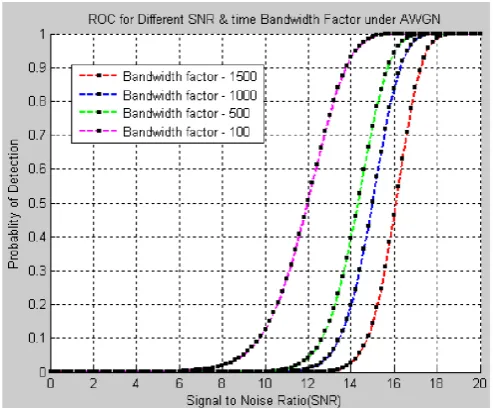
. After reconstruction using (7) the presence or absence of user is decided by combined energy detection and cyclostationary detection. Fig.4. depicts the Receiver Operating characteristic curve for Probability of detection at various SNR for fixed bandwidth factors. Fig.5. shows the effect of sparsity level kand the compression ratio
v M N
M
v
i i
M
1on the detection
performance.
From the fig it is inferred that lower the sparsity level better is the detection performance. Also fig depicts that the higher the compression ratio lower is the probability of false alarm and higher is the probability of detection. Fig.6. shows the comparison of MSE reconstruction of the spectrum for the compression ratio below 0.25 the proposed combined MASS can achieve smaller MSE when compared to both CS based approach and the future rate of innovation approach. Fig.7. shows the effect of lack of synchronization between sampling branches, time effects considered here is the range 0~0.8
sFig.4. Receiver Operating characteristic curve for Probability of detection at various SNR for fixed bandwidth factors
Fig 5. Shows the influence of sparsity level k and the compression ratio on the detection performance of Combined MASS with
average SNR=10Db
Fig.6. Comparison between the proposed system and the existing approaches in terms of MSE reconstruction of the spectrum and
Fig.7. Comparison of spectrum recovery performance of synchronous samplers and asynchronous samplers with Nb=40
and Nb=50 over AWGN channels with average SNR=10dB
Fig.8. The detection performance of combined MASS over AWGN and Rayleigh fading channels with the number of
subbands Nb=30
Fig.9. The detection performance of combined MASS as a function of SNR at different sensing times 80us and 160 us when
the downsampling factor L=20
and the observation time is
s. From the figure it is inferred that the both the asynchronous and synchronous samplers perform similarly when detection is considered. Fig illustrates that as the number of sampling branches increases better spectrum sensing performance can be achieved. Because with more sampling branches a higher accuracy in spectrum recovery can be obtained. Fig.8 shows the detection performance of combined MASS over AWGN and Rayleigh fading channels. When signal to noise ratio is zero decibels (db) detection performance of combined MASS over fading channels, is roughly as same as non-fading AWGN channels. This is because the strength of the signal is mostly masked by noise. Also, the detection performance of combined MASS over AWGN channel is better than that of fading channel when SNR=5db. Fig. also shows that the performance of combined MASS over Rayleigh fading channel is poorer in comparison to the case of AWGN channel.We provide a simulation setup for calculating sensing time by varying the down sampling factor. We assume that there are M=5 sub bands in the frequency range (0, fmax) = [0, 1.0]GHz.
hence the nyquist rate is fmax =1/To=1GHz.the bandwidth of
each sub band are 5MHz.The down sampling factor is chosen
as L=20,corresponding to the Sub-Nyquist rate of
1/LTo=75MHz(>Bmax=5MHz). FFT size considered here is
N=12000 and 24000 corresponding to the sensing time Z=NLTo =80us and 160 us. Fig.9.depicts the detection performance of combined MASS as a function of SNR at different sensing times 80us and 160 us when the downsampling factor L=20.From the figure it is inferred that longer sensing time leads to improved sensing accuracy hence reduced sensing error. A similar system possessing the same performance is CS based system. But the disadvantage of CS based approach is that it requires pseudo random sequence generator as compression devices at the each CR node. Also lack of synchronization leads to false spectral recovery. But for two-stage MASS no separate device is required for generating measurement matrix and the synchronization requirements also relaxed. The spectral recovery and robustness against fading is improved in combined MASS even at very low SNR with slight increase in implementation complexity which is contributed by cyclostationary detector.
Conclusion
In this paper, we have proposed a two-stage wide band SS system i.e. two stage MASS. The basic procedure of sampling the wide band SS at different sub Nyquist rates by parallel low rate sampler is accomplished followed by spectrum recovery and detection by energy detection and cyclostationary detection. The prior knowledge needed is an upper bound on the number of sampling branches and the frequency range of interest CS based spectrum recovery is followed. Simulation results have shown that improved MASS has outstanding compressive capability compared with Nyquist sampling system. Compared with other available sub Nyquist sampling system of CS based system the two-stage MASS has been seen to be against lack of synchronization and have superior performance in AWGN and Rayleigh fading scenarios.
REFERENCES
[1] J. Mitola and G. Maguire, “Cognitive radio: making software radios more personal,” IEEE Personal
[2] F.C.C., ”Spectrum policy task force,” IEEE Trans. Inf.
Forens. Security, pp. 02-155,Nov 2002.
[3] F.C.C., “In the matter of unlicensed operation in the TV broadcast bands,” Second Report and order and
Memorandam opinion and Order, no. FCC-08-260A1,
Nov.2008.
[4] C. Bazelon, “Licensed or unlicensed: The economic
considerations in increment spectrum allocations,” New Frontiers in Dynamic Spectrum Access Networks, 2008
DySPAN 2008. 3rd IEEE Symposium on, pp1-8, Oct.
2008.
[5] Mitola, J., I. and J.Maguire, G.Q., “Cognitive Radio: making software radios more personal,” IEEE Pers.,
Commun. Vol6, no 4,pp. 13-18, Aug. 1999.
[6] I.F. Akyildiz, W.Y. Lee, M.C. Vuran, and S.Mohanty,
“Nextgeneration/dynamic spectrum access/Cognitive
radio Wireless Networks: a Survey,” Comput. Netw., vol 50, no.13, pp.2127-2159, 2006
[7] C.R. Stevenson, G. Chouinard, Z. Lei, W.Hu, S.J.
Shellhammer, and W. Caldwell, IEEE 802.22: The first cognitive radio wireless regional area network standard,”
IEEE Commun. Mag., Jan 2009.
[8] Y.-C. Liang, K.-C. Chen, G. Y. Li, and P. Mahonen, “Cognitive radio networking and communications: An overview,” IEEE Trans. Veh. Technol., vol. 60, no. 7, pp. 3386–3407, Sep. 2011.
[9] S. Chaudhari, V. Koivunen, and H.V. Poor,
“Autocorrelation-based decentralized sequential
detection of OFDM signals in cognitive radios,” IEEE
Trans. Signal Process., vol. 57, no. 7, pp. 2690–2700,
Jul. 2009.
[10] Md. AliHussain, Md. Mastan and Syed Umar, “Quality of Service Issues in Wireless Ad-Hoc Network (IEEE 802.11B)”, International Journal of Computer Science &
Information Security (IJCSIS), Vol.8 No.3 June 2010,
ISSN: 1047 – 5500.
[11] E. Axell, G. Leus, E. G. Larsson, and H. V. Poor, “Spectrum sensing for cognitive radio: State-of-the-art and recent advances,” IEEE Signal Process. Mag., vol. 29, no. 3, pp. 101–116, May 2012.
[12] H. Sun, A. Nallanathan, J. Jiang, D. Laurenson, C.-X. Wang, and H. Poor, “A novel wideband spectrum sensing system for distributed cognitive radio networks,” in Proc.
IEEE Global Telecommun. Conf., Houston, TX, Dec.
2011, pp. 1–6.
[13] Z. Tian and G. Giannakis, “A wavelet approach to wideband spectrum sensing for cognitive radios,” in
Proc. IEEE Cognitive Radio Oriented Wireless Netw. Commun., Mykonos Island, Greece, Jun. 2006, pp. 1–5.
[14] Z. Quan, S. Cui, A. H. Sayed, and H. V. Poor, “Optimal
multiband joint detection for spectrum sensing in cognitive radio networks,” IEEE Trans. Signal Process., vol. 57, no. 3, pp. 1128–1140, Mar. 2009.
[15] Z. Quan, S. Cui, A. H. Sayed, and H. V. Poor,
“Wideband spectrum sensing in cognitive radio networks,” in Proc. IEEE Int. Conf. Commun., Beijing, China, May 2008, pp. 901–906.
[16] B. Farhang-Boroujeny, “Filter bank spectrum sensing for
cognitive radios,” IEEE Trans. Signal Process., vol.56, no.5, pp.1801–1811, 2008.
[17] D. Donoho, “Compressed sensing,” IEEE Trans. Inf.
Theory, vol. 52, no. 4, pp. 1289–1306, Apr. 2006.
[18] E. Candes, J. Romberg, and T. Tao, “Robust uncertainty
principles: Exact signal reconstruction from highly incomplete frequency information,” IEEE Trans. Inf.
Theory, vol. 52, no. 2, pp. 489–509, Feb. 2006.
[19] H. Sun, A. Nallanathan, J. Jiang, and H. V. Poor, “Compressive autonomous sensing (CASe) for wideband spectrum sensing,” in Proc. IEEE Int. Conf. Commun., Ottawa, Canada, Jun. 2012, pp. 5953–5957.
[20] Z. Tian and G. Giannakis, “Compressed sensing for wideband cognitive radios,” in Proc. IEEE Int. Conf.
Acoust., Speech, Signal Process., Honolulu, HI, Apr.
2007, pp. 1357–1360.
[21] Y. Polo, Y. Wang, A. Pandharipande, and G. Leus, “Compressive wide-band spectrum sensing,” in Proc.
IEEE Int. Conf. Acoust., Speech, Signal Process., Taipei,
Taiwan, Apr. 2009, pp. 2337–2340.
[22] F. Zeng, C. Li, and Z. Tian, “Distributed compressive spectrum sensing in cooperative multihop cognitive networks,” IEEE J.Sel. Topics Signal Process., vol. 5, no. 1, pp. 37–48, Feb. 2011.
[23] F. Zeng, Z. Tian, and C. Li, “Distributed compressive wide band spectrum sensing in cooperative multi-hop cognitive networks,” in Proc. IEEE Int. Conf. Commun., Cape Town, South Africa, May 2010, pp. 1–5.
[24] Z. Tian, E. Blasch, W. Li, G. Chen, and X. Li, “Performance evaluation of distributed Compressed wideband sensing for cognitive radio networks,” in Proc.
Int. Conf. Inf. Fusion, Cologne, Germany, Jul. 2008, pp.
1–8.
[25] H. Sun, D. Laurenson, and C.-X. Wang,
“Computationally tractable model of energy detection performance over slow fading channels,” IEEE
Commun. Lett., vol. 14, no. 10, 9 pp.924–926, Oct. 2010.
[26] W. A. Gardner, Statistical Spectral Analysis: A
Nonprobabistic Theory. Upper Saddle River, NJ:
Prentice-Hall, 1986.
[27] D. L. Donoho and M. Elad, “Optimally sparse
representation in general (nonorthogonal) dictionaries via
minimization,” Proc. Nat. Acad.Sci. USA, vol. 100, no. 5, pp. 2197–2202, 2003.
[28]` Hongjian Sun, Wei-Yu Chiu, Jing jiang, Srumugam
Nallanathan and H.Poor, “Wideband Spectrum sensing with sub-Nyquist sampling in Cognitive Radios” IEEE
Transactions on Signal Processing, vol.60, no.11,
pp.6068-6073, Nov-2013.