112 | P a g e
Design, Analysis, Manufacturing and Testing of Mono Composite
Leaf Spring Using UD E-Glass Fiber/Epoxy
Mr. Akshay Kumar
1, Mr. V. J. Shinde
2, Mr. S. S. Chavan
3 1PG Student, Department of Mechanical Engineering2
Associate Professor, Department of Mechanical Engineering
3Research Scholar, Department of Production Engineering
Bharti Vidyapeeth Deemed University College of Engineering, Pune (India)
ABSTRACT
Composite materials have attracted all researchers due to its light weight and high strength. Today’s need of
manufacturing industries is to make the automobiles fuel efficient. Considering this view we have manufacture
glass epoxy mono composite leaf spring. This mono composite leaf spring will reduce 77% weight as compared
to steel leaf spring. Statistical calculations and FEA analysis is reported in this paper. Advance polymer
composite in specific.
Keywords--Composite Material, Fea, Leaf Spring, Static Analysis, Suspension System
1.
INTRODUCTION
In automobile industry increasing innovations and development of the product tend to replace material, optimize
design & better manufacturing process. Now days automobile sector replace conventional metal alloys to
composite material for weight reduction as well as fuel consumption. It is possible to replace composite material
to have desired material property. Leaf spring is an automobile part using suspension system. One of the
purposes of the leaf springs is to bear the weight of the vehicle and control the vehicle so that the tires keep in
contact with the road. The leaf springs absorb all the bumps and dips in the road, thus providing a more
comfortable ride for the vehicle's occupants. But steel leaf springs have unsprang weight. So we have developed
E-glass/epoxy mono composite leaf spring to reduce weight up to 77% with increase driving reliability come
greater suspension.
1.1
Suspension System
The leaf spring suspension system is the oldest suspension system used for automobile device. The leaf spring
system was used from 1970s production cars and many racers even prefer to utilize the leaf spring rear
suspension design in their fabricated late model stock and modified race cars. The leaf spring supports some or
all of the chassis weight and controls chassis roll more efficiently. Control axle dampening andbraking forces.
Better maintaining wheelbase lengths under acceleration and braking.
1.2
Composite Material
A composite is a structural material which consists of combining two or more constituents. The constituents are
combined at a macroscopic level and are not soluble in each other. One constituent is called the reinforcing
113 | P a g e
aerospace industries, but now a days also use in automobile industries. Advance composite materials are
Carbon, Graphite, Kevlar and Glass fiber with suitable matrixes is widely used because of their higher specific
strength & higher specific modulus. Composite leaf springs are a fairly new component in racing that has been
further refined recently. They are made of unidirectional E-glass fiber/epoxy composite material instead of steel.
It has good mechanical properties for required design.
1.3
Mono Composite Leaf Spring
In this paper we have replaced conventional steel leaf spring which has unsprung weight into light weight
material unidirectional E-glass fiber/epoxy composite material. The glass/epoxy composite leaf springs fatigue
lives have five times more durable than steel leaf springs. It’s also gives a smoother ride than steel leaf springs
& also gives more rapid response to stress cause by road shock. Moreover, it is offer less chance of catastrophic
failure and has excellent corrosion resistance.
2.
DESIGN PARAMETER AND MATERIAL PROPERTIES
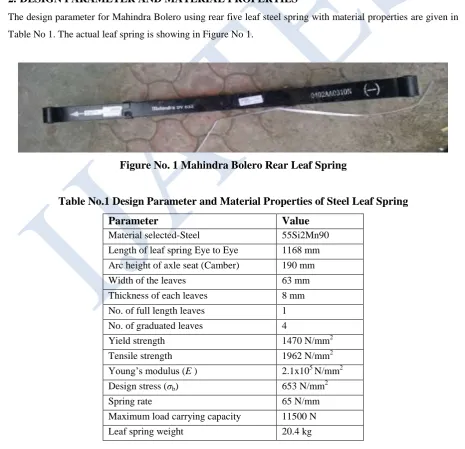
The design parameter for Mahindra Bolero using rear five leaf steel spring with material properties are given in
Table No 1. The actual leaf spring is showing in Figure No 1.
Figure No. 1 Mahindra Bolero Rear Leaf Spring
Table No.1 Design Parameter and Material Properties of Steel Leaf Spring
Parameter
Value
Material selected-Steel 55Si2Mn90
Length of leaf spring Eye to Eye 1168 mm
Arc height of axle seat (Camber) 190 mm
Width of the leaves 63 mm
Thickness of each leaves 8 mm
No. of full length leaves 1
No. of graduated leaves 4
Yield strength 1470 N/mm2
Tensile strength 1962 N/mm2
Young’s modulus (E ) 2.1x10⁵ N/mm2
Design stress (σb) 653 N/mm2
Spring rate 65 N/mm
Maximum load carrying capacity 11500 N
114 | P a g e
The dimensions are measured from Mahindra service center and material properties are taken from the research
paper [3].
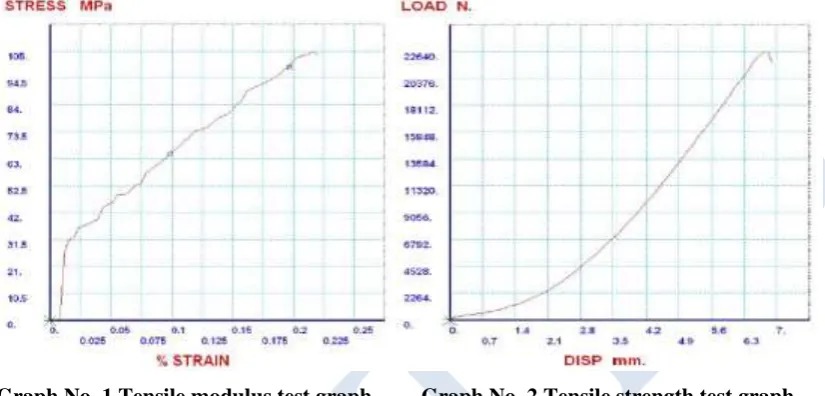
This steel leaf spring replaces to mono composite (UD E-glass fiber 92145/epoxy 5015) leaf spring. This
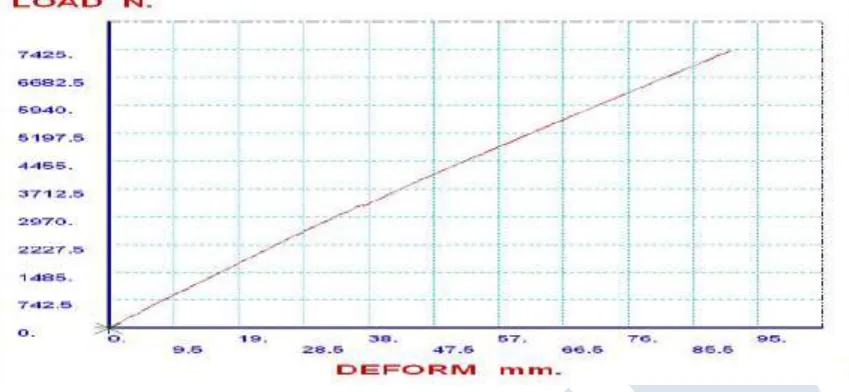
composite material is tested tensile modulus and tensile strength in laboratory; it is shown in Graph No 1 and 2.
Design parameter and there material properties are given in Table No-2.
Graph No. 1 Tensile modulus test graph. Graph No. 2 Tensile strength test graph
Table No.2 Design Parameter and Material Properties of Composite Leaf Spring
Parameter Value
Material selected– UD E-glass/epoxy 92145/5015
Tensile modulus of fiber along X-axis 76000 N/mm2
Tensile modulus of matrix along X-axis 2800 N/mm2
Weight ratio 0.607/0.393
Young’s modulus (Ex) 33547.79 N/mm2
Tensile strength 395.16 N/mm2
Length of leaf spring Eye to Eye 1168 mm
Arc height at axle seat (Camber) 180 mm
Width of the leaves 60 mm
Thickness at base (tb) 36 mm
Thickness at end (te) 16 mm
3.
STATISTICAL CALCULATIONS OF LEAF SPRING(STEEL & COMPOSITE)
3.1
Steel Leaf Spring
Leaf spring is the type of cantilever beam, it is simple rectangle shape. One side force is applied and other side
115 | P a g e
,
3.1.1
Laminated spring
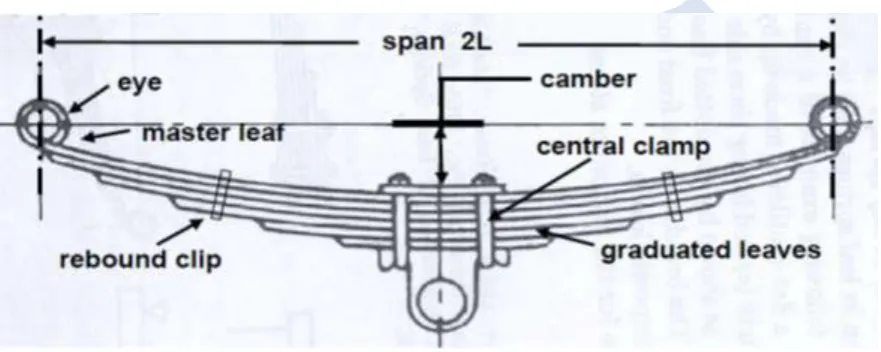
The difficulties of the uniform strength beam, say lozenge shape is that the value of width b sometimes is too
large to accommodate in a machine assembly.One practice is that instead of keeping this large width one can
make several slices and put the pieces together as a longitudinal stripe.
Figure No. 2 Laminated Semi-elliptic spring
To prove that stress developed in the full length leaves is 50% more at the graduated leaves. The stress ratio is
= 1.5
Let
if = No. of full length leaves
ig = No. of graduated leaves including the master leaf
b = Width of each leaf
t = Thickness of each leaf
L = Length of the cantilever or half the length of the spring
F = Total force applied at the end of the spring
E = Young’s modulus
116 | P a g e
3.2Composite Leaf Spring
The minimum weight criteria in the design of automobile vehicles coupled with the ever growing use of light
polymer material that can undergo large displacements without exceeding their specified elastic limit. The mono
composite leaf spring is the type of constant width varying thickness cantilever taper beam or nonlinear beam.
So this type problem solve by Elastica Theory. The exact shape of the deflection curve of a flexible member is
called the Elastica [2].
3.2.1
The Euler-Bernoulli Law of Nonlinear Deformations for Taper beam
The flexible structural component is permitted to have any arbitrary variation in I and EI along its length. A
tapered flexible cantilever beam loaded with a vertical load (P) at its free end, y is the vertical deflection of the
member at any x and θ is rotation. The relations is
, and
Where f(x) is the moment of inertia function and g(x) is the modulus function are representing the variation of
with and with .
4.
FEA Analysis Using ANSYS(Steel & Composite)
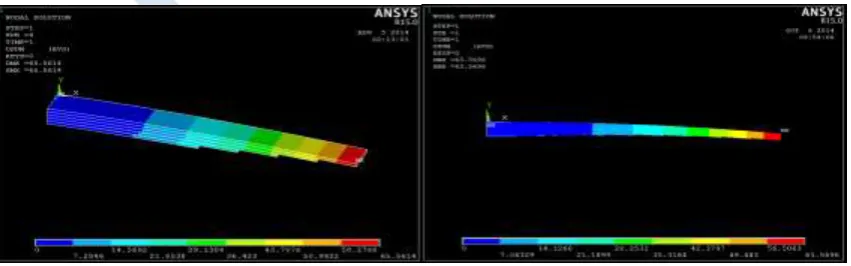
The finite element analysis (FEA) of steel leaf spring and composite mono leaf spring is carried by ANSYS 15.0
APDL. The steel leaf spring is taken as a cantilever beam type which is created in ANSYS modeling in x-y
direction after extrude in z direction. Taking element type is solid brick 8 node 185; mash size is manually
control and meshing. After meshing contact pair is create lower and upper surface. The boundary condition is
one side fixed, all DOF and another side applies forces.
For FEA analysis of composite material standard properties has been taken in Table No. 3 [3].
Figure No. 3 Compare the result steel vs. composite leaf spring, deflection vector remains
117 | P a g e
Table No. 3 The mechanical properties of E-glass/epoxy
Properties Value
Tensile modulus along X-direction(Ex) 34000N/mm2
Tensile modulus along Y-direction(Ey) 6530N/mm2
Tensile modulus along Y-direction(Ez) 6530N/mm2
Poisson ratio along XY-direction(NUxy) 0.217
Poisson ratio along YZ-direction(NUyz) 0.366
Poisson ratio along ZX-direction(NUzx) 0.217
Shear modulus along XY-direction(Gxy) 2433N/mm2
Shear modulus along YZ-direction(Gyz) 1698N/mm2
Shear modulus along ZX-direction(Gzx) 2433N/mm2
The composite leaf spring modeling is 2-D take 0.2 mm thin 180 layers of varying length in Pro-E and import in
ANSYS. Taking element type is solid Quad 4 node 182; which gives thickness. The material used UD E-glass
fiber/epoxy is orthogonal material. Before mashing, glue the thick layer. The boundary conduction is applied.
5.
MANUFACTURE PROTOTYPE MONO COMPOSITE LEAF SPRING
Mono composite leaf spring is manufactured by hand-layup open molding process in various steps. Which
areillustrated in figure No - 4 to figure No- 6.
Step-1 First prepare mold as refer design of composite leaf spring.
Figure No. 4 Wooden mold
Step-2 Take UD E-glass fiber (style-92145) sheet and cut in five different lengths.
Step-3 Takesepoxy (resin+ hardener) and other equipment’s (brush, bicker, mug).
Step-4Now arranges all the equipment before going to manufacture. This fiber is arranged in unidirectional and
epoxy is mixed with fiber.
118 | P a g e
Figure No. 5 Mono composite leaf spring
Step-6 We attach external two pieces of steel eye with require dimension and also create two holes on each steel
eye plate. Same diameter hole is created on mono composite leaf spring and another hole on support plate.
Assemble steel eyes and mono composite leaf spring with the help of nut bolt.
Figure No. 6 Mono composite leaf spring assemble
6.
TESTING COMPOSITE LEAF SPRING
The leaf spring weight test is carried out to find actual weight of composite leaf and steel eye. The total weight
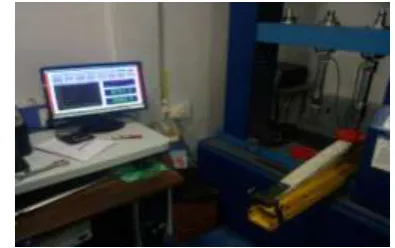
of composite leaf spring compare with steel leaf spring.The leaf spring is tested on universal testing machine in
lab. We attach the composite leaf spring in C channel, one side is fixed and other side provide 100 mm channel
height; connect with frictionless attach. Apply load gradually 50 mm/min speed under computer programming
testing software. Show the result in display.
119 | P a g e
Graph No. 3 Testing mono composite leaf spring (load vs. deflection)
7.
RESULT
The deflection, stress and stiffness are shown in Table No.4; at different load condition of steel leaf spring and
mono composite leaf spring.
Table No. 4 Steel leaf spring and composite leaf spring statistical calculations, FEA analysis and
testing reported (loadvs. deflection, stress and stiffness)
Parameter
Load
(N)
(mm)
(N/mm
2)
Stiffness
(N/mm)
Steel Analytical
2000
32.07 173.81 62.35
FEA 33.17 181.87 60.29
Composite
Analytical 29.46 87.36 67.89
FEA 31.78 91.11 62.93
Testing 22 91
Steel
Analytical
4000
64.15 347.62 62.35
FEA 65.56 367.47 61
Composite
Analytical 58.63 175 68.22
FEA 63.57 182.24 62.92
Testing 46.5 86
Steel Analytical
6000
96.23 521.43 62.34
FEA 97.44 550.74 61.57
Composite
Analytical 87.79 262 68.34
FEA 95.23 273.35 63
120 | P a g e
This Graph No 4 is shown the load vs. deflection curve; to observe that statistical calculations, FEAresult is
same and testing result is approximately same.
Graph No. 4 Load vs.deflections
Conventional steel leaf spring weight = 20.4 kg
Mono composite leaf spring weight = 4.63 kg
Weight reduction = 77.3 %
8.
CONCLUSIONS
This work involves to comparison of steel leaf spring with E-glass/epoxy mono composite leaf spring under
static load condition is observed. The same deflection with improve stiffness and weight reduction is 77.3%.
From the result, it is observed that if we mixed carbon fiber with E-glass fiber to improve strength;passible to
apply heavy weight vehicles.
REFERENCE
[1]. Autar K. Kaw - Mechanics of Composite Materials.
[2]. Demeter G. Fertis – Nonlinear static engineering.
[3]. Shiva Shankar and Vijayarangan,”Mono composite leaf springs for light weight vehicle design, End joint,
analysis and testing”, Material science Vol 12 Nov 3 2006.
[4]. I.Rajendran, S.Vijayarangan, “optimal design of composite leaf springs using genetic algorithm,” Computer
and Structure 79 (2001) 1121-1129.
[5]. U. S. RAMAKANTH & K. SOWJANYA – Design and analysis of automotive multi-leaf spring using
composite materials (IJMPERD).
[6]. Yu.W.J, Kinm.H.C,”Double Tapered FRP Beam from Automotive suspension leaf springs”, Composite
121 | P a g e
[7]. Shishay Amare Gebremeskel- Design, Simulation, and Prototyping of Single Composite Leaf Spring for
Light Weight Vehicle Volume 12 Issue 7 Versions 1.0 Year 2012.
[8]. Mr. P. B. Patole, Mr. Jeevesh Kumar (2012) Static analysis of composite mono leaf spring for LCVC Tata
ACE – Design, Manufacturing, and Testing.
[9]. Gretchen b.Murri, T.Kevin, O.Brien (1997) Fatigue life mythology for tapered composite flex beam
laminates.
[10].R. Lalitha Narayana, Ravi Kumar V, Ch. Srinivas (2013) Analysis of Natural Fiber Composite Leaf Spring
[11].B. Raghu Kumar1, R. Vijaya Prakash2* and N. Ramesh3 (2013) Static analysis of mono leaf spring with
different composite materials.
[12].Nisar S. Shaikh, S.M. Rajmane(2014) Modeling and Analysis of Suspension System of TATA SUMO by