FACE RECOGNITION IN JAVA ENVIRONMENT
1
Paras Wadhwa,
2Amanjolly,
3Virender Prajapati,
4Aditya Sharma
1,2,3,4
Computer Science & Engineering, HMRITM,GSSIPU Delhi, (India)
ABSTRACT
In today’s world, face recognition has its application in many fields incorporating: Automotive sector, image
enhancing, robotics, gaming & manufacturing.
It is an exciting field with hurdles. Such as limited hardware, poor visualisation or quality & connectivity. This
paper demonstrates a face recognition system in JAVA environment. The aim is to have high recognition rate
Keywords
:Face Recognition, Image Processing, JAVA environment, Open CV
I. INTRODUCTION
Image processing is a field that deals with manipulation of image with intent to carry out to enhance image and
to extract some useful information from it. It usually deals with treating images at 2D signals and applying
signal processing methods to them. It can be generally defined as a 3 step process starting by importing the
image. Continuing with its analysis and ending with either an alter image or an output.
Fig-1
Fig-2
II. FACE RECOGNITION TECHNIQUES
This section is about different techniques that are used in recognizing the face, detecting the face and tracking
the video object in general. It also briefly describes the algorithms available in the market for the above. We
have expressed different face recognition techniques in the tabular format in table1
Face detection is a computer technology that determines the locations and sizes of human faces in digital
images. Face tracking is an extension of face-detection when applied to a video image.
There are certain face-detection techniques which are actually Feature-based methods, which include detection
of blinking eye pattern in a video stream and template-based matching or finding the face segments by using
colour of skin as a basic parameter. In Feature based technique, features are basically the content of a given
region of an image that is transformed into features, after which a classifier trained on example faces decides
whether that particular region of the image is a face, or not.
III. IMPLEMENTATION OF FACE RECOGNITION
In this work we used JAVA programming language in our aim to develop successful face recognition with a
high recognition rate. There are various reasons for using JAVA.
We aim to develop a simple but robust and efficient system for implementation in various domains. JAVA has
various advantages over other languages and environments which is the reason for choosing it for a
programming task;
It is easy to learn, easy to use, write and compile. Furthermore it allows us to create object oriented modular
programs and usable code. Moreover the language probability feature highlights as one of the most significant
Being platform independent at source & binary level, the language help to succeed us in our aim to result a
robust system that can be implemented in JAVA. Building applications in JAVA environment. In our proposed
application we performed face detection using JAVA.
The general steps used for developing this application are as following:
1) To detect and access camera hardware if present.
2) Create a class that can display live image data. Coming from camera so that one can view or capture a
desired.
3) To develop a preview pane for the camera class that contains image source captured through camera and the
UI controls that can be used for carrying out desired operations.
4) To connect actions to the listeners interface controls to excite response to user actions such as clicking on
the pause button.
5) To save files that could be used further processing.
6) To develop a database of images that could be used a source for comparison with the image obtained from
the previous pane.
7) To develop a report generation function that generates an output report with desired contents.
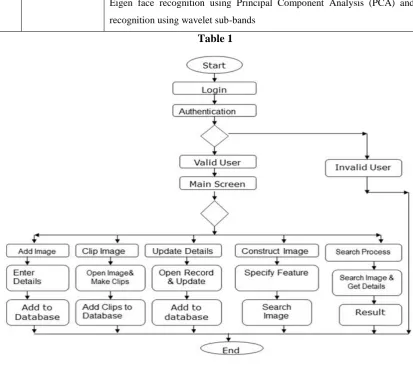
3.1 An example of face identification system implemented in java:
As a part of this research work, we have developed a prisoner detection system, application software
implementing face identification
This software is aimed to identify the criminals in any investigation department. Here the technique is we
already store some images of the criminals in our database along with his details and that images are segmented
into many slices say eyes, hairs, lips, nose, etc. These images are again stored in another database record so to
identify any criminals; eyewitnesses will see the images or slices that appear on the screen by using it we
develop the face, which may or may not be matched with our images. If any image is matched up to 99% then
we predict that he is only the criminal. Thus using this project it provides a very friendly environment for both
operator and eyewitness to easily design any face can identify criminals very easy.
It is intended to identify a person using the images previously taken. The identification will be done according
the previous images of different persons.
IV. EXISTING SYSTEM
The development of face identification has been past from the year to years. In recent years to identify any
criminal face they used to make a sketch or draw a image based on the eyewitnesses. It used to take more
amount of time and it was very difficult task for any investigation department to easily catch the criminals
within a stipulated time. In order to catch the criminals first they used to search their record whether to find out
is there any record about that particular person in the past. In olden days each and every record was maintained
in the books or registers or files which used to contain information about previous criminals with their names,
There are three major research groups, which propose three different approaches to the face recognition
problem. The largest group has dealt with facial characteristics. The second group performs human face
identification based on feature vectors extracted from profile silhouettes. The third group uses feature vectors
extracted from a frontal view of the face. The first method is based on the information theory concepts in other
words on the principal component analysis methods. In this approach, the most relevant information that best
describes a face is derived from the entire face image. The second method is based on extracting feature vectors
from the basic parts of a face such as eyes, nose, mouth and chin.
V. PROPOSED SYSTEM
To overcome the drawbacks that were in the existing system we develop a system that will be very useful for
any investigation department. Here the program keeps track of the record number of each slice during the
construction of Identifiable human face and calculate maximum number of slices of the similar record number.
Based on this record number the program retrieves the personal record of the suspect (whose slice constituted
the major parts of the constructed human face) on exercising the “locate” option.
VI. FIGURES AND TABLES
Fig 5
Sno. Name Description
1 Gaussian
weighting
We apply Gaussian weighting to the centre of the face.it is a part of Face
recognition by feature matching method. Here We have to locate points in the
face image with high information content. We don’t have to consider the face
contour or the hair. We have to concentrate on the centre of the face area, as most
stable and informative features are found there. The high informative points in the
face are considered around eyes, nose and mouth.
2 Linear
Discriminate
Analysis
algorithm
Discriminant Analysis is a classic method of classification that has stood the test
of time. Discriminant analysis often produces models whose accuracy approaches
(and occasionally exceeds) more complex modern methods. Here we look for the
linear combinations of the variables which explain the given data well. LDA
explicitly attempts to model the difference between the classes of data. Linear
discriminant analysis is primarily used here to reduce the number of features to a
more manageable number before classification. Each of the new dimensions is a
linear combination of pixel values, which form a template. The linear
combinations obtained using Fisher's linear discriminant are called Fisher Faces.
3 Principal
Component
Analysis with
Eigen faces
It is one of the popular algorithms for face recognition. Principal component
analysis is a mathematical procedure that uses orthogonal co-ordinates to convert
a set of observations of possibly correlated variables into a set of values of
uncorrelated variables called principal components. PCA is then applied on the
4 Wavelet
sub-bands
Wavelet sub-bands with PCA algorithm uses wavelets. This method decomposes
the image into several smaller images. This is faster as well as accurate compared
to other methods. . Our focus here is on two methods of face recognition that is
Eigen face recognition using Principal Component Analysis (PCA) and Face
recognition using wavelet sub-bands
Table 1
VII. CONCLUSION
In this paper, we have presented the implementation of and robust and efficient face recognition system in
JAVA environment. We have demonstrated the general steps that could be used for its implementations. Our
implemented system is customised for its applications into prisoner detection system however the generalised
steps can be customised to adapt to various applications in various different environments. We have also listed
the techniques which can be deployed in JAVA environment in this domain
REFERENCES
[1]. Nitesh Aggarwal, Dayanand, Evolution in Digital Image Processing system international journal of
[3]. Tracking and Recognizing Rigid and Non-Rigid Facial Motions using Local Parametric Model of Image
Motion". In Proceedings of International Conference on Computer Vision, 1995.
[4]. E. Hillesland, S. Molinov, R. Grzeszczuk, Nonlinear Optimization Framework for Image-Based Modeling
on Programmable Graphics Hardware. ACM Transactions on Graphics. 22 (3), 2003.
[5]. Ara V Nefian, Lu Hong Liang, Xiao Xing Liu, Xiaobo Pi and Kevin Murphy, Dynamic Bayesian networks
for audio-visual speech recognition, to appear in EURASIP, Journal of Applied Signal Processing, special
issue on Joint Audio Visual Speech Processing.
[6]. Tim Anderson,” Choose your weapon: SEO or social media?”, Guardian News and Media Limited, Jan 6,
2014, Retrieved Feb 27, 2015,from
http://www.theguardian.com/technology/2014/jan/06/seo-or-social-media
[7]. Jeff Bullas,” 22 Social Media Facts and Statistics You Should Know in 2014” Incisive Interactive
Marketing LLC, Jan 17, 2014, Retrieved Feb 27, 2015,from