331 |
P a g e
FINDING AN EMULATION ATTACK IN COGNITIVE
RADIO
S. Umanayaki
1, M. Sabari Devi
2, S. Regina
31,2
PG Scholar,
3Associate Professor, Raja College of Engineering and Technology,
Madurai, Tamilnadu,(India)
ABSTRACT
Cognitive radio, the recent emerging software enabled radio system, which is capable of self-turning frequency band and setting suitable parameters for utilizing a channel freed or unused by licensed primary user . The cognitive radio which utilize unused channel, are called secondary user. The Secondary User detect whether a Primary User’s channel is free or occupied at the time using spectrum sensing techniques. It is proved that single Secondary User free channel detection success ratio is comparatively low than cooperative sensing with other secondary user because of noisy wireless channel. The security concern arises when any of the cognitive radio selfish node is transmitting false detection report to fusion center which taken decision would be wrong and result of low free channel utilization. We propose model detect wrong information sent by cognitive radio and misbehaving cognitive radio in cognitive radio network. By using the advanced encryption standard find the authorized primary user.
Keywords: Cognitive Radio Network, Primary User Emulation Attack, DTV, AES-Encrypted, DSA, CR
Networks
I.INTRODUCTION
Cognitive radio can be described as an intelligent and dynamically reconfigurable radio that can adaptively regulate
its internal parameters as a response to the changes in the surrounding environment. Namely, its parameters can be
reconfigured in order to accommodate the current needs of either the network operator, spectrum lessor, or the
end-user. Although this doesn’t necessarily need to be the case, Cognitive Radio (CR) is usually being defined as an
upgraded and enhanced Software Defined Radio (SDR). Typically, full Cognitive Radios will have learning
mechanisms based on some of the deployed machine learning techniques, and may potentially also be equipped with
smart antennas, geolocation capabilities, biometrical identification, etc.However, the newly-introduced cognitive
capabilities are exactly what make Cognitive Radios susceptible to a whole new set of possible security issues and
breaches. Furthermore, the threats characteristic to Software Defined Radios, as well as those characteristic to
―traditional‖ wireless networks also need to be taken into account.Cognitive Radio Network can be described as a
network in which one or more users are Cognitive Radios. With the assumption of the potential attacker,
as well as legitimate Secondary Users (SUs) always being CRs, the taxonomy of the threats within
332 |
P a g e
II. RELATED WORK
It is desired to minimize spectrumsensing error that means sum of false alarm and miss detectionprobabilities since
minimizing spectrum sensing error bothreduces collision probability with primary user and enhancesusage level of
vacant spectrum. To provide reliable spectrumsensing performance (i.e., minimize spectrum sensing error),one of
the great challenges is determining threshold levelsince spectrum sensing performance depends on thethreshold
level. When determining threshold level, besidesspectrum sensing error, spectrum sensing constraint whichrequires
false alarm and miss detection probabilities to bebelow target level should also be considered since itguarantees
minimum required protection level of primaryuser and usage level of vacant spectrum.
III. PROPOSED SYSTEM
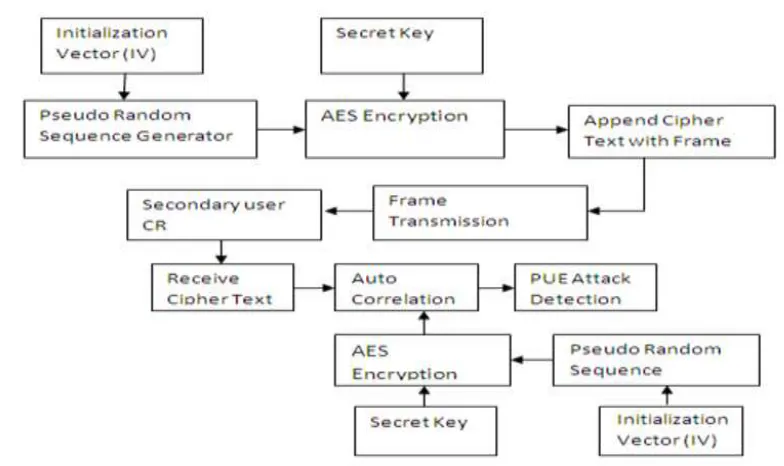
In the proposed system an Advanced Encryption Standardfor DTV is robust and reliable primary and secondary
systemoperations. In the proposed system, At the Sending end primary user generatesa pseudo-random number
AES-encrypted reference signal that is usedas the segment sync bits. The sync bits in the field sync segmentsremain
unchanged for the channel estimation purposes at the receiving end, the reference signal is regenerated forthe
detection of the primary user and malicious user. It shouldbe emphasized that synchronization is still guaranteed in
theproposed scheme since the reference bits are also used forsynchronization purposes. For each Slot period check
the correlation and the threshold value it will detect the Primary user emulation attack.
IV. BLOCK DIAGRAM AND DESCRIPTION OF THE PROPOSED SYSTEM:
333 |
P a g e
Primary user is detected in its spectrum band immediately vacate that band and switch to a vacant one
―vertical spectrum sharing‖ when another secondary
.
user is detected in its spectrum band When there are
no better spectrum opportunities, it may choose to share the band with the detected secondary
user―horizontal spectrum sharing‖ CR MAC protocol guarantees fair resource allocation among
secondary usersPrimary signal transmitter localization is more challenging than the standard localization
problem due to two reasons no modification should be made to primary users to accommodate the DSA
of licensed spectrum. This requirement excludes the possibility of using localization Protocol that
involves the interaction between a primary user and the localization device. PST localization problem is a
non-interactive localization problem when a receiver is localized, one does not need to consider the
existence of other receivers. However, the existence of multiple transmitters may add difficulty to
transmitter localization.
V RESULT AND DISCUSSSION
In this section, we demonstrate the effectiveness of the AES-assisted DTV scheme through simulation. the impact of
the noise level on the optimal thresholds we evaluate the false alarm rates and miss detection probabilities for both
primary user and malicious user detection. In the simulations. By using the Matlab software we will find the miss
detection probabilityBy using the Mask and Seed Value Primary User generates the Key. The number is generated
by use AES Algorithm and the Key are encrypted as a reference Signal. Here consider the number of Primary user
will be one
.
This simulation model is shown in the below fig.334 |
P a g e
Fig:3 Checking of Correlation and Threshold by each slot
335 |
P a g e
Fig5: Graphs for Different SNR Value
VI. ADVANTAGE AND APPLICATION
Identification of Primary user and Malicious users are easy.
If the Primary user and the second user are exchange the key means the data’s are more secure
This system is simple, convenient, time saving and high security..
Because of the immediate decision making and interface provides an instant diagnosis based on
limits.
The focus of this project is to develop a system effective and robust, easy operation and mainly
low cost which permits to manage the network security and improve quality.
The protection and efficiency of the whole system is increased dramatically.
These are mainly used where the security is most important.
VII. CONCLUSION AND FUTUREWORK
AES-assisted DTV scheme was proposed for robust primary and secondary system operations under primary user
emulation attacks. An AES-encrypted reference signal is generated at the TV transmitter and used as the sync bits of
the DTV data frames. By allowing a shared secret between the transmitter and the receiver, the reference signal can
be regenerated at the receiver and be used to achieve accurate identification of authorized primary users. Moreover,
when combined with the analysis on the auto-correlation of the received signal, the presence of the malicious user
can be detected accurately no matter the primary user is present or not. This approach is practically feasible in the
336 |
P a g e
chip. Potentially, it can be applied directly to today’s HDTV systems for more robust spectrum sharing. It would beinteresting to explore Primary User Emulation Attack detection over each sub-band in multi-carrier DTV systems.
In defense against primary user emulation attack in cognitive radio using advanced encryption standard technique
the secret key is shared among Secondary users. No need of 3rd party reliable system. Because time consumption is
high when the third party maintain the secret key. To avoid this future work secondary user maintains the secret key
instead of third party.
REFERENCES
[1].Chen and J.-M. Park, ―Ensuring trustworthy spectrum sensing in cognitive radio networks,‖ in Proc. IEEE Workshop Netw. Technol. Softw.Defined Radio Netw., Sep. 2006
[2. Chen, J.-M. Park, and J. Reed, ―Defense against primary user emulation attacks in cognitive radio networks,‖
IEEE J. Sel. Areas Commun., vol. 26, no. 1, pp. 25–37, Jan. 2008
[3].FCC, ―Unlicensed operation in the TV broadcast bands and additional spectrum for unlicensed devices below
900 MHz and in the 3 GHz band,‖ Federal Commun. Commission, Columbia, SC, USA, Tech. Rep. ET Docket
No. 04-186 and 02-380, Sep. 2010
[4].Z. Jin, S. Anand, and K. P. Subbalakshmi, ―Mitigating primary user emulation attacks in dynamic spectrum
access networks using hypothesis testing,‖ SIGMOBILE Mobile Comput. Commun. Rev., vol. 13, no. 2, pp. 74– 85, 2009
[5]. K. Borle, B. Chen, and W. Du, ―A physical layer authentication scheme for countering primary user emulation
attack,‖ in Proc. IEEE ICASSP, May 2013
[6]. L. Zhang, J. Ren, and T. Li, ―Time-varying jamming modeling and classification,‖ IEEE Trans. Signal Process., vol. 60, no. 7, pp. 3902–3907, Jul. 2012
[7]. N. Singhal and J. Raina, ―Comparative analysis of AES and RC4 algorithms for better utilization,‖ Int. J. Comput. Trends Technol.,pp. 177–181, Aug. 2011.
[8].Mathur and K. P. Subbalakshmi, ―Digital signatures for centralizedDSA networks,‖ in Proc. 4th IEEE CCNC, Jan. 2007.
[9].L. Zhang, H. Wang, and T. Li, ―Anti-jamming message-driven frequencyhopping—Part I: System design,‖
IEEE Trans. Wireless Commun.,vol. 12, no. 1, pp. 70–79, Jan. 2013