University of Pennsylvania
ScholarlyCommons
Publicly Accessible Penn Dissertations
1-1-2012
Provenance and Uncertainty
SUDEEPA ROY
University of Pennsylvania, [email protected]
Follow this and additional works at:
http://repository.upenn.edu/edissertations
Part of the
Computer Sciences Commons
This paper is posted at ScholarlyCommons.http://repository.upenn.edu/edissertations/570
For more information, please [email protected].
Recommended Citation
ROY, SUDEEPA, "Provenance and Uncertainty" (2012).Publicly Accessible Penn Dissertations. 570.
Provenance and Uncertainty
Abstract
Data provenance, a record of the origin and transformation of data, explains how output data is derived from input data. This dissertation focuses on exploring the connection between provenance and uncertainty in two main directions: (1) how a succinct representation of provenance can help infer uncertainty in the input or the output, and (2) how introducing uncertainty can facilitate publishing provenance information while hiding associated private information.
A significant fraction of the data found in practice is imprecise, unreliable, and incomplete, and therefore uncertain. The level of uncertainty in the data must be measured and recorded in order to estimate the
confidence in the results and find potential sources of error. In probabilistic databases, uncertainty in the input is recorded as a probability distribution, and the goal is to efficiently compute the induced probability
distribution on the outputs. In general, this problem is computationally hard, and we seek to expand the class of inputs for which efficient evaluation is possible by exploiting provenance structure.
In some scenarios, the output data is directly examined for errors and is labeled accordingly. We need to trace back the errors in the output to the input so that the input can be refined for future processing. Because of incomplete labeling of the output and complexity of the processes generating it, the sources of error may be uncertain. We formalize the problem of source refinement, and propose models and solutions using
provenance that can handle incomplete labeling. We also evaluate our solutions empirically for an application of source refinement in information extraction.
Data provenance is extensively used to help understand and debug scientific experiments that often involve proprietary and sensitive information. In this dissertation, we consider privacy of proprietary and commercial modules when they belong to a workflow and interact with other modules. We propose a model for module privacy that makes the exact functionality of the modules uncertain by selectively hiding provenance information. We also study the optimization problem of minimizing the information hidden while guaranteeing a desired level of privacy.
Degree Type
Dissertation
Degree Name
Doctor of Philosophy (PhD)
Graduate Group
Computer and Information Science
First Advisor
Susan B. Davidson
Second Advisor
Keywords
Algorithms, Databases, Information Extraction, Privacy, Probabilistic Databases, Provenance
Subject Categories
PROVENANCE AND UNCERTAINTY
Sudeepa Roy
A DISSERTATION
in
Computer and Information Science
Presented to the Faculties of the University of Pennsylvania
in
Partial Fulfillment of the Requirements for the
Degree of Doctor of Philosophy
2012
Supervisor of Dissertation Supervisor of Dissertation
Signature Signature
Susan B. Davidson, Professor Sanjeev Khanna, Professor
Computer and Information Science Computer and Information Science
Graduate Group Chairperson
Signature
Jianbo Shi, Professor, Computer and Information Science
Dissertation Committee
Val Tannen, Professor, Computer and Information Science (Chair)
Andreas Haeberlen, Assistant Professor, Computer and Information Science
Zachary G. Ives, Associate Professor, Computer and Information Science
Tova Milo, Professor, School of Computer Science, Tel Aviv University (External)
Christopher Re, Assistant Professor, Department of Computer Sciences,
PROVENANCE AND UNCERTAINTY
COPYRIGHT
2012
To
Acknowledgements
This thesis would not have been possible without the generous help and support from
my professors, colleagues, friends, and family. I humbly extend my heartfelt gratitude to
all of them, and sincerely apologize to any of them who I forget to name here.
First and foremost, I thank my advisors Susan Davidson and Sanjeev Khanna, who
taught me how to do research: right from selecting problems to improving the written
and oral presentation of results. Their doors were always open in spite of their incredibly
busy schedule, and I was always fortunate to get their support in academic matters and
beyond.
I thank my dissertation committee members Andreas Haeberlen, Zack Ives, Tova Milo,
Chris Re, and Val Tannen, who graciously agreed to serve on the committee. They helped
me improve the presentation immensely with thoughtful and objective suggestions right
from when I submitted my thesis proposal.
The work presented in this dissertation is a result of an extensive and fruitful
collabo-ration with my advisors, and also with Laura Chiticariu, Vitaly Feldman, Tova Milo,
Deb-malya Panigrahi, Vittorio Perduca, Frederick Reiss, Val Tannen, and Huaiyu Zhu. Their
expertise in a diverse set of areas like algorithms and theory, databases and systems, and
machine learning enriched my knowledge and broadened my interests as a computer
scientist. I gratefully acknowledge their contributions in realizing this dissertation.
I sincerely thank Val Tannen, who has been a close collaborator, a mentor, and an
informal advisor to me. Val gave me far more attention and advice than I could have
asked for, and patiently suggested ways to overcome my shortcomings and consolidate
my strengths. My thanks to Tova Milo who was a wonderful collaborator and great source
of support. My research experience would not have been the same if I did not have the
opportunity to work with Tova and Val, who mentored me, made each research meeting
tremendously enjoyable, and helped me get a toe-hold in the academic community.
I was fortunate to be mentored and advised by a number of eminent researchers from
different fields. My heartfelt thanks to Laura Chiticariu, Julia Chuzhoy, Sudipto Guha,
every bit of advice enhanced my experience as a graduate student. My sincere gratitude
to my advisors, Manindra Agrawal and Somenath Biswas, at IIT Kanpur who encouraged
me to join a doctoral program in the first place.
I thank all the members of the vibrant database group at Penn, especially Allen, Julia,
Ling, Marie, Medha, Mengmeng, Nan, Svilen, and Zhuowei, for giving me comments on
my research directions, being critical yet immensely helpful during practice talks, and
making my overall experience at Penn so enjoyable. Thanks to the administrative and
business staff who were always there to take care of administrative issues. My heartfelt
thanks are to Mike Felker, who is the one-stop solution for all matters in the department.
I do not have enough words to thank Annie and Marie, who were my closest friends,
confidants, and my immediate source of support, encouragement, and criticism, in the
last five years. We started our journey as a PhD student together five years back, and since
then I have shared every single achievement and failure with them, and have fallen back
on them for any need, whether academic or personal. Our gang of girls was strengthened
when Medha and Nan joined us last year, who have since wholesomely added to my life. I
have been blessed with a number of very close friends. I thank Aditi, Anirban (Basu and
Dey), Arindam, Arnab, Barna, Chandan, Debarghya, Dipanjan, Joydeep, Lakhsminath,
Maunendra, Payel, Sagarmoy, Sayak, Shaon, Shubhankar, Srobona, Subhendu, Sumit,
Supratim, Sunny, Varun, Vinaya, and all my other friends, for always being with me.
I could not have reached here without the unconditional love and support from my
family. My parents Sumita Roy and Sushanta Kumar Roy, my dear sister Urmimala,
uncles, aunts, and grandparents had unwavering belief in me and were overjoyed at my
tiniest achievements. I thank my parents-in-law, who are always more concerned than
I am about my health, happiness and professional career. My grandmother would have
been the happiest person today, and her memories will drive me in life forever. Last
but not the least, I do not know how to thank my loving husband Debmalya in words.
He is my best friend, colleague, and collaborator, my strongest source of support and
encouragement, and a pillar of strength at times of sorrow and desperation who can
change it to a smile in no time. I can only thank him by making our days to come
ABSTRACT
PROVENANCE AND UNCERTAINTY
Sudeepa Roy
Susan B. Davidson
Sanjeev Khanna
Data provenance, a record of the origin and transformation of data, explains how
out-put data is derived from inout-put data. This dissertation focuses on exploring the connection
between provenance and uncertainty in two main directions: (1) how a succinct
represen-tation of provenance can help infer uncertainty in the input or the output, and (2) how
introducing uncertainty can facilitate publishing provenance information while hiding
associated private information.
A significant fraction of the data found in practice is imprecise, unreliable, and
in-complete, and therefore uncertain. The level of uncertainty in the data must be measured
and recorded in order to estimate the confidence in the results and find potential sources
of error. In probabilistic databases, uncertainty in the input is recorded as a probability distribution, and the goal is to efficiently compute the induced probability distribution
on the outputs. In general, this problem is computationally hard, and we seek to expand
the class of inputs for which efficient evaluation is possible by exploiting provenance
structure.
In some scenarios, the output data is directly examined for errors and islabeled accord-ingly. We need to trace back the errors in the output to the input so that the input can be
refined for future processing. Because of incomplete labeling of the output and
complex-ity of the processes generating it, the sources of error may be uncertain. We formalize
the problem of source refinement, and propose models and solutions using provenance
that can handle incomplete labeling. We also evaluate our solutions empirically for an
application of source refinement ininformation extraction.
Data provenance is extensively used to help understand and debug scientific
exper-iments that often involve proprietary and sensitive information. In this dissertation, we
work-flowand interact with other modules. We propose a model formodule privacythat makes the exact functionality of the modules uncertain by selectively hiding provenance
infor-mation. We also study the optimization problem of minimizing the information hidden
Contents
1 Introduction 1
1.1 Provenance for Inferring Uncertainty in Input or Output . . . 4
1.1.1 Projecting Input Uncertainty to the Output . . . 5
1.1.2 Tracing Output Uncertainty back to the Input . . . 10
1.2 Introducing Uncertainty for Privacy-aware Provenance . . . 14
1.3 Roadmap . . . 18
2 Background 19 2.1 Data Provenance . . . 19
2.1.1 Boolean provenance in Probabilistic Databases . . . 21
2.1.2 Boolean Provenance in Information Extraction . . . 24
2.2 Workflow Provenance . . . 28
2.2.1 Workflows . . . 29
2.2.2 Provenance Relations . . . 30
2.3 Complexity Classes and Approximation . . . 32
3 Query Evaluation in Probabilistic Databases using Read-Once Functions 34 3.1 Overview . . . 34
3.2 Preliminaries . . . 39
3.2.1 Provenance Graphs . . . 39
3.2.2 Co-occurrence Graphs vs. Co-table Graphs . . . 41
3.3 Computing the Co-Table Graph . . . 43
3.3.2 Computing the Table-Adjacency Graph . . . 46
3.3.3 Computing the Co-Table Graph . . . 46
3.4 Computing the Read-Once Form . . . 48
3.4.1 Algorithm CompRO . . . 49
3.5 Discussion . . . 56
3.6 Related Work . . . 59
3.7 Conclusions . . . 60
4 Queries with Difference on Probabilistic Databases 63 4.1 Overview . . . 63
4.2 Preliminaries . . . 67
4.2.1 Difference Rank . . . 67
4.2.2 Read-Once and d-DNNF . . . 68
4.2.3 From Graphs to Queries . . . 70
4.3 Hardness of Exact Computation . . . 71
4.4 Approximating Tuple Probabilities . . . 73
4.4.1 Probability-Friendly Form (PFF) . . . 74
4.4.2 PFF and General Karp-Luby Framework . . . 74
4.4.3 FPRAS to Approximate Tuple Probabilities . . . 75
4.4.4 Classes of Queries Producing PFF . . . 79
4.5 Related Work . . . 80
4.6 Conclusions . . . 80
5 Provenance-based Approach for Dictionary Refinement in Information Extrac-tion 82 5.1 Overview . . . 82
5.2 Dictionary Refinement Problem . . . 87
5.2.1 Estimating Labels of Results for Sparse Labeling . . . 88
5.2.2 Formal Problem Definition . . . 89
5.3 Estimating Labels . . . 91
5.3.2 Estimating Labels from Entry-Precisions . . . 92
5.3.3 Estimating Entry-Precisions by EM . . . 92
5.4 Refinement Optimization . . . 94
5.4.1 Refinement Optimization for Single Dictionary . . . 95
5.4.2 Refinement Optimization for Multiple Dictionaries . . . 100
5.5 Experiments . . . 102
5.5.1 Evaluation Datasets . . . 103
5.5.2 Dictionary Refinement with Full Labeling . . . 104
5.5.3 Dictionary Refinement with Incomplete Labeling . . . 107
5.6 Related Work . . . 111
5.7 Conclusions . . . 113
6 Provenance Views for Module Privacy 114 6.1 Overview . . . 115
6.2 Module Privacy . . . 117
6.2.1 Standalone Module Privacy . . . 118
6.3 Standalone Module Privacy . . . 122
6.3.1 Lower Bounds . . . 123
6.3.2 Upper Bounds . . . 125
6.4 All-Private Workflows . . . 126
6.4.1 Standalone-Privacy vs. Workflow-Privacy . . . 127
6.4.2 TheSecure-ViewProblem . . . 131
6.4.3 Complexity results . . . 133
6.5 Public Modules . . . 137
6.5.1 Standalone vs. Workflow Privacy (Revisited) . . . 137
6.5.2 TheSecure-ViewProblem (Revisited) . . . 140
6.6 Related Work . . . 140
6.7 Conclusions . . . 142
7.2 Privacy via propagation . . . 148
7.2.1 Upward vs. downward propagation . . . 149
7.2.2 Recursive propagation . . . 150
7.2.3 Selection of hidden attributes . . . 151
7.3 Privacy for Single-Predecessor workflows . . . 154
7.3.1 Proof of the Privacy Theorem . . . 154
7.3.2 Necessity of Single-Predecessor Assumption . . . 161
7.4 Optimization . . . 162
7.4.1 Optimization in Four Steps . . . 163
7.4.2 Solutions for Individual Modules . . . 165
7.4.3 Optimization: Single Private Module . . . 166
7.5 General Workflows . . . 169
7.6 Conclusion . . . 170
8 Conclusions 172 A Additional Details and Proofs 176 A.1 Proofs from Chapter3 . . . 176
A.2 Proofs from Chapter4 . . . 190
A.3 Proofs from Chapter5 . . . 201
A.4 Proofs from Chapter6 . . . 209
A.5 Proofs from Chapter7 . . . 233
List of Tables
1.1 Complexity of exact and approximate computation of probability for
dif-ference of two positive queries (CQ = conjunctive query, UCQ = Union of
conjunctive query). . . 10 7.1 Relation Rfor workflow given in Figure7.3a . . . 157 7.2 Relation R0, a possible world of the relation R for the workflow in
Fig-ure7.3a w.r.t. V={a1,a2,a6}. . . 160 7.3 Relation Ra for workflowWa given in Figure7.3b . . . 161
A.1 Relation Rbfor workflowWbgiven in Figure A.5a . . . 249
A.2 Relation R
List of Illustrations
1.1 A database instanceI with three relationsR,S, andT, queryq, and Boolean
provenance of the output tuples. . . 5
1.2 Input relations UserGroup,GroupAccess, and output relation UserAccess with correct/incorrect labeling on the output tuples. . . 12
2.1 A tuple-independent probabilistic database I with three input relations R,S,T, where the tuples are annotated with tuple variables and probabilities. 21 2.2 Asafequeryqand Boolean provenance of the output tuples inq(I). . . 22
2.3 Anunsafequeryq0 and Boolean provenance of the output tuples inq0(I). . 23
2.4 Example Person Extractor with Input Document, rules, dictionaries and intermediate and output views. . . 25
2.5 An example workflow, and module and workflow executions as prove-nance relations . . . 30
3.1 A tuple-independent probabilistic database where the tuples are annotated with tuple variables and probabilities. . . 35
3.2 Provenance graph forR./S. . . 40
3.3 Provenance graph forπ()((R./S)./T). . . 40
3.4 Co-occurrence graph Gco for the Boolean provenance f in Example3.2. . . 41
3.5 Table-adjacency graphGT for the relations in Example3.2. . . 42
3.6 Co-table graphGC for the Boolean provenance f in Example3.2. . . 43
3.7 GC,1andGC,2. . . 54
4.1 Boolean provenance for the queryq−q0. . . 64
4.2 φ=u1(v1+v2) +u3v4: (a) as a read-once tree, (b) as a d-DNNF. . . 69
5.1 Details of evaluation data sets . . . 104
5.2 Histograms for statistics of the data : (i) Fraction of bad results produced by entries and relative frequencies of entries, (ii) Count of bad results pro-duced by entries. . . 105
5.3 Performance of refinement optimization algorithms for single dictionary: (i) Size constraint, (ii) Recall constraint . . . 106
5.4 Running times of refinement algorithms for single dictionary : (i) Size con-straint, (ii) Recall constraint . . . 107
5.5 Refinement algorithms for multiple dictionary: (i) Size Vs. F-score, (ii) Recall budget Vs. F-score . . . 108
5.6 Running time for multiple dictionary (i) Size Vs. Time, (ii) Recall Budget Vs. Time . . . 109
5.7 Effect of the labeled data size on F-score for single dictionary (i) Size con-straint, (ii) Recall constraint. . . 110
5.8 Effect of the labeled data size on F-score for multiple dictionary (i) Size constraint, (ii) Recall constraint. . . 111
5.9 Top 10 entries output by the (near) optimal algorithms for size and recall constraints. . . 112
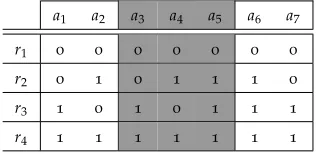
6.1 (a): Projected relation for m1 when attribute {a2,a4} are hidden, (b)-(d): Ri1∈Worlds(R1,V),i∈[1, 4] . . . 119
6.2 IP forSecure-Viewwith cardinality constraints . . . 134
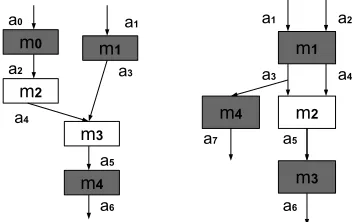
7.1 A single-predecessor workflow. White modules are public, grey are private; the box denotes the composite module M forV2={a2}. . . 151
7.2 UD-safe solutions for modules . . . 152
7.3 White modules are public, grey are private. . . 156
A.2 Reduction from label cover: bold edges correspond to(p,q)∈Ruw, dotted
edges are for data sharing. . . 224
A.3 Reduction from vertex cover, the dark edges show a solution with cost
|E0|+K,K=size of a vertex cover inG0 . . . 226
A.4 Reduction from label cover: (p,q)∈ Ruw, the public modules are darken,
all public modules have unit cost, all data have zero cost, the names of the
data never hidden are omitted for simplicity . . . 230
A.5 White modules are public, Grey are private. . . 249
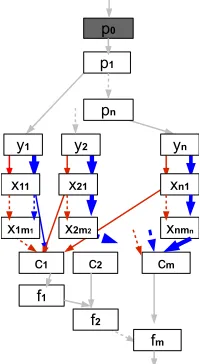
A.6 Reduction from3SAT. Module p0is private, the rest are public. The narrow
dark edges (in red) denote TRUE assignment, the bold dark edges (in blue)
Chapter
1
Introduction
Data provenance (also known aslineageor pedigree) is a record of origin and transforma-tion of data [33]. Data provenance, which explains how the output data is derived from
the input data in an experiment, simulation, or query evaluation, has been extensively
studied over the last decade. Its applications include data cleaning, sharing, and
integra-tion [46, 99, 166], data warehousing [51], transport of annotations between data sources
and views [34], view update and maintenance [18,34,44,81,87,88,173], verifiability and
debugging in scientific workflows [19, 24, 27, 128, 158] and business processes [53, 69],
and so on. Various tools and frameworks have been proposed to support provenance in
these applications [32,99,175].
The central focus of this dissertation is to explore the connection between provenance and
uncertainty. A significant fraction of data found in practice is imprecise, unreliable, and incomplete, which leads to uncertainty in data. For example, RFID sensor data in wireless
sensor networks is often noisy due to environmental interference, inherent measurement
noise, and sensor failures. Similarly, data collected by surveys or crowd-sourced platforms
like Amazon Mechanical Turk [1] is uncertain because of variations in taste, opinion,
and the level of effort put in by the crowd in generating the data. In addition, some
information may be lost or introduced when data undergoes multiple transformations
and is stored in different formats.
In any practical application, it is important to measure and record the level of
potential sources of errors. Uncertainty can be recorded either in the source or in the
output. In applications like sensor networks, it is well-known that RFID sensors often
record inaccurate values. Therefore, multiple sensors are usually deployed for the same
task,e.g., recording the temperature of a room. Based on the values these sensors record,
we obtain a probability distribution over a range of temperatures. This is an example of
recording uncertainty in the source. Further processing of the recorded temperatures (e.g.,
finding whether the room temperature was greater than a certain threshold at any time
of a day) induces a probability distribution on the possible outputs.
In some scenarios, we do not have a prior measure of confidence on the source data,
whereas the output data can be directly examined for errors and is labeled accordingly.
For instance, in the above example, an independent observer may certify that the room
temperature was always lower than the given threshold, whereas the sensors recorded
otherwise. In this case, the sensor recordings are labeled as incorrect. It is important that
this (often incompletely) labeled output data is now used to identify the faulty sensors
for rectification or removal.
The above examples motivate the first part of this dissertation. Here we study
appli-cations of provenance, i.e. how the output was generated from the input, in inferring uncertainty in the input or the output data. The framework of projecting uncertainty in
the input, specified as probability distributions, to the output has been widely studied
in the field of probabilistic databases [161]. Here the main challenge is to compute the
probability distribution on the possible output values as efficiently as possible for a large
input data set. We use a certain form of provenance, that we call Boolean provenance, to efficiently compute the exact or approximate probabilities of the outputs. It has been
shown in the literature that there is a class of “hard” positive relational queries (involving
SELECT-PROJECT-JOIN-UNION operators) that are not amenable to efficient
computa-tion of output probabilities on some instances. Our first contribucomputa-tion is to efficiently
identify a natural class ofquery-database instance pairs that allow efficient computation of
the output probabilities even if the query is hard. Our second contribution is to initiate
the study of queries that involve theset difference operator (EXCEPT or MINUS in SQL),
Conversely, for tracing uncertainty in the output back to the input, we also use Boolean
provenance. The goal is to refine the source, i.e. find and remove inputs that are
respon-sible for producing many incorrect outputs. However, the same input might produce
a combination of correct and incorrect outputs. So we must ensure that refining the
inputs does not delete a significant number of correct outputs. We formalize the
prob-lem of balancing incorrect outputs retained and correct outputs deleted by the process
of source refinement, and propose efficient algorithmic solutions for this problem. We
also address the problem of incomplete labeling of the output by proposing a
statisti-cal model that helps predict the missing labels using techniques from machine learning.
Our approach of source refinement is discussed via an important application in informa-tion extracinforma-tionwhere we also evaluate our solutions empirically on a real-life information
extraction system [114].
In general, data provenance helps understand and debug an experiment, transaction,
or query evaluation in scientific, medical, or pharmaceutical research and business
pro-cesses [19,24,27,53, 69,128,158]. Workflows, which capture processes and data flows in
these domains, constitute a critical component of experiments like genome sequencing,
protein folding, phylogenetic tree construction, clinical trials, drug design and
synthe-sis, etc. Due to substantial investments in developing a workflow and its components,
which also often includes proprietary or sensitive elements (e.g., medical information,
proprietary algorithms, etc), organizations may wish to keep certain details private while
publishing the provenance information.
The second part of this dissertationfocuses on module privacy for proprietary and mercial modules when they combine with other modules in a workflow in order to
com-plete a task. Unlike the first part of the dissertation where we use provenance to infer
uncertainty in the input or the output, we intentionallyintroduce uncertaintyin provenance
to protect functionality of the private modules. Arbitrary network structure and
interac-tion with other modules in a workflow make it difficult to guarantee desired privacy
levels for proprietary modules. Here we show that we can find private solutions locally
for individual modules and combine them to ensure privacy of modules in a workflow
provenance information and privacy of modules. So our algorithms aim to minimize the
provenance information hidden while ensuring a required privacy level. We also argue
that the guarantees provided by our algorithms are essentially the best possible.
In view of the above discussion, we now describe two main directions in this
dis-sertation connecting provenance and uncertainty: (i) how a succinct representation of
provenance can help infer uncertainty in the input or the output (Section 1.1), and (ii)
how uncertainty can facilitate privacy-aware provenance (Section 1.2). In these sections,
we briefly review the relevant previous approaches, discuss how we use provenance to
address the underlying challenges, and summarize our technical contributions.
1
.
1
Provenance for Inferring Uncertainty in Input or Output
We consider the relational setting For inferring uncertainty in the input or the output,
where a relational algebra query runs on an input (relational) database to compute the
output view. Both projecting uncertainty in the input to the output and tracing
un-certainty in the output back to the input require the knowledge of how-provenance of
the outputs, which encodes how each output tuple is generated from the input tuples1
.
Specifically, we can encode the how-provenance of an output tuple as a polynomial in
variables annotating the source tuples (see Figure 1.1). Then joint use of source tuples
by the JOIN operator is captured by Boolean AND (·), alternative ways of generating an output tuple by the PROJECT and UNION operators are captured by Boolean OR
(+), and SELECT operator maps potential output tuples to True or False. We call these
polynomialsBoolean provenance (also known asevent expressionsorlineage) ImielinskiL84,
GreenKT07. Figure 1.1 shows an example of Boolean provenance annotating output
tu-ples. The provenance of tupleb2isu2·v3·w3, which says that the tupleb2is generated in
the output by joining the source tuples R(b1,c3),S(c2,a3)and T(a3). On the other hand,
it follows from the provenance of b1 that it can be generated by joining three different
combinations of source tuples. Next, we discuss the specific use of Boolean provenance
in inferring uncertainty in the input and the output.
1
R
b1 c1 u1
b2 c2 u2 b1 c3 u3
S
c1 a1 v1 c1 a2 v2
c2 a3 v3 c3 a2 v4
T a1 w1
a2 w2 a3 w3
q(I)
b1 u1·v1·w1+u1·v2·w2+u3·v4·w2 b2 u2·v3·w3
q(x):−R(x,y),S(y,z),T(z)
Figure 1.1: A database instance I with three relations R,S, and T, queryq, and Boolean
provenance of the output tuples.
1.1.1 Projecting Input Uncertainty to the Output
Unreliable data sources, noisy data collectors (like sensor data), and multiple
transforma-tions and revisions inject uncertainty in data. Probabilistic databasesenable us to capture,
model, and process uncertain data assuming a probability distribution on the possible
instances of the database. Query evaluation on probabilistic databases results in a
proba-bility distribution on possible outputs instead of a deterministic answer.
Boolean provenance in probabilistic databases. A standard and fundamental model
is to assumetuple-independentprobabilistic databases. Here each source tuple realizes in a random instance of the database with some probability independent of the other source
tuples. The Boolean variable annotating a source tuple correspond to the event that the source tuple realizes,e.g. R(b1,c1)exists in a random instance of the database if and only
if u1 =True, and this event has a certain probability Pr[u1]. It can be easily seen that
an output tuple appears as a result of query evaluation on a random database instance
if and only if its Boolean provenance evaluates to True. Therefore, in tuple-independent
probabilistic databases, the probability of an output tuple equals the probability of its
Boolean provenance,e.g.Pr[b1appears inq(I)]= Pr[u1·v1·w1+u1·v2·w2+u3·v4·w2].
There are several reasons to use Boolean provenance for query evaluation in
proba-bilistic databases. First, the number of random instances of the input database can be
exponential in the number of source tuples with non-zero probability. Using Boolean
gives the intended output tuple2
. Second, evaluating the probability of a Boolean
expres-sion from the probabilities of its constituent variables has been extensively studied in the
literature, and is closely related to computing the number of satisfying assignments of
a Boolean expression. This enables us to have a better understanding of the difficulties
in probability computation. Moreover, the Boolean provenance of the output tuples can
be computed without much overhead when a query is evaluated on an annotated source
database. The challenge in computing the probability distributions using Boolean
prove-nance appears in the next step. The problem of computing the probability of an arbitrary
Boolean expression from that of its constituent variables is directly related to counting
the number of satisfying assignments of the expression which is known to be
computa-tionally hard (#P-hard). Further, these hardexpressions may be generated by very simple queries. Therefore, the key challenge in probabilistic databases is to be able to efficiently
compute the probability distribution on the outputs for a large class of inputs.
Previous approaches. Dalvi et. al. have studied efficient computability of
proba-bility distribution on the outputs, and have given importantdichotomy results forpositive relational algebra queries [54–57]. These results show that the set of such queries can be
divided into (i) the queries for which poly-time computation of output probability
dis-tribution is possible on all instances (called safe queries); and (ii) the queries for which such computation is hard (called unsafe queries). There has been interesting progress in
other directions in probabilistic databases as well. Several systems for query processing
on probabilistic databases have been developed, including MistiQ [25], Trio [17,174], and
MayBMS [10]. Significant work has been done on top-k queries [117,144,159] and
aggre-gate queries [146] on probabilistic databases. The relation between Boolean provenance
generated by safe queries and several knowledge compilation techniques has also been
explained [101,137]. Frameworks have been proposed for exact and approximate
evalua-tion of the answers that work well in practice (but may not run in time polynomial in the
size of input database) [77, 100, 140]. A completely different approach models
correla-tions between tuples, compiles queries and databases into probabilistic graphical models
and then performs inference on these [149, 154, 155]. Another line of work has focused
2
For some queries, explicit computation of the Boolean provenance is not needed and the probabilities of
on exploring more expressible query languages for probabilistic databases and their
com-putability. For instance, [68] considers datalog, fixpoint and “while” queries, where either
the state of the database changes after each evaluation of the query, or new results are
added to the answer set; [109] studies compositional use of confidence parameters in the
query such as selection based on marginal and conditional probabilities.
Our contributions. In view of the above state of the art, this dissertation considers
two simple yet fundamental questions. In Chapter3, we extend the class of inputs
(query-database pairs) for which poly-time exact computation is possible, while in Chapter4, we
enrich the class of queries studied in the literature by including thedifference operations. Here we give a technical summary of our contributions in these two chapters.
• Query Evaluation in Probabilistic Databases using Read-Once Functions
Chapter3is based on the results published in [152] (joint work with Vittorio Perduca
and Val Tannen). As mentioned earlier, safe queries are amenable to poly-time
computation for all input databases. However, the class of unsafe queries includes
very simple queries like q():−R(x),S(x,y),T(y) and are unavoidable in practice. Our observation is that, even for unsafe queries, there may be classes of “easy” data
inputs where the answer probabilities can be computed in polynomial time in the
size of the database: this we call theinstance-by-instanceapproach. In particular, our goal is efficiently identify the input query-database pairs where Boolean provenance
of an output isread-once.
A Boolean expression is inread-once formif each of its variables appears exactly once,
e.g. x(y+z)3
. The significance of a read-once expression is that its probability can be
computed in linear-time in the number of variables when the variables are mutually
independent (repeatedly use Pr[xy] =Pr[x]Pr[y]and Pr[x+y] =1−(1−Pr[x])(1−
Pr[y])). However, there are expressions that are not in read-once form, but are read-once,i.e.such an expression has an equivalent read-once form (e.g. xy+xz). Indeed,
there are non-read-once expressions as well (e.g. xy+yz+zx or xy+yz+zw). In
Figure1.1the provenance ofb2(i.e. u2v3w3) is read-once and also in read-once form,
while the provenance of b1 (i.e. u1v1w1+u1v2w2+u3v4w2) is not read-once. Our
3
goal in this chapter is to decide whether a Boolean provenance is read-once (and if
yes, to compute the read-once form) as efficiently as possible.
When the Boolean formula is given in “irredundant” disjunctive normal form (DNF)
(i.e. none of the disjuncts can be omitted using absorption likex+xy=x), there is a fast algorithm by Golumbic et. al. [85] to decide whether a Boolean expression is
read-once. This algorithm is based upon a characterization given by Gurvich [91].
For positive relational queries, the size of the irredundant DNF for a Boolean
prove-nance is polynomial in the size of the table, but can be exponential in the size of
the query. On the other hand, often optimized query plans produce more compact
expressions, motivating the study of approaches that can avoid the explicit
compu-tation of these DNFs. However, DNF compucompu-tation seems unavoidable for arbitrary
Boolean expressions. Hellerstein and Karpinski[97] have shown that given a
mono-tone Boolean formula defining a read-once function, the equivalent read-once form
cannot be computed in poly-time in the size of the formula unless NP=RP4
.
In [152], we exploit special structures of Boolean provenance to avoid expanding
the expression into DNF. We show that for a large and important class of queries,
conjunctive queries without self-join, the existing characterization and algorithms can be used to decide read-once-ness of arbitrary Boolean provenance (not necessarily
in irredundant DNF) by recording some additional information when the query is
evaluated. Moreover, using the properties of conjunctive queries without self-join,
we propose a simpler and asymptotically faster algorithm that also introduces a
novel characterization of the read-once Boolean provenance for this class of queries.
• Queries with Difference on Probabilistic Databases
Chapter4presents our results published in [106] (joint work with Sanjeev Khanna
and Val Tannen). Difference operations (e.g. EXCEPT, MINUS in SQL) are
fre-quently found in real-life queries, but the complexity of query evaluation with these
operations had not been studied previously for probabilistic databases. The concept
4
The complexity classRP(Randomized Polynomial time) consists of the languagesLhaving a polynomial-time randomized algorithm that rejects all inputs not inLwith probability1, and accepts all inputs inLwith
of Boolean provenance naturally extends to difference (see Chapter 4). However,
there are some new and considerable difficulties with such queries. For any
posi-tive query without difference operations, even if the exact computation is hard, the
well-known DNF-counting algorithm given by Karp and Luby [104] can be adapted
to approximatethe probabilities upto any desired level of accuracy. But, for queries with difference, the DNF of Boolean provenance is no longer monotone, and may be
exponential in the size of the database. This precludes using both the read-onceness
testing algorithm of [85], and also the approximation algorithm given by Karp and
Luby. In recent and independent work [77], Fink et. al. proposed a framework
to compute exact and approximate probabilities for answers of arbitrary relational
algebra queries that allow difference operations. However, there is no guarantee of
polynomial running time.
In this work, we study the complexity of computing the probability for queries
with difference on tuple-independent databases. (1) We exhibit two Boolean queries
q1 and q2, both of which independently have nice structures, namely they aresafe
conjunctive queries without self-joins (i.e. allow poly-time computation on all
in-stances), but such that computing the probability ofq1−q2 is #P-hard. This
hard-ness of exact computation result suggests that any class of interesting queries with
difference which aresafein the spirit of [54–56] would have to be severely restricted5
(2) In view of this lower bound for exact computation, we give a Fully
Polyno-mial Randomized Approximation Scheme (FPRAS) for approximating probabilities for a class of queries with difference. In particular, a corollary of our result applies to
queries of the form q1−q2, where q1 is an arbitrary positive query while q2 is a
safe positive query without self-join. Our algorithm uses a new application of the
Karp-Luby framework[104] that goes well beyond DNF counting, and also works for
the instance-by-instance approach in the spirit of Chapter 3. (3) We show that the
latter restriction stated above is important: computing the probability of “True−q” isinapproximable (no FPRAS exists) whereTrue is the Boolean query that is always
true while q is the Boolean conjunctive query q():−S(x),R(x,y),S(y). Table 1.1
5
Pr[q1−q2]
q1 q2 Exact Approximate
UCQ safe CQ without self-join
#P-hard FPRAS
UCQ UCQ Inapproximable
Table1.1: Complexity of exact and approximate computation of probability for difference
of two positive queries (CQ = conjunctive query, UCQ = Union of conjunctive query).
summarizes the three results for differences of positive queries. This work is a first
step to explore the complexity of queries with difference operation; an important
future direction in this area is to obtain a complete classification of these queries
(and Boolean provenance) in terms of their complexity.
1.1.2 Tracing Output Uncertainty back to the Input
In applications like information extraction (e.g., finding all instances of person names from a document), database administration (e.g., curating source data in order to satisfy
certain requirements on one or more views), and business reorganization (e.g., reorganiz-ing connections between employees and customers) the outputs are often identified as
correct (as expected), or incorrect (spurious). In other words, an output of these systems
can be labeledas atrue positive orfalse positive by an expert or user of the system. A
nat-ural goal related to these applications is to use this (potentially incomplete) labeling to
improve the quality of the output of the system by refining potential erroneous inputs.
Previous approaches. In this regard, there have been two main directions of work
in the literature: deletion propagation [35, 107, 108] and causality [124, 125]. The goal of
deletion propagation, as studied in [35, 107, 108], is to delete a single incorrect answer
tuple of a positive relational query while minimizing thesource-side-effect(the number of source tuples needed to be deleted) orview-side-effect(the number of other output tuples
deleted). Clearly, a more general version of the deletion propagation problem can be
defined which can handle deletion of multiple tuples in the output. On the other hand,
to the other source tuples (in addition to the current source tuple) that gives the desired
set of outputs (if possible). The notion of causality can be considered as propagation of
undesired tuple deletion and missing tuple insertion with a minimal source-side-effect.
In the presence of only incorrect tuples (i.e. no missing tuples), both deletion
propa-gation and causality approaches attempt to deleteall false positives in the output: while the former primarily aims to minimize the number of true positives deleted, the latter
aims to minimize the modifications in source data that also preserves all true positives.
However, these approach have shortcomings for many practical purposes. For instance,
deleting a false positive may require deleting many other true positives. Figure1.2shows
an example mentioned in [35,50,107,108]. Here there are two source tables,UserGroup
(allocation of users to groups) and GroupAccess (files that a group has access to). The output viewUserAccesscomputed as
UserAccess(u,f) =UserGroup(u,g)1GroupAccess(g,f)
As depicted in the figure, the output tuple(John,f1)is incorrect (e.g., the userJohndoes not want to work on the file f1) and is desired to be removed. To delete(John,f1), either
(John,sale)or(sale,f1)has to be deleted in the source. Whichever source tuple is chosen to be deleted, two other correct output tuples are deleted as well (either (John,f2)and
(John,f3), or(Lisa,f1)and(Joe,f1)). Though either of these two solutions are optimum for the deletion propagation approach in [35, 50, 107, 108]6, depending on the
applica-tion and importance of the correct output tuples being deleted as a side effect, simply
retaining the single incorrect tuple (John,f1) may be a better option. To formalize the
above intuition, we need to quantify and optimize the “balance” between true positives
removed and false positives retained in the answer. In Chapter5, we will see an important
application of this approach in improving the output quality of an information extraction
system.
To balance theprecision(minimize false positives) andrecall(avoid discarding true pos-itives) in the output, our goal in Chapter5is to maximize theF-score(the harmonic mean
of precision and recall) [171]. We study this optimization problem under two natural
con-6
The causality approach computes responsibility of every source tuple as zero since no transformation on
UserGroup John sale Lisa sale Joe sale mary eng Ted mkt .. . GroupAccess sale f1
sale f2
sale f3
eng f4
mkt f5 .. .
UserAccess
John f1 incorrect
Lisa f1 correct
Joe f1 correct
John f2 correct
Lisa f2 correct
Joe f2 correct
John f3 correct
Lisa f3 correct
Joe f4 correct
Ted f4 correct
.. .
Figure1.2: Input relationsUserGroup,GroupAccess, and output relationUserAccesswith
correct/incorrect labeling on the output tuples.
straints that a human supervisor is likely to use: a limit on the number of source tuples
to remove (size constraint), or the maximum allowable decrease in recall (recall constraint).
Boolean provenance in source refinement. Boolean provenanceof the output tuples in terms of the input tuples help the objective of source refinement. First, an output tuple
gets deleted if and only if its Boolean provenance becomes False. This is an efficient way
to check if an output tuple survives, and thus to measure the F-score of the output after
refinement. Second, Boolean provenance also helps when the labeling on the output is incomplete. In practice, only a small amount of labeled data is available since manually
labeling a large output data is an expensive and time consuming task. We assume that
an output tuple is correct if and only if its Boolean provenance evaluates to True given
True and Falsevalues of the source tuples in the provenance (denoting whether or not
the source tuples are correct for this output tuple). Given the labeled output tuples, the
probability of the correctness of the source tuples can be estimated. These probabilities
are then used to compute the probability of an unlabeled output tuple being correct. This
and avoid over-fitting the small labeled data.
Although the focus of Chapter 5 is on rule-based information extraction system, this
work generalizes to any application where (i) the inputs can be modeled as source tuples
in relational databases, (i) the query can be abstracted as a positive relational query, and
(iii) the output tuples can be marked as correct (true positive) or incorrect (false positive).
In particular, the application in information extraction (extraction of structured data from
unstructured text) involves operations dealing with text data (e.g., finding occurrences of person names in the text using lists or dictionaries of such names, merging two
occur-rences of first and last names which are close to each other to get a candidate person
name, etc.). These operations can be abstracted using relational algebra operators like
selection and join. We defer all the details specific to information extraction systems to
Chapters2and5.
Our contributions. Chapter 5 is based on [151] (joint work with Laura Chiticariu,
Vitaly Feldman, Frederick R. Reiss and Huaiyu Zhu), where we systematically study the
source refinement problem when the labeling is incomplete. We summarize our results
abstracted in terms of positive relational algebra queries on relational databases; the
ac-tual results in Chapter 5 are presented in the context of improving the quality of an
information extraction system.
• Provenance-based Approach for Dictionary Refinement in Information Extraction
In Chapter 5, we divide the refinement problem into two sub-problems: (a) Label
estimationcopes with incomplete labeled data and estimates the “fractional” labels
for the unlabeled outputs assuming a statistical model. (b) Refinement optimization
takes the (exact or estimated) labels of the output tuples as input. It selects a set of
source tuples to remove that maximizes the resulting F-score under size constraint
(at most k entries are removed) or recall constraint (the recall after refinement is
above a threshold).
(1) For label estimation, we give a method based on the well-known
Expectation-Maximization(EM) algorithm [67]. Our algorithm takes Boolean provenance of the
labeled outputs as input and estimates labels of the unlabeled outputs. Under
expression for the update rules in EM which can be efficiently evaluated.
(2) For refinement optimization, we show that the problem is NP-hardunder both
size and recall constraint, even for a simple query likeq1(x,y):−R(x),T(x,y),S(y)
where the relationsRandSare potential sources of errors and Tis trusted. Under recall constraint, this problem remains NP-hard for a simpler query like q2(x):
−R(x),T(x)where only the relationRis a potential source of errors7
. However, for
queries likeq2, which is of independent interest in information extraction, we give
an optimal poly-time algorithm under size-constraint.
(3) We conduct a comprehensive set of experiments on a variety of real-world
infor-mation extraction rule-sets and competition datasets that demonstrate the
effective-ness of our techniques in the context of information extraction systems.
1
.
2
Introducing Uncertainty for Privacy-aware Provenance
This section gives an overview of our contributions in the second part of this dissertation:
how introducing uncertainty in provenance can protect privacy of proprietary modules
when they belong to a workflow. In the previous section, we discussed applications of
Boolean provenance in inferring uncertainty in the input or the output. Boolean
prove-nance is a form offine-grained data provenance that captures low-level operations when a
relational algebra query is evaluated on an input (relational) database. However, in the
experiments in scientific research, the researchers need to handle more complex inputs
than tuples (files with data in different formats) and more complicated processes than the
SELECT-PROJECT-JOIN-UNION operations (e.g.gene sequencing algorithms). To
under-stand and debug these experiments, the researchers are often interested incoarse-grained data provenance(also known asworkflow provenance), which is a record of the involved
pro-cesses and intermediate data values responsible for producing a result. Coarse-grained
provenance can handle arbitrary inputs and processes, but it treats individual processes
(called modules) as black box hiding their finer details. It also does not have a
well-7
The provenance of the answers underq1is of the formx·y, whereas forq2, they are simply of the form
defined semantics like fine-grained Boolean provenance like equivalence under
equiva-lent queries.
Workflows, which graphically capture systematic execution of a set of modules con-nected via data paths, constitute a key component in many modern scientific
experi-ments and business processes. Provenance support in workflows ensures repeatability
and verifiability of experimental results, facilitates debugging, and helps validate the
quality of the output, which is frequently considered to be as important as the result
itself in scientific experiments. There are some obvious challenges related to using
work-flow provenance, like efficient processing of provenance queries, managing the
poten-tially overwhelming amount of provenance data, and extracting useful knowledge from
the provenance data 8
. However, we study an almost unexplored but highly important
challenge, privacy concerns in provenance, that restrains people from providing and
us-ing provenance information. We identified and illustrated important privacy concerns in
workflow provenance in several workshop and vision papers [61,65,162] that include
pri-vacy of sensitive data, behavior of proprietary modules, or important decision processes
involved in an execution of a workflow. Previous work [42, 83, 84] proposes solutions
to enforce access control in a workflow given a set of access permissions. But, the
pri-vacy notions are somewhat informal and no guarantees on the quality of the solution are
provided both in terms of privacy and utility.
Module privacy by uncertainty. In the second part of this dissertation (Chapters 6
and 7), we initiate the study of module privacy in workflow provenance. A module can be
abstracted as a function f that maps the inputs x to the outputs f(x). Our goal is to
hide this mapping from x to f(x)when f is a commercial or proprietary module (called
aprivate module), which interacts with other modules in a workflow. Publishing accurate provenance information,i.e.the data values in an execution, reveals the exact value of f(x)
for one or multiple inputsxto f. Our approach is toselectively hide provenance information, so that the exact value of f(x)is not revealed with probability more thanγ, whereγis the
desired level of privacy. We show that selectively hiding provenance information makes a
8
In fact, our work in this area has considered two approaches to address this issue: compactuser-views
that reduce provenance overload but preserve relevant information [20]; and compact and efficientreachability
private module indistinguishable from many other modules (calledpossible worlds), even when the private module interacts with other modules in a workflow, and when there
arepublic modulesin the workflow with known functionality (like reformatting modules). Moreover, each inputxis mapped to a large number of outputs by these possible worlds
(there are more than 1/γdifferent possible values of f(x)).
Our contributions. Our first contribution is to formalize the notion of Γ-privacy of
a private module given a “privacy requirement”Γ(= 1/γ), when it is a standalone entity
(Γ-standalone privacy) as well as when it is a component of a workflow (Γ-workflow privacy).
We extend the notion of`-diversity [121]9to our workflow setting to defineΓ-privacy. Our
other contributions in these two chapters are summarized below.
• Provenance Views for Module Privacy
Chapter 6 presents the results in [63] (joint work with Susan B. Davidson,
San-jeev Khanna, Tova Milo and Debmalya Panigrahi). (1) We start with standalone
modules, i.e. a simple workflow with a single module. We analyze the
computa-tional and communication complexity of obtaining a minimal cost set of
input/out-put data items to hide such that the remaining, visible attributes guarantee Γ
-standalone-privacy. In addition to being the simplest special case, the solutions
forΓ-standalone-privacy serve as building blocks forΓ-workflow-privacy.
(2) Then we consider workflows in which all modules areprivate, i.e. modules for
which the user has no a priori knowledge and whose behavior must be hidden.
The privacy of a module within a workflow is inherently linked to the workflow
topology and the functionality of the other modules. Nevertheless, we show that
guaranteeing workflow-privacy in this setting essentially reduces to implementing
the standalone-privacy requirements for each module. For such all-private work-flows, we also analyze the complexity of minimizing the cost of hidden attributes
by assembling the standalone-private solutions optimally. We show that the
min-imization problem is NP-hard, even in a very restricted case. Therefore, we give
poly-time approximation algorithms and matching hardness results for different
9
variants of inputs (based on how standalone solutions are provided). We also show
that a much better approximation can be achieved whendata sharing,i.e. using the
same data as input by multiple modules, is limited.
(3) However, as expected, ensuring privacy of private modules is much more
diffi-cult when public modules with known functionality are present in the same
work-flow. In particular, the standalone-private solutions no more compose to give a
workflow-private solution. To solve this problem, we make some of the public
modules private (privatization) and prove that this ensures workflow-privacy of the
private modules. We study the revised optimization problem assuming a cost
asso-ciated with privatization; the optimization problem now has much worse
approxi-mation in all the scenarios.
• Propagation Model for Module Privacy in Public/Private Workflows
Chapter 7 is based on [66] (joint work with Susan B. Davidson and Tova Milo),
where we take a closer look at module privacy in workflows having both public and
private modules. Although the approach in Chapter6(privatization) is reasonable
in some cases, there are many practical scenarios where it cannot be employed. For
example, privatization does not work when the workflow specification (the module
names and connections) is known to the users, or when the identity of the privatized
public module can be discovered through the structure of the workflow and the
names or types of its inputs/outputs.
To overcome this problem we propose an alternative novel solution, based on prop-agation of data hiding through public modules. Suppose a private module m1 is
embedded in a chain workflow m1−→m2, wherem2 is a public equality modules
(e.g., a formatting module). In the propagation model, if the output fromm1 is
hid-den, then the output fromm2 would also be hidden, although the user would still
know thatm1 is the equality function (in privatization, the “name” ofm2 is hidden
so that no one knows it is an equality module).
We show that for a special class of workflows, that includes common tree and chain
workflows, propagating data hiding downstream along the paths comprising
facili-tated by a different composability property between standalone-private solutions
of private modules and “safe” solutions for public modules. We also argue why
the assumptions of downward propagation (instead of propagating both upward
and downward) and the properties of this special class of workflows are necessary.
However, we also provide solutions to handle general workflows, where the data
hiding may have to propagated beyond the public-closure of a private module.
Then we consider the optimization problem of minimizing the cost of the hidden
data. We study the complexity of finding “safe” subsets of public modules, and
show that for chain and tree workflows an optimal assembly is possible in
poly-time, whereas for general DAG workflows the problem becomes NP-hard.
1
.
3
Roadmap
The rest of the dissertation is organized as follows. In Chapter 2, we discuss
prelim-inaries and review related work that will be frequently used in this dissertation. The
first part of the dissertation, the results on inferring input and output uncertainty using
Boolean provenance, is discussed in Chapters 3to 5. Chapter3 discusses query
evalua-tion in probabilistic databases using read-once funcevalua-tions, Chapter4 discusses evaluation
of queries with difference operations in probabilistic databases, and Chapter5 discusses
tracing errors in the output back to the input in the context of information extraction.
Then we present the second part of this dissertation, introducing uncertainty to ensure
module privacy, in Chapters6and7. Chapter6introduces the notion of module privacy
and studies the problem with a focus on workflows with all private modules.
Chap-ter7describes the propagation model to handle workflows with both private and public
Chapter
2
Background
This chapter presents some preliminary notions that are relevant to the rest of the
disser-tation. As mentioned in Chapter1, this dissertation considers both Boolean provenance
(used in Chapters3to 5), and workflow provenance (used in Chapters6and7); here we
discuss these two notions in more detail. First in Section2.1, we review the background
and related work for fine-graineddata provenance, which generalizes Boolean provenance, in the context of both projecting input uncertainty to the output in probabilistic databases
and tracing errors in the output back to the input in information extraction. Then in
Sec-tion2.2, we present our model forcoarse-grained workflow provenance. Finally, Section 2.3
describes several complexity classes and notions of approximation and hardness used in
this dissertation.
2
.
1
Data Provenance
The fine-grained data provenance describes the derivation of a particular data item in a dataset [33, 36, 43]. In recent years, several forms of provenance for database queries
have been proposed to explain the origin of an output and its relation with source data
(see the surveys [43, 165]). Cui et. al. formalized the notion lineage of output tuples
[51], where each output tuple is associated with the source tuples that contributed to that
output tuple. However, this form of provenance does not explain whether two source
output tuple. Subsequently, Buneman et. al. proposed the notion ofwhy-provenance that captures different witnessesfor an output tuple [33]. They showed that a certain notion
of “minimal” witnesses (a set of source tuples that is sufficient to ensure existence of an
output tuple) exhibits equivalent why-provenance under equivalent queries. Buneman
et. al. [33] also introduced another notion of provenance called where-provenance, which
describes the relation between the source and output locations. Here the location refers
to acellin the table,i.e.the column name in addition to the identity of a tuple. However, why-provenance and where-provenance fail to capture some information about “how”
an output tuple is derived. For instance, in the case of queries with self-joins,
why-provenance does not reflect whether or not a source tuple joins with itself to produce an
output tuple.
This is addressed in the notion of how-provenance, which has been formalized using
provenance semirings by Green et. al. [87]. Intuitively, the provenance of an output
tu-ple is represented as a polynomial (using semiring operations) with integer coefficients
in terms of variables annotating the source tuples. These polynomials can reflect not
only the result of the query, but also how the query has been evaluated on the source
tuples to produce the output tuples using the specific query plan. Nevertheless, equiva-lent queries always produce equivaequiva-lent provenance polynomials. Moreover, provenance
semirings generalize any other semiring that can be used to annotate the output tuples
in terms of the source tuples. Examples include set and bag semantics, event tables by
Fuhr-R ¨olleke and Zimanyi [79, 178], Imielinski-Lipski algebra on c-tables [98], and also
why-provenance. The semiring approach captures where-provenance as well when each
location in the source relations (i.e.each attribute of each source tuple) is annotated with
a variable [165]. In addition, provenance semirings exhibit a commutativity property
for this mapping (homomorphism) to another semiring: first applying the mapping and
then evaluating the query yields the same result as first evaluating the query and then
applying the mapping.
In Chapters 3, 4and 5 we will use a certain form of how-provenance (same as event
expressions in [79, 178]), where the output tuples are annotated with Boolean
PosBool[X] in [87], that eliminates the integer coefficients of monomials and exponents
of variables by the idempotence property of Boolean algebra (e.g.. 2x2≡x); we call this
Boolean provenance. Next we discuss its connection with projecting input uncertainty to the output in probabilistic databases, and tracing errors in the output back to the input
in the context of information extraction in Sections2.1.1and2.1.2respectively.
2.1.1 Boolean provenance in Probabilistic Databases
Continuing the discussion of Section 1.1, here we detail relevant previous work as well
as the connection between query evaluation and Boolean provenance in probabilistic
databases. In both Chapters3and4, we work with the widely studied and fundamental
model oftuple-independent probabilistic databases[41,54–57,79,86,178]. Tuple-independent
databases are defined by tables such as those in Figure2.1, where each tuple ti is
associ-ated with a probability pi∈[0, 1]. We annotate each tupleti by a distinct Boolean variable
uiwhich can be thought of as a notation for the event thatti appears in a random instance of the database independent of the other tuples. Then pi=Pr[ui]. We call the ui’s tuple
variables. For example in Figure 2.1, the tuple variableu1 denotes the event that the tuple
R(b1,c1)appears in a random instance defined byI and the fraction 0.7 inside parentheses
is the probability of that event (i.e.Pr[u1] =0.7).
R
b1 c1 u1(0.7)
b2 c2 u2(0.8) b1 c3 u3(1.0)
S
c1 a1 v1(0.1)
c1 a2 v2(0.5) c2 a3 v3(0.2)
c3 a2 v4(0.9)
T
a1 w1(0.3)
a2 w2(0.4) a3 w3(0.6)
Figure2.1: A tuple-independent probabilistic databaseIwith three input relationsR,S,T,
where the tuples are annotated with tuple variables and probabilities.
Boolean provenance in probabilistic databases. Explicitly manipulating all possible
instances is expensive (the number of such instances can be exponential in the size of
the database), so techniques have been developed for obtaining the query answers from
tuple-independent probabilistic databases reduces to the computation of probability of
the Boolean provenance of the output tuples given the probabilities of the source tuples
(see Section1.1).
For all queriesq, given a probabilistic database I, the computation of the probabilities
for the tuples in the answerq(I)can be presented in two stages [79,178]. In thefirst stage
we compute the Boolean provenance for each tuple in the answer q(I). This first stage
is not a source of computational hardness, provided we are concerned, as is the case in
this dissertation, only withdata complexity10
(i.e., we assume that the size of the query is
a constant). Indeed, every Boolean provenance in q(I)is of polynomial size and can be computed in polynomial time in the size of I.
q(x):−R(x,y),S(y,z)
q(I)
b1 u1(v1+v2) +u3v4
b2 u2v3
Figure2.2: Asafequeryqand Boolean provenance of the output tuples inq(I).
In thesecond stage, the probability of each Boolean provenance is computed from the
probabilities that the model associates with the tuples in I, i.e., with the tuple variables using the standard laws. For example, in Figure 2.2 the event that the output tuple b2
appears in q(I) for a random instance described by I is described by its Boolean prove-nance u2v3. By the independence assumptions it has probability Pr[u2v3] =Pr[u2]Pr[v3] =
0.4×0.2=0.08.
This break into two stages using the Boolean provenance is calledintensionalsemantics
by Fuhr and R ¨olleke [79], and they observe that with this method computing the query
answer probabilities requires exponentially many steps in general. Indeed, the data
com-plexity of query evaluation on probabilistic databases is related to counting the number of
its satisfying assignments which leads to #SAT, Valiant’s first #P-complete problem [169],
This problem has shown to be #P-hard, even for conjunctive queries [86], in fact even for
quite simple Boolean queries likeq():−R(x),S(x,y),T(z) [55].
10
In this dissertation, the data input consists of the representation tables [55,86] (possible source tuples