
DESIGN DEVELOPMENT AND EVALUATION OF MODIFIED RELEASE TABLET OF MONTELUKAST SODIUM BY PELLETIZATION COMPRESSION AND TABLET COATING
5
0
0
Full text
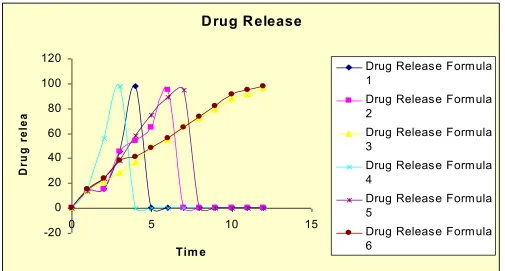
(2) Patel Krunal M et al. IRJP 2 (2) 2011 141-145 Dissolution Studies The dissolution of coated tablet was carried out for 12 hrs, for first two hr it was carried out in pH 1.2 buffer solution and for the next 10 hr it was carried out in pH 7.2 buffer solution. The dissolution was carried out using USP basket app. After every 1 hr 5 ml sample was withdrawn and was analyzed using UV spectrophotometer at max absorbance at 350 nm. RESULT AND DISCUSSION In the various formulation of the tablet coating various concentration of the coating polymer were employed. From the drug dissolution profile it was studied that low concentration of the coating polymer where unable to sustain the drug release of the drug from the tablet which was the main aim of these study.. Hence formula 3 and 6 shows that coating polymer employed in this formula was of the optimum concentration. And shown in the table below formula 3 and 6 have the drug release more than 95%. ACKNOWLEDGEMENT I am thankful to the company who provided me with the gift sample for carrying out my research work. REFERENCES 1. Alderman DA, A review of cellulose ethers in hydrophilic matrices for oral controlled-release dosage forms. Int. J. Pharm. Tech. Prod. Mfr., 1984: 1-9. 2. Colombo P et al. Drug release modulation by physical restriction of matrix swelling. Int. J. Pharm 1990; 63: 43-48. 3. Colombo P, Catellani PL, Peppas NA, Maggi L and Conte U. Swelling characteristics of hydrophilic matrices for controlled release. New dimensionless number to describe the swelling and release behavior. Int. J. Pharm 1992; 88 : 99-109. 4. Ford JL, Rubinstein MH and Hogan JE. Formulation of sustained release promethazine hydrochloride tablets using hydroxypropylmethylcellulose matrices. Int. J. Pharm 1985; 24: 327-338. 5. Ford JL, Rubinstein MH and Hogan JE. Propranolol hydrochloride and aminophylline release from matrix tablets containing hydroxypropylmethylcellulose. Int. J. Pharm 1985; 24: 339-350 6. Ford JL, Rubinstein MH and Hogan JE. Dissolution of a poorly water soluble drug, indomethacin, from hydroxypropylmethylcellulose controlled release tablets. J. Pharm. Pharmacol 1985; 37 : 33P. 7. Ford JL, Rubinstein MH, McCaul F, Hogan JE and Edgar PJ. Importance of drug type, tablet shape and added diluents on drug release kinetics from hydroxypropylmethylcellulose matrix tablets. Int. J. Pharm 1987; 40: 223-234. 8. Ford JL et al. Mathematical modeling of drug release from hydroxypropylmethylcellulose: effect of temperature. Int. J. Pharm 1991; 71: 95 104 9. Harland RS, Gazzaniga A, Sangalli ME, Colombo PC and Peppas NA. Drug/polymer matrix swelling and dissolution. Pharm. Res 1988; 5: 488 494. 10. Higuchi T. Mechanism of sustained-action medication. Theoretical analysis of rate of release of solid drugs dispersed in solid matrices. J. Pharm. Sci 1963; 52: 1145-1149. 11. Higuchi WI. Analysis of data on the medicament release from ointments. J. Pharm. Sci 1962;52:802804. 12. Hogan JE. Hydroxypropylmethylcellulose sustained release technology. Drug Dev. Ind. Pharm 1989; 15:975-1000. 13. Korsmeyer RW, Gurny R, Doelker E, Buff P and Peppas NA. Mechanisms of solute release from porus hydrophilic polymers. Int. J. Pharm 1983; 15 :25 35. 14. Langer RS and Peppas NA. Present and future applications of biomaterials in controlled drug delivery. Biomaterials 1987; 2 :201-214. 15. Lapidus H and Lordi NG. Some factors affecting the release of water-soluble drug from a compressed hydrophilic matrix. J. Pharm. Sci 1966; 55:840-843.. IRJP 2 (2) Feb 2011. Page 141-145.
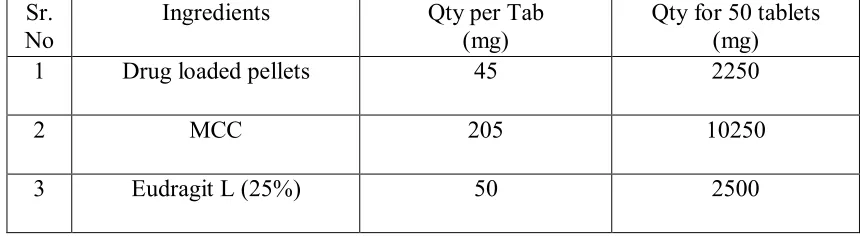
(3) Patel Krunal M et al. IRJP 2 (2) 2011 141-145 16. Lapidus H and Lordi NG. Drug release from compressed hydrophilic matrices. J. Pharm. Sci 1968;57:1292-1301. 17. Lee PI and Peppas NA. Prediction of polymer dissolution in swellable controlled-release systems. J. Control. Release 1987; 6:207-215 Sr. No 1. Table 1: Formulation 1 preparation of tablet by compression of pellets Ingredients Qty per Tab Qty for 50 tablets (mg) (mg) Drug loaded pellets 45 2250. 2. MCC. 205. 10250. 3. Eudragit L (5%). 50. 2500. Table 2: Formulation 2 preparation of tablet by compression of pellets Sr. Ingredients Qty per Tab Qty for 50 tablets No (mg) (mg) Drug loaded pellets 45 2250 1 2. MCC. 205. 10250. 3. Eudragit L (10%). 50. 2500. Table 3: Formulation 3 preparation of tablet by compression of pellets. Drug loaded pellets. Qty per Tab (mg) 45. Qty for 50 tablets (mg) 2250. 2. MCC. 205. 10250. 3. Eudragit L (25%). 50. 2500. Sr. No 1. Ingredients. Table 4: Formulation 4 preparation of tablet by compression of pellets Sr. No 1. Drug loaded pellets. Qty per Tab (mg) 45. Qty for 50 tablets (mg) 2250. 2. MCC. 205. 10250. 3. Eudragit S (5%). 50. 2500. Ingredients. IRJP 2 (2) Feb 2011. Page 141-145.
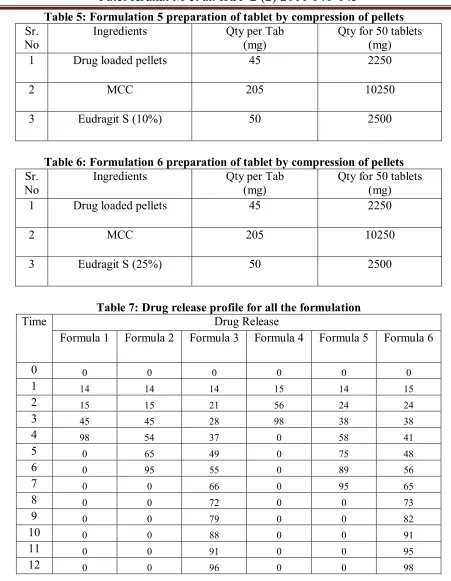
(4) Patel Krunal M et al. IRJP 2 (2) 2011 141-145 Sr. No 1. Table 5: Formulation 5 preparation of tablet by compression of pellets Qty per Tab Ingredients Qty for 50 tablets (mg) (mg) Drug loaded pellets 45 2250. 2. MCC. 205. 10250. 3. Eudragit S (10%). 50. 2500. Table 6: Formulation 6 preparation of tablet by compression of pellets Sr. Ingredients Qty per Tab Qty for 50 tablets No (mg) (mg) Drug loaded pellets 45 2250 1 2. MCC. 205. 10250. 3. Eudragit S (25%). 50. 2500. Time. 0 1 2 3 4 5 6 7 8 9 10 11 12. Table 7: Drug release profile for all the formulation Drug Release Formula 1 Formula 2 Formula 3 Formula 4 Formula 5. Formula 6. 0. 0. 0. 0. 0. 0. 14. 14. 14. 15. 14. 15. 15. 15. 21. 56. 24. 24. 45. 45. 28. 98. 38. 38. 98. 54. 37. 0. 58. 41. 0. 65. 49. 0. 75. 48. 0. 95. 55. 0. 89. 56. 0. 0. 66. 0. 95. 65. 0. 0. 72. 0. 0. 73. 0. 0. 79. 0. 0. 82. 0. 0. 88. 0. 0. 91. 0. 0. 91. 0. 0. 95. 0. 0. 96. 0. 0. 98. IRJP 2 (2) Feb 2011. Page 141-145.
(5) Patel Krunal M et al. IRJP 2 (2) 2011 141-145. D rug R elease. D ru g release. 120 100. Drug Release Formula 1. 80. Drug Release Formula 2 Drug Release Formula 3. 60 40 20. Drug Release Formula 4. 0. Drug Release Formula 5. -20. 0. 5. 10. 15. Tim e. Drug Release Formula 6. Fig 1: Drug release pattern for all the formulation. Drug Relase 100 90 80 70 60 Drug release 50 40 30 20 10 0. Time Drug Release Formula 1 Drug Release Formula 2 Drug Release Formula 3 Drug Release Formula 4 Drug Release Formula 5 1. 3. 5. 7. 9. 11. 13. Drug Release Formula 6. Time. Fig 2: Drug Release Comparison Source of support: Nil, Conflict of interest: None Declared. IRJP 2 (2) Feb 2011. Page 141-145.
(6)
Figure
Related documents
ITACA, working together with the Italian Hereditary Angioedema Patients ’ Association, col- lected data from C1-INH-HAE patients referring to 17 centers active in Italy.. Here
An initial introduction to the workshop and evidence- based review of existing problems with electronic health records and health information exchange during patient transitions of
Whereas legislative petitioning, due to most members of civil society lacking legislative drafting capacity, usually will be done in the form of legislative suggestions but not
(Right) During the test. Extraction–displacement curve for specimen B2482. Stages of the UPC ring method. A total of four circular specimens 30 cm in diameter per fabric were
According to a study published in 2016 by Michael Dynes, A National Study of Child and Family Therapists: The Relationships Between Parent Engagement, Supervision and Training, and
Among the many side effects are increased insulin resistance with disturbances in glucose/insulin homeostasis and increased deposition of lipids (mostly triglycerides) in the
[53] in their work evaluate the effect of the incident wave direction, wave height, wave period and rigidity of the floating body on the characteristics of the motion and the
Previous studies have shown that rhoptry proteins can undergo multiple pro- cessing events to remove the signal peptide and an N-terminal prodomain (4, 36, 44). It therefore
