c European Geosciences Union 2002
and Earth
System Sciences
Modelling of interaction between a snow mantle and a flexible
structure using a discrete element method
F. Nicot1and M. Gay2
1, 2Cemagref de Grenoble, Unit´e de Recherche Erosion Torrentielle Neige et avalanches, France 2Rue de la Papeterie, BP 76, F-38402 Saint Martin d’H`eres Cedex, France
Received: 20 September 2001 – Revised: 14 January 2002 – Accepted: 7 February 2002
Abstract. The search of improvement of protective tech-niques against natural phenomena such as snow avalanches continues to use classic methods for calculating flexible structures. This paper deals with a new method to design avalanche protection nets. This method is based on a cou-pled analysis of both net structure and snow mantle by using a Discrete Element Method. This has led to the development of computational software so that avalanche nets can be eas-ily designed. This tool gives the evolution of the forces acting in several parts of the work as a function of the snow situa-tion.
1 Introduction
1.1 Mountainous areas and snow instabilities
Mountainous areas are generally characterized by strong snow precipitation. Furthermore, these regions have com-mon geomorphological features: erosion has formed a set of valleys whose slopes are often steep. With the effects of gravity, a snow mantle on a slope is likely to develop a me-chanical instability. Its development depends on several fac-tors such as rheological properties of the material, the kind of soil, the topography, or the climatic conditions. Snow in-stability induces many natural phenomena characteristic of the mountain environment during winter: avalanches, snow mantle creeping, etc.
1.2 A case of active risk intervention: snow avalanche net structures
In the case of snow instabilities, risks can be reduced in dif-ferent ways. Active risk intervention aims to prevent the fail-ure of the snow mantle and the resulting avalanche; this is possible by stabilizing the snow mantle. Passive intervention does not prevent the triggering of the avalanche, but aims Correspondence to: F. Nicot
to control the avalanche flow in terms of avalanche direc-tion, velocity, width, and height. Snow avalanche net struc-tures belong to the category of active intervention. This pa-per deals with the modelling of interaction between a snow mantle and such a structure. Because of their linear shape, snow avalanche net structures are often well adapted to the local topographic conditions. These structures are composed of a set of panels of metallic net, held by poles and anchors (Fig. 1). The downward movement of the snow mantle is composed of a sliding motion (translation displacement of the entire mantle considered, parallel to the ground surface), and of a repetitive motion (creeping deformation with set-tlement). This complex movement directs a strain field and then a stress field into the net sheets. Consequently, a reac-tion force is applied to the snow mantle; this force results in a stabilization effect.
1.3 Goals and methodology
164 F. Nicot and M. Gay: Modelling of interaction between a snow mantle and a flexible structure
right side
left side
Fig. 1. Example of a snow avalanche net structure (EI Montagne).
upstream
downstream
θ
e
l
e
h L
Fig. 2. Spatial description of the snow mantle.
– Initially proposing the final geometrical shape of the structure (net sheets and wires) remains problematic. – Results from classic methods show that there is a strong
relationship between the final geometrical shape and the distribution of internal forces.
2 Mechanical modelling
2.1 Spatial description
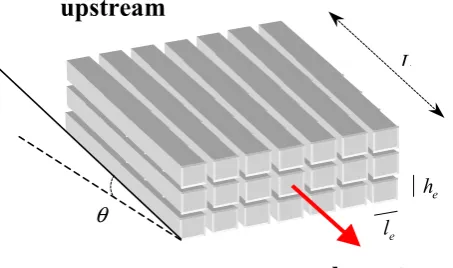
Let consider now the case of a stratified snowpack, located above a net structure, and laying on uniform slope (θ). We denoteLthe length of the snowpack,lits width, andH its height. It is assumed thatH is uniform. The snowpack is composed ofnl layers, whose height (hl) and length (L) are
uniform. The height of the entire mantle is given by relation:
H=
nl X
l=1
Hl. (1)
It is assumed that both densityρland mechanical
parame-ters related to the mantle are uniform within each layer “l”. It can be shown (Nicot, 2002) that each layer can be described
-1 -0.8 -0.6 -0.4 -0.2 0 0.2 0.4 0.6 0.8 1
-3 -2.5 -2 -1.5 -1 -0.5 0 0.5 INITIAL STRUCTURE
-Fig. 3. Spatial description of avalanche net structure.
by a regular set of rigid parallelepipedic elements (snow ele-ments). By denotinghe, le,andLrespectively the height, the
width and the length of each snow element “e”, the volume
Veis given by the relation:
Ve=he le L. (2)
It must be noted that the sizes ofheandle are very small
with regard toH andl. These elements are in contact each other, and may slide downsteam (Fig. 2). The constitutive behaviour of the snowpack is modelled by a viscoplastic law (Gagliardini, 1997) which allows the contact between each snow element to be described.
F. Nicot and M. Gay: Modelling of interaction between a snow mantle and a flexible structure 165 x uρ I4 I I1 I3 I2 I1 1 I I x x− θ ( )1
I
N
( )1
I
T
I
Fig. 4. Description of snow elements.
2.2 Mechanical description
2.2.1 Lagrangian description of the snowpack
Each snow element I which belongs to the layerl, is in con-tact with four other neighbouring elements (Fig. 4). It is sub-mitted to the action of both its weight and a set of four contact forcesTI(i). If the element is in contact with a node
belong-ing to the net sheet, it is submitted in addition to the reaction forceRI.
The kinematics of each snow element is completely de-scribed by a single parameterxI, which represents the total
displacement of elementIin directionux. The displacement
xI of snow element I belonging to the layerl, is given by
Eq. (3). If this element is not in contact with a node belong-ing to the net sheet,RI =0.
ρl Ve x¨1=ρl Ve sinθ+
4
X
i=1
TI(i)+RI. (3)
The contact forceT I (i) is computed by integrating the shear stressτI(i)along the surface at the interface of the two
elementsI andIi. As a first assumption, τI(i)is constant
along this surface, and only depends on the shear strainγI(i).
γI(i)can be assessed from the displacements of the elements
belonging to the common neighbouring ofI andIi (Nicot,
2002).
2.2.2 Discrete description of the net structure
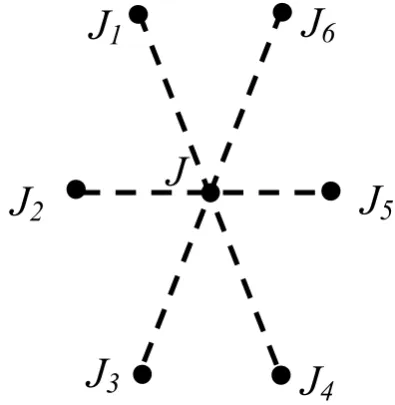
Each nodeJ belonging to the net sheet is connected to six neighbouring nodesJj (Fig. 5). In each fictitious single wire
joining neighbouring nodesJ andJj acts an elastic force
FJ(j ).
The vectorial locationxJ of nodeJ (massm), in contact
with snow elementI, is given by Eq. (4):
mx¨J =mg+
6
X
j=1
FJ(j )−RI ux, (4)
with:
FJ(j )=E S
kxJj −xJ k −loj loj
xJj−xJ kxJj−xJ k
, (5)
whereSis the cross section of the single wire joining nodesJ
andJj,lojis their initial length, andEis the elastic modulus
of the steel. It is assumed thatFJ(j )is a tension force; thus,
ifkJ JJ < loj, FJ(j )is equal to zero.
J
J
1
J
3
J
4
J
6
J
5
J
2
Fig. 5. Description of the net sheet. A set of neighbouring nodes.
2.2.3 Mechanical interaction between snowpack and net structure
It is assumed that during contact between a snow elementI
and a nodeJ, the node does not penetrate into the elementI. Thus, at each time, the incremental displacements of the two bodiesIandJin directionuxare equal:
dxj·ux =dxI. (6)
This kinematic condition allows reaction forceRI to be
computed.
3 Numerical modelling
Every balance Eqs. (3) and (4) can be written under the fol-lowing general formulation:
¨
ql =f (qm,q˙m) . (7)
An explicit numerical algorithm was developed which in-troduces time sampling of general Eq. (7) by using the ex-plicit Finite Differences Method. Thus, a set of exex-plicit equa-tions was obtained:
qI(t+τ )=2ql(t )−ql(t−τ )+τ2
f
qm(t )
qm(t )−qm(t−τ )
τ
, (8)
166 F. Nicot and M. Gay: Modelling of interaction between a snow mantle and a flexible structure
Table 1. Comparison between experimental and numerical results
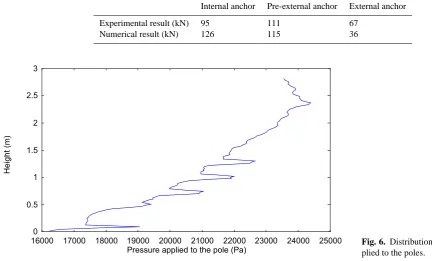
Internal anchor Pre-external anchor External anchor Experimental result (kN) 95 111 67
Numerical result (kN) 126 115 36
0 0.5 1 1.5 2 2.5 3
16000 17000 18000 19000 20000 21000 22000 23000 24000 25000
H
e
ight
(m)
Pressure applied to the pole (Pa) Fig. 6. Distribution of the pressure ap-plied to the poles.
4 A tool for designing avalanche structures
The numerical algorithm has led to the development of com-putational software so that avalanche nets can be easily de-signed as a function of upstream snow conditions. It is possi-ble to simulate several successive snow-meteorological sce-narios. By changing the number of layers, their height, their density or their mechanical parameters, snowfalls or melting with settlement can be simulated. Thus, this tool allows en-gineers to predict the mechanical behavior of the structure during usual or unusual climatic situations. The validation of this numerical tool is in progress. During the 1999–2000 winter, several snow avalanche net structures were monitored in the French Alps. Force sensors were mounted in order to record the changes in the forces acting in the upstream anchors. Analysis of the experimental results showed that those from the site of Flaine (Haute-Savoie) provided the most reliable and useable results. Data from this site were consequently chosen for analysis. In what follows, the situa-tion observed at the beginning of April 2000 (12 April 2000) is considered. The height of the snow mantle was equal to 3.58 m, and the average density was equal to 560 kg/m3. These values were measured 4 m upstream of the poles. A comparison between experimental and numerical values of the forces acting in the upstream anchors is presented in Table 1. The rather good agreement between experimental and numerical values provides a first element of validation. The distribution of the pressure applied to an internal pole is shown in Fig. 6. It can be noted that the shape of this distri-bution is approximatively linear along the pole.
5 Conclusions and perspectives
The forces acting into a protective structure can be under-stood as the final result of a chain of complex phenomena: (i) snow falls, (ii) physical and mechanical evolutions of the snowpack in interaction with the climatic conditions, the ground surface, and a flexible structure, and (iii) mechanical behaviour of a flexible structure.
As a direct experimental study of the snowpack remains a very difficult task, it seems it seems reasonable to use numer-ical simulation to indirectly obtain information related to the snowpack. In these conditions, the net structure appears like a macroscopic but relevant sensor. This paper presents a first step in this original approach. Further studies, which are in progress, aim to validate main assumptions used above.
References
Cundall, P. A. and Roger, D. H.: Numerical modelling of discon-tinua, Engineering computations, 9, 101–113, 1992.
Gagliardini, O. and Meyssonnier, J.: Flow simulation of a firn-covered cold glacier, Annals of Glaciology, 24, 242–248, 1997. Kern, F.: Calcul des efforts dans les filets paravalanches, Compte
rendu de la seconde deuxi`eme rencontre internationale sur la neige et les avalanches, ANENA, Grenoble, 241–250, 1978. Larsen, J. O.: Design criteria for cylindrical masts exposed to snow
creep forces, Snow engineering, Balkema, Rotterdam, 105–112, 2000.
Margreth, S.: Snow pressure measurements on snow net systems, Acte de colloque, Chamonix, 241–248, 1995.
Nicot, F.: Etude du comportement m´ecanique des ouvrages souples de protection contre les ´eboulements rocheux, Th`ese de troisi`eme cycle, Ecole Centrale de Lyon, 1999.
Nicot, F., Gay, M., and Tacnet, J. M.: Interaction between a snow mantle and a flexible structure, a new method to design
avalanche nets, Cold Regions Science and Technology, in press, 2001.
Nicot, F.: Modelling of a snowpack in interaction with a flexible structure by using a coupled Lagragian-Discrete approach, Me-chanics of Cohesive-frictional Materials, submitted, 2002. Sidoroff, F.: Comportement des mat´eriaux, Ecole Centrale de Lyon,