
ISSN (e): 2250-3021, ISSN (p): 2278-8719
Vol. 09, Issue 5 (May. 2019), ||S (IX) || PP 75-79
Traffic Surveillance System
Yashika Asnani, Jay Paryani, Prateek Meshram
1Department of Computer Science Engg,Jhulelal Institute Of Technology ,RTMNU, Nagpur 2Department of Computer Science Engg,Jhulelal Institute Of Technology ,RTMNU, Nagpur 3 Department of Computer Science Engg,Jhulelal Institute Of Technology ,RTMNU, Nagpur
Abstract:
Due to the large number of vehicles in circulation, studies of intelligent traffic systems have increased. Most of studies focus on the detection, tracking and counting of vehicles and on the estimation of traffic parameters. Two wheelers are most important mode of transport in many countries. The main advantages of motorcycles are their low price and operation cost compared with other vehicles. But the number of accidents involving motorcycles has increased during the last decade and no proper database maintenance is provided. There are various technologies of object detection being used today however accuracy is still not provided. Thus, our paper brings a new and efficient technology YOLO which is the most advanced technology which has inbuilt functions for object detection. Using this algorithm will result into improving traffic conditions and for avoiding accidents.Keywords:
Traffic control, traffic census, traffic statistics, traffic system, You Only Look Once, YOLO.I.
Introduction
Now-a-days traffic control is very essential in managing transportation systems. It is commonly seen in many modern cities that the road facilities do not improve proportionally in time with increase of population and vehicles. Massive vehicles on roads have brought about a sharp increase of traffic congestion, and further caused a series of social and economic problems [1]. Also, disobey of certain basic rules such as wearing helmet, avoiding triple seat, and driving within a certain limit has increased rates of accidents substantially thus causing a threat to the lives of lakhs of people.
India faces more than 200,000 deaths caused by road accidents and this was recorded by the Global Road Safety Report,2015 “the report states that the Indian road safety laws do not meet the best practice requirements for four out of five risk factors: enforcing speed limits, prevention of drunk driving, safety of children and use of helmets [2].
The accidents ratio is increasing day by day and various precautions are mandatory to be implemented. Smart cities have employed various techniques and methods for safety and emergencies such as helmet detection and automatic chalan generation which is yet not the most effective method in India with a huge crowd at a single signal. For generation of chalan, the camera needs to capture the image of the vehicle‟s number through which the chalan for the particular vehicle owner is generated and sent to their address. However, the camera captures only the vehicles of the front line and is unable to capture image of the vehicles behind this line. Thus, more improvements are required.
Looking into the accident prone areas in the past decades, one research focus has been urban intelligent transportation systems (ITSs) with the development of intelligent control and computer technology. ITS aims to provide innovative services for different modes of transportation and traffic management, and enable smarter use of transportation systems by individuals with better information and coordination [3].
Database collection for various road accidents occurring in several places all over India is done on a minimal rate. There are various proposed papers for traffic analysis and fall detection rates. Some major accident reports captured over years by traditional techniques gave the following analysis as shown in the figure below:
This is a report generated in the state of Andra Pradesh by Reserve Bank of India & Ministry of Shipping, Road Transport & Highways, GoI [3]. These statistics are not accurate and need more improvisation on data maintenance about the entire details of the accident occurrence along with the actual cause so that using that information certain conclusions can be made about the accident prone areas and how to improve the situation in those areas. Also, such information will prove helpful in estimating accidents through the type of vehicle and if it occurred due to alcohol consumption, crash, or due to non-helmet driving.
There is no such single database maintained for purposes such as detection of helmet, occurrences of accidents, triple seat, etc. which can help the government improve road conditions atleast in smart cities where the infrastructure can be borne. Therefore we to provide efficiency in results we put forward a new and smarter technology YOLO that is well known for its better frame per second speed that can prove beneficial in huge traffic areas.
II.
Related Work
1) Sharad Shrestha [4] did Analysis of Road Traffic Fatal Accidents Using Data Mining Techniques in which he followed traditional data analysis steps of data pre-processing, modelling and result analysis.
A. Data Preparation: Data preparation step was the first step in data analysis where all records with missing value in the chosen attributes were removed. Fatal rate is divided into two categories: high and low. Several variables are calculated from other independent variables
B. Modelling: They first calculated several statistics from the dataset to show the basic characteristics of the fatal accidents. We then applied association rule mining, clustering, and Naïve Bayes classification to find relationships among the attributes and the patterns.
C. Result Analysis USA has their results which include number of population along with the class labels and they use clustering algorithms to find the number of fatal accident in their region. They used a data analytic tool Weka to perform these analysis [4].
In their conclusion they stated that according to the statistics of classification and association rule mining, the weather conditions, road surface or light conditions do not contribute much into human fatalities than do human factors like being drunk, collision types, etc.
2) Wei Liu and Miaohui Zhang [5] used Deep Learning Method for Vehicle Type Classification on Visual Traffic Surveillance Sensors
To correctly classify vehicle type on images acquired from visual traffic surveillance sensors, we proposed an image classification scheme based on ensemble deep learning. The proposed vehicle classification scheme consists of two main stages. In the first stage, data augmentation with balanced sampling is applied to alleviate the unbalanced dataset problem. In the second stage, an ensemble of convolutional neural network models with different architectures is constructed with parameters learned on the augmented training dataset. Experiments on the MIO-TCD classification challenge dataset demonstrate that the proposed method is able to increase mean precision to some extent, compared with the baseline algorithms [5].
3) Hough Transform descriptor is basically used for detecting
regular curves such as lines, circles etc. They proposed to detect circles here and find whether a person is wearing helmet or not. If a person is not wearing helmet, use back ground subtraction method for extracting the license plate and use optical recognition method, to get license number of the
vehicle. Then look into the database and send the ticket to the matched person [6].
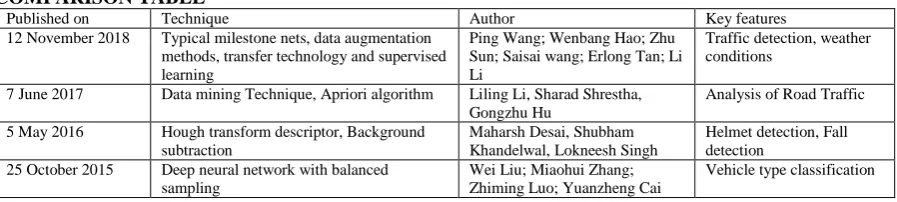
COMPARISON TABLE
Published on Technique Author Key features
12 November 2018 Typical milestone nets, data augmentation methods, transfer technology and supervised learning
Ping Wang; Wenbang Hao; Zhu Sun; Saisai wang; Erlong Tan; Li Li
Traffic detection, weather conditions
7 June 2017 Data mining Technique, Apriori algorithm Liling Li, Sharad Shrestha, Gongzhu Hu
Analysis of Road Traffic
5 May 2016 Hough transform descriptor, Background subtraction
Maharsh Desai, Shubham Khandelwal, Lokneesh Singh
Helmet detection, Fall detection
25 October 2015 Deep neural network with balanced sampling
Wei Liu; Miaohui Zhang; Zhiming Luo; Yuanzheng Cai
Vehicle type classification
Here we have compared authors of various publications along with the techniques they have used for factors like helmet detection, monitoring vehicular type, fall detection and traffic detection.
III.
Proposed Plan
After the survey we found that there are various schemes and algorithms implemented for object detection used in traffic analysis however accuracy is still not provided to its best. So, we want to put forth a latest algorithm for object detection YOLO which provides better accuracy and faster speed.
About YOLO:
YOLO is a new approach to object detection. Previous work on object detection and image recognition repurposes classifiers to perform detection. Instead, they did frame object detection as a regression problem to spatially separated bounding boxes and associated class probabilities. A single neural network predicts bounding boxes and class probabilities directly from full images in one evaluation.
Our unified architecture is extremely fast. Our base YOLO model processes images in real-time at a speed of 45 frames per second. A smaller version of the network, Fast YOLO, processes an astounding at a speed of 155 frames per second while still achieving double the mAP of other real-time detectors.
Fig 2: The YOLO Detection System. Processing images with YOLO is simple and straightforward. Our system
(1) resizes the input image to 448 × 448, (2) runs a single convolutional network on the image, and (3) thresholds the resulting detections by the model‟s confidence. [8].
Unified Detection: In a single neural network object in single neural network is unified .feature from entire
unique box are used to predict bounding box. Bounding boxes across all classes for an image are predicted. This means our network reasons globally about the full image simultaneously, and all the objects in the image. End to end training and real time speed are maintained by using YOLO design.
And the input image is divided into L × L grid by the system itself.
Fig 3: The Model. Our system models detection as a regression problem. It divides the image into an L × L grid and for each grid cell predicts „b‟ bounding boxes, confidence for those boxes, and „c‟ class probabilities. These predictions are encoded as an
L × L × (b ∗ 5 + c) tensor [8]
FLOW DIAGRAM
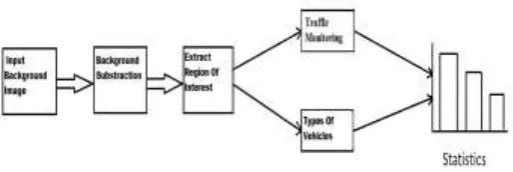
According to the below figure which shows data flow in our system, the camera recording the entire video captures pictures having vehicles. The background is subtracted and the region of interest is taken from that picture.
Background subtraction: In this method image background is extracted for further processing. It is the best approach for detecting objects from various videos taken by static cameras at traffic signal. There are many techniques and both expert and new comers can be confused about limitations and benefits of it.
Then the two purposes that our system provides of traffic monitoring and types of vehicles are served and are stored in the database. From the information collected, the entire data is represented in the form of statistics which provides better visualization.
we have data for daily traffic analysis to understand the statistics better.
Fig.4 Data flow diagram
SYSTEM ARCHITECTURE
Fig 5. Data of vehicles getting detected in image frame
Fig.6 Overview of main dashboard
IV.
Result Analysis
Real-Time Detection of image and objects in the wild: YOLO has proved itself as a fast and accurate object
detector, making it ideal for computer vision applications. We connect YOLO to a webcam and verify that it maintains real-time performance, including the time to fetch images from the camera and display the detections. The resulting system is interactive and engaging. While It functions like a tracking system when attached to a web cam and has individual object processing, detecting objects as they move around and change in appearance. When compared to state-of-the-art detection systems, YOLO is known for making more localization errors but is less likely to predict false positives on background. Finally, YOLO learns very general representations of objects. It outperforms other detection methods, including DPM and R-CNN, when generalizing from natural images to other domains like artwork.
Fig 7: Picasso Dataset precision-recall curves [9].
V.
Conclusion
We studied various algorithms in implementation for traffic surveillance that are used in several sectors of the world. Data mining and Apriori algorithm is used for analysis of road traffic, supervised learning for traffic detection and weather conditions, Hough transform descriptor for helmet detection and deep neural network for vehicle type classification.
We proposed to use YOLOv3 which is a deep neural network object detection algorithm for detecting objects and thus making tasks such as helmet detection, fall detection, classification of vehicles to be achieved under a single platform. YOLOv3, a state-of-the-art, real-time object detection system that can detect over 9000 object categories. This will increase accuracy in places with huge traffic like cities in India.
Fast YOLOv3 is the fastest general-purpose object detector in the literature and YOLOv3 pushes the state-of-the-art in real-time object detection. YOLOv3 also generalizes well to new domains making it ideal for applications that rely on fast, robust object detection.
References
[1]. G. Dimitrakopoulos and P. Demestichas, „„Intelligent transportation systems,‟‟ IEEE Veh. Technol. Mag., vol. 5, no. 1, pp. 77–84, Mar. 2010.
[2]. International Journal of Engineering Trends and Technology (IJETT) – Volume 35 Number 5- May 2016
[3]. Reserve Bank of India, Government of India, Macro-economic aggregates (at constant prices) in India. Available from, http://www.indiastat.com.
[4]. Liling Li, Sharad Shrestha, Gongzhu Hu, “Analysis of Road Traffic Fatal Accidents Using Data Mining Techniques,” in 2017 IEEE SERA 2017, June 7-9, 201
[5]. WEI LIU 1,2, MIAOHUI ZHANG3, ZHIMING LUO4, AND YUANZHENG CAI5, “An Ensemble Deep Learning Method for Vehicle Type Classification on Visual Traffic Surveillance Sensors” VOLUME 5, 2017
[6]. Maharsh Desai , Shubham Khandelwal , Lokneesh Singh , Prof. Shilpa Gite “Automatic Helmet Detection on Public Roads” International Journal of Engineering Trends and Technology (IJETT) – Volume 35 Number 5- May 2016.
[7]. PENGFEI SHAO1, LEI WANG, “A Distributed Traffic Control Strategy Based on Cell-Transmission Model” version March 15, 2018.
[8]. Joseph Redmon, Ali Farhadi, “YOLO9000: Better, Faster, Stronger”25 dec 2016.
[9]. Joseph Redmon, Santosh Divvala, Ross Girshick, Ali Farhadi, “You Only Look Once: Unified, Real-Time Object Detection,” University of Washington, Allen Institute for AI, Facebook AI Research May 2016
[10]. S. Bell, C. L. Zitnick, K. Bala, and R. Girshick. Insideoutside net: Detecting objects in context with skip pooling and recurrent neural networks. arXiv preprint arXiv:1512.04143, 2015.
[11]. J. Deng, W. Dong, R. Socher, L.-J. Li, K. Li, and L. FeiFei. Imagenet: A large-scale hierarchical image database. In Computer Vision and Pattern Recognition, 2009. CVPR 2009. IEEE Conference on, pages 248–255. IEEE, 2009.
![Fig 1. Exposure risk per 10 000 vehicles and 100 000 people [3].](https://thumb-us.123doks.com/thumbv2/123dok_us/7803166.1660872/1.595.177.507.618.731/fig-exposure-risk-vehicles-people.webp)
![Fig 7: Picasso Dataset precision-recall curves [9].](https://thumb-us.123doks.com/thumbv2/123dok_us/7803166.1660872/5.595.213.390.212.344/fig-picasso-dataset-precision-recall-curves.webp)
