e- ISSN: 2278-067X, p-ISSN: 2278-800X, www.ijerd.com
Volume 14, Issue 7 (July Ver. I 2018), PP.71-77
Sun Tracking System Performance- A Report
Anil Kumar Jaiswal
1, Binay Kumar
21- Assistant Professor, Mechanical Engineering, HITM, Ambala, Haryana, India 2-Professor, Mechanical Engineering, MMDU, Mullana, Ambala, Haryana, India
Corresponding Author: Dr. Binay Kumar
ABSTRACT
The adjustable PV cell panels are currently not widely deployed due to mainly the cost of the additional parts that are needed for adjustments. Such cost is greater than the additional energy generated due to the Sun tracking for some locations.
This research contributes to the ongoing discussions about the grid-connected solar photovoltaic (PV) systems and draws attention to considering various PV arrays tracking systems by the different researchers for the power generation. The PV tracking system configurations are considered in the present study.
KEY WORD: Sun Tracker, Photovoltaic Cell, Two Axis Tracker, Grid Connection, Adjustment types
--- --- Date of Submission: 09-07-2018 Date of acceptance: 23-07-2018 --- ---
I. INTRODUCTION
Solar energy is a very attractive renewable energy source due its various advantages like light weight, free, sustainable, less complex structural requirement, noise free operation, absence of large rotating machinery, easy installation, application close to requirement, less maintenance are some of its advantageous features for gaining attention in the energy sector in comparison to fossil fuels.
The consumption of fossil fuels causes climatic changes due to the release of carbon-dioxide to the atmosphere. The increasing demand for energy, the continuous reduction in existing sources of fossil fuels and the growing concern regarding environment pollution, have pushed mankind to explore new technologies for the production of electrical energy using clean, renewable sources, such as solar energy.
Among the non-conventional, renewable energy sources, solar energy affords great potential for conversion into electric power and able to ensure an important part of the electrical energy needs of the planet.
Solar tracking is also an efficient way of improving the efficiency of the module. Load matching is required for extracting maximum power from a PV module. There are two ways of tracking passive tracking where the module orientation changes slowly as per the set path and active tracking which is based on the use of optical sensors.
The use of Sun-trackers cause an increase in the energy collected from Sun by 10% to 50% which depends on geographical conditions and time period. Recently a 45-day experimental study conducted by researchers concludes the fact that by the use of Sun-trackers, the amount of energy produced significantly increases by 20–50%. Dust deposition on the surface of solar modules can cause two different effects i.e. firstly by reducing the amount of solar radiation by decreasing the transmittance of the glass cover and secondly by reducing the concentrating ability of the concentrating optical system.
Dust deposition depends on various factors like material, size, wind speed, humidity, tilt, geographical location, seasonal effect etc. In a partially shadowed cell the shadowed portion does not produce any electrical power where as the unhanded part produces power. The voltage generated from the illuminated part forward bias the parallel rectifier. Subsequent development of the solar cell i.e. developed by a semi-conductive material, converts visible light into a direct current (DC). A Solar tracker is a device used for orienting a solar photovoltaic panel or lens towards the Sun by using the solar or light sensors connected with the system.
Extracting usable electricity from the Sun was made possible by the discovery of the photoelectric effect. Solar arrays, a series of solar cells electrically connected, generates a DC voltage which can be used on a load solar tracker is a system which chase the Sun during day time as it rotate from east to west. This tracker will provide two or three degree accuracy. Using a solar tracker will increase the solar energy input to the panel and helps in producing more electricity generation. The overall performance can be increased from 25-35%.
In the case of solar light conversion into electricity, due to the continuous change in the relative positions of the Sun and the earth, the incident radiation on a fixed PV panel is continuously changing, reaching a maximum point when the direction of solar radiation is perpendicular to the panel surface. In this context, it is necessary to have it equipped with a solar tracking system for the maximal energy efficiency of a PV panel system.
RESEARCH AREAS
Many research have been carried out on the Sun tracking system and fixed photovoltaic systems. Some of them are mentioned below:
Alik et_al [1] have presented a study of shading Effect on photovoltaic modules with proposed P&O checking algorithm. Basore et_al [2] have design a New Polycrystalline Silicon PV Technology. Chahid et_al [3] have developed a knowledge based system related effect of measurement factors on photovoltaic cell parameter.
Chenlo et_al [4] have presented a linear concentrator photovoltaic module analysis of non-uniform illumination and temperature effects on efficiency. Whereas, Ismail et_al [5] have analyzed and evaluatedthe various aspects of solar radiation in the Palestinian territories.
Kumari et_al [6] have mathematical modeling and simulation of Photovoltaic cell using met lab simulink environment. Mousazadeh et_al [7] have reviewed of principle and Sun-tracking methods for maximizing solar systems output. Musthafa et_al [8] have designed for enhancing photoelectric conversion efficiency of solar panel by water cooling. Saidan et_al [9] have developed Experimental study on the effect of dust deposition on solar photovoltaic panels in desert environment.
Sanderson et_al [10] have worked on the effects of non-uniform illumination and temperature profiles on silicon solar cells under concentrated Sunlight. Sathyanarayan et_al [11] have presented on the effect of shading on the performance of solar PV panel.
II. SOLAR LIGHT CONVERSION SYSTEM
The conversion of solar light into electrical energy represents one of the most promising and challenging energetic technologies in continuous development is being clean, silent and reliable, with very low maintenance costs and minimal ecological impact. Solar energy is free, practically inexhaustible and involves no polluting residues or greenhouse gases emissions.
The conversion principle of solar light into electricity is, called Photo-Voltaic or PV conversion that is not very new but the efficiency improvement of the PV conversion equipment is still one of the top priorities for many academic and/or industrial research groups all over the world.
We can mention the solar tracking, the optimization of solar cell configuration and geometry, new materials and technologies, etc. are among the proposed solutions for improving the efficiency of PV conversion system.
3.1 SOLAR TRACKER
A Solar tracker is a device used for orienting a solar photovoltaic panel or lens towards the Sun by using the solar or light sensors connected with the system like stepper motor, servo motor, gas filled piston. A solar tracker is a devices that orient or align various payloads toward the Sun in which payloads are photovoltaic panels, reflectors, collectors, lenses or other optical devices. The system focuses on the optimization of the electric energy produced by photovoltaic cells through the development of a Sun-tracking system.
3.2 NECESSITY OF SUN TRACKER
Global warming has increased the demand and request for green energy produced by renewable sources such as solar power. To increase efficiency up to 40% by using of tracker as compare to fixed solar panel. The performance gain of 25-35% by using single axis tracker & double-axis solar trackers, performance goes up additionally 5-10% in comparison to fixed type of solar Panel[4].
The global market for PV conversion equipment has an exponential increase over the last years, showing a good tendency for the years to come. Physically, a PV panel consists of a flat surface on which numerous p-n junctions are placed and connected together through electrically conducting strips. The PV panel ensures the conversion of light radiation into electricity and it is characterized by a strong dependence of the output power on the incident light radiation.
3.3 Aspect of Solar Tracker
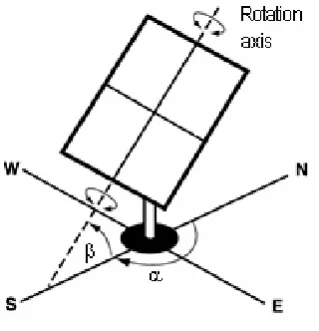
solar panel is fixed, now it has to bear the rise and fall extremes of 75 degree, and there must be a loss of approximately 75% of solar radiation. The rotating panels well help to recover those losses. This is the working of single axis tracker. Now, during the entire year the Sun moves 45 degrees north-south. The panel placed (Fig.1) at mid moving east-west will find the Sun moves 23 degree on each side north-south. Now when this is able to track on daily and also depending on other axis north-south is a dual axis solar tracker.
Fig.1: Rotating Panel Direction
III. PV PANEL EFFICIENCY WITH SOLAR TRACKER
Compared to a fixed panel, a mobile PV panel driven by a solar tracker is kept under the best possible in solution for all positions of the Sun, as the light falls close to the geometric normal incidence angle. Automatic solar tracking systems (using light intensity sensing) may boost consistently the conversion efficiency of a PV panel, thus in this way deriving more energy from the Sun.
Technical reports in the USA have shown solar tracking to be particularly effective in summer, when the increases in output energy may reach over 50%, while in autumn they may be higher than 20%, depending on the technology used. Solar tracking systems are of several types and can be classified according to several criteria. The first classification can be made depending on the number of rotation axes i.e. solar tracking system with a single rotation axis and with dual rotation axes. Since solar tracking implies moving parts and control systems that tend to be expensive, single-axis tracking systems seem to be the best solution for small PV power plants (Fig.2). Single axis trackers will usually have a manual elevation (axis tilt) adjustment on the second axis which is adjusted at regular intervals throughout the year.
A single-axis solar tracking system uses a tilted PV panel mount, and a single electric motor to move the panel on an approximate trajectory relative to the Sun’s position.
Fig. 2: Two Axis Rotation Solar Tracker
Second classification of solar tracking systems can be made depending on the orientation type. According to this criterion, solar tracking systems which orient the PV panels based on a previously computed Sun trajectory in comparison with panels with an on-line orientation system that reacts to the instantaneous solar light radiation perpendicular to the solar panel. The later solution is more efficient and it was chosen for the solar tracking system proposed in this paper work.
IV. THE SOLAR TRACKING SYSTEM
The proposed solar tracking system should satisfy certain technical requirements specific to the studied are as follows:
Minimum energy consumption, for the maximization of global Efficiency installation and optimum performance cost ratio.
Reliability in operation, under different perturbation conditions (wind, dust, rain, important temperature variations).
Simplicity of movement solution (motor, gears, sensors), to diminish the cost and to increase the viability.
Possibility of system integration in a monitoring and control centralized structure which means a digital control solution.
Taking into account these implicitly necessary technical requirements, the chosen solution to drive the PV panel is based on the following components a DC electric motor, voltage mode driven, with current monitoring, without movement sensors (speed or position).
A motor control system of intelligent drive type, completely digital, that allows the implementation of the digital control of the motor as well as the implementation in a dedicated motion control language of the PV panel orientation application.
A measurement system for light intensity applied to the PV panel representing the sensor that commands the solar panel movement. The chosen technical solution offers the following important advantages.
Simplicity of power scheme: DC motor and H bridge converter (4 transistors) for the motor drive.
V. THE COMPONENT OF SOLOR TRACKING SYSTEM
The Solar Panel Stepper Motor Actuator Micro-controller
A Display unit (optional) Interfacing Cable
6.1 Solar Panel
An array of solar panels (Fig.3) makes photovoltaic system which converts solar radiation into electricity. Each panel is made of modules and each module is made of solar cells which are mostly semiconductors. Fill factor and efficiency are the estimating factor for knowing the capacity of the PV cell. Study shows that only a fraction of solar light striking the module is converted into electrical energy and the rest of the absorbed energy is converted to heat which cause increase in the junction temperature.
6.2 Stepper Motor
A stepper motor (Fig.4) is an electro-mechanical device which converts electrical pulses into discrete mechanical movements.
Fig.4: Stepper Motor i. Motor Drive System[1]
DC motor the parameters of the DC motor used as the movement execution element are: rated voltage 24 V, rated current 3 A, maximum speed 3000 rpm, gear box with a speed reduction ratio of 1:20 intelligent drive unit IBL2403. To command the DC motor, the intelligent drive unit IBL2403, executed by Techno soft. This component is a completely digital drive system, executed using DSP technology, dedicated to the command of DC electric motors, sinusoidal or trapezoidal commutated brushless motors or stepper motors. It accepts as position sensors, incremental encoders, digital or linear Hall sensors.
A motor drive, in the field of photography, is a powered film transport mechanism. Historically, film loading, advancing, and rewinding were all manually driven functions. The desires of professional photographers for more efficient shooting, particularly in sports and wildlife photography, and the desires of amateur and novice photographers for easier to use cameras both drove the development of automatic film transport. Some early developments were made with clockwork drives, but most development in the field has been in the direction of electrically driven transport.
6.3 Actuator
An actuator is a component of a machine that is responsible for moving or controlling a mechanism or system, for example by actuating (opening or closing) a valve; in simple terms, it is a "mover".
An actuator requires a control signal and a source of energy. The control signal is relatively low energy and may be electric voltage or current, pneumatic or hydraulic pressure, or even human power. The supplied main energy source may be electric current, hydraulic fluid pressure, or pneumatic pressure. When the control signal is received, the actuator responds by converting the energy into mechanical motion.
An actuator is the mechanism by which a control system acts upon an environment. The control system can be simple (a fixed mechanical or electronic system), software-based (e.g. a printer driver, robot control system), a human, or any other input.
i. Hydraulic actuator ii. Pneumatic actuator iii. Electric actuator iv. Mechanical actuator
v. Thermal and magnetic actuator
VI. TECHNOLOGY OF SOLAR SYSTEM
Many industrialized nations have installed significant solar power capacity into their grids to supplement or provide an alternative to conventional energy sources while an increasing number of less developed nations have turned to solar to reduce dependence on expensive imported fuels. Long distance transmission allows remote renewable energy resources to displace fossil fuel consumption. Solar power plants use one of two technologies
i. Photovoltaic Cell
work of Russell Ohl in the 1940s, researchers Gerald Pearson, Calvin Fuller and Daryl Chapin created the silicon solar cell in 1954. These early solar cells cost 286 USD/watt and reached efficiencies of 4.5–6%
ii.Conventional Photovoltaic system
The array of a photovoltaic power system[1], or PV system, produces direct current (DC) power which fluctuates with the sunlight's intensity. For practical use this usually requires conversion to certain desired voltages or alternating current (AC), through the use of inverters. Multiple solar cells are connected inside modules. Modules are wired together to form arrays, then tied to an inverter, which produces power at the desired voltage, and for AC, the desired frequency/phase.
Many residential PV systems are connected to the grid wherever available, especially in developed countries with large markets. In these grid-connected PV systems, use of energy storage is optional. In certain applications such as satellites, lighthouses, or in developing countries, batteries or additional power generators are often added as back-ups. Such stand-alone power systems permit operations at night and at other times of limited Sunlight.
VII.TRANSPORT APPLICATION
Development of a solar-powered car has been an engineering goal since the 1980s. The World Solar Challenge is a biannual solar-powered car race, where teams from universities and enterprises compete over 3,021 km (1,877 mi) across central Australia from Darwin to Adelaide. In 1987, when it was founded, the winner's average speed was 67 km per hour (42 mph) and by 2007 the winner's average speed had improved to 90.87 km per hour (56.46 mph). The North American Solar Challenge and the planned South African Solar Challenge are comparable competitions that reflect an international interest in the engineering and development of solar powered vehicles. Some vehicles use solar panels for auxiliary power, such as for air conditioning, to keep the interior cool, thus reducing fuel consumption[7].
In 1975, the first practical solar boat was constructed in England. By 1995, passenger boats incorporating PV panels began appearing and are now used extensively. In 1996, Kenichi Horie made the first solar-powered crossing of the Pacific Ocean, and the Sun21catamaran made the first solar-powered crossing of the Atlantic Ocean in the winter of 2006–2007. There were plans to circumnavigate the globe in 2010.
A solar balloon is a black balloon that is filled with ordinary air. As Sunlight shines on the balloon, the air inside is heated and expands causing an upward buoyancy force, much like an artificially heated hot air balloon. Some solar balloons are large enough for human flight, but usage is generally limited to the toy market as the surface-area to payload-weight ratio is relatively high.
VIII. PERFORMANCE OF THE PHOTOVOLTAIC MODULE
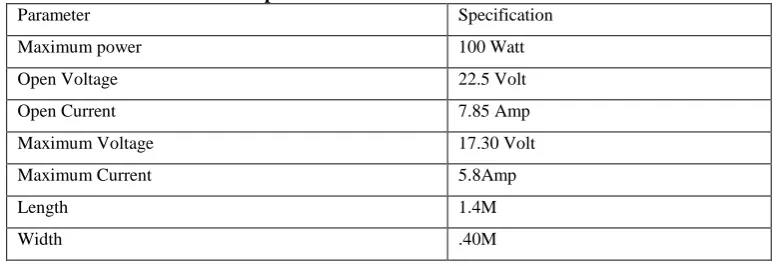
Studies show [9] that that there are several factors which affect the power output of PV module, while designing a PV system these factors should be given importance for better performance. Solar was used for the experiment purpose. The module specification is given in Table-1 below. A solar meter was used to measure the irradiance level. Resistance temperature detector was used to measure the temperature of the PV module. A voltmeter and ammeter of dc type was used for measurement of voltage and current. A rheostat was connected for varying the resistance which acts like a load. For the soiling and shading test two numbers of PV modules of same rating was used so that the output of dusty panel was compared with that of the clean panel and un-shaded panel with shaded one. The output characteristics of solar cells are expressed in the form of I-V curve and P-V curve. The module specification is given as below.
Table 1. Specification of the Photovoltaic Module Parameter Specification
Maximum power 100 Watt
Open Voltage 22.5 Volt
Open Current 7.85 Amp
Maximum Voltage 17.30 Volt
Maximum Current 5.8Amp
Length 1.4M
77
IX. RESULTS AND ANALYSIS
In this analysis various factors like irradiance, temperature, angle of tilt, soiling and shading are taken to see the effect of these various factors on the power output of the PV module.
i. Effect of Irradiance
As the Sun’s position changes throughout the day irradiance also keeps changing with it[2]. It is found that maximum irradiance is around 12:00 to 1:00 pm and slowly it goes on decreasing. Keeping factors like temperature and spectral content constant both short circuit current and open circuit voltage increases with increase in the intensity of radiation. As the no of photons striking the module increases photon generated current also increases
X. CONCLUSIONS
Based on the obtained results from different researchers, it can be concluded that the proposed solution for a solar tracking system offers several advantages concerning the movement command of the PV panel[1,4,8]:
An optimum cost/performance ratio, which is achieved via simplicity of adopted mechanical solution and the flexibility of the intelligent command strategy.
The minimum of energy consumption, due to fact that the panel movement is carried out only in justified cases by eliminating unnecessary consumption of energy and due to the cutting of the power circuit supply between the movement periods of the PV panel.
The maximization of output energy produced by the PV panel, through an optimal positioning executed only for sufficient values of light signal intensity that guarantee of panel in positions starting from any initial position of the PV panel.
Horizontal tracker with continuous adjustment shows the highest net present cost (NPC) and the highest level zed cost of energy (LCOE) with a high penetration of solar energy to the grid.
The vertical axis tracker with continuous adjustment is the best option as it has low LCOE and NPC values with a positive return on investment (ROI) as well as high renewable energy penetration to the grid, which enhances its viability for a utility-size solar PV grid-connected system.
The elimination of unnecessary movements at too small intensities of the light signals or at too small differences between the signals received from the two LEDs.
The possibility of extending this solution to an array of PV panels, connected to each other, with inter-connected operable by CAN protocol communication among the panels and managed by a central computation unit for monitoring and control.
Based on the obtained results, this can affirm that proposed solution is effective and presents interesting advantages from the point of view of practical applicability to larger power PV structures.
REFERENCES
[1]. R. Alik, “A Study of Shading Effect on Photovoltaic Modules with Proposed P&O Checking Algorithm,” International journal of Electrical and Computer engineering, IJECE, Vol. 7, No. 1, pp. 29-40, 2017.
[2]. P. A. Basore, “Manufacturing a New Polycrystalline Silicon PV Technology” Conference Record of the 2006 IEEE 4th World Conference on Photovoltaic Energy Conversion, pp. 2089-2093, 2006.
[3]. E. H. Chahid,“Effect of Measurement Factors on Photovoltaic Cell Parameters Extracting,” International Journal of Electrical and Computer Engineering, IJECE, Vol. 7, No.1, pp. 50-57, 2017.
[4]. F. Chenlo and M. Cid,, “A linear concentrator photovoltaic module: analysis of non-uniform illumination and temperature effects on efficiency,” Sol. Cells, Vol. 20, pp. 27–39, 2008.
[5]. M. S. Ismail,“Analysis and evaluation of various aspects of solar radiation in the Palestinian territories,” Energy Convers Manage, pp. 7357–7368, 2013.
[6]. J. S. Kumari,“Mathematical Modeling and Simulation of Photovoltaic Cell using Matlab-Simulink Environment,” International journal of Electrical and Computer engineering, Vol. 2, No. 1, pp. 26-34, 2012.
[7]. H. Mousazadeh, “A review of principle and Sun-tracking methods for maximizing solar systems output,” Renew Sust Energy Rev, Vol. 13, pp. 1800–1818, 2009.
[8]. M. M. Musthafa,“Enhancing Photoelectric Conversion Efficiency of Solar Panel by Water Cooling,” J Fundam Renewable Energy Appl, Vol. 5, No. 4, pp. 1-5, 2015.
[9]. M. Saidan, “Experimental study on the effect of dust deposition on solar photovoltaic panels in desert environment,” Elsevier, Renewable Energy, Vol. 92, pp. 499-505, 2016.
[10]. R. W. Sanderson, “The effects of nonuniform illumination and temperature profiles on silicon solar cells under concentrated Sunlight,” Conference record, 14th IEEE PVSC, pp. 43–436, 2007.