© 2015, IJCSMC All Rights Reserved 36
Available Online atwww.ijcsmc.com
International Journal of Computer Science and Mobile Computing
A Monthly Journal of Computer Science and Information Technology
ISSN 2320–088X
IJCSMC, Vol. 4, Issue. 1, January 2015, pg.36 – 44
RESEARCH ARTICLE
Different QoS Based Simulation Evaluation of
AODV Protocol Using
Direct Sequence
for 1 Mbps
and 11 Mbps Using OPNET
Narender
1, Ravi Antil
2, Jonish
3¹M-Tech Department of ECE, MSIT, Sonepat, Haryana, India ²Assistant Professor, Department of ECE, MSIT, Sonepat, Haryana, India
³Department of CSE, Sonepat, Haryana, India
1
[email protected]; 2 [email protected]; 3 [email protected]
Abstract— Mobile Ad-Hoc network (MANET) is a network of mobile nodes that can communicate with each other without using any centralized control or fixed infrastructure .In this paper analysis of the performance of AODV routing protocol is done with the use of OPNET simulation tool, we created a 27 mobile nodes networks on data rate 1 and 11 Mbps and transmission power 0.005 watts with buffer size 256000 bits the time of simulation was 1200 sec. AODV routing protocol is compared in terms of AODV Route Discovery time, FTP Download Response Time(sec), HTTP Object Response Time (sec), WLAN Delay (sec) and AODV Total Cached Replies Sent in scenario for the simulation analysis and performances. According to the resulted performance AODV performed better in 11 Mbps then 1 Mbps. The simulation result of the research has practical reference value for further study.
Keywords— AODV, MANET, QOS, OPNET
I. INTRODUCTION
© 2015, IJCSMC All Rights Reserved 37
Routing protocol is the major issue in data communication’s performance of MANET. Hence, routing protocol required is to be effective and accurate so as to handle mobility of nodes and to give best utilization to technology. In this paper performance of AODV protocol is evaluated by using FTP and HTTP application type of IEEE 802.11a/b/g WLAN Standard. [2]
II. RELATED WORK
Sandeep Kaur [1] Mobile Ad hoc network is concept of communication that mobiles nodes want to communicate using dynamic topology. The important characteristics of having dynamic topology is node can change position quite frequently. Nodes consists laptops and personal digital assistants and are often very limited in resources like CPU capacity, storage capacity, battery lifetime and bandwidth. The routing protocol should minimize the control traffic and calculate route only when they receive request. In this paper they present simulation analysis of the AODV Protocol consider two networks one having smaller nodes and other having larger nodes.
Anjali [2] analyzed the performance of AODV, OLSR and GRP routing protocols is evaluated for FTP based application traffic on IEEE 802.11 WLAN Standard and 48 Mbps data rate. The network performance is evaluated by using OPNET simulator based on various quantitative metrics- Network Load, Throughput, Retransmission Attempts and Media Access Delay by varying physical characteristics and number of nodes. A comparative performance analysis of these protocols have been carried out in this paper and in the last conclusion will be presented which demonstrate that performance of routing protocols differs by varying the network and selection of accurate routing protocol according to the network ultimately influences the efficiency of the network in a magnificent way.
Ravinder Ahuja [4] evaluated performance of three types of routing protocols (AODV, OLSR and ZRP) based on random waypoint mobility model. In this paper they analyze and compare the performance of protocols using Qualnet 4.5 from scalable network .These routing protocols were compared in terms of Packet delivery ratio, Average end-to end delay and Throughput when subjected to change in no. of nodes and pause time. Simulation results show that Reactive protocols better in terms of packet delivery ratio and throughput
III. MANET ROUTING PROTOCOLS
In a wireless network, simultaneous packet transmission by nearby nodes is often undesirable. This is because any resulting collision between these packets may cause a receiving node to fail to receive some or all of these packets. The vision of mobile ad hoc networking is to support robust and efficient operation in mobile wireless networks by incorporating routing functionality into mobile nodes. Such networks are envisioned to have dynamic, sometimes rapidly-changing, random, multi-hop topologies which are likely composed of relatively bandwidth-constrained wireless links. A number of routing protocols are created to be implemented on MANET categorized in three different types according to the functionality. Here in this paper we are discussing about AODV protocol which comes under the Reactive Protocols category.[5]
© 2015, IJCSMC All Rights Reserved 38
AODV is an on-demand routing algorithm in that it determines a route to a destination only when a node wants to send a packet to that destination. Routes are maintained as long as they are needed by the source. AODV is capable of both unicast and multicast routing. [8]
IV. SIMULATION SETUP
We used software known as OPNET Modeler to conduct this work, Which is a tool provided by the OPNET Technologies in order to undertake the experimental evaluation; the version named OPNET Modeler 14.5 has been adopted for study [7]. OPNET is one of the most extensively used commercial simulators based on Microsoft Windows platform, which incorporates most of the MANET routing parameters compared to other commercial simulators. It simulates the network graphically and gives the graphical structure of actual networks and network components.
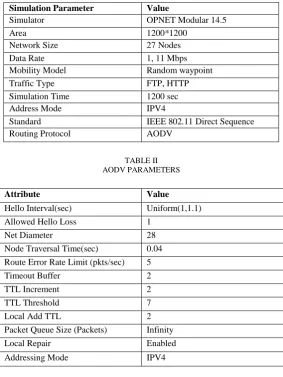
TABLE I
SIMULATION PARAMETERS
Simulation Parameter Value
Simulator OPNET Modular 14.5
Area 1200*1200
Network Size 27 Nodes Data Rate 1, 11 Mbps Mobility Model Random waypoint Traffic Type FTP, HTTP Simulation Time 1200 sec Address Mode IPV4
Standard IEEE 802.11 Direct Sequence Routing Protocol AODV
TABLE II AODV PARAMETERS
Attribute Value
Hello Interval(sec) Uniform(1,1.1) Allowed Hello Loss 1
© 2015, IJCSMC All Rights Reserved 39
TABLE III
WIRELESS LAN PARAMETERS
Attribute Value
Physical Characteristics Direct Sequence Data Rate 1,11 Mbps Short Retry Limit 7
Long Retry Limit 4 Max Receive Lifetime (sec) 0.5 Buffer Size(bits) 256000 Roaming Capability Disabled
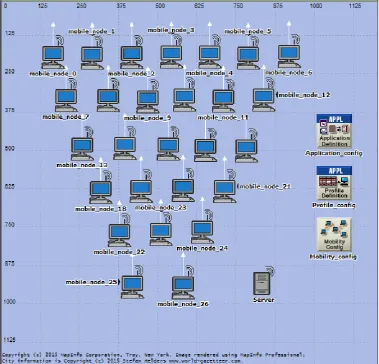
Fig. 1 shows the simulation environment of scenario containing 27 WLAN mobile nodes, one fixed WLAN Server, Application definition, Profile definition and Mobility config. We configured the nodes in the scenario to work with 1 Mbps and 11 Mbps data rate.
© 2015, IJCSMC All Rights Reserved 40
V. PERFORMANCE METRICS
A. AODV Route Discovery time
This is how we can check the AODV Route Discovery time i.e. the time taken to find out the route for the process.
B. FTP Download Response Time(sec)
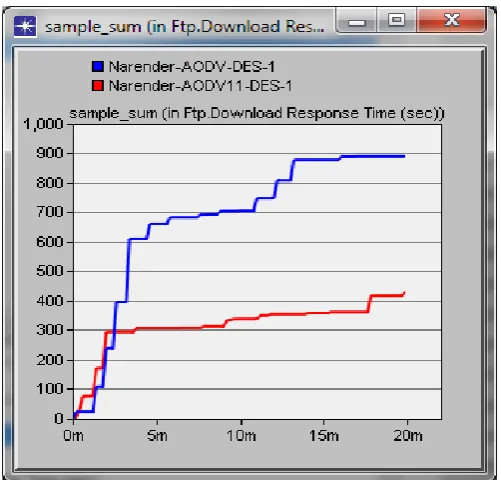
Time elapsed between sending a request and receiving the response packet. Measured from the time a client application sends a request to the server to the time it receives a response packet. Every response packet sent from a server to an FTP application is included in this statistic.
C. HTTP Object Response Time (sec)
Time elapsed between sending a request and receiving the response packet. Measured from the time a client application sends a request to the server to the time it receives a response packet. Every response packet sent from a server to an HTTP application is included in this statistic.
D. WLAN Delay (sec)
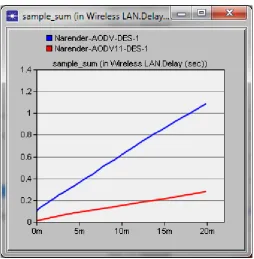
It is the time taken by a packet from the movement it is transmitted on the network by source node to reach the destination node.
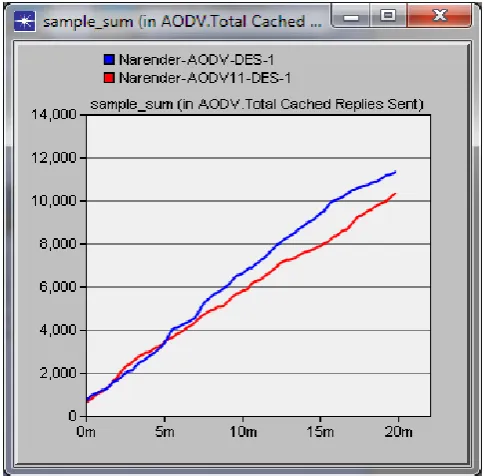
E. AODV Total Cached Replies Sent
This is how we can check the AODV Total Cached Replies Sent i.e. the cached replies sent from throughout the process.
VI. SIMULATION RESULTS AND ANALYSIS
© 2015, IJCSMC All Rights Reserved 41
A. AODV Route Discovery time
Fig. 2 Sample Sum for AODV Route Discovery timein 1 and 11 Mbps
According to simulation, as we can see in Fig. 2, AODV have performed better for 11 Mbps than 1 Mbps.
B. FTP Download Response Time (sec)
Fig. 3 Sample Sum for FTP Download Response Time (sec) for AODV in 1 and 11 Mbps
© 2015, IJCSMC All Rights Reserved 42
C. HTTP Object Response Time (sec)
Fig. 4 Sample Sum for HTTP Object Response Time (sec) for AODV in 1 and 11 Mbps
According to simulation, as we can see in Fig. 4, HTTP Object Response time in AODV is higher in 1 Mbps than 11 Mbps.
D. WLAN Delay (Sec)
© 2015, IJCSMC All Rights Reserved 43
According to simulation, as we can see in Fig. 5, Wireless LAN Delay in AODV for 1 Mbps is higher than AODV 11 Mbps. Hence here also AODV have performed better than 1 Mbps in 11 Mbps.
E. AODV Total Cached Replies Sent
Fig. 6 Sample Sum for AODV Total Cached Replies Sent in 1 and 11 Mbps
According to simulation, as we can see in Fig. 6, Total cached replies sent in 1 Mbps are higher than 11 Mbps.
VII. CONCLUSION
In this paper performance of AODV is evaluated for metrics like Route Discovery time, FTP Download Response Time (sec), HTTP Object Response Time (sec), WLAN Delay (sec) and AODV Total Cached Replies Sent by using 27 nodes scenario with IEEE 802.11 Direct Sequence WLAN Standard in 1 Mbps and 11 Mbps. From the above discussion we find out that AODV performs better in all above terms for 11 Mbps then 1 Mbps.
TABLE 5 RESULTING VALUES
S. NO.
PERFORMANCE METRICS AODV (1 Mbps)
AODV (11 Mbps)
1 ROUTE DISCOVERY TIME MORE LESS
2 DOWNLOAD RESPONSE TIME MORE LESS
3 OBJECT RESPONSE TIME MORE LESS
4 WLANDELAY MORE LESS
© 2015, IJCSMC All Rights Reserved 44
As from the table it is clear that AODV works better in 11 Mbps data rate than 1 Mbps data rate. The simulation result of the research has practical reference value for further study.
REFERENCES
[1] Sandeep Kaur, Nitin Bhatia, “Simulation Analysis of AODV Routing Protocol of MANET using OPNET”, IJCST Vol. 2, pp.389-391, Issue 3, September 2011.
[2] Anjali, Maninder Singh, “Performance Analysis of Proactive, Reactive and Hybrid MANET Routing Protocols on IEEE 802.11 Standard”, International Journal of Computer Applications,pp.1-8,Volume 54-No.12,September 2012.
[3] Anjali, Maninder Singh, “Simulation and Performance Analysis of AODV,OLSR,GRP Routing Protocol by considering IEEE 802.11Standard”,IJARCSSE,Volume2 ,issue 6, pp-171-178,June 2012.
[4] Ravinder Ahuja, “Simulation based Performance Evaluation and Comparison of Reactive, Proactive and Hybrid Routing Protocols based on Random Waypoint Mobility Model”, International Journal of Computer Applications, Vol. 7, No.11, pp. 20-24, Oct. 2010.
[5] Guo, L, and Peng, Y. (2010) “Performance evaluation for on-demand routing protocol based on OPNET modules in wireless mesh network” Computer and Electrical Engineering (Elsevier), vol. 37(2011), pp. 106-114.
[6] Humaira Nishat, Vamsi Krishna, Dr. D.Srinivasa Rao, Shakeel Ahmed,” Performance Evaluation of On Demand Routing Protocols AODV and Modified AODV (R-AODV)in MANETS”, International Journal of Distributed and Parallel Systems (IJDPS) Vol.2, No.1, January 2011.
[7] Opnet Technologies, Inc. “Opnet Simulator,” Internet: www.opnet.com.