Available Online at www.ijpret.com 1104
INTERNATIONAL JOURNAL OF PURE AND
APPLIED RESEARCH IN ENGINEERING AND
TECHNOLOGY
A PATH FOR HORIZING YOUR INNOVATIVE WORK
A SPECTRUM SELECTION FRAMEWORK FOR MOBILITY MANAGEMENT IN
COGNITIVE RADIO CELLULAR NETWORK
MR. PRITAM B. SALWE1, PROF. MRS. DIMPLE CHAUDHARI2
Department of Electronics & Telecommunication Engineering, Yadavrao Tasgaonkar Institute Of Engineering and Technology, Chandhai, Karjat - 410201
Accepted Date: 05/03/2015; Published Date: 01/05/2015
\
Abstract: Cognitive radio (CR) offer solution to the spectrum inefficiency by using the spectrum holes in space without introducing any sort of interference to the primary user. It also solves the spectrum inefficiency and spectrum scarcity problem. This exploits potential opportunities for use of spectrum without any interference. It has main tasks like Spectrum Sensing, Spectrum Analysis and Spectrum Allocation. In this paper, A spectrum selection framework for mobility management in cognitive radio cellular network is discussed. First the Spectrum decision is done to determine a set of available spectrum bands by considering the dynamic nature of spectrum band & users need. A handoff process for each spectrum is characterized by jointly considering primary user activity in cell area and spectrum sensing process. On this basis, a dynamic resource management scheme is modeled to accommodate the spectrum decision adaptively dependent on the time-varying cognitive radio network capacity. This mobility management framework improves total capacity & throughput of system.
Keywords: Cognitive radio, Cognitive radio architecture, Resource management, Spectrum selection, Handoff schemes, Intercell resource management, spectrum selection method, Load balancing base open access spectral selection method.
.
Corresponding Author: MR. PRITAM B. SALWE
Access Online On:
www.ijpret.com
How to Cite This Article:
Available Online at www.ijpret.com 1105 INTRODUCTION
Available Online at www.ijpret.com 1106 [15].in decentralized MAC(Media Access control) opportunity to minimizes the interference caused to neighboring cells, reduces their transmission chances, leading to the so-called sensing efficiency problem [19].
Fig1: cognitive radio network
1. SYSTEM MODEL
2.1 Handoff technique
Related work on CR (cognitive radio) based spectrum handoff falls into two categories based on the moment when SUs (secondary user) carry out spectrum handoffs. One approach is that SUs (Secondary user) perform spectrum switching and radio frequency (RF) front-end reconfiguration after detecting a PU (Primary user) namely the reactive approach. Although the concept of this approach is intuitive, there is a non-negligible sensing and reconfiguration delay which causes unavoidable disruptions to both the PU (Primary user) and the SU (Secondary user) transmissions. Handoff type is related to different mobility event, and its performance is mainly dependent on both network and user conditions, such as resource availability, network capacity, user location, etc. Thus, Cognitive radio networks require a unified mobility management scheme to exploit different handoff types adaptively to the dynamic nature of underlying spectrum bands.
2.2 Spectrum decision making
Available Online at www.ijpret.com 1107 layer protocols, such as the network layer, and transport layer protocols are investigated, and open research issues in these areas are also outlined.
3. In fig 1, see the infrastructure-based CR networks consist of multiple cells. Each cell has a single BS and its CR users. In this architecture, CR users observe their radio environments and report the results to the BS (base station). Accordingly, the BS determines proper action in support of a upper-level control node, Such as the mobility management entity (MME) in 3GPP. CR users have a single wideband RF transceiver that can sense multiple contiguous spectrum bands at the same time without RF reconfiguration. In this technique occurring two main problem that are,
4. 1. Resource allocation: In resource allocation there is lack of memory, large number of users can not be accomodate.
5. 2. Handoff technique: In our spectrum selection method is convince to the radio network and sensor network not worth able for mobile based network.
FIG2: Cognitive Radio Architecture (Wiley publication)
3. ALGORITHM DESCRIPTION
3.1 Dynamic spectrum algorithm
Available Online at www.ijpret.com 1108 equal to 10-40% for different value of traffic rate per cognitive terminal, also increase this gain the traffic rate also increased per cognitive terminal.
3.2 Intercell Resource Allocation
Since each cell has time-varying wireless resource because of the dynamic nature of underlying spectrum in CR networks, it cannot have a permanent extended spectrum. Furthermore, as explained in Section 2, the extended spectrum of the current cell cannot be used in its extended neighbors, leading to decrease in their capacity. As a result, CR networks necessitate an intercell resource allocation scheme to select and maintain the extended spectrum. Although global optimization in every spectrum change achieves optimal allocation, it requires a huge computational complexity and also causes a high communication overhead due to frequent spectrum switching. Instead, we consider the stochastic characteristics of spatial and temporal spectrum availabilities, and develop a distributed intercell resource allocation method, which improves total network capacity as well as mobility support, i.e., the availability of the extended spectrum. The following are the procedures of the proposed method:
1. Initially, all available spectrum bands in current cell i are considered as basic spectrum bands.
2. CR users can access the spectrum band only when all PU activity regions in the BA of the current cell are idle. Thus, the expected capacity of spectrum band j at cell i is defined as follows:
𝐶𝑖 𝑗 = 𝑁𝑖𝑚𝑎𝑥 𝑗 · 𝑃𝑜𝑓𝑓
𝑘𝜖 𝐴𝑖𝐵(𝑗 )
𝑗, 𝑘
3.3 An algorithm for combined cell-site selection and power control to maximize cellular spread spectrum capacity
There is vast attention in spread spectrum wireless mobile communications and in meticulous the subject of spread spectrum wireless capability. We portray spread spectrum cellular capacity and provide a combined power control, cell-site selection algorithm that facilitates this capacity is to be reach.
4. PROPOSED WORK
Available Online at www.ijpret.com 1109 alleviates the heterogeneous spectrum availability. Based on this structural design, a cohesive mobility management framework is defined to maintain assorted mobility events in CR networks, made up of inter-cell resource allocation, spectrum mobility management, and user mobility management functions. Through inter-cell resource allotment, every cell regulates its spectrum configuration to better mobility as well as overall capacity. To back spectrum mobility while keeping optimum cell capacity, the spectrum mobility management regulates a appropriate handoff type and target cell for CR users encounters PU activities by taking into consideration both spectrum utilization and stochastic connectivity models. On the other hand, user mobility management mainly focuses on spectrum heterogeneity in space, and offers a switching cost-based handoff decision mechanism to minimize service quality degradation in mobile users.
4.1 Algorithm- Load balancing base open access spectral selection method
Depending upon this, a least variance based spectrum decision is proposed for real-time functions, which reduces the capacity variance of the desired spectrum bands subject to the capacity constraints. Load balancing base open access spectral selection method was proposed for CR spectral selection, And it provide the opportunities to improve user experience & increase network capacity. Network topology includes seven wireless access nodes. Each wireless access node has Omni-directional antenna. Each wireless access node is assigned different frequency band. So, there is no interference between different wireless access nodes.
4.2 Structural design model
In fig2, explain the concept of the cognitive network, the mobility management technique to track the where the subscriber allow the call and then delivered to other service. In spectrum pool is a set of licensed spectrum band, each of its spectrum consist of multiple channel. Resource allocation it depends on the spectrum availability, first to find the available spectrum band after to allocate user in the white space spectrum. We use the spectrum handoff technique, first to sense the spectrum, after to detect the primary user, Then to find who are currently active. Based on this information spectrum holes or white space will be recognized. In spectrum selection method to use the algorithm of load balancing spectral selection method it is used to find the available spectrum band after allocate the user it depends upon the capacity allocation scheme to resolve the collision between the two calls, After to avoid the spectral inefficiency problem.
CR users using 𝑁𝑟𝑒 𝑞+𝑁𝑖𝑎𝑣
Available Online at www.ijpret.com 1110 5. SIMULATION RESULT
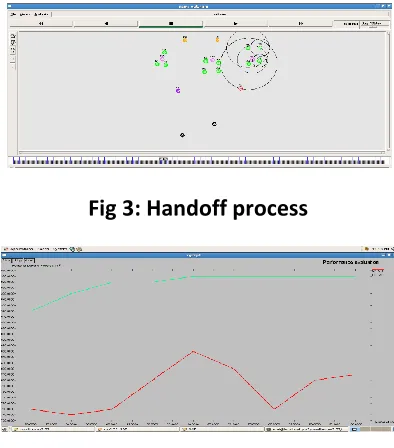
In fig 3, the infrastructure-based CR (cognitive radio) network is developed. In the network topology includes 20 wireless access nodes. Fig.4 shows data packet transfer. Each wireless access node has its own Omni-directional antenna. It has assigned various frequency band. In CR network is composed of single base-station and multiple mobile users. Each user is evenly separated over the network coverage with the radius of 2 km.
Fig 3: Handoff process
Fig 4: Graph for no. of delivered packets Vs User capacity
In fig 3, MR initiates the handoff process in within the network. If the user capacity is augmented means drop rate is also increased in the network, and also cell capacity will be decreased.
6. CONCLUSION
Available Online at www.ijpret.com 1111 necessitates a rethinking of the existing solutions developed for classical wireless networks. results shows that the proposed methodology efficiently gives rise in mobility management.
7. REFERENCES
1. Won-Yeol Lee, Student Member, IEEE, and Ian F. Akyildiz, Fellow, IEEE, “Spectrum-Aware Mobility Management in Cognitive Radio Cellular Networks”, IEEE Transaction on Mobile Computing, Vol. 11, No. 4, April 2012.
2. Won-yeol-lee, “A spectrum decision framework for cognitive radio network”, IEEE Transaction on Mobile Computing, Vol. 10, No. 2, feb-2011.
3. stanislav filin, hiroshi harada, “Qos guaranteed load balancing dynamic spectrum access algorithm”, National Institute of Information and Communications Technology, Tokyo University of Science, Tokyo, Japan 2008.
4. evfik yucek & huseyin arslan, “A survey of spectrum sensing algorithms for cognitive radio application” IEEE Communication Surveys & Tutorial, Vol. 11, No. 1, 2009
5. Chhavi viz ,siba k.udgata, “Spectrum handoff schemes & optimum utilization of spectrum holes in cognitive radio network”,.
6. Yiyang pei+, Ying-chang liang, Kah chan Teh, “Sensing- throughput tradeoff for cognitive radio networks: a multiple-channel scenario”, April-2008.
7. Lei Yang, Lili Cao and Haitao Zheng, “Proactive channel Access in Dynamic spectrum networks”, July-2007.
8. T. A. Weiss and F.K.Jondral, “Spectrum pooling: A Innovative strategy for the enhancement of spectrum efficiency”, mar-2004
9. S. M. Mishra, A. Sahai, and R.W. Brodersen, “Cooperative Sensing among Cognitive Radios”.
10.A.Sang, X. Wang, M. Madihian, and R.D. Gitlin, “Coordinated load balancing handoff/cell-site selection,and scheduling in multi-cell packet data systems”, Aprl-2008
Available Online at www.ijpret.com 1112 12.Q. Zhao, L. Tong, A. Swami, and Y. Chen, “Decentrallized Cognitive Mac Opportunistic Spectrum Access in Ad Hoc Networks: A Pomdp Framework,”Apr. 2007
13.W.Y. Lee and I.F. Akyildiz, “Joint Spectrum and Power Allocation for Inter-Cell Spectrum Sharing in Cognitive Radio Networks,” Oct. 2008
14.A. Sang, X. Wang, M. Madihian, “Performance Analysis of Cognitive Radio Spectrum Access with Prioritized Traffic”,july2006.
15.Won-Yeol Lee, Student Member, IEEE, and Ian. F. Akyildiz, “Optimal Spectrum Sensing Framework for Cognitive Radio Networks”.
16.M. M. Buddhikot, I. Kennedy, F. Mullany, and H. Viswanathan,“ Ultra broadband Femtocells via Opportunistic Reuse of Multi-Operator and Multi-Service Spectrum,” Bell Labs Technical J., Special Issue on 4G Networks, vol. 13, pp. 129-143, Feb. 2009.
17.3GPP TSG RAN WG4, “RF Requirements for Multicarrier and Multi-RAT BS (Release 9),” 3GPP.
18.R. Zhang, “On peak versus average interference power constraints for protecting primary users in cognitive radio networks,”.
19.R. Tandra, S.M. Mishra, and A. Sahai, “What Is a Spectrum Hole and What Does It Take to Recognize One?”
20.K. Sriram and W. Whitt, “Characterizing Superposition Arrival Processes in Packet Multiplexers for Voice and Data,”.